By Mustahid ali

1


GSM defines a standard for a Public Land Mobile Network (PLMN)



GSM is a globally accepted standard for digital cellular communication





Because GSM provides a common standard, cellular subscribers can use their
telephones over the entire GSM service area which includes all the countries
around the world where GSM system is used



Three bands of operation :
GSM900
GSM1800
GSM1900 (used in USA)



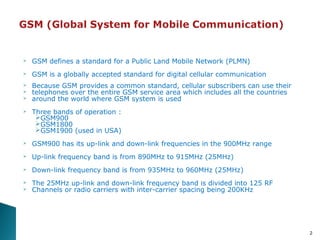
GSM900 has its up-link and down-link frequencies in the 900MHz range



Up-link frequency band is from 890MHz to 915MHz (25MHz)



Down-link frequency band is from 935MHz to 960MHz (25MHz)




The 25MHz up-link and down-link frequency band is divided into 125 RF
Channels or radio carriers with inter-carrier spacing being 200KHz

2
NK
PLI
U

K
LIN
N
OW
D

200KHz

890MHz

915MHz

0

124

BW = 25MHz
125 Channels of 200KHz BW

935MHz

960MHz

0

124

BW = 25MHz
125 Channels of 200KHz BW

3





f

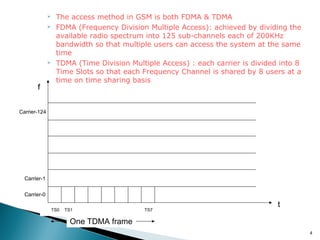
The access method in GSM is both FDMA & TDMA
FDMA (Frequency Division Multiple Access): achieved by dividing the
available radio spectrum into 125 sub-channels each of 200KHz
bandwidth so that multiple users can access the system at the same
time
TDMA (Time Division Multiple Access) : each carrier is divided into 8
Time Slots so that each Frequency Channel is shared by 8 users at a
time on time sharing basis

Carrier-124

Carrier-1
Carrier-0
TS0

TS1

TS7

t

One TDMA frame
4
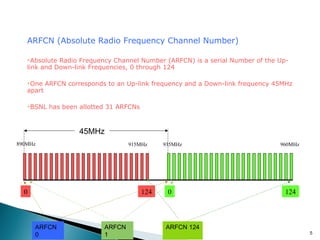
ARFCN (Absolute Radio Frequency Channel Number)
Absolute Radio Frequency Channel Number (ARFCN) is a serial Number of the Uplink and Down-link Frequencies, 0 through 124


One ARFCN corresponds to an Up-link frequency and a Down-link frequency 45MHz
apart


BSNL has been allotted 31 ARFCNs



45MHz
890MHz

915MHz

0

124

ARFCN
0

ARFCN
1

935MHz

0

ARFCN 124

960MHz

124

5
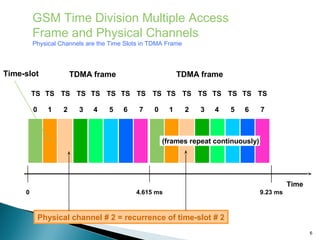
GSM Time Division Multiple Access
Frame and Physical Channels
Physical Channels are the Time Slots in TDMA Frame

Time-slot

TDMA frame

TDMA frame

TS TS TS TS TS TS TS TS TS TS TS TS TS TS TS TS
0

1

2

3

4

5

6

7

0

1

2

3

4

5

6

7

(frames repeat continuously)

Time
0

4.615 ms

9.23 ms

Physical channel # 2 = recurrence of time-slot # 2
6



One Time Slot has a duration of 0.577mS (148 bits)
8 timeslots (8 x 0.577 = 4.615 ms) form a TDMA frame

7
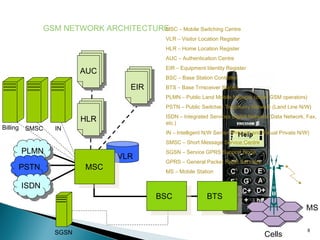
GSM NETWORK ARCHITECTURE – Mobile Switching Centre
MSC
VLR – Visitor Location Register
HLR – Home Location Register
AUC – Authentication Centre
EIR – Equipment Identity Register

AUC

BSC – Base Station Controller

EIR

BTS – Base Trnsceiver Station
PLMN – Public Land Mobile Network (other GSM operators)
PSTN – Public Switched Telephony Network (Land Line N/W)

Billing

ISDN – Integrated Services Digital Network (Data Network, Fax,
etc.)

HLR
SMSC

IN

IN – Intelligent N/W Server (Prepaid and Virtual Private N/W)
SMSC – Short Message Service Centre

PLMN

VLR

PSTN

MSC

ISDN

SGSN – Service GPRS Support Node
GPRS – General Packet Radio Services
MS – Mobile Station

BSC

BTS
MS

SGSN

Cells

8
GSM NETWORK ELEMENTS
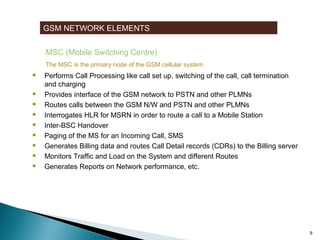
MSC (Mobile Switching Centre)
The MSC is the primary node of the GSM cellular system











Performs Call Processing like call set up, switching of the call, call termination
and charging
Provides interface of the GSM network to PSTN and other PLMNs
Routes calls between the GSM N/W and PSTN and other PLMNs
Interrogates HLR for MSRN in order to route a call to a Mobile Station
Inter-BSC Handover
Paging of the MS for an Incoming Call, SMS
Generates Billing data and routes Call Detail records (CDRs) to the Billing server
Monitors Traffic and Load on the System and different Routes
Generates Reports on Network performance, etc.

9
GSM NETWORK ELEMENTS
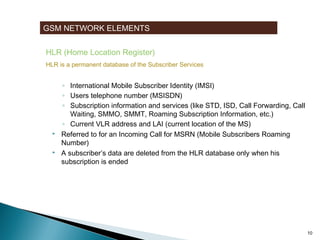
HLR (Home Location Register)
HLR is a permanent database of the Subscriber Services






Stores user data of all Subscribers related to the GMSC
◦ International Mobile Subscriber Identity (IMSI)
◦ Users telephone number (MSISDN)
◦ Subscription information and services (like STD, ISD, Call Forwarding, Call
Waiting, SMMO, SMMT, Roaming Subscription Information, etc.)
◦ Current VLR address and LAI (current location of the MS)
Referred to for an Incoming Call for MSRN (Mobile Subscribers Roaming
Number)
A subscriber’s data are deleted from the HLR database only when his
subscription is ended

10
GSM NETWORK ELEMENTS
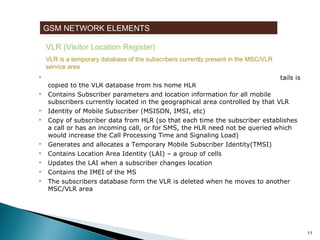
VLR (Visitor Location Register)
VLR is a temporary database of the subscribers currently present in the MSC/VLR
service area













When a subscriber enters the MSC/VLR area a copy of his Subscription details is
copied to the VLR database from his home HLR
Contains Subscriber parameters and location information for all mobile
subscribers currently located in the geographical area controlled by that VLR
Identity of Mobile Subscriber (MSISDN, IMSI, etc)
Copy of subscriber data from HLR (so that each time the subscriber establishes
a call or has an incoming call, or for SMS, the HLR need not be queried which
would increase the Call Processing Time and Signaling Load)
Generates and allocates a Temporary Mobile Subscriber Identity(TMSI)
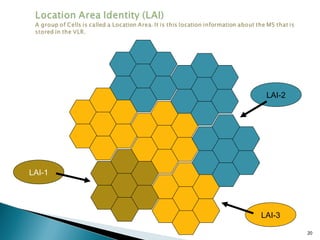
Contains Location Area Identity (LAI) – a group of cells
Updates the LAI when a subscriber changes location
Contains the IMEI of the MS
The subscribers database form the VLR is deleted when he moves to another
MSC/VLR area

11
GSM NETWORK ELEMENTS
AUC (Authentication Centre)
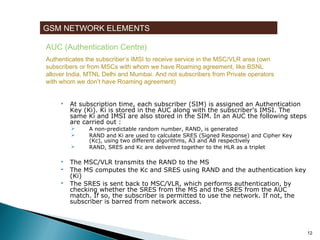
Authenticates the subscriber’s IMSI to receive service in the MSC/VLR area (own
subscribers or from MSCs with whom we have Roaming agreement, like BSNL
allover India, MTNL Delhi and Mumbai. And not subscribers from Private operators
with whom we don’t have Roaming agreement)



At subscription time, each subscriber (SIM) is assigned an Authentication
Key (Ki). Ki is stored in the AUC along with the subscriber’s IMSI. The
same Ki and IMSI are also stored in the SIM. In an AUC the following steps
are carried out :








A non-predictable random number, RAND, is generated
RAND and Ki are used to calculate SRES (Signed Response) and Cipher Key
(Kc), using two different algorithms, A3 and A8 respectively
RAND, SRES and Kc are delivered together to the HLR as a triplet

The MSC/VLR transmits the RAND to the MS
The MS computes the Kc and SRES using RAND and the authentication key
(Ki)
The SRES is sent back to MSC/VLR, which performs authentication, by
checking whether the SRES from the MS and the SRES from the AUC
match. If so, the subscriber is permitted to use the network. If not, the
subscriber is barred from network access.

12
GSM NETWORK ELEMENTS
EIR (Equipment Identity Register)

EIR The equipment identification procedure uses the identity of the equipment itself
(IMEI) to ensure that the MS terminal equipment is valid.


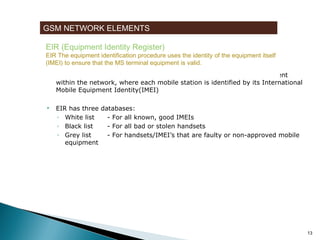
EIR is a database that contains a list of all valid mobile station equipment
within the network, where each mobile station is identified by its International
Mobile Equipment Identity(IMEI)



EIR has three databases:
◦ White list
- For all known, good IMEIs
◦ Black list
- For all bad or stolen handsets
◦ Grey list
- For handsets/IMEI’s that are faulty or non-approved mobile
equipment

13
GSM NETWORK ELEMENTS
BSC (Base Station Controller)

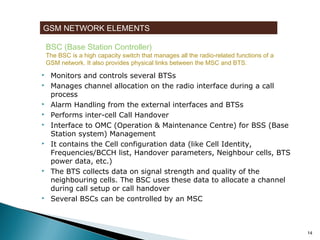
The BSC is a high capacity switch that manages all the radio-related functions of a
GSM network. It also provides physical links between the MSC and BTS.













Monitors and controls several BTSs
Manages channel allocation on the radio interface during a call
process
Alarm Handling from the external interfaces and BTSs
Performs inter-cell Call Handover
Interface to OMC (Operation & Maintenance Centre) for BSS (Base
Station system) Management
It contains the Cell configuration data (like Cell Identity,
Frequencies/BCCH list, Handover parameters, Neighbour cells, BTS
power data, etc.)
The BTS collects data on signal strength and quality of the
neighbouring cells. The BSC uses these data to allocate a channel
during call setup or call handover
Several BSCs can be controlled by an MSC

14
GSM NETWORK ELEMENTS
BTS (Base Transceiver Station)

The BTS is the radio equipment (transceivers and antennas) needed to serve each cell in the
network. A group of BTSs are controlled by a BSC.









The BTS's main function is to provide connection with the MSs over
the air interface.
Consists of one or more radio terminals (called TRU – Transceiver
Unit) for transmission and reception
Each Radio terminal/TRU handles an RF Channel/ARFCN
Receiption of channel requests from MSs (during a call setup,
handover, etc)
The BTS is responsible for the processing of signals before
transmission and after reception. This includes:
◦ Ciphering using the ciphering key (Kc)
◦ Modulation and Demodulation (GSM uses GMSK-Gaussian Minimum
Shift Keying), etc.

15
GSM NETWORK ELEMENTS
The Cell
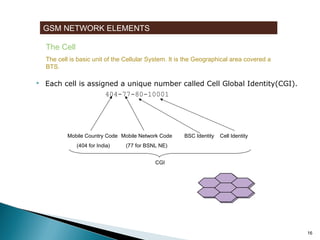
The cell is basic unit of the Cellular System. It is the Geographical area covered a
BTS.


Each cell is assigned a unique number called Cell Global Identity(CGI).
404-77-80-10001

Mobile Country Code Mobile Network Code
(404 for India)

BSC Identity

Cell Identity

(77 for BSNL NE)
CGI

16
GSM NETWORK ELEMENTS
Why Cellular structure
The Need of the Cell
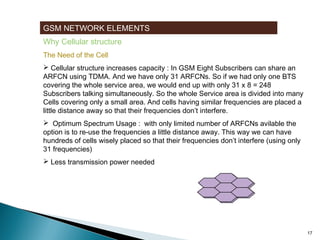
 Cellular structure increases capacity : In GSM Eight Subscribers can share an
ARFCN using TDMA. And we have only 31 ARFCNs. So if we had only one BTS
covering the whole service area, we would end up with only 31 x 8 = 248
Subscribers talking simultaneously. So the whole Service area is divided into many
Cells covering only a small area. And cells having similar frequencies are placed a
little distance away so that their frequencies don’t interfere.
 Optimum Spectrum Usage : with only limited number of ARFCNs avilable the
option is to re-use the frequencies a little distance away. This way we can have
hundreds of cells wisely placed so that their frequencies don’t interfere (using only
31 frequencies)
 Less transmission power needed

17


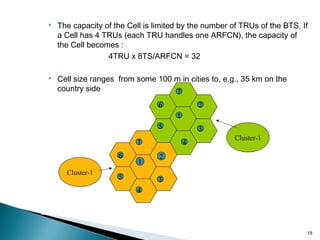
The capacity of the Cell is limited by the number of TRUs of the BTS. If
a Cell has 4 TRUs (each TRU handles one ARFCN), the capacity of
the Cell becomes :
4TRU x 8TS/ARFCN = 32



Cell size ranges from some 100 m in cities to, e.g., 35 km on the
country side
7
6

2
1

5
7
6
Cluster-1

1

5

3
4

Cluster-1

2
3

4

18




Portable Card with memory (ROM-6KB to 16KB-has A3/A8
algorithms, RAM- 128KB TO 256KB, EEPROM- 3KB to 8KB )
It contains:
◦ International Mobile Subscriber Identity (IMSI)
◦ Personal Identification Number (PIN)
◦ Pin Unlock Key (PUK)
◦ Authentication Key (Ki)
◦ Location Area Identity (LAI)

19
LAI-2

LAI-1

LAI-3
20
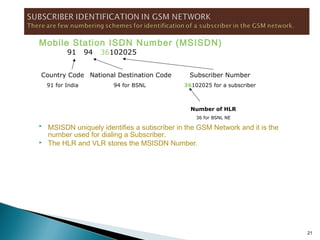
Mobile Station ISDN Number (MSISDN)
91

94

36102025

Country Code National Destination Code
91 for India

94 for BSNL

Subscriber Number
36102025 for a subscriber

Number of HLR
36 for BSNL NE




MSISDN uniquely identifies a subscriber in the GSM Network and it is the
number used for dialing a Subscriber.
The HLR and VLR stores the MSISDN Number.

21
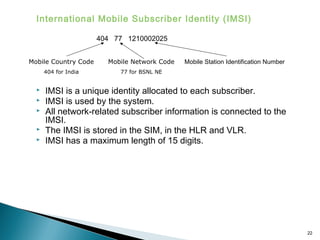
International Mobile Subscriber Identity (IMSI)
404 77 1210002025
Mobile Country Code

Mobile Network Code

404 for India

Mobile Station Identification Number

77 for BSNL NE







IMSI is a unique identity allocated to each subscriber.
IMSI is used by the system.
All network-related subscriber information is connected to the
IMSI.
The IMSI is stored in the SIM, in the HLR and VLR.
IMSI has a maximum length of 15 digits.

22
Mobile Station Roaming Number (MSRN)








The MSRN is a number temporarily allocated to a Subscriber for
routing a Call to him.
MSRN is allocated by the current VLR the Subscriber is in.
After the Call is established the MSRN is released, and it can now
be allotted to another MS for an Incoming Call Setup.
The HLR stores address of the current VLR where the subscriber is
located. When a call is made to a mobile subscriber , the HLR
requests the current MSC/VLR to provide an MSRN as a temporary
routing number for the called subscriber. Upon reception of the
MSRN, the HLR sends it to the MSC which can now use this
number to route the call to the MSC/VLR where the called
subscriber is currently registered.
MSRN has the same format as of MSISDN.
In an MSC/VLR some thousands of Numbers are reserved to be
used as MSRN during Call Setup. These numbers are not allotted
as MSISDN to Subscribers.

23
International Mobile Equipment Identity (IMEI)




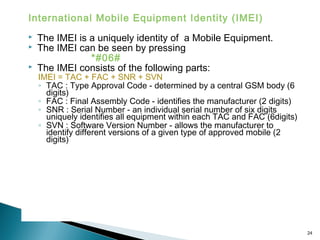
The IMEI is a uniquely identity of a Mobile Equipment.
The IMEI can be seen by pressing
*#06#
The IMEI consists of the following parts:

IMEI = TAC + FAC + SNR + SVN
◦ TAC : Type Approval Code - determined by a central GSM body (6
digits)
◦ FAC : Final Assembly Code - identifies the manufacturer (2 digits)
◦ SNR : Serial Number - an individual serial number of six digits
uniquely identifies all equipment within each TAC and FAC (6digits)
◦ SVN : Software Version Number - allows the manufacturer to
identify different versions of a given type of approved mobile (2
digits)

24
Thank You
25

Gsm architecture

  • 1.
  • 2.
     GSM defines astandard for a Public Land Mobile Network (PLMN)  GSM is a globally accepted standard for digital cellular communication    Because GSM provides a common standard, cellular subscribers can use their telephones over the entire GSM service area which includes all the countries around the world where GSM system is used  Three bands of operation : GSM900 GSM1800 GSM1900 (used in USA)  GSM900 has its up-link and down-link frequencies in the 900MHz range  Up-link frequency band is from 890MHz to 915MHz (25MHz)  Down-link frequency band is from 935MHz to 960MHz (25MHz)   The 25MHz up-link and down-link frequency band is divided into 125 RF Channels or radio carriers with inter-carrier spacing being 200KHz 2
  • 3.
    NK PLI U K LIN N OW D 200KHz 890MHz 915MHz 0 124 BW = 25MHz 125Channels of 200KHz BW 935MHz 960MHz 0 124 BW = 25MHz 125 Channels of 200KHz BW 3
  • 4.
       f The access methodin GSM is both FDMA & TDMA FDMA (Frequency Division Multiple Access): achieved by dividing the available radio spectrum into 125 sub-channels each of 200KHz bandwidth so that multiple users can access the system at the same time TDMA (Time Division Multiple Access) : each carrier is divided into 8 Time Slots so that each Frequency Channel is shared by 8 users at a time on time sharing basis Carrier-124 Carrier-1 Carrier-0 TS0 TS1 TS7 t One TDMA frame 4
  • 5.
    ARFCN (Absolute RadioFrequency Channel Number) Absolute Radio Frequency Channel Number (ARFCN) is a serial Number of the Uplink and Down-link Frequencies, 0 through 124  One ARFCN corresponds to an Up-link frequency and a Down-link frequency 45MHz apart  BSNL has been allotted 31 ARFCNs  45MHz 890MHz 915MHz 0 124 ARFCN 0 ARFCN 1 935MHz 0 ARFCN 124 960MHz 124 5
  • 6.
    GSM Time DivisionMultiple Access Frame and Physical Channels Physical Channels are the Time Slots in TDMA Frame Time-slot TDMA frame TDMA frame TS TS TS TS TS TS TS TS TS TS TS TS TS TS TS TS 0 1 2 3 4 5 6 7 0 1 2 3 4 5 6 7 (frames repeat continuously) Time 0 4.615 ms 9.23 ms Physical channel # 2 = recurrence of time-slot # 2 6
  • 7.
      One Time Slothas a duration of 0.577mS (148 bits) 8 timeslots (8 x 0.577 = 4.615 ms) form a TDMA frame 7
  • 8.
    GSM NETWORK ARCHITECTURE– Mobile Switching Centre MSC VLR – Visitor Location Register HLR – Home Location Register AUC – Authentication Centre EIR – Equipment Identity Register AUC BSC – Base Station Controller EIR BTS – Base Trnsceiver Station PLMN – Public Land Mobile Network (other GSM operators) PSTN – Public Switched Telephony Network (Land Line N/W) Billing ISDN – Integrated Services Digital Network (Data Network, Fax, etc.) HLR SMSC IN IN – Intelligent N/W Server (Prepaid and Virtual Private N/W) SMSC – Short Message Service Centre PLMN VLR PSTN MSC ISDN SGSN – Service GPRS Support Node GPRS – General Packet Radio Services MS – Mobile Station BSC BTS MS SGSN Cells 8
  • 9.
    GSM NETWORK ELEMENTS MSC(Mobile Switching Centre) The MSC is the primary node of the GSM cellular system          Performs Call Processing like call set up, switching of the call, call termination and charging Provides interface of the GSM network to PSTN and other PLMNs Routes calls between the GSM N/W and PSTN and other PLMNs Interrogates HLR for MSRN in order to route a call to a Mobile Station Inter-BSC Handover Paging of the MS for an Incoming Call, SMS Generates Billing data and routes Call Detail records (CDRs) to the Billing server Monitors Traffic and Load on the System and different Routes Generates Reports on Network performance, etc. 9
  • 10.
    GSM NETWORK ELEMENTS HLR(Home Location Register) HLR is a permanent database of the Subscriber Services    Stores user data of all Subscribers related to the GMSC ◦ International Mobile Subscriber Identity (IMSI) ◦ Users telephone number (MSISDN) ◦ Subscription information and services (like STD, ISD, Call Forwarding, Call Waiting, SMMO, SMMT, Roaming Subscription Information, etc.) ◦ Current VLR address and LAI (current location of the MS) Referred to for an Incoming Call for MSRN (Mobile Subscribers Roaming Number) A subscriber’s data are deleted from the HLR database only when his subscription is ended 10
  • 11.
    GSM NETWORK ELEMENTS VLR(Visitor Location Register) VLR is a temporary database of the subscribers currently present in the MSC/VLR service area          When a subscriber enters the MSC/VLR area a copy of his Subscription details is copied to the VLR database from his home HLR Contains Subscriber parameters and location information for all mobile subscribers currently located in the geographical area controlled by that VLR Identity of Mobile Subscriber (MSISDN, IMSI, etc) Copy of subscriber data from HLR (so that each time the subscriber establishes a call or has an incoming call, or for SMS, the HLR need not be queried which would increase the Call Processing Time and Signaling Load) Generates and allocates a Temporary Mobile Subscriber Identity(TMSI) Contains Location Area Identity (LAI) – a group of cells Updates the LAI when a subscriber changes location Contains the IMEI of the MS The subscribers database form the VLR is deleted when he moves to another MSC/VLR area 11
  • 12.
    GSM NETWORK ELEMENTS AUC(Authentication Centre) Authenticates the subscriber’s IMSI to receive service in the MSC/VLR area (own subscribers or from MSCs with whom we have Roaming agreement, like BSNL allover India, MTNL Delhi and Mumbai. And not subscribers from Private operators with whom we don’t have Roaming agreement)  At subscription time, each subscriber (SIM) is assigned an Authentication Key (Ki). Ki is stored in the AUC along with the subscriber’s IMSI. The same Ki and IMSI are also stored in the SIM. In an AUC the following steps are carried out :       A non-predictable random number, RAND, is generated RAND and Ki are used to calculate SRES (Signed Response) and Cipher Key (Kc), using two different algorithms, A3 and A8 respectively RAND, SRES and Kc are delivered together to the HLR as a triplet The MSC/VLR transmits the RAND to the MS The MS computes the Kc and SRES using RAND and the authentication key (Ki) The SRES is sent back to MSC/VLR, which performs authentication, by checking whether the SRES from the MS and the SRES from the AUC match. If so, the subscriber is permitted to use the network. If not, the subscriber is barred from network access. 12
  • 13.
    GSM NETWORK ELEMENTS EIR(Equipment Identity Register) EIR The equipment identification procedure uses the identity of the equipment itself (IMEI) to ensure that the MS terminal equipment is valid.  EIR is a database that contains a list of all valid mobile station equipment within the network, where each mobile station is identified by its International Mobile Equipment Identity(IMEI)  EIR has three databases: ◦ White list - For all known, good IMEIs ◦ Black list - For all bad or stolen handsets ◦ Grey list - For handsets/IMEI’s that are faulty or non-approved mobile equipment 13
  • 14.
    GSM NETWORK ELEMENTS BSC(Base Station Controller) The BSC is a high capacity switch that manages all the radio-related functions of a GSM network. It also provides physical links between the MSC and BTS.         Monitors and controls several BTSs Manages channel allocation on the radio interface during a call process Alarm Handling from the external interfaces and BTSs Performs inter-cell Call Handover Interface to OMC (Operation & Maintenance Centre) for BSS (Base Station system) Management It contains the Cell configuration data (like Cell Identity, Frequencies/BCCH list, Handover parameters, Neighbour cells, BTS power data, etc.) The BTS collects data on signal strength and quality of the neighbouring cells. The BSC uses these data to allocate a channel during call setup or call handover Several BSCs can be controlled by an MSC 14
  • 15.
    GSM NETWORK ELEMENTS BTS(Base Transceiver Station) The BTS is the radio equipment (transceivers and antennas) needed to serve each cell in the network. A group of BTSs are controlled by a BSC.      The BTS's main function is to provide connection with the MSs over the air interface. Consists of one or more radio terminals (called TRU – Transceiver Unit) for transmission and reception Each Radio terminal/TRU handles an RF Channel/ARFCN Receiption of channel requests from MSs (during a call setup, handover, etc) The BTS is responsible for the processing of signals before transmission and after reception. This includes: ◦ Ciphering using the ciphering key (Kc) ◦ Modulation and Demodulation (GSM uses GMSK-Gaussian Minimum Shift Keying), etc. 15
  • 16.
    GSM NETWORK ELEMENTS TheCell The cell is basic unit of the Cellular System. It is the Geographical area covered a BTS.  Each cell is assigned a unique number called Cell Global Identity(CGI). 404-77-80-10001 Mobile Country Code Mobile Network Code (404 for India) BSC Identity Cell Identity (77 for BSNL NE) CGI 16
  • 17.
    GSM NETWORK ELEMENTS WhyCellular structure The Need of the Cell  Cellular structure increases capacity : In GSM Eight Subscribers can share an ARFCN using TDMA. And we have only 31 ARFCNs. So if we had only one BTS covering the whole service area, we would end up with only 31 x 8 = 248 Subscribers talking simultaneously. So the whole Service area is divided into many Cells covering only a small area. And cells having similar frequencies are placed a little distance away so that their frequencies don’t interfere.  Optimum Spectrum Usage : with only limited number of ARFCNs avilable the option is to re-use the frequencies a little distance away. This way we can have hundreds of cells wisely placed so that their frequencies don’t interfere (using only 31 frequencies)  Less transmission power needed 17
  • 18.
     The capacity ofthe Cell is limited by the number of TRUs of the BTS. If a Cell has 4 TRUs (each TRU handles one ARFCN), the capacity of the Cell becomes : 4TRU x 8TS/ARFCN = 32  Cell size ranges from some 100 m in cities to, e.g., 35 km on the country side 7 6 2 1 5 7 6 Cluster-1 1 5 3 4 Cluster-1 2 3 4 18
  • 19.
      Portable Card withmemory (ROM-6KB to 16KB-has A3/A8 algorithms, RAM- 128KB TO 256KB, EEPROM- 3KB to 8KB ) It contains: ◦ International Mobile Subscriber Identity (IMSI) ◦ Personal Identification Number (PIN) ◦ Pin Unlock Key (PUK) ◦ Authentication Key (Ki) ◦ Location Area Identity (LAI) 19
  • 20.
  • 21.
    Mobile Station ISDNNumber (MSISDN) 91 94 36102025 Country Code National Destination Code 91 for India 94 for BSNL Subscriber Number 36102025 for a subscriber Number of HLR 36 for BSNL NE   MSISDN uniquely identifies a subscriber in the GSM Network and it is the number used for dialing a Subscriber. The HLR and VLR stores the MSISDN Number. 21
  • 22.
    International Mobile SubscriberIdentity (IMSI) 404 77 1210002025 Mobile Country Code Mobile Network Code 404 for India Mobile Station Identification Number 77 for BSNL NE      IMSI is a unique identity allocated to each subscriber. IMSI is used by the system. All network-related subscriber information is connected to the IMSI. The IMSI is stored in the SIM, in the HLR and VLR. IMSI has a maximum length of 15 digits. 22
  • 23.
    Mobile Station RoamingNumber (MSRN)       The MSRN is a number temporarily allocated to a Subscriber for routing a Call to him. MSRN is allocated by the current VLR the Subscriber is in. After the Call is established the MSRN is released, and it can now be allotted to another MS for an Incoming Call Setup. The HLR stores address of the current VLR where the subscriber is located. When a call is made to a mobile subscriber , the HLR requests the current MSC/VLR to provide an MSRN as a temporary routing number for the called subscriber. Upon reception of the MSRN, the HLR sends it to the MSC which can now use this number to route the call to the MSC/VLR where the called subscriber is currently registered. MSRN has the same format as of MSISDN. In an MSC/VLR some thousands of Numbers are reserved to be used as MSRN during Call Setup. These numbers are not allotted as MSISDN to Subscribers. 23
  • 24.
    International Mobile EquipmentIdentity (IMEI)    The IMEI is a uniquely identity of a Mobile Equipment. The IMEI can be seen by pressing *#06# The IMEI consists of the following parts: IMEI = TAC + FAC + SNR + SVN ◦ TAC : Type Approval Code - determined by a central GSM body (6 digits) ◦ FAC : Final Assembly Code - identifies the manufacturer (2 digits) ◦ SNR : Serial Number - an individual serial number of six digits uniquely identifies all equipment within each TAC and FAC (6digits) ◦ SVN : Software Version Number - allows the manufacturer to identify different versions of a given type of approved mobile (2 digits) 24
  • 25.