Understanding MulteFire’s
Radio Link
Dr. Tamer Kadous, Radio Workgroup Chair
Agenda
• Coexisting in unlicensed spectrum
• MulteFire Technology—extensions added to 3GPP LAA and eLAA
• MulteFire performance advantages and results
• Summary
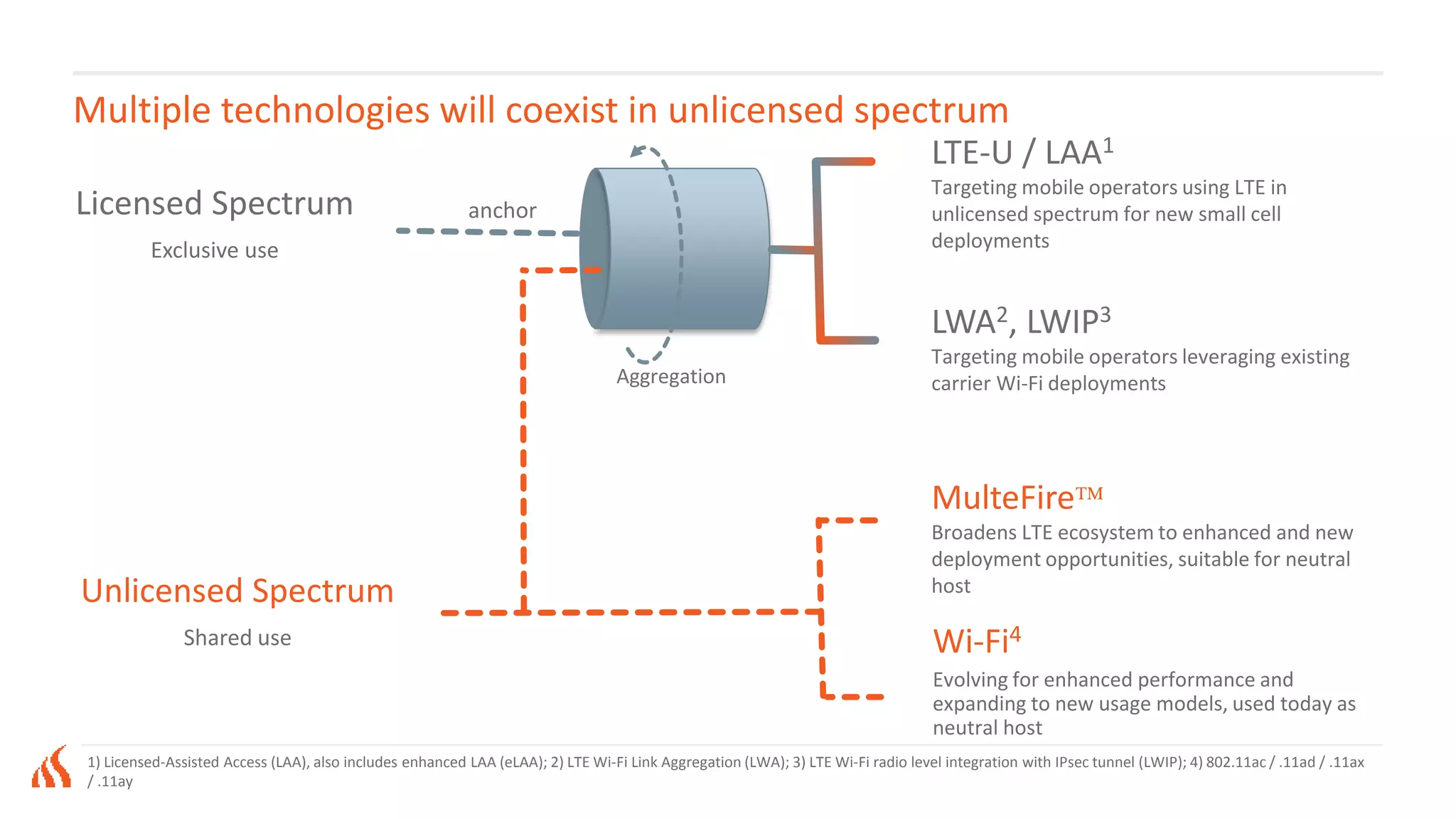
Multiple technologies will coexist in unlicensed spectrum
1) Licensed-Assisted Access (LAA), also includes enhanced LAA (eLAA); 2) LTE Wi-Fi Link Aggregation (LWA); 3) LTE Wi-Fi radio level integration with IPsec tunnel (LWIP); 4) 802.11ac / .11ad / .11ax
/ .11ay
Wi-Fi4
Evolving for enhanced performance and
expanding to new usage models, used today as
neutral host
Licensed Spectrum
Exclusive use
Unlicensed Spectrum
Shared use
Aggregation
MulteFire
Broadens LTE ecosystem to enhanced and new
deployment opportunities, suitable for neutral
host
LWA2, LWIP3
Targeting mobile operators leveraging existing
carrier Wi-Fi deployments
LTE-U / LAA1
Targeting mobile operators using LTE in
unlicensed spectrum for new small cell
deployments
anchor
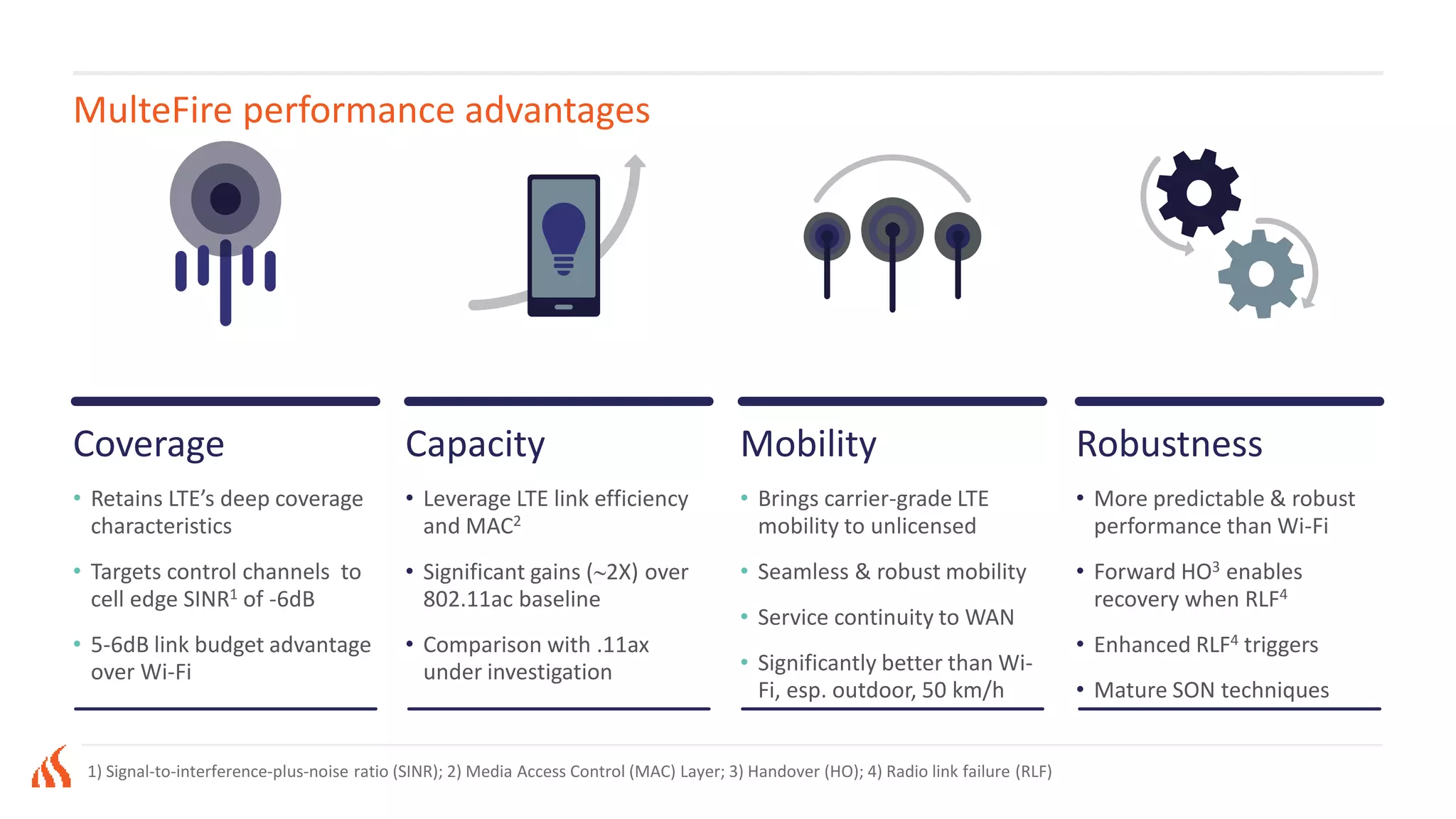
MulteFire performance advantages
1) Signal-to-interference-plus-noise ratio (SINR); 2) Media Access Control (MAC) Layer; 3) Handover (HO); 4) Radio link failure (RLF)
Coverage
• Retains LTE’s deep coverage
characteristics
• Targets control channels to
cell edge SINR1 of -6dB
• 5-6dB link budget advantage
over Wi-Fi
Capacity
• Leverage LTE link efficiency
and MAC2
• Significant gains (2X) over
802.11ac baseline
• Comparison with .11ax
under investigation
Mobility
• Brings carrier-grade LTE
mobility to unlicensed
• Seamless & robust mobility
• Service continuity to WAN
• Significantly better than Wi-
Fi, esp. outdoor, 50 km/h
Robustness
• More predictable & robust
performance than Wi-Fi
• Forward HO3 enables
recovery when RLF4
• Enhanced RLF4 triggers
• Mature SON techniques
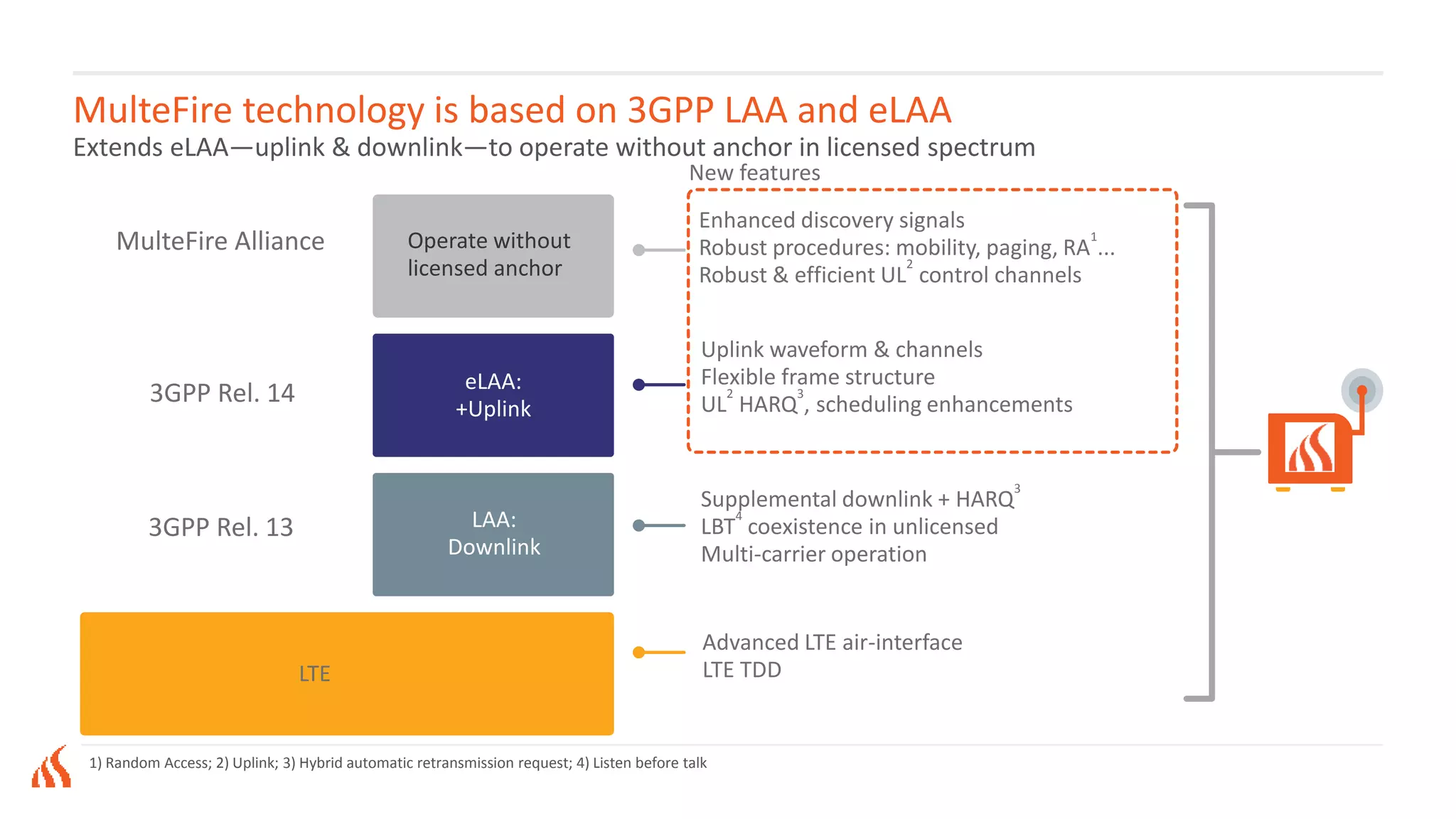
MulteFire technology is based on 3GPP LAA and eLAA
Extends eLAA—uplink & downlink—to operate without anchor in licensed spectrum
3GPP Rel. 13
3GPP Rel. 14
Uplink waveform & channels
Flexible frame structure
UL
2
HARQ
3
, scheduling enhancements
Supplemental downlink + HARQ
3
LBT
4
coexistence in unlicensed
Multi-carrier operation
Enhanced discovery signals
Robust procedures: mobility, paging, RA
1
...
Robust & efficient UL
2
control channels
Advanced LTE air-interface
LTE TDD
MulteFire Alliance Operate without
licensed anchor
eLAA:
+Uplink
LAA:
Downlink
LTE
New features
1) Random Access; 2) Uplink; 3) Hybrid automatic retransmission request; 4) Listen before talk
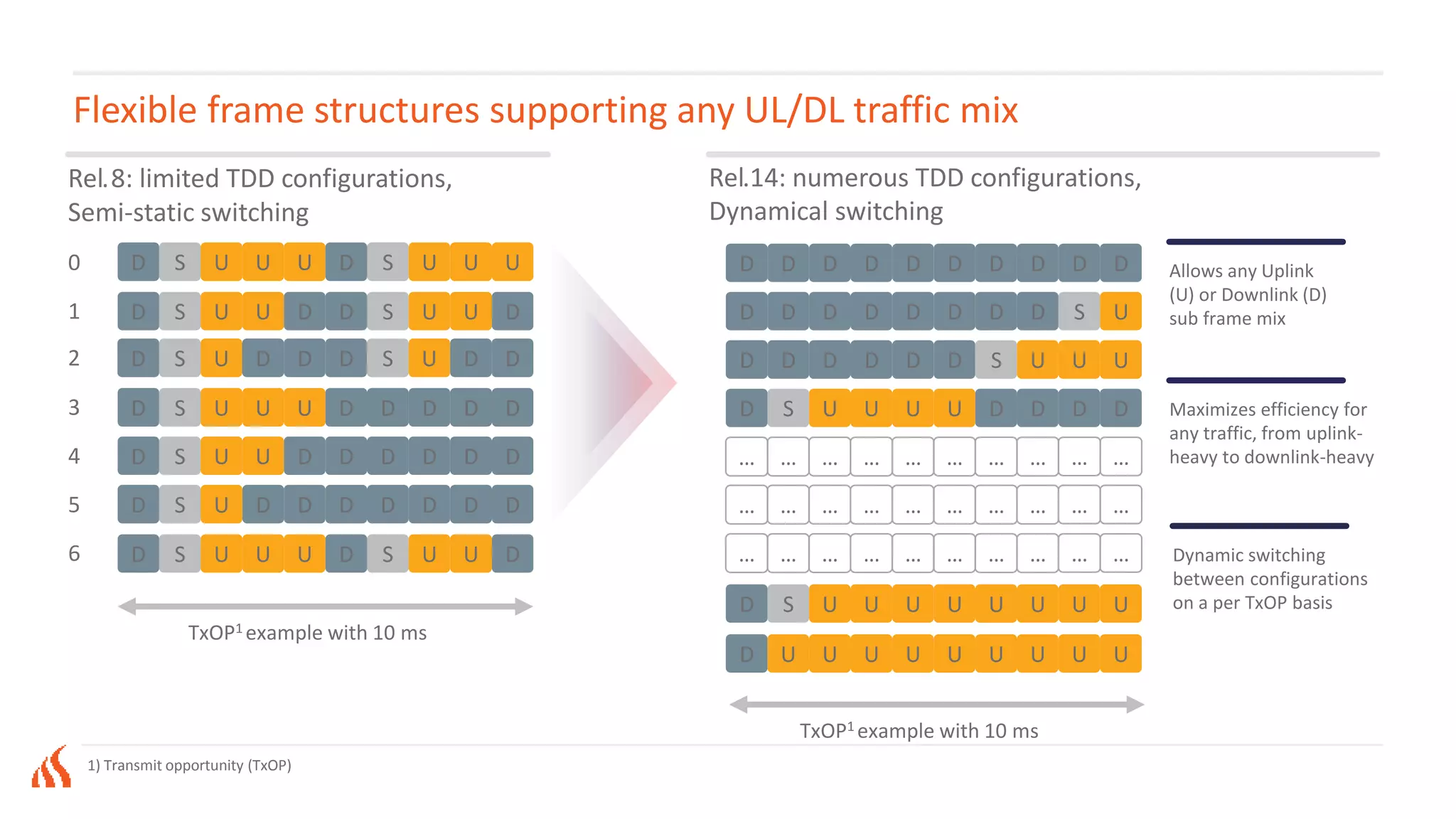
Flexible frame structures supporting any UL/DL traffic mix
D S U U U U U U U U
D D D D D D D D S U
D D D D D D S U U U
Allows any Uplink
(U) or Downlink (D)
sub frame mix
D S U U U D S U U U0
D S U U D D S U U D1
D S U U U D D D D D3
D S U U D D D D D D4
D S U D D D D D D D5
D S U U U D S U U D6
Maximizes efficiency for
any traffic, from uplink-
heavy to downlink-heavy
D S U D D D S U D D2
D D D D D D D D D D
D U U U U U U U U U
Rel.14: numerous TDD configurations,
Dynamical switching
Rel.8: limited TDD configurations,
Semi-static switching
Dynamic switching
between configurations
on a per TxOP basis
… … … … … … … … … …
D S U U U U D D D D
… … … … … … … … … …
… … … … … … … … … …
TxOP1 example with 10 ms
1) Transmit opportunity (TxOP)
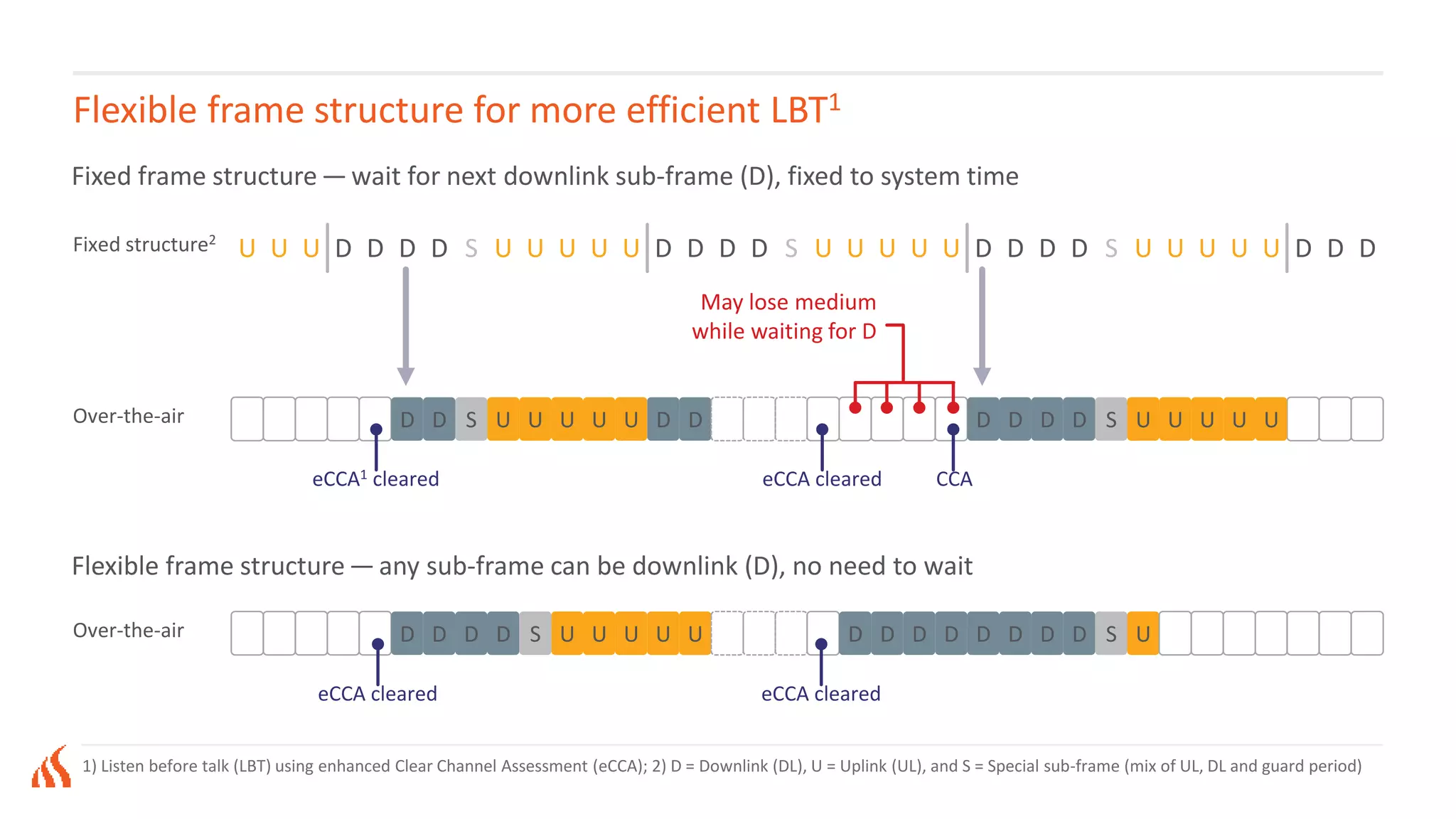
Flexible frame structure for more efficient LBT1
Fixed frame structure—wait for next downlink sub-frame (D), fixed to system time
Flexible frame structure—any sub-frame can be downlink (D), no need to wait
Fixed structure2
Over-the-air
U U U D D D D S U U U U U D D D D S U U U U U D D D D S U U U U U D D D
DD D U U U U U D D D D D U U U U US S
eCCA1 cleared eCCA cleared CCA
May lose medium
while waiting for D
Over-the-air UD D D S U U U U D D D D D D D D UD S
eCCA cleared eCCA cleared
1) Listen before talk (LBT) using enhanced Clear Channel Assessment (eCCA); 2) D = Downlink (DL), U = Uplink (UL), and S = Special sub-frame (mix of UL, DL and guard period)
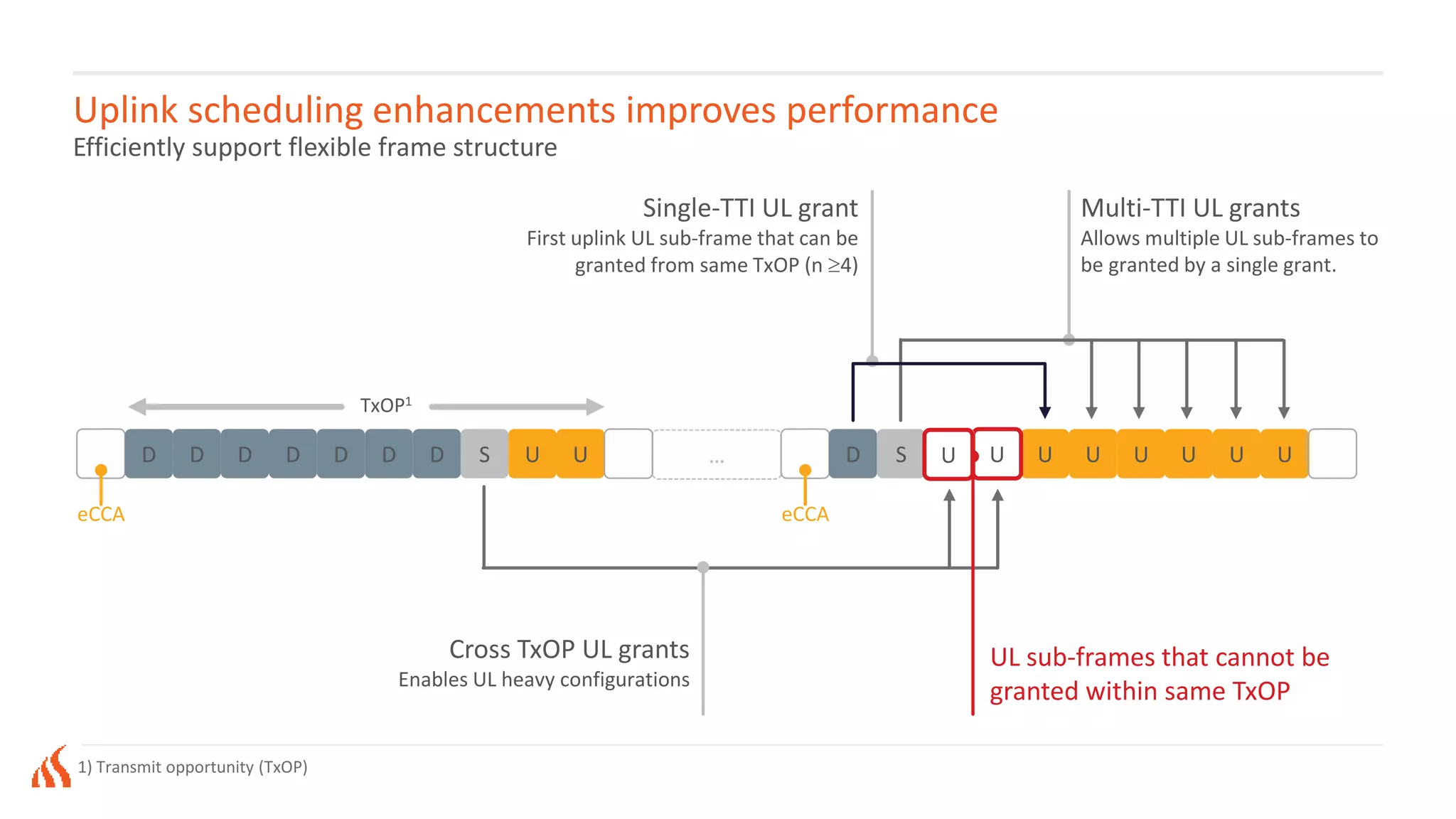
Uplink scheduling enhancements improves performance
Efficiently support flexible frame structure
…D D D D D D D S U U D S U U U U U U
eCCA eCCA
TxOP1
Single-TTI UL grant
First uplink UL sub-frame that can be
granted from same TxOP (n 4)
Multi-TTI UL grants
Allows multiple UL sub-frames to
be granted by a single grant.
U
Cross TxOP UL grants
Enables UL heavy configurations
UL sub-frames that cannot be
granted within same TxOP
1) Transmit opportunity (TxOP)
U
U D U S UU US
S
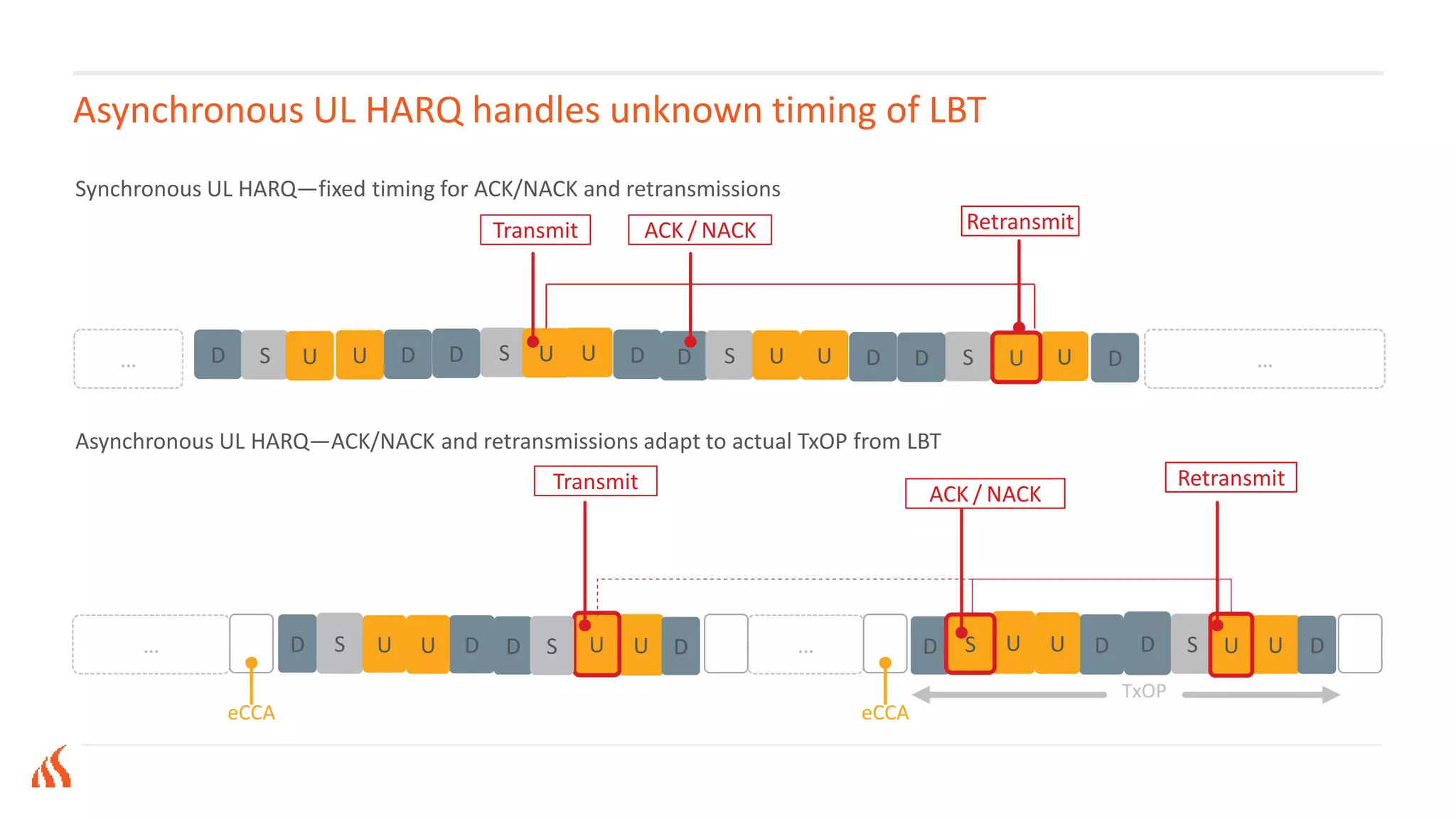
Asynchronous UL HARQ handles unknown timing of LBT
Synchronous UL HARQ—fixed timing for ACK/NACK and retransmissions
Asynchronous UL HARQ—ACK/NACK and retransmissions adapt to actual TxOP from LBT
…… D D D D D D D D
ACK / NACK RetransmitTransmit
… …
eCCA eCCA
TxOP
ACK / NACK
RetransmitTransmit
S U
D D D D D D DS
SS
S
U U
U
UUUUU
U U
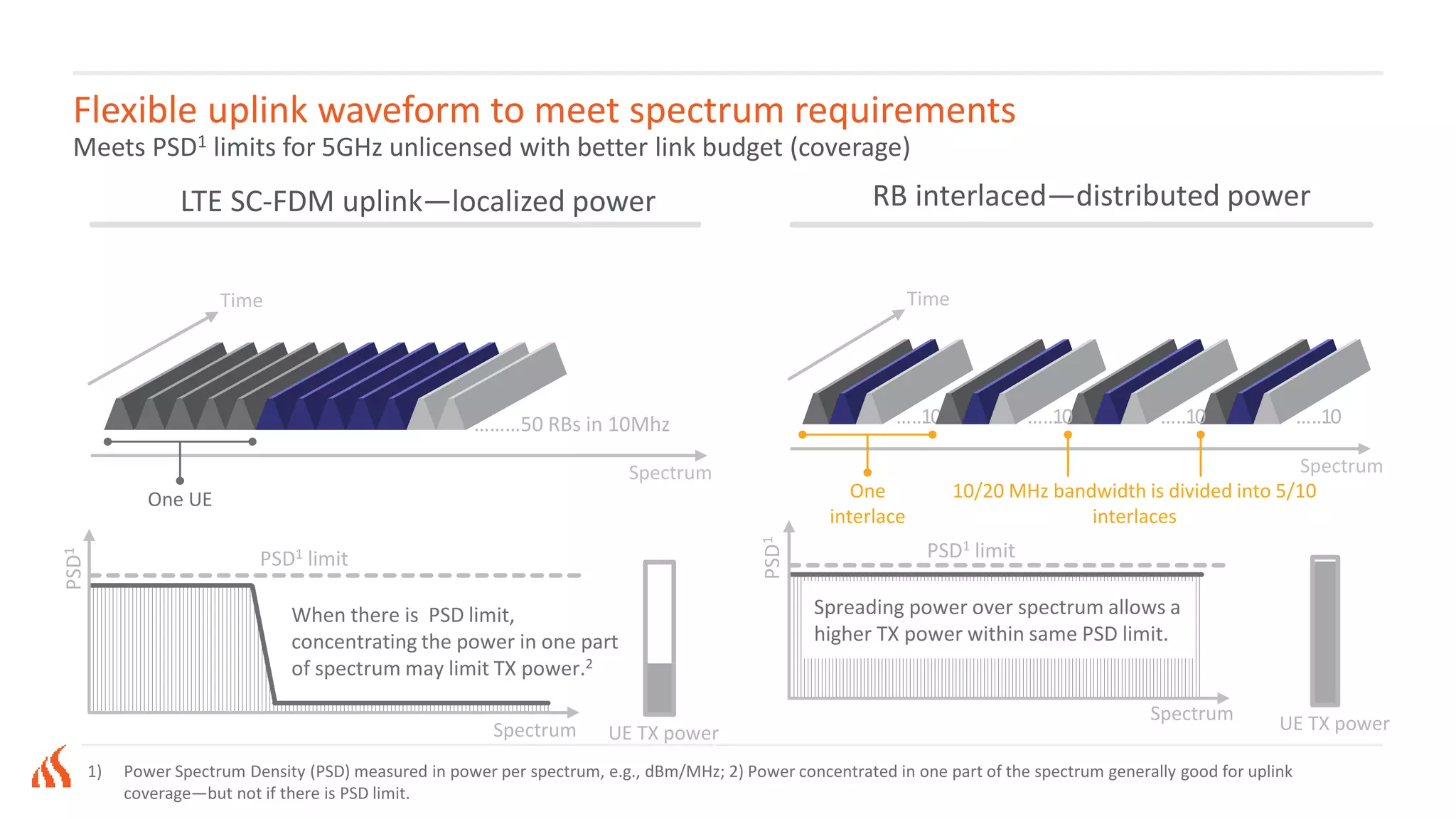
Flexible uplink waveform to meet spectrum requirements
Meets PSD1 limits for 5GHz unlicensed with better link budget (coverage)
LTE SC-FDM uplink—localized power
1) Power Spectrum Density (PSD) measured in power per spectrum, e.g., dBm/MHz; 2) Power concentrated in one part of the spectrum generally good for uplink
coverage—but not if there is PSD limit.
RB interlaced—distributed power
………50 RBs in 10Mhz
Time
Spectrum
PSD1
When there is PSD limit,
concentrating the power in one part
of spectrum may limit TX power.2
Spectrum
PSD1 limit
One UE
UE TX power
Time
Spectrum
……10
One
interlace
10/20 MHz bandwidth is divided into 5/10
interlaces
……10 ……10 ……10
Spreading power over spectrum allows a
higher TX power within same PSD limit.
Spectrum UE TX power
PSD1
PSD1 limit
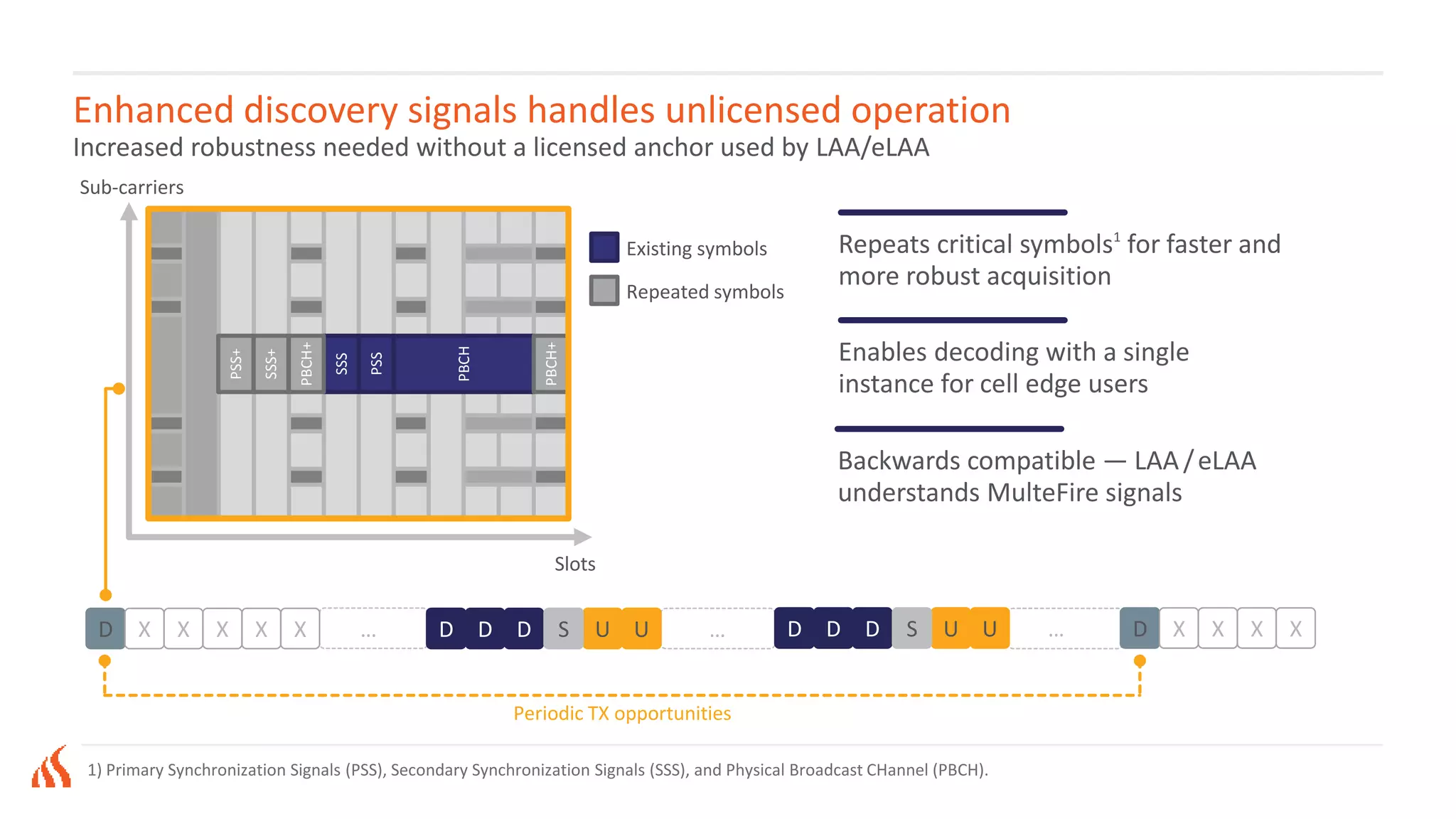
Enhanced discovery signals handles unlicensed operation
Increased robustness needed without a licensed anchor used by LAA/eLAA
1) Primary Synchronization Signals (PSS), Secondary Synchronization Signals (SSS), and Physical Broadcast CHannel (PBCH).
DD X X X X X … D D U U … DS
Backwards compatible — LAA/eLAA
understands MulteFire signals
Slots
Sub-carriers
SSS
PSS
PBCH
PBCH+
PBCH+
SSS+
PSS+
Repeats critical symbols1
for faster and
more robust acquisition
Enables decoding with a single
instance for cell edge users
Existing symbols
… DD D U US X X X X
Periodic TX opportunities
Repeated symbols
… …
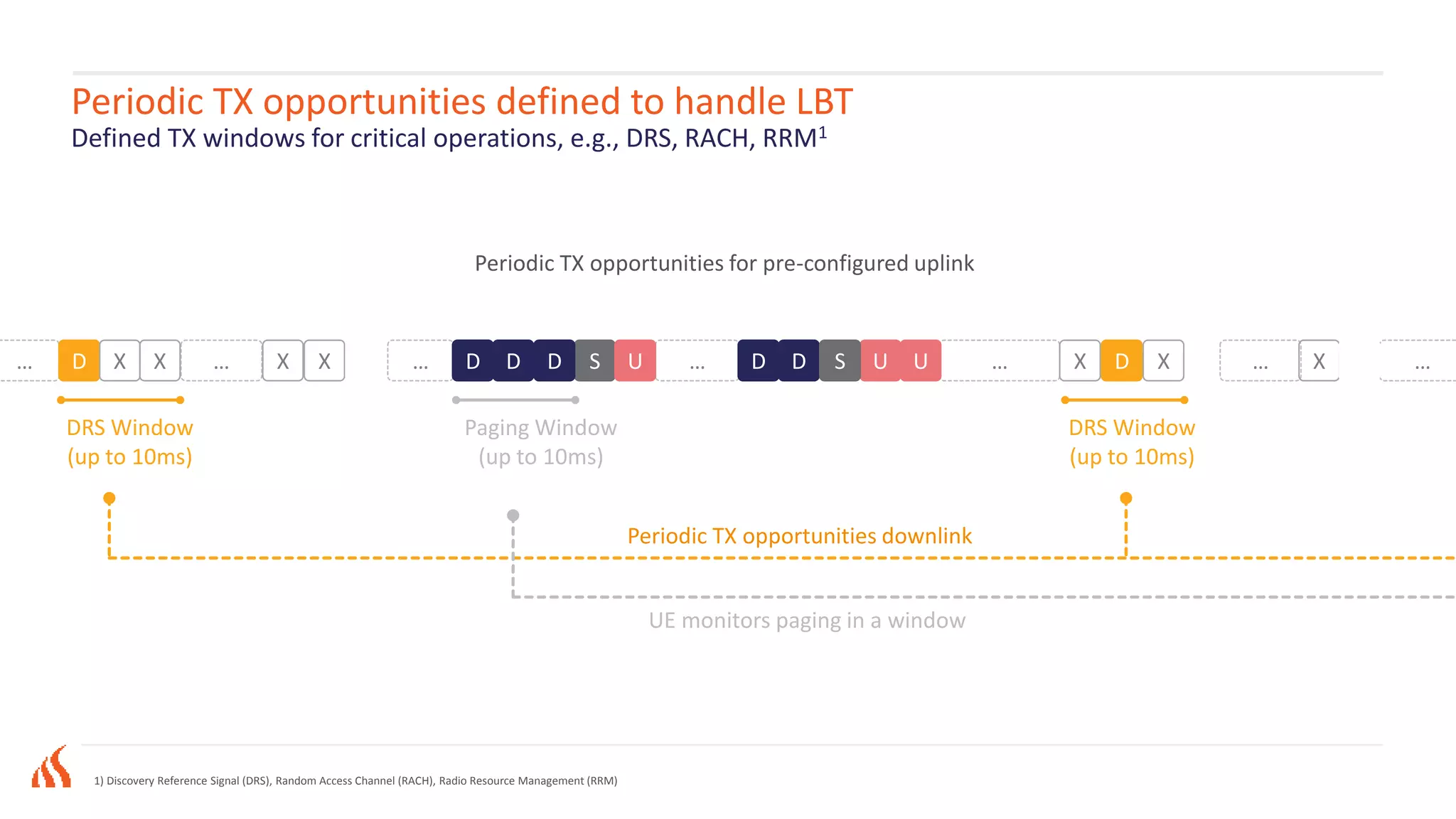
Periodic TX opportunities defined to handle LBT
…………… DD X X U D S U DD DD U US X U
Periodic TX opportunities downlink
Periodic TX opportunities for pre-configured uplink
X X
DRS Window
(up to 10ms)
1) Discovery Reference Signal (DRS), Random Access Channel (RACH), Radio Resource Management (RRM)
X X
DRS Window
(up to 10ms)
Paging Window
(up to 10ms)
UE monitors paging in a window
Defined TX windows for critical operations, e.g., DRS, RACH, RRM1
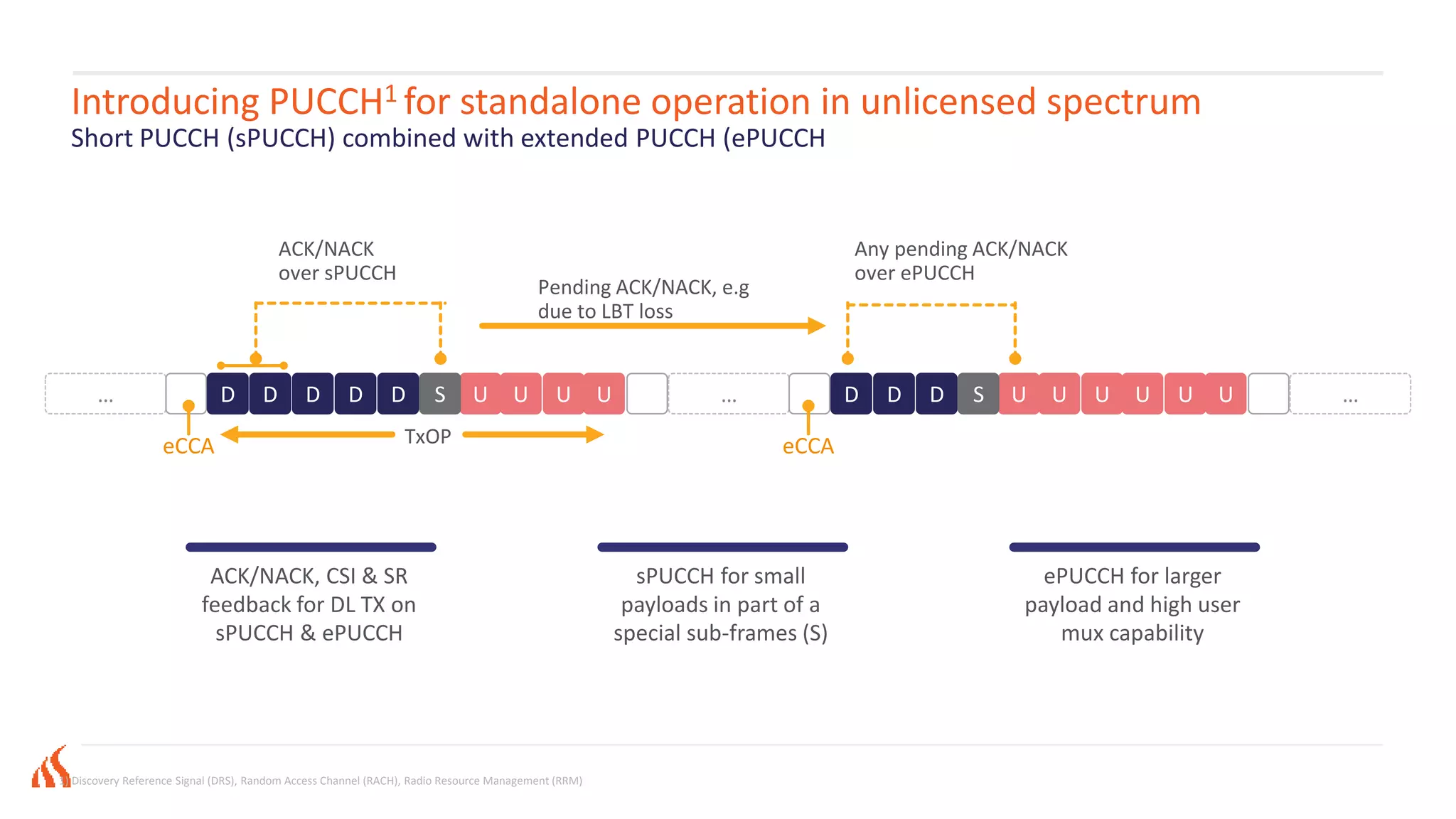
Introducing PUCCH1 for standalone operation in unlicensed spectrum
1) Discovery Reference Signal (DRS), Random Access Channel (RACH), Radio Resource Management (RRM)
Short PUCCH (sPUCCH) combined with extended PUCCH (ePUCCH
Periodic TX opportunities for pre-configured uplink
… D D D D D U US U U … D D D U US U U U U …
ACK/NACK
over sPUCCH
Pending ACK/NACK, e.g
due to LBT loss
Any pending ACK/NACK
over ePUCCH
TxOPeCCA eCCA
sPUCCH for small
payloads in part of a
special sub-frames (S)
ePUCCH for larger
payload and high user
mux capability
ACK/NACK, CSI & SR
feedback for DL TX on
sPUCCH & ePUCCH
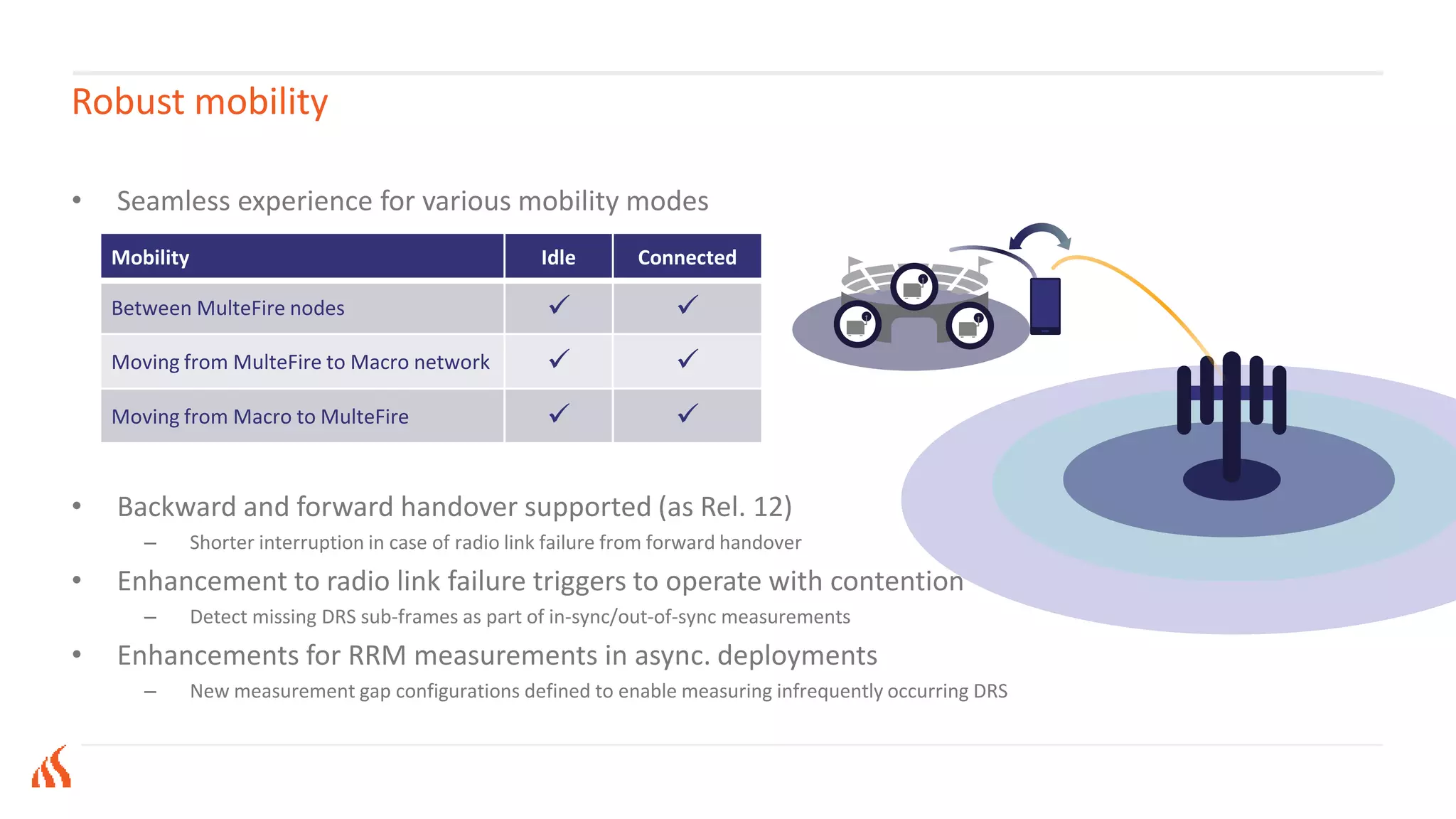
Robust mobility
• Seamless experience for various mobility modes
• Backward and forward handover supported (as Rel. 12)
– Shorter interruption in case of radio link failure from forward handover
• Enhancement to radio link failure triggers to operate with contention
– Detect missing DRS sub-frames as part of in-sync/out-of-sync measurements
• Enhancements for RRM measurements in async. deployments
– New measurement gap configurations defined to enable measuring infrequently occurring DRS
Mobility Idle Connected
Between MulteFire nodes  
Moving from MulteFire to Macro network  
Moving from Macro to MulteFire  
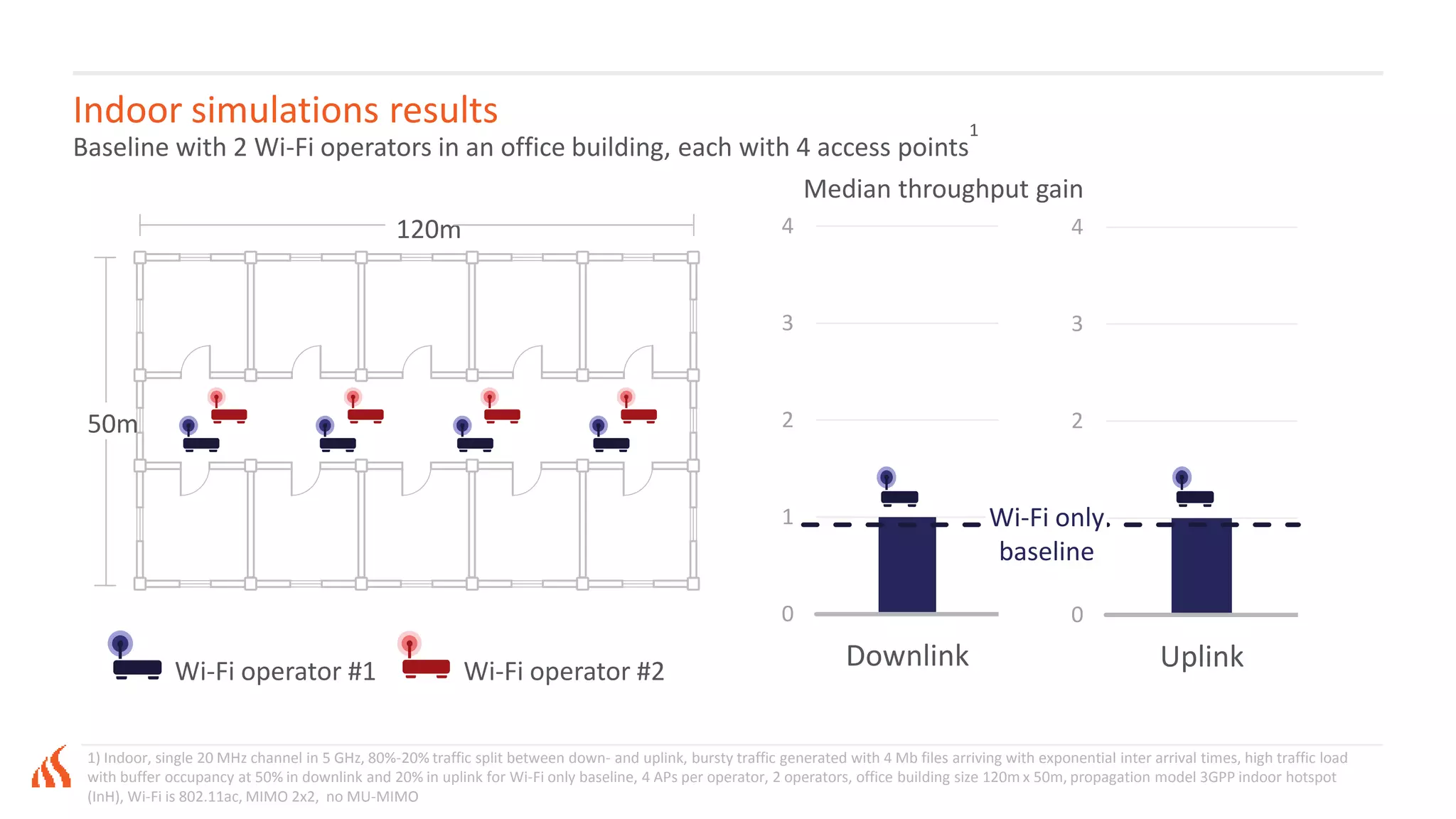
Indoor simulations results
Baseline with 2 Wi-Fi operators in an office building, each with 4 access points
1
1) Indoor, single 20 MHz channel in 5 GHz, 80%-20% traffic split between down- and uplink, bursty traffic generated with 4 Mb files arriving with exponential inter arrival times, high traffic load
with buffer occupancy at 50% in downlink and 20% in uplink for Wi-Fi only baseline, 4 APs per operator, 2 operators, office building size 120m x 50m, propagation model 3GPP indoor hotspot
(InH), Wi-Fi is 802.11ac, MIMO 2x2, no MU-MIMO
Wi-Fi operator #1 Wi-Fi operator #2
120m
50m
0
1
2
3
4
Downlink
0
1
2
3
4
Uplink
Median throughput gain
Wi-Fi only
baseline
0
1
2
3
4
Uplink
0
1
2
3
4
Downlink
Median throughput gain
2X gain
Wi-Fi only
baseline
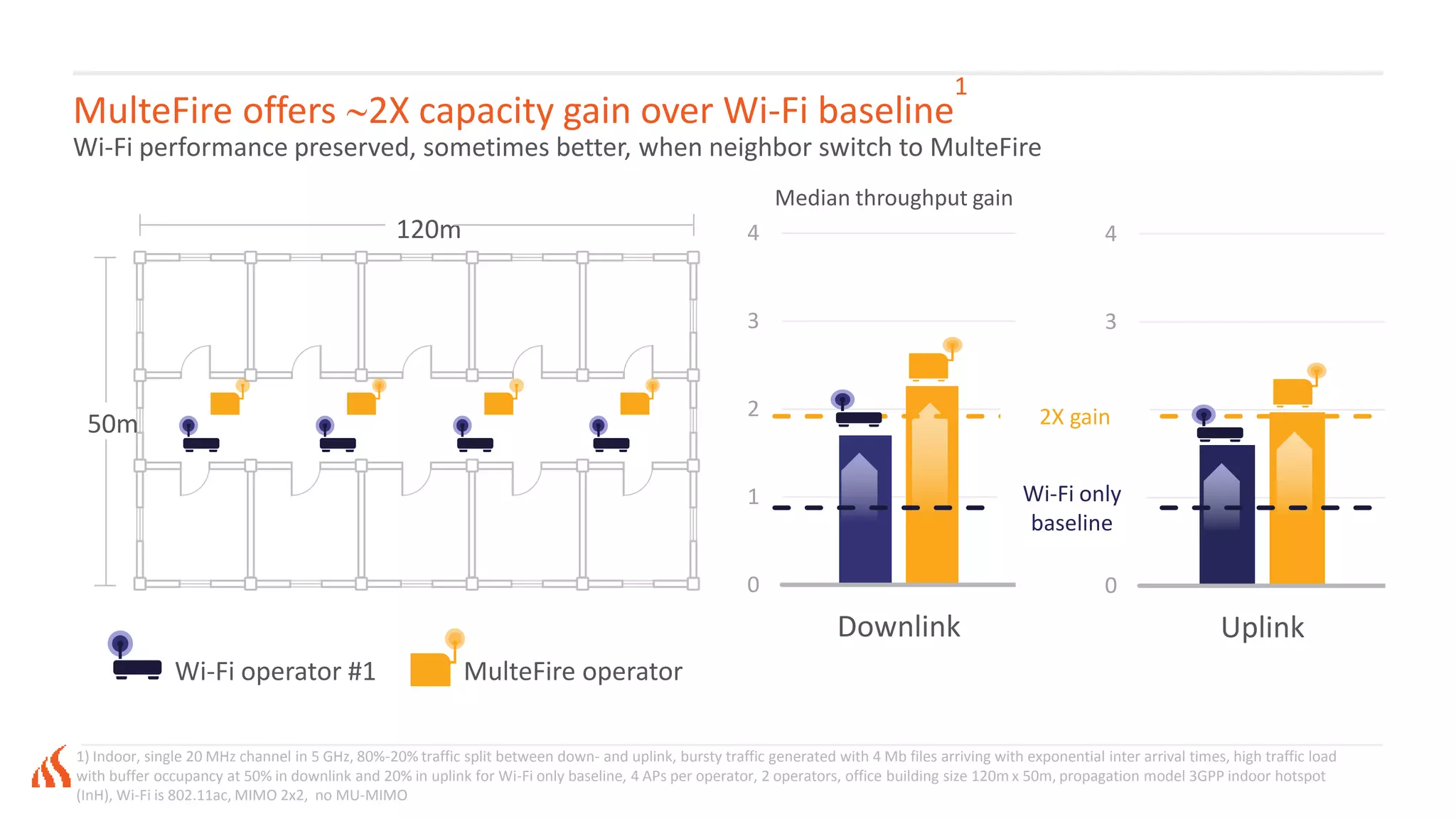
MulteFire offers 2X capacity gain over Wi-Fi baseline
1
Wi-Fi performance preserved, sometimes better, when neighbor switch to MulteFire
1) Indoor, single 20 MHz channel in 5 GHz, 80%-20% traffic split between down- and uplink, bursty traffic generated with 4 Mb files arriving with exponential inter arrival times, high traffic load
with buffer occupancy at 50% in downlink and 20% in uplink for Wi-Fi only baseline, 4 APs per operator, 2 operators, office building size 120m x 50m, propagation model 3GPP indoor hotspot
(InH), Wi-Fi is 802.11ac, MIMO 2x2, no MU-MIMO
Wi-Fi operator #1 MulteFire operator
120m
50m
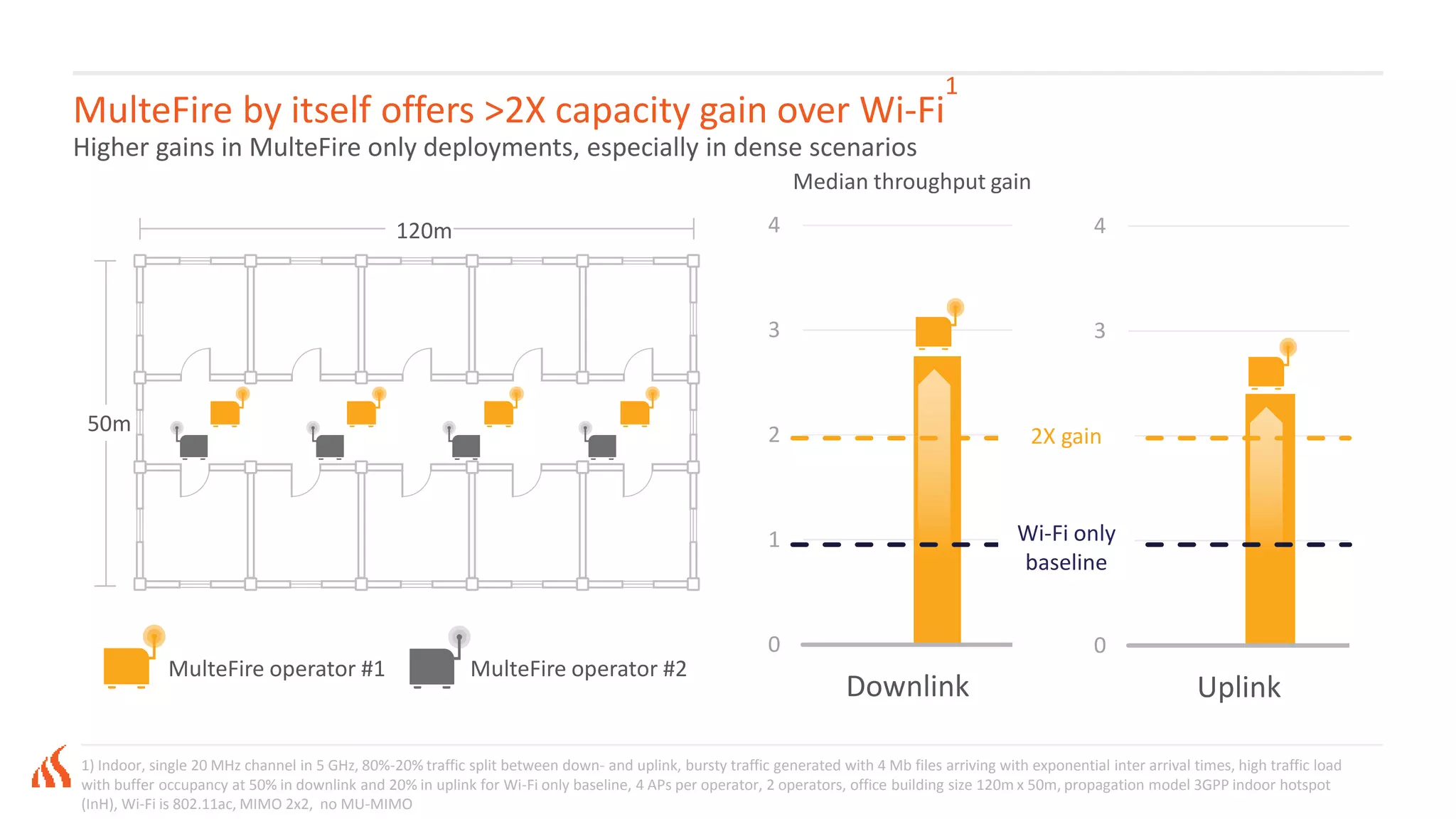
MulteFire by itself offers >2X capacity gain over Wi-Fi
1
Higher gains in MulteFire only deployments, especially in dense scenarios
MulteFire operator #1 MulteFire operator #2
50m
120m
0
1
2
3
4
Downlink
0
1
2
3
4
Uplink
Median throughput gain
Wi-Fi only
baseline
2X gain
1) Indoor, single 20 MHz channel in 5 GHz, 80%-20% traffic split between down- and uplink, bursty traffic generated with 4 Mb files arriving with exponential inter arrival times, high traffic load
with buffer occupancy at 50% in downlink and 20% in uplink for Wi-Fi only baseline, 4 APs per operator, 2 operators, office building size 120m x 50m, propagation model 3GPP indoor hotspot
(InH), Wi-Fi is 802.11ac, MIMO 2x2, no MU-MIMO
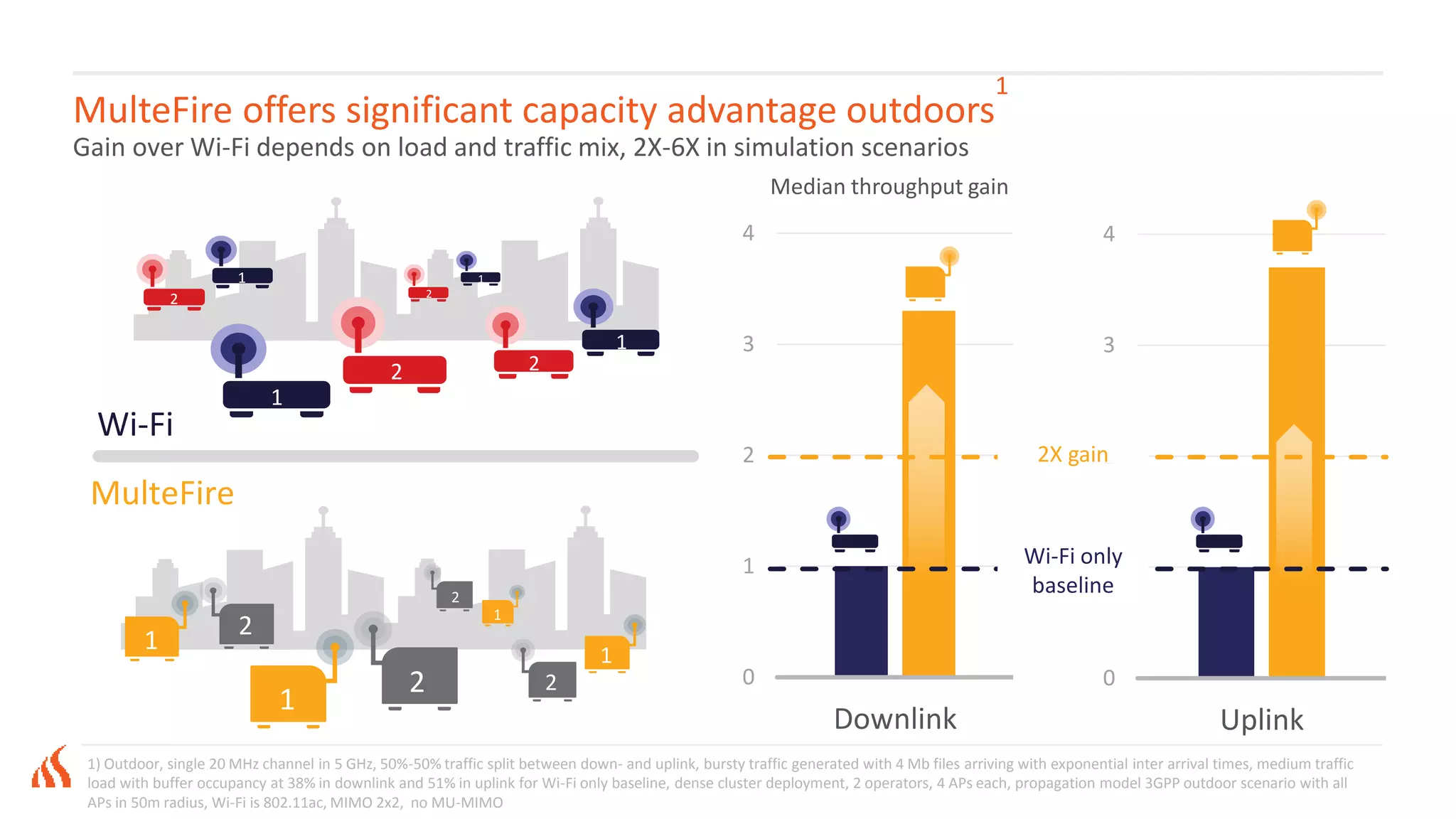
MulteFire offers significant capacity advantage outdoors
1
Gain over Wi-Fi depends on load and traffic mix, 2X-6X in simulation scenarios
Wi-Fi
MulteFire
1
2
1
2
1
2
2
1
2
1
2
1
2
1
2
1
0
1
2
3
4
Uplink
0
1
2
3
4
Downlink
Median throughput gain
Wi-Fi only
baseline
2X gain
1) Outdoor, single 20 MHz channel in 5 GHz, 50%-50% traffic split between down- and uplink, bursty traffic generated with 4 Mb files arriving with exponential inter arrival times, medium traffic
load with buffer occupancy at 38% in downlink and 51% in uplink for Wi-Fi only baseline, dense cluster deployment, 2 operators, 4 APs each, propagation model 3GPP outdoor scenario with all
APs in 50m radius, Wi-Fi is 802.11ac, MIMO 2x2, no MU-MIMO
MulteFire Summary
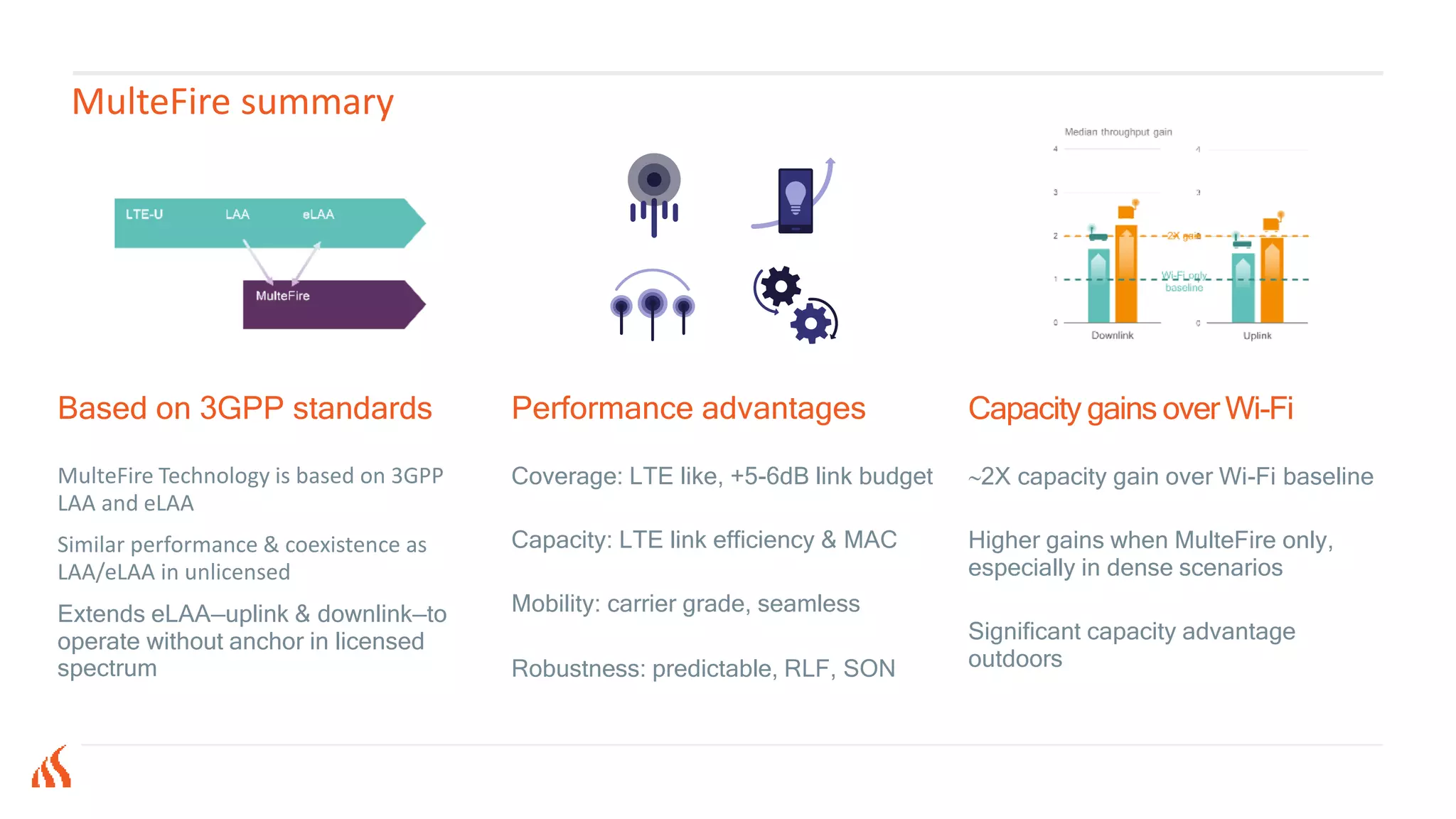
Based on 3GPP standards
MulteFire Technology is based on 3GPP
LAA and eLAA
Similar performance & coexistence as
LAA/eLAA in unlicensed
Extends eLAA—uplink & downlink—to
operate without anchor in licensed
spectrum
Performance advantages
Coverage: LTE like, +5-6dB link budget
Capacity: LTE link efficiency & MAC
Mobility: carrier grade, seamless
Robustness: predictable, RLF, SON
Capacity gains over Wi-Fi
2X capacity gain over Wi-Fi baseline
Higher gains when MulteFire only,
especially in dense scenarios
Significant capacity advantage
outdoors
MulteFire summary
Thank youThank You
For more information,
visit us at www.multefire.org

Understanding MulteFire’s Radio Link

  • 1.
    Understanding MulteFire’s Radio Link Dr.Tamer Kadous, Radio Workgroup Chair
  • 2.
    Agenda • Coexisting inunlicensed spectrum • MulteFire Technology—extensions added to 3GPP LAA and eLAA • MulteFire performance advantages and results • Summary
  • 3.
    Multiple technologies willcoexist in unlicensed spectrum 1) Licensed-Assisted Access (LAA), also includes enhanced LAA (eLAA); 2) LTE Wi-Fi Link Aggregation (LWA); 3) LTE Wi-Fi radio level integration with IPsec tunnel (LWIP); 4) 802.11ac / .11ad / .11ax / .11ay Wi-Fi4 Evolving for enhanced performance and expanding to new usage models, used today as neutral host Licensed Spectrum Exclusive use Unlicensed Spectrum Shared use Aggregation MulteFire Broadens LTE ecosystem to enhanced and new deployment opportunities, suitable for neutral host LWA2, LWIP3 Targeting mobile operators leveraging existing carrier Wi-Fi deployments LTE-U / LAA1 Targeting mobile operators using LTE in unlicensed spectrum for new small cell deployments anchor
  • 4.
    MulteFire performance advantages 1)Signal-to-interference-plus-noise ratio (SINR); 2) Media Access Control (MAC) Layer; 3) Handover (HO); 4) Radio link failure (RLF) Coverage • Retains LTE’s deep coverage characteristics • Targets control channels to cell edge SINR1 of -6dB • 5-6dB link budget advantage over Wi-Fi Capacity • Leverage LTE link efficiency and MAC2 • Significant gains (2X) over 802.11ac baseline • Comparison with .11ax under investigation Mobility • Brings carrier-grade LTE mobility to unlicensed • Seamless & robust mobility • Service continuity to WAN • Significantly better than Wi- Fi, esp. outdoor, 50 km/h Robustness • More predictable & robust performance than Wi-Fi • Forward HO3 enables recovery when RLF4 • Enhanced RLF4 triggers • Mature SON techniques
  • 5.
    MulteFire technology isbased on 3GPP LAA and eLAA Extends eLAA—uplink & downlink—to operate without anchor in licensed spectrum 3GPP Rel. 13 3GPP Rel. 14 Uplink waveform & channels Flexible frame structure UL 2 HARQ 3 , scheduling enhancements Supplemental downlink + HARQ 3 LBT 4 coexistence in unlicensed Multi-carrier operation Enhanced discovery signals Robust procedures: mobility, paging, RA 1 ... Robust & efficient UL 2 control channels Advanced LTE air-interface LTE TDD MulteFire Alliance Operate without licensed anchor eLAA: +Uplink LAA: Downlink LTE New features 1) Random Access; 2) Uplink; 3) Hybrid automatic retransmission request; 4) Listen before talk
  • 6.
    Flexible frame structuressupporting any UL/DL traffic mix D S U U U U U U U U D D D D D D D D S U D D D D D D S U U U Allows any Uplink (U) or Downlink (D) sub frame mix D S U U U D S U U U0 D S U U D D S U U D1 D S U U U D D D D D3 D S U U D D D D D D4 D S U D D D D D D D5 D S U U U D S U U D6 Maximizes efficiency for any traffic, from uplink- heavy to downlink-heavy D S U D D D S U D D2 D D D D D D D D D D D U U U U U U U U U Rel.14: numerous TDD configurations, Dynamical switching Rel.8: limited TDD configurations, Semi-static switching Dynamic switching between configurations on a per TxOP basis … … … … … … … … … … D S U U U U D D D D … … … … … … … … … … … … … … … … … … … … TxOP1 example with 10 ms TxOP1 example with 10 ms 1) Transmit opportunity (TxOP)
  • 7.
    Flexible frame structurefor more efficient LBT1 Fixed frame structure—wait for next downlink sub-frame (D), fixed to system time Flexible frame structure—any sub-frame can be downlink (D), no need to wait Fixed structure2 Over-the-air U U U D D D D S U U U U U D D D D S U U U U U D D D D S U U U U U D D D DD D U U U U U D D D D D U U U U US S eCCA1 cleared eCCA cleared CCA May lose medium while waiting for D Over-the-air UD D D S U U U U D D D D D D D D UD S eCCA cleared eCCA cleared 1) Listen before talk (LBT) using enhanced Clear Channel Assessment (eCCA); 2) D = Downlink (DL), U = Uplink (UL), and S = Special sub-frame (mix of UL, DL and guard period)
  • 8.
    Uplink scheduling enhancementsimproves performance Efficiently support flexible frame structure …D D D D D D D S U U D S U U U U U U eCCA eCCA TxOP1 Single-TTI UL grant First uplink UL sub-frame that can be granted from same TxOP (n 4) Multi-TTI UL grants Allows multiple UL sub-frames to be granted by a single grant. U Cross TxOP UL grants Enables UL heavy configurations UL sub-frames that cannot be granted within same TxOP 1) Transmit opportunity (TxOP) U
  • 9.
    U D US UU US S Asynchronous UL HARQ handles unknown timing of LBT Synchronous UL HARQ—fixed timing for ACK/NACK and retransmissions Asynchronous UL HARQ—ACK/NACK and retransmissions adapt to actual TxOP from LBT …… D D D D D D D D ACK / NACK RetransmitTransmit … … eCCA eCCA TxOP ACK / NACK RetransmitTransmit S U D D D D D D DS SS S U U U UUUUU U U
  • 10.
    Flexible uplink waveformto meet spectrum requirements Meets PSD1 limits for 5GHz unlicensed with better link budget (coverage) LTE SC-FDM uplink—localized power 1) Power Spectrum Density (PSD) measured in power per spectrum, e.g., dBm/MHz; 2) Power concentrated in one part of the spectrum generally good for uplink coverage—but not if there is PSD limit. RB interlaced—distributed power ………50 RBs in 10Mhz Time Spectrum PSD1 When there is PSD limit, concentrating the power in one part of spectrum may limit TX power.2 Spectrum PSD1 limit One UE UE TX power Time Spectrum ……10 One interlace 10/20 MHz bandwidth is divided into 5/10 interlaces ……10 ……10 ……10 Spreading power over spectrum allows a higher TX power within same PSD limit. Spectrum UE TX power PSD1 PSD1 limit
  • 11.
    Enhanced discovery signalshandles unlicensed operation Increased robustness needed without a licensed anchor used by LAA/eLAA 1) Primary Synchronization Signals (PSS), Secondary Synchronization Signals (SSS), and Physical Broadcast CHannel (PBCH). DD X X X X X … D D U U … DS Backwards compatible — LAA/eLAA understands MulteFire signals Slots Sub-carriers SSS PSS PBCH PBCH+ PBCH+ SSS+ PSS+ Repeats critical symbols1 for faster and more robust acquisition Enables decoding with a single instance for cell edge users Existing symbols … DD D U US X X X X Periodic TX opportunities Repeated symbols
  • 12.
    … … Periodic TXopportunities defined to handle LBT …………… DD X X U D S U DD DD U US X U Periodic TX opportunities downlink Periodic TX opportunities for pre-configured uplink X X DRS Window (up to 10ms) 1) Discovery Reference Signal (DRS), Random Access Channel (RACH), Radio Resource Management (RRM) X X DRS Window (up to 10ms) Paging Window (up to 10ms) UE monitors paging in a window Defined TX windows for critical operations, e.g., DRS, RACH, RRM1
  • 13.
    Introducing PUCCH1 forstandalone operation in unlicensed spectrum 1) Discovery Reference Signal (DRS), Random Access Channel (RACH), Radio Resource Management (RRM) Short PUCCH (sPUCCH) combined with extended PUCCH (ePUCCH Periodic TX opportunities for pre-configured uplink … D D D D D U US U U … D D D U US U U U U … ACK/NACK over sPUCCH Pending ACK/NACK, e.g due to LBT loss Any pending ACK/NACK over ePUCCH TxOPeCCA eCCA sPUCCH for small payloads in part of a special sub-frames (S) ePUCCH for larger payload and high user mux capability ACK/NACK, CSI & SR feedback for DL TX on sPUCCH & ePUCCH
  • 14.
    Robust mobility • Seamlessexperience for various mobility modes • Backward and forward handover supported (as Rel. 12) – Shorter interruption in case of radio link failure from forward handover • Enhancement to radio link failure triggers to operate with contention – Detect missing DRS sub-frames as part of in-sync/out-of-sync measurements • Enhancements for RRM measurements in async. deployments – New measurement gap configurations defined to enable measuring infrequently occurring DRS Mobility Idle Connected Between MulteFire nodes   Moving from MulteFire to Macro network   Moving from Macro to MulteFire  
  • 15.
    Indoor simulations results Baselinewith 2 Wi-Fi operators in an office building, each with 4 access points 1 1) Indoor, single 20 MHz channel in 5 GHz, 80%-20% traffic split between down- and uplink, bursty traffic generated with 4 Mb files arriving with exponential inter arrival times, high traffic load with buffer occupancy at 50% in downlink and 20% in uplink for Wi-Fi only baseline, 4 APs per operator, 2 operators, office building size 120m x 50m, propagation model 3GPP indoor hotspot (InH), Wi-Fi is 802.11ac, MIMO 2x2, no MU-MIMO Wi-Fi operator #1 Wi-Fi operator #2 120m 50m 0 1 2 3 4 Downlink 0 1 2 3 4 Uplink Median throughput gain Wi-Fi only baseline
  • 16.
    0 1 2 3 4 Uplink 0 1 2 3 4 Downlink Median throughput gain 2Xgain Wi-Fi only baseline MulteFire offers 2X capacity gain over Wi-Fi baseline 1 Wi-Fi performance preserved, sometimes better, when neighbor switch to MulteFire 1) Indoor, single 20 MHz channel in 5 GHz, 80%-20% traffic split between down- and uplink, bursty traffic generated with 4 Mb files arriving with exponential inter arrival times, high traffic load with buffer occupancy at 50% in downlink and 20% in uplink for Wi-Fi only baseline, 4 APs per operator, 2 operators, office building size 120m x 50m, propagation model 3GPP indoor hotspot (InH), Wi-Fi is 802.11ac, MIMO 2x2, no MU-MIMO Wi-Fi operator #1 MulteFire operator 120m 50m
  • 17.
    MulteFire by itselfoffers >2X capacity gain over Wi-Fi 1 Higher gains in MulteFire only deployments, especially in dense scenarios MulteFire operator #1 MulteFire operator #2 50m 120m 0 1 2 3 4 Downlink 0 1 2 3 4 Uplink Median throughput gain Wi-Fi only baseline 2X gain 1) Indoor, single 20 MHz channel in 5 GHz, 80%-20% traffic split between down- and uplink, bursty traffic generated with 4 Mb files arriving with exponential inter arrival times, high traffic load with buffer occupancy at 50% in downlink and 20% in uplink for Wi-Fi only baseline, 4 APs per operator, 2 operators, office building size 120m x 50m, propagation model 3GPP indoor hotspot (InH), Wi-Fi is 802.11ac, MIMO 2x2, no MU-MIMO
  • 18.
    MulteFire offers significantcapacity advantage outdoors 1 Gain over Wi-Fi depends on load and traffic mix, 2X-6X in simulation scenarios Wi-Fi MulteFire 1 2 1 2 1 2 2 1 2 1 2 1 2 1 2 1 0 1 2 3 4 Uplink 0 1 2 3 4 Downlink Median throughput gain Wi-Fi only baseline 2X gain 1) Outdoor, single 20 MHz channel in 5 GHz, 50%-50% traffic split between down- and uplink, bursty traffic generated with 4 Mb files arriving with exponential inter arrival times, medium traffic load with buffer occupancy at 38% in downlink and 51% in uplink for Wi-Fi only baseline, dense cluster deployment, 2 operators, 4 APs each, propagation model 3GPP outdoor scenario with all APs in 50m radius, Wi-Fi is 802.11ac, MIMO 2x2, no MU-MIMO
  • 19.
  • 20.
    Based on 3GPPstandards MulteFire Technology is based on 3GPP LAA and eLAA Similar performance & coexistence as LAA/eLAA in unlicensed Extends eLAA—uplink & downlink—to operate without anchor in licensed spectrum Performance advantages Coverage: LTE like, +5-6dB link budget Capacity: LTE link efficiency & MAC Mobility: carrier grade, seamless Robustness: predictable, RLF, SON Capacity gains over Wi-Fi 2X capacity gain over Wi-Fi baseline Higher gains when MulteFire only, especially in dense scenarios Significant capacity advantage outdoors MulteFire summary
  • 21.
    Thank youThank You Formore information, visit us at www.multefire.org