The GSM technology
GLOBAL SYSTEM
FOR MOBILE
COMMUNICATION
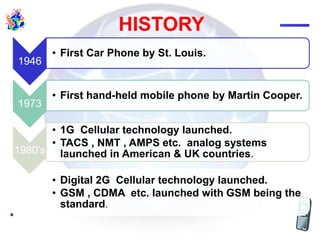
1946
• First Car Phone by St. Louis.
1973
• First hand-held mobile phone by Martin Cooper.
1980’s
• 1G Cellular technology launched.
• TACS , NMT , AMPS etc. analog systems
launched in American & UK countries.
1990’s
• Digital 2G Cellular technology launched.
• GSM , CDMA etc. launched with GSM being the
standard.
HISTORY
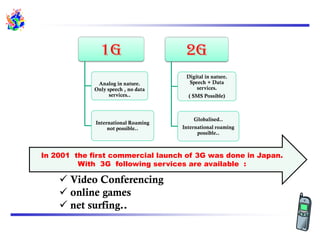
1G
Analog in nature.
Only speech , no data
services..
International Roaming
not possible..
2G
Digital in nature.
Speech + Data
services.
( SMS Possible)
Globalised..
International roaming
possible..
In 2001 the first commercial launch of 3G was done in Japan.
With 3G following services are available :
 Video Conferencing
 online games
 net surfing..
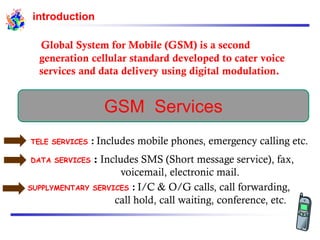
introduction
Global System for Mobile (GSM) is a second
generation cellular standard developed to cater voice
services and data delivery using digital modulation.
GSM Services
TELE SERVICES : Includes mobile phones, emergency calling etc.
DATA SERVICES : Includes SMS (Short message service), fax,
voicemail, electronic mail.
SUPPLYMENTARY SERVICES : I/C & O/G calls, call forwarding,
call hold, call waiting, conference, etc.
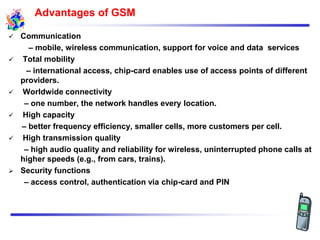
 Communication
– mobile, wireless communication, support for voice and data services
 Total mobility
– international access, chip-card enables use of access points of different
providers.
 Worldwide connectivity
– one number, the network handles every location.
 High capacity
– better frequency efficiency, smaller cells, more customers per cell.
 High transmission quality
– high audio quality and reliability for wireless, uninterrupted phone calls at
higher speeds (e.g., from cars, trains).
 Security functions
– access control, authentication via chip-card and PIN
Advantages of GSM
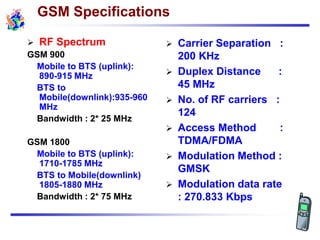
GSM Specifications
 RF Spectrum
GSM 900
Mobile to BTS (uplink):
890-915 MHz
BTS to
Mobile(downlink):935-960
MHz
Bandwidth : 2* 25 MHz
GSM 1800
Mobile to BTS (uplink):
1710-1785 MHz
BTS to Mobile(downlink)
1805-1880 MHz
Bandwidth : 2* 75 MHz
 Carrier Separation :
200 KHz
 Duplex Distance :
45 MHz
 No. of RF carriers :
124
 Access Method :
TDMA/FDMA
 Modulation Method :
GMSK
 Modulation data rate
: 270.833 Kbps
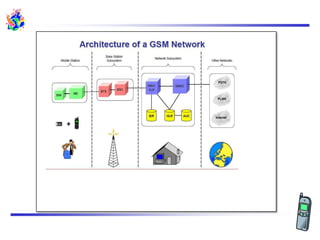
GSM architecture
 Network sub-system
 Radio sub-system
 Operation and maintenance sub-
system
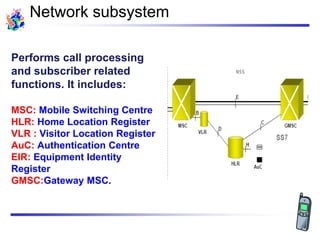
Network subsystem
Performs call processing
and subscriber related
functions. It includes:
MSC: Mobile Switching Centre
HLR: Home Location Register
VLR : Visitor Location Register
AuC: Authentication Centre
EIR: Equipment Identity
Register
GMSC:Gateway MSC.
 It is included in the GSM system for call-switching. Its overall purpose is
the same as that of any telephone exchange.
The functions carried out by the MSC are listed below:
 Call Processing
Includes control of data/voice call setup, inter-BSS and inter-MSC
handovers and control of mobility management (subscriber validation
and location).
 Operations and Maintenance Support
Includes database management, traffic metering and measurement, and
a man–machine interface.
 Internetwork Interworking
Manages the interface between the GSM network and the PSTN.
When the MSC provides the interface with the other networks in the
GSM network it is known as a Gateway MSC.
Network
subsystem
Mobile switching centre
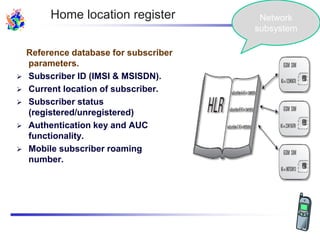
Reference database for subscriber
parameters.
 Subscriber ID (IMSI & MSISDN).
 Current location of subscriber.
 Subscriber status
(registered/unregistered)
 Authentication key and AUC
functionality.
 Mobile subscriber roaming
number.
Home location register Network
subsystem
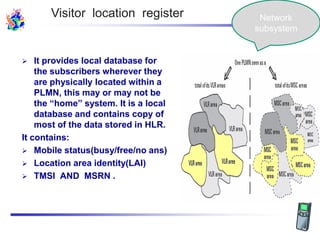
 It provides local database for
the subscribers wherever they
are physically located within a
PLMN, this may or may not be
the “home” system. It is a local
database and contains copy of
most of the data stored in HLR.
It contains:
 Mobile status(busy/free/no ans)
 Location area identity(LAI)
 TMSI AND MSRN .
Network
subsystem
Visitor location register
 It provides authentication and encryption
parameters for verification of subscriber
identity.
 It ensures confidentiality of each cell.
 It protects network operators from frauds in
today's cellular world.
 It is associated with HLR.
 The authentication process will usually take
place each time the subscriber “initializes” on
the system.
Authentication centre Network
subsystem
 The EIR contains a centralized database for validating the
International Mobile Equipment Identity (IMEI).
 It contains three lists:
 White List
Contains those IMEIs which are known to have been
assigned to valid MS equipment.
 Black List
 Contains IMEIs of MS which have been reported stolen or
which are to be denied service for some other reason.
 Grey List
Contains IMEIs of MS which have problems (for example,
faulty software). These are not, however, sufficiently
significant to warrant a „„black listing”.
EQUIPMENT IDENTITY REGISTER
Network
subsystem
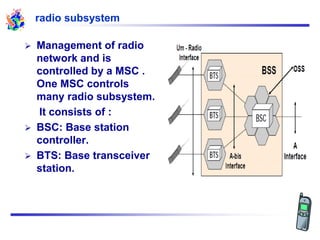
radio subsystem
 Management of radio
network and is
controlled by a MSC .
One MSC controls
many radio subsystem.
It consists of :
 BSC: Base station
controller.
 BTS: Base transceiver
station.
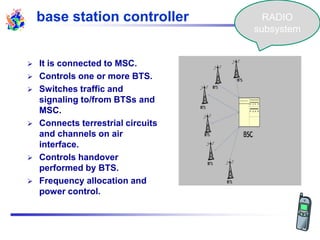
base station controller
 It is connected to MSC.
 Controls one or more BTS.
 Switches traffic and
signaling to/from BTSs and
MSC.
 Connects terrestrial circuits
and channels on air
interface.
 Controls handover
performed by BTS.
 Frequency allocation and
power control.
RADIO
subsystem
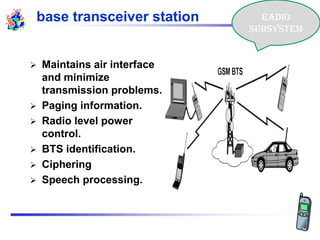
base transceiver station
 Maintains air interface
and minimize
transmission problems.
 Paging information.
 Radio level power
control.
 BTS identification.
 Ciphering
 Speech processing.
RADIO
subsystem
 Dynamic monitoring and controlling of
network.
 operation and maintenance data
function.
 Configuration management.
 Fault report and alarm handling.
 Performance supervision.
 Storage of software and data.
 Stores data for minimum one year.
OPERATION AND MAINTENANCE SUBSYSTEM
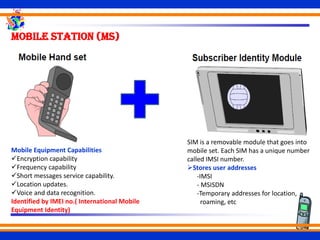
Mobile station (MS)
SIM is a removable module that goes into
mobile set. Each SIM has a unique number
called IMSI number.
Stores user addresses
-IMSI
- MSISDN
-Temporary addresses for location,
roaming, etc
Mobile Equipment Capabilities
Encryption capability
Frequency capability
Short messages service capability.
Location updates.
Voice and data recognition.
Identified by IMEI no.( International Mobile
Equipment Identity)
The GSM technology
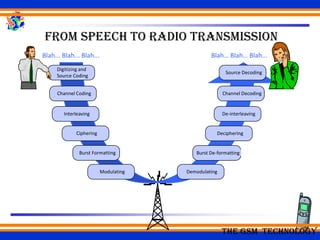
From Speech to Radio Transmission
Blah… Blah… Blah...
Blah... Blah... Blah...
Digitizing and
Source Coding
Channel Coding
Interleaving
Ciphering
Burst Formatting
Modulating Demodulating
Burst De-formatting
Deciphering
De-interleaving
Channel Decoding
Source Decoding
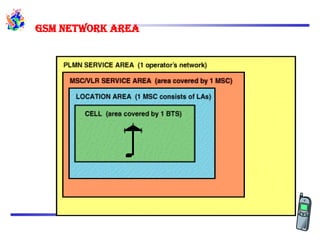
Gsm network area
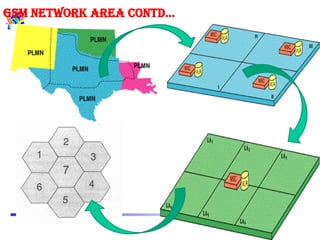
Gsm network area contd…
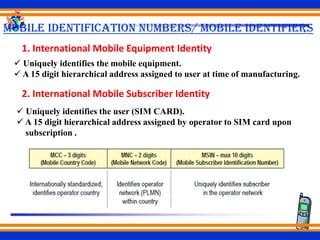
Mobile Identification numbers/ mobile identifiers
1. International Mobile Equipment Identity
 Uniquely identifies the mobile equipment.
 A 15 digit hierarchical address assigned to user at time of manufacturing.
2. International Mobile Subscriber Identity
 Uniquely identifies the user (SIM CARD).
 A 15 digit hierarchical address assigned by operator to SIM card upon
subscription .
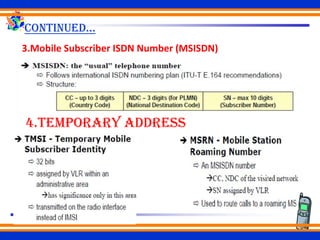
continued…
3.Mobile Subscriber ISDN Number (MSISDN)
4.TEMPORARY ADDRESS
• Call Originating from MS
• Call termination to MS
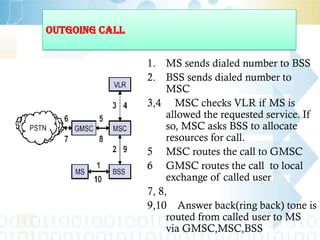
OUTGOING CALL
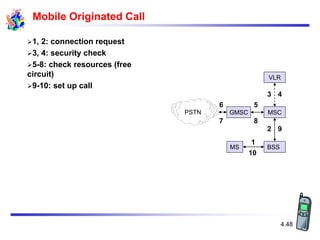
1. MS sends dialed number to BSS
2. BSS sends dialed number to
MSC
3,4 MSC checks VLR if MS is
allowed the requested service. If
so, MSC asks BSS to allocate
resources for call.
5 MSC routes the call to GMSC
6 GMSC routes the call to local
exchange of called user
7, 8,
9,10 Answer back(ring back) tone is
routed from called user to MS
via GMSC,MSC,BSS
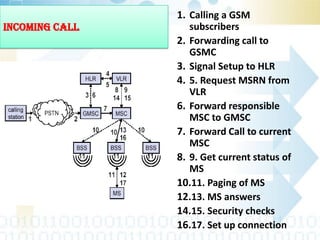
INCOMING CALL
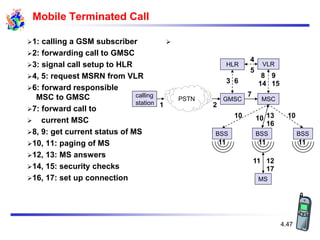
1. Calling a GSM
subscribers
2. Forwarding call to
GSMC
3. Signal Setup to HLR
4. 5. Request MSRN from
VLR
6. Forward responsible
MSC to GMSC
7. Forward Call to current
MSC
8. 9. Get current status of
MS
10.11. Paging of MS
12.13. MS answers
14.15. Security checks
16.17. Set up connection
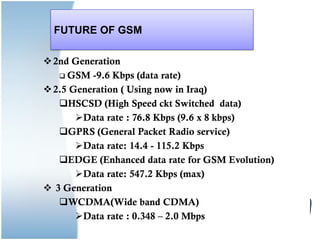
FUTURE OF GSM
2nd Generation
 GSM -9.6 Kbps (data rate)
2.5 Generation ( Using now in Iraq)
HSCSD (High Speed ckt Switched data)
Data rate : 76.8 Kbps (9.6 x 8 kbps)
GPRS (General Packet Radio service)
Data rate: 14.4 - 115.2 Kbps
EDGE (Enhanced data rate for GSM Evolution)
Data rate: 547.2 Kbps (max)
 3 Generation
WCDMA(Wide band CDMA)
Data rate : 0.348 – 2.0 Mbps
4.30
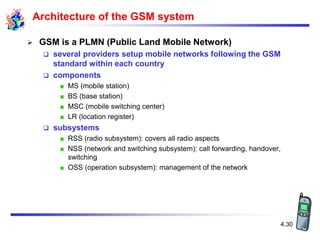
Architecture of the GSM system
 GSM is a PLMN (Public Land Mobile Network)
 several providers setup mobile networks following the GSM
standard within each country
 components
MS (mobile station)
BS (base station)
MSC (mobile switching center)
LR (location register)
 subsystems
RSS (radio subsystem): covers all radio aspects
NSS (network and switching subsystem): call forwarding, handover,
switching
OSS (operation subsystem): management of the network
4.31
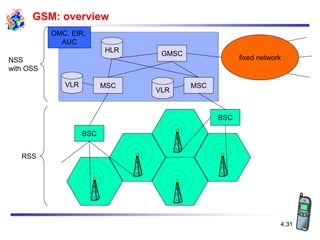
GSM: overview
fixed network
BSC
BSC
MSC MSC
GMSC
OMC, EIR,
AUC
VLR
HLR
NSS
with OSS
RSS
VLR
4.32
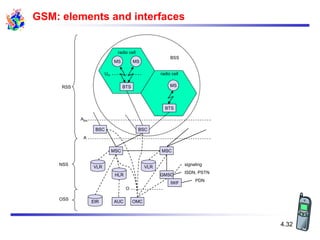
GSM: elements and interfaces
NSS
MS MS
BTS
BSC
GMSC
IWF
OMC
BTS
BSC
MSC MSC
Abis
Um
EIR
HLR
VLR VLR
A
BSS
PDN
ISDN, PSTN
RSS
radio cell
radio cell
MS
AUC
OSS
signaling
O
4.33
Um
Abis
A
BSS
radio
subsystem
MS MS
BTS
BSC
BTS
BTS
BSC
BTS
network and
switching subsystem
MSC
MSC
fixed
partner networks
IWF
ISDN
PSTN
PSPDN
CSPDN
SS7
EIR
HLR
VLR
ISDN
PSTN
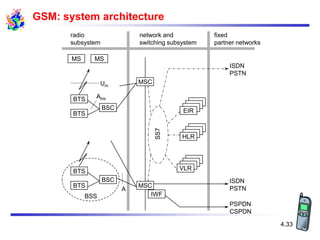
GSM: system architecture
4.34
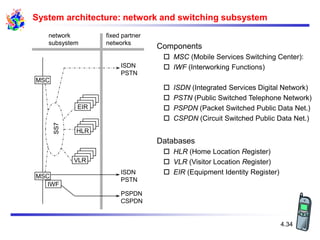
System architecture: network and switching subsystem
Components
 MSC (Mobile Services Switching Center):
 IWF (Interworking Functions)
 ISDN (Integrated Services Digital Network)
 PSTN (Public Switched Telephone Network)
 PSPDN (Packet Switched Public Data Net.)
 CSPDN (Circuit Switched Public Data Net.)
Databases
 HLR (Home Location Register)
 VLR (Visitor Location Register)
 EIR (Equipment Identity Register)
network
subsystem
MSC
MSC
fixed partner
networks
IWF
ISDN
PSTN
PSPDN
CSPDN
SS7
EIR
HLR
VLR
ISDN
PSTN
4.35
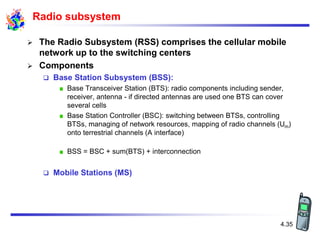
Radio subsystem
 The Radio Subsystem (RSS) comprises the cellular mobile
network up to the switching centers
 Components
 Base Station Subsystem (BSS):
Base Transceiver Station (BTS): radio components including sender,
receiver, antenna - if directed antennas are used one BTS can cover
several cells
Base Station Controller (BSC): switching between BTSs, controlling
BTSs, managing of network resources, mapping of radio channels (Um)
onto terrestrial channels (A interface)
BSS = BSC + sum(BTS) + interconnection
 Mobile Stations (MS)
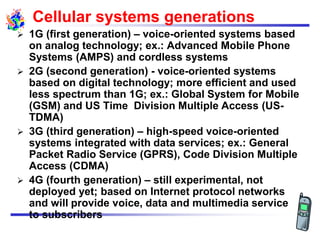
Cellular systems generations
 1G (first generation) – voice-oriented systems based
on analog technology; ex.: Advanced Mobile Phone
Systems (AMPS) and cordless systems
 2G (second generation) - voice-oriented systems
based on digital technology; more efficient and used
less spectrum than 1G; ex.: Global System for Mobile
(GSM) and US Time Division Multiple Access (US-
TDMA)
 3G (third generation) – high-speed voice-oriented
systems integrated with data services; ex.: General
Packet Radio Service (GPRS), Code Division Multiple
Access (CDMA)
 4G (fourth generation) – still experimental, not
deployed yet; based on Internet protocol networks
and will provide voice, data and multimedia service
to subscribers
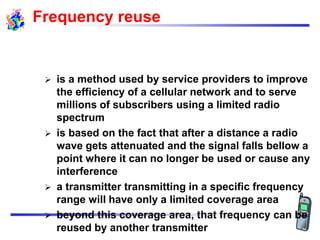
Frequency reuse
 is a method used by service providers to improve
the efficiency of a cellular network and to serve
millions of subscribers using a limited radio
spectrum
 is based on the fact that after a distance a radio
wave gets attenuated and the signal falls bellow a
point where it can no longer be used or cause any
interference
 a transmitter transmitting in a specific frequency
range will have only a limited coverage area
 beyond this coverage area, that frequency can be
reused by another transmitter
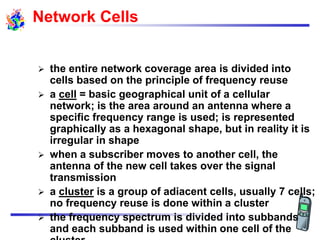
Network Cells
 the entire network coverage area is divided into
cells based on the principle of frequency reuse
 a cell = basic geographical unit of a cellular
network; is the area around an antenna where a
specific frequency range is used; is represented
graphically as a hexagonal shape, but in reality it is
irregular in shape
 when a subscriber moves to another cell, the
antenna of the new cell takes over the signal
transmission
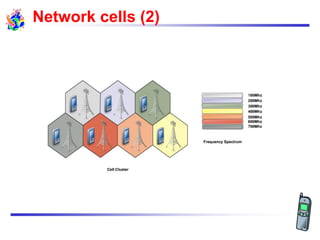
 a cluster is a group of adiacent cells, usually 7 cells;
no frequency reuse is done within a cluster
 the frequency spectrum is divided into subbands
and each subband is used within one cell of the
Network cells (2)
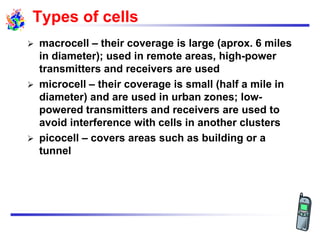
Types of cells
 macrocell – their coverage is large (aprox. 6 miles
in diameter); used in remote areas, high-power
transmitters and receivers are used
 microcell – their coverage is small (half a mile in
diameter) and are used in urban zones; low-
powered transmitters and receivers are used to
avoid interference with cells in another clusters
 picocell – covers areas such as building or a
tunnel
4.41
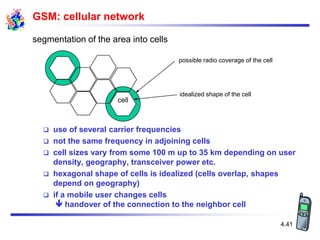
possible radio coverage of the cell
idealized shape of the cell
cell
segmentation of the area into cells
GSM: cellular network
 use of several carrier frequencies
 not the same frequency in adjoining cells
 cell sizes vary from some 100 m up to 35 km depending on user
density, geography, transceiver power etc.
 hexagonal shape of cells is idealized (cells overlap, shapes
depend on geography)
 if a mobile user changes cells
 handover of the connection to the neighbor cell
4.42
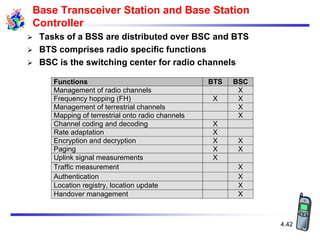
Base Transceiver Station and Base Station
Controller
 Tasks of a BSS are distributed over BSC and BTS
 BTS comprises radio specific functions
 BSC is the switching center for radio channels
Functions BTS BSC
Management of radio channels X
Frequency hopping (FH) X X
Management of terrestrial channels X
Mapping of terrestrial onto radio channels X
Channel coding and decoding X
Rate adaptation X
Encryption and decryption X X
Paging X X
Uplink signal measurements X
Traffic measurement X
Authentication X
Location registry, location update X
Handover management X
4.43
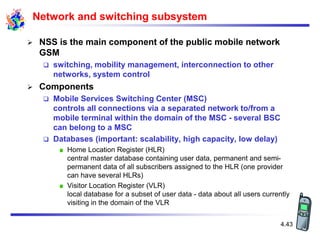
Network and switching subsystem
 NSS is the main component of the public mobile network
GSM
 switching, mobility management, interconnection to other
networks, system control
 Components
 Mobile Services Switching Center (MSC)
controls all connections via a separated network to/from a
mobile terminal within the domain of the MSC - several BSC
can belong to a MSC
 Databases (important: scalability, high capacity, low delay)
Home Location Register (HLR)
central master database containing user data, permanent and semi-
permanent data of all subscribers assigned to the HLR (one provider
can have several HLRs)
Visitor Location Register (VLR)
local database for a subset of user data - data about all users currently
visiting in the domain of the VLR
4.44
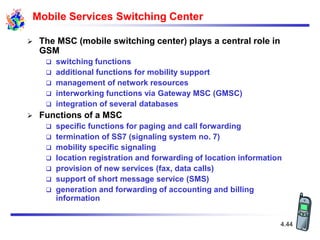
Mobile Services Switching Center
 The MSC (mobile switching center) plays a central role in
GSM
 switching functions
 additional functions for mobility support
 management of network resources
 interworking functions via Gateway MSC (GMSC)
 integration of several databases
 Functions of a MSC
 specific functions for paging and call forwarding
 termination of SS7 (signaling system no. 7)
 mobility specific signaling
 location registration and forwarding of location information
 provision of new services (fax, data calls)
 support of short message service (SMS)
 generation and forwarding of accounting and billing
information
4.45
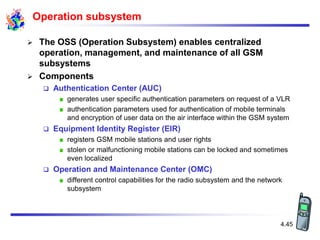
Operation subsystem
 The OSS (Operation Subsystem) enables centralized
operation, management, and maintenance of all GSM
subsystems
 Components
 Authentication Center (AUC)
generates user specific authentication parameters on request of a VLR
authentication parameters used for authentication of mobile terminals
and encryption of user data on the air interface within the GSM system
 Equipment Identity Register (EIR)
registers GSM mobile stations and user rights
stolen or malfunctioning mobile stations can be locked and sometimes
even localized
 Operation and Maintenance Center (OMC)
different control capabilities for the radio subsystem and the network
subsystem
4.46
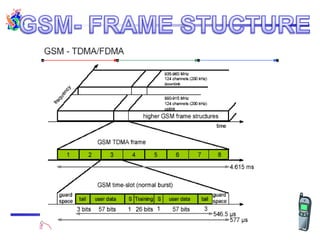
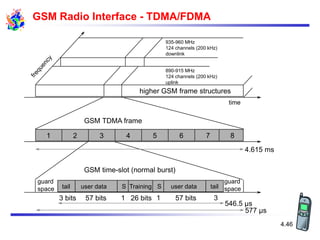
1 2 3 4 5 6 7 8
higher GSM frame structures
935-960 MHz
124 channels (200 kHz)
downlink
890-915 MHz
124 channels (200 kHz)
uplink
time
GSM TDMA frame
GSM time-slot (normal burst)
4.615 ms
546.5 µs
577 µs
tail user data Training
S
guard
space S user data tail
guard
space
3 bits 57 bits 26 bits 57 bits
1 1 3
GSM Radio Interface - TDMA/FDMA
4.47
Mobile Terminated Call
PSTN
calling
station
GMSC
HLR VLR
BSS
BSS
BSS
MSC
MS
1 2
3
4
5
6
7
8 9
10
11 12
13
16
10 10
11 11 11
14 15
17
1: calling a GSM subscriber
2: forwarding call to GMSC
3: signal call setup to HLR
4, 5: request MSRN from VLR
6: forward responsible
MSC to GMSC
7: forward call to
 current MSC
8, 9: get current status of MS
10, 11: paging of MS
12, 13: MS answers
14, 15: security checks
16, 17: set up connection

4.48
Mobile Originated Call
PSTN GMSC
VLR
BSS
MSC
MS
1
2
6 5
3 4
9
10
7 8
1, 2: connection request
3, 4: security check
5-8: check resources (free
circuit)
9-10: set up call
Other cellular concepts
 handover = moving a call from one zone (from the
transmitter-receiver from one zone) to another
zone due to subscriber‟s mobility
 roaming = allowing the subscriber to
send/receive calls outside the service provider‟s
coverage area
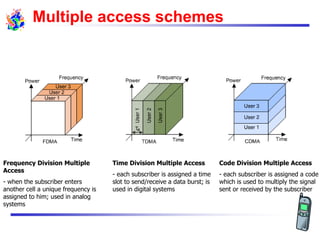
Multiple access schemes
Frequency Division Multiple
Access
- when the subscriber enters
another cell a unique frequency is
assigned to him; used in analog
systems
Time Division Multiple Access
- each subscriber is assigned a time
slot to send/receive a data burst; is
used in digital systems
Code Division Multiple Access
- each subscriber is assigned a code
which is used to multiply the signal
sent or received by the subscriber
The control channel
 this channel is used by a cellular phone to
indicate its presence before a frequency/time
slot/code is allocated to him
Cellular services
 voice communication
 Short Messaging Service (SMS)
 Multimedia Messaging Service (MMS)
 Global Positioning System (GPS)
 Wireless Application Protocol (WAP) – to access
the Internet
4.53
Handoffs
 GSM uses mobile assisted hand-off (MAHO). Signal
strength measurements are sent to the BS from the mobile.
 The MSC decides when to do a handoff and it informs the
new BS and the mobile.
 When a mobile switches to a new BS it sends a series of
shortened bursts to adjust its timing (giving the bS time to
calculate it and send it) and allow the new BS to
synchronize its receiver to the arrival time of the messages
4.54
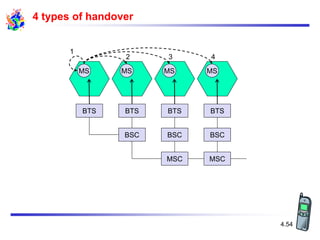
4 types of handover
MSC MSC
BSC BSC
BSC
BTS BTS BTS
BTS
MS MS MS MS
1
2 3 4
4.55
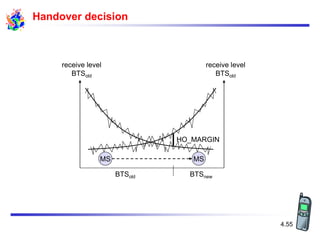
Handover decision
receive level
BTSold
receive level
BTSold
MS MS
HO_MARGIN
BTSold BTSnew

GSM lecture mobile package telecommunication .pdf

  • 1.
    The GSM technology GLOBALSYSTEM FOR MOBILE COMMUNICATION
  • 2.
    1946 • First CarPhone by St. Louis. 1973 • First hand-held mobile phone by Martin Cooper. 1980’s • 1G Cellular technology launched. • TACS , NMT , AMPS etc. analog systems launched in American & UK countries. 1990’s • Digital 2G Cellular technology launched. • GSM , CDMA etc. launched with GSM being the standard. HISTORY
  • 3.
    1G Analog in nature. Onlyspeech , no data services.. International Roaming not possible.. 2G Digital in nature. Speech + Data services. ( SMS Possible) Globalised.. International roaming possible.. In 2001 the first commercial launch of 3G was done in Japan. With 3G following services are available :  Video Conferencing  online games  net surfing..
  • 4.
    introduction Global System forMobile (GSM) is a second generation cellular standard developed to cater voice services and data delivery using digital modulation. GSM Services TELE SERVICES : Includes mobile phones, emergency calling etc. DATA SERVICES : Includes SMS (Short message service), fax, voicemail, electronic mail. SUPPLYMENTARY SERVICES : I/C & O/G calls, call forwarding, call hold, call waiting, conference, etc.
  • 5.
     Communication – mobile,wireless communication, support for voice and data services  Total mobility – international access, chip-card enables use of access points of different providers.  Worldwide connectivity – one number, the network handles every location.  High capacity – better frequency efficiency, smaller cells, more customers per cell.  High transmission quality – high audio quality and reliability for wireless, uninterrupted phone calls at higher speeds (e.g., from cars, trains).  Security functions – access control, authentication via chip-card and PIN Advantages of GSM
  • 6.
    GSM Specifications  RFSpectrum GSM 900 Mobile to BTS (uplink): 890-915 MHz BTS to Mobile(downlink):935-960 MHz Bandwidth : 2* 25 MHz GSM 1800 Mobile to BTS (uplink): 1710-1785 MHz BTS to Mobile(downlink) 1805-1880 MHz Bandwidth : 2* 75 MHz  Carrier Separation : 200 KHz  Duplex Distance : 45 MHz  No. of RF carriers : 124  Access Method : TDMA/FDMA  Modulation Method : GMSK  Modulation data rate : 270.833 Kbps
  • 7.
    GSM architecture  Networksub-system  Radio sub-system  Operation and maintenance sub- system
  • 9.
    Network subsystem Performs callprocessing and subscriber related functions. It includes: MSC: Mobile Switching Centre HLR: Home Location Register VLR : Visitor Location Register AuC: Authentication Centre EIR: Equipment Identity Register GMSC:Gateway MSC.
  • 10.
     It isincluded in the GSM system for call-switching. Its overall purpose is the same as that of any telephone exchange. The functions carried out by the MSC are listed below:  Call Processing Includes control of data/voice call setup, inter-BSS and inter-MSC handovers and control of mobility management (subscriber validation and location).  Operations and Maintenance Support Includes database management, traffic metering and measurement, and a man–machine interface.  Internetwork Interworking Manages the interface between the GSM network and the PSTN. When the MSC provides the interface with the other networks in the GSM network it is known as a Gateway MSC. Network subsystem Mobile switching centre
  • 11.
    Reference database forsubscriber parameters.  Subscriber ID (IMSI & MSISDN).  Current location of subscriber.  Subscriber status (registered/unregistered)  Authentication key and AUC functionality.  Mobile subscriber roaming number. Home location register Network subsystem
  • 12.
     It provideslocal database for the subscribers wherever they are physically located within a PLMN, this may or may not be the “home” system. It is a local database and contains copy of most of the data stored in HLR. It contains:  Mobile status(busy/free/no ans)  Location area identity(LAI)  TMSI AND MSRN . Network subsystem Visitor location register
  • 13.
     It providesauthentication and encryption parameters for verification of subscriber identity.  It ensures confidentiality of each cell.  It protects network operators from frauds in today's cellular world.  It is associated with HLR.  The authentication process will usually take place each time the subscriber “initializes” on the system. Authentication centre Network subsystem
  • 14.
     The EIRcontains a centralized database for validating the International Mobile Equipment Identity (IMEI).  It contains three lists:  White List Contains those IMEIs which are known to have been assigned to valid MS equipment.  Black List  Contains IMEIs of MS which have been reported stolen or which are to be denied service for some other reason.  Grey List Contains IMEIs of MS which have problems (for example, faulty software). These are not, however, sufficiently significant to warrant a „„black listing”. EQUIPMENT IDENTITY REGISTER Network subsystem
  • 15.
    radio subsystem  Managementof radio network and is controlled by a MSC . One MSC controls many radio subsystem. It consists of :  BSC: Base station controller.  BTS: Base transceiver station.
  • 16.
    base station controller It is connected to MSC.  Controls one or more BTS.  Switches traffic and signaling to/from BTSs and MSC.  Connects terrestrial circuits and channels on air interface.  Controls handover performed by BTS.  Frequency allocation and power control. RADIO subsystem
  • 17.
    base transceiver station Maintains air interface and minimize transmission problems.  Paging information.  Radio level power control.  BTS identification.  Ciphering  Speech processing. RADIO subsystem
  • 18.
     Dynamic monitoringand controlling of network.  operation and maintenance data function.  Configuration management.  Fault report and alarm handling.  Performance supervision.  Storage of software and data.  Stores data for minimum one year. OPERATION AND MAINTENANCE SUBSYSTEM
  • 19.
    Mobile station (MS) SIMis a removable module that goes into mobile set. Each SIM has a unique number called IMSI number. Stores user addresses -IMSI - MSISDN -Temporary addresses for location, roaming, etc Mobile Equipment Capabilities Encryption capability Frequency capability Short messages service capability. Location updates. Voice and data recognition. Identified by IMEI no.( International Mobile Equipment Identity)
  • 20.
    The GSM technology FromSpeech to Radio Transmission Blah… Blah… Blah... Blah... Blah... Blah... Digitizing and Source Coding Channel Coding Interleaving Ciphering Burst Formatting Modulating Demodulating Burst De-formatting Deciphering De-interleaving Channel Decoding Source Decoding
  • 22.
  • 23.
  • 24.
    Mobile Identification numbers/mobile identifiers 1. International Mobile Equipment Identity  Uniquely identifies the mobile equipment.  A 15 digit hierarchical address assigned to user at time of manufacturing. 2. International Mobile Subscriber Identity  Uniquely identifies the user (SIM CARD).  A 15 digit hierarchical address assigned by operator to SIM card upon subscription .
  • 25.
    continued… 3.Mobile Subscriber ISDNNumber (MSISDN) 4.TEMPORARY ADDRESS
  • 26.
    • Call Originatingfrom MS • Call termination to MS
  • 27.
    OUTGOING CALL 1. MSsends dialed number to BSS 2. BSS sends dialed number to MSC 3,4 MSC checks VLR if MS is allowed the requested service. If so, MSC asks BSS to allocate resources for call. 5 MSC routes the call to GMSC 6 GMSC routes the call to local exchange of called user 7, 8, 9,10 Answer back(ring back) tone is routed from called user to MS via GMSC,MSC,BSS
  • 28.
    INCOMING CALL 1. Callinga GSM subscribers 2. Forwarding call to GSMC 3. Signal Setup to HLR 4. 5. Request MSRN from VLR 6. Forward responsible MSC to GMSC 7. Forward Call to current MSC 8. 9. Get current status of MS 10.11. Paging of MS 12.13. MS answers 14.15. Security checks 16.17. Set up connection
  • 29.
    FUTURE OF GSM 2ndGeneration  GSM -9.6 Kbps (data rate) 2.5 Generation ( Using now in Iraq) HSCSD (High Speed ckt Switched data) Data rate : 76.8 Kbps (9.6 x 8 kbps) GPRS (General Packet Radio service) Data rate: 14.4 - 115.2 Kbps EDGE (Enhanced data rate for GSM Evolution) Data rate: 547.2 Kbps (max)  3 Generation WCDMA(Wide band CDMA) Data rate : 0.348 – 2.0 Mbps
  • 30.
    4.30 Architecture of theGSM system  GSM is a PLMN (Public Land Mobile Network)  several providers setup mobile networks following the GSM standard within each country  components MS (mobile station) BS (base station) MSC (mobile switching center) LR (location register)  subsystems RSS (radio subsystem): covers all radio aspects NSS (network and switching subsystem): call forwarding, handover, switching OSS (operation subsystem): management of the network
  • 31.
    4.31 GSM: overview fixed network BSC BSC MSCMSC GMSC OMC, EIR, AUC VLR HLR NSS with OSS RSS VLR
  • 32.
    4.32 GSM: elements andinterfaces NSS MS MS BTS BSC GMSC IWF OMC BTS BSC MSC MSC Abis Um EIR HLR VLR VLR A BSS PDN ISDN, PSTN RSS radio cell radio cell MS AUC OSS signaling O
  • 33.
    4.33 Um Abis A BSS radio subsystem MS MS BTS BSC BTS BTS BSC BTS network and switchingsubsystem MSC MSC fixed partner networks IWF ISDN PSTN PSPDN CSPDN SS7 EIR HLR VLR ISDN PSTN GSM: system architecture
  • 34.
    4.34 System architecture: networkand switching subsystem Components  MSC (Mobile Services Switching Center):  IWF (Interworking Functions)  ISDN (Integrated Services Digital Network)  PSTN (Public Switched Telephone Network)  PSPDN (Packet Switched Public Data Net.)  CSPDN (Circuit Switched Public Data Net.) Databases  HLR (Home Location Register)  VLR (Visitor Location Register)  EIR (Equipment Identity Register) network subsystem MSC MSC fixed partner networks IWF ISDN PSTN PSPDN CSPDN SS7 EIR HLR VLR ISDN PSTN
  • 35.
    4.35 Radio subsystem  TheRadio Subsystem (RSS) comprises the cellular mobile network up to the switching centers  Components  Base Station Subsystem (BSS): Base Transceiver Station (BTS): radio components including sender, receiver, antenna - if directed antennas are used one BTS can cover several cells Base Station Controller (BSC): switching between BTSs, controlling BTSs, managing of network resources, mapping of radio channels (Um) onto terrestrial channels (A interface) BSS = BSC + sum(BTS) + interconnection  Mobile Stations (MS)
  • 36.
    Cellular systems generations 1G (first generation) – voice-oriented systems based on analog technology; ex.: Advanced Mobile Phone Systems (AMPS) and cordless systems  2G (second generation) - voice-oriented systems based on digital technology; more efficient and used less spectrum than 1G; ex.: Global System for Mobile (GSM) and US Time Division Multiple Access (US- TDMA)  3G (third generation) – high-speed voice-oriented systems integrated with data services; ex.: General Packet Radio Service (GPRS), Code Division Multiple Access (CDMA)  4G (fourth generation) – still experimental, not deployed yet; based on Internet protocol networks and will provide voice, data and multimedia service to subscribers
  • 37.
    Frequency reuse  isa method used by service providers to improve the efficiency of a cellular network and to serve millions of subscribers using a limited radio spectrum  is based on the fact that after a distance a radio wave gets attenuated and the signal falls bellow a point where it can no longer be used or cause any interference  a transmitter transmitting in a specific frequency range will have only a limited coverage area  beyond this coverage area, that frequency can be reused by another transmitter
  • 38.
    Network Cells  theentire network coverage area is divided into cells based on the principle of frequency reuse  a cell = basic geographical unit of a cellular network; is the area around an antenna where a specific frequency range is used; is represented graphically as a hexagonal shape, but in reality it is irregular in shape  when a subscriber moves to another cell, the antenna of the new cell takes over the signal transmission  a cluster is a group of adiacent cells, usually 7 cells; no frequency reuse is done within a cluster  the frequency spectrum is divided into subbands and each subband is used within one cell of the
  • 39.
  • 40.
    Types of cells macrocell – their coverage is large (aprox. 6 miles in diameter); used in remote areas, high-power transmitters and receivers are used  microcell – their coverage is small (half a mile in diameter) and are used in urban zones; low- powered transmitters and receivers are used to avoid interference with cells in another clusters  picocell – covers areas such as building or a tunnel
  • 41.
    4.41 possible radio coverageof the cell idealized shape of the cell cell segmentation of the area into cells GSM: cellular network  use of several carrier frequencies  not the same frequency in adjoining cells  cell sizes vary from some 100 m up to 35 km depending on user density, geography, transceiver power etc.  hexagonal shape of cells is idealized (cells overlap, shapes depend on geography)  if a mobile user changes cells  handover of the connection to the neighbor cell
  • 42.
    4.42 Base Transceiver Stationand Base Station Controller  Tasks of a BSS are distributed over BSC and BTS  BTS comprises radio specific functions  BSC is the switching center for radio channels Functions BTS BSC Management of radio channels X Frequency hopping (FH) X X Management of terrestrial channels X Mapping of terrestrial onto radio channels X Channel coding and decoding X Rate adaptation X Encryption and decryption X X Paging X X Uplink signal measurements X Traffic measurement X Authentication X Location registry, location update X Handover management X
  • 43.
    4.43 Network and switchingsubsystem  NSS is the main component of the public mobile network GSM  switching, mobility management, interconnection to other networks, system control  Components  Mobile Services Switching Center (MSC) controls all connections via a separated network to/from a mobile terminal within the domain of the MSC - several BSC can belong to a MSC  Databases (important: scalability, high capacity, low delay) Home Location Register (HLR) central master database containing user data, permanent and semi- permanent data of all subscribers assigned to the HLR (one provider can have several HLRs) Visitor Location Register (VLR) local database for a subset of user data - data about all users currently visiting in the domain of the VLR
  • 44.
    4.44 Mobile Services SwitchingCenter  The MSC (mobile switching center) plays a central role in GSM  switching functions  additional functions for mobility support  management of network resources  interworking functions via Gateway MSC (GMSC)  integration of several databases  Functions of a MSC  specific functions for paging and call forwarding  termination of SS7 (signaling system no. 7)  mobility specific signaling  location registration and forwarding of location information  provision of new services (fax, data calls)  support of short message service (SMS)  generation and forwarding of accounting and billing information
  • 45.
    4.45 Operation subsystem  TheOSS (Operation Subsystem) enables centralized operation, management, and maintenance of all GSM subsystems  Components  Authentication Center (AUC) generates user specific authentication parameters on request of a VLR authentication parameters used for authentication of mobile terminals and encryption of user data on the air interface within the GSM system  Equipment Identity Register (EIR) registers GSM mobile stations and user rights stolen or malfunctioning mobile stations can be locked and sometimes even localized  Operation and Maintenance Center (OMC) different control capabilities for the radio subsystem and the network subsystem
  • 46.
    4.46 1 2 34 5 6 7 8 higher GSM frame structures 935-960 MHz 124 channels (200 kHz) downlink 890-915 MHz 124 channels (200 kHz) uplink time GSM TDMA frame GSM time-slot (normal burst) 4.615 ms 546.5 µs 577 µs tail user data Training S guard space S user data tail guard space 3 bits 57 bits 26 bits 57 bits 1 1 3 GSM Radio Interface - TDMA/FDMA
  • 47.
    4.47 Mobile Terminated Call PSTN calling station GMSC HLRVLR BSS BSS BSS MSC MS 1 2 3 4 5 6 7 8 9 10 11 12 13 16 10 10 11 11 11 14 15 17 1: calling a GSM subscriber 2: forwarding call to GMSC 3: signal call setup to HLR 4, 5: request MSRN from VLR 6: forward responsible MSC to GMSC 7: forward call to  current MSC 8, 9: get current status of MS 10, 11: paging of MS 12, 13: MS answers 14, 15: security checks 16, 17: set up connection 
  • 48.
    4.48 Mobile Originated Call PSTNGMSC VLR BSS MSC MS 1 2 6 5 3 4 9 10 7 8 1, 2: connection request 3, 4: security check 5-8: check resources (free circuit) 9-10: set up call
  • 49.
    Other cellular concepts handover = moving a call from one zone (from the transmitter-receiver from one zone) to another zone due to subscriber‟s mobility  roaming = allowing the subscriber to send/receive calls outside the service provider‟s coverage area
  • 50.
    Multiple access schemes FrequencyDivision Multiple Access - when the subscriber enters another cell a unique frequency is assigned to him; used in analog systems Time Division Multiple Access - each subscriber is assigned a time slot to send/receive a data burst; is used in digital systems Code Division Multiple Access - each subscriber is assigned a code which is used to multiply the signal sent or received by the subscriber
  • 51.
    The control channel this channel is used by a cellular phone to indicate its presence before a frequency/time slot/code is allocated to him
  • 52.
    Cellular services  voicecommunication  Short Messaging Service (SMS)  Multimedia Messaging Service (MMS)  Global Positioning System (GPS)  Wireless Application Protocol (WAP) – to access the Internet
  • 53.
    4.53 Handoffs  GSM usesmobile assisted hand-off (MAHO). Signal strength measurements are sent to the BS from the mobile.  The MSC decides when to do a handoff and it informs the new BS and the mobile.  When a mobile switches to a new BS it sends a series of shortened bursts to adjust its timing (giving the bS time to calculate it and send it) and allow the new BS to synchronize its receiver to the arrival time of the messages
  • 54.
    4.54 4 types ofhandover MSC MSC BSC BSC BSC BTS BTS BTS BTS MS MS MS MS 1 2 3 4
  • 55.
    4.55 Handover decision receive level BTSold receivelevel BTSold MS MS HO_MARGIN BTSold BTSnew