Nature of public issue
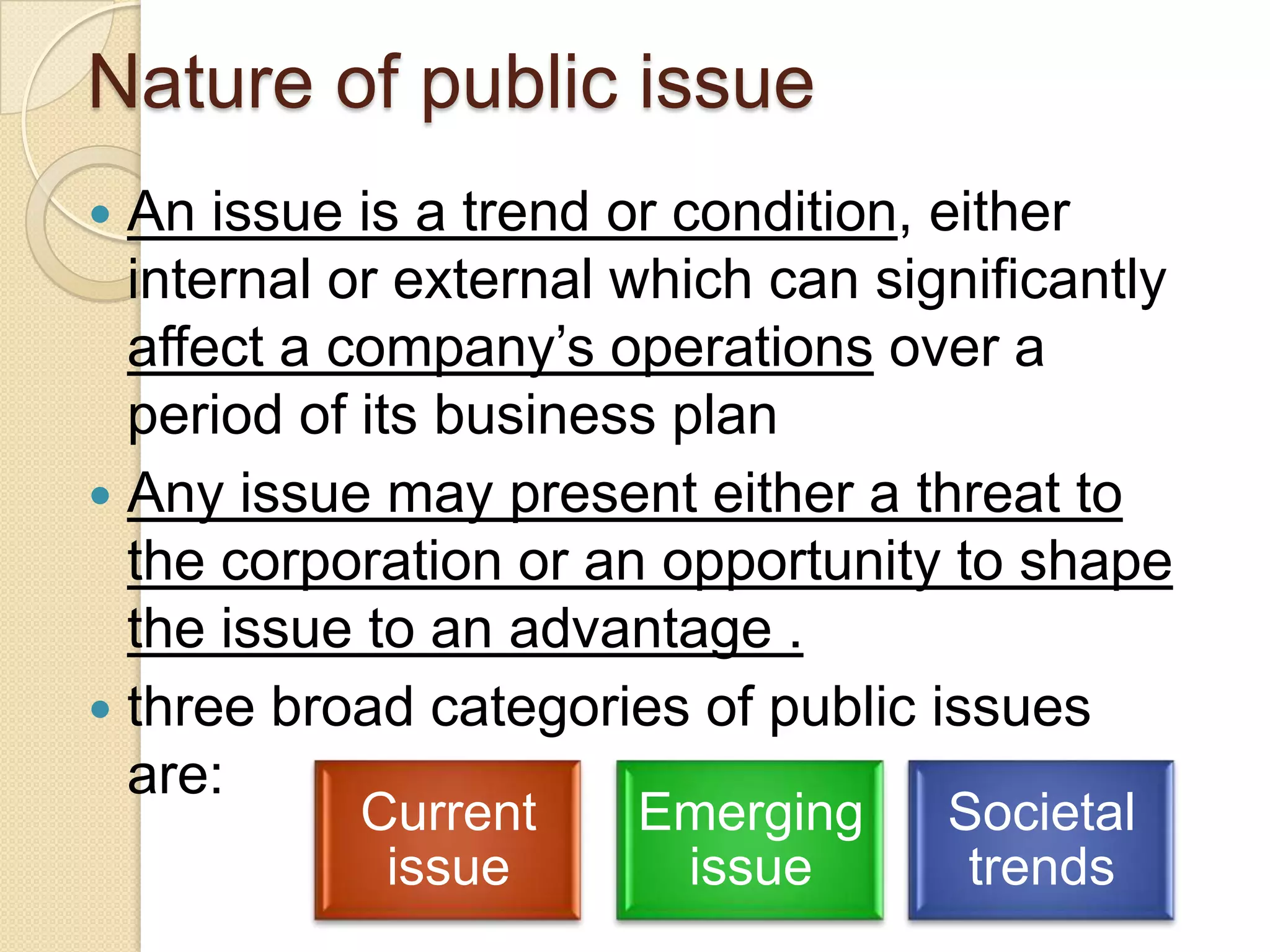
 An issue is a trend or condition, either
internal or external which can significantly
affect a company’s operations over a
period of its business plan
 Any issue may present either a threat to
the corporation or an opportunity to shape
the issue to an advantage .
 three broad categories of public issues
are:
Current
issue
Emerging
issue
Societal
trends
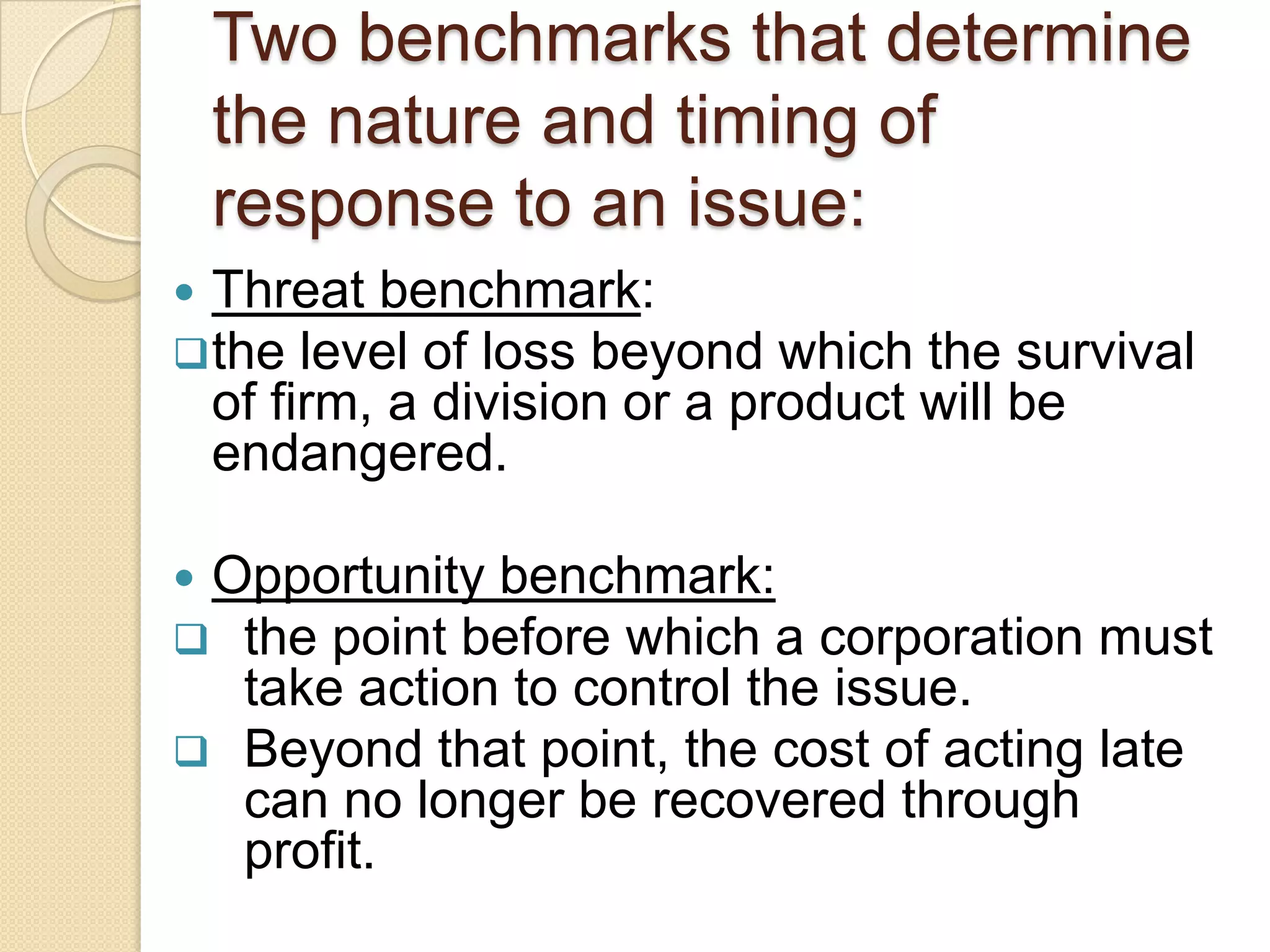
Two benchmarks that determine
the nature and timing of
response to an issue:
 Threat benchmark:
the level of loss beyond which the survival
of firm, a division or a product will be
endangered.
 Opportunity benchmark:
 the point before which a corporation must
take action to control the issue.
 Beyond that point, the cost of acting late
can no longer be recovered through
profit.
Current issue
 Public questions currently being acted
or debated by governmental bodies.
 Such issues generally are subject only
to reactive public affairs responses.
Emerging issues
 Issues of public policy that are likely to
be the subject of legislation in the two-
five years period ahead , but that have
not yet been fully formulated, nor the
position is different
 It is in this evolving stage that issues
can best be influenced or controlled.
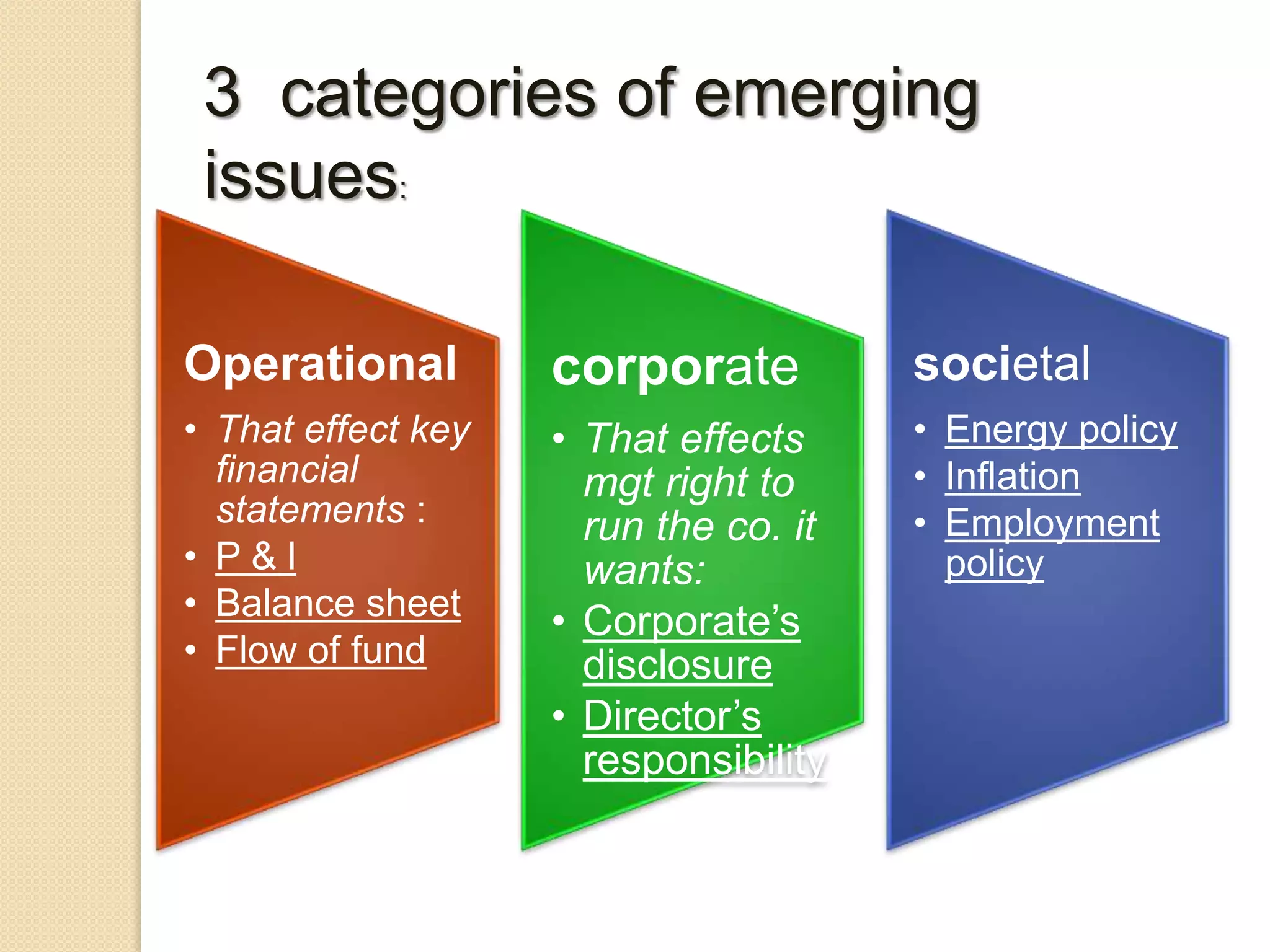
Operational
• That effect key
financial
statements :
• P & l
• Balance sheet
• Flow of fund
corporate
• That effects
mgt right to
run the co. it
wants:
• Corporate’s
disclosure
• Director’s
responsibility
societal
• Energy policy
• Inflation
• Employment
policy
3 categories of emerging
issues:
Societal trends
 These involve changing attitudes and
human behavior and are the most difficult
to influence or reverse.
 They include demographic, social,
resource related and technology related
trends, all of which may have political and
economic effects.
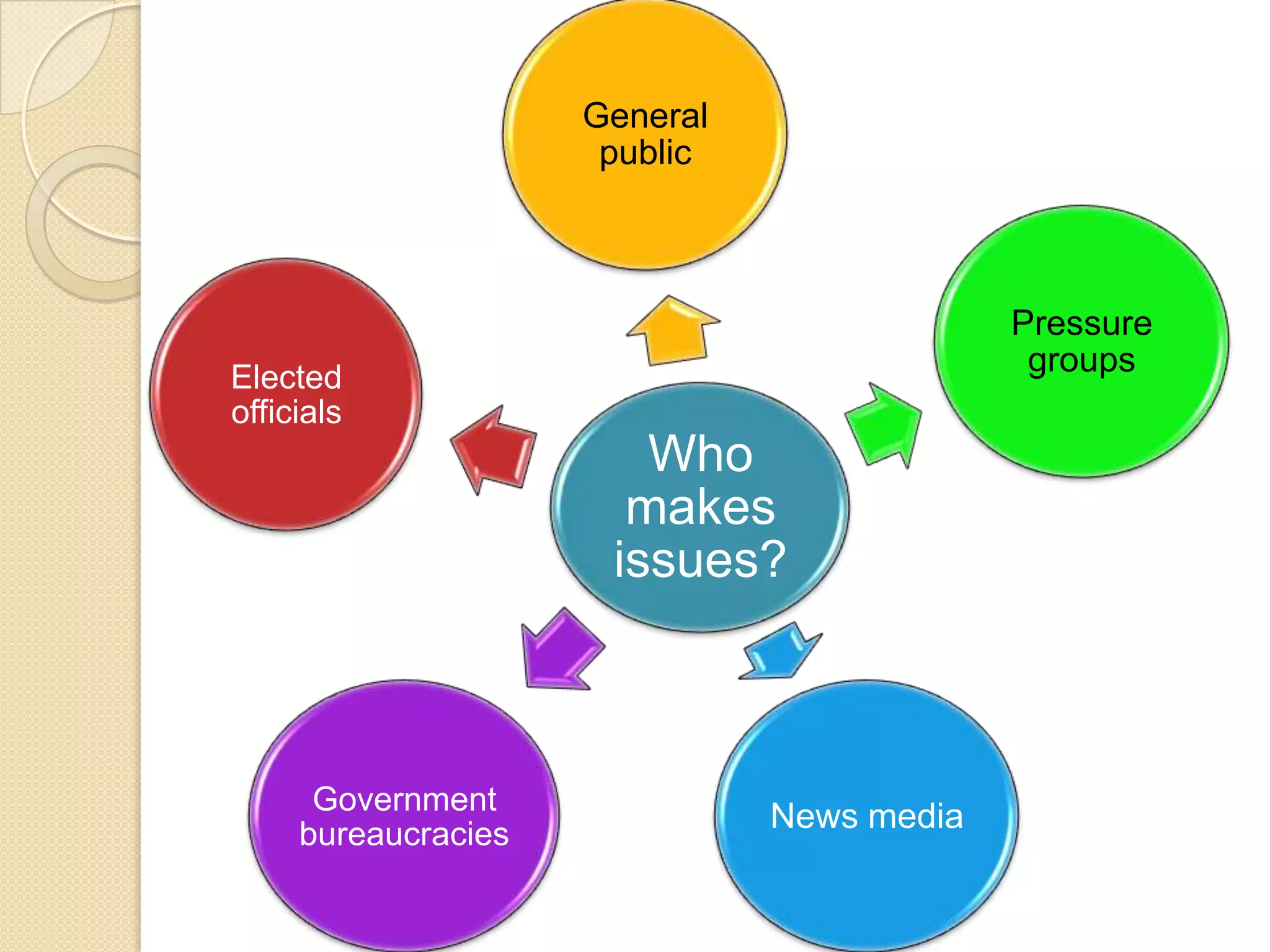
Who
makes
issues?
General
public
Pressure
groups
News mediaGovernment
bureaucracies
Elected
officials
Pressure Groups- These groups form
the most important elements of issues.
The significant factors are its ability to
capture media attention and the alliances
it can make beyond its own membership.
News media- They call attention to
public issues. They may build up
pressures on one side or another, or
drop the issue if interest is minimal.
General Public- The greatest power of
the general public is the passive veto-
the non acceptance of laws and
regulation.
Government Bureaucracies- The
government bodies formulate rules
and regulation which affect the
business in one or the other way.
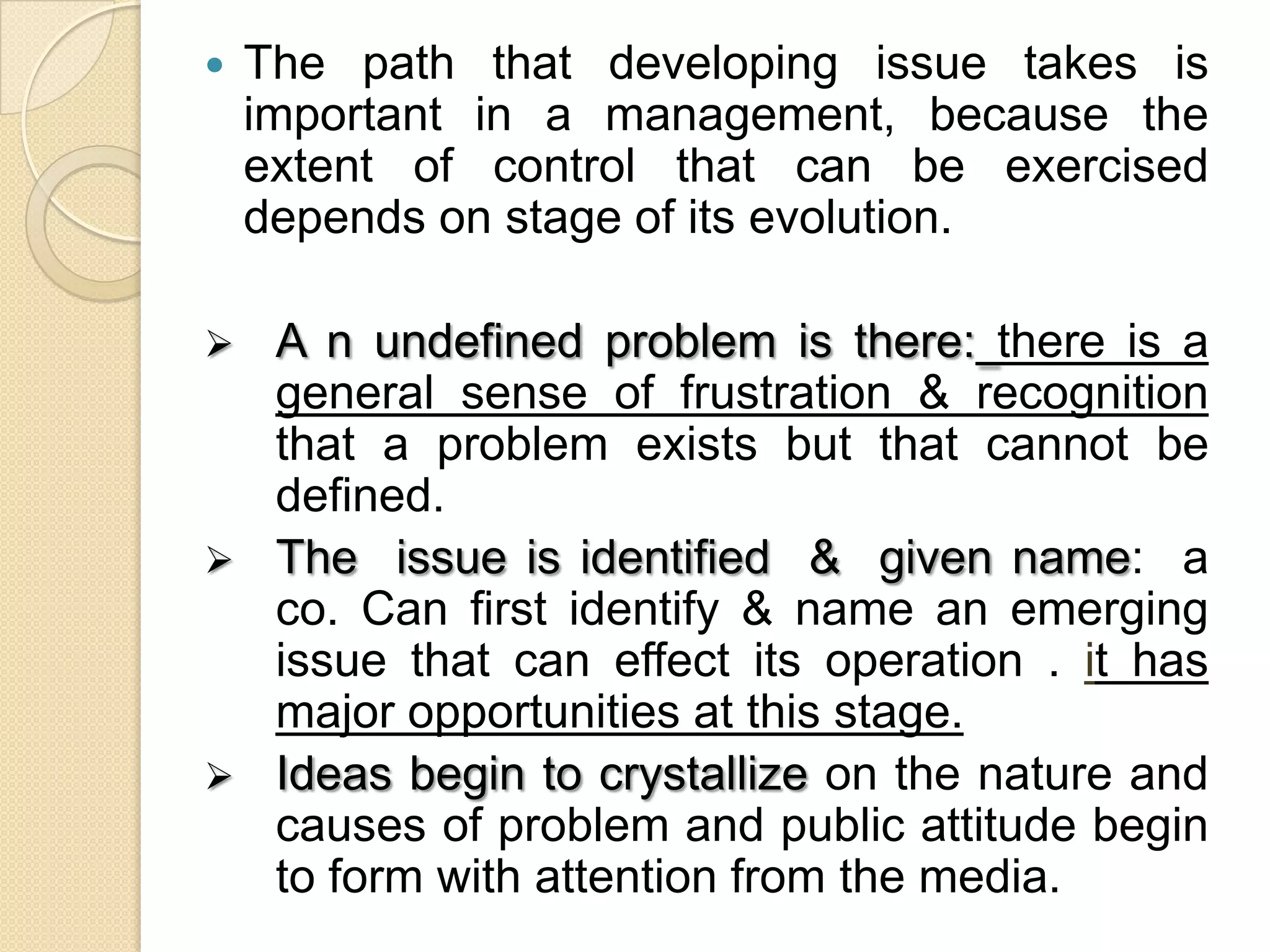
Elected Officials- Often a politician or
local legislator will pick up an issue just
to get attention.
name is given
Crystallisation
of ideas
emerging of
solution
Introduction
of legislation
adjustments
new life cycle
Life cycle
of public
issue
 The path that developing issue takes is
important in a management, because the
extent of control that can be exercised
depends on stage of its evolution.
 A n undefined problem is there: there is a
general sense of frustration & recognition
that a problem exists but that cannot be
defined.
 The issue is identified & given name: a
co. Can first identify & name an emerging
issue that can effect its operation . it has
major opportunities at this stage.
 Ideas begin to crystallize on the nature and
causes of problem and public attitude begin
to form with attention from the media.
 Solutions emerge: on an issue of importance
hundreds of solutions emerge and eventually
reduce to a few.
 Legislation is introduced & enacted: at this
stage a company can only react to some
influence on the legislation may be effected,
but control is no longer possible.
 Adjustments are made ,via regulation or
judicial services: here also the company’s
position is one simply of reacting, although it
may affect the interpretation of regulations.
court action is often an effective issue mgt
technique.
 Formerly non existed or unnoticed problems
often arise after an issue has completed its
life cycle,perpetutaing in a new contact.
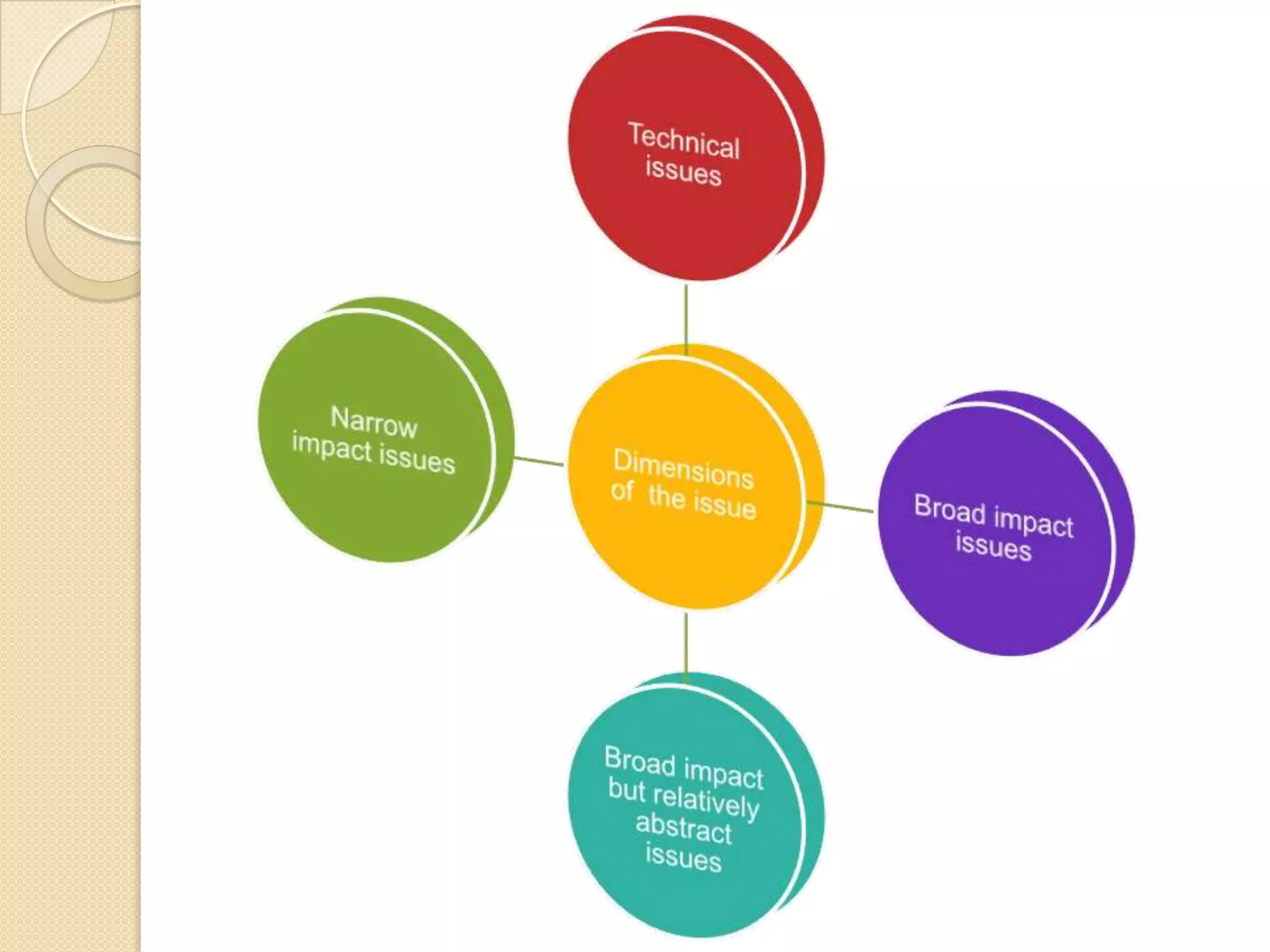
Broad impact but relatively abstract issues-
Fewer people feel these issues directly although
many may be aware that they are potentially
affected.
Narrow impact issues- These generally effect
an identifiable minority or a geographical area.
(tba * example)
Technical issues-These issues are identified
and crystallized by the leadership. For
Example- multinational taxation.
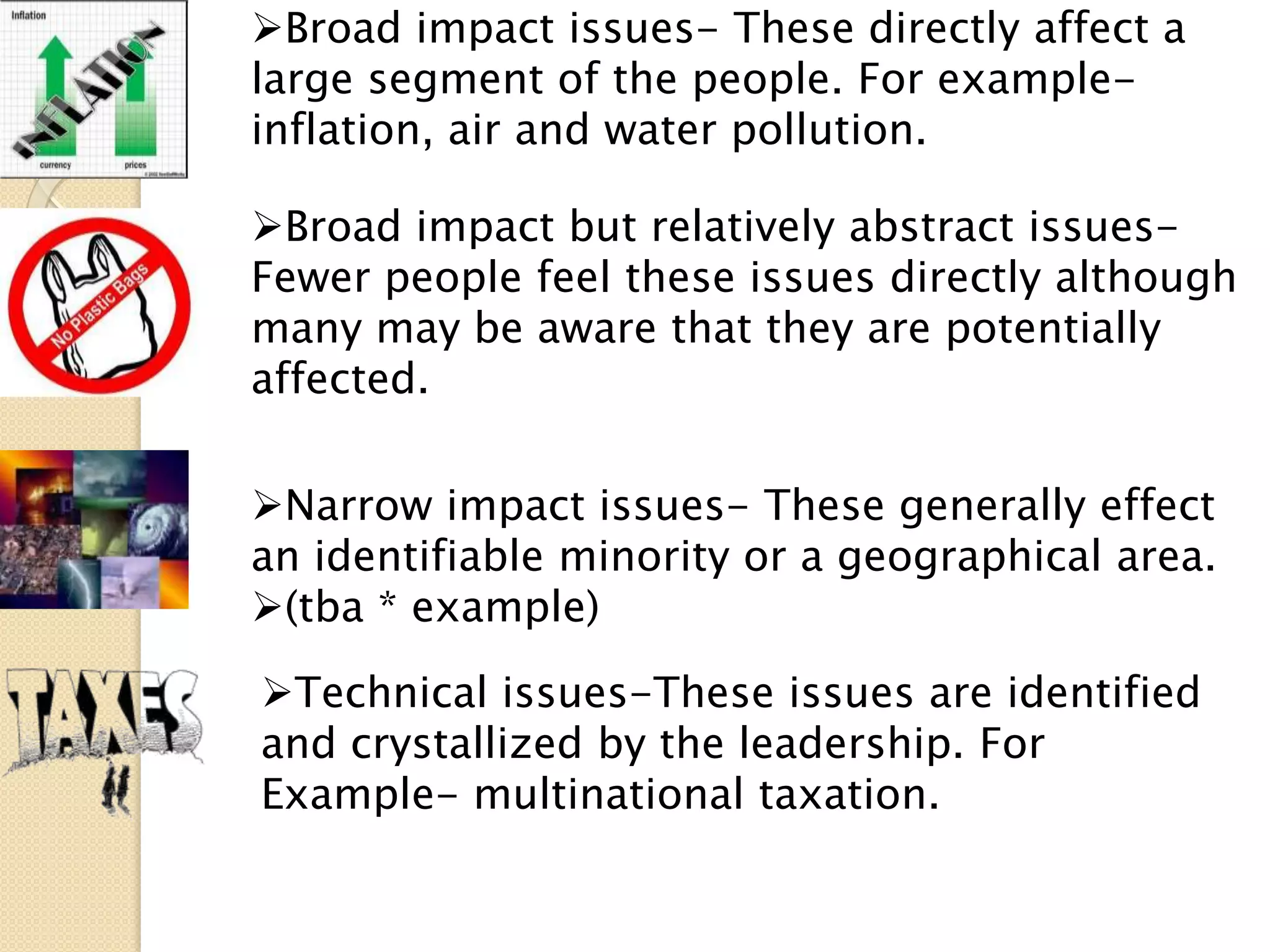
Broad impact issues- These directly affect a
large segment of the people. For example-
inflation, air and water pollution.
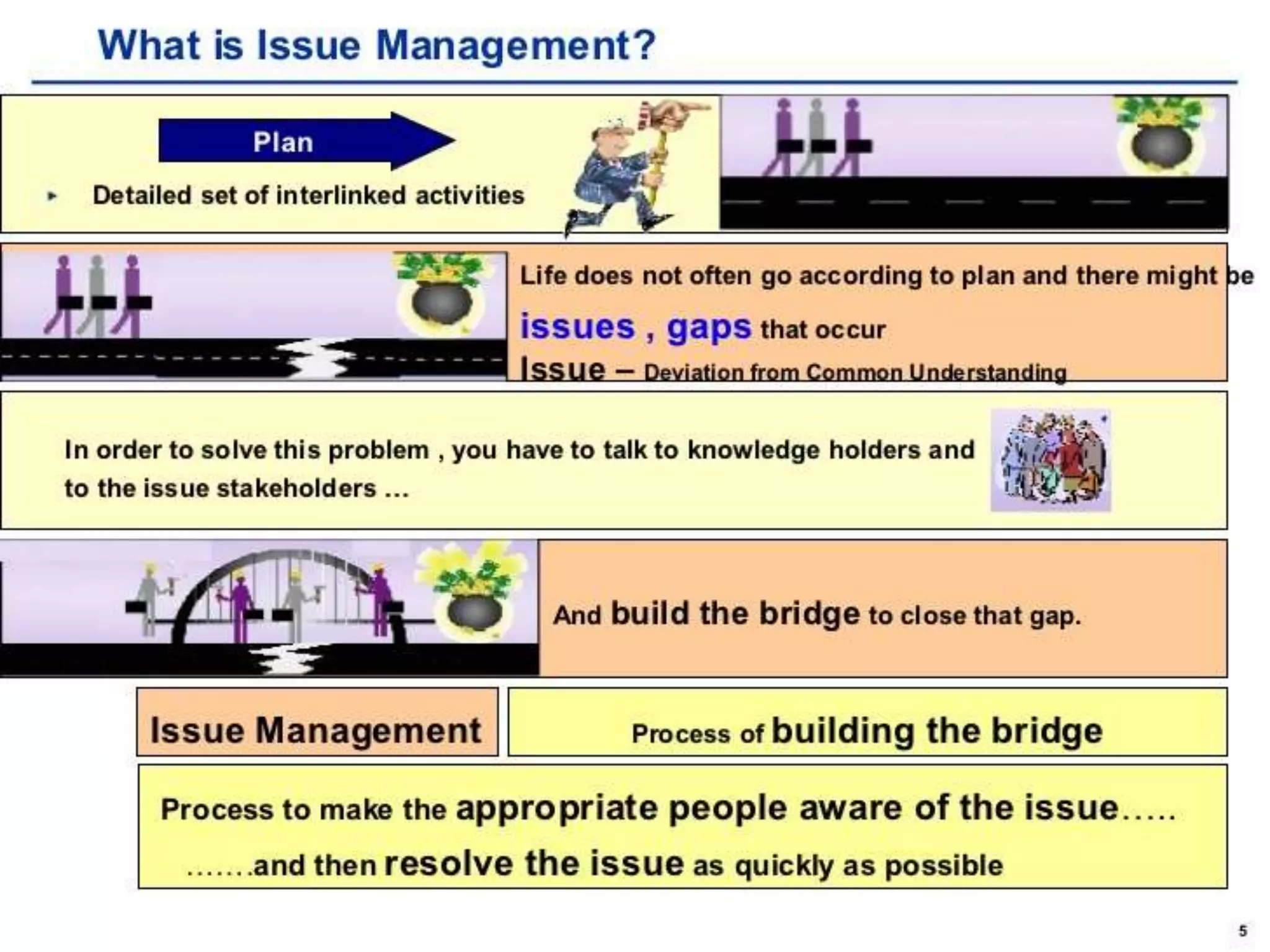
Issue Management
An effective issue management program enables a
company, an association or a group to influence the
development of public issues or trends that may affect it
– rather than merely react to issues after they have
developed
The earlier a company can identify a potential threat, or
opportunity and commit itself to appropriate actions, the
more able it will be to shape the issue.
Its like a war where the focus is not on the weapons but
it requires a strategy to make decisions as to whether
the issue requires a combat, on what ground the battle
will be fought, and when will it be enraged.
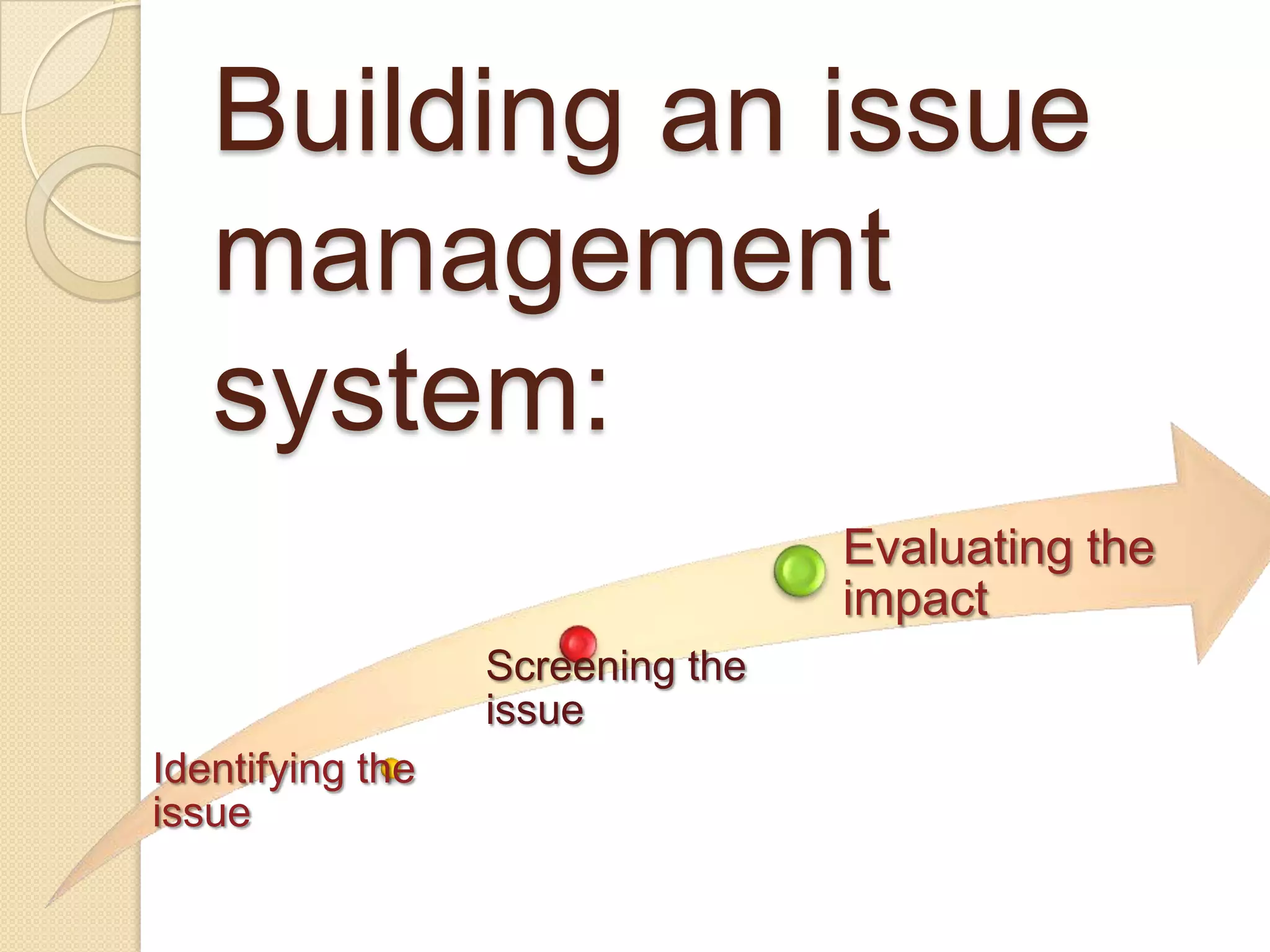
Building an issue
management
system:
Identifying the
issue
Screening the
issue
Evaluating the
impact
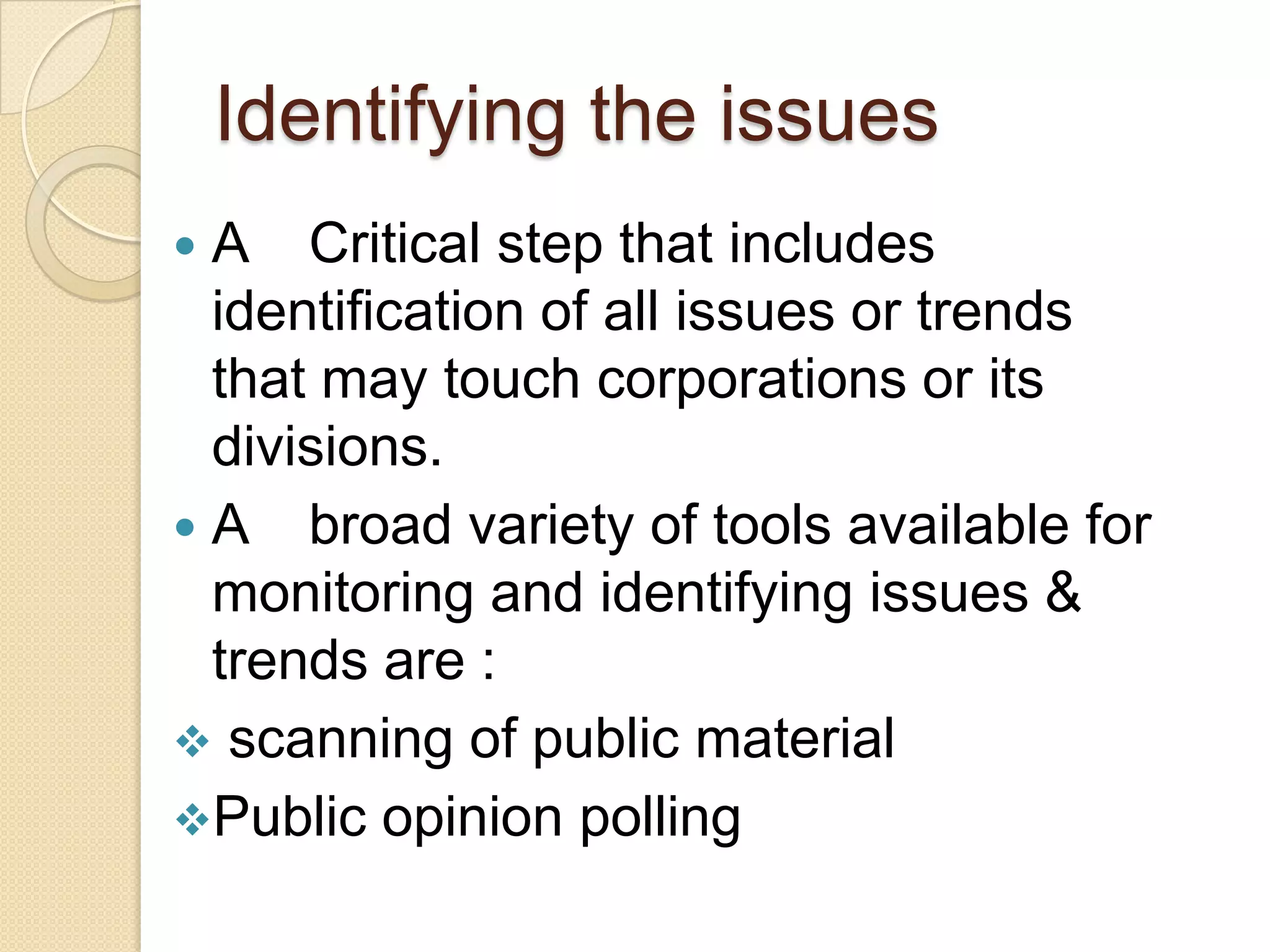
Identifying the issues
 A Critical step that includes
identification of all issues or trends
that may touch corporations or its
divisions.
 A broad variety of tools available for
monitoring and identifying issues &
trends are :
 scanning of public material
Public opinion polling
 Techniques for predicting what will
happen includes:
 extrapolation techniques
historical analysis
Intuitive reasoning
Scenario building
Cross impact matrices
Mathematical model building
Delphi techniques
Cross matrix method
Delphi technique
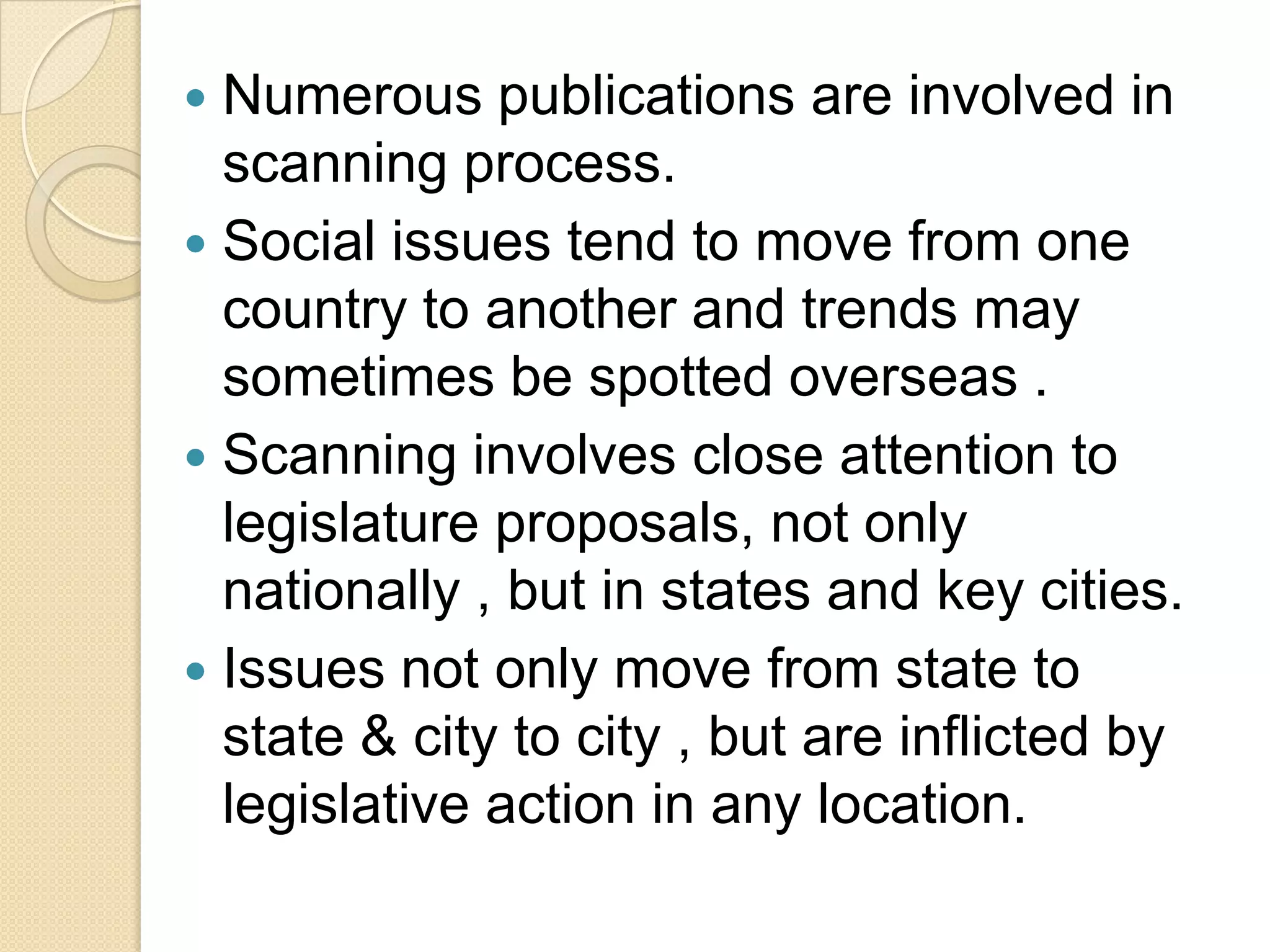
 Numerous publications are involved in
scanning process.
 Social issues tend to move from one
country to another and trends may
sometimes be spotted overseas .
 Scanning involves close attention to
legislature proposals, not only
nationally , but in states and key cities.
 Issues not only move from state to
state & city to city , but are inflicted by
legislative action in any location.
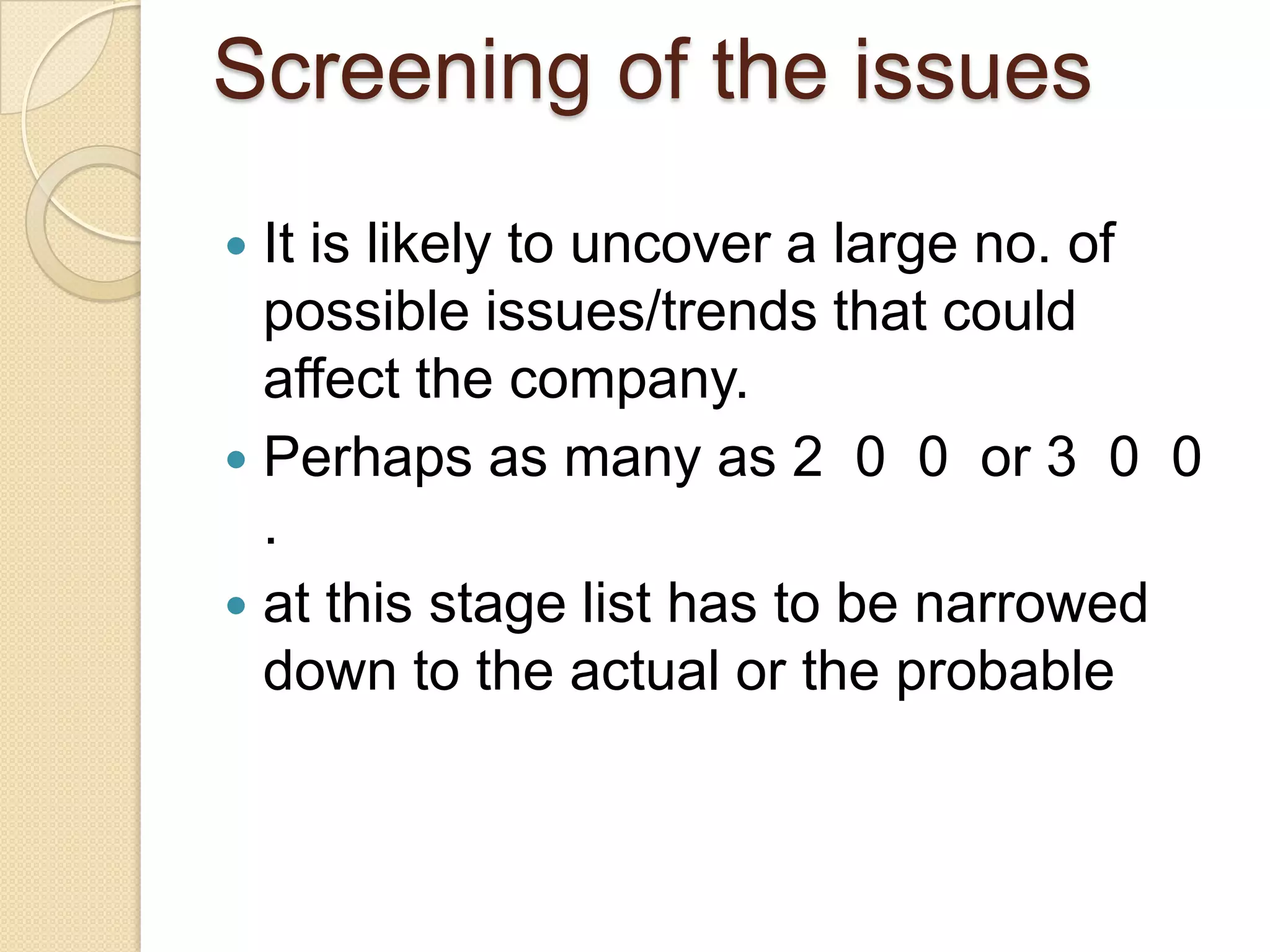
Screening of the issues
 It is likely to uncover a large no. of
possible issues/trends that could
affect the company.
 Perhaps as many as 2 0 0 or 3 0 0
.
 at this stage list has to be narrowed
down to the actual or the probable
Evaluating the impact
 Each actual issues are now analyzed, for
its likely and , where appropriate , worst
can impact to determine which issues
should be programmed into an action
plan, & which merely tracked.
 Cost is a principal factor.
 If the cost of managing an issue will
warrant the eventual return on
investment, it will fall into the category of
those to be attacked.
 .how much is preventing damage five years from now
worth to the company today?
Issue management

Issue management

  • 3.
    Nature of publicissue  An issue is a trend or condition, either internal or external which can significantly affect a company’s operations over a period of its business plan  Any issue may present either a threat to the corporation or an opportunity to shape the issue to an advantage .  three broad categories of public issues are: Current issue Emerging issue Societal trends
  • 4.
    Two benchmarks thatdetermine the nature and timing of response to an issue:  Threat benchmark: the level of loss beyond which the survival of firm, a division or a product will be endangered.  Opportunity benchmark:  the point before which a corporation must take action to control the issue.  Beyond that point, the cost of acting late can no longer be recovered through profit.
  • 5.
    Current issue  Publicquestions currently being acted or debated by governmental bodies.  Such issues generally are subject only to reactive public affairs responses.
  • 6.
    Emerging issues  Issuesof public policy that are likely to be the subject of legislation in the two- five years period ahead , but that have not yet been fully formulated, nor the position is different  It is in this evolving stage that issues can best be influenced or controlled.
  • 7.
    Operational • That effectkey financial statements : • P & l • Balance sheet • Flow of fund corporate • That effects mgt right to run the co. it wants: • Corporate’s disclosure • Director’s responsibility societal • Energy policy • Inflation • Employment policy 3 categories of emerging issues:
  • 8.
    Societal trends  Theseinvolve changing attitudes and human behavior and are the most difficult to influence or reverse.  They include demographic, social, resource related and technology related trends, all of which may have political and economic effects.
  • 9.
  • 10.
    Pressure Groups- Thesegroups form the most important elements of issues. The significant factors are its ability to capture media attention and the alliances it can make beyond its own membership. News media- They call attention to public issues. They may build up pressures on one side or another, or drop the issue if interest is minimal. General Public- The greatest power of the general public is the passive veto- the non acceptance of laws and regulation.
  • 11.
    Government Bureaucracies- The governmentbodies formulate rules and regulation which affect the business in one or the other way. Elected Officials- Often a politician or local legislator will pick up an issue just to get attention.
  • 12.
    name is given Crystallisation ofideas emerging of solution Introduction of legislation adjustments new life cycle Life cycle of public issue
  • 13.
     The paththat developing issue takes is important in a management, because the extent of control that can be exercised depends on stage of its evolution.  A n undefined problem is there: there is a general sense of frustration & recognition that a problem exists but that cannot be defined.  The issue is identified & given name: a co. Can first identify & name an emerging issue that can effect its operation . it has major opportunities at this stage.  Ideas begin to crystallize on the nature and causes of problem and public attitude begin to form with attention from the media.
  • 14.
     Solutions emerge:on an issue of importance hundreds of solutions emerge and eventually reduce to a few.  Legislation is introduced & enacted: at this stage a company can only react to some influence on the legislation may be effected, but control is no longer possible.  Adjustments are made ,via regulation or judicial services: here also the company’s position is one simply of reacting, although it may affect the interpretation of regulations. court action is often an effective issue mgt technique.  Formerly non existed or unnoticed problems often arise after an issue has completed its life cycle,perpetutaing in a new contact.
  • 16.
    Broad impact butrelatively abstract issues- Fewer people feel these issues directly although many may be aware that they are potentially affected. Narrow impact issues- These generally effect an identifiable minority or a geographical area. (tba * example) Technical issues-These issues are identified and crystallized by the leadership. For Example- multinational taxation. Broad impact issues- These directly affect a large segment of the people. For example- inflation, air and water pollution.
  • 17.
    Issue Management An effectiveissue management program enables a company, an association or a group to influence the development of public issues or trends that may affect it – rather than merely react to issues after they have developed The earlier a company can identify a potential threat, or opportunity and commit itself to appropriate actions, the more able it will be to shape the issue. Its like a war where the focus is not on the weapons but it requires a strategy to make decisions as to whether the issue requires a combat, on what ground the battle will be fought, and when will it be enraged.
  • 18.
    Building an issue management system: Identifyingthe issue Screening the issue Evaluating the impact
  • 19.
    Identifying the issues A Critical step that includes identification of all issues or trends that may touch corporations or its divisions.  A broad variety of tools available for monitoring and identifying issues & trends are :  scanning of public material Public opinion polling
  • 20.
     Techniques forpredicting what will happen includes:  extrapolation techniques historical analysis Intuitive reasoning Scenario building Cross impact matrices Mathematical model building Delphi techniques
  • 21.
  • 22.
     Numerous publicationsare involved in scanning process.  Social issues tend to move from one country to another and trends may sometimes be spotted overseas .  Scanning involves close attention to legislature proposals, not only nationally , but in states and key cities.  Issues not only move from state to state & city to city , but are inflicted by legislative action in any location.
  • 23.
    Screening of theissues  It is likely to uncover a large no. of possible issues/trends that could affect the company.  Perhaps as many as 2 0 0 or 3 0 0 .  at this stage list has to be narrowed down to the actual or the probable
  • 24.
    Evaluating the impact Each actual issues are now analyzed, for its likely and , where appropriate , worst can impact to determine which issues should be programmed into an action plan, & which merely tracked.  Cost is a principal factor.  If the cost of managing an issue will warrant the eventual return on investment, it will fall into the category of those to be attacked.  .how much is preventing damage five years from now worth to the company today?