Corporate Communication: Advertising, Marketing Communication, Marketing & Public Relations
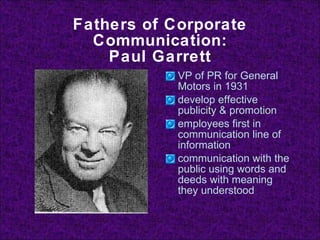
Fathers of Corporate Communication: Paul Garrett VP of PR for General Motors in 1931 develop effective publicity & promotion employees first in communication line of information communication with the public using words and deeds with meaning they understood
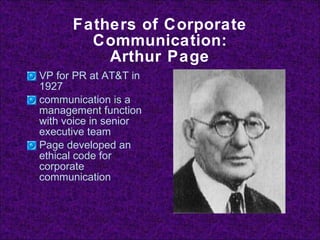
VP for PR at AT&T in 1927 communication is a management function with voice in senior executive team Page developed an ethical code for corporate communication Fathers of Corporate Communication: Arthur Page
Arthur Page’s Corporate Ethics Tell the truth. Prove it with your actions. Listen to the customer. Manage for tomorrow…the future. Conduct public relations as if the whole company depends upon it. Remain calm, patient, and good humored.
Historical Roots:  Corporate Communication and Public Relations Corporate communication began as public relations in major corporations. The primary historical roots of corporate communication come from public relations. Corporate communication developed as a communication practice in an industry setting within major corporations as a direct spin off of public relations. The business aspects came later with advertising, branding, and marketing responsibilities assumed by the corporate communication department, sometimes called corporate relations within major industries.
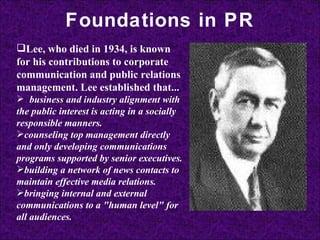
Foundations in PR Lee, who died in 1934, is known for his contributions to corporate communication and public relations management. Lee established that...       business and industry alignment with the public interest is acting in a socially responsible manners.   counseling top management directly and only developing communications programs supported by senior executives.   building a network of news contacts to maintain effective media relations.   bringing internal and external communications to a "human level" for all audiences.
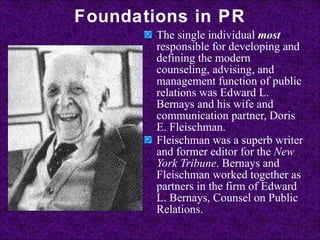
Foundations in PR The single individual  most  responsible for developing and defining the modern counseling, advising, and management function of public relations was Edward L. Bernays and his wife and communication partner, Doris E. Fleischman.  Fleischman was a superb writer and former editor for the  New York Tribune . Bernays and Fleischman worked together as partners in the firm of Edward L. Bernays, Counsel on Public Relations.
Issues of Importance to Corporate Communication Today The Global Economy Quality of the Environment Increased Role of Management Emphasis on Issues Management Professionalism of the Publics Proliferation of Publics/Splintering of Mass Markets Fragmentation of the Mass Media Rapid Development of New Media Technology Leading in Communication Trends
Defining Corporate Communication What is included in corporate communication? Advertising Marketing Communications Marketing Public Relations
Defining Corporate Communication Advertising  is paid and controlled mass communication with a purpose to impart.
Defining Corporate Communication Marketing Communication (or marcom)  is the branding of products, services, and organizations including such areas as consistency, differentiation, equity, identity, imaging, loyalty, positioning, publicity, promotion, relationships, and reputation.
Defining Corporate Communication Marketing  is the management function which creates products or services to fill public needs and then persuades the public to buy the products or services.
Defining Corporate Communication Public Relations   is the management function which creates policies and actions to fill public demands and then persuades the public to approve the policies and actions.   It involves target audiences, markets, programs, campaigns, special events, publicity, and promotions.
Defining Corporate Communication What is a clear and understandable definition of corporate communication? Corporate communication includes advertising, marketing communications, marketing, and public relations, but they all function under a managed perspective. Corporate communication is  managing an organization's internal and external communications.
Aspects of Corporate Communication managing communication or fulfilling the communication management function   dealing with controlled and uncontrolled media   serving both internal and external audiences   proactive communication planning   advocating communication strategies and tactics   dissemination of persuasion and information branding images and reputation branding products and services monitoring the responses from audiences and markets   counseling and advising senior executives   managing issues and responding to crisis situations   lobbying for favorable stances for the organization   organizational image creation and maintenance   organizational presence building and monitoring
Today’s Successful Professionals in Corporate Communication Today the keys to success in corporate communication are  multitasking ,  management , and  integration . It’s integrated corporate communication or integrated marketing communication. A combination of knowledge and skills in advertising, marketing communication, marketing, and public relations are expected in major industry. The greatest industry interest in communication professionals today is for individuals who have integrated corporate communication talent and skills and who desire supervisory positions and have a management capability and capacity.
Professional Communicator Responsibilities A professional corporate communicator must develop a communication plan which anticipates problems and leaves sufficient room for change.  Adaptability  is a must! Such a plan should be flexible, but cover all of the areas of communication within and related to the organization, both internal and external. Anticipation  of crisis situations, managing issues, and creating and maintaining and image and presence for the organization are imperative parts of corporate communications.  The communication plan must include media relations networking, corporate spokesperson training, government, investor and community relations as well as relationships to department heads.
Professional Communicator Responsibilities The function of  advocacy  or  lobbying  government agencies on issues and policies directly related to and affecting an organization must also be maintained.  The goal is an outcome(s) favorable to the organization. Using  paid advertising  and  free publicity  within the mass media are important variables in the success of any marketing or public relations campaign or special events management.
Ethics in Corporate Communication Ethics in the area of corporate communication is drawn from four major professional organizations today. These organizations help to define professionalism for communicators.
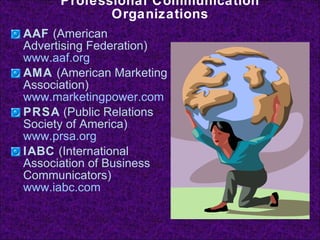
Professional Communication Organizations AAF  (American Advertising Federation)  www.aaf.org AMA  (American Marketing Association)  www.marketingpower.com PRSA  (Public Relations Society of America)  www.prsa.org IABC  (International Association of Business Communicators)  www.iabc.com
Professionalism? A solid, agreed upon knowledge base. Knowledge gained only through study in higher education. The offering of a special set of skills and characteristics available only through the profession. Licensure or Accreditation Recognition as a profession by the general public. Community of experts in agreement on a set of industry standards. Consistency within the practice and performance of the industry.
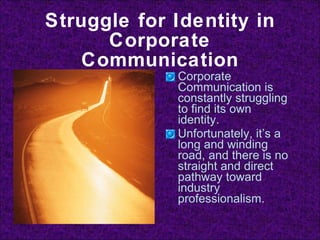
Struggle for Identity in Corporate Communication Corporate Communication is constantly struggling to find its own identity. Unfortunately, it’s a long and winding road, and there is no straight and direct pathway toward industry professionalism.
Corporate Communication Facts Public relations is a multibillion dollar business just in the United States.  The U. S. Bureau of Labor Statistics found more than 200,000 practicing public relations professionals in 2000 with a job rate increase predicted of nearly 47% by 2005.   Bergen (1999) indicates that a 1999 Council of Public Relations firms study reviewing corporate communication spending patterns of Fortune 500 firms found a direct correlation between how much a company spends on public relations and how much that company is respected.   The U. S. government has 9,000 workers employed in just the U. S. Information Agency; an additional 1,000 communication specialists work in the Defense Department. O'Dwyer (1999) reports that the 20 largest public relations firms in the U. S. generate over $2-billion in fee income annually.
Scope of Corporate Communication Corporations - Departments with the tasks such as community relations and marketing communications dealing with an organization's reputation and service to clients.  Nonprofit Agencies - Options ranging from membership organizations to social and cultural groups, hospitals, and health care agencies offer public relations opportunities where fund raising is always involved.  Entertainment, Sports and Travel - Communicators in these areas are usually concerned with  press agentry  and promotion of events.  Publicity  is an important part of practitioner duties here.  *Government and Military - Here communicators focus on  promotion of political issues  (often including lobbying), information dissemination about government activities to citizens, and information distribution to and about the military.  Education - Higher education opportunities cover  relationships with alumni, faculty and administration, students , and the general public promoting the college image, recruiting students, and raising funds.  International - With today's almost instantaneous global communication, intriguing new areas have opened. These areas are particularly desirable for bilingual or multilingual practitioners who are familiar with many cultures.
Outsourcing of Corporate Communication Among the most alarming trends in corporate communications today is the great amount of outsourcing used by major companies today. Wilcox, Ault, Agee, and Cameron (2000) indicate that nearly 47% of Fortune 500 companies are increasingly  outsourcing  communications work to advertising and marketing communications agencies and public relations firms.
What does this outsourcing trend mean for professional communication careers? It really is not a danger sign of declining corporate communication careers. Rather, it’s a redefinition of the type of corporate communication practiced today. The growth today in corporate communication is primarily one of agency and firm employment.
Management Perspective in Corporate Communication Strategic and Operational Management Knowledge   Develop strategies for solving public relations and communication problems.  Manage the organization's response to issues.  Develop goals and objectives for the communication department.  Prepare a departmental budget.  Manage people.    Research Knowledge   Perform environmental scanning.  Determine public relations to your organization.  use research to segment publics.  Conduct evaluative research.
Management Perspective in Corporate Communication Negotiation Knowledge   Negotiate with an activist public.  Help management to understand the opinions of particular publics.  Use theories of conflict resolution in dealing with publics.    Persuasion Knowledge   Persuade a public that you organization is right on an issue.  Use attitude theory in a campaign.  Get publics to behave as your organization wants ,
Media Relations The always increasing role of the electronic media (Internet, newspapers, magazines, radio, and television) has created a special importance for media relations. In fact, the news media have become dependent on PR for  news , and PR has become dependent upon the news media for  publicity.
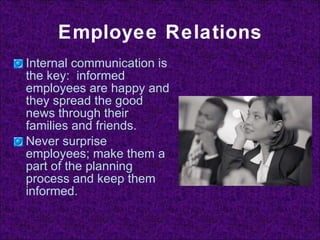
Employee Relations Internal communication is the key:  informed employees are happy and they spread the good news through their families and friends. Never surprise employees; make them a part of the planning process and keep them informed.
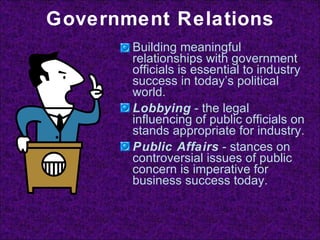
Government Relations Building meaningful relationships with government officials is essential to industry success in today’s political world. Lobbying  - the legal influencing of public officials on stands appropriate for industry. Public Affairs  - stances on controversial issues of public concern is imperative for business success today.
Relations with Special Interest Groups There are literally thousands of special interest and activist groups in the U. S. today. If there’s a cause, some group will pick it up. Defending corporate America from frivolous lawsuits and harassment from these groups has become a full time job in itself.
Dealing with Stakeholders It is important to recognize  stakeholders  (those with a vested interest in a specific industry within corporate America). It’s not only socially responsible to deal effectively with these stakeholders, it pays in good will and financial stability. Monitoring and managing key issues and moving to offset crisis and emergency situations in a  pro-active  way is essential to sold corporate relations today. The hottest issues in corporate America today are  the environment ,  health and safety , and  honesty  toward all stakeholders, especially to the media, stockholders, the government, and special interest groups .
Investor Relations With the failure of Fortune 500 companies, often based in fraud and embezzlement, a renewed focus on investor’s rights has emerged in the U. S. today. Investor or financial relations must focus on stockholders and stakeholders out of necessity. It’s the LAW, and it pays dividends. The Securities and Exchange Commission requires an annual meeting, timely disclosure of financial information, and many other regulations. But, it is wise to do it anyway to keep the reputation of a corporation in tact.
Advertising Relations Advertising writing and production is usually outsourced today. Market analysis is imperative; ratings, circulation, visits, are all important. Reach & frequency are important. Media buying is an important part of corporate communication. Sufficient advertising knowledge and skill are essential for a professional communicator today
Thank you

Corporate Communication

  • 1.
    Corporate Communication: Advertising,Marketing Communication, Marketing & Public Relations
  • 2.
    Fathers of CorporateCommunication: Paul Garrett VP of PR for General Motors in 1931 develop effective publicity & promotion employees first in communication line of information communication with the public using words and deeds with meaning they understood
  • 3.
    VP for PRat AT&T in 1927 communication is a management function with voice in senior executive team Page developed an ethical code for corporate communication Fathers of Corporate Communication: Arthur Page
  • 4.
    Arthur Page’s CorporateEthics Tell the truth. Prove it with your actions. Listen to the customer. Manage for tomorrow…the future. Conduct public relations as if the whole company depends upon it. Remain calm, patient, and good humored.
  • 5.
    Historical Roots: Corporate Communication and Public Relations Corporate communication began as public relations in major corporations. The primary historical roots of corporate communication come from public relations. Corporate communication developed as a communication practice in an industry setting within major corporations as a direct spin off of public relations. The business aspects came later with advertising, branding, and marketing responsibilities assumed by the corporate communication department, sometimes called corporate relations within major industries.
  • 6.
    Foundations in PRLee, who died in 1934, is known for his contributions to corporate communication and public relations management. Lee established that...   business and industry alignment with the public interest is acting in a socially responsible manners. counseling top management directly and only developing communications programs supported by senior executives. building a network of news contacts to maintain effective media relations. bringing internal and external communications to a "human level" for all audiences.
  • 7.
    Foundations in PRThe single individual most responsible for developing and defining the modern counseling, advising, and management function of public relations was Edward L. Bernays and his wife and communication partner, Doris E. Fleischman. Fleischman was a superb writer and former editor for the New York Tribune . Bernays and Fleischman worked together as partners in the firm of Edward L. Bernays, Counsel on Public Relations.
  • 8.
    Issues of Importanceto Corporate Communication Today The Global Economy Quality of the Environment Increased Role of Management Emphasis on Issues Management Professionalism of the Publics Proliferation of Publics/Splintering of Mass Markets Fragmentation of the Mass Media Rapid Development of New Media Technology Leading in Communication Trends
  • 9.
    Defining Corporate CommunicationWhat is included in corporate communication? Advertising Marketing Communications Marketing Public Relations
  • 10.
    Defining Corporate CommunicationAdvertising is paid and controlled mass communication with a purpose to impart.
  • 11.
    Defining Corporate CommunicationMarketing Communication (or marcom) is the branding of products, services, and organizations including such areas as consistency, differentiation, equity, identity, imaging, loyalty, positioning, publicity, promotion, relationships, and reputation.
  • 12.
    Defining Corporate CommunicationMarketing is the management function which creates products or services to fill public needs and then persuades the public to buy the products or services.
  • 13.
    Defining Corporate CommunicationPublic Relations is the management function which creates policies and actions to fill public demands and then persuades the public to approve the policies and actions. It involves target audiences, markets, programs, campaigns, special events, publicity, and promotions.
  • 14.
    Defining Corporate CommunicationWhat is a clear and understandable definition of corporate communication? Corporate communication includes advertising, marketing communications, marketing, and public relations, but they all function under a managed perspective. Corporate communication is managing an organization's internal and external communications.
  • 15.
    Aspects of CorporateCommunication managing communication or fulfilling the communication management function dealing with controlled and uncontrolled media serving both internal and external audiences proactive communication planning advocating communication strategies and tactics dissemination of persuasion and information branding images and reputation branding products and services monitoring the responses from audiences and markets counseling and advising senior executives managing issues and responding to crisis situations lobbying for favorable stances for the organization organizational image creation and maintenance organizational presence building and monitoring
  • 16.
    Today’s Successful Professionalsin Corporate Communication Today the keys to success in corporate communication are multitasking , management , and integration . It’s integrated corporate communication or integrated marketing communication. A combination of knowledge and skills in advertising, marketing communication, marketing, and public relations are expected in major industry. The greatest industry interest in communication professionals today is for individuals who have integrated corporate communication talent and skills and who desire supervisory positions and have a management capability and capacity.
  • 17.
    Professional Communicator ResponsibilitiesA professional corporate communicator must develop a communication plan which anticipates problems and leaves sufficient room for change. Adaptability is a must! Such a plan should be flexible, but cover all of the areas of communication within and related to the organization, both internal and external. Anticipation of crisis situations, managing issues, and creating and maintaining and image and presence for the organization are imperative parts of corporate communications. The communication plan must include media relations networking, corporate spokesperson training, government, investor and community relations as well as relationships to department heads.
  • 18.
    Professional Communicator ResponsibilitiesThe function of advocacy or lobbying government agencies on issues and policies directly related to and affecting an organization must also be maintained. The goal is an outcome(s) favorable to the organization. Using paid advertising and free publicity within the mass media are important variables in the success of any marketing or public relations campaign or special events management.
  • 19.
    Ethics in CorporateCommunication Ethics in the area of corporate communication is drawn from four major professional organizations today. These organizations help to define professionalism for communicators.
  • 20.
    Professional Communication OrganizationsAAF (American Advertising Federation) www.aaf.org AMA (American Marketing Association) www.marketingpower.com PRSA (Public Relations Society of America) www.prsa.org IABC (International Association of Business Communicators) www.iabc.com
  • 21.
    Professionalism? A solid,agreed upon knowledge base. Knowledge gained only through study in higher education. The offering of a special set of skills and characteristics available only through the profession. Licensure or Accreditation Recognition as a profession by the general public. Community of experts in agreement on a set of industry standards. Consistency within the practice and performance of the industry.
  • 22.
    Struggle for Identityin Corporate Communication Corporate Communication is constantly struggling to find its own identity. Unfortunately, it’s a long and winding road, and there is no straight and direct pathway toward industry professionalism.
  • 23.
    Corporate Communication FactsPublic relations is a multibillion dollar business just in the United States. The U. S. Bureau of Labor Statistics found more than 200,000 practicing public relations professionals in 2000 with a job rate increase predicted of nearly 47% by 2005. Bergen (1999) indicates that a 1999 Council of Public Relations firms study reviewing corporate communication spending patterns of Fortune 500 firms found a direct correlation between how much a company spends on public relations and how much that company is respected. The U. S. government has 9,000 workers employed in just the U. S. Information Agency; an additional 1,000 communication specialists work in the Defense Department. O'Dwyer (1999) reports that the 20 largest public relations firms in the U. S. generate over $2-billion in fee income annually.
  • 24.
    Scope of CorporateCommunication Corporations - Departments with the tasks such as community relations and marketing communications dealing with an organization's reputation and service to clients. Nonprofit Agencies - Options ranging from membership organizations to social and cultural groups, hospitals, and health care agencies offer public relations opportunities where fund raising is always involved. Entertainment, Sports and Travel - Communicators in these areas are usually concerned with press agentry and promotion of events. Publicity is an important part of practitioner duties here. *Government and Military - Here communicators focus on promotion of political issues (often including lobbying), information dissemination about government activities to citizens, and information distribution to and about the military. Education - Higher education opportunities cover relationships with alumni, faculty and administration, students , and the general public promoting the college image, recruiting students, and raising funds. International - With today's almost instantaneous global communication, intriguing new areas have opened. These areas are particularly desirable for bilingual or multilingual practitioners who are familiar with many cultures.
  • 25.
    Outsourcing of CorporateCommunication Among the most alarming trends in corporate communications today is the great amount of outsourcing used by major companies today. Wilcox, Ault, Agee, and Cameron (2000) indicate that nearly 47% of Fortune 500 companies are increasingly outsourcing communications work to advertising and marketing communications agencies and public relations firms.
  • 26.
    What does thisoutsourcing trend mean for professional communication careers? It really is not a danger sign of declining corporate communication careers. Rather, it’s a redefinition of the type of corporate communication practiced today. The growth today in corporate communication is primarily one of agency and firm employment.
  • 27.
    Management Perspective inCorporate Communication Strategic and Operational Management Knowledge Develop strategies for solving public relations and communication problems. Manage the organization's response to issues. Develop goals and objectives for the communication department. Prepare a departmental budget. Manage people.   Research Knowledge Perform environmental scanning. Determine public relations to your organization. use research to segment publics. Conduct evaluative research.
  • 28.
    Management Perspective inCorporate Communication Negotiation Knowledge Negotiate with an activist public. Help management to understand the opinions of particular publics. Use theories of conflict resolution in dealing with publics.   Persuasion Knowledge Persuade a public that you organization is right on an issue. Use attitude theory in a campaign. Get publics to behave as your organization wants ,
  • 29.
    Media Relations Thealways increasing role of the electronic media (Internet, newspapers, magazines, radio, and television) has created a special importance for media relations. In fact, the news media have become dependent on PR for news , and PR has become dependent upon the news media for publicity.
  • 30.
    Employee Relations Internalcommunication is the key: informed employees are happy and they spread the good news through their families and friends. Never surprise employees; make them a part of the planning process and keep them informed.
  • 31.
    Government Relations Buildingmeaningful relationships with government officials is essential to industry success in today’s political world. Lobbying - the legal influencing of public officials on stands appropriate for industry. Public Affairs - stances on controversial issues of public concern is imperative for business success today.
  • 32.
    Relations with SpecialInterest Groups There are literally thousands of special interest and activist groups in the U. S. today. If there’s a cause, some group will pick it up. Defending corporate America from frivolous lawsuits and harassment from these groups has become a full time job in itself.
  • 33.
    Dealing with StakeholdersIt is important to recognize stakeholders (those with a vested interest in a specific industry within corporate America). It’s not only socially responsible to deal effectively with these stakeholders, it pays in good will and financial stability. Monitoring and managing key issues and moving to offset crisis and emergency situations in a pro-active way is essential to sold corporate relations today. The hottest issues in corporate America today are the environment , health and safety , and honesty toward all stakeholders, especially to the media, stockholders, the government, and special interest groups .
  • 34.
    Investor Relations Withthe failure of Fortune 500 companies, often based in fraud and embezzlement, a renewed focus on investor’s rights has emerged in the U. S. today. Investor or financial relations must focus on stockholders and stakeholders out of necessity. It’s the LAW, and it pays dividends. The Securities and Exchange Commission requires an annual meeting, timely disclosure of financial information, and many other regulations. But, it is wise to do it anyway to keep the reputation of a corporation in tact.
  • 35.
    Advertising Relations Advertisingwriting and production is usually outsourced today. Market analysis is imperative; ratings, circulation, visits, are all important. Reach & frequency are important. Media buying is an important part of corporate communication. Sufficient advertising knowledge and skill are essential for a professional communicator today
  • 36.