VALUE-BASED CHANGE MANAGEMENT
Introduction
2
 Values are deeply held principles that people adhere to
when making decisions.
 Individuals express their values through their actions
and behaviour.
 Organizations express their values through their work
culture.
 Value-driven organizations are more successful (Senge,
Collins & Porras, Kotterand Heskett).
Contd…
1. Values drive culture
2. Culture drives employee fulfilment
3. Employee fulfilment drives customer satisfaction
4. Customer satisfaction drives shareholder value
 Kotter and Heskett - In corporate culture and
performance, companies with a strong adaptive culture
based on shared values outperformed other companies
by a significant margin.
3
Contd…
 Value based management is the management approach
that ensures corporations are run consistently on value
(maximizing shareholder’s wealth).
1. Creating value – ways to increase future value
2. Managing for value – Governance, Change
Management, Organizational Culture, Communication,
Leadership etc.)
3. Measuring value (Valuation)
4
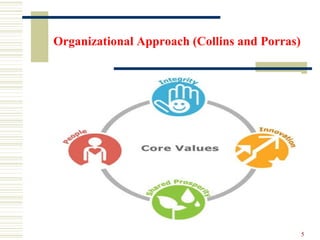
Organizational Approach (Collins and Porras)
5
Differentiation/Fragmentation Model
 Joanne Martin (1992, 2002)
 In a differentiation perspective, employees will rarely
share the vision and values of management and will not
increase their effectiveness.
6
Contd…
 In a fragmentation perspective, employees will
sometimes share the vision and the values of
management, but will chose what suits them.
 People can be motivated by common values–but they
also have their own motivational base.
7
Variables of Value-Based Change Management
 Corporate mission (business philosophy)
 Corporate strategy
 Corporate culture
 Corporate governance
 Corporate communication
 Decision making
 Performance management
 Compensation management
8
Nurturing Organizational Change
1. Controlling
 Top-down view of management
 Fayol’s theory of management: planning, organizing,
commanding, coordinating and controlling.
2. Shaping
 Participative style of management
 Improving the capabilities of people within the
organization
9
Contd…
 Intended Change
 Change is a result of planned action
 Partially Intended Change
 Change may need to be re-modified after it is
initially implemented
 Unintended Change
 Forces beyond the control of the change manager
10
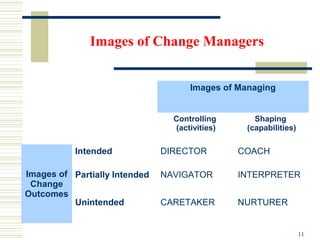
Images of Change Managers
11
Images of Managing
Controlling
(activities)
Shaping
(capabilities)
Images of
Change
Outcomes
Intended DIRECTOR COACH
Partially Intended NAVIGATOR INTERPRETER
Unintended CARETAKER NURTURER
Contd…
1. Caretaker
 The manager’s control is severely impeded by a variety of
internal and external forces beyond their scope. The caretaker take
their organizations along as best they can.
 Supported by life-cycle, population-ecology and institutional
theories.
2. Nurturer
 Even small changes may have a large impact on organizations and
managers are not able to control the outcome of these changes but
may nurture their organizations.
 This facilitates organizational qualities that enable positive self-
organizing to occur.
12

Value based change management and nurturing organizational change

  • 1.
  • 2.
    Introduction 2  Values aredeeply held principles that people adhere to when making decisions.  Individuals express their values through their actions and behaviour.  Organizations express their values through their work culture.  Value-driven organizations are more successful (Senge, Collins & Porras, Kotterand Heskett).
  • 3.
    Contd… 1. Values driveculture 2. Culture drives employee fulfilment 3. Employee fulfilment drives customer satisfaction 4. Customer satisfaction drives shareholder value  Kotter and Heskett - In corporate culture and performance, companies with a strong adaptive culture based on shared values outperformed other companies by a significant margin. 3
  • 4.
    Contd…  Value basedmanagement is the management approach that ensures corporations are run consistently on value (maximizing shareholder’s wealth). 1. Creating value – ways to increase future value 2. Managing for value – Governance, Change Management, Organizational Culture, Communication, Leadership etc.) 3. Measuring value (Valuation) 4
  • 5.
  • 6.
    Differentiation/Fragmentation Model  JoanneMartin (1992, 2002)  In a differentiation perspective, employees will rarely share the vision and values of management and will not increase their effectiveness. 6
  • 7.
    Contd…  In afragmentation perspective, employees will sometimes share the vision and the values of management, but will chose what suits them.  People can be motivated by common values–but they also have their own motivational base. 7
  • 8.
    Variables of Value-BasedChange Management  Corporate mission (business philosophy)  Corporate strategy  Corporate culture  Corporate governance  Corporate communication  Decision making  Performance management  Compensation management 8
  • 9.
    Nurturing Organizational Change 1.Controlling  Top-down view of management  Fayol’s theory of management: planning, organizing, commanding, coordinating and controlling. 2. Shaping  Participative style of management  Improving the capabilities of people within the organization 9
  • 10.
    Contd…  Intended Change Change is a result of planned action  Partially Intended Change  Change may need to be re-modified after it is initially implemented  Unintended Change  Forces beyond the control of the change manager 10
  • 11.
    Images of ChangeManagers 11 Images of Managing Controlling (activities) Shaping (capabilities) Images of Change Outcomes Intended DIRECTOR COACH Partially Intended NAVIGATOR INTERPRETER Unintended CARETAKER NURTURER
  • 12.
    Contd… 1. Caretaker  Themanager’s control is severely impeded by a variety of internal and external forces beyond their scope. The caretaker take their organizations along as best they can.  Supported by life-cycle, population-ecology and institutional theories. 2. Nurturer  Even small changes may have a large impact on organizations and managers are not able to control the outcome of these changes but may nurture their organizations.  This facilitates organizational qualities that enable positive self- organizing to occur. 12