Fund Based Financial Services
- Presented By :
- Gaurav
- Mehak
- Swati
- Saumya
- Srikriti
 The finance industry encompasses a broad range of
organizations that deal with the management of money.
 Among these organizations are Asset Management Companies
like leasing companies, merchant bankers and Liability
Management Companies like discounting houses and
acceptance houses, and general financial institutions like
banks, credit card companies, insurance companies, consumer
finance companies, stock exchanges.
 The term ‘Financial Services’ in a broad sense means “mobilizing
and allocating savings.” Thus, it includes all activities involved in
the transformation of savings into investment.
FINANCIAL SERVICES: MEANING
 Following are some of the examples of financial services:
 Leasing, credit card services, factoring, portfolio
management, financial consultancy services, Underwriting,
discounting and rediscounting of bills, Depository services,
housing finance, Hire purchases, Mutual Fund
management.
 The financial services can also be called ‘financial
intermediation’. It is the process by which funds are
mobilized from a large number of savers and make them
available to all those who are in need of it.
The financial intermediaries in India can be classified as:
 Capital Market Intermediaries which constitutes
Term Lending Institutions and Investing Institutions
which mainly provide long term funds.
 Money Market Intermediaries which consists of
commercial banks, Cooperative Banks, and other
financial agencies which supply only short term funds.
Classification of Financial Services
Industry
Financial Services offered are mainly 2 types -
-Fee based merchant banking, broking services, credit
rating, portfolio management services, underwriting,
etc.
-Fund based factoring, leasing, hire purchases, housing
finance, bill discounting, Venture Capital, etc.
Types of Financial Services
Leasing
 A lease may be defined as :
 a contractual arrangement / transaction in which
 a party owning an asset / equipment (lessor)
 provides the asset for use to another / transfer the right to use
the equipment to the user (lessee)
 over a certain / for an agreed period of time
 for consideration in form of / in return for periodic payment
(rental)
 at the end of the period of contract (lease period) ,the asset
/equipment reverts back to the lessor
 unless there is a provision for the renewal of the contract.
Meaning
 Leasing essentially involves the divorce of ownership
from the economic use of an asset/equipment.
 LESSOR: Lessor is the owner of the asset that is being
leased.
 LESSEE: Lessee is the receiver of the services of the
asset under a lease contact.
Parties In Leasing
 The Parties
 The Asset
 The Term
 The Lease Rentals
Characteristics of a lease
Classification of Lease
1. Financial lease and operating lease
2. Sales and lease back and direct lease
3. Single investor lease and leveraged lease
4. Domestic lease and international lease
Hire Purchase
It is defined as a peculiar kind of transaction in which the goods are
let on hire with an option to the hirer to purchase them with the
following stipulations:
 -payment to be made in installments over a specified period
 -the possession is delivered to the hirer at the time of entering in to
the contract
 -the property in the goods passes to the hirer on payment of the
last installment
 -each installment is treated as hire charges so that if default is made
in payment of any installment the seller becomes entitled to take
away the goods &
 -the hirer is free to return the goods with out being required to pay
any further installments falling due after the return.
Meaning
 Goods are let out on finance by a finance company to the
hire purchaser customer.
 Buyer is required to pay an equal amount of periodic
installments during a given period.
 Ownership transfers at the payment of the last installment.
 The hirer is required to make a down payment of 20-25% of
the cost and pay the balance amount along with interest in
advance or arrears over a time period of 36-48months.
Various Aspect of HP Transaction
 The interest on each hire purchase installment is
computed on the basis of flat rate of interest is
applied to the declining balance of original loan
amount to determine the interest component of
installment for a given flat rate of interest, the
equivalent effective rate of interest is higher.
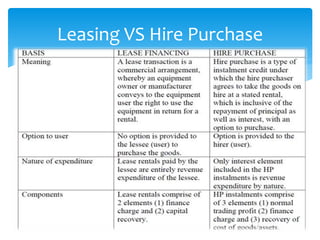
Leasing VS Hire Purchase
Factoring
Meaning
Undertakes the task of realizing ‘receivables’, i.e.
accounts receivables, book debts, bills receivables etc .
Also manages the sales registers, sundry debts of the
commercial firms/trading agents , for a commission.
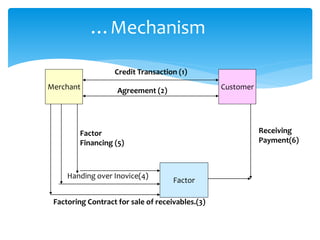
…Mechanism
Merchant Customer
Factor
Credit Transaction (1)
Agreement (2)
Factor
Financing (5)
Handing over Inovice(4)
Factoring Contract for sale of receivables.(3)
Receiving
Payment(6)
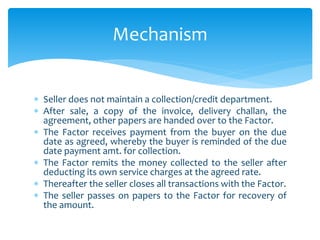
Mechanism
 Seller does not maintain a collection/credit department.
 After sale, a copy of the invoice, delivery challan, the
agreement, other papers are handed over to the Factor.
 The Factor receives payment from the buyer on the due
date as agreed, whereby the buyer is reminded of the due
date payment amt. for collection.
 The Factor remits the money collected to the seller after
deducting its own service charges at the agreed rate.
 Thereafter the seller closes all transactions with the Factor.
 The seller passes on papers to the Factor for recovery of
the amount.
Types of Factoring
 Domestic Factoring
 Export Factoring
 Cross Border Factoring
WHAT IS VENTURE CAPITAL
Money provided by investors to startup firms and small
businesses with perceived long-term growth potential.
Venture Capital Financing
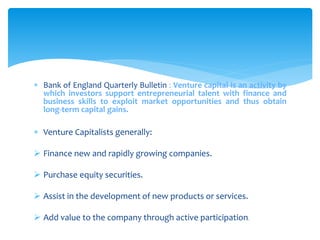
 Bank of England Quarterly Bulletin : Venture capital is an activity by
which investors support entrepreneurial talent with finance and
business skills to exploit market opportunities and thus obtain
long-term capital gains.
 Venture Capitalists generally:
 Finance new and rapidly growing companies.
 Purchase equity securities.
 Assist in the development of new products or services.
 Add value to the company through active participation.
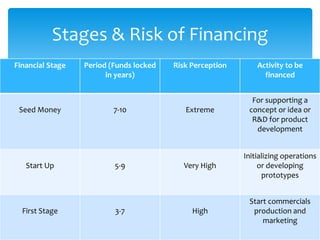
Financial Stage Period (Funds locked
in years)
Risk Perception Activity to be
financed
Seed Money 7-10 Extreme
For supporting a
concept or idea or
R&D for product
development
Start Up 5-9 Very High
Initializing operations
or developing
prototypes
First Stage 3-7 High
Start commercials
production and
marketing
Stages & Risk of Financing
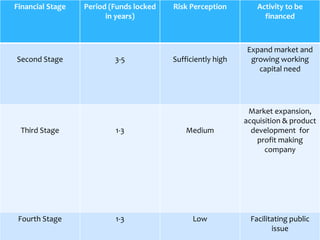
Financial Stage Period (Funds locked
in years)
Risk Perception Activity to be
financed
Second Stage 3-5 Sufficiently high
Expand market and
growing working
capital need
Third Stage 1-3 Medium
Market expansion,
acquisition & product
development for
profit making
company
Fourth Stage 1-3 Low Facilitating public
issue
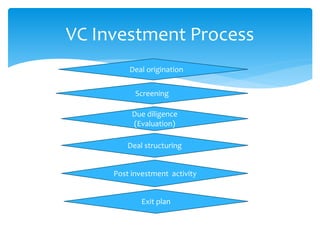
Deal origination
Screening
Due diligence
(Evaluation)
Deal structuring
Post investment activity
Exit plan
VC Investment Process
 A legal contract between two parties whereby one
party called insurer undertakes to pay a fixed amount
of money on the happening of a particular event,
which may be certain or uncertain. The other party
called insured ,pays in exchange a fixed sum , called
premium.
Definition
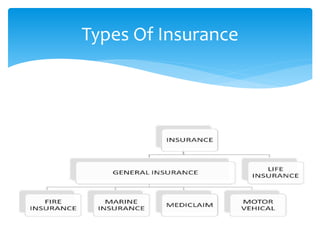
Types Of Insurance
 Till end of FY 1999-2000, two state-run insurance
companies, Life Insurance Corporation (LIC); General
Insurance Corporation (GIC) were the monopoly
insurance provider in India.
 Under GIC there were four subsidiaries:
National Insurance Company Ltd.
Oriental Insurance Company Ltd.
New India Assurance Company Ltd.
United India Insurance Company Ltd.
ORIGIN AND GROWTH OF
INSURANCE SECTOR
 In fiscal 2000-01, the Indian federal government lifted
all entry restrictions for private sector investors.
 Foreign investment insurance market was also
allowed with 26 percent cap.
 GIC was converted into India's national reinsurer,
from December 2000.
 All the subsidiaries working under the GIC umbrella
were restructured as independent insurance
companies.
 Insurance Regulatory and Development Authority
(IRDA) is an autonomous apex statutory body which
regulates and develops the insurance industry in
India.
 IRDA batted for a hike in the foreign direct
investment (FDI) limit to 49 per cent in the insurance
sector from the erstwhile 26 per cent. The FDI limit in
insurance sector was raised to 49% in July 2013.
IRDA
Mutual Fund Services
A mutual fund is a pool of money from numerous
investors who wish to save or make money. Investing
in a mutual fund can be a lot easier than buying and
selling individual stocks and bonds on your own.
Investors can sell their shares when they want.
What is a Mutual Fund?
Professional Management
Each fund's investments are chosen and monitored
by qualified professionals who use this money to
create a portfolio.
Fund Ownership
As an investor, you own shares of the mutual fund,
not the individual securities. All shareholders share in
the fund's gains and losses on an equal basis,
proportionately to the amount they've invested.
What is a Mutual Fund?
Mutual Funds are Diversified
By investing in mutual funds, you could diversify your
portfolio across a large number of securities so as to
minimize risk. By spreading your money over
numerous securities, which is what a mutual fund
does, you need not worry about the fluctuation of the
individual securities in the fund's portfolio.
What is a Mutual Fund?
 Mutual funds Schemes can be segregated into two heads –
1. Schemes according to Maturity Period:
 Open-ended Fund/ Scheme
 Open-ended schemes are those schemes where investors can redeem
and buy new units all throughout the year as per.
 Close-ended Fund/ Scheme
 The fund is open for subscription only during a specified period at the
time of launch of the scheme. Investors can invest in the scheme at the
time of the initial public issue and there after they can buy or sell the
units of the scheme on the stock exchanges where the units are listed.
Types Of Mutual Fund Schemes
2. Schemes according to Investment Objective:
Growth / Equity Oriented Scheme
Income / Debt Oriented Scheme
Balanced Fund
Money Market Mutual Fund (are low risk funds offers
highest possible current income consistent with
preservation of capital)
 All mutual funds in India today are regulated by SEBI.
 The Association of Mutual Funds of India (AMFI) is a
self-governing association of Indian Mutual Funds
that regulates its members' sales, distribution and
communication practices. Investors can invest in
Indian mutual funds directly or through distributors
under codes of practice developed by AMFI.
Regulation & Distribution
Housing Finance
 Housing finance connotes finance (or loans) for
meeting the various needs relating to housing,
namely:
 a) Purchase of a flat or house.
 b) Acquisition of a plot.
 c) Construction of a house.
 d) Extension of a house.
 e) Repairs, renovation and up gradation of a
house/flat.
Meaning
 Create & meet a growing housing demand
 Reduce poverty
 Prevent slum proliferation
 Engine of equitable economic growth
 Take part in financial sector liberalization
Importance
 The following is the list of different types of Home Loans you can
avail from the market:
 Home Purchase Loans
 Home Construction Loans
 Home Improvement Loans
 Home Extension Loans
 Home Conversion Loans
 Land Purchase Loans
 Stamp Duty Loans
 Bridge Loans
 Balance Transfer Loans
 Loans to NRIs
Types Of Home Loan
THE END

Fund based financial services

  • 1.
    Fund Based FinancialServices - Presented By : - Gaurav - Mehak - Swati - Saumya - Srikriti
  • 2.
     The financeindustry encompasses a broad range of organizations that deal with the management of money.  Among these organizations are Asset Management Companies like leasing companies, merchant bankers and Liability Management Companies like discounting houses and acceptance houses, and general financial institutions like banks, credit card companies, insurance companies, consumer finance companies, stock exchanges.  The term ‘Financial Services’ in a broad sense means “mobilizing and allocating savings.” Thus, it includes all activities involved in the transformation of savings into investment. FINANCIAL SERVICES: MEANING
  • 3.
     Following aresome of the examples of financial services:  Leasing, credit card services, factoring, portfolio management, financial consultancy services, Underwriting, discounting and rediscounting of bills, Depository services, housing finance, Hire purchases, Mutual Fund management.  The financial services can also be called ‘financial intermediation’. It is the process by which funds are mobilized from a large number of savers and make them available to all those who are in need of it.
  • 4.
    The financial intermediariesin India can be classified as:  Capital Market Intermediaries which constitutes Term Lending Institutions and Investing Institutions which mainly provide long term funds.  Money Market Intermediaries which consists of commercial banks, Cooperative Banks, and other financial agencies which supply only short term funds. Classification of Financial Services Industry
  • 5.
    Financial Services offeredare mainly 2 types - -Fee based merchant banking, broking services, credit rating, portfolio management services, underwriting, etc. -Fund based factoring, leasing, hire purchases, housing finance, bill discounting, Venture Capital, etc. Types of Financial Services
  • 6.
  • 7.
     A leasemay be defined as :  a contractual arrangement / transaction in which  a party owning an asset / equipment (lessor)  provides the asset for use to another / transfer the right to use the equipment to the user (lessee)  over a certain / for an agreed period of time  for consideration in form of / in return for periodic payment (rental)  at the end of the period of contract (lease period) ,the asset /equipment reverts back to the lessor  unless there is a provision for the renewal of the contract. Meaning
  • 8.
     Leasing essentiallyinvolves the divorce of ownership from the economic use of an asset/equipment.  LESSOR: Lessor is the owner of the asset that is being leased.  LESSEE: Lessee is the receiver of the services of the asset under a lease contact. Parties In Leasing
  • 9.
     The Parties The Asset  The Term  The Lease Rentals Characteristics of a lease
  • 10.
    Classification of Lease 1.Financial lease and operating lease 2. Sales and lease back and direct lease 3. Single investor lease and leveraged lease 4. Domestic lease and international lease
  • 11.
  • 12.
    It is definedas a peculiar kind of transaction in which the goods are let on hire with an option to the hirer to purchase them with the following stipulations:  -payment to be made in installments over a specified period  -the possession is delivered to the hirer at the time of entering in to the contract  -the property in the goods passes to the hirer on payment of the last installment  -each installment is treated as hire charges so that if default is made in payment of any installment the seller becomes entitled to take away the goods &  -the hirer is free to return the goods with out being required to pay any further installments falling due after the return. Meaning
  • 13.
     Goods arelet out on finance by a finance company to the hire purchaser customer.  Buyer is required to pay an equal amount of periodic installments during a given period.  Ownership transfers at the payment of the last installment.  The hirer is required to make a down payment of 20-25% of the cost and pay the balance amount along with interest in advance or arrears over a time period of 36-48months. Various Aspect of HP Transaction
  • 14.
     The intereston each hire purchase installment is computed on the basis of flat rate of interest is applied to the declining balance of original loan amount to determine the interest component of installment for a given flat rate of interest, the equivalent effective rate of interest is higher.
  • 15.
  • 16.
  • 17.
    Meaning Undertakes the taskof realizing ‘receivables’, i.e. accounts receivables, book debts, bills receivables etc . Also manages the sales registers, sundry debts of the commercial firms/trading agents , for a commission.
  • 18.
    …Mechanism Merchant Customer Factor Credit Transaction(1) Agreement (2) Factor Financing (5) Handing over Inovice(4) Factoring Contract for sale of receivables.(3) Receiving Payment(6)
  • 19.
    Mechanism  Seller doesnot maintain a collection/credit department.  After sale, a copy of the invoice, delivery challan, the agreement, other papers are handed over to the Factor.  The Factor receives payment from the buyer on the due date as agreed, whereby the buyer is reminded of the due date payment amt. for collection.  The Factor remits the money collected to the seller after deducting its own service charges at the agreed rate.  Thereafter the seller closes all transactions with the Factor.  The seller passes on papers to the Factor for recovery of the amount.
  • 20.
    Types of Factoring Domestic Factoring  Export Factoring  Cross Border Factoring
  • 21.
    WHAT IS VENTURECAPITAL Money provided by investors to startup firms and small businesses with perceived long-term growth potential.
  • 22.
  • 23.
     Bank ofEngland Quarterly Bulletin : Venture capital is an activity by which investors support entrepreneurial talent with finance and business skills to exploit market opportunities and thus obtain long-term capital gains.  Venture Capitalists generally:  Finance new and rapidly growing companies.  Purchase equity securities.  Assist in the development of new products or services.  Add value to the company through active participation.
  • 24.
    Financial Stage Period(Funds locked in years) Risk Perception Activity to be financed Seed Money 7-10 Extreme For supporting a concept or idea or R&D for product development Start Up 5-9 Very High Initializing operations or developing prototypes First Stage 3-7 High Start commercials production and marketing Stages & Risk of Financing
  • 25.
    Financial Stage Period(Funds locked in years) Risk Perception Activity to be financed Second Stage 3-5 Sufficiently high Expand market and growing working capital need Third Stage 1-3 Medium Market expansion, acquisition & product development for profit making company Fourth Stage 1-3 Low Facilitating public issue
  • 26.
    Deal origination Screening Due diligence (Evaluation) Dealstructuring Post investment activity Exit plan VC Investment Process
  • 28.
     A legalcontract between two parties whereby one party called insurer undertakes to pay a fixed amount of money on the happening of a particular event, which may be certain or uncertain. The other party called insured ,pays in exchange a fixed sum , called premium. Definition
  • 29.
  • 30.
     Till endof FY 1999-2000, two state-run insurance companies, Life Insurance Corporation (LIC); General Insurance Corporation (GIC) were the monopoly insurance provider in India.  Under GIC there were four subsidiaries: National Insurance Company Ltd. Oriental Insurance Company Ltd. New India Assurance Company Ltd. United India Insurance Company Ltd. ORIGIN AND GROWTH OF INSURANCE SECTOR
  • 32.
     In fiscal2000-01, the Indian federal government lifted all entry restrictions for private sector investors.  Foreign investment insurance market was also allowed with 26 percent cap.  GIC was converted into India's national reinsurer, from December 2000.  All the subsidiaries working under the GIC umbrella were restructured as independent insurance companies.
  • 33.
     Insurance Regulatoryand Development Authority (IRDA) is an autonomous apex statutory body which regulates and develops the insurance industry in India.  IRDA batted for a hike in the foreign direct investment (FDI) limit to 49 per cent in the insurance sector from the erstwhile 26 per cent. The FDI limit in insurance sector was raised to 49% in July 2013. IRDA
  • 34.
  • 35.
    A mutual fundis a pool of money from numerous investors who wish to save or make money. Investing in a mutual fund can be a lot easier than buying and selling individual stocks and bonds on your own. Investors can sell their shares when they want. What is a Mutual Fund?
  • 36.
    Professional Management Each fund'sinvestments are chosen and monitored by qualified professionals who use this money to create a portfolio. Fund Ownership As an investor, you own shares of the mutual fund, not the individual securities. All shareholders share in the fund's gains and losses on an equal basis, proportionately to the amount they've invested. What is a Mutual Fund?
  • 37.
    Mutual Funds areDiversified By investing in mutual funds, you could diversify your portfolio across a large number of securities so as to minimize risk. By spreading your money over numerous securities, which is what a mutual fund does, you need not worry about the fluctuation of the individual securities in the fund's portfolio. What is a Mutual Fund?
  • 38.
     Mutual fundsSchemes can be segregated into two heads – 1. Schemes according to Maturity Period:  Open-ended Fund/ Scheme  Open-ended schemes are those schemes where investors can redeem and buy new units all throughout the year as per.  Close-ended Fund/ Scheme  The fund is open for subscription only during a specified period at the time of launch of the scheme. Investors can invest in the scheme at the time of the initial public issue and there after they can buy or sell the units of the scheme on the stock exchanges where the units are listed. Types Of Mutual Fund Schemes
  • 39.
    2. Schemes accordingto Investment Objective: Growth / Equity Oriented Scheme Income / Debt Oriented Scheme Balanced Fund Money Market Mutual Fund (are low risk funds offers highest possible current income consistent with preservation of capital)
  • 40.
     All mutualfunds in India today are regulated by SEBI.  The Association of Mutual Funds of India (AMFI) is a self-governing association of Indian Mutual Funds that regulates its members' sales, distribution and communication practices. Investors can invest in Indian mutual funds directly or through distributors under codes of practice developed by AMFI. Regulation & Distribution
  • 41.
  • 42.
     Housing financeconnotes finance (or loans) for meeting the various needs relating to housing, namely:  a) Purchase of a flat or house.  b) Acquisition of a plot.  c) Construction of a house.  d) Extension of a house.  e) Repairs, renovation and up gradation of a house/flat. Meaning
  • 43.
     Create &meet a growing housing demand  Reduce poverty  Prevent slum proliferation  Engine of equitable economic growth  Take part in financial sector liberalization Importance
  • 44.
     The followingis the list of different types of Home Loans you can avail from the market:  Home Purchase Loans  Home Construction Loans  Home Improvement Loans  Home Extension Loans  Home Conversion Loans  Land Purchase Loans  Stamp Duty Loans  Bridge Loans  Balance Transfer Loans  Loans to NRIs Types Of Home Loan
  • 45.