How to provide communication antidotes for media-obsessed CEOs, Ministers and Ministerial staff Addiction to sound bites and the media
A quick quiz *  What was the page three lead in Monday’s Age? * What was the lead item on Sunday’s Channel 9 news last night? * What was the largest topic of conversation on Monday’s Jon Faine program? * What were the top five talk radio topics in the past week? * What was the editorial in Saturday’s Australian about and what line did it take?
And the big question:  Who cares?
The new media context Explosion of information channels Declining newspaper circulation and readership Declining mass market TV penetration Audience segmentation Rise of alternative communication networks Yet… Demography determines media usage (Suits - male and middle class  dominate) They think it is important because it is important to them
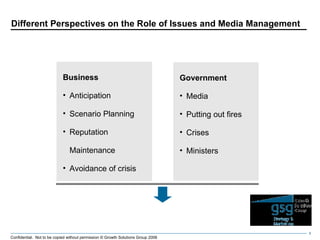
Different Perspectives on the Role of Issues and Media Management Business Anticipation Scenario Planning Reputation Maintenance Avoidance of crisis Government Media Putting out fires Crises Ministers
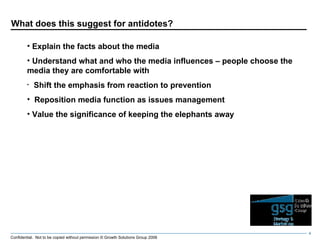
What does this suggest for antidotes? Explain the facts about the media Understand what and who the media influences – people choose the media they are comfortable with Shift the emphasis from reaction to prevention Reposition media function as issues management Value the significance of keeping the elephants away
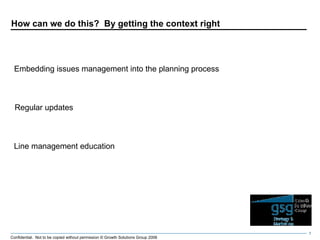
How can we do this?  By getting the context right Embedding issues management into the planning process Regular updates Line management education
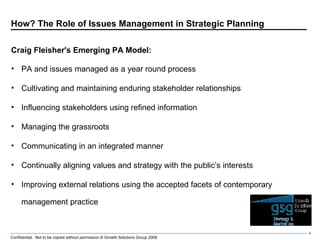
How? The Role of Issues Management in Strategic Planning Craig Fleisher's Emerging PA Model: PA and issues managed as a year round process Cultivating and maintaining enduring stakeholder relationships Influencing stakeholders using refined information Managing the grassroots Communicating in an integrated manner Continually aligning values and strategy with the public’s interests Improving external relations using the accepted facets of contemporary management practice
How? Using risk, opportunity and issues analysis Conduct issues monitoring and environmental scans locally and globally Analyse threats and be sceptical Use standard analytical tools: SWOT, PEST, Porter model Undertake scenario planning: What ifs? Constantly retest internal perception against external realities
How? Researching stakeholders and publics Categorise risks, threats and opportunities according to priorities around: Capacity to impact on survival/success Probability Capacity to influence Impact on individual organisations versus group influences Use benchmark stakeholder research to identify key relationship needs
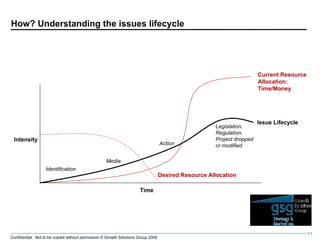
How? Understanding the issues lifecycle Time Intensity Current Resource Allocation: Time/Money Desired Resource Allocation Issue Lifecycle Identification  Media Action Legislation, Regulation, Project dropped or modified
How? Anticipating and defining issues Understanding the context – global trends, demography, economics, social change Political monitoring Media content and trend analysis Reality therapy - listening to, and looking at, the world to avoid group think The internet Using conventional planning tools e.g., scenario planning, SWOT, environmental analysis, stakeholder analysis, corporate planning situation analysis methodologies
And then - managing issues through a strategic framework Who centres and frames the issue? What is the issue - how do we define the real core of the problem? Why is it an issue? Where will it be contested? Why is it important - what social, economic, political factor or interest group underpins it? Who are the players? How can it be resolved?
Managing Issues and thus the media - Techniques and Tactics Rectification Media programs Starving issues of oxygen Masterly inaction
Some Conclusions No perfect systems – the boss is the boss is the boss The media can make a difference but just how much? Masterly inaction is an option Put an issues management plan in place and decide on the media strategy in the context of that Managing issues – not the media as such -  effectively is the best way to avoid crises

Addictions To Soundbites

  • 1.
    How to providecommunication antidotes for media-obsessed CEOs, Ministers and Ministerial staff Addiction to sound bites and the media
  • 2.
    A quick quiz* What was the page three lead in Monday’s Age? * What was the lead item on Sunday’s Channel 9 news last night? * What was the largest topic of conversation on Monday’s Jon Faine program? * What were the top five talk radio topics in the past week? * What was the editorial in Saturday’s Australian about and what line did it take?
  • 3.
    And the bigquestion: Who cares?
  • 4.
    The new mediacontext Explosion of information channels Declining newspaper circulation and readership Declining mass market TV penetration Audience segmentation Rise of alternative communication networks Yet… Demography determines media usage (Suits - male and middle class dominate) They think it is important because it is important to them
  • 5.
    Different Perspectives onthe Role of Issues and Media Management Business Anticipation Scenario Planning Reputation Maintenance Avoidance of crisis Government Media Putting out fires Crises Ministers
  • 6.
    What does thissuggest for antidotes? Explain the facts about the media Understand what and who the media influences – people choose the media they are comfortable with Shift the emphasis from reaction to prevention Reposition media function as issues management Value the significance of keeping the elephants away
  • 7.
    How can wedo this? By getting the context right Embedding issues management into the planning process Regular updates Line management education
  • 8.
    How? The Roleof Issues Management in Strategic Planning Craig Fleisher's Emerging PA Model: PA and issues managed as a year round process Cultivating and maintaining enduring stakeholder relationships Influencing stakeholders using refined information Managing the grassroots Communicating in an integrated manner Continually aligning values and strategy with the public’s interests Improving external relations using the accepted facets of contemporary management practice
  • 9.
    How? Using risk,opportunity and issues analysis Conduct issues monitoring and environmental scans locally and globally Analyse threats and be sceptical Use standard analytical tools: SWOT, PEST, Porter model Undertake scenario planning: What ifs? Constantly retest internal perception against external realities
  • 10.
    How? Researching stakeholdersand publics Categorise risks, threats and opportunities according to priorities around: Capacity to impact on survival/success Probability Capacity to influence Impact on individual organisations versus group influences Use benchmark stakeholder research to identify key relationship needs
  • 11.
    How? Understanding theissues lifecycle Time Intensity Current Resource Allocation: Time/Money Desired Resource Allocation Issue Lifecycle Identification Media Action Legislation, Regulation, Project dropped or modified
  • 12.
    How? Anticipating anddefining issues Understanding the context – global trends, demography, economics, social change Political monitoring Media content and trend analysis Reality therapy - listening to, and looking at, the world to avoid group think The internet Using conventional planning tools e.g., scenario planning, SWOT, environmental analysis, stakeholder analysis, corporate planning situation analysis methodologies
  • 13.
    And then -managing issues through a strategic framework Who centres and frames the issue? What is the issue - how do we define the real core of the problem? Why is it an issue? Where will it be contested? Why is it important - what social, economic, political factor or interest group underpins it? Who are the players? How can it be resolved?
  • 14.
    Managing Issues andthus the media - Techniques and Tactics Rectification Media programs Starving issues of oxygen Masterly inaction
  • 15.
    Some Conclusions Noperfect systems – the boss is the boss is the boss The media can make a difference but just how much? Masterly inaction is an option Put an issues management plan in place and decide on the media strategy in the context of that Managing issues – not the media as such - effectively is the best way to avoid crises

Editor's Notes

  • #2 10
  • #3 Hand out Worksheets to participants
  • #4 Hand out Worksheets to participants
  • #6 Hand out Worksheets to participants
  • #8 Hand out Worksheets to participants
  • #14 Hand out Worksheets to participants
  • #15 Hand out Worksheets to participants
  • #16 Hand out Worksheets to participants