ISOSCHIZOMERS
Umair Ahmad
ISOSCHIZOMER
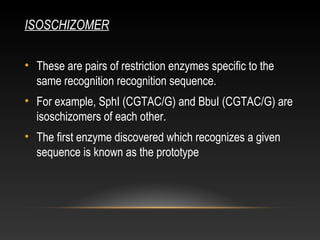
• These are pairs of restriction enzymes specific to the 
same recognition recognition sequence.
• For example, SphI (CGTAC/G) and BbuI (CGTAC/G) are 
isoschizomers of each other.
• The first enzyme discovered which recognizes a given 
sequence is known as the prototype
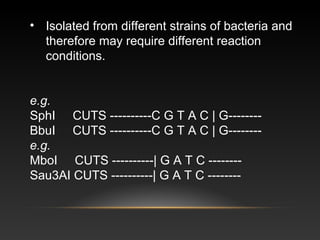
• Isolated from different strains of bacteria and
therefore may require different reaction
conditions.
e.g.
SphI CUTS ----------C G T A C | G--------
BbuI CUTS ----------C G T A C | G--------
e.g.
MboI CUTS ----------| G A T C --------
Sau3AI CUTS ----------| G A T C --------
Neoschizomers
Isocaudomers
SUB TYPES
NEOSCHIZOMERS
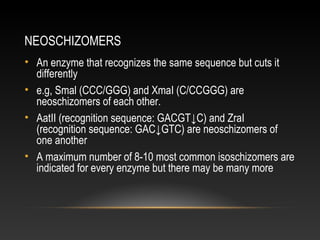
• An enzyme that recognizes the same sequence but cuts it 
differently
• e.g, Smal (CCC/GGG) and XmaI (C/CCGGG) are 
neoschizomers of each other.
• AatII (recognition sequence: GACGT↓C) and ZraI 
(recognition sequence: GAC↓GTC) are neoschizomers of 
one another
• A maximum number of 8-10 most common isoschizomers are 
indicated for every enzyme but there may be many more
e.g.
SmaI CUTS ----------C C C | G G G--------
XmaI CUTS ----------C | C C G G G--------
ISOCAUDOMERS
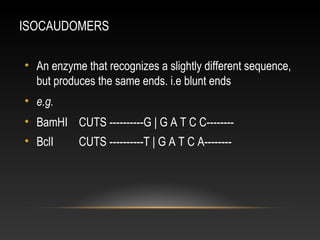
• An enzyme that recognizes a slightly different sequence, 
but produces the same ends. i.e blunt ends
• e.g.
• BamHI    CUTS ----------G | G A T C C--------
• BclI         CUTS ----------T | G A T C A-------- 
WHAT ARE RESTRICTION ENZYMES?
• Molecular scissors that cut double stranded DNA molecules
at specific points.
• Also called restriction endoneuclease.
• Found naturally in a wide variety of prokaryotes
• An important tool for manipulating DNA.
Diversity of Enzymes
EcoRI Esherichia coli R G/AATTC
BamHI Baccilu amyloliquefaciens H G/GATCC
HindIII Haemophilus influenzae Rd A/AGCCT
PstI Providencia stuartii CTGCA/G
PmeI Psuedomonas mendocina GTTT/AAAC
TYPES OF RESTRICTION ENZYMES
Cleavage
site
Location of
methylase
Examples
Type I Random
Around 1000bp
away from
recognition site
Endonuclease
and methylase
located on a
single protein
molecule
EcoK I
EcoA I
CfrA I
Type II Specific
Within the
recognition site
Endonuclease
and methylase
are separate
entities
EcoR I
BamH I
Hind III
Type III Random
24-26 bp away
Endonuclease
and methylase
EcoP I
Hinf III
RECOGNITON SEQUENCES AND CUTTING SITES FOR SOME RESTRICTION ENZYMES
HISTORY
• Arbor and Dussoix in 1962 discovered that certain
bacteria contain Endonucleases which have the ability to
cleave DNA.
• Michelson & Yuan, 1968, purification of the first
endonuclease from E.coli K12. This enzyme can bind to
DNA specifically, but cut randomly.
•In 1970 Smith and colleagues purified and
characterized the cleavage site of a Restriction
Enzyme.
•1974 – A Memorable Year 17 new restriction
enzymes found including AluI, HhaI, MboI, MboII,
SalI by Walter Fiers, Jeff Schell and Marc Van
Montagu
• Werner Arbor, Hamilton Smith and Daniel
Nathans shared the 1978 Nobel prize for
Medicine and Physiology for their discovery of
Restriction Enzymes.
TYPES OF ENDS GENERATED BY DIFFERENT RESTRICTION ENZYMES
RECOGNITION SITES OF MOST RESTRICTION
ENZYMES HAVE A TWO FOLD ROTATIONAL
SYMMETRY
Restriction enzymes have corresponding symmetry to facilitate recognition
and usually cleave the DNA on the axis of symmetry
RESTRICTION FRAGMENTS CAN BE BLUNT
ENDED OR STICKY ENDED
5’ G A A T T C 3’ 5’ G A T A T C 3’
3’ C T T A A G 5’ 3’ C T A T A G 5’
Sticky Ends Blunt Ends
Sticky ends or blunt ends can be used to join DNA fragments.
Sticky ends are more cohesive compared to blunt ends.
MECHANISM OF ACTION
 Restriction Endonuclease scan the length of the DNA.
GGACGCTAGCTGATGAATTCGCATCGGATCCGAATCCGCTCTTTCAA
CCTGCGATCGACTACTTAAGCGTAGCCTAGGCTTAGGCGAGAAAGTT
 Recognition Sequences
GGACGCTAGCTGATGAATTCGCATCGGATCCGAATCCGCTCTTTCAA
CCTGCGATCGACTACTTAAGCGTAGCCTAGGCTTAGGCGAGAAAGTT
 Cut the DNA into small
fragments.
• Produces one cut in each of the sugar
phosphate backbones of the double helix –
by hydrolyzing the phoshphodiester bond.
Specifically,the bond between the 3’ O atom
and the P atom is broken.
STRUCTURE OF ECOR 1 ENDONUCLEASE
 Consists of two subunits –
dimers related by two fold
rotational symmetry.
 Binds to the matching
symmetry of the DNA
molecule at the restriction site
and produces a kink at the
site.
BIOLOGICAL ROLE
 Most bacteria use Restriction Enzymes as a defence
against bacteriophages.
 Prevent the replication of the phage by cleaving its DNA
at specific sites.
 The host DNA is protected by Methylases which add
methyl groups to adenine or cytosine bases within the
recognition site thereby modifying the site and protecting
the DNA.
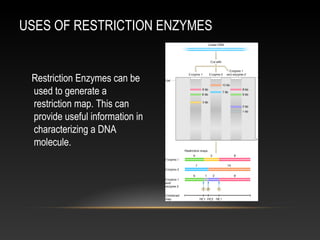
USES OF RESTRICTION ENZYMES
Restriction Enzymes can be
used to generate a
restriction map. This can
provide useful information in
characterizing a DNA
molecule.
USES….
Restriction Fragment Length Polymorphism is a tool to study
variations among individuals & among species
Restriction enzymes are
most widely used in
recombinant DNA
technology.
USES….
The ability to produce
recombinant DNA molecules
has not only revolutionized the
study of genetics, but has laid
the foundation for much of the
biotechnology industry. The
availability of
human insulin (for DM),
human factor VIII (for males
with hemophilia A), and other
proteins used in human
therapy all were made possible
by recombinant DNA.
Functions for host cells
1) Modifying their own DNA
2) Destroying the incoming DNA
REFERENCES
• Biochemistry (1995), Wiley & Sons, Inc.
Voet D. and Voet J.G.
• Biochemistry (2002), Freeman & Co.
Berg, J.M., Tymoczco, J.L., Stryer, L.
• An Introduction to Genetic Analysis (2000), Freeman & Co.
Griffiths, A., Miller, J.H., Suzuki, D.T., Lewontin, R.C., Gelbart, W.M.
• Molecular Cell Biology (2000), Freeman & Co.
Lodish, Berk, Zipursky, Matsudaria, Baltimore, Darnell
Special thanks
Madam Nazia Akbar
Sir Sajjid ul ghafoor
Prof. Dr. Noor Mohammad

Isochizomers

  • 2.
  • 3.
  • 4.
    • Isolated fromdifferent strains of bacteria and therefore may require different reaction conditions. e.g. SphI CUTS ----------C G T A C | G-------- BbuI CUTS ----------C G T A C | G-------- e.g. MboI CUTS ----------| G A T C -------- Sau3AI CUTS ----------| G A T C --------
  • 5.
  • 6.
    NEOSCHIZOMERS • An enzyme that recognizes the same sequence but cuts it  differently • e.g, Smal (CCC/GGG) and XmaI (C/CCGGG) are  neoschizomers of each other. •AatII (recognition sequence: GACGT↓C) and ZraI  (recognition sequence: GAC↓GTC) are neoschizomers of  one another • A maximum number of 8-10 most common isoschizomers are  indicated for every enzyme but there may be many more
  • 7.
    e.g. SmaI CUTS ----------CC C | G G G-------- XmaI CUTS ----------C | C C G G G--------
  • 8.
    ISOCAUDOMERS • An enzyme that recognizes a slightly different sequence,  but produces the same ends. i.e blunt ends • e.g. •BamHI    CUTS ----------G | G A T C C-------- • BclI         CUTS ----------T | G A T C A-------- 
  • 9.
    WHAT ARE RESTRICTIONENZYMES? • Molecular scissors that cut double stranded DNA molecules at specific points. • Also called restriction endoneuclease. • Found naturally in a wide variety of prokaryotes • An important tool for manipulating DNA.
  • 10.
    Diversity of Enzymes EcoRIEsherichia coli R G/AATTC BamHI Baccilu amyloliquefaciens H G/GATCC HindIII Haemophilus influenzae Rd A/AGCCT PstI Providencia stuartii CTGCA/G PmeI Psuedomonas mendocina GTTT/AAAC
  • 11.
    TYPES OF RESTRICTIONENZYMES Cleavage site Location of methylase Examples Type I Random Around 1000bp away from recognition site Endonuclease and methylase located on a single protein molecule EcoK I EcoA I CfrA I Type II Specific Within the recognition site Endonuclease and methylase are separate entities EcoR I BamH I Hind III Type III Random 24-26 bp away Endonuclease and methylase EcoP I Hinf III
  • 12.
    RECOGNITON SEQUENCES ANDCUTTING SITES FOR SOME RESTRICTION ENZYMES
  • 13.
    HISTORY • Arbor andDussoix in 1962 discovered that certain bacteria contain Endonucleases which have the ability to cleave DNA. • Michelson & Yuan, 1968, purification of the first endonuclease from E.coli K12. This enzyme can bind to DNA specifically, but cut randomly.
  • 14.
    •In 1970 Smithand colleagues purified and characterized the cleavage site of a Restriction Enzyme. •1974 – A Memorable Year 17 new restriction enzymes found including AluI, HhaI, MboI, MboII, SalI by Walter Fiers, Jeff Schell and Marc Van Montagu
  • 15.
    • Werner Arbor,Hamilton Smith and Daniel Nathans shared the 1978 Nobel prize for Medicine and Physiology for their discovery of Restriction Enzymes.
  • 16.
    TYPES OF ENDSGENERATED BY DIFFERENT RESTRICTION ENZYMES
  • 17.
    RECOGNITION SITES OFMOST RESTRICTION ENZYMES HAVE A TWO FOLD ROTATIONAL SYMMETRY Restriction enzymes have corresponding symmetry to facilitate recognition and usually cleave the DNA on the axis of symmetry
  • 18.
    RESTRICTION FRAGMENTS CANBE BLUNT ENDED OR STICKY ENDED 5’ G A A T T C 3’ 5’ G A T A T C 3’ 3’ C T T A A G 5’ 3’ C T A T A G 5’ Sticky Ends Blunt Ends Sticky ends or blunt ends can be used to join DNA fragments. Sticky ends are more cohesive compared to blunt ends.
  • 19.
    MECHANISM OF ACTION Restriction Endonuclease scan the length of the DNA. GGACGCTAGCTGATGAATTCGCATCGGATCCGAATCCGCTCTTTCAA CCTGCGATCGACTACTTAAGCGTAGCCTAGGCTTAGGCGAGAAAGTT  Recognition Sequences GGACGCTAGCTGATGAATTCGCATCGGATCCGAATCCGCTCTTTCAA CCTGCGATCGACTACTTAAGCGTAGCCTAGGCTTAGGCGAGAAAGTT
  • 20.
     Cut theDNA into small fragments.
  • 21.
    • Produces onecut in each of the sugar phosphate backbones of the double helix – by hydrolyzing the phoshphodiester bond. Specifically,the bond between the 3’ O atom and the P atom is broken.
  • 22.
    STRUCTURE OF ECOR1 ENDONUCLEASE  Consists of two subunits – dimers related by two fold rotational symmetry.  Binds to the matching symmetry of the DNA molecule at the restriction site and produces a kink at the site.
  • 23.
    BIOLOGICAL ROLE  Mostbacteria use Restriction Enzymes as a defence against bacteriophages.  Prevent the replication of the phage by cleaving its DNA at specific sites.  The host DNA is protected by Methylases which add methyl groups to adenine or cytosine bases within the recognition site thereby modifying the site and protecting the DNA.
  • 24.
    USES OF RESTRICTIONENZYMES Restriction Enzymes can be used to generate a restriction map. This can provide useful information in characterizing a DNA molecule.
  • 25.
    USES…. Restriction Fragment LengthPolymorphism is a tool to study variations among individuals & among species
  • 26.
    Restriction enzymes are mostwidely used in recombinant DNA technology. USES….
  • 27.
    The ability toproduce recombinant DNA molecules has not only revolutionized the study of genetics, but has laid the foundation for much of the biotechnology industry. The availability of human insulin (for DM), human factor VIII (for males with hemophilia A), and other proteins used in human therapy all were made possible by recombinant DNA.
  • 28.
    Functions for hostcells 1) Modifying their own DNA 2) Destroying the incoming DNA
  • 29.
    REFERENCES • Biochemistry (1995),Wiley & Sons, Inc. Voet D. and Voet J.G. • Biochemistry (2002), Freeman & Co. Berg, J.M., Tymoczco, J.L., Stryer, L. • An Introduction to Genetic Analysis (2000), Freeman & Co. Griffiths, A., Miller, J.H., Suzuki, D.T., Lewontin, R.C., Gelbart, W.M. • Molecular Cell Biology (2000), Freeman & Co. Lodish, Berk, Zipursky, Matsudaria, Baltimore, Darnell
  • 30.
    Special thanks Madam NaziaAkbar Sir Sajjid ul ghafoor Prof. Dr. Noor Mohammad