[LAB REPORT] 
Microbial Genetic Engineering : MIC 401 
SUBMITTED TO: DR. ZEENAT JAHAN 
SUBMITTED BY: MOHAMMAD AL MAHMUD-UN-NABI 
DEPARTMENT OF MATHEMATICS AND NATURAL SCIENCES
Date: 24th November, 2014 
Name of the experiment: 
Isolation of plasmid DNA 
Purpose: 
To isolate plasmid from a bacterium that was transformed with the pGLO plasmid. 
Principle: 
A plasmid is a small DNA molecule within a cell that is physically separated from a 
chromosomal DNA and can replicate independently. They are most commonly found in 
bacteria as small (usually 1 kb to 500 kb in size) and are circular, double-stranded DNA 
molecules; however, plasmids are sometimes present in archaea and eukaryotic organisms. In 
nature, plasmids carry genes that may benefit survival of the organism by developing 
antibiotic resistance gene (R Plasmid) and production of restriction enzymes, carries genes 
for utilization of some unusual metabolites, toxin production, nitrogen fixation, conjugation 
and some have no apparent function (cryptic plasmids). The plasmids use the enzymes and 
proteins for replication encoded from the host chromosomal DNA. If a cell contains 10 to 100 
copies of plasmid are called high copy number plasmid and it the plasmid number is in 
between 1 to 4 is said to be low copy number plasmid. The plasmids can frequently be 
transmitted from one bacterium to another or even of another species via horizontal gene 
transfer. Artificial plasmids are widely used as vectors in molecular cloning. The basic 
feature of plasmid which is essential for a high quality vector- 
1. The small size of plasmid is necessary to transfer larger sized exogenous DNA. 
2. The unique restriction sites in plasmid help to insert the foreign DNA into the 
plasmid. 
3. The plasmid also contains some selectable markers or the markers may be inserted in 
order to confirm the transformation of the exogenous gene. 
Plasmids serve as important tools in genetics and biotechnology labs, where they are 
commonly used to multiply or express particular genes. The first task of the genetic 
engineering of plasmid, it needs to be isolated form the cell. In our plasmid isolating 
experiment we will follow the modified alkali lyses method of Birnboim and Doly. We have 
been supplied with a inoculate of a single colony of E. coli (Dh5-Alpha) to a 50ml LB broth 
containing amplicilin antibiotic. The strain is resistant to ampicillin. The culture is grown for 
overnight.
Meterials and Methods 
Media: 
50ml LB broth medium containing Ampicillin as antibiotic. 
Reagents: 
Solution 1: Alkaline lyses solution (pH 8) [Containing- 50mM Glucose + 25mM Tris + 
10mM EDTA] 
Solution 2: Detergent for lyses [1% SDS + 0.2N NaOH] 
Solution 3: To maintain pH Balance [3M Potasium acetate + 5M Glacial Acetic Acid] 
TE Buffer: [10mM Tris HCl + 1mM EDTA] 
Ice cold ethanol (95%) 
Equipments: 
Micropipette, inoculating loop, sterile tips, Eppendorf tubes, falcon tubes and markers. 
Procedure: 
1. One of the bacterial colony was selected and inoculated in 50ml of LB broth 
containing ampicillin antibiotic and incubated for overnight at 37°C 
2. The culture was kept in room temperature. 
3. For harvesting the culture, they were transferred 4 different falcon tubes (12.5ml 
each) and were centrifuged at 8000rpm for 5min. the supernatant were discarded and 
the pellets were collected. 
4. The pellets were re-suspended to 100μl of solution 1 from all the falcon tubes and 
were transferred to an Eppendorf tube. It was kept for 5min in room temperature. 
5. After that 200μl of solution 2 was added to the Eppendorf tube and kept in ice cool 
solution for 10min. 
6. Followed by 150μl precooled solution 3 was added to the Eppendorf tube and kept for 
5min at ice-cooled temperature. 
7. Then the Eppendorf tube was mixed by vortex machine to make a uniform mixture 
then they were centrifuged for 5min with 14000rpm at temperature 25°C. The 
supernatant was collected in another Eppendorf tube and the pellet was discarded. 
8. Two volume of ice-cooled 95% ethanol was added to the supernatant and was kept in 
room temperature for 10min. 
9. The Eppendorf tube was again centrifuged at 14000rpm for 5min and now the pellet is 
collected.
10. The pellet was washed and dried with 70% ethanol solution. 
11. The pellet was re-suspended with 50μl TE buffer and can be stored at -20°C for future 
use. 
12. The Isolated plasmid DNA has to be now tested by GEL Electrophoresis with a 
known ladder for comparison. 
Observation: 
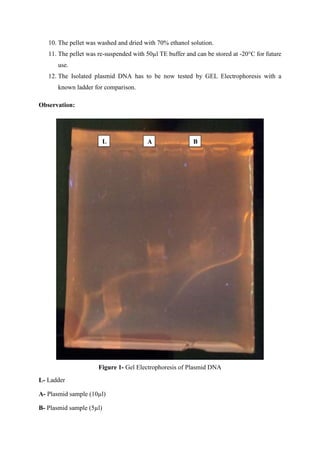
Figure 1- Gel Electrophoresis of Plasmid DNA 
L- Ladder 
A- Plasmid sample (10μl) 
B- Plasmid sample (5μl) 
L A B
Discussion: 
We were able to isolate the plasmid DNA form the supplied E. coli (Dh5-Alpha) sample. 
After the gel run we have seen a single band for both sample A and B. But there might be any 
problem occurred in the ladder DNA we have used for comparing the plasmid. The ladder 
should have two distinct bands after the gel run, but we can observe only one band and it has 
travelled a lot of distance, which is a bit unusual. Therefore, we cannot further analyse our 
plasmid with the help of the ladder. Sample A contains 10μl of isolated plasmid and sample 
B contains 5μl, therefore, the concentration of plasmid was more in sample A which resulted 
a very sharp band in the gel than sample B.

Plasmid Isolation Lab Report

  • 1.
    [LAB REPORT] MicrobialGenetic Engineering : MIC 401 SUBMITTED TO: DR. ZEENAT JAHAN SUBMITTED BY: MOHAMMAD AL MAHMUD-UN-NABI DEPARTMENT OF MATHEMATICS AND NATURAL SCIENCES
  • 2.
    Date: 24th November,2014 Name of the experiment: Isolation of plasmid DNA Purpose: To isolate plasmid from a bacterium that was transformed with the pGLO plasmid. Principle: A plasmid is a small DNA molecule within a cell that is physically separated from a chromosomal DNA and can replicate independently. They are most commonly found in bacteria as small (usually 1 kb to 500 kb in size) and are circular, double-stranded DNA molecules; however, plasmids are sometimes present in archaea and eukaryotic organisms. In nature, plasmids carry genes that may benefit survival of the organism by developing antibiotic resistance gene (R Plasmid) and production of restriction enzymes, carries genes for utilization of some unusual metabolites, toxin production, nitrogen fixation, conjugation and some have no apparent function (cryptic plasmids). The plasmids use the enzymes and proteins for replication encoded from the host chromosomal DNA. If a cell contains 10 to 100 copies of plasmid are called high copy number plasmid and it the plasmid number is in between 1 to 4 is said to be low copy number plasmid. The plasmids can frequently be transmitted from one bacterium to another or even of another species via horizontal gene transfer. Artificial plasmids are widely used as vectors in molecular cloning. The basic feature of plasmid which is essential for a high quality vector- 1. The small size of plasmid is necessary to transfer larger sized exogenous DNA. 2. The unique restriction sites in plasmid help to insert the foreign DNA into the plasmid. 3. The plasmid also contains some selectable markers or the markers may be inserted in order to confirm the transformation of the exogenous gene. Plasmids serve as important tools in genetics and biotechnology labs, where they are commonly used to multiply or express particular genes. The first task of the genetic engineering of plasmid, it needs to be isolated form the cell. In our plasmid isolating experiment we will follow the modified alkali lyses method of Birnboim and Doly. We have been supplied with a inoculate of a single colony of E. coli (Dh5-Alpha) to a 50ml LB broth containing amplicilin antibiotic. The strain is resistant to ampicillin. The culture is grown for overnight.
  • 3.
    Meterials and Methods Media: 50ml LB broth medium containing Ampicillin as antibiotic. Reagents: Solution 1: Alkaline lyses solution (pH 8) [Containing- 50mM Glucose + 25mM Tris + 10mM EDTA] Solution 2: Detergent for lyses [1% SDS + 0.2N NaOH] Solution 3: To maintain pH Balance [3M Potasium acetate + 5M Glacial Acetic Acid] TE Buffer: [10mM Tris HCl + 1mM EDTA] Ice cold ethanol (95%) Equipments: Micropipette, inoculating loop, sterile tips, Eppendorf tubes, falcon tubes and markers. Procedure: 1. One of the bacterial colony was selected and inoculated in 50ml of LB broth containing ampicillin antibiotic and incubated for overnight at 37°C 2. The culture was kept in room temperature. 3. For harvesting the culture, they were transferred 4 different falcon tubes (12.5ml each) and were centrifuged at 8000rpm for 5min. the supernatant were discarded and the pellets were collected. 4. The pellets were re-suspended to 100μl of solution 1 from all the falcon tubes and were transferred to an Eppendorf tube. It was kept for 5min in room temperature. 5. After that 200μl of solution 2 was added to the Eppendorf tube and kept in ice cool solution for 10min. 6. Followed by 150μl precooled solution 3 was added to the Eppendorf tube and kept for 5min at ice-cooled temperature. 7. Then the Eppendorf tube was mixed by vortex machine to make a uniform mixture then they were centrifuged for 5min with 14000rpm at temperature 25°C. The supernatant was collected in another Eppendorf tube and the pellet was discarded. 8. Two volume of ice-cooled 95% ethanol was added to the supernatant and was kept in room temperature for 10min. 9. The Eppendorf tube was again centrifuged at 14000rpm for 5min and now the pellet is collected.
  • 4.
    10. The pelletwas washed and dried with 70% ethanol solution. 11. The pellet was re-suspended with 50μl TE buffer and can be stored at -20°C for future use. 12. The Isolated plasmid DNA has to be now tested by GEL Electrophoresis with a known ladder for comparison. Observation: Figure 1- Gel Electrophoresis of Plasmid DNA L- Ladder A- Plasmid sample (10μl) B- Plasmid sample (5μl) L A B
  • 5.
    Discussion: We wereable to isolate the plasmid DNA form the supplied E. coli (Dh5-Alpha) sample. After the gel run we have seen a single band for both sample A and B. But there might be any problem occurred in the ladder DNA we have used for comparing the plasmid. The ladder should have two distinct bands after the gel run, but we can observe only one band and it has travelled a lot of distance, which is a bit unusual. Therefore, we cannot further analyse our plasmid with the help of the ladder. Sample A contains 10μl of isolated plasmid and sample B contains 5μl, therefore, the concentration of plasmid was more in sample A which resulted a very sharp band in the gel than sample B.