
MOHAMMAD ANAS SIDDIQUI
ISO 9001:2008
QUALITY MANAGEMENT SYSTEM
2ISO 9001:2008
Declaration
3ISO 9001:2008
Agenda
 About ISO
 What is Quality
 Quality statement
 Aim
 Definitions
 The 8 quality management principles
 Benefits of the Quality Management System
 ISO 9001 Definition
 ISO 9001 Requirements
 Why certification of the QMS
 Employees involvement
 ISO 9001:2008 main additional requirements
4ISO 9001:2008
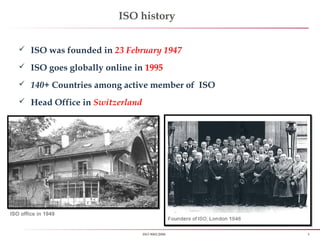
ISO history
 ISO was founded in 23 February 1947
 ISO goes globally online in 1995
 140+ Countries among active member of ISO
 Head Office in Switzerland
ISO office in 1949
5ISO 9001:2008
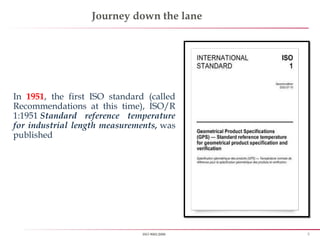
Journey down the lane
In 1951, the first ISO standard (called
Recommendations at this time), ISO/R
1:1951 Standard reference temperature
for industrial length measurements, was
published
6ISO 9001:2008
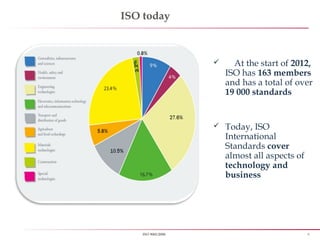
ISO today
 At the start of 2012,
ISO has 163 members
and has a total of over
19 000 standards
 Today, ISO
International
Standards cover
almost all aspects of
technology and
business
7ISO 9001:2008
What is quality [1]
 Degree of excellence/ Extent to which a product or a service satisfies
the customer expectation
8ISO 9001:2008
What is quality [2]
 First rule of quality - An organization shall be a “Process based”,
instead of old tradition “Man based organization”
 All process shall have a “Control measure”, hence ensuring low defect
and enhancing customer delight or satisfaction
9ISO 9001:2008
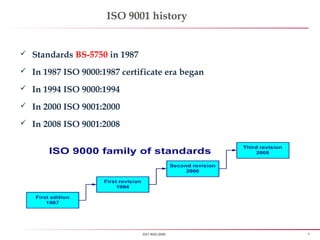
ISO 9001 history
 Standards BS-5750 in 1987
 In 1987 ISO 9000:1987 certificate era began
 In 1994 ISO 9000:1994
 In 2000 ISO 9001:2000
 In 2008 ISO 9001:2008
10ISO 9001:2008
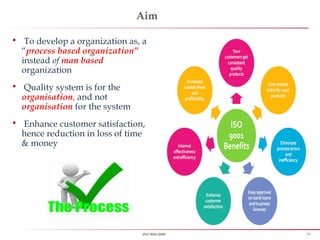
Aim
 To develop a organization as, a
“process based organization”
instead of man based
organization
 Quality system is for the
organisation, and not
organisation for the system
 Enhance customer satisfaction,
hence reduction in loss of time
& money
11ISO 9001:2008
Definitions
ISO : International Organization for Standardization
QMS : Coordinated activities to direct & control an organization with
regard to quality
Management : “The process of dealing with or controlling things or
people”
12ISO 9001:2008
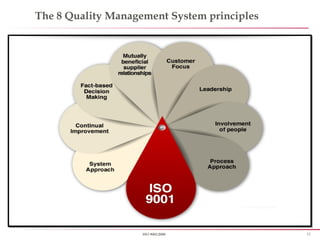
The 8 Quality Management System principles
13ISO 9001:2008
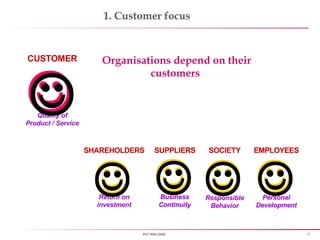
1. Customer focus
Organisations depend on their
customers

SHAREHOLDERS
Return on
investment


CUSTOMER
Quality of
Product / Service


EMPLOYEES
Personal
Development

EMPLOYEES
Personal
Development
EMPLOYEES
Pe

SOCIETY
Responsible
Behavior
r

SUPPLIERS
Business
Continuity

SUPPLIERS
Business
Continuity
SUPPLIERS
Business
Continuity
14ISO 9001:2008
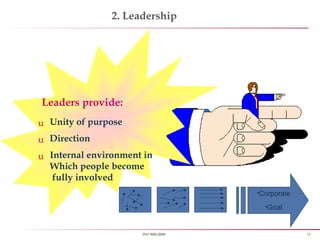
2. Leadership
Leaders provide:
u Unity of purpose
u Direction
u Internal environment in
Which people become
fully involved
•Corporate
•Goal
15ISO 9001:2008
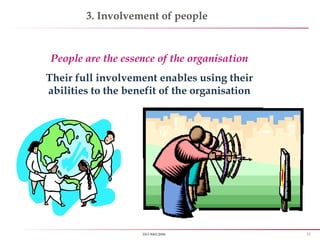
3. Involvement of people
People are the essence of the organisation
Their full involvement enables using their
abilities to the benefit of the organisation
16ISO 9001:2008
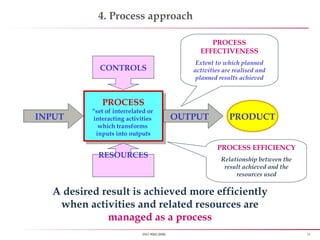
4. Process approach
A desired result is achieved more efficiently
when activities and related resources are
managed as a process
PROCESS
“set of interrelated or
interacting activities
which transforms
inputs into outputs
PROCESS
“set of interrelated or
interacting activities
which transforms
inputs into outputs
INPUT OUTPUT
RESOURCES
CONTROLS
PRODUCT
PROCESS
EFFECTIVENESS
Extent to which planned
activities are realised and
planned results achieved
PROCESS EFFICIENCY
Relationship between the
result achieved and the
resources used
17ISO 9001:2008
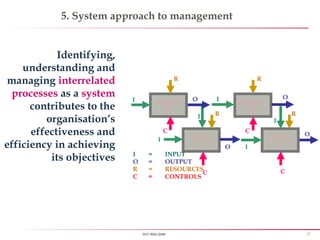
5. System approach to management
Identifying,
understanding and
managing interrelated
processes as a system
contributes to the
organisation’s
effectiveness and
efficiency in achieving
its objectives
Process
A
Process
B
Process
C
Process
D
R R
R R
I
I
I
CC
C C
I O
I
I
O
O
O
I = INPUT
O = OUTPUT
R = RESOURCES
C = CONTROLS
18ISO 9001:2008
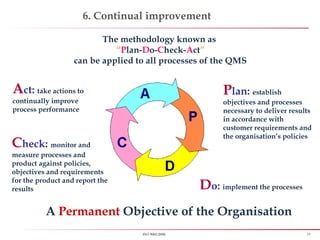
6. Continual improvement
A Permanent Objective of the Organisation
Plan: establish
objectives and processes
necessary to deliver results
in accordance with
customer requirements and
the organisation’s policies
Check: monitor and
measure processes and
product against policies,
objectives and requirements
for the product and report the
results
Act: take actions to
continually improve
process performance
Do: implement the processes
The methodology known as
“Plan-Do-Check-Act”
can be applied to all processes of the QMS
19ISO 9001:2008
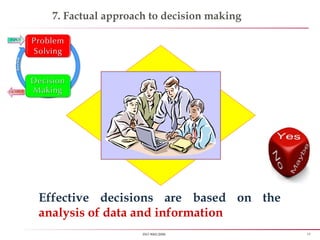
7. Factual approach to decision making
Effective decisions are based on the
analysis of data and information
20ISO 9001:2008
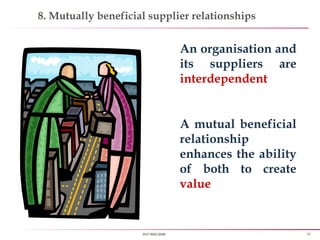
8. Mutually beneficial supplier relationships
An organisation and
its suppliers are
interdependent
A mutual beneficial
relationship
enhances the ability
of both to create
value
21ISO 9001:2008
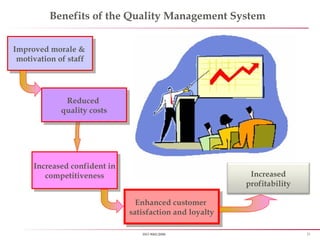
Benefits of the Quality Management System
Improved morale &
motivation of staff
Improved morale &
motivation of staff
Reduced
quality costs
Reduced
quality costs
Increased confident in
competitiveness
Increased confident in
competitiveness
Enhanced customer
satisfaction and loyalty
Enhanced customer
satisfaction and loyalty
Increased
profitability
22ISO 9001:2008
ISO 9000 & 9001 definitions
What is ISO
 ISO 9000 is a family of standards for quality management system.
 ISO 9001 requirements include the requirements which an organization
needs to fulfill if it is to achieve customer satisfaction through
consistent products and services which meet customer expectations.
 ISO 9001 is based on Deming Model of Plan-DO-Check-Act & takes into
consideration the 8 Quality Principles
 An ISO certificate is not a once-and-for-all award, but must be renewed at
regular intervals recommended by the certification body, usually around
three years.
Remark: A company or organization that has been independently audited
and certified to be in conformance with ISO 9001 may publicly state that it
is ‘ISO 9001 certified’ . Certification to an ISO 9001 standard does not
guarantee any quality of end products and services; rather, it certifies
that formalized business processes are being applied.
23ISO 9001:2008
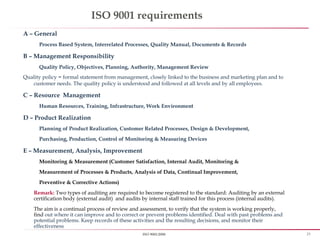
ISO 9001 requirements
A – General
Process Based System, Interrelated Processes, Quality Manual, Documents & Records
B – Management Responsibility
Quality Policy, Objectives, Planning, Authority, Management Review
Quality policy = formal statement from management, closely linked to the business and marketing plan and to
customer needs. The quality policy is understood and followed at all levels and by all employees.
C – Resource Management
Human Resources, Training, Infrastructure, Work Environment
D – Product Realization
Planning of Product Realization, Customer Related Processes, Design & Development,
Purchasing, Production, Control of Monitoring & Measuring Devices
E – Measurement, Analysis, Improvement
Monitoring & Measurement (Customer Satisfaction, Internal Audit, Monitoring &
Measurement of Processes & Products, Analysis of Data, Continual Improvement,
Preventive & Corrective Actions)
Remark: Two types of auditing are required to become registered to the standard: Auditing by an external
certification body (external audit) and audits by internal staff trained for this process (internal audits).
The aim is a continual process of review and assessment, to verify that the system is working properly,
find out where it can improve and to correct or prevent problems identified. Deal with past problems and
potential problems. Keep records of these activities and the resulting decisions, and monitor their
effectiveness
24ISO 9001:2008
C
U
S
T
O
M
E
R
S
C
U
S
T
O
M
E
R
S
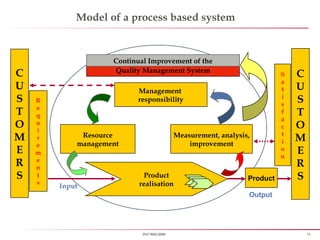
Management
responsibility
Resource
management
Measurement, analysis,
improvement
ProductProduct
realisation
Continual Improvement of the
Quality Management System
R
e
q
u
i
r
e
m
e
n
t
s
S
a
t
i
s
f
a
c
t
i
o
n
Input
Output
Model of a process based system
Continual Improvement of the
25ISO 9001:2008
Why certification of the QMS
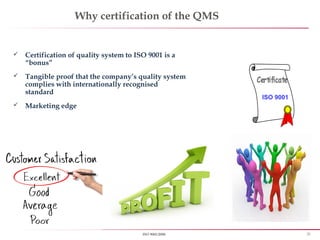
 Certification of quality system to ISO 9001 is a
“bonus”
 Tangible proof that the company’s quality system
complies with internationally recognised
standard
 Marketing edge
ISO 9001
Certificate
26ISO 9001:2008
Employees involvement (1)
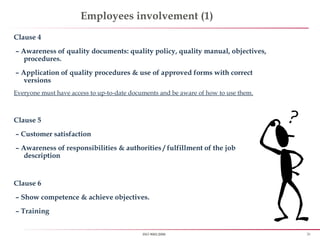
Clause 4
– Awareness of quality documents: quality policy, quality manual, objectives,
procedures.
– Application of quality procedures & use of approved forms with correct
versions
Everyone must have access to up-to-date documents and be aware of how to use them.
Clause 5
– Customer satisfaction
– Awareness of responsibilities & authorities / fulfillment of the job
description
Clause 6
– Show competence & achieve objectives.
– Training
27ISO 9001:2008
Employees involvement (2)
Clause 7
– Reporting of complaints & customer feedback
Clause 8
– Suggest & implement corrective & preventive actions
– Reporting of non conformities
– Contribute in internal audits & continual improvement
28ISO 9001:2008
ISO 9001:2008 main additional requirements
 Management representative has to be a member of the organization
management & not an external individual
 Clarification that information systems are included as part of the
company infrastructure
 Requirement to review the effectiveness of corrective & preventive
action
 For internal audits, the management of the audited unit must ensure
that necessary corrections and corrective actions are taken
 Competence of all personnel affecting conformity to product
requirement must be controlled by the organization
THANK YOU

Iso 9001 2008

  • 1.
    MOHAMMAD ANAS SIDDIQUI ISO9001:2008 QUALITY MANAGEMENT SYSTEM
  • 2.
  • 3.
    3ISO 9001:2008 Agenda  AboutISO  What is Quality  Quality statement  Aim  Definitions  The 8 quality management principles  Benefits of the Quality Management System  ISO 9001 Definition  ISO 9001 Requirements  Why certification of the QMS  Employees involvement  ISO 9001:2008 main additional requirements
  • 4.
    4ISO 9001:2008 ISO history ISO was founded in 23 February 1947  ISO goes globally online in 1995  140+ Countries among active member of ISO  Head Office in Switzerland ISO office in 1949
  • 5.
    5ISO 9001:2008 Journey downthe lane In 1951, the first ISO standard (called Recommendations at this time), ISO/R 1:1951 Standard reference temperature for industrial length measurements, was published
  • 6.
    6ISO 9001:2008 ISO today At the start of 2012, ISO has 163 members and has a total of over 19 000 standards  Today, ISO International Standards cover almost all aspects of technology and business
  • 7.
    7ISO 9001:2008 What isquality [1]  Degree of excellence/ Extent to which a product or a service satisfies the customer expectation
  • 8.
    8ISO 9001:2008 What isquality [2]  First rule of quality - An organization shall be a “Process based”, instead of old tradition “Man based organization”  All process shall have a “Control measure”, hence ensuring low defect and enhancing customer delight or satisfaction
  • 9.
    9ISO 9001:2008 ISO 9001history  Standards BS-5750 in 1987  In 1987 ISO 9000:1987 certificate era began  In 1994 ISO 9000:1994  In 2000 ISO 9001:2000  In 2008 ISO 9001:2008
  • 10.
    10ISO 9001:2008 Aim  Todevelop a organization as, a “process based organization” instead of man based organization  Quality system is for the organisation, and not organisation for the system  Enhance customer satisfaction, hence reduction in loss of time & money
  • 11.
    11ISO 9001:2008 Definitions ISO :International Organization for Standardization QMS : Coordinated activities to direct & control an organization with regard to quality Management : “The process of dealing with or controlling things or people”
  • 12.
    12ISO 9001:2008 The 8Quality Management System principles
  • 13.
    13ISO 9001:2008 1. Customerfocus Organisations depend on their customers  SHAREHOLDERS Return on investment   CUSTOMER Quality of Product / Service   EMPLOYEES Personal Development  EMPLOYEES Personal Development EMPLOYEES Pe  SOCIETY Responsible Behavior r  SUPPLIERS Business Continuity  SUPPLIERS Business Continuity SUPPLIERS Business Continuity
  • 14.
    14ISO 9001:2008 2. Leadership Leadersprovide: u Unity of purpose u Direction u Internal environment in Which people become fully involved •Corporate •Goal
  • 15.
    15ISO 9001:2008 3. Involvementof people People are the essence of the organisation Their full involvement enables using their abilities to the benefit of the organisation
  • 16.
    16ISO 9001:2008 4. Processapproach A desired result is achieved more efficiently when activities and related resources are managed as a process PROCESS “set of interrelated or interacting activities which transforms inputs into outputs PROCESS “set of interrelated or interacting activities which transforms inputs into outputs INPUT OUTPUT RESOURCES CONTROLS PRODUCT PROCESS EFFECTIVENESS Extent to which planned activities are realised and planned results achieved PROCESS EFFICIENCY Relationship between the result achieved and the resources used
  • 17.
    17ISO 9001:2008 5. Systemapproach to management Identifying, understanding and managing interrelated processes as a system contributes to the organisation’s effectiveness and efficiency in achieving its objectives Process A Process B Process C Process D R R R R I I I CC C C I O I I O O O I = INPUT O = OUTPUT R = RESOURCES C = CONTROLS
  • 18.
    18ISO 9001:2008 6. Continualimprovement A Permanent Objective of the Organisation Plan: establish objectives and processes necessary to deliver results in accordance with customer requirements and the organisation’s policies Check: monitor and measure processes and product against policies, objectives and requirements for the product and report the results Act: take actions to continually improve process performance Do: implement the processes The methodology known as “Plan-Do-Check-Act” can be applied to all processes of the QMS
  • 19.
    19ISO 9001:2008 7. Factualapproach to decision making Effective decisions are based on the analysis of data and information
  • 20.
    20ISO 9001:2008 8. Mutuallybeneficial supplier relationships An organisation and its suppliers are interdependent A mutual beneficial relationship enhances the ability of both to create value
  • 21.
    21ISO 9001:2008 Benefits ofthe Quality Management System Improved morale & motivation of staff Improved morale & motivation of staff Reduced quality costs Reduced quality costs Increased confident in competitiveness Increased confident in competitiveness Enhanced customer satisfaction and loyalty Enhanced customer satisfaction and loyalty Increased profitability
  • 22.
    22ISO 9001:2008 ISO 9000& 9001 definitions What is ISO  ISO 9000 is a family of standards for quality management system.  ISO 9001 requirements include the requirements which an organization needs to fulfill if it is to achieve customer satisfaction through consistent products and services which meet customer expectations.  ISO 9001 is based on Deming Model of Plan-DO-Check-Act & takes into consideration the 8 Quality Principles  An ISO certificate is not a once-and-for-all award, but must be renewed at regular intervals recommended by the certification body, usually around three years. Remark: A company or organization that has been independently audited and certified to be in conformance with ISO 9001 may publicly state that it is ‘ISO 9001 certified’ . Certification to an ISO 9001 standard does not guarantee any quality of end products and services; rather, it certifies that formalized business processes are being applied.
  • 23.
    23ISO 9001:2008 ISO 9001requirements A – General Process Based System, Interrelated Processes, Quality Manual, Documents & Records B – Management Responsibility Quality Policy, Objectives, Planning, Authority, Management Review Quality policy = formal statement from management, closely linked to the business and marketing plan and to customer needs. The quality policy is understood and followed at all levels and by all employees. C – Resource Management Human Resources, Training, Infrastructure, Work Environment D – Product Realization Planning of Product Realization, Customer Related Processes, Design & Development, Purchasing, Production, Control of Monitoring & Measuring Devices E – Measurement, Analysis, Improvement Monitoring & Measurement (Customer Satisfaction, Internal Audit, Monitoring & Measurement of Processes & Products, Analysis of Data, Continual Improvement, Preventive & Corrective Actions) Remark: Two types of auditing are required to become registered to the standard: Auditing by an external certification body (external audit) and audits by internal staff trained for this process (internal audits). The aim is a continual process of review and assessment, to verify that the system is working properly, find out where it can improve and to correct or prevent problems identified. Deal with past problems and potential problems. Keep records of these activities and the resulting decisions, and monitor their effectiveness
  • 24.
    24ISO 9001:2008 C U S T O M E R S C U S T O M E R S Management responsibility Resource management Measurement, analysis, improvement ProductProduct realisation ContinualImprovement of the Quality Management System R e q u i r e m e n t s S a t i s f a c t i o n Input Output Model of a process based system Continual Improvement of the
  • 25.
    25ISO 9001:2008 Why certificationof the QMS  Certification of quality system to ISO 9001 is a “bonus”  Tangible proof that the company’s quality system complies with internationally recognised standard  Marketing edge ISO 9001 Certificate
  • 26.
    26ISO 9001:2008 Employees involvement(1) Clause 4 – Awareness of quality documents: quality policy, quality manual, objectives, procedures. – Application of quality procedures & use of approved forms with correct versions Everyone must have access to up-to-date documents and be aware of how to use them. Clause 5 – Customer satisfaction – Awareness of responsibilities & authorities / fulfillment of the job description Clause 6 – Show competence & achieve objectives. – Training
  • 27.
    27ISO 9001:2008 Employees involvement(2) Clause 7 – Reporting of complaints & customer feedback Clause 8 – Suggest & implement corrective & preventive actions – Reporting of non conformities – Contribute in internal audits & continual improvement
  • 28.
    28ISO 9001:2008 ISO 9001:2008main additional requirements  Management representative has to be a member of the organization management & not an external individual  Clarification that information systems are included as part of the company infrastructure  Requirement to review the effectiveness of corrective & preventive action  For internal audits, the management of the audited unit must ensure that necessary corrections and corrective actions are taken  Competence of all personnel affecting conformity to product requirement must be controlled by the organization
  • 29.

Editor's Notes

  • #25 Briefly explain that Clause 4 of ISO 9001:2008 is essentially describing the documentation requirements of any management system, and that this is represented by the highlighted box in the process diagram illustrated in the standard.