Clause 9.3 Management Review -
AS9100:2016, ISO9001:2015; What's New?
Dr. Rajesh S. Ransing, Swansea University, UK
Dr. Meghana R. Ransing, p-matrix Ltd., UK
Invited Guest Lecture
Technical Session 3: Management (Room 342A)
Part 1- Innovative Management Practices
Date: 18th April 2016. Time: 14:15-14.45
Le Palais des Congrès de Paris - Niveau 3 Bordeaux, 2 place de la Porte Maillot 75017 Paris
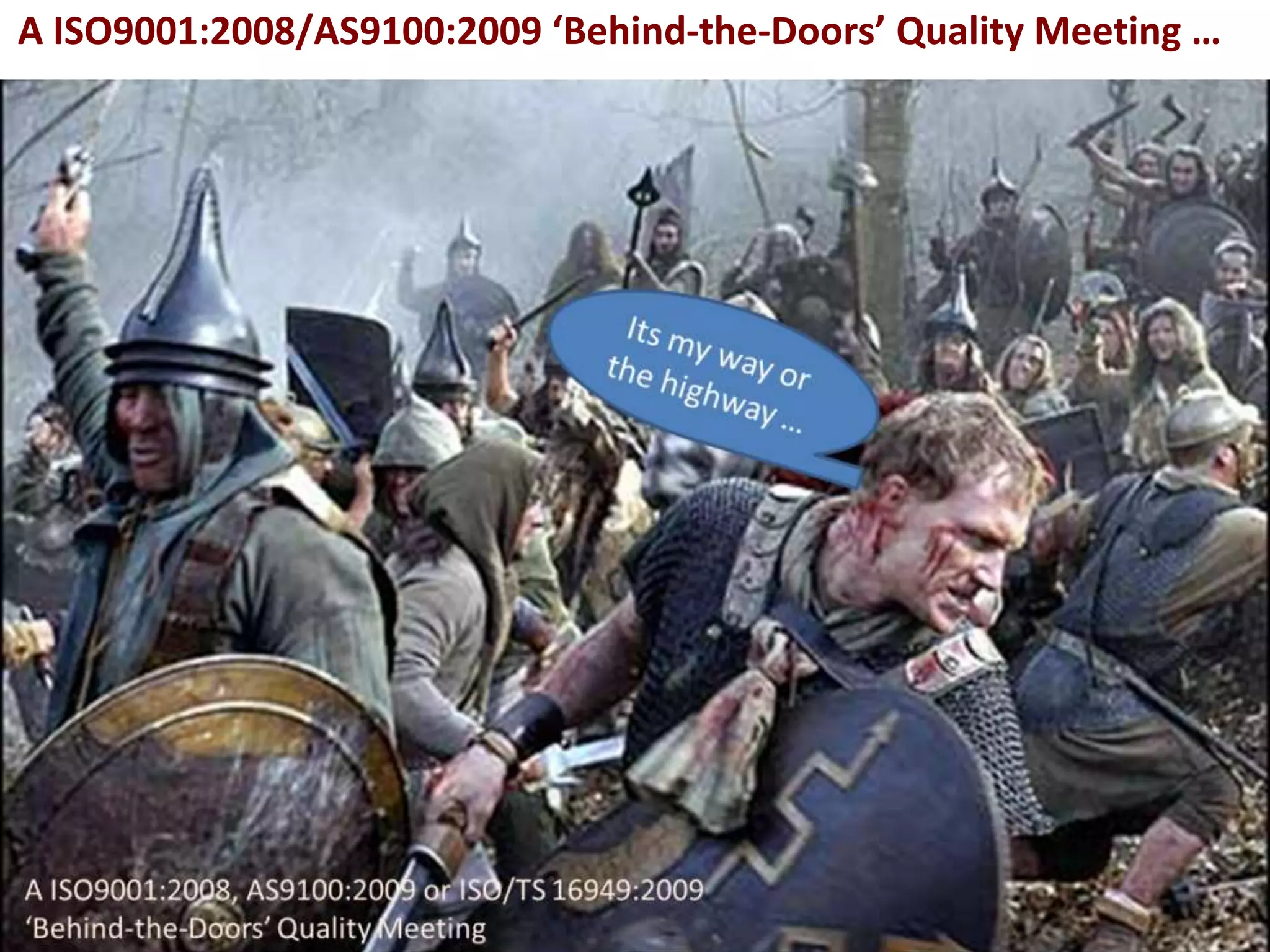
A ISO9001:2008/AS9100:2009 ‘Behind-the-Doors’ Quality Meeting …
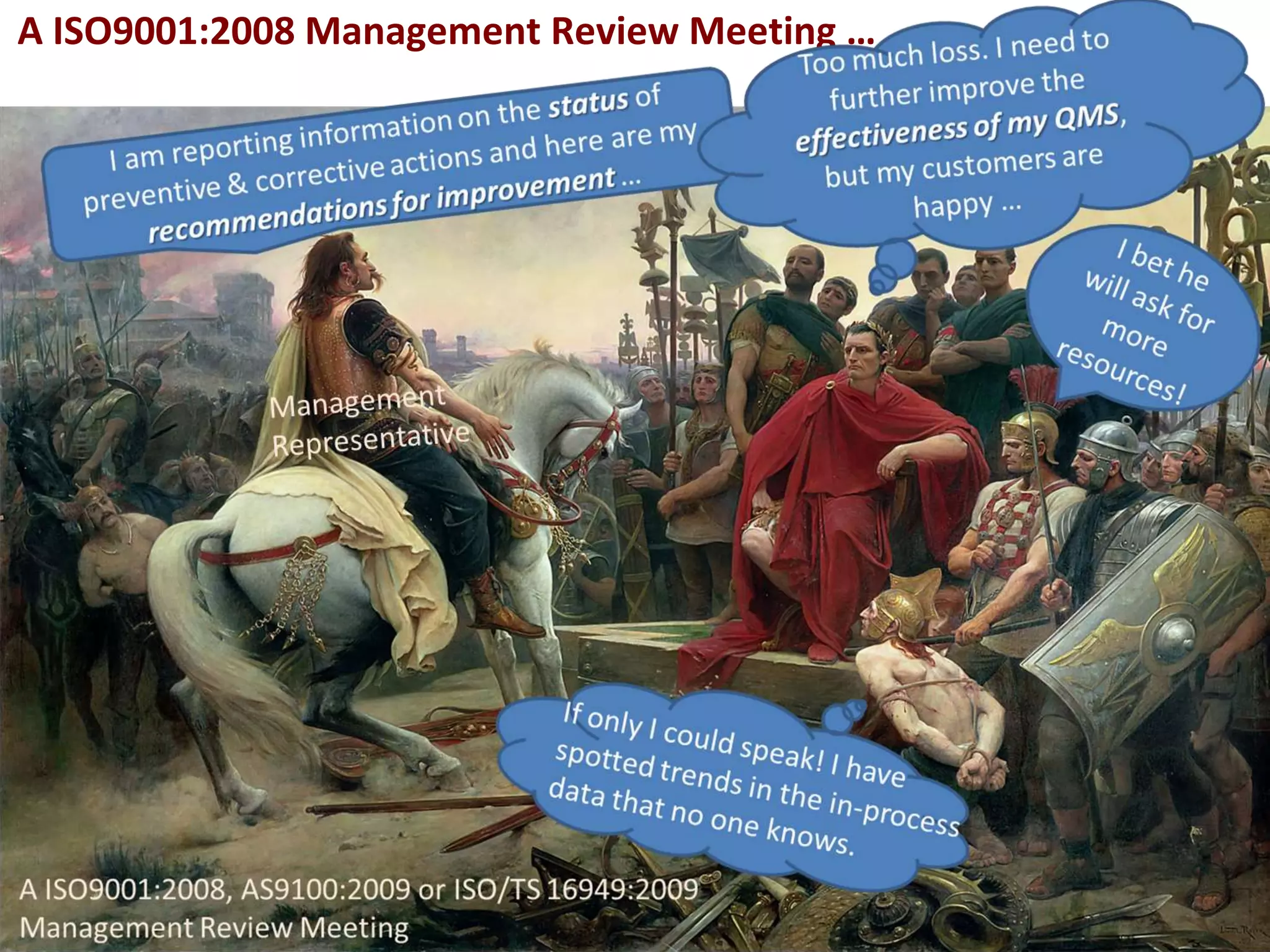
A ISO9001:2008 Management Review Meeting …
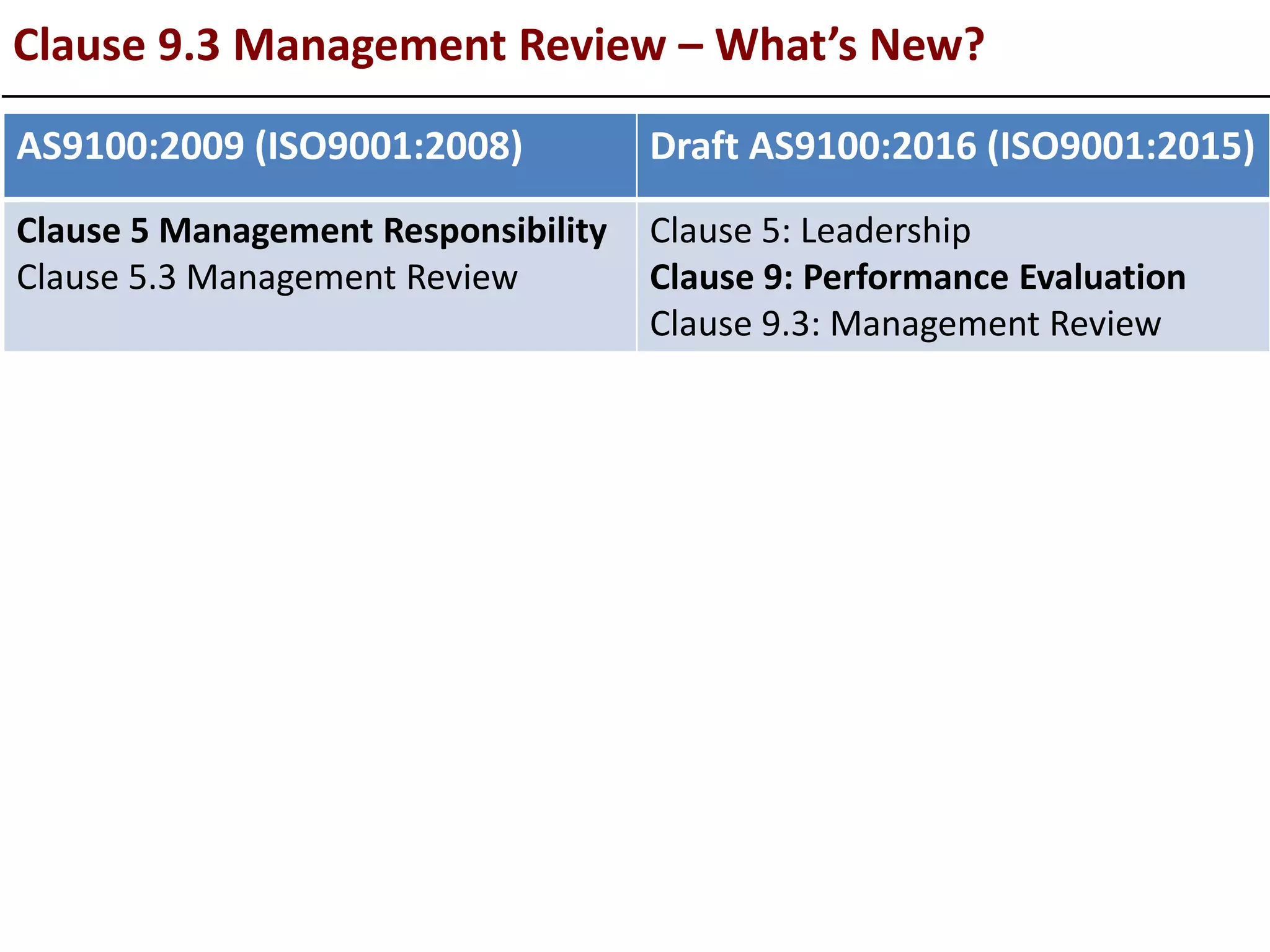
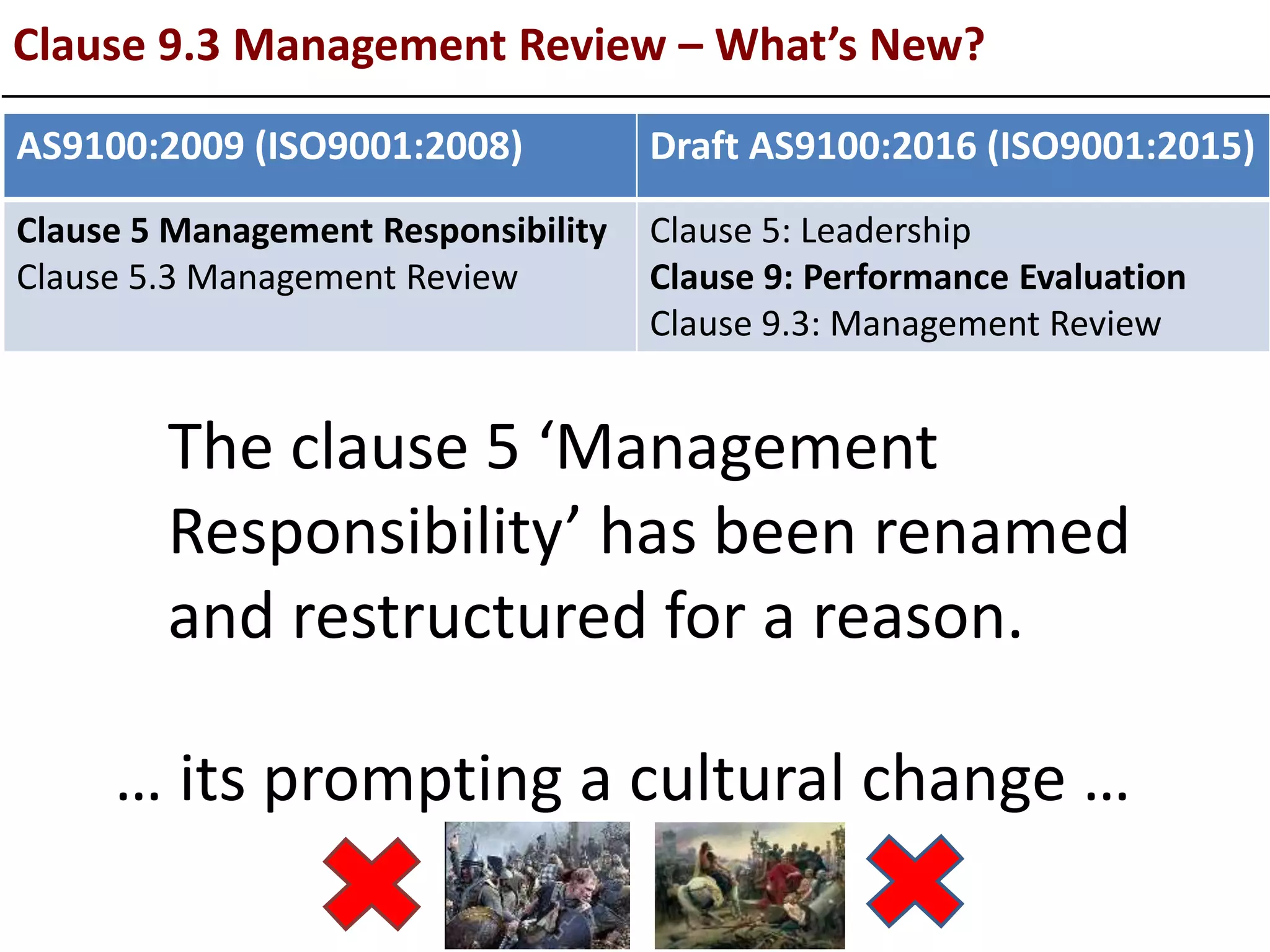
Clause 9.3 Management Review – What’s New?
AS9100:2009 (ISO9001:2008) Draft AS9100:2016 (ISO9001:2015)
Clause 5 Management Responsibility
Clause 5.3 Management Review
Clause 5: Leadership
Clause 9: Performance Evaluation
Clause 9.3: Management Review
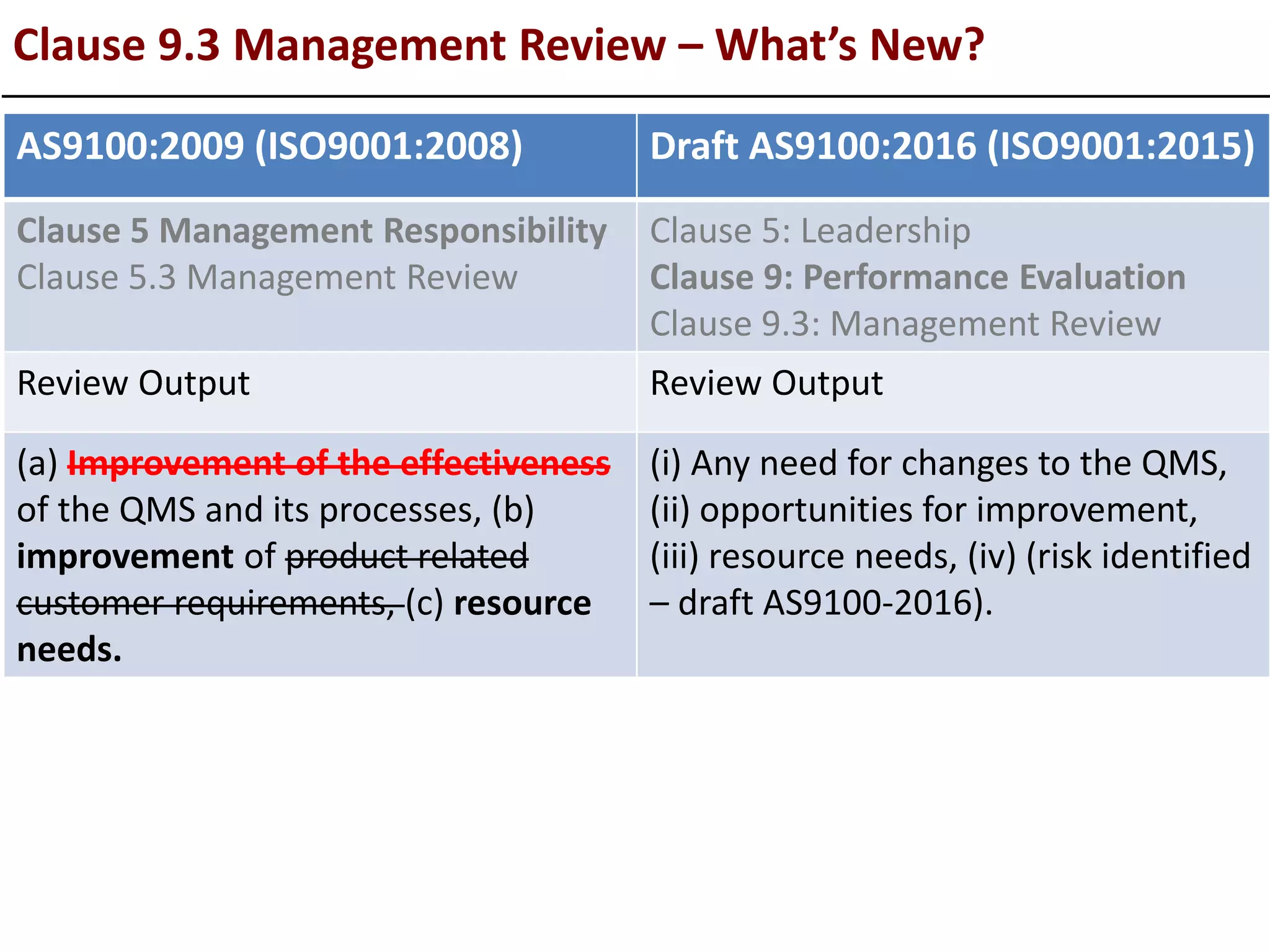
Clause 9.3 Management Review – What’s New?
AS9100:2009 (ISO9001:2008) Draft AS9100:2016 (ISO9001:2015)
Clause 5 Management Responsibility
Clause 5.3 Management Review
Clause 5: Leadership
Clause 9: Performance Evaluation
Clause 9.3: Management Review
The clause 5 ‘Management
Responsibility’ has been renamed
and restructured for a reason.
… its prompting a cultural change …
Clause 9.3 Management Review – What’s New?
AS9100:2009 (ISO9001:2008) Draft AS9100:2016 (ISO9001:2015)
Clause 5 Management Responsibility
Clause 5.3 Management Review
Clause 5: Leadership
Clause 9: Performance Evaluation
Clause 9.3: Management Review
Review Output Review Output
(a) Improvement of the effectiveness
of the QMS and its processes, (b)
improvement of product related
customer requirements, (c) resource
needs.
(i) Any need for changes to the QMS,
(ii) opportunities for improvement,
(iii) resource needs, (iv) (risk identified
– draft AS9100-2016).
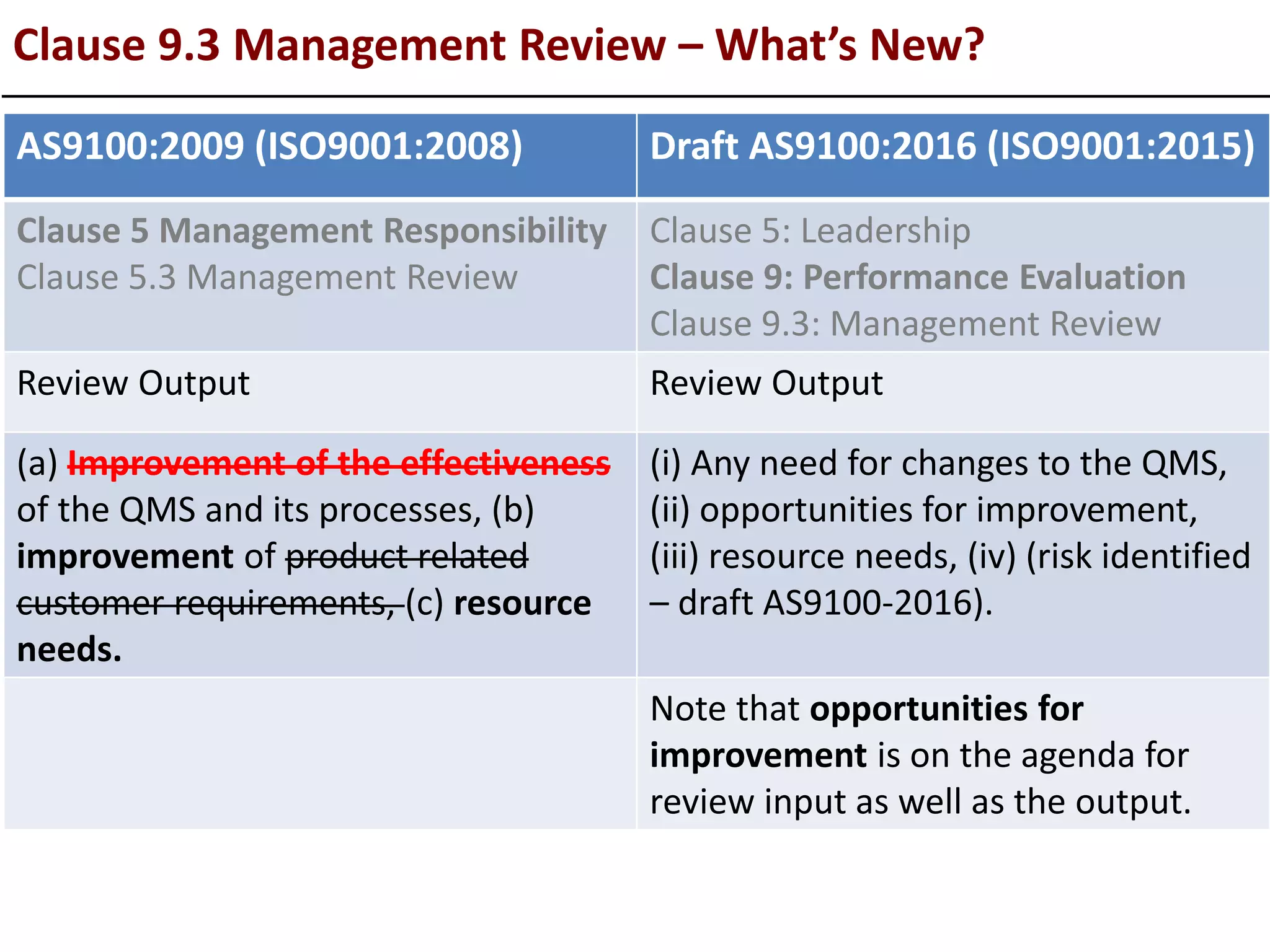
Clause 9.3 Management Review – What’s New?
AS9100:2009 (ISO9001:2008) Draft AS9100:2016 (ISO9001:2015)
Clause 5 Management Responsibility
Clause 5.3 Management Review
Clause 5: Leadership
Clause 9: Performance Evaluation
Clause 9.3: Management Review
Review Output Review Output
(a) Improvement of the effectiveness
of the QMS and its processes, (b)
improvement of product related
customer requirements, (c) resource
needs.
(i) Any need for changes to the QMS,
(ii) opportunities for improvement,
(iii) resource needs, (iv) (risk identified
– draft AS9100-2016).
Note that opportunities for
improvement is on the agenda for
review input as well as the output.
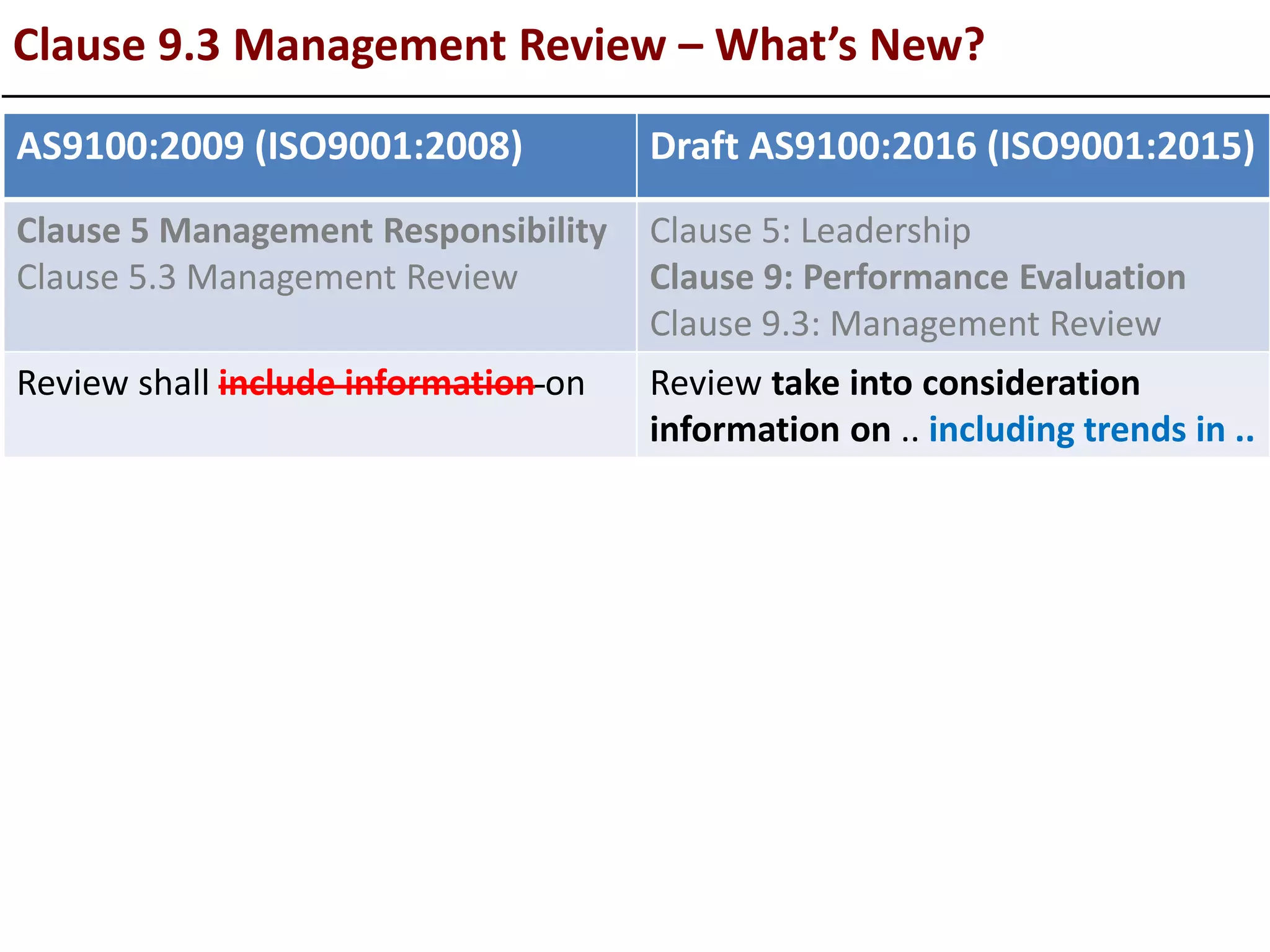
Clause 9.3 Management Review – What’s New?
AS9100:2009 (ISO9001:2008) Draft AS9100:2016 (ISO9001:2015)
Clause 5 Management Responsibility
Clause 5.3 Management Review
Clause 5: Leadership
Clause 9: Performance Evaluation
Clause 9.3: Management Review
Review shall include information on Review take into consideration
information on .. including trends in ..
Clause 9.3 Management Review – What’s New?
AS9100:2009 (ISO9001:2008) Draft AS9100:2016 (ISO9001:2015)
Clause 5 Management Responsibility
Clause 5.3 Management Review
Clause 5: Leadership
Clause 9: Performance Evaluation
Clause 9.3: Management Review
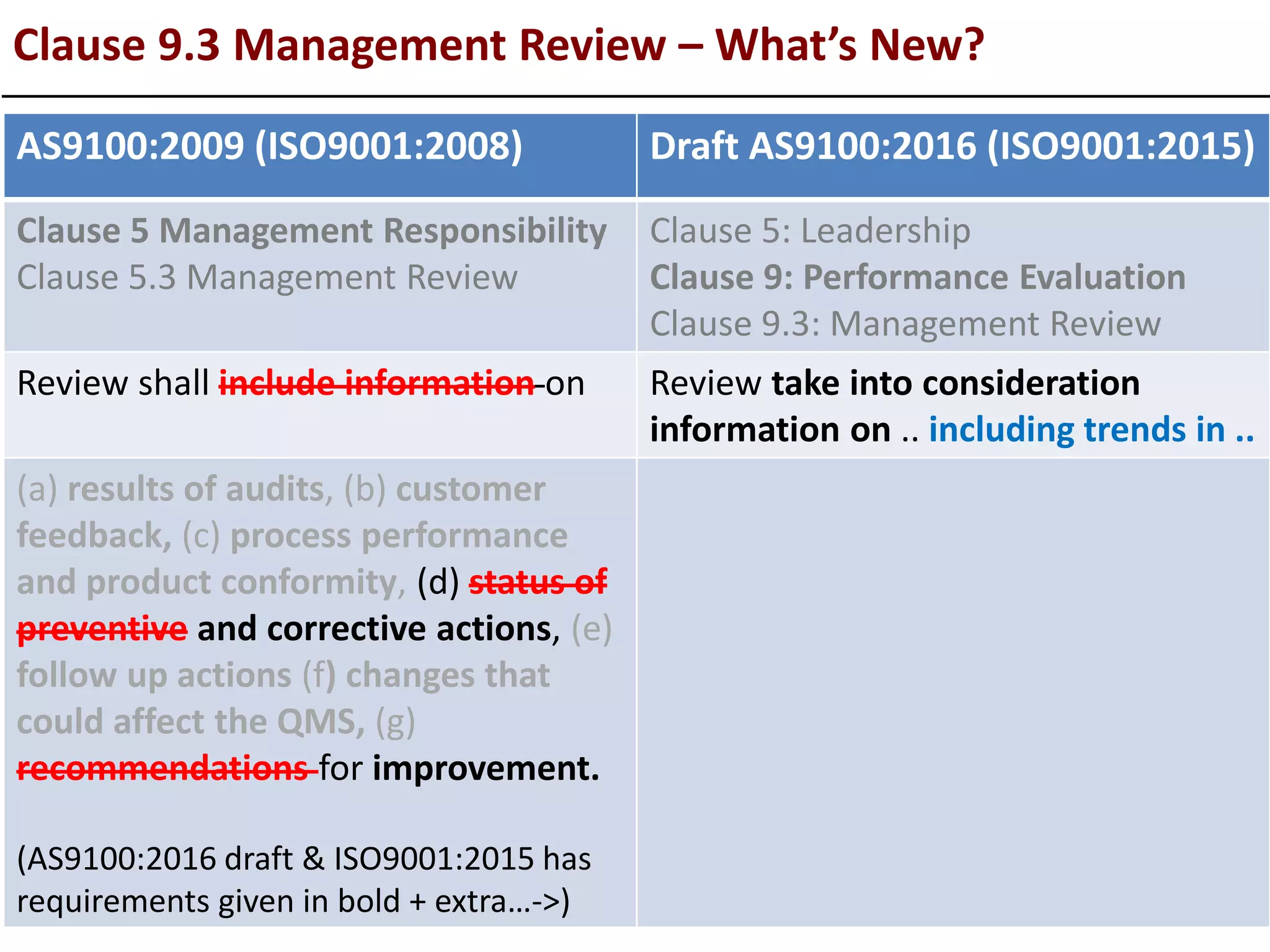
Review shall include information on Review take into consideration
information on .. including trends in ..
(a) results of audits, (b) customer
feedback, (c) process performance
and product conformity, (d) status of
preventive and corrective actions, (e)
follow up actions (f) changes that
could affect the QMS, (g)
recommendations for improvement.
(AS9100:2016 draft & ISO9001:2015 has
requirements given in bold + extra…->)
Clause 9.3 Management Review – What’s New?
AS9100:2009 (ISO9001:2008) Draft AS9100:2016 (ISO9001:2015)
Clause 5 Management Responsibility
Clause 5.3 Management Review
Clause 5: Leadership
Clause 9: Performance Evaluation
Clause 9.3: Management Review
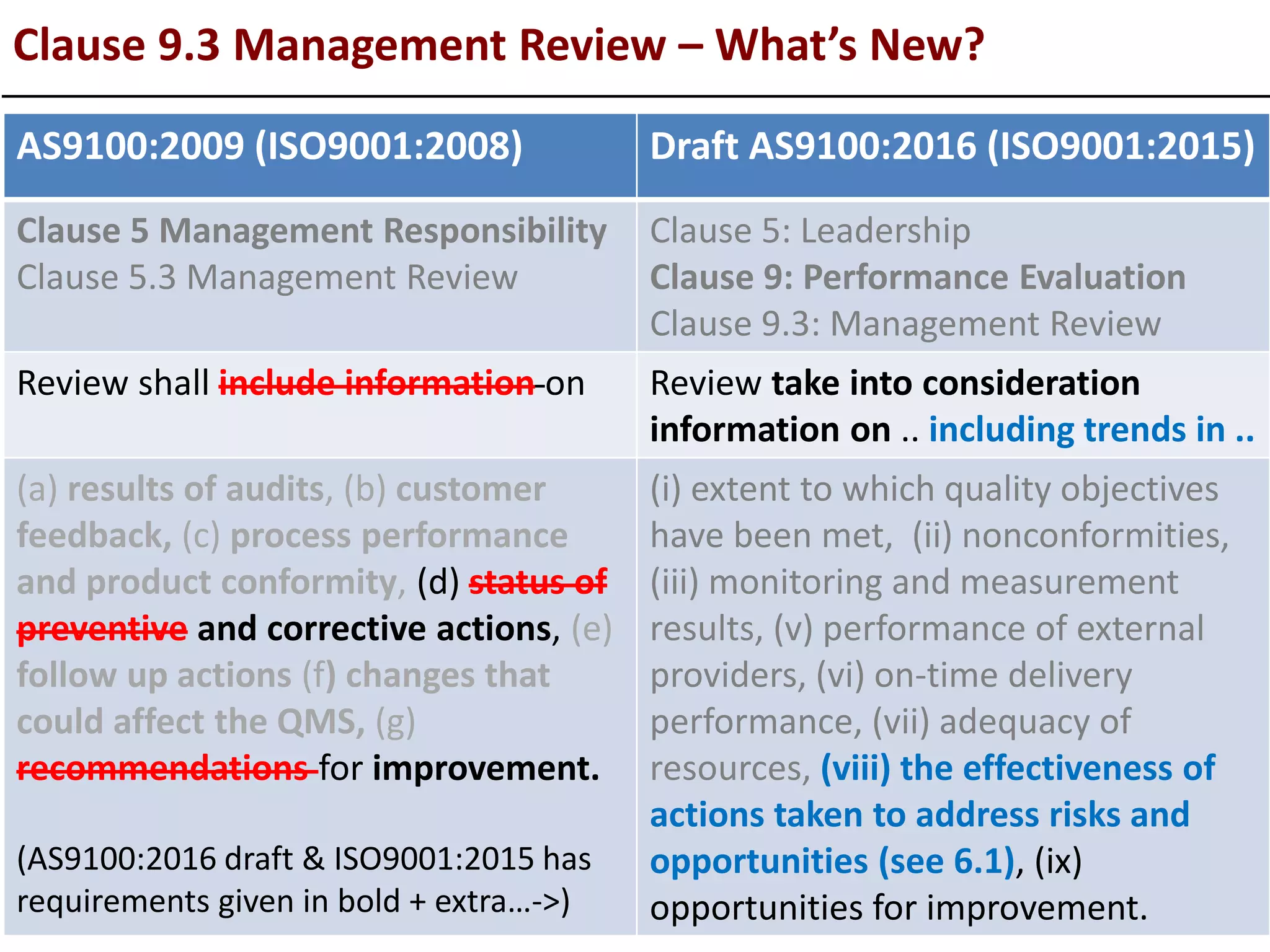
Review shall include information on Review take into consideration
information on .. including trends in ..
(a) results of audits, (b) customer
feedback, (c) process performance
and product conformity, (d) status of
preventive and corrective actions, (e)
follow up actions (f) changes that
could affect the QMS, (g)
recommendations for improvement.
(AS9100:2016 draft & ISO9001:2015 has
requirements given in bold + extra…->)
(i) extent to which quality objectives
have been met, (ii) nonconformities,
(iii) monitoring and measurement
results, (v) performance of external
providers, (vi) on-time delivery
performance, (vii) adequacy of
resources, (viii) the effectiveness of
actions taken to address risks and
opportunities (see 6.1), (ix)
opportunities for improvement.
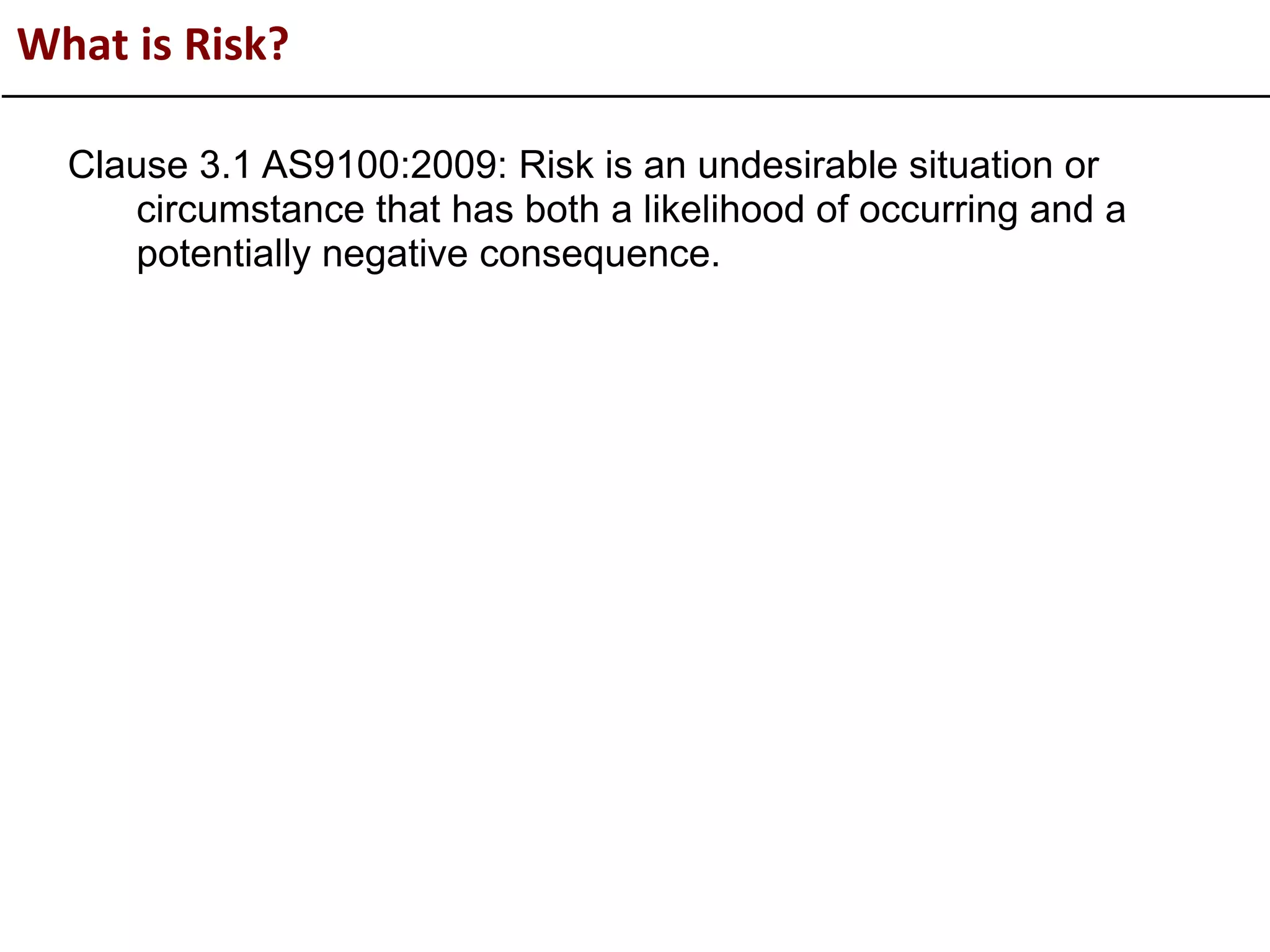
What is Risk?
Clause 3.1 AS9100:2009: Risk is an undesirable situation or
circumstance that has both a likelihood of occurring and a
potentially negative consequence.
What is Risk?
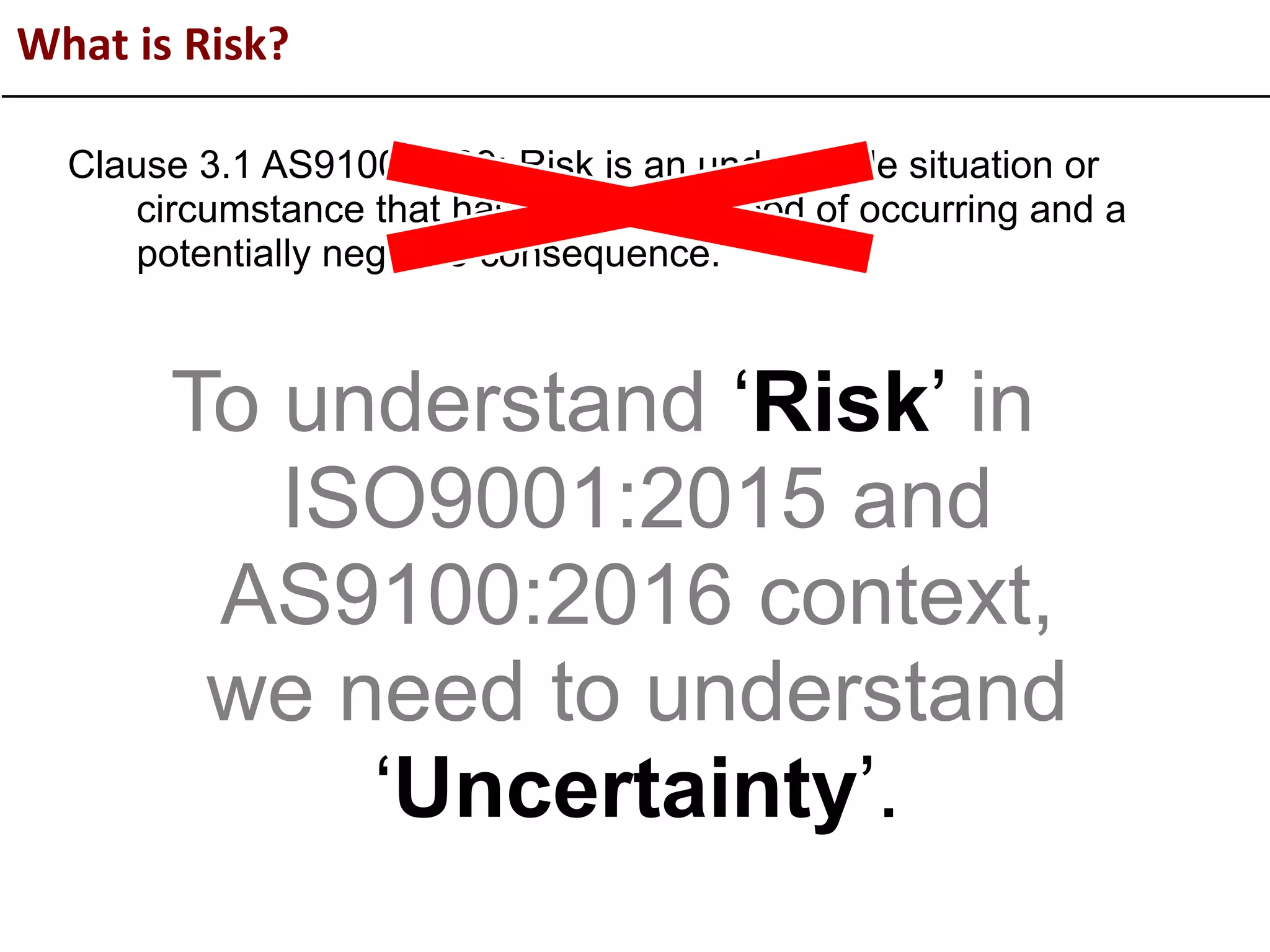
Clause 3.1 AS9100:2009: Risk is an undesirable situation or
circumstance that has both a likelihood of occurring and a
potentially negative consequence.
To understand ‘Risk’ in
ISO9001:2015 and
AS9100:2016 context,
we need to understand
‘Uncertainty’.
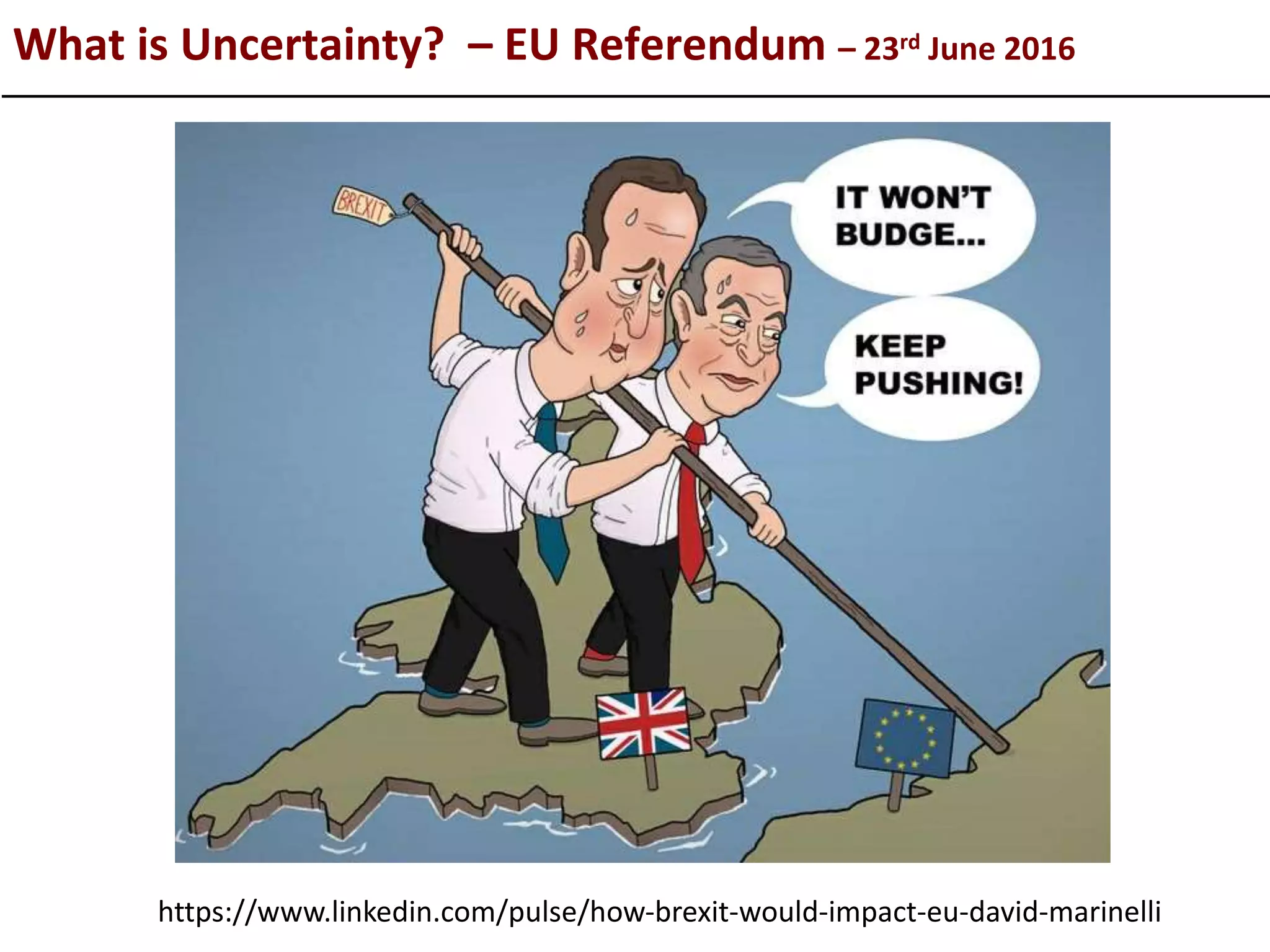
What is Uncertainty? – EU Referendum – 23rd June 2016
https://www.linkedin.com/pulse/how-brexit-would-impact-eu-david-marinelli
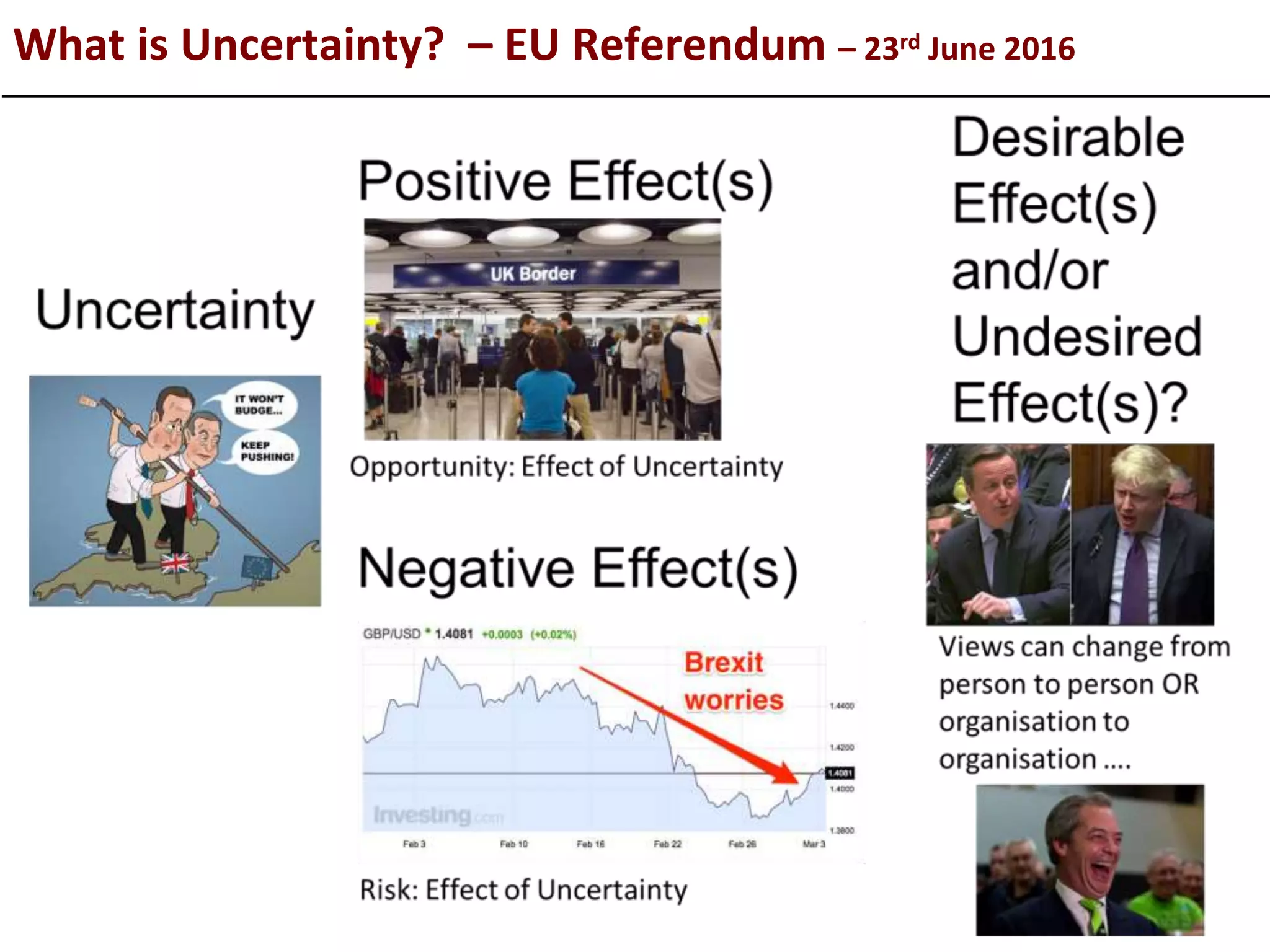
What is Uncertainty? – EU Referendum – 23rd June 2016
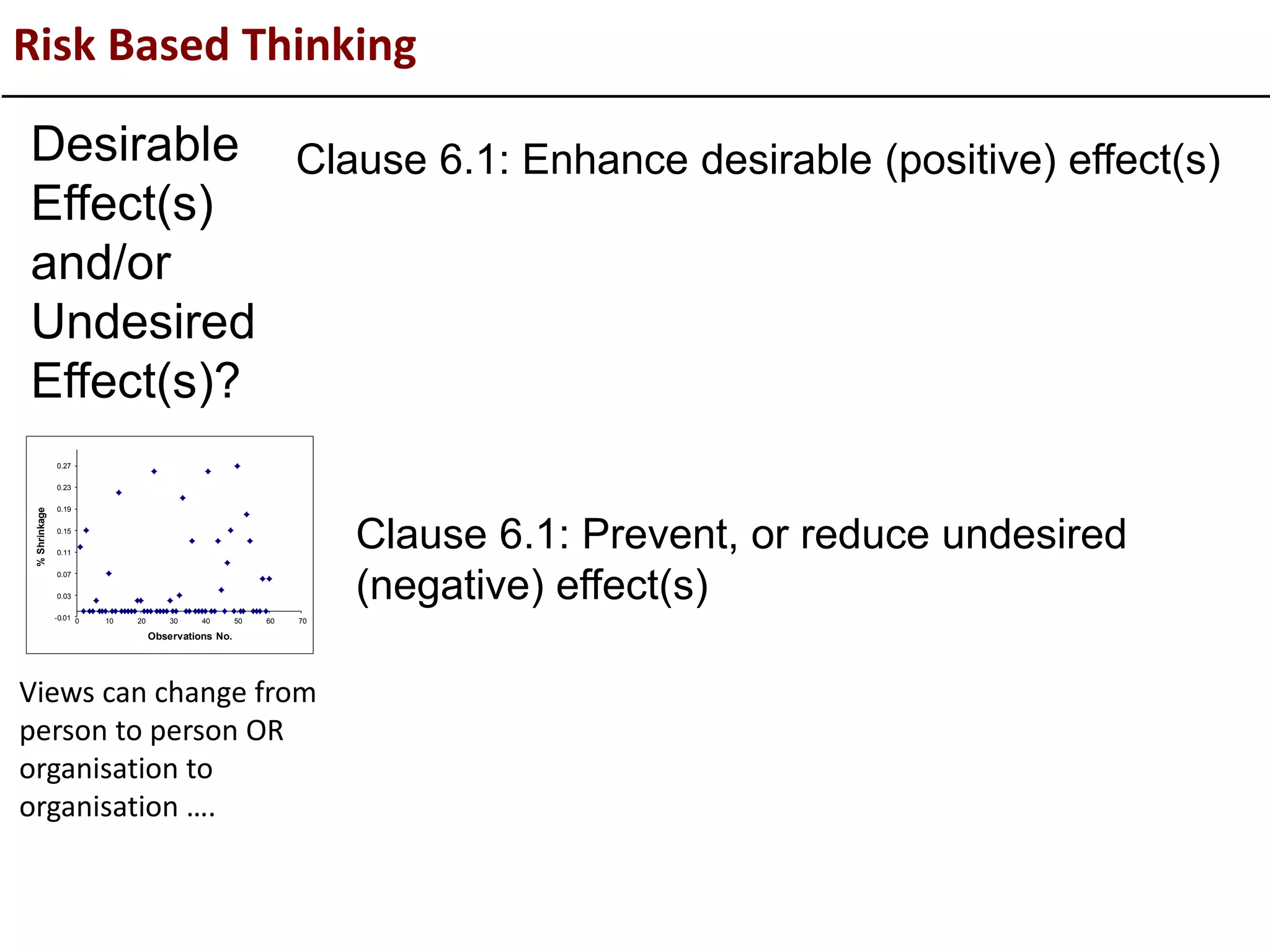
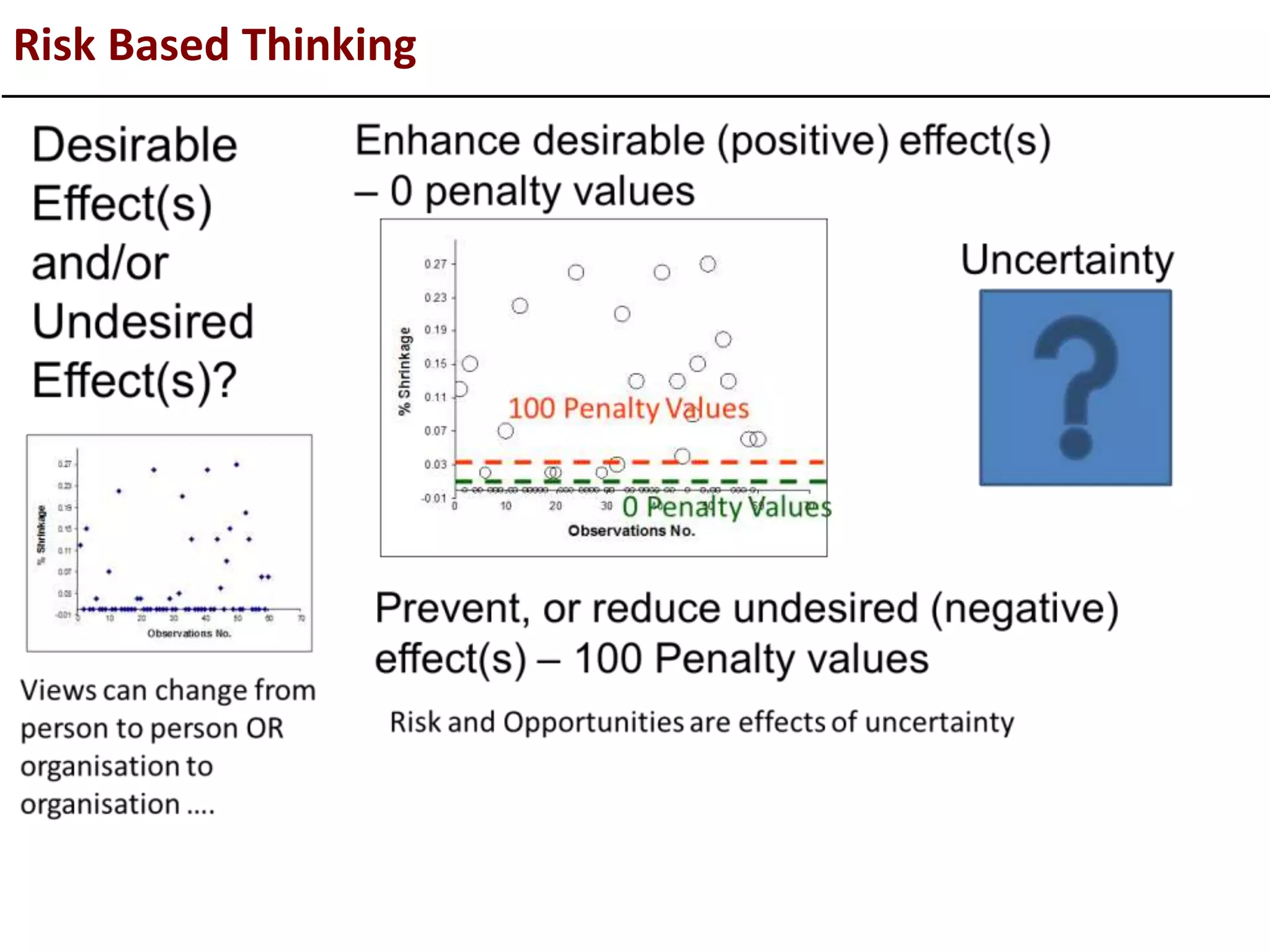
Risk Based Thinking
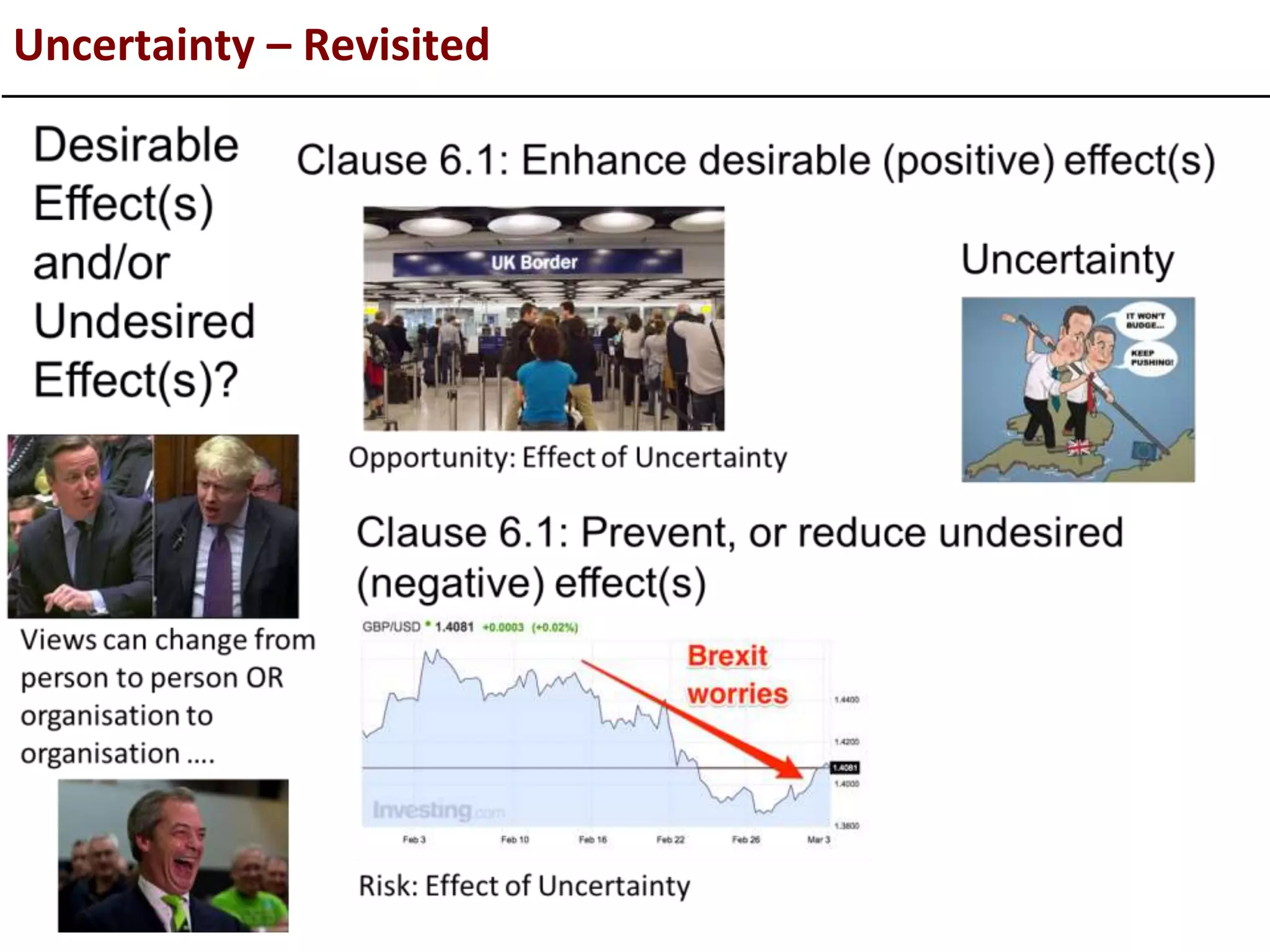
Clause 6.1: Enhance desirable (positive) effect(s)
Clause 6.1: Prevent, or reduce undesired
(negative) effect(s)
Desirable
Effect(s)
and/or
Undesired
Effect(s)?
Views can change from
person to person OR
organisation to
organisation ….
-0.01
0.03
0.07
0.11
0.15
0.19
0.23
0.27
0 10 20 30 40 50 60 70
%Shrinkage
Observations No.
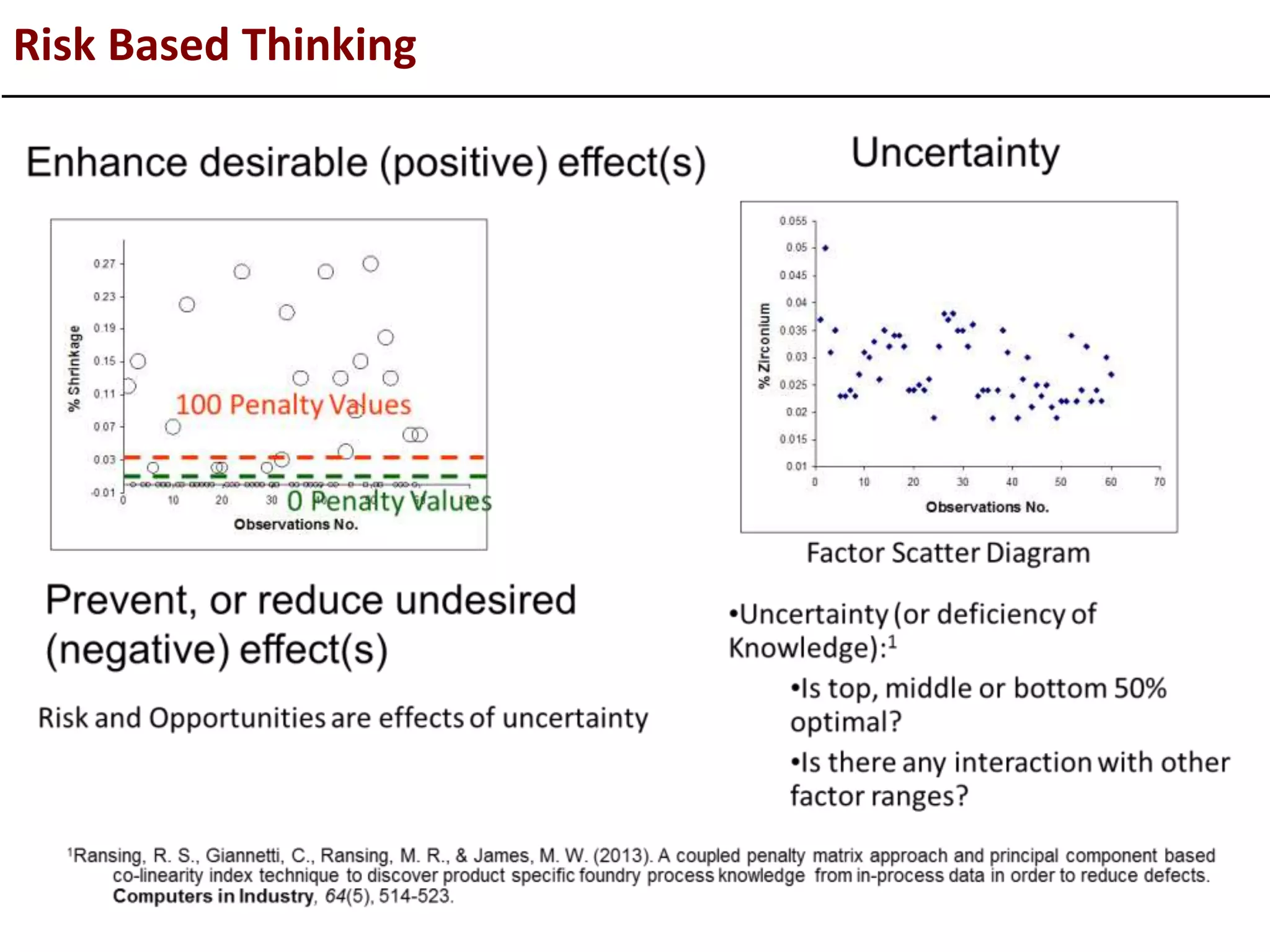
Uncertainty – Revisited
Risk Based Thinking
Risk Based Thinking
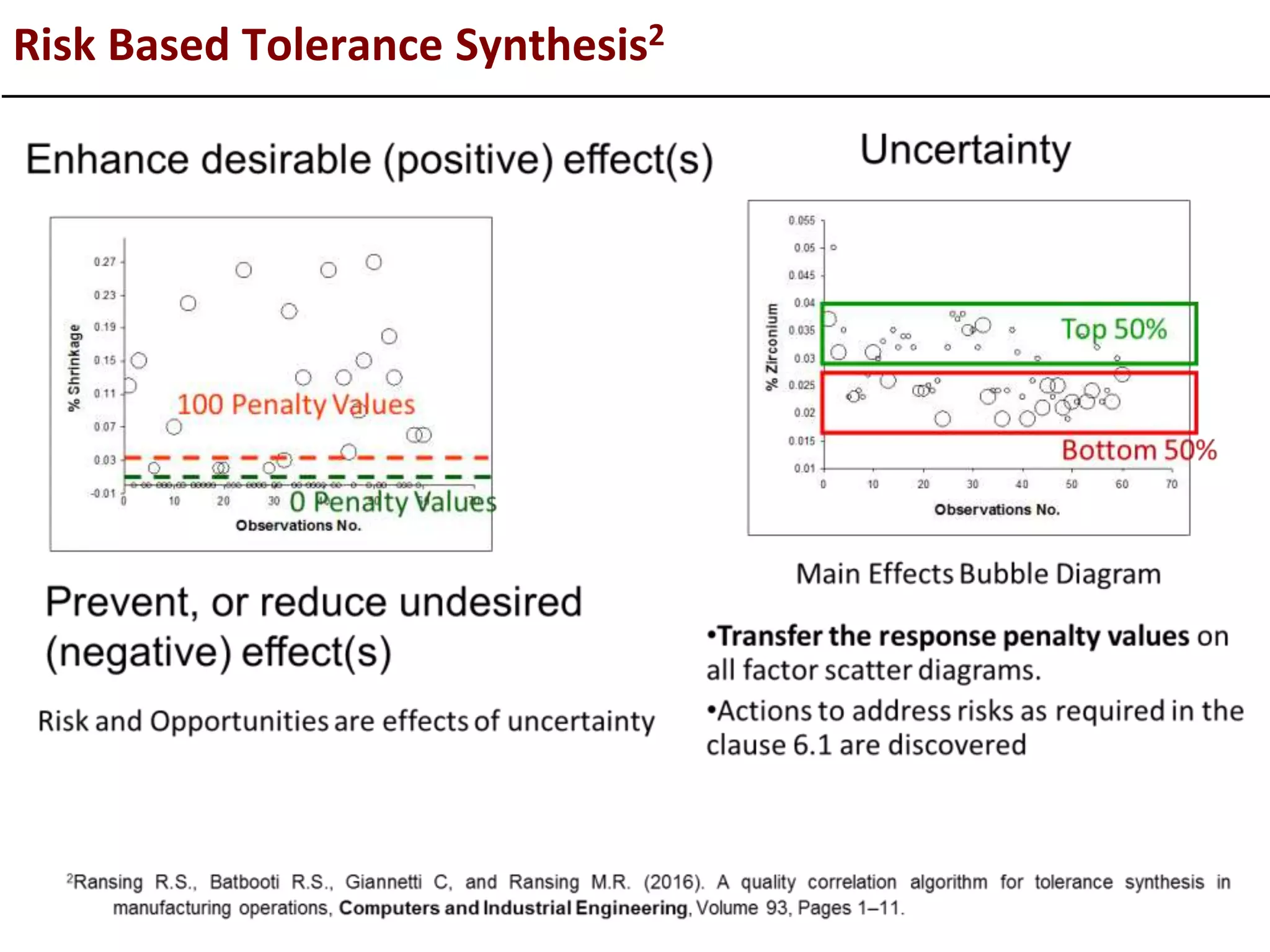
Risk Based Tolerance Synthesis2
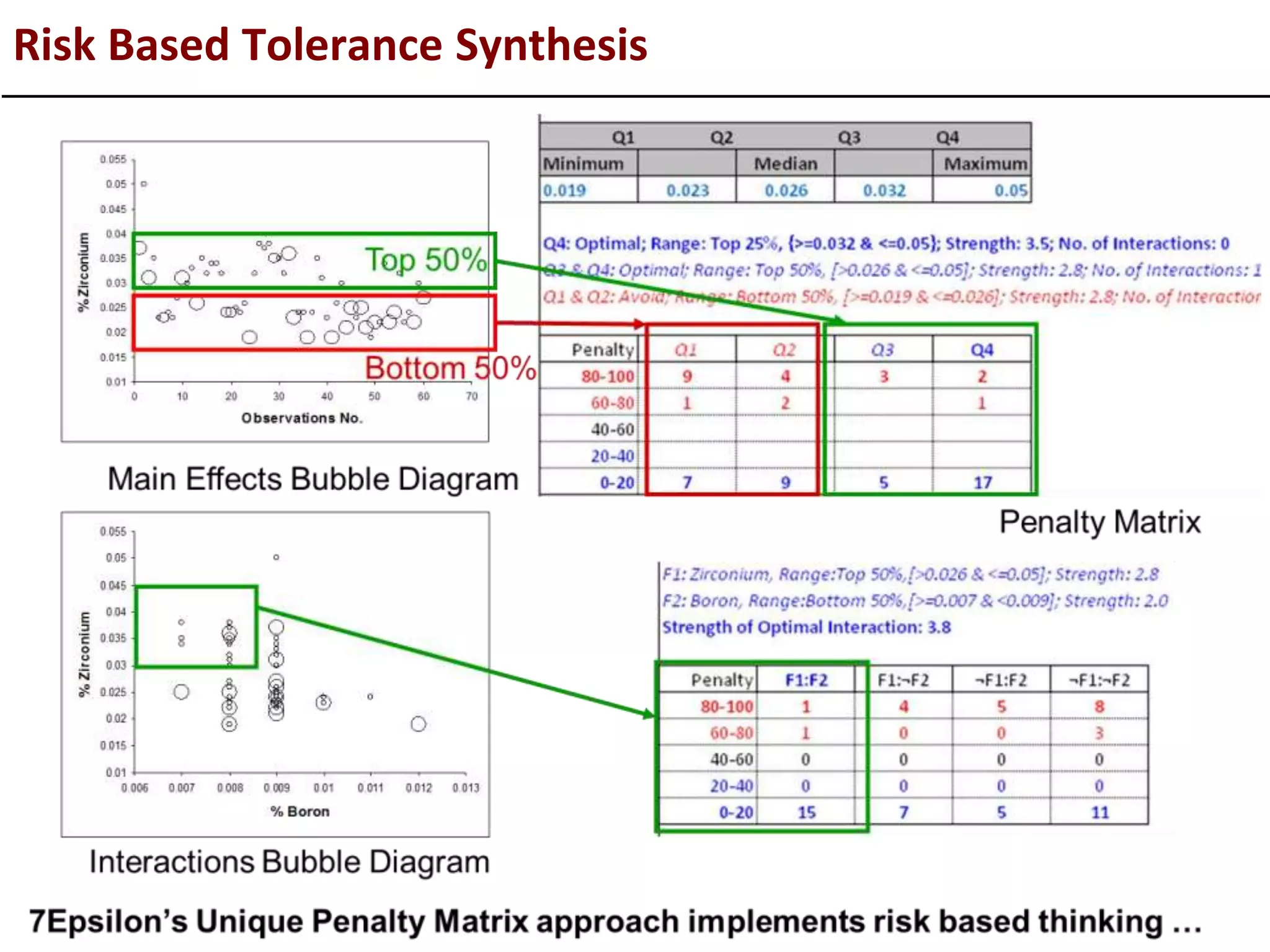
Risk Based Tolerance Synthesis
Let’s Make a Solemn Promise …
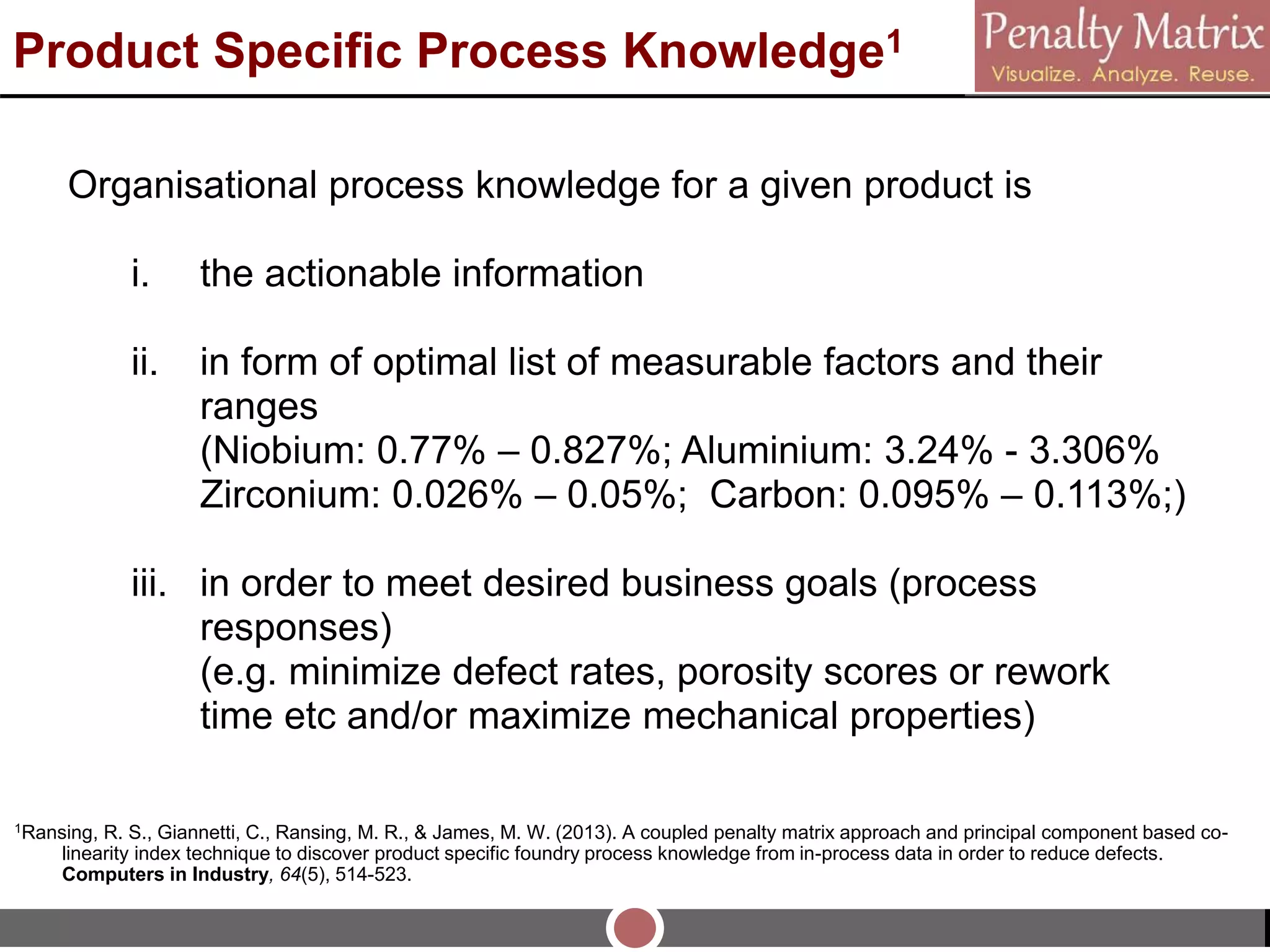
Product Specific Process Knowledge1
Organisational process knowledge for a given product is
i. the actionable information
ii. in form of optimal list of measurable factors and their
ranges
(Niobium: 0.77% – 0.827%; Aluminium: 3.24% - 3.306%
Zirconium: 0.026% – 0.05%; Carbon: 0.095% – 0.113%;)
iii. in order to meet desired business goals (process
responses)
(e.g. minimize defect rates, porosity scores or rework
time etc and/or maximize mechanical properties)
1Ransing, R. S., Giannetti, C., Ransing, M. R., & James, M. W. (2013). A coupled penalty matrix approach and principal component based co-
linearity index technique to discover product specific foundry process knowledge from in-process data in order to reduce defects.
Computers in Industry, 64(5), 514-523.
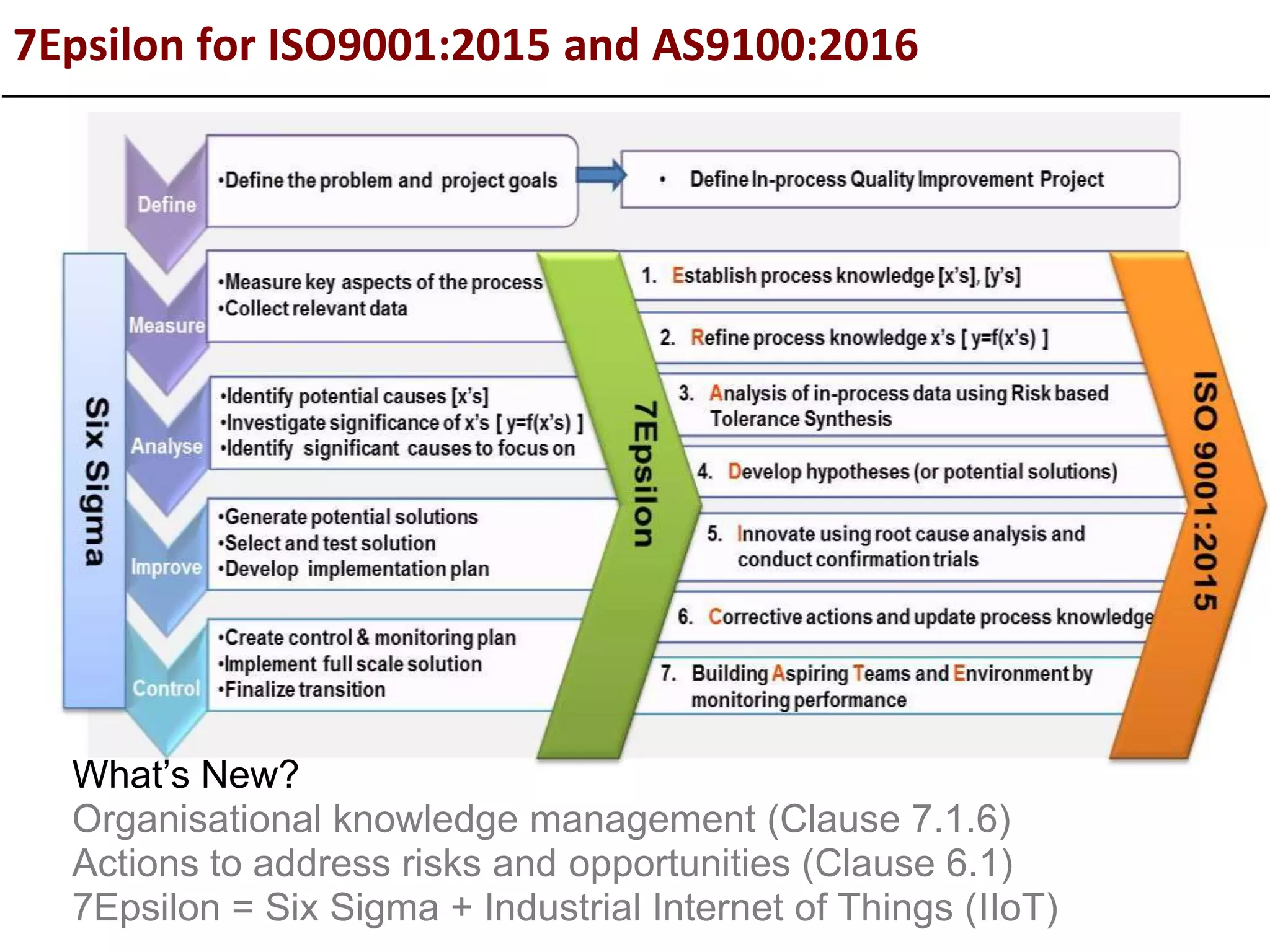
7Epsilon for ISO9001:2015 and AS9100:2016
What’s New?
Organisational knowledge management (Clause 7.1.6)
Actions to address risks and opportunities (Clause 6.1)
7Epsilon = Six Sigma + Industrial Internet of Things (IIoT)
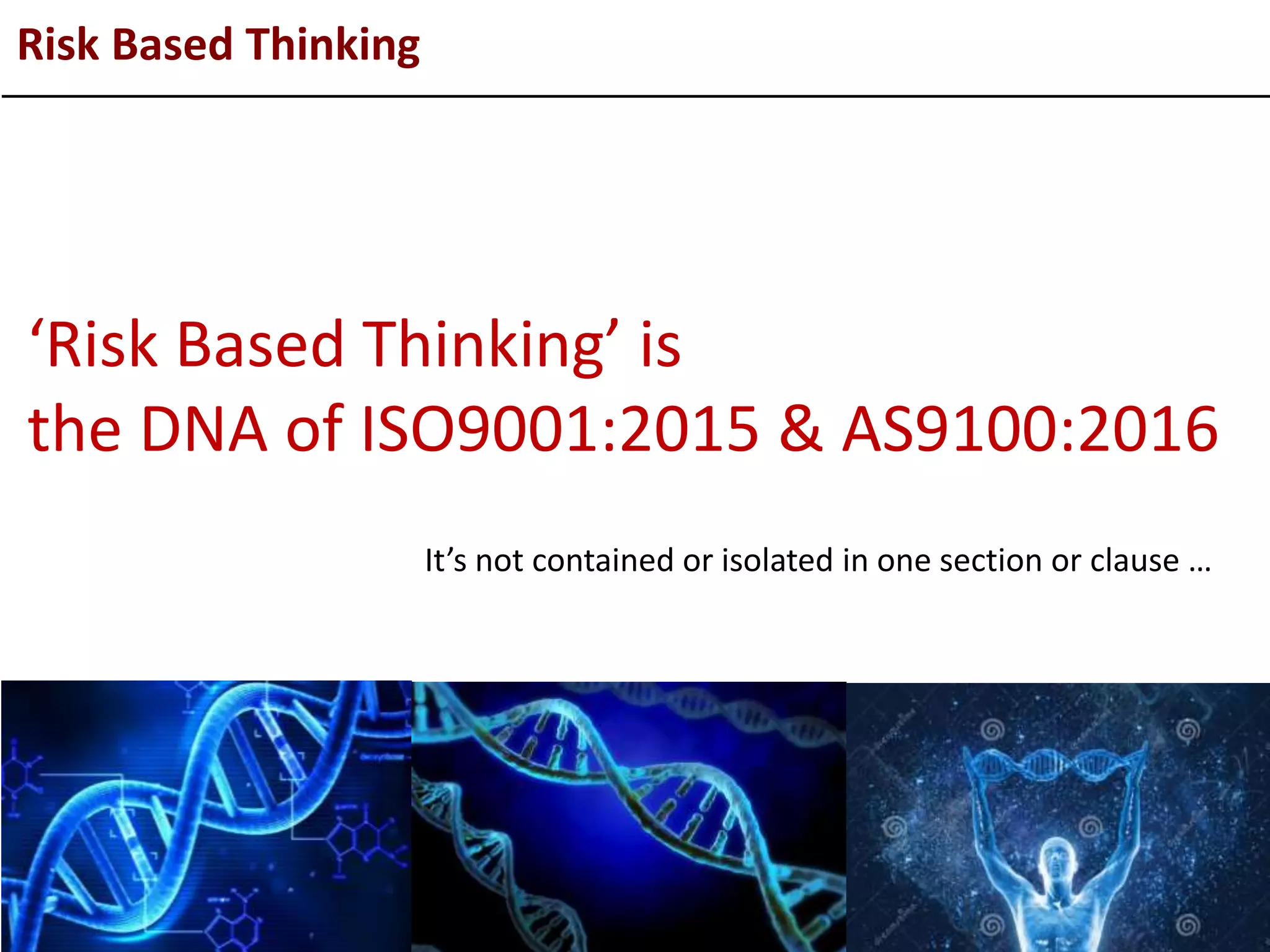
Risk Based Thinking
‘Risk Based Thinking’ is
the DNA of ISO9001:2015 & AS9100:2016
It’s not contained or isolated in one section or clause …
Risk Based Thinking
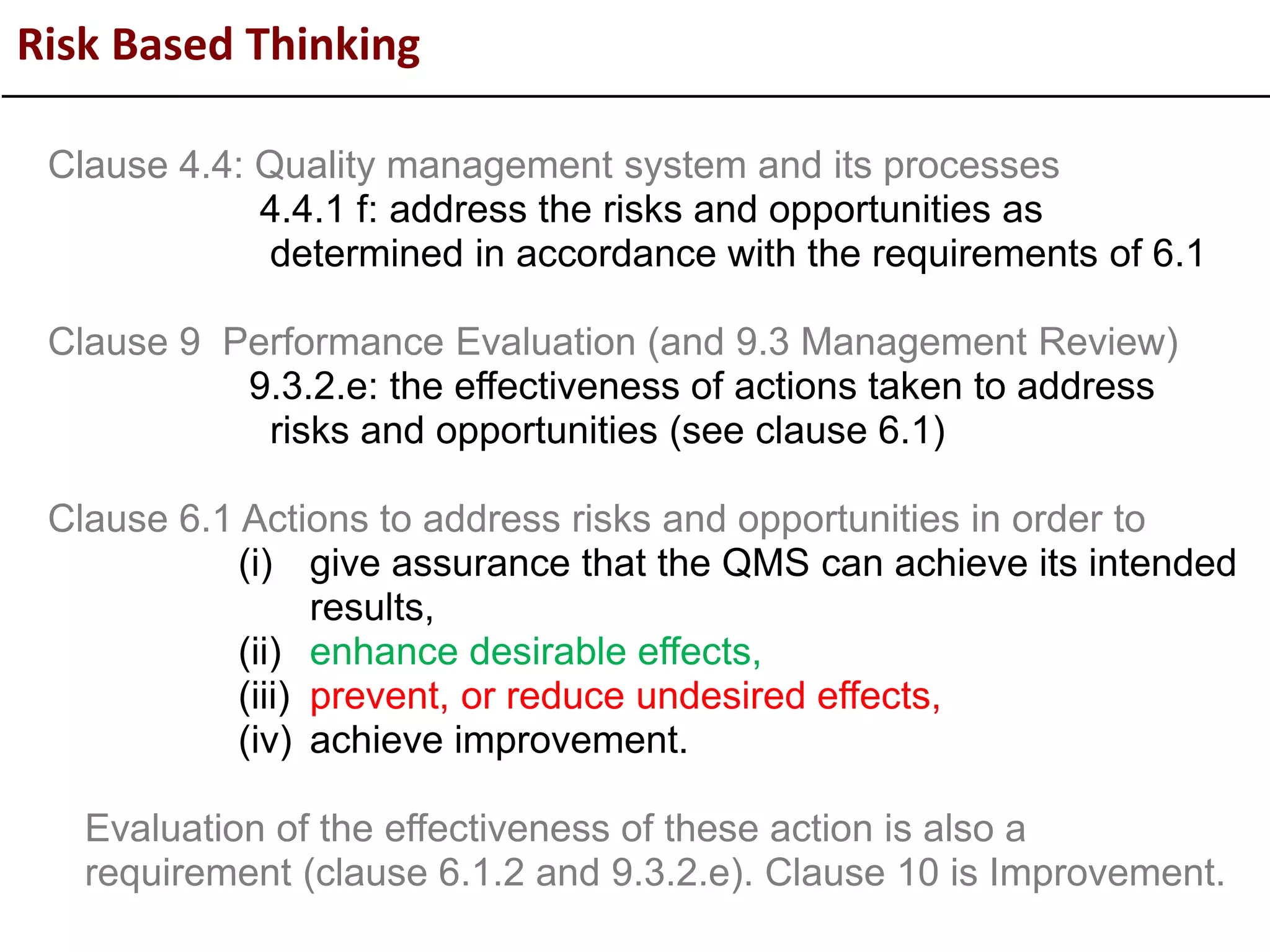
Clause 4.4: Quality management system and its processes
4.4.1 f: address the risks and opportunities as
determined in accordance with the requirements of 6.1
Clause 9 Performance Evaluation (and 9.3 Management Review)
9.3.2.e: the effectiveness of actions taken to address
risks and opportunities (see clause 6.1)
Clause 6.1 Actions to address risks and opportunities in order to
(i) give assurance that the QMS can achieve its intended
results,
(ii) enhance desirable effects,
(iii) prevent, or reduce undesired effects,
(iv) achieve improvement.
Evaluation of the effectiveness of these action is also a
requirement (clause 6.1.2 and 9.3.2.e). Clause 10 is Improvement.
Conclusions
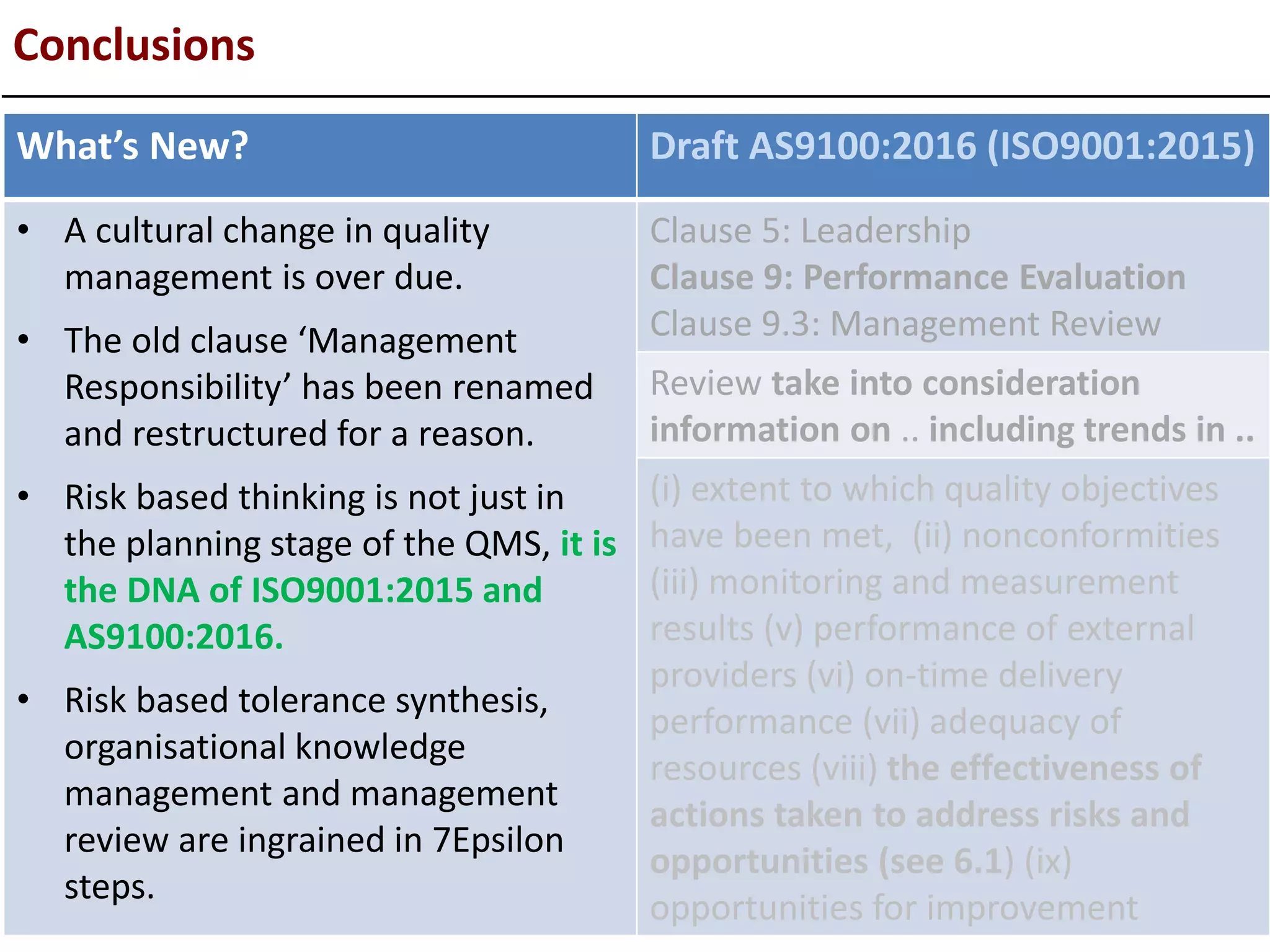
What’s New? Draft AS9100:2016 (ISO9001:2015)
• A cultural change in quality
management is over due.
• The old clause ‘Management
Responsibility’ has been renamed
and restructured for a reason.
• Risk based thinking is not just in
the planning stage of the QMS, it is
the DNA of ISO9001:2015 and
AS9100:2016.
• Risk based tolerance synthesis,
organisational knowledge
management and management
review are ingrained in 7Epsilon
steps.
Clause 5: Leadership
Clause 9: Performance Evaluation
Clause 9.3: Management Review
Review take into consideration
information on .. including trends in ..
(i) extent to which quality objectives
have been met, (ii) nonconformities
(iii) monitoring and measurement
results (v) performance of external
providers (vi) on-time delivery
performance (vii) adequacy of
resources (viii) the effectiveness of
actions taken to address risks and
opportunities (see 6.1) (ix)
opportunities for improvement
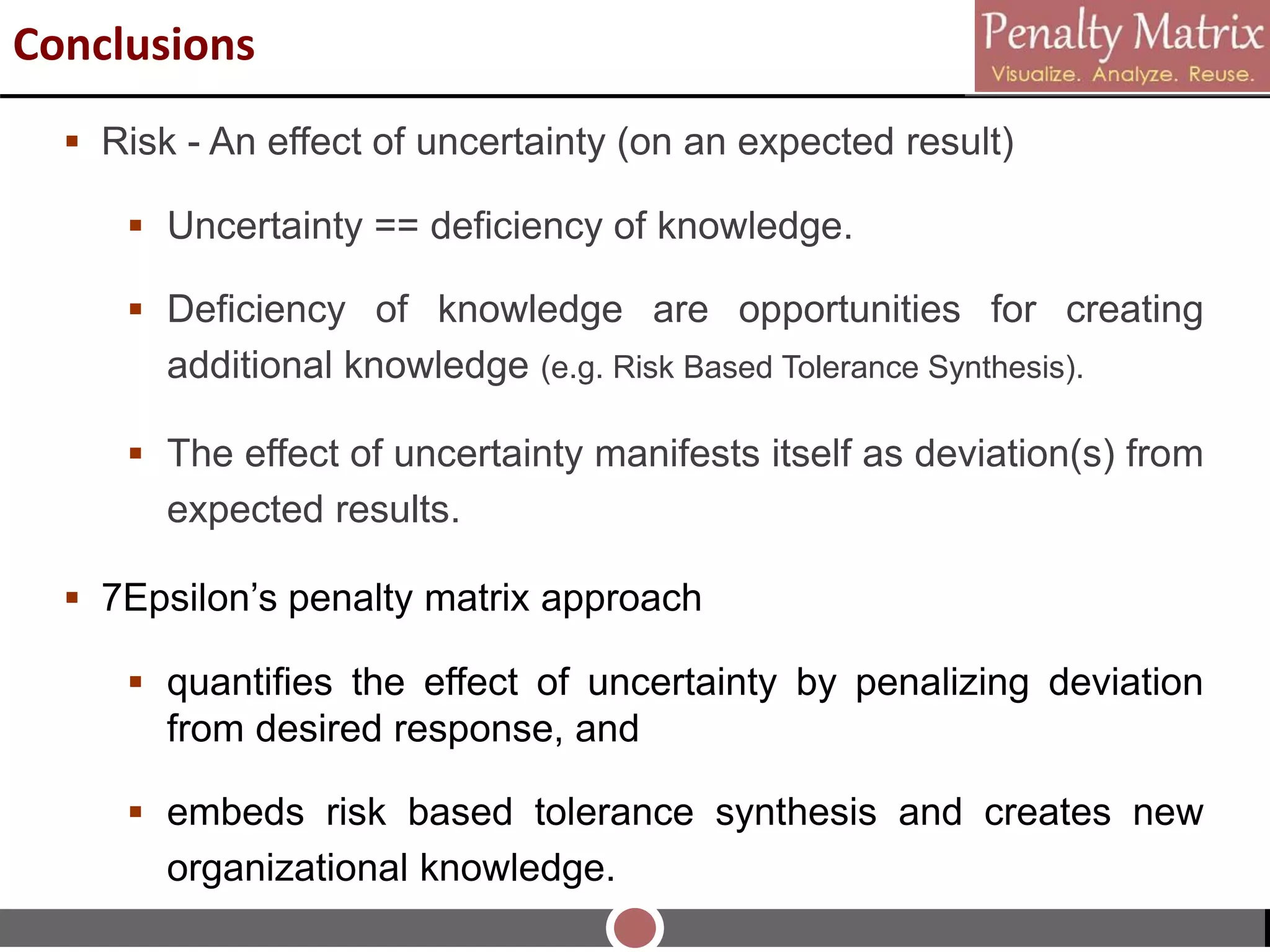
 Risk - An effect of uncertainty (on an expected result)
 Uncertainty == deficiency of knowledge.
 Deficiency of knowledge are opportunities for creating
additional knowledge (e.g. Risk Based Tolerance Synthesis).
 The effect of uncertainty manifests itself as deviation(s) from
expected results.
 7Epsilon’s penalty matrix approach
 quantifies the effect of uncertainty by penalizing deviation
from desired response, and
 embeds risk based tolerance synthesis and creates new
organizational knowledge.
Conclusions
What’s Next?
www.7epsilon.org
What’s Next?
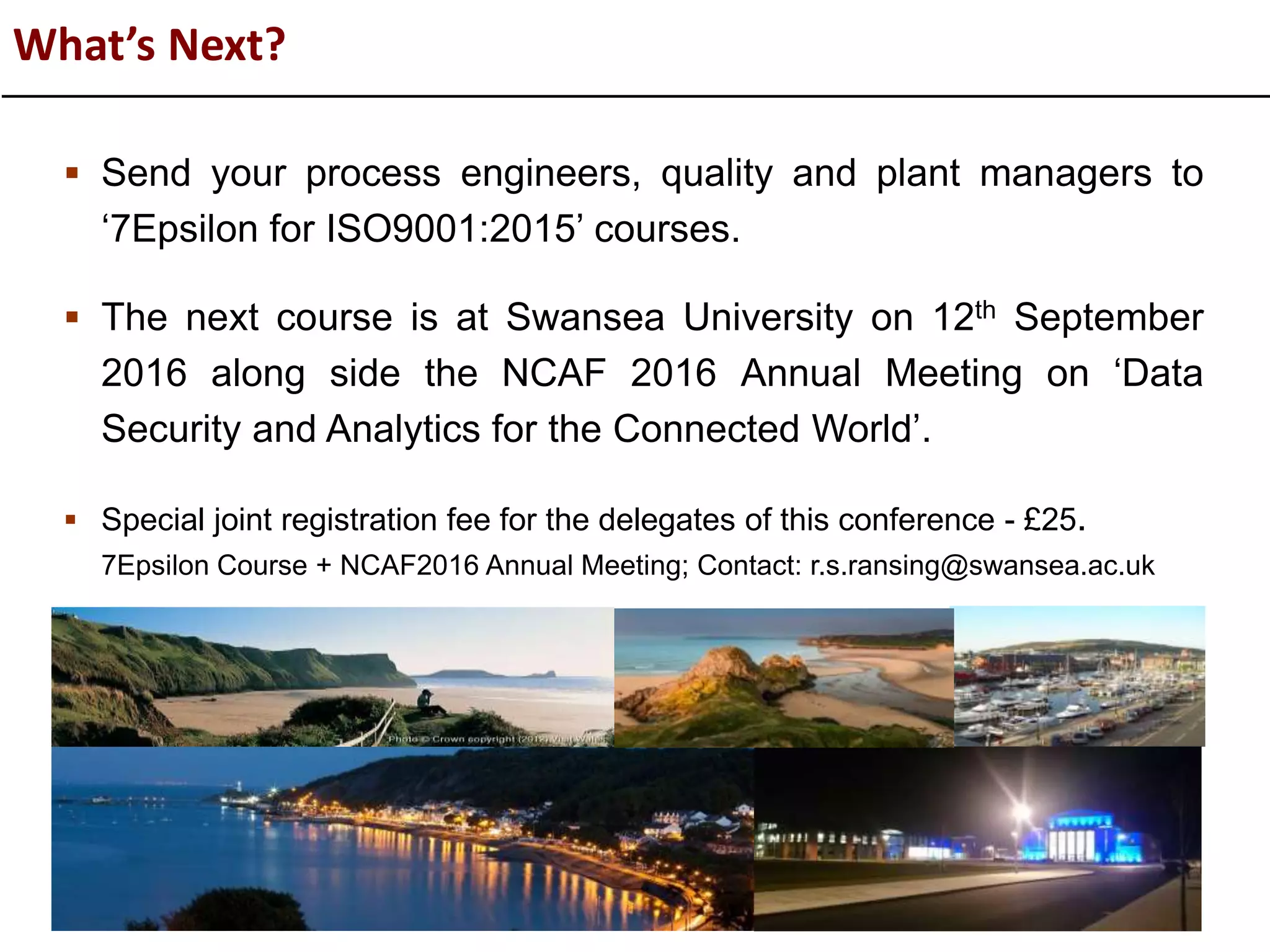
 Send your process engineers, quality and plant managers to
‘7Epsilon for ISO9001:2015’ courses.
 The next course is at Swansea University on 12th September
2016 along side the NCAF 2016 Annual Meeting on ‘Data
Security and Analytics for the Connected World’.
 Special joint registration fee for the delegates of this conference - £25.
7Epsilon Course + NCAF2016 Annual Meeting; Contact: r.s.ransing@swansea.ac.uk

AS 9100:2016 and ISO 9001:2015 - Clause 9.3 Management Review : What's New?

  • 1.
    Clause 9.3 ManagementReview - AS9100:2016, ISO9001:2015; What's New? Dr. Rajesh S. Ransing, Swansea University, UK Dr. Meghana R. Ransing, p-matrix Ltd., UK Invited Guest Lecture Technical Session 3: Management (Room 342A) Part 1- Innovative Management Practices Date: 18th April 2016. Time: 14:15-14.45 Le Palais des Congrès de Paris - Niveau 3 Bordeaux, 2 place de la Porte Maillot 75017 Paris
  • 2.
  • 3.
    A ISO9001:2008 ManagementReview Meeting …
  • 4.
    Clause 9.3 ManagementReview – What’s New? AS9100:2009 (ISO9001:2008) Draft AS9100:2016 (ISO9001:2015) Clause 5 Management Responsibility Clause 5.3 Management Review Clause 5: Leadership Clause 9: Performance Evaluation Clause 9.3: Management Review
  • 5.
    Clause 9.3 ManagementReview – What’s New? AS9100:2009 (ISO9001:2008) Draft AS9100:2016 (ISO9001:2015) Clause 5 Management Responsibility Clause 5.3 Management Review Clause 5: Leadership Clause 9: Performance Evaluation Clause 9.3: Management Review The clause 5 ‘Management Responsibility’ has been renamed and restructured for a reason. … its prompting a cultural change …
  • 6.
    Clause 9.3 ManagementReview – What’s New? AS9100:2009 (ISO9001:2008) Draft AS9100:2016 (ISO9001:2015) Clause 5 Management Responsibility Clause 5.3 Management Review Clause 5: Leadership Clause 9: Performance Evaluation Clause 9.3: Management Review Review Output Review Output (a) Improvement of the effectiveness of the QMS and its processes, (b) improvement of product related customer requirements, (c) resource needs. (i) Any need for changes to the QMS, (ii) opportunities for improvement, (iii) resource needs, (iv) (risk identified – draft AS9100-2016).
  • 7.
    Clause 9.3 ManagementReview – What’s New? AS9100:2009 (ISO9001:2008) Draft AS9100:2016 (ISO9001:2015) Clause 5 Management Responsibility Clause 5.3 Management Review Clause 5: Leadership Clause 9: Performance Evaluation Clause 9.3: Management Review Review Output Review Output (a) Improvement of the effectiveness of the QMS and its processes, (b) improvement of product related customer requirements, (c) resource needs. (i) Any need for changes to the QMS, (ii) opportunities for improvement, (iii) resource needs, (iv) (risk identified – draft AS9100-2016). Note that opportunities for improvement is on the agenda for review input as well as the output.
  • 8.
    Clause 9.3 ManagementReview – What’s New? AS9100:2009 (ISO9001:2008) Draft AS9100:2016 (ISO9001:2015) Clause 5 Management Responsibility Clause 5.3 Management Review Clause 5: Leadership Clause 9: Performance Evaluation Clause 9.3: Management Review Review shall include information on Review take into consideration information on .. including trends in ..
  • 9.
    Clause 9.3 ManagementReview – What’s New? AS9100:2009 (ISO9001:2008) Draft AS9100:2016 (ISO9001:2015) Clause 5 Management Responsibility Clause 5.3 Management Review Clause 5: Leadership Clause 9: Performance Evaluation Clause 9.3: Management Review Review shall include information on Review take into consideration information on .. including trends in .. (a) results of audits, (b) customer feedback, (c) process performance and product conformity, (d) status of preventive and corrective actions, (e) follow up actions (f) changes that could affect the QMS, (g) recommendations for improvement. (AS9100:2016 draft & ISO9001:2015 has requirements given in bold + extra…->)
  • 10.
    Clause 9.3 ManagementReview – What’s New? AS9100:2009 (ISO9001:2008) Draft AS9100:2016 (ISO9001:2015) Clause 5 Management Responsibility Clause 5.3 Management Review Clause 5: Leadership Clause 9: Performance Evaluation Clause 9.3: Management Review Review shall include information on Review take into consideration information on .. including trends in .. (a) results of audits, (b) customer feedback, (c) process performance and product conformity, (d) status of preventive and corrective actions, (e) follow up actions (f) changes that could affect the QMS, (g) recommendations for improvement. (AS9100:2016 draft & ISO9001:2015 has requirements given in bold + extra…->) (i) extent to which quality objectives have been met, (ii) nonconformities, (iii) monitoring and measurement results, (v) performance of external providers, (vi) on-time delivery performance, (vii) adequacy of resources, (viii) the effectiveness of actions taken to address risks and opportunities (see 6.1), (ix) opportunities for improvement.
  • 11.
    What is Risk? Clause3.1 AS9100:2009: Risk is an undesirable situation or circumstance that has both a likelihood of occurring and a potentially negative consequence.
  • 12.
    What is Risk? Clause3.1 AS9100:2009: Risk is an undesirable situation or circumstance that has both a likelihood of occurring and a potentially negative consequence. To understand ‘Risk’ in ISO9001:2015 and AS9100:2016 context, we need to understand ‘Uncertainty’.
  • 13.
    What is Uncertainty?– EU Referendum – 23rd June 2016 https://www.linkedin.com/pulse/how-brexit-would-impact-eu-david-marinelli
  • 14.
    What is Uncertainty?– EU Referendum – 23rd June 2016
  • 15.
    Risk Based Thinking Clause6.1: Enhance desirable (positive) effect(s) Clause 6.1: Prevent, or reduce undesired (negative) effect(s) Desirable Effect(s) and/or Undesired Effect(s)? Views can change from person to person OR organisation to organisation …. -0.01 0.03 0.07 0.11 0.15 0.19 0.23 0.27 0 10 20 30 40 50 60 70 %Shrinkage Observations No.
  • 16.
  • 17.
  • 18.
  • 19.
  • 20.
  • 21.
    Let’s Make aSolemn Promise …
  • 22.
    Product Specific ProcessKnowledge1 Organisational process knowledge for a given product is i. the actionable information ii. in form of optimal list of measurable factors and their ranges (Niobium: 0.77% – 0.827%; Aluminium: 3.24% - 3.306% Zirconium: 0.026% – 0.05%; Carbon: 0.095% – 0.113%;) iii. in order to meet desired business goals (process responses) (e.g. minimize defect rates, porosity scores or rework time etc and/or maximize mechanical properties) 1Ransing, R. S., Giannetti, C., Ransing, M. R., & James, M. W. (2013). A coupled penalty matrix approach and principal component based co- linearity index technique to discover product specific foundry process knowledge from in-process data in order to reduce defects. Computers in Industry, 64(5), 514-523.
  • 23.
    7Epsilon for ISO9001:2015and AS9100:2016 What’s New? Organisational knowledge management (Clause 7.1.6) Actions to address risks and opportunities (Clause 6.1) 7Epsilon = Six Sigma + Industrial Internet of Things (IIoT)
  • 24.
    Risk Based Thinking ‘RiskBased Thinking’ is the DNA of ISO9001:2015 & AS9100:2016 It’s not contained or isolated in one section or clause …
  • 25.
    Risk Based Thinking Clause4.4: Quality management system and its processes 4.4.1 f: address the risks and opportunities as determined in accordance with the requirements of 6.1 Clause 9 Performance Evaluation (and 9.3 Management Review) 9.3.2.e: the effectiveness of actions taken to address risks and opportunities (see clause 6.1) Clause 6.1 Actions to address risks and opportunities in order to (i) give assurance that the QMS can achieve its intended results, (ii) enhance desirable effects, (iii) prevent, or reduce undesired effects, (iv) achieve improvement. Evaluation of the effectiveness of these action is also a requirement (clause 6.1.2 and 9.3.2.e). Clause 10 is Improvement.
  • 26.
    Conclusions What’s New? DraftAS9100:2016 (ISO9001:2015) • A cultural change in quality management is over due. • The old clause ‘Management Responsibility’ has been renamed and restructured for a reason. • Risk based thinking is not just in the planning stage of the QMS, it is the DNA of ISO9001:2015 and AS9100:2016. • Risk based tolerance synthesis, organisational knowledge management and management review are ingrained in 7Epsilon steps. Clause 5: Leadership Clause 9: Performance Evaluation Clause 9.3: Management Review Review take into consideration information on .. including trends in .. (i) extent to which quality objectives have been met, (ii) nonconformities (iii) monitoring and measurement results (v) performance of external providers (vi) on-time delivery performance (vii) adequacy of resources (viii) the effectiveness of actions taken to address risks and opportunities (see 6.1) (ix) opportunities for improvement
  • 27.
     Risk -An effect of uncertainty (on an expected result)  Uncertainty == deficiency of knowledge.  Deficiency of knowledge are opportunities for creating additional knowledge (e.g. Risk Based Tolerance Synthesis).  The effect of uncertainty manifests itself as deviation(s) from expected results.  7Epsilon’s penalty matrix approach  quantifies the effect of uncertainty by penalizing deviation from desired response, and  embeds risk based tolerance synthesis and creates new organizational knowledge. Conclusions
  • 28.
  • 29.
    What’s Next?  Sendyour process engineers, quality and plant managers to ‘7Epsilon for ISO9001:2015’ courses.  The next course is at Swansea University on 12th September 2016 along side the NCAF 2016 Annual Meeting on ‘Data Security and Analytics for the Connected World’.  Special joint registration fee for the delegates of this conference - £25. 7Epsilon Course + NCAF2016 Annual Meeting; Contact: r.s.ransing@swansea.ac.uk