ISO 9001 QMS LEAD AUDITER COURSE BASICS
Prepared By .
Nithin V Joseph
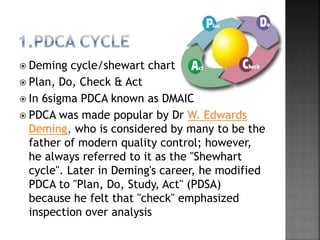
 Deming cycle/shewart chart
 Plan, Do, Check & Act
 In 6sigma PDCA known as DMAIC
 PDCA was made popular by Dr W. Edwards
Deming, who is considered by many to be the
father of modern quality control; however,
he always referred to it as the "Shewhart
cycle". Later in Deming's career, he modified
PDCA to "Plan, Do, Study, Act" (PDSA)
because he felt that "check" emphasized
inspection over analysis
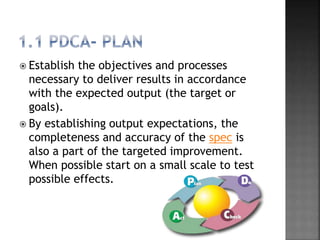
 Establish the objectives and processes
necessary to deliver results in accordance
with the expected output (the target or
goals).
 By establishing output expectations, the
completeness and accuracy of the spec is
also a part of the targeted improvement.
When possible start on a small scale to test
possible effects.
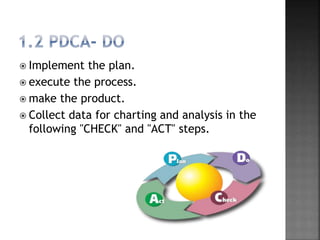
 Implement the plan.
 execute the process.
 make the product.
 Collect data for charting and analysis in the
following "CHECK" and "ACT" steps.
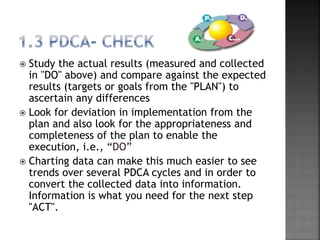
 Study the actual results (measured and collected
in "DO" above) and compare against the expected
results (targets or goals from the "PLAN") to
ascertain any differences
 Look for deviation in implementation from the
plan and also look for the appropriateness and
completeness of the plan to enable the
execution, i.e., “DO”
 Charting data can make this much easier to see
trends over several PDCA cycles and in order to
convert the collected data into information.
Information is what you need for the next step
"ACT".
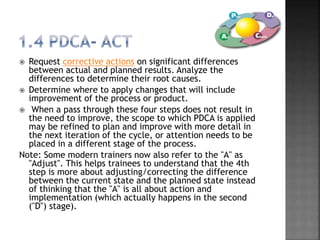
 Request corrective actions on significant differences
between actual and planned results. Analyze the
differences to determine their root causes.
 Determine where to apply changes that will include
improvement of the process or product.
 When a pass through these four steps does not result in
the need to improve, the scope to which PDCA is applied
may be refined to plan and improve with more detail in
the next iteration of the cycle, or attention needs to be
placed in a different stage of the process.
Note: Some modern trainers now also refer to the "A" as
"Adjust". This helps trainees to understand that the 4th
step is more about adjusting/correcting the difference
between the current state and the planned state instead
of thinking that the "A" is all about action and
implementation (which actually happens in the second
("D") stage).
2. RELATIONSHIP B/W
QUALITY MANAGEMENT &
CUSTOMER
SATISFACTION
2.1Customer Satisfaction
 Customer satisfaction is a term
frequently used in marketing.
 It is a measure of how products and
services supplied by a company meet or
surpass customer expectation.
 Customer satisfaction is defined as
"the number of customers, or percentage
of total customers, whose reported
experience with a firm, its products, or its
services (ratings) exceeds
specified satisfaction goals.
CUSTOMER SATISFACTION-
Why, How?
 Within organizations, customer
satisfaction ratings can have powerful
effects. They focus employees on the
importance of fulfilling customers'
expectations. Furthermore, when these
ratings dip, they warn of problems that
can affect sales and profitability.
 Therefore, it is essential for businesses
to effectively manage customer
satisfaction.
 To be able do this, firms need reliable
and representative measures of
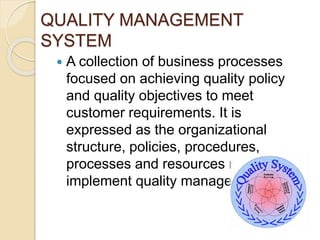
QUALITY MANAGEMENT
SYSTEM
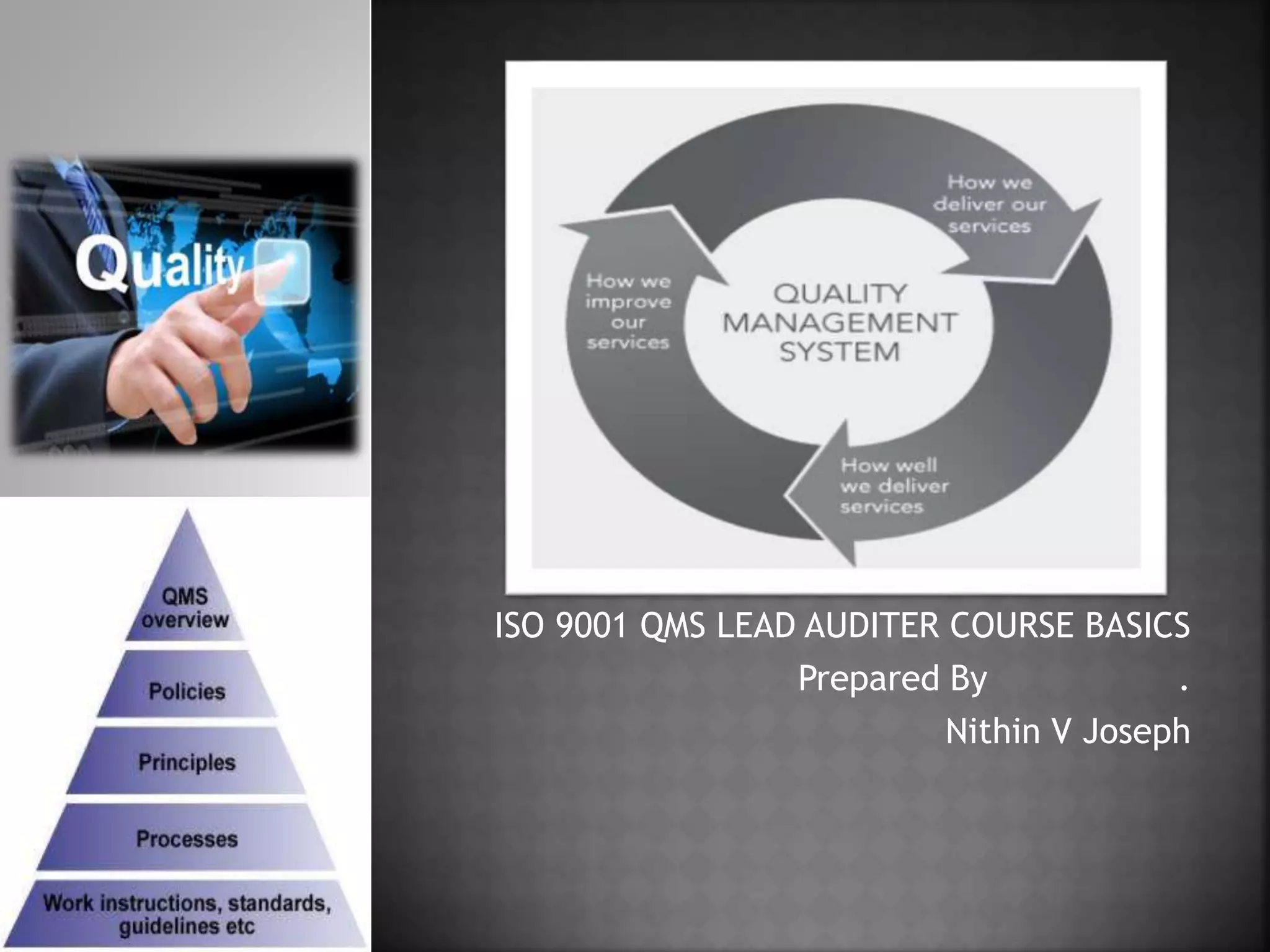
 A collection of business processes
focused on achieving quality policy
and quality objectives to meet
customer requirements. It is
expressed as the organizational
structure, policies, procedures,
processes and resources needed to
implement quality management.
Quality Management System
process
 A QMS process is an element of an
organizational QMS.
 The ISO9001:2000 standard requires
organizations
seeking compliance or certification to define the
processes which form the QMS and the
sequence and interaction of these processes.
ISO 9000 & ISO 9001
 ISO 9001 deals with the requirements that
organizations wishing to meet the standard
must fulfil.
 ISO 9000 family of quality management
systems standards is designed to help
organizations ensure that they meet the
needs of customers and other stakeholders
while meeting statutory and regulatory
requirements related to a product. ISO 9000
deals with the fundamentals of quality
management systems, including the eight
management principles upon which the family
of standards is based
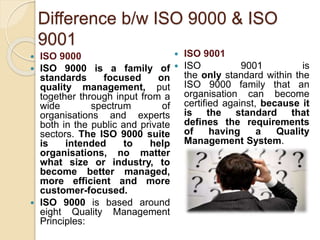
Difference b/w ISO 9000 & ISO
9001
 ISO 9000
 ISO 9000 is a family of
standards focused on
quality management, put
together through input from a
wide spectrum of
organisations and experts
both in the public and private
sectors. The ISO 9000 suite
is intended to help
organisations, no matter
what size or industry, to
become better managed,
more efficient and more
customer-focused.
 ISO 9000 is based around
eight Quality Management
Principles:
 ISO 9001
 ISO 9001 is
the only standard within the
ISO 9000 family that an
organisation can become
certified against, because it
is the standard that
defines the requirements
of having a Quality
Management System.
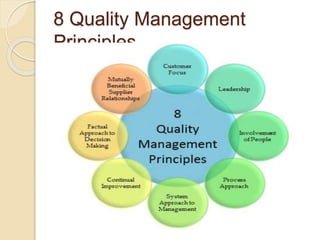
8 Quality Management
Principles
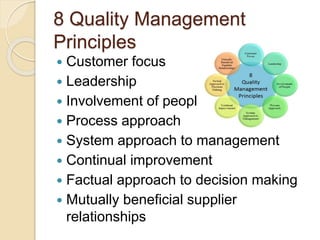
8 Quality Management
Principles
 Customer focus
 Leadership
 Involvement of people
 Process approach
 System approach to management
 Continual improvement
 Factual approach to decision making
 Mutually beneficial supplier
relationships
QUALITY MANAGEMENT
TERMS

BASICS FOR ISO 9001 QMS LEAD AUDITOR COURSE

  • 1.
    ISO 9001 QMSLEAD AUDITER COURSE BASICS Prepared By . Nithin V Joseph
  • 2.
     Deming cycle/shewartchart  Plan, Do, Check & Act  In 6sigma PDCA known as DMAIC  PDCA was made popular by Dr W. Edwards Deming, who is considered by many to be the father of modern quality control; however, he always referred to it as the "Shewhart cycle". Later in Deming's career, he modified PDCA to "Plan, Do, Study, Act" (PDSA) because he felt that "check" emphasized inspection over analysis
  • 3.
     Establish theobjectives and processes necessary to deliver results in accordance with the expected output (the target or goals).  By establishing output expectations, the completeness and accuracy of the spec is also a part of the targeted improvement. When possible start on a small scale to test possible effects.
  • 4.
     Implement theplan.  execute the process.  make the product.  Collect data for charting and analysis in the following "CHECK" and "ACT" steps.
  • 5.
     Study theactual results (measured and collected in "DO" above) and compare against the expected results (targets or goals from the "PLAN") to ascertain any differences  Look for deviation in implementation from the plan and also look for the appropriateness and completeness of the plan to enable the execution, i.e., “DO”  Charting data can make this much easier to see trends over several PDCA cycles and in order to convert the collected data into information. Information is what you need for the next step "ACT".
  • 6.
     Request correctiveactions on significant differences between actual and planned results. Analyze the differences to determine their root causes.  Determine where to apply changes that will include improvement of the process or product.  When a pass through these four steps does not result in the need to improve, the scope to which PDCA is applied may be refined to plan and improve with more detail in the next iteration of the cycle, or attention needs to be placed in a different stage of the process. Note: Some modern trainers now also refer to the "A" as "Adjust". This helps trainees to understand that the 4th step is more about adjusting/correcting the difference between the current state and the planned state instead of thinking that the "A" is all about action and implementation (which actually happens in the second ("D") stage).
  • 7.
    2. RELATIONSHIP B/W QUALITYMANAGEMENT & CUSTOMER SATISFACTION
  • 8.
    2.1Customer Satisfaction  Customersatisfaction is a term frequently used in marketing.  It is a measure of how products and services supplied by a company meet or surpass customer expectation.  Customer satisfaction is defined as "the number of customers, or percentage of total customers, whose reported experience with a firm, its products, or its services (ratings) exceeds specified satisfaction goals.
  • 9.
    CUSTOMER SATISFACTION- Why, How? Within organizations, customer satisfaction ratings can have powerful effects. They focus employees on the importance of fulfilling customers' expectations. Furthermore, when these ratings dip, they warn of problems that can affect sales and profitability.  Therefore, it is essential for businesses to effectively manage customer satisfaction.  To be able do this, firms need reliable and representative measures of
  • 10.
    QUALITY MANAGEMENT SYSTEM  Acollection of business processes focused on achieving quality policy and quality objectives to meet customer requirements. It is expressed as the organizational structure, policies, procedures, processes and resources needed to implement quality management.
  • 11.
    Quality Management System process A QMS process is an element of an organizational QMS.  The ISO9001:2000 standard requires organizations seeking compliance or certification to define the processes which form the QMS and the sequence and interaction of these processes.
  • 12.
    ISO 9000 &ISO 9001  ISO 9001 deals with the requirements that organizations wishing to meet the standard must fulfil.  ISO 9000 family of quality management systems standards is designed to help organizations ensure that they meet the needs of customers and other stakeholders while meeting statutory and regulatory requirements related to a product. ISO 9000 deals with the fundamentals of quality management systems, including the eight management principles upon which the family of standards is based
  • 13.
    Difference b/w ISO9000 & ISO 9001  ISO 9000  ISO 9000 is a family of standards focused on quality management, put together through input from a wide spectrum of organisations and experts both in the public and private sectors. The ISO 9000 suite is intended to help organisations, no matter what size or industry, to become better managed, more efficient and more customer-focused.  ISO 9000 is based around eight Quality Management Principles:  ISO 9001  ISO 9001 is the only standard within the ISO 9000 family that an organisation can become certified against, because it is the standard that defines the requirements of having a Quality Management System.
  • 14.
  • 15.
    8 Quality Management Principles Customer focus  Leadership  Involvement of people  Process approach  System approach to management  Continual improvement  Factual approach to decision making  Mutually beneficial supplier relationships
  • 16.