
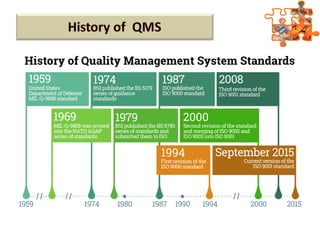






SIVASANKARAN.N
 Few Facts about ISO
 ISO 9001:2015 Principles
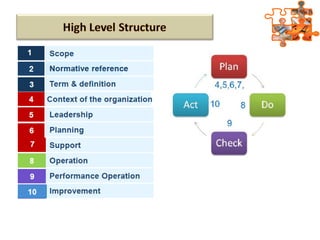
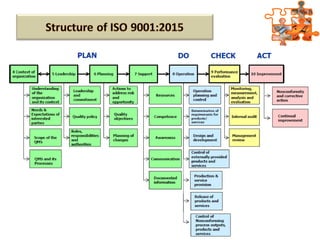
 High Level Structure
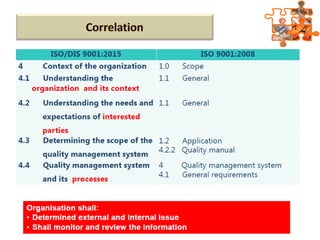
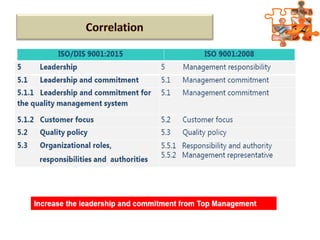
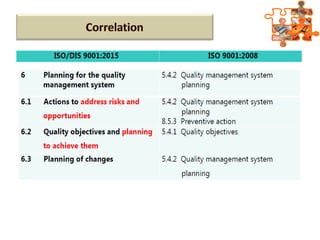
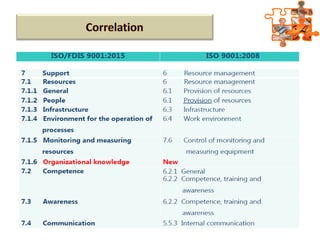
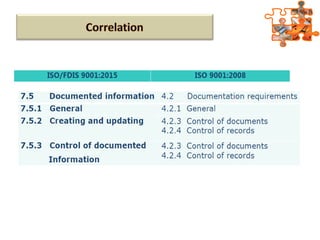
 Clause wise correlation
 Internal Quality Audit
Name:
Function :
Years of experience:
Knowledge on ISO (1-10):
Expectation :
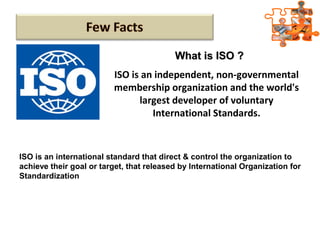
ISO is an independent, non-governmental
membership organization and the world's
largest developer of voluntary
International Standards.
ISO is an international standard that direct & control the organization to
achieve their goal or target, that released by International Organization for
Standardization
What is ISO ?What is ISO ?
International Organization for Standardization
Founded in 1946 , Switzerland
Made up of over 160 National Standards Bodies (“NSB’s”)
Almost 20,000 standards in the ISO portfolio
All standards are based on INTERNATIONAL CONSENSUS
International Organization for Standardization would have different acronyms in different
languages
English - IOS
French - OIN or Organisation internationale denormalisation
ISO standards are usually developed by its Technical Committees (“TC’s”) and Sub-
committees (“SC’s”)
ISO/TC176/SC2 (Quality Systems) is responsible for ISO 9001
Decided to give it the short form ISO.
ISO is derived from the Greek isos, meaning equal.
What ever the country, what ever the language, we are always ISO.
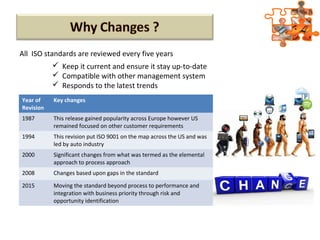
All ISO standards are reviewed every five years
 Keep it current and ensure it stay up-to-date
 Compatible with other management system
 Responds to the latest trends
Year of
Revision
Key changes
1987 This release gained popularity across Europe however US
remained focused on other customer requirements
1994 This revision put ISO 9001 on the map across the US and was
led by auto industry
2000 Significant changes from what was termed as the elemental
approach to process approach
2008 Changes based upon gaps in the standard
2015 Moving the standard beyond process to performance and
integration with business priority through risk and
opportunity identification
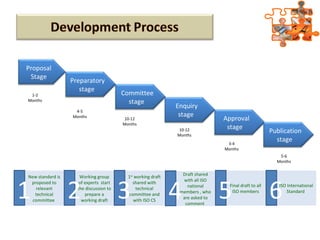
New standard is
proposed to
relevant
technical
committee
1
Working group
of experts start
the discussion to
prepare a
working draft
2
1st
working draft
shared with
technical
committee and
with ISO CS
3
Draft shared
with all ISO
national
members , who
are asked to
comment
4 Final draft to all
ISO members
5 ISO International
Standard
6
Proposal
Stage
Preparatory
stage
Committee
stage
Enquiry
stage
Approval
stage
Publication
stage
1-2
Months
4-5
Months 10-12
Months
3-4
Months
5-6
Months
10-12
Months
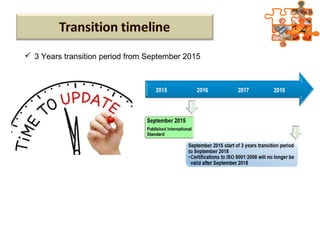
 3 Years transition period from September 2015
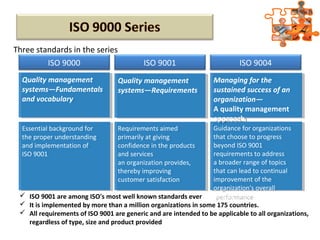
Essential background for
the proper understanding
and implementation of
ISO 9001
Essential background for
the proper understanding
and implementation of
ISO 9001
Requirements aimed
primarily at giving
confidence in the products
and services
an organization provides,
thereby improving
customer satisfaction
Requirements aimed
primarily at giving
confidence in the products
and services
an organization provides,
thereby improving
customer satisfaction
Guidance for organizations
that choose to progress
beyond ISO 9001
requirements to address
a broader range of topics
that can lead to continual
improvement of the
organization's overall
performance
Guidance for organizations
that choose to progress
beyond ISO 9001
requirements to address
a broader range of topics
that can lead to continual
improvement of the
organization's overall
performance
ISO 9000
Three standards in the series
ISO 9001 ISO 9004
Quality management
systems—Fundamentals
and vocabulary
Quality management
systems—Fundamentals
and vocabulary
Quality management
systems—Requirements
Quality management
systems—Requirements
Managing for the
sustained success of an
organization—
A quality management
approach
Managing for the
sustained success of an
organization—
A quality management
approach
 ISO 9001 are among ISO's most well known standards ever
 It is implemented by more than a million organizations in some 175 countries.
 All requirements of ISO 9001 are generic and are intended to be applicable to all organizations,
regardless of type, size and product provided
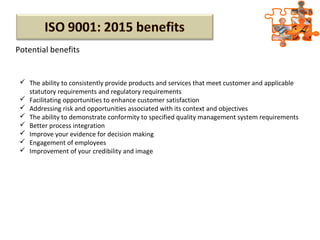
Potential benefits
 The ability to consistently provide products and services that meet customer and applicable
statutory requirements and regulatory requirements
 Facilitating opportunities to enhance customer satisfaction
 Addressing risk and opportunities associated with its context and objectives
 The ability to demonstrate conformity to specified quality management system requirements
 Better process integration
 Improve your evidence for decision making
 Engagement of employees
 Improvement of your credibility and image
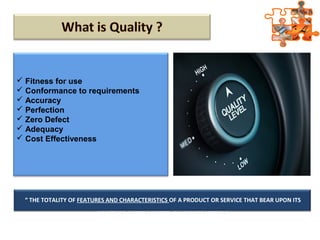
 Fitness for use
 Conformance to requirements
 Accuracy
 Perfection
 Zero Defect
 Adequacy
 Cost Effectiveness
“ THE TOTALITY OF FEATURES AND CHARACTERISTICS OF A PRODUCT OR SERVICE THAT BEAR UPON ITS
ABILITY TO SATISFY STATED OR IMPLIED NEEDS “
 A group of interacting, interrelated, or interdependent
elements forming a complex whole
 Set of detailed methods ,procedures and routines
established or formulated to carry out a specific activity ,
perform a duty , or solve a problem
Quality Management
System
A System of coordinated activities which is meant to “direct”
and “control” an organization with regard to quality.
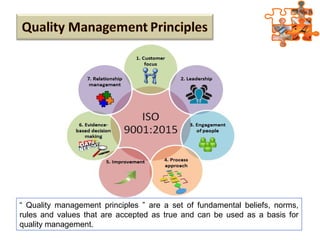
“ Quality management principles ” are a set of fundamental beliefs, norms,
rules and values that are accepted as true and can be used as a basis for
quality management.
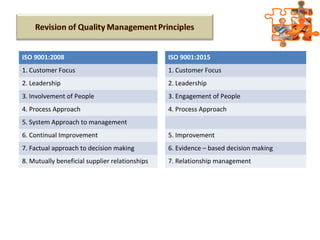
ISO 9001:2008
1. Customer Focus
2. Leadership
3. Involvement of People
4. Process Approach
5. System Approach to management
6. Continual Improvement
7. Factual approach to decision making
8. Mutually beneficial supplier relationships
ISO 9001:2015
1. Customer Focus
2. Leadership
3. Engagement of People
4. Process Approach
5. Improvement
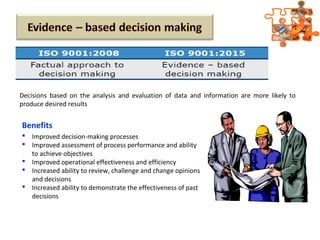
6. Evidence – based decision making
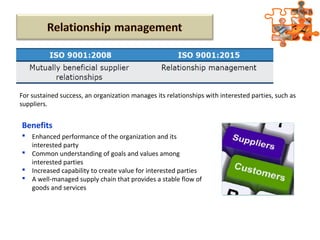
7. Relationship management
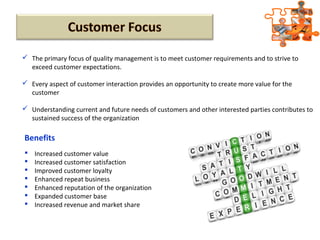
 The primary focus of quality management is to meet customer requirements and to strive to
exceed customer expectations.
 Every aspect of customer interaction provides an opportunity to create more value for the
customer
 Understanding current and future needs of customers and other interested parties contributes to
sustained success of the organization
 Increased customer value
 Increased customer satisfaction
 Improved customer loyalty
 Enhanced repeat business
 Enhanced reputation of the organization
 Expanded customer base
 Increased revenue and market share
Benefits
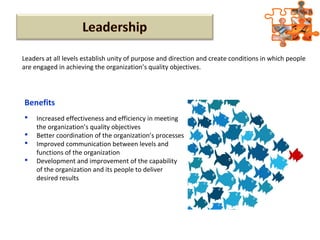
Leaders at all levels establish unity of purpose and direction and create conditions in which people
are engaged in achieving the organization’s quality objectives.
 Increased effectiveness and efficiency in meeting
the organization’s quality objectives
 Better coordination of the organization’s processes
 Improved communication between levels and
functions of the organization
 Development and improvement of the capability
of the organization and its people to deliver
desired results
Benefits
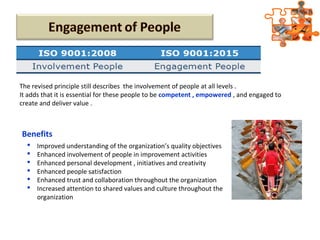
The revised principle still describes the involvement of people at all levels .
It adds that it is essential for these people to be competent , empowered , and engaged to
create and deliver value .
Benefits
 Improved understanding of the organization’s quality objectives
 Enhanced involvement of people in improvement activities
 Enhanced personal development , initiatives and creativity
 Enhanced people satisfaction
 Enhanced trust and collaboration throughout the organization
 Increased attention to shared values and culture throughout the
organization
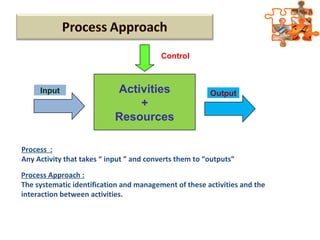
Activities
+
Resources
Input Output
Control
Process :
Any Activity that takes “ input ” and converts them to “outputs”
Process Approach :
The systematic identification and management of these activities and the
interaction between activities.
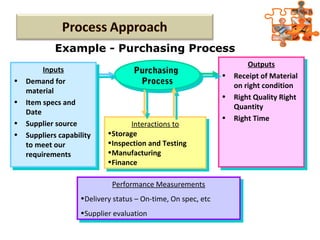
Example - Purchasing Process
Performance Measurements
•Delivery status – On-time, On spec, etc
•Supplier evaluation
Performance Measurements
•Delivery status – On-time, On spec, etc
•Supplier evaluation
Outputs
• Receipt of Material
on right condition
• Right Quality Right
Quantity
• Right Time
Outputs
• Receipt of Material
on right condition
• Right Quality Right
Quantity
• Right Time
Purchasing
Process
Purchasing
Process
Interactions to
•Storage
•Inspection and Testing
•Manufacturing
•Finance
Interactions to
•Storage
•Inspection and Testing
•Manufacturing
•Finance
Inputs
• Demand for
material
• Item specs and
Date
• Supplier source
• Suppliers capability
to meet our
requirements
Inputs
• Demand for
material
• Item specs and
Date
• Supplier source
• Suppliers capability
to meet our
requirements
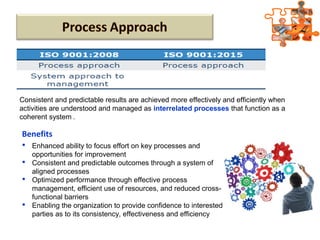
Benefits
 Enhanced ability to focus effort on key processes and
opportunities for improvement
 Consistent and predictable outcomes through a system of
aligned processes
 Optimized performance through effective process
management, efficient use of resources, and reduced cross-
functional barriers
 Enabling the organization to provide confidence to interested
parties as to its consistency, effectiveness and efficiency
Consistent and predictable results are achieved more effectively and efficiently when
activities are understood and managed as interrelated processes that function as a
coherent system .
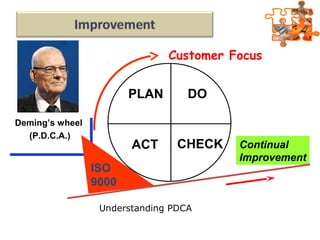
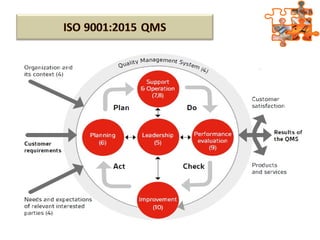
Deming’s wheel
(P.D.C.A.)
Deming’s wheel
(P.D.C.A.)
ISO
9000
PLAN DO
ACT CHECK Continual
Improvement
Customer Focus
Understanding PDCA
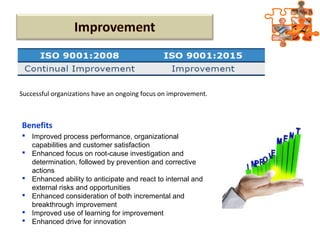
Benefits
 Improved process performance, organizational
capabilities and customer satisfaction
 Enhanced focus on root-cause investigation and
determination, followed by prevention and corrective
actions
 Enhanced ability to anticipate and react to internal and
external risks and opportunities
 Enhanced consideration of both incremental and
breakthrough improvement
 Improved use of learning for improvement
 Enhanced drive for innovation
Successful organizations have an ongoing focus on improvement.
Benefits
 Improved decision-making processes
 Improved assessment of process performance and ability
to achieve objectives
 Improved operational effectiveness and efficiency
 Increased ability to review, challenge and change opinions
and decisions
 Increased ability to demonstrate the effectiveness of past
decisions
Decisions based on the analysis and evaluation of data and information are more likely to
produce desired results
Benefits
 Enhanced performance of the organization and its
interested party
 Common understanding of goals and values among
interested parties
 Increased capability to create value for interested parties
 A well-managed supply chain that provides a stable flow of
goods and services
For sustained success, an organization manages its relationships with interested parties, such as
suppliers.
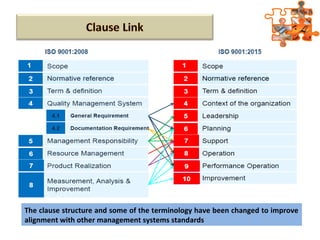
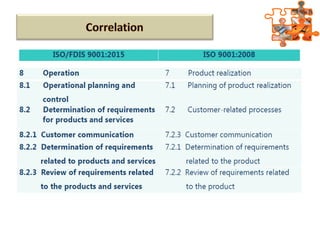
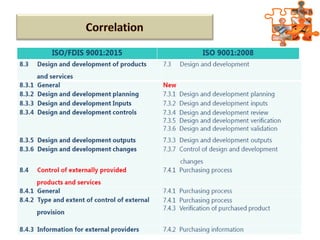
The clause structure and some of the terminology have been changed to improve
alignment with other management systems standards
Why Documentation / Formats ?
 Communication
 Avoid Subjectivity
 Bench marking
 Auditing
Difference between documents & records
It provides guidelines
Documents are dynamic and can be
revised
It provides guidelines
Documents are dynamic and can be
revised
It provides evidence of work done
Records cannot be changed
It provides evidence of work done
Records cannot be changed
Examples
- Procedure for production
planning
- Drawing
- Quality Standard
- Work Instruction
Examples
- Production Report
- Inspection Report
Document Record
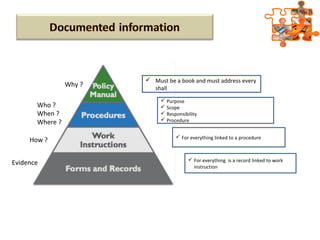
Why ?
Who ?
When ?
Where ?
How ?
Evidence
 Must be a book and must address every
shall
 Purpose
 Scope
 Responsibility
 Procedure
 For everything linked to a procedure
 For everything is a record linked to work
instruction
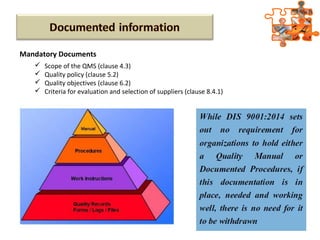
 Scope of the QMS (clause 4.3)
 Quality policy (clause 5.2)
 Quality objectives (clause 6.2)
 Criteria for evaluation and selection of suppliers (clause 8.4.1)
Mandatory Documents
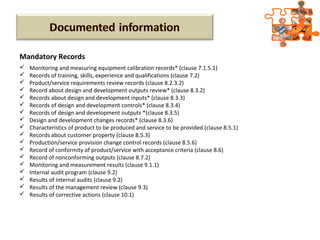
Mandatory Records
 Monitoring and measuring equipment calibration records* (clause 7.1.5.1)
 Records of training, skills, experience and qualifications (clause 7.2)
 Product/service requirements review records (clause 8.2.3.2)
 Record about design and development outputs review* (clause 8.3.2)
 Records about design and development inputs* (clause 8.3.3)
 Records of design and development controls* (clause 8.3.4)
 Records of design and development outputs *(clause 8.3.5)
 Design and development changes records* (clause 8.3.6)
 Characteristics of product to be produced and service to be provided (clause 8.5.1)
 Records about customer property (clause 8.5.3)
 Production/service provision change control records (clause 8.5.6)
 Record of conformity of product/service with acceptance criteria (clause 8.6)
 Record of nonconforming outputs (clause 8.7.2)
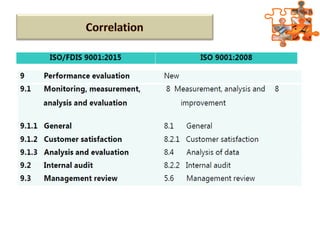
 Monitoring and measurement results (clause 9.1.1)
 Internal audit program (clause 9.2)
 Results of internal audits (clause 9.2)
 Results of the management review (clause 9.3)
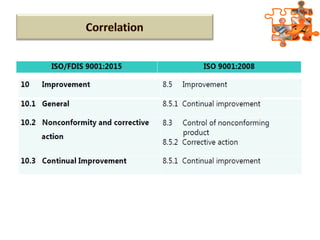
 Results of corrective actions (clause 10.1)
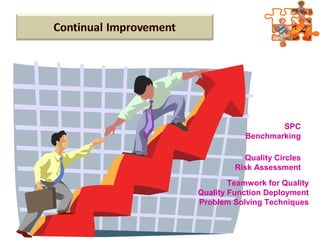
SPC
Benchmarking
Quality Circles
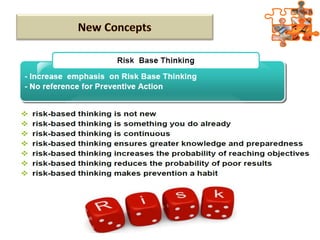
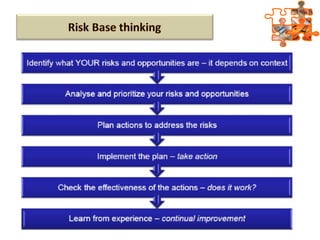
Risk Assessment
Teamwork for Quality
Quality Function Deployment
Problem Solving Techniques
Thank You !Thank You !

9001 15 awareness v1

  • 1.
  • 2.
     Few Factsabout ISO  ISO 9001:2015 Principles  High Level Structure  Clause wise correlation  Internal Quality Audit
  • 3.
    Name: Function : Years ofexperience: Knowledge on ISO (1-10): Expectation :
  • 5.
    ISO is anindependent, non-governmental membership organization and the world's largest developer of voluntary International Standards. ISO is an international standard that direct & control the organization to achieve their goal or target, that released by International Organization for Standardization What is ISO ?What is ISO ?
  • 6.
    International Organization forStandardization Founded in 1946 , Switzerland Made up of over 160 National Standards Bodies (“NSB’s”) Almost 20,000 standards in the ISO portfolio All standards are based on INTERNATIONAL CONSENSUS International Organization for Standardization would have different acronyms in different languages English - IOS French - OIN or Organisation internationale denormalisation ISO standards are usually developed by its Technical Committees (“TC’s”) and Sub- committees (“SC’s”) ISO/TC176/SC2 (Quality Systems) is responsible for ISO 9001 Decided to give it the short form ISO. ISO is derived from the Greek isos, meaning equal. What ever the country, what ever the language, we are always ISO.
  • 8.
    All ISO standardsare reviewed every five years  Keep it current and ensure it stay up-to-date  Compatible with other management system  Responds to the latest trends Year of Revision Key changes 1987 This release gained popularity across Europe however US remained focused on other customer requirements 1994 This revision put ISO 9001 on the map across the US and was led by auto industry 2000 Significant changes from what was termed as the elemental approach to process approach 2008 Changes based upon gaps in the standard 2015 Moving the standard beyond process to performance and integration with business priority through risk and opportunity identification
  • 9.
    New standard is proposedto relevant technical committee 1 Working group of experts start the discussion to prepare a working draft 2 1st working draft shared with technical committee and with ISO CS 3 Draft shared with all ISO national members , who are asked to comment 4 Final draft to all ISO members 5 ISO International Standard 6 Proposal Stage Preparatory stage Committee stage Enquiry stage Approval stage Publication stage 1-2 Months 4-5 Months 10-12 Months 3-4 Months 5-6 Months 10-12 Months
  • 10.
     3 Yearstransition period from September 2015
  • 11.
    Essential background for theproper understanding and implementation of ISO 9001 Essential background for the proper understanding and implementation of ISO 9001 Requirements aimed primarily at giving confidence in the products and services an organization provides, thereby improving customer satisfaction Requirements aimed primarily at giving confidence in the products and services an organization provides, thereby improving customer satisfaction Guidance for organizations that choose to progress beyond ISO 9001 requirements to address a broader range of topics that can lead to continual improvement of the organization's overall performance Guidance for organizations that choose to progress beyond ISO 9001 requirements to address a broader range of topics that can lead to continual improvement of the organization's overall performance ISO 9000 Three standards in the series ISO 9001 ISO 9004 Quality management systems—Fundamentals and vocabulary Quality management systems—Fundamentals and vocabulary Quality management systems—Requirements Quality management systems—Requirements Managing for the sustained success of an organization— A quality management approach Managing for the sustained success of an organization— A quality management approach  ISO 9001 are among ISO's most well known standards ever  It is implemented by more than a million organizations in some 175 countries.  All requirements of ISO 9001 are generic and are intended to be applicable to all organizations, regardless of type, size and product provided
  • 12.
    Potential benefits  Theability to consistently provide products and services that meet customer and applicable statutory requirements and regulatory requirements  Facilitating opportunities to enhance customer satisfaction  Addressing risk and opportunities associated with its context and objectives  The ability to demonstrate conformity to specified quality management system requirements  Better process integration  Improve your evidence for decision making  Engagement of employees  Improvement of your credibility and image
  • 14.
     Fitness foruse  Conformance to requirements  Accuracy  Perfection  Zero Defect  Adequacy  Cost Effectiveness “ THE TOTALITY OF FEATURES AND CHARACTERISTICS OF A PRODUCT OR SERVICE THAT BEAR UPON ITS ABILITY TO SATISFY STATED OR IMPLIED NEEDS “
  • 15.
     A groupof interacting, interrelated, or interdependent elements forming a complex whole  Set of detailed methods ,procedures and routines established or formulated to carry out a specific activity , perform a duty , or solve a problem
  • 16.
    Quality Management System A Systemof coordinated activities which is meant to “direct” and “control” an organization with regard to quality.
  • 17.
    “ Quality managementprinciples ” are a set of fundamental beliefs, norms, rules and values that are accepted as true and can be used as a basis for quality management.
  • 18.
    ISO 9001:2008 1. CustomerFocus 2. Leadership 3. Involvement of People 4. Process Approach 5. System Approach to management 6. Continual Improvement 7. Factual approach to decision making 8. Mutually beneficial supplier relationships ISO 9001:2015 1. Customer Focus 2. Leadership 3. Engagement of People 4. Process Approach 5. Improvement 6. Evidence – based decision making 7. Relationship management
  • 19.
     The primaryfocus of quality management is to meet customer requirements and to strive to exceed customer expectations.  Every aspect of customer interaction provides an opportunity to create more value for the customer  Understanding current and future needs of customers and other interested parties contributes to sustained success of the organization  Increased customer value  Increased customer satisfaction  Improved customer loyalty  Enhanced repeat business  Enhanced reputation of the organization  Expanded customer base  Increased revenue and market share Benefits
  • 21.
    Leaders at alllevels establish unity of purpose and direction and create conditions in which people are engaged in achieving the organization’s quality objectives.  Increased effectiveness and efficiency in meeting the organization’s quality objectives  Better coordination of the organization’s processes  Improved communication between levels and functions of the organization  Development and improvement of the capability of the organization and its people to deliver desired results Benefits
  • 22.
    The revised principlestill describes the involvement of people at all levels . It adds that it is essential for these people to be competent , empowered , and engaged to create and deliver value . Benefits  Improved understanding of the organization’s quality objectives  Enhanced involvement of people in improvement activities  Enhanced personal development , initiatives and creativity  Enhanced people satisfaction  Enhanced trust and collaboration throughout the organization  Increased attention to shared values and culture throughout the organization
  • 23.
    Activities + Resources Input Output Control Process : AnyActivity that takes “ input ” and converts them to “outputs” Process Approach : The systematic identification and management of these activities and the interaction between activities.
  • 24.
    Example - PurchasingProcess Performance Measurements •Delivery status – On-time, On spec, etc •Supplier evaluation Performance Measurements •Delivery status – On-time, On spec, etc •Supplier evaluation Outputs • Receipt of Material on right condition • Right Quality Right Quantity • Right Time Outputs • Receipt of Material on right condition • Right Quality Right Quantity • Right Time Purchasing Process Purchasing Process Interactions to •Storage •Inspection and Testing •Manufacturing •Finance Interactions to •Storage •Inspection and Testing •Manufacturing •Finance Inputs • Demand for material • Item specs and Date • Supplier source • Suppliers capability to meet our requirements Inputs • Demand for material • Item specs and Date • Supplier source • Suppliers capability to meet our requirements
  • 25.
    Benefits  Enhanced abilityto focus effort on key processes and opportunities for improvement  Consistent and predictable outcomes through a system of aligned processes  Optimized performance through effective process management, efficient use of resources, and reduced cross- functional barriers  Enabling the organization to provide confidence to interested parties as to its consistency, effectiveness and efficiency Consistent and predictable results are achieved more effectively and efficiently when activities are understood and managed as interrelated processes that function as a coherent system .
  • 26.
    Deming’s wheel (P.D.C.A.) Deming’s wheel (P.D.C.A.) ISO 9000 PLANDO ACT CHECK Continual Improvement Customer Focus Understanding PDCA
  • 27.
    Benefits  Improved processperformance, organizational capabilities and customer satisfaction  Enhanced focus on root-cause investigation and determination, followed by prevention and corrective actions  Enhanced ability to anticipate and react to internal and external risks and opportunities  Enhanced consideration of both incremental and breakthrough improvement  Improved use of learning for improvement  Enhanced drive for innovation Successful organizations have an ongoing focus on improvement.
  • 28.
    Benefits  Improved decision-makingprocesses  Improved assessment of process performance and ability to achieve objectives  Improved operational effectiveness and efficiency  Increased ability to review, challenge and change opinions and decisions  Increased ability to demonstrate the effectiveness of past decisions Decisions based on the analysis and evaluation of data and information are more likely to produce desired results
  • 29.
    Benefits  Enhanced performanceof the organization and its interested party  Common understanding of goals and values among interested parties  Increased capability to create value for interested parties  A well-managed supply chain that provides a stable flow of goods and services For sustained success, an organization manages its relationships with interested parties, such as suppliers.
  • 38.
    The clause structureand some of the terminology have been changed to improve alignment with other management systems standards
  • 45.
    Why Documentation /Formats ?  Communication  Avoid Subjectivity  Bench marking  Auditing
  • 46.
    Difference between documents& records It provides guidelines Documents are dynamic and can be revised It provides guidelines Documents are dynamic and can be revised It provides evidence of work done Records cannot be changed It provides evidence of work done Records cannot be changed Examples - Procedure for production planning - Drawing - Quality Standard - Work Instruction Examples - Production Report - Inspection Report Document Record
  • 47.
    Why ? Who ? When? Where ? How ? Evidence  Must be a book and must address every shall  Purpose  Scope  Responsibility  Procedure  For everything linked to a procedure  For everything is a record linked to work instruction
  • 48.
     Scope ofthe QMS (clause 4.3)  Quality policy (clause 5.2)  Quality objectives (clause 6.2)  Criteria for evaluation and selection of suppliers (clause 8.4.1) Mandatory Documents
  • 49.
    Mandatory Records  Monitoringand measuring equipment calibration records* (clause 7.1.5.1)  Records of training, skills, experience and qualifications (clause 7.2)  Product/service requirements review records (clause 8.2.3.2)  Record about design and development outputs review* (clause 8.3.2)  Records about design and development inputs* (clause 8.3.3)  Records of design and development controls* (clause 8.3.4)  Records of design and development outputs *(clause 8.3.5)  Design and development changes records* (clause 8.3.6)  Characteristics of product to be produced and service to be provided (clause 8.5.1)  Records about customer property (clause 8.5.3)  Production/service provision change control records (clause 8.5.6)  Record of conformity of product/service with acceptance criteria (clause 8.6)  Record of nonconforming outputs (clause 8.7.2)  Monitoring and measurement results (clause 9.1.1)  Internal audit program (clause 9.2)  Results of internal audits (clause 9.2)  Results of the management review (clause 9.3)  Results of corrective actions (clause 10.1)
  • 55.
    SPC Benchmarking Quality Circles Risk Assessment Teamworkfor Quality Quality Function Deployment Problem Solving Techniques
  • 58.