ISO 9001:2008ISO 9001:2008
QUALITY MANAGEMENT SYSTEMQUALITY MANAGEMENT SYSTEM
BACKGROUNDBACKGROUND
• The International Organization for
Standardization (ISO) is a worldwide
organization that develops many different
kinds of Standards.
• ISO was formed in February 23, 1947February 23, 1947 in
GenevaGeneva.
• First Family of Quality Standard was released
in 1987.
WHAT IS ISO?WHAT IS ISO?
• The official title for the International
Organization for Standardization
• It is derived from the Greek isos, meaning
“equal”, which is the root of the prefix “iso”.
• ISO is the specialized international agency for
standards making.
WHAT ISWHAT IS
ISO 9000?ISO 9000?
• Primarily concerned with Quality Management.
• Achieve Customer Satisfaction and continual
improvement.
• ISO 9001:2008 is the actual specification for QMS.
It can be used irrespective of size or type of
organization.
ISO 9000 SERIESISO 9000 SERIES
• ISO is the internationally accepted minimum
requirements for quality management systems.
• It provides for 3rd party registration of the
organization’s QMS.
• It has become a condition requirement for doing
business with many organizations around the
world.
WHAT IS ISO 9001: 2008WHAT IS ISO 9001: 2008
Applicable to all types & sizes of Organizations with
possible permissible omissions of certain requirements
ISO 9001:2008 basically renarrates ISO 9001:2000. The
2008 version only introduced clarifications to the existing
requirements of ISO 9001:2000 and some changes
intended to improve consistency with ISO 14001:2004.
WHY PURSUE ISO 9001?WHY PURSUE ISO 9001?
• To comply with internationally accepted
quality standards
• To meet customer requirements
• To increase customer satisfaction
• To keep up with the competition
• To improve quality management system
• To reduce process variation and rework cost
• To increase personal satisfaction
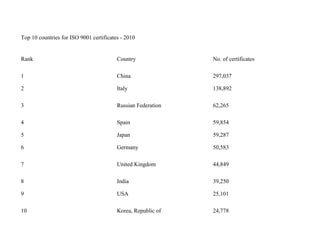
Top 10 countries for ISO 9001 certificates - 2010
Rank Country No. of certificates
1 China 297,037
2 Italy 138,892
3 Russian Federation 62,265
4 Spain 59,854
5 Japan 59,287
6 Germany 50,583
7 United Kingdom 44,849
8 India 39,250
9 USA 25,101
10 Korea, Republic of 24,778
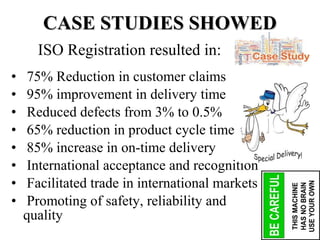
• 75% Reduction in customer claims
• 95% improvement in delivery time
• Reduced defects from 3% to 0.5%
• 65% reduction in product cycle time
• 85% increase in on-time delivery
• International acceptance and recognition
• Facilitated trade in international markets
• Promoting of safety, reliability and
quality
CASE STUDIES SHOWEDCASE STUDIES SHOWED
ISO Registration resulted in:
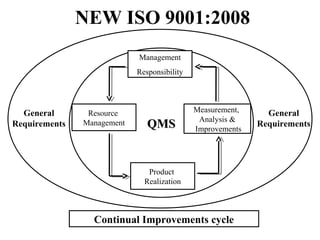
NEW ISO 9001:2008
QMSQMS
Resource
Management
Measurement,
Analysis &
Improvements
Product
Realization
Management
Responsibility
Continual Improvements cycle
General
Requirements
General
Requirements
ISO 9001:2008 STRUCTUREISO 9001:2008 STRUCTURE
• Four major sections
–Management Responsibility
–Resource Management
–Product Realisation
–Measurement, Analysis and Improvement
• Divided into 21 elements
ISO 9001:2008 STRUCTURE IISO 9001:2008 STRUCTURE I
Management Responsibility
1. Management commitment
2. Customer focus
3. Quality policy
4. Planning
5. Administration
6. Management review
ISO 9001:2008 STRUCTURE IIISO 9001:2008 STRUCTURE II
Resource Management
7. Provision of resources
8. Human resources
9. Facilities
10.Work environment
ISO 9001:2008 STRUCTURE IIIISO 9001:2008 STRUCTURE III
Product Realisation
11. Planning of realisation processes
12. Customer-related processes
13. Design and/or development
14. Purchasing
15. Production and service operations
16. Control of measuring and monitoring
Equipments
ISO 9001:2008 STRUCTURE IVISO 9001:2008 STRUCTURE IV
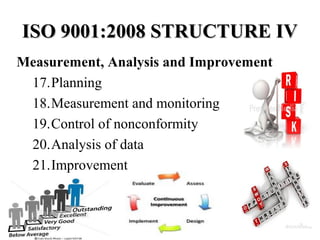
Measurement, Analysis and Improvement
17.Planning
18.Measurement and monitoring
19.Control of nonconformity
20.Analysis of data
21.Improvement
KEY QMS PRINCIPLESKEY QMS PRINCIPLES
Create an ISO( QMS ) document like
Manual, procedures and processes that
affect quality.
Ensure that all processes adhere to those
written procedures.
Documented evidence that the quality
standard is being implemented effectively.
Periodic internal and external audits to
ensure continued suitability, compliance,
and effectiveness of the QMS.
Define what should
be done?
Do what you say?
Show what you
have done?
Verify system
effectiveness
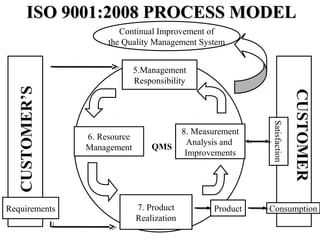
ISO 9001:2008 PROCESS MODELISO 9001:2008 PROCESS MODEL
CUSTOMER’S
CUSTOMER
QMS
5.Management
Responsibility
7. Product
Realization
6. Resource
Management
8. Measurement
Analysis and
Improvements
Requirements
Satisfaction
Continual Improvement of
the Quality Management System
ConsumptionProduct
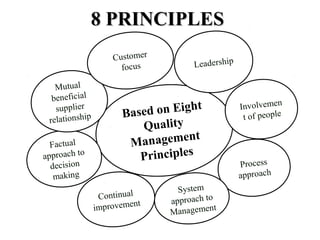
8 PRINCIPLES8 PRINCIPLES
Based on Eight
Quality
Management
Principles
Leadership
Process
approach
Involvemen
t of people
System
approach to
Management
Continual
improvement
Factual
approach to
decision
making
Mutual
beneficial
supplier
relationship
Customer
focus
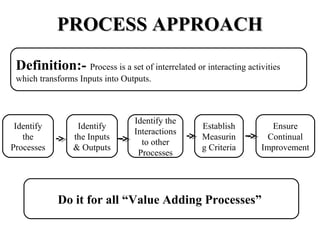
PROCESS APPROACHPROCESS APPROACH
Definition:- Process is a set of interrelated or interacting activities
which transforms Inputs into Outputs.

Ensure
Continual
Improvement
Identify
the
Processes
Do it for all “Value Adding Processes”
Establish
Measurin
g Criteria
Identify the
Interactions
to other
Processes
Identify
the Inputs
& Outputs
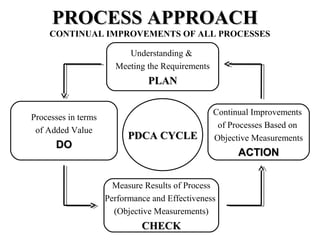
PROCESS APPROACHPROCESS APPROACH
CONTINUAL IMPROVEMENTS OF ALL PROCESSES
PDCA CYCLEPDCA CYCLE
Processes in terms
of Added Value
DODO
Continual Improvements
of Processes Based on
Objective Measurements
ACTIONACTION
Measure Results of Process
Performance and Effectiveness
(Objective Measurements)
CHECKCHECK
Understanding &
Meeting the Requirements
PLANPLAN
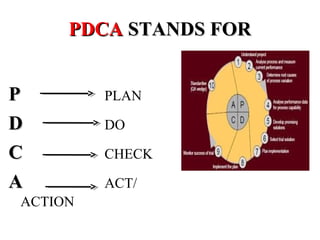
PDCAPDCA STANDS FORSTANDS FOR
PP PLAN
DD DO
CC CHECK
AA ACT/
ACTION
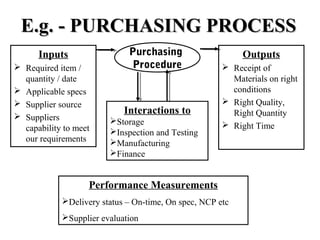
E.g. - PURCHASING PROCESSE.g. - PURCHASING PROCESS
Performance Measurements
Delivery status – On-time, On spec, NCP etc
Supplier evaluation
Outputs
 Receipt of
Materials on right
conditions
 Right Quality,
Right Quantity
 Right Time
Purchasing
Procedure
Interactions to
Storage
Inspection and Testing
Manufacturing
Finance
Inputs
 Required item /
quantity / date
 Applicable specs
 Supplier source
 Suppliers
capability to meet
our requirements
Provision of
Resources
Human
Resources
Infrastructure
Work
Environment
6.
Resource
Management
General
Requirements
Documentation
Requirements
Planning
Customer
Related
Processes
Design &
Developme
nt
Purchasing
Production
& Service
Provision
Management
Commitment
Customer
Focus
Quality
Policy
Planning
Responsibility,
Authority &
Communication
Management
Reviews
5.
Management
Responsibility
8.
Measurement
Analysis &
Improvements
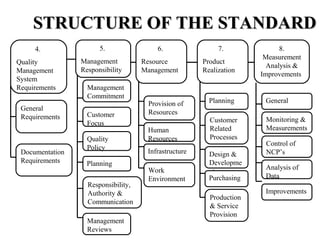
STRUCTURE OF THE STANDARDSTRUCTURE OF THE STANDARD
4.
Quality
Management
System
Requirements
7.
Product
Realization
General
Monitoring &
Measurements
Control of
NCP’s
Analysis of
Data
Improvements
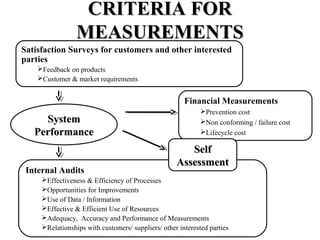
CRITERIA FORCRITERIA FOR
MEASUREMENTSMEASUREMENTS
Internal Audits
Effectiveness & Efficiency of Processes
Opportunities for Improvements
Use of Data / Information
Effective & Efficient Use of Resources
Adequacy, Accuracy and Performance of Measurements
Relationships with customers/ suppliers/ other interested parties
Financial Measurements
Prevention cost
Non conforming / failure cost
Lifecycle cost
SelfSelf
AssessmentAssessment
Satisfaction Surveys for customers and other interested
parties
Feedback on products
Customer & market requirements
SystemSystem
PerformancePerformance
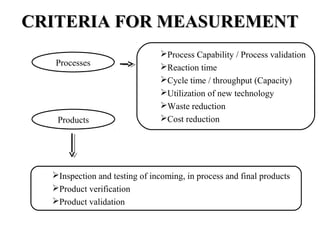
CRITERIA FOR MEASUREMENTCRITERIA FOR MEASUREMENT
Inspection and testing of incoming, in process and final products
Product verification
Product validation
Process Capability / Process validation
Reaction time
Cycle time / throughput (Capacity)
Utilization of new technology
Waste reduction
Cost reductionProducts
Processes
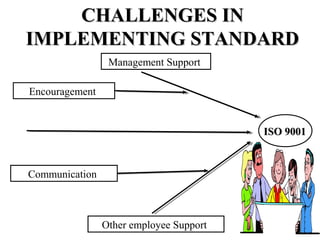
CHALLENGES INCHALLENGES IN
IMPLEMENTING STANDARDIMPLEMENTING STANDARD
Communication
Management Support
Other employee Support
ISO 9001ISO 9001
Encouragement
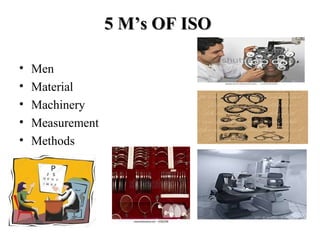
5 M’s OF ISO5 M’s OF ISO
• Men
• Material
• Machinery
• Measurement
• Methods
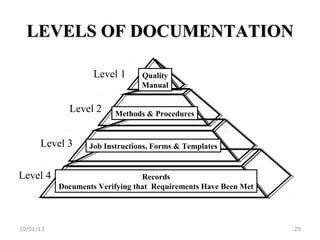
LEVELS OF DOCUMENTATIONLEVELS OF DOCUMENTATION
10/01/13 29
Quality
Manual
Level 1
Level 2
Level 3
Level 4
Methods & Procedures
Job Instructions, Forms & Templates
Records
Documents Verifying that Requirements Have Been Met
BENEFITSBENEFITS
• Increased employee morale as they are asked
to take control of their processes
(empowerment).
• Reduction in conflicts.
• Improved communications.
• Performance evaluation (Continual
Improvement).
ISO STANDS FORISO STANDS FOR
INTERNATIONAL ORGANIZATIONINTERNATIONAL ORGANIZATION
FOR STANDARDIZATIONFOR STANDARDIZATION
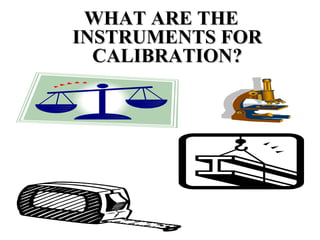
WHAT ARE THEWHAT ARE THE
INSTRUMENTS FORINSTRUMENTS FOR
CALIBRATION?CALIBRATION?
CONFORMITYCONFORMITY
The fulfillment of a requirement.
NONCONFORMITYNONCONFORMITY
The preferred term (ISO 19011, ISO 9001) for the non-
fulfillment of requirements (also known as deficiency,
discrepancy, finding, infraction, non-compliance).
CALIBRATIONCALIBRATION
All the operations for the purpose of determining the values
of the errors of a measuring instrument (and if necessary, to
determine other metrological properties).
COMPLIANCECOMPLIANCE
An indication or judgment that the product or service meets
the requirements of the relevant specification or regulation;
also the state of meeting the requirements.
IMPLIED NEEDS-IMPLIED NEEDS- without saying it directly,
understood
STATED NEEDS-STATED NEEDS- declared requirements
A SMALL TRUTH TO MAKEA SMALL TRUTH TO MAKE
LIFE 100%LIFE 100%
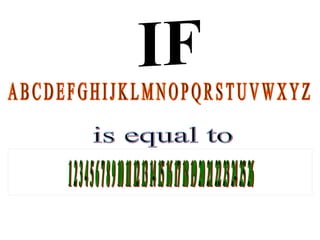
THEN WHAT MAKES 100% ?THEN WHAT MAKES 100% ?
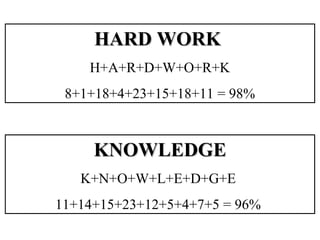
HARD WORKHARD WORK
H+A+R+D+W+O+R+K
8+1+18+4+23+15+18+11 = 98%
KNOWLEDGEKNOWLEDGE
K+N+O+W+L+E+D+G+E
11+14+15+23+12+5+4+7+5 = 96%
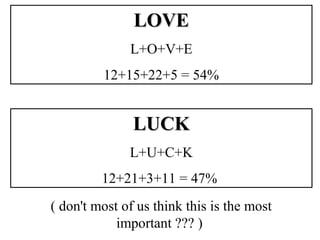
LOVELOVE
L+O+V+E
12+15+22+5 = 54%
LUCKLUCK
L+U+C+K
12+21+3+11 = 47%
( don't most of us think this is the most
important ??? )
THEN WHAT MAKES 100% ?THEN WHAT MAKES 100% ?
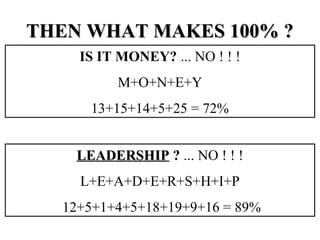
IS IT MONEY? ... NO ! ! !
M+O+N+E+Y
13+15+14+5+25 = 72%
LEADERSHIPLEADERSHIP ? ... NO ! ! !
L+E+A+D+E+R+S+H+I+P
12+5+1+4+5+18+19+9+16 = 89%
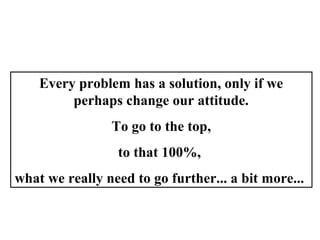
Every problem has a solution, only if we
perhaps change our attitude.
To go to the top,
to that 100%,
what we really need to go further... a bit more...
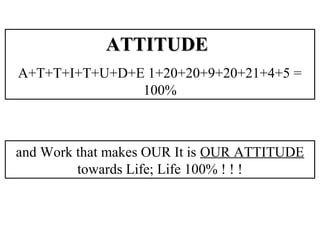
ATTITUDEATTITUDE
A+T+T+I+T+U+D+E 1+20+20+9+20+21+4+5 =
100%
and Work that makes OUR It is OUR ATTITUDE
towards Life; Life 100% ! ! !
Change Your Attitude …
And You Change Your Life ! ! !
INSTRUCTIONS FORINSTRUCTIONS FOR
LIFE/WORKLIFE/WORK
 Take in to account that great love,
great achievement involves great risk.
 When you loose don't loose the
lesson
 Follow the three “ R”s:
Respect for self,
Respect for others and,
Responsibility for
all your actions
INTERNATIONAL SURVEYINTERNATIONAL SURVEY
SHOWS HOW YOU CAN GAINSHOWS HOW YOU CAN GAIN
MAXIMUM BENEFIT FROMMAXIMUM BENEFIT FROM
ISOISO
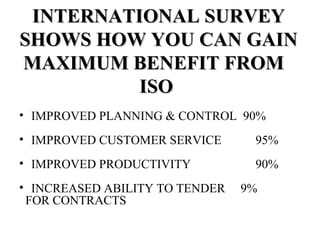
• IMPROVED PLANNING & CONTROL 90%
• IMPROVED CUSTOMER SERVICE 95%
• IMPROVED PRODUCTIVITY 90%
• INCREASED ABILITY TO TENDER 9%
FOR CONTRACTS
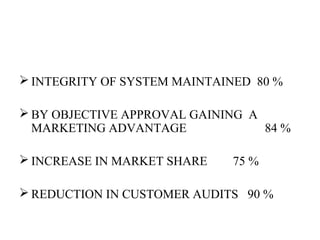
 INTEGRITY OF SYSTEM MAINTAINED 80 %
 BY OBJECTIVE APPROVAL GAINING A
MARKETING ADVANTAGE 84 %
 INCREASE IN MARKET SHARE 75 %
 REDUCTION IN CUSTOMER AUDITS 90 %
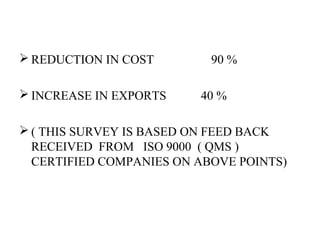
 REDUCTION IN COST 90 %
 INCREASE IN EXPORTS 40 %
 ( THIS SURVEY IS BASED ON FEED BACK
RECEIVED FROM ISO 9000 ( QMS )
CERTIFIED COMPANIES ON ABOVE POINTS)
ADVANTAGES OF ISOADVANTAGES OF ISO
Marketing Tool
Sets benchmark
Acts as a set of discipline
Basis for TQM
• Serves Export/domestic Customer’s
requirement
• Helps to revisit system
• Helps document practices
• Helps in manpower training.
• Brings clarity in roles and
responsibilities
• Reduces frustration
• Helps tide over problems arising out of
manpower training
EXPECTEDEXPECTED
BENEFITS OF ISOBENEFITS OF ISO
 Inspires confidence in the company’s
potential
 It helps the company achieve consistent
levels of quality.
 The overall image of the company in the
market is likely to improve
Market share can go up with the resultant
improved market credibility.
Company’s own management has greater
confidence in its own internal system.
The systematic approach to problem solving
results in elimination of chronic problems by
taking care of the root causes.
Exports of the organization can be increased as
ISO 9000 System standards are Globally
accepted in over 150 countries
ISO 9000 implementation puts a company on
the road to TQM
Iso awareness training

Iso awareness training

  • 1.
    ISO 9001:2008ISO 9001:2008 QUALITYMANAGEMENT SYSTEMQUALITY MANAGEMENT SYSTEM
  • 2.
    BACKGROUNDBACKGROUND • The InternationalOrganization for Standardization (ISO) is a worldwide organization that develops many different kinds of Standards. • ISO was formed in February 23, 1947February 23, 1947 in GenevaGeneva. • First Family of Quality Standard was released in 1987.
  • 3.
    WHAT IS ISO?WHATIS ISO? • The official title for the International Organization for Standardization • It is derived from the Greek isos, meaning “equal”, which is the root of the prefix “iso”. • ISO is the specialized international agency for standards making.
  • 4.
    WHAT ISWHAT IS ISO9000?ISO 9000? • Primarily concerned with Quality Management. • Achieve Customer Satisfaction and continual improvement. • ISO 9001:2008 is the actual specification for QMS. It can be used irrespective of size or type of organization.
  • 5.
    ISO 9000 SERIESISO9000 SERIES • ISO is the internationally accepted minimum requirements for quality management systems. • It provides for 3rd party registration of the organization’s QMS. • It has become a condition requirement for doing business with many organizations around the world.
  • 6.
    WHAT IS ISO9001: 2008WHAT IS ISO 9001: 2008 Applicable to all types & sizes of Organizations with possible permissible omissions of certain requirements ISO 9001:2008 basically renarrates ISO 9001:2000. The 2008 version only introduced clarifications to the existing requirements of ISO 9001:2000 and some changes intended to improve consistency with ISO 14001:2004.
  • 7.
    WHY PURSUE ISO9001?WHY PURSUE ISO 9001? • To comply with internationally accepted quality standards • To meet customer requirements • To increase customer satisfaction • To keep up with the competition • To improve quality management system • To reduce process variation and rework cost • To increase personal satisfaction
  • 8.
    Top 10 countriesfor ISO 9001 certificates - 2010 Rank Country No. of certificates 1 China 297,037 2 Italy 138,892 3 Russian Federation 62,265 4 Spain 59,854 5 Japan 59,287 6 Germany 50,583 7 United Kingdom 44,849 8 India 39,250 9 USA 25,101 10 Korea, Republic of 24,778
  • 9.
    • 75% Reductionin customer claims • 95% improvement in delivery time • Reduced defects from 3% to 0.5% • 65% reduction in product cycle time • 85% increase in on-time delivery • International acceptance and recognition • Facilitated trade in international markets • Promoting of safety, reliability and quality CASE STUDIES SHOWEDCASE STUDIES SHOWED ISO Registration resulted in:
  • 10.
    NEW ISO 9001:2008 QMSQMS Resource Management Measurement, Analysis& Improvements Product Realization Management Responsibility Continual Improvements cycle General Requirements General Requirements
  • 11.
    ISO 9001:2008 STRUCTUREISO9001:2008 STRUCTURE • Four major sections –Management Responsibility –Resource Management –Product Realisation –Measurement, Analysis and Improvement • Divided into 21 elements
  • 12.
    ISO 9001:2008 STRUCTUREIISO 9001:2008 STRUCTURE I Management Responsibility 1. Management commitment 2. Customer focus 3. Quality policy 4. Planning 5. Administration 6. Management review
  • 13.
    ISO 9001:2008 STRUCTUREIIISO 9001:2008 STRUCTURE II Resource Management 7. Provision of resources 8. Human resources 9. Facilities 10.Work environment
  • 14.
    ISO 9001:2008 STRUCTUREIIIISO 9001:2008 STRUCTURE III Product Realisation 11. Planning of realisation processes 12. Customer-related processes 13. Design and/or development 14. Purchasing 15. Production and service operations 16. Control of measuring and monitoring Equipments
  • 15.
    ISO 9001:2008 STRUCTUREIVISO 9001:2008 STRUCTURE IV Measurement, Analysis and Improvement 17.Planning 18.Measurement and monitoring 19.Control of nonconformity 20.Analysis of data 21.Improvement
  • 16.
    KEY QMS PRINCIPLESKEYQMS PRINCIPLES Create an ISO( QMS ) document like Manual, procedures and processes that affect quality. Ensure that all processes adhere to those written procedures. Documented evidence that the quality standard is being implemented effectively. Periodic internal and external audits to ensure continued suitability, compliance, and effectiveness of the QMS. Define what should be done? Do what you say? Show what you have done? Verify system effectiveness
  • 17.
    ISO 9001:2008 PROCESSMODELISO 9001:2008 PROCESS MODEL CUSTOMER’S CUSTOMER QMS 5.Management Responsibility 7. Product Realization 6. Resource Management 8. Measurement Analysis and Improvements Requirements Satisfaction Continual Improvement of the Quality Management System ConsumptionProduct
  • 18.
    8 PRINCIPLES8 PRINCIPLES Basedon Eight Quality Management Principles Leadership Process approach Involvemen t of people System approach to Management Continual improvement Factual approach to decision making Mutual beneficial supplier relationship Customer focus
  • 19.
    PROCESS APPROACHPROCESS APPROACH Definition:-Process is a set of interrelated or interacting activities which transforms Inputs into Outputs. Ensure Continual Improvement Identify the Processes Do it for all “Value Adding Processes” Establish Measurin g Criteria Identify the Interactions to other Processes Identify the Inputs & Outputs
  • 20.
    PROCESS APPROACHPROCESS APPROACH CONTINUALIMPROVEMENTS OF ALL PROCESSES PDCA CYCLEPDCA CYCLE Processes in terms of Added Value DODO Continual Improvements of Processes Based on Objective Measurements ACTIONACTION Measure Results of Process Performance and Effectiveness (Objective Measurements) CHECKCHECK Understanding & Meeting the Requirements PLANPLAN
  • 21.
    PDCAPDCA STANDS FORSTANDSFOR PP PLAN DD DO CC CHECK AA ACT/ ACTION
  • 23.
    E.g. - PURCHASINGPROCESSE.g. - PURCHASING PROCESS Performance Measurements Delivery status – On-time, On spec, NCP etc Supplier evaluation Outputs  Receipt of Materials on right conditions  Right Quality, Right Quantity  Right Time Purchasing Procedure Interactions to Storage Inspection and Testing Manufacturing Finance Inputs  Required item / quantity / date  Applicable specs  Supplier source  Suppliers capability to meet our requirements
  • 24.
    Provision of Resources Human Resources Infrastructure Work Environment 6. Resource Management General Requirements Documentation Requirements Planning Customer Related Processes Design & Developme nt Purchasing Production &Service Provision Management Commitment Customer Focus Quality Policy Planning Responsibility, Authority & Communication Management Reviews 5. Management Responsibility 8. Measurement Analysis & Improvements STRUCTURE OF THE STANDARDSTRUCTURE OF THE STANDARD 4. Quality Management System Requirements 7. Product Realization General Monitoring & Measurements Control of NCP’s Analysis of Data Improvements
  • 25.
    CRITERIA FORCRITERIA FOR MEASUREMENTSMEASUREMENTS InternalAudits Effectiveness & Efficiency of Processes Opportunities for Improvements Use of Data / Information Effective & Efficient Use of Resources Adequacy, Accuracy and Performance of Measurements Relationships with customers/ suppliers/ other interested parties Financial Measurements Prevention cost Non conforming / failure cost Lifecycle cost SelfSelf AssessmentAssessment Satisfaction Surveys for customers and other interested parties Feedback on products Customer & market requirements SystemSystem PerformancePerformance
  • 26.
    CRITERIA FOR MEASUREMENTCRITERIAFOR MEASUREMENT Inspection and testing of incoming, in process and final products Product verification Product validation Process Capability / Process validation Reaction time Cycle time / throughput (Capacity) Utilization of new technology Waste reduction Cost reductionProducts Processes
  • 27.
    CHALLENGES INCHALLENGES IN IMPLEMENTINGSTANDARDIMPLEMENTING STANDARD Communication Management Support Other employee Support ISO 9001ISO 9001 Encouragement
  • 28.
    5 M’s OFISO5 M’s OF ISO • Men • Material • Machinery • Measurement • Methods
  • 29.
    LEVELS OF DOCUMENTATIONLEVELSOF DOCUMENTATION 10/01/13 29 Quality Manual Level 1 Level 2 Level 3 Level 4 Methods & Procedures Job Instructions, Forms & Templates Records Documents Verifying that Requirements Have Been Met
  • 30.
    BENEFITSBENEFITS • Increased employeemorale as they are asked to take control of their processes (empowerment). • Reduction in conflicts. • Improved communications. • Performance evaluation (Continual Improvement).
  • 31.
    ISO STANDS FORISOSTANDS FOR INTERNATIONAL ORGANIZATIONINTERNATIONAL ORGANIZATION FOR STANDARDIZATIONFOR STANDARDIZATION
  • 32.
    WHAT ARE THEWHATARE THE INSTRUMENTS FORINSTRUMENTS FOR CALIBRATION?CALIBRATION?
  • 33.
    CONFORMITYCONFORMITY The fulfillment ofa requirement. NONCONFORMITYNONCONFORMITY The preferred term (ISO 19011, ISO 9001) for the non- fulfillment of requirements (also known as deficiency, discrepancy, finding, infraction, non-compliance).
  • 34.
    CALIBRATIONCALIBRATION All the operationsfor the purpose of determining the values of the errors of a measuring instrument (and if necessary, to determine other metrological properties). COMPLIANCECOMPLIANCE An indication or judgment that the product or service meets the requirements of the relevant specification or regulation; also the state of meeting the requirements. IMPLIED NEEDS-IMPLIED NEEDS- without saying it directly, understood STATED NEEDS-STATED NEEDS- declared requirements
  • 35.
    A SMALL TRUTHTO MAKEA SMALL TRUTH TO MAKE LIFE 100%LIFE 100%
  • 37.
    THEN WHAT MAKES100% ?THEN WHAT MAKES 100% ?
  • 38.
    HARD WORKHARD WORK H+A+R+D+W+O+R+K 8+1+18+4+23+15+18+11= 98% KNOWLEDGEKNOWLEDGE K+N+O+W+L+E+D+G+E 11+14+15+23+12+5+4+7+5 = 96%
  • 39.
    LOVELOVE L+O+V+E 12+15+22+5 = 54% LUCKLUCK L+U+C+K 12+21+3+11= 47% ( don't most of us think this is the most important ??? )
  • 40.
    THEN WHAT MAKES100% ?THEN WHAT MAKES 100% ? IS IT MONEY? ... NO ! ! ! M+O+N+E+Y 13+15+14+5+25 = 72% LEADERSHIPLEADERSHIP ? ... NO ! ! ! L+E+A+D+E+R+S+H+I+P 12+5+1+4+5+18+19+9+16 = 89%
  • 41.
    Every problem hasa solution, only if we perhaps change our attitude. To go to the top, to that 100%, what we really need to go further... a bit more...
  • 42.
    ATTITUDEATTITUDE A+T+T+I+T+U+D+E 1+20+20+9+20+21+4+5 = 100% andWork that makes OUR It is OUR ATTITUDE towards Life; Life 100% ! ! !
  • 43.
    Change Your Attitude… And You Change Your Life ! ! !
  • 45.
    INSTRUCTIONS FORINSTRUCTIONS FOR LIFE/WORKLIFE/WORK Take in to account that great love, great achievement involves great risk.  When you loose don't loose the lesson  Follow the three “ R”s: Respect for self, Respect for others and, Responsibility for all your actions
  • 46.
    INTERNATIONAL SURVEYINTERNATIONAL SURVEY SHOWSHOW YOU CAN GAINSHOWS HOW YOU CAN GAIN MAXIMUM BENEFIT FROMMAXIMUM BENEFIT FROM ISOISO • IMPROVED PLANNING & CONTROL 90% • IMPROVED CUSTOMER SERVICE 95% • IMPROVED PRODUCTIVITY 90% • INCREASED ABILITY TO TENDER 9% FOR CONTRACTS
  • 47.
     INTEGRITY OFSYSTEM MAINTAINED 80 %  BY OBJECTIVE APPROVAL GAINING A MARKETING ADVANTAGE 84 %  INCREASE IN MARKET SHARE 75 %  REDUCTION IN CUSTOMER AUDITS 90 %
  • 48.
     REDUCTION INCOST 90 %  INCREASE IN EXPORTS 40 %  ( THIS SURVEY IS BASED ON FEED BACK RECEIVED FROM ISO 9000 ( QMS ) CERTIFIED COMPANIES ON ABOVE POINTS)
  • 49.
    ADVANTAGES OF ISOADVANTAGESOF ISO Marketing Tool Sets benchmark Acts as a set of discipline Basis for TQM
  • 50.
    • Serves Export/domesticCustomer’s requirement • Helps to revisit system • Helps document practices • Helps in manpower training.
  • 51.
    • Brings clarityin roles and responsibilities • Reduces frustration • Helps tide over problems arising out of manpower training
  • 52.
    EXPECTEDEXPECTED BENEFITS OF ISOBENEFITSOF ISO  Inspires confidence in the company’s potential  It helps the company achieve consistent levels of quality.  The overall image of the company in the market is likely to improve
  • 53.
    Market share cango up with the resultant improved market credibility. Company’s own management has greater confidence in its own internal system. The systematic approach to problem solving results in elimination of chronic problems by taking care of the root causes.
  • 54.
    Exports of theorganization can be increased as ISO 9000 System standards are Globally accepted in over 150 countries ISO 9000 implementation puts a company on the road to TQM

Editor's Notes

  • #17 The key areas where you will do something different Very few requirements that are additive to the Management Consulting Process Do It Document it That’s it
  • #30 Create the required Quality Manual (level 1) as a foundation for establishing required level 2, 3 and 4 documentation, not as a primary QMS communication vehicle for E&Y MC methodologies. Meet the requirements for level 2 and 3 documentation by incorporating requirements in existing methodologies wherever appropriate, minimizing the need to create new documentation. Establish a practice-wide approach for maintaining records and data for required level 4 documentation.