Design of Transformers
1
Introduction
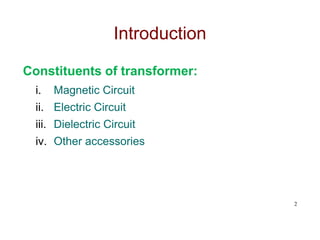
Constituents of transformer:
i. Magnetic Circuit
ii. Electric Circuit
iii. Dielectric Circuit
iv. Other accessories
2
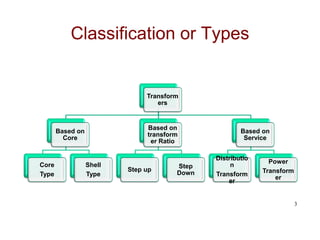
Classification or Types
Transform
ers
Based on
Core
Core
Type
Shell
Type
Based on
transform
er Ratio
Step up
Step
Down
Based on
Service
Distributio
n
Transform
er
Power
Transform
er
3
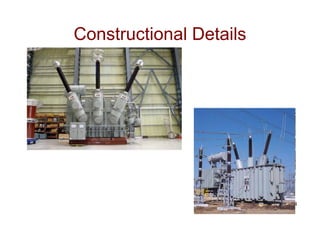
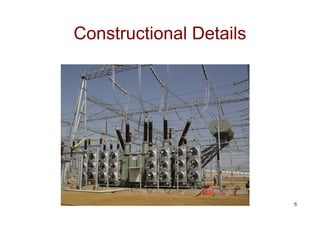
Constructional Details
4
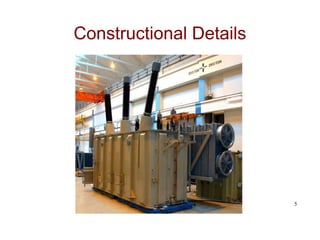
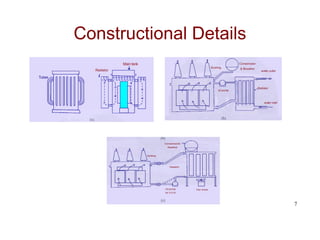
Constructional Details
5
Constructional Details
6
Constructional Details
7
Constructional Details
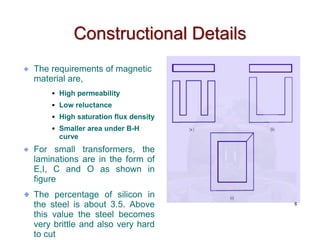
The requirements of magnetic
material are,
 High permeability
 Low reluctance
 High saturation flux density
 Smaller area under B-H
curve
For small transformers, the
laminations are in the form of
E,I, C and O as shown in
figure
The percentage of silicon in
the steel is about 3.5. Above
this value the steel becomes
very brittle and also very hard
to cut
8
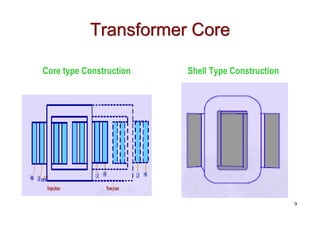
Transformer Core
Core type Construction Shell Type Construction
9
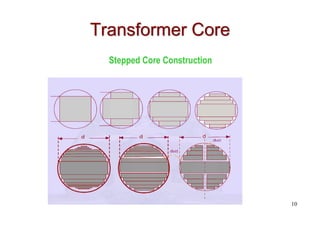
Stepped Core Construction
Transformer Core
10
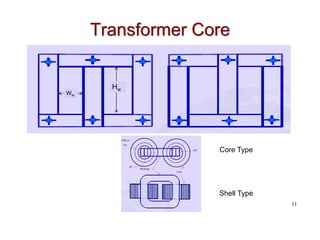
Shell Type
Core Type
Transformer Core
Ww
Hw
11
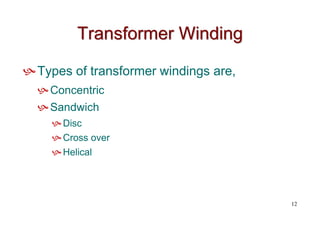
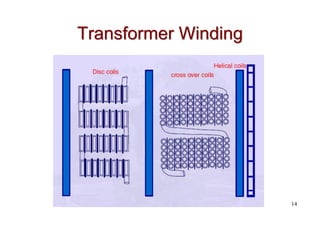
Transformer Winding
Types of transformer windings are,
Concentric
Sandwich
Disc
Cross over
Helical
12
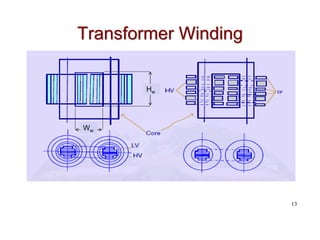
Transformer Winding
Ww
Hw
13
Transformer Winding
14
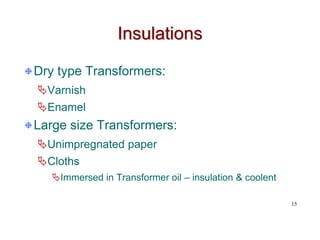
Insulations
Dry type Transformers:
Varnish
Enamel
Large size Transformers:
Unimpregnated paper
Cloths
Immersed in Transformer oil – insulation & coolent
15
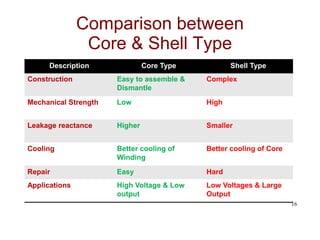
Comparison between
Core & Shell Type
Description Core Type Shell Type
Construction Easy to assemble &
Dismantle
Complex
Mechanical Strength Low High
Leakage reactance Higher Smaller
Cooling Better cooling of
Winding
Better cooling of Core
Repair Easy Hard
Applications High Voltage & Low
output
Low Voltages & Large
Output
16
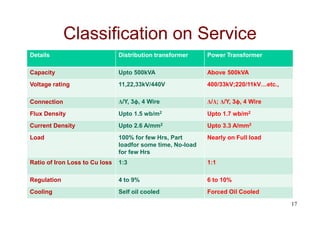
Classification on Service
Details Distribution transformer Power Transformer
Capacity Upto 500kVA Above 500kVA
Voltage rating 11,22,33kV/440V 400/33kV;220/11kV…etc.,
Connection Δ/Y, 3φ, 4 Wire Δ/Δ; Δ/Y, 3φ, 4 Wire
Flux Density Upto 1.5 wb/m2 Upto 1.7 wb/m2
Current Density Upto 2.6 A/mm2 Upto 3.3 A/mm2
Load 100% for few Hrs, Part
loadfor some time, No-load
for few Hrs
Nearly on Full load
Ratio of Iron Loss to Cu loss 1:3 1:1
Regulation 4 to 9% 6 to 10%
Cooling Self oil cooled Forced Oil Cooled
17
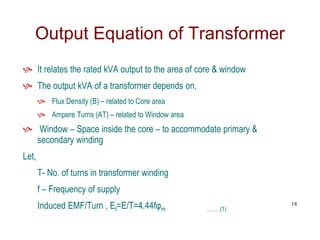
Output Equation of Transformer
 It relates the rated kVA output to the area of core & window
 The output kVA of a transformer depends on,
 Flux Density (B) – related to Core area
 Ampere Turns (AT) – related to Window area
 Window – Space inside the core – to accommodate primary &
secondary winding
Let,
T- No. of turns in transformer winding
f – Frequency of supply
Induced EMF/Turn , Et=E/T=4.44fφm ……. (1)
18
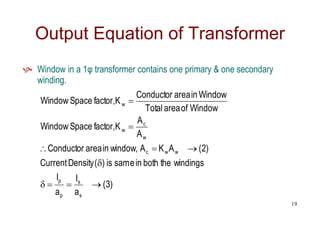
 Window in a 1φ transformer contains one primary & one secondary
winding.
Output Equation of Transformer
)
3
(
a
I
a
I
windings
the
both
in
same
is
)
(
Density
Current
)
2
(
A
K
A
window,
in
area
Conductor
A
A
factor,K
Space
Window
Window
of
area
Total
Window
in
area
Conductor
factor,K
Space
Window
s
s
p
p
w
w
c
w
c
w
w










19
Output Equation of Transformer




 s
s
p
p
I
a
;
I
a
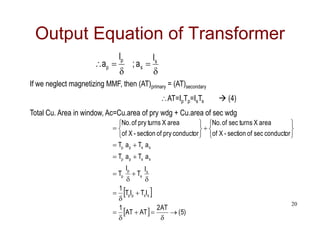
If we neglect magnetizing MMF, then (AT)primary = (AT)secondary
AT=IpTp=IsTs  (4)
Total Cu. Area in window, Ac=Cu.area of pry wdg + Cu.area of sec wdg
 
  )
5
(
AT
2
AT
AT
1
I
T
I
T
1
I
T
I
T
a
T
a
T
a
T
a
T
conductor
sec
of
section
-
X
of
area
X
turns
sec
of
.
No
conductor
pry
of
section
-
X
of
area
X
turns
pry
of
.
No
s
s
p
p
s
s
p
p
s
s
p
p
s
s
p
p































20
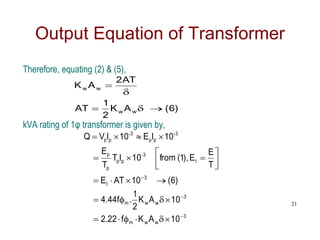
Therefore, equating (2) & (5),
kVA rating of 1φ transformer is given by,
Output Equation of Transformer
)
6
(
A
K
2
1
AT
AT
2
A
K
w
w
w
w





3
w
w
m
3
w
w
m
3
t
t
3
-
p
p
p
p
-3
p
p
-3
p
p
10
A
K
f
22
.
2
10
A
K
2
1
.
f
44
.
4
)
6
(
10
AT
E
T
E
E
),
1
(
from
10
I
T
T
E
10
I
E
10
I
V
Q






























21
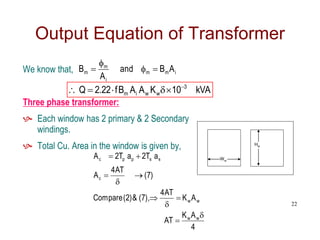
We know that,
Three phase transformer:
 Each window has 2 primary & 2 Secondary
windings.
 Total Cu. Area in the window is given by,
Output Equation of Transformer
i
m
m
i
m
m A
B
and
A
B 



kVA
10
K
A
A
B
f
22
.
2
Q 3
w
w
i
m






Ww
Hw
4
A
K
AT
A
K
AT
4
),
7
(
&
)
2
(
Compare
)
7
(
AT
4
A
a
T
2
a
T
2
A
w
w
w
w
c
s
s
p
p
c










22
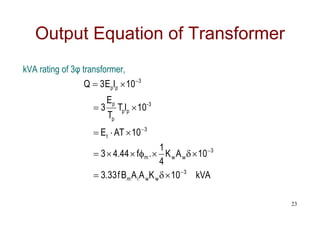
kVA rating of 3φ transformer,
Output Equation of Transformer
kVA
10
K
A
A
B
f
33
.
3
10
A
K
4
1
.
f
44
.
4
3
10
AT
E
10
I
T
T
E
3
10
I
E
3
Q
3
w
w
i
m
3
w
w
m
3
t
3
-
p
p
p
p
3
p
p





















23
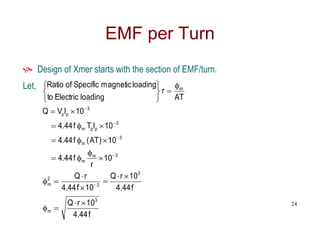
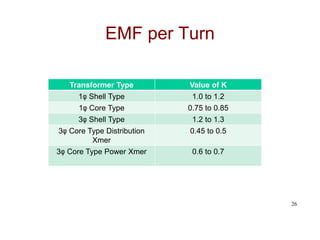
EMF per Turn
 Design of Xmer starts with the section of EMF/turn.
Let,
f
44
.
4
10
r
Q
f
44
.
4
10
r
Q
10
f
44
.
4
r
Q
10
r
f
44
.
4
10
)
AT
(
f
44
.
4
10
I
T
f
44
.
4
10
I
V
Q
AT
r
loading
Electric
to
loading
magnetic
Specific
of
Ratio
3
m
3
3
2
m
3
m
m
3
m
3
p
p
m
3
p
p
m




































24
Q
10
r
f
44
.
4
f
44
.
4
Q
.
10
r
f
44
.
4
f
44
.
4
f
44
.
4
10
r
Q
f
44
.
4
f
44
.
4
E
,
t
.
k
.
w
3
3
3
m
t













Q
K
Et 

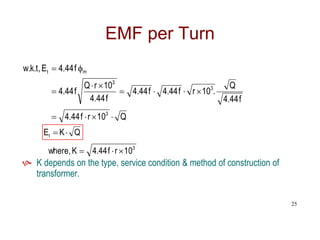
EMF per Turn
3
10
r
f
44
.
4
K
,
where 


 K depends on the type, service condition & method of construction of
transformer.
25
EMF per Turn
Transformer Type Value of K
1φ Shell Type 1.0 to 1.2
1φ Core Type 0.75 to 0.85
3φ Shell Type 1.2 to 1.3
3φ Core Type Distribution
Xmer
0.45 to 0.5
3φ Core Type Power Xmer 0.6 to 0.7
26
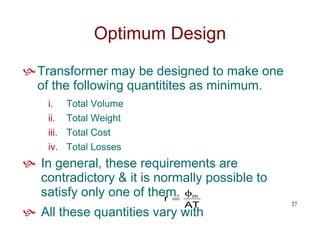
Optimum Design
Transformer may be designed to make one
of the following quantitites as minimum.
i. Total Volume
ii. Total Weight
iii. Total Cost
iv. Total Losses
 In general, these requirements are
contradictory & it is normally possible to
satisfy only one of them.
 All these quantities vary with
AT
r m


27
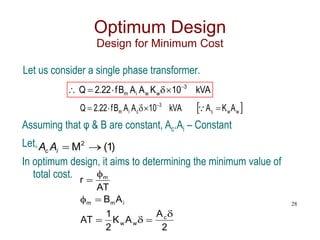
Optimum Design
Design for Minimum Cost
Let us consider a single phase transformer.
kVA
10
K
A
A
B
f
22
.
2
Q 3
w
w
i
m






 
w
w
c
3
c
i
m A
K
A
kVA
10
A
A
B
f
22
.
2
Q 



 

Assuming that φ & B are constant, Ac.Ai – Constant
Let,
In optimum design, it aims to determining the minimum value of
total cost.
2
A
A
K
2
1
AT
A
B
AT
r
c
w
w
i
m
m
m








28
)
1
(
M2


A
A i
c
Optimum Design
Design for Minimum Cost




c
i
m
c
i
m
A
A
B
2
2
A
A
B
r
)
2
(
r
B
2
A
A
B
2
A
A
r
m
c
i
m
c
i








β is the function of r alone [δ & Bm – Constant]
From (1) & (2),
29




M
A
&
M
A c
i
 
2
M

A
A i
c

30
Optimum Design
Design for Minimum Cost
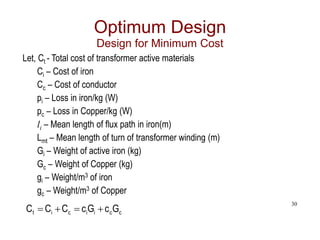
Let, Ct - Total cost of transformer active materials
Ci – Cost of iron
Cc – Cost of conductor
pi – Loss in iron/kg (W)
pc – Loss in Copper/kg (W)
li – Mean length of flux path in iron(m)
Lmt – Mean length of turn of transformer winding (m)
Gi – Weight of active iron (kg)
Gc – Weight of Copper (kg)
gi – Weight/m3 of iron
gc – Weight/m3 of Copper
c
c
i
i
c
i
t G
c
G
c
C
C
C 



31
.
ly
respective
copper
and
iron
of
ts
cos
specific
c
&
c
,
where
A
g
c
A
g
c
C
c
i
c
c
c
i
i
i
t


 mt
i L
l
Optimum Design
Design for Minimum Cost




M
g
c
M
g
c
C c
c
i
i
t mt
i L
l
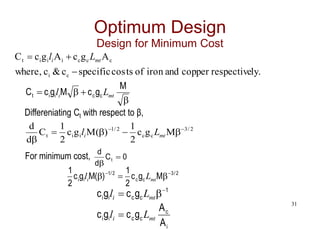
Differeniating Ct with respect to β,
2
/
3
c
c
2
/
1
i
i
t M
g
c
2
1
)
(
M
g
c
2
1
C
d
d 






mt
i L
l
For minimum cost, 0
C
d
d
t 

2
/
3
c
c
2
/
1
i
i M
g
c
2
1
)
(
M
g
c
2
1 



 mt
i L
l
1
c
c
i
i g
c
g
c 

 mt
i L
l
i
c
c
c
i
i
A
A
g
c
g
c mt
i L
l 
32
c
c
c
i
i
i A
g
c
A
g
c mt
i L
l 
Optimum Design
Design for Minimum Cost
c
i
c
c
i
i
C
C
G
c
G
c


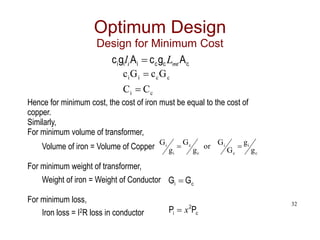
Hence for minimum cost, the cost of iron must be equal to the cost of
copper.
Similarly,
For minimum volume of transformer,
Volume of iron = Volume of Copper
For minimum weight of transformer,
Weight of iron = Weight of Conductor
For minimum loss,
Iron loss = I2R loss in conductor
c
i
c
i
c
c
i
i
g
g
G
G
or
g
G
g
G 

c
i G
G 
c
2
i P
P x

Optimum Design
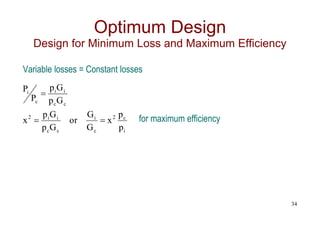
Design for Minimum Loss and Maximum Efficiency
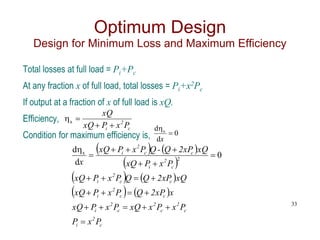
Total losses at full load = Pi+Pc
At any fraction x of full load, total losses = Pi+x2Pc
If output at a fraction of x of full load is xQ.
Efficiency,
Condition for maximum efficiency is,
33
c
2
i P
x
P
xQ
xQ



x
0
d
d x


x
   
 
   
   
c
2
i
c
2
c
2
c
2
i
c
c
2
i
c
c
2
i
c
2
i
c
c
2
i
P
x
P
P
x
P
x
xQ
P
x
P
xQ
x
2xP
Q
P
x
P
xQ
xQ
2xP
Q
Q
P
x
P
xQ
P
x
P
xQ
xQ
2xP
Q
-
Q
P
x
P
xQ
x






















0
d
d
2
x
Variable losses = Constant losses
for maximum efficiency
34
Optimum Design
Design for Minimum Loss and Maximum Efficiency
i
c
2
c
i
c
c
i
i
2
c
c
i
i
c
i
p
p
x
G
G
or
G
p
G
p
x
G
p
G
p
P
P



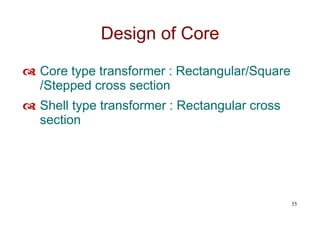
Design of Core
 Core type transformer : Rectangular/Square
/Stepped cross section
 Shell type transformer : Rectangular cross
section
35
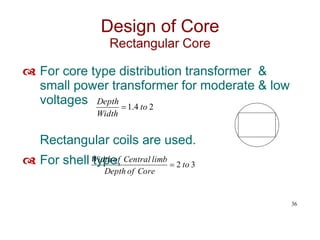
 For core type distribution transformer &
small power transformer for moderate & low
voltages
Rectangular coils are used.
 For shell type,
36
Design of Core
Rectangular Core
2
4
.
1 to
Width
Depth

3
2 to
Core
of
Depth
limb
Central
of
Width

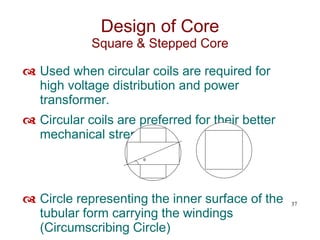
 Used when circular coils are required for
high voltage distribution and power
transformer.
 Circular coils are preferred for their better
mechanical strength.
 Circle representing the inner surface of the
tubular form carrying the windings
(Circumscribing Circle)
37
Design of Core
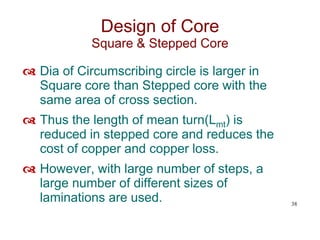
Square & Stepped Core

 Dia of Circumscribing circle is larger in
Square core than Stepped core with the
same area of cross section.
 Thus the length of mean turn(Lmt) is
reduced in stepped core and reduces the
cost of copper and copper loss.
 However, with large number of steps, a
large number of different sizes of
laminations are used. 38
Design of Core
Square & Stepped Core
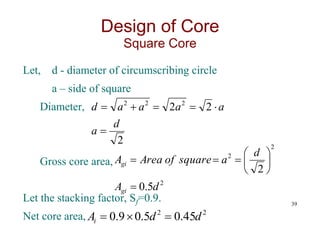
Let, d - diameter of circumscribing circle
a – side of square
Diameter,
Gross core area,
Let the stacking factor, Sf=0.9.
Net core area,
39
Design of Core
Square Core
2
2
2 2
2
2
d
a
a
a
a
a
d






2
2
2
5
.
0
2
d
A
d
a
square
of
Area
A
gi
gi










2
2
45
.
0
5
.
0
9
.
0 d
d
Ai 


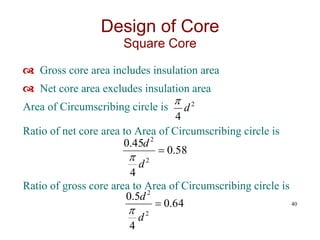
 Gross core area includes insulation area
 Net core area excludes insulation area
Area of Circumscribing circle is
Ratio of net core area to Area of Circumscribing circle is
Ratio of gross core area to Area of Circumscribing circle is
40
2
4
d

58
.
0
4
45
.
0
2
2

d
d

64
.
0
4
5
.
0
2
2

d
d

Design of Core
Square Core
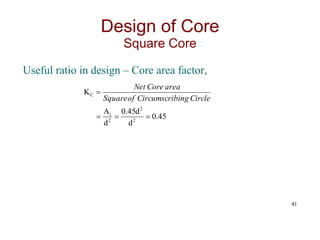
Useful ratio in design – Core area factor,
41
Design of Core
Square Core
45
.
0
d
d
45
.
0
d
A
K
2
2
2
i
C




Circle
bing
Circumscri
of
Square
area
Core
Net
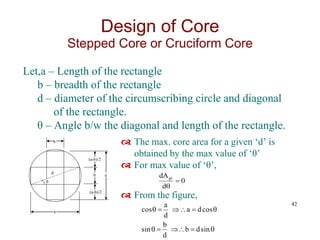
Let,a – Length of the rectangle
b – breadth of the rectangle
d – diameter of the circumscribing circle and diagonal
of the rectangle.
θ – Angle b/w the diagonal and length of the rectangle.
42
Design of Core
Stepped Core or Cruciform Core
θ
d
b
b
a
a
(a-b)/2
(a-b)/2
 The max. core area for a given ‘d’ is
obtained by the max value of ‘θ’
 For max value of ‘θ’,
 From the figure,
0
d
dAgi













sin
d
b
d
b
sin
cos
d
a
d
a
cos
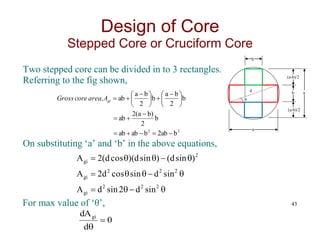
Two stepped core can be divided in to 3 rectangles.
Referring to the fig shown,
43
Design of Core
Stepped Core or Cruciform Core
θ
d
b
b
a
a
(a-b)/2
(a-b)/2
2
2
b
ab
2
b
ab
ab
b
2
)
b
a
(
2
ab
b
2
b
a
b
2
b
a
ab













 






 


gi
A
area,
core
Gross
On substituting ‘a’ and ‘b’ in the above equations,














2
2
2
gi
2
2
2
gi
2
gi
sin
d
2
sin
d
A
sin
d
sin
cos
d
2
A
)
sin
d
(
)
sin
d
)(
cos
d
(
2
A
For max value of ‘θ’,
0
d
dAgi


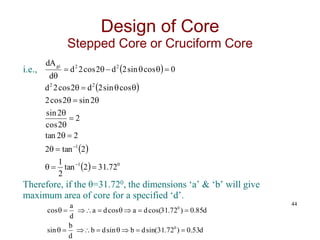
i.e.,
Therefore, if the θ=31.720, the dimensions ‘a’ & ‘b’ will give
maximum area of core for a specified ‘d’.
44
Design of Core
Stepped Core or Cruciform Core
 
 
 
  0
1
1
2
2
2
2
gi
72
.
31
2
tan
2
1
2
tan
2
2
2
tan
2
2
cos
2
sin
2
sin
2
cos
2
cos
sin
2
d
2
cos
2
d
0
cos
sin
2
d
2
cos
2
d
d
dA


























d
53
.
0
)
72
.
31
sin(
d
b
sin
d
b
d
b
sin
d
85
.
0
)
72
.
31
cos(
d
a
cos
d
a
d
a
cos
0
0

















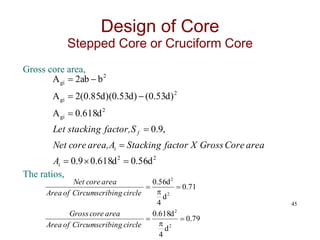
Gross core area,
The ratios,
45
2
2
2
gi
2
gi
2
gi
d
56
.
0
d
618
.
0
9
.
0
,
9
.
0
d
618
.
0
A
)
d
53
.
0
(
)
d
53
.
0
)(
d
85
.
0
(
2
A
b
ab
2
A










i
i
f
A
area
Core
Gross
X
factor
Stacking
A
area,
core
Net
S
factor,
stacking
Let
Design of Core
Stepped Core or Cruciform Core
79
.
0
d
4
d
618
.
0
71
.
0
d
4
d
56
.
0
2
2
2
2






circle
bing
Circumscri
of
Area
area
core
Gross
circle
bing
Circumscri
of
Area
area
core
Net
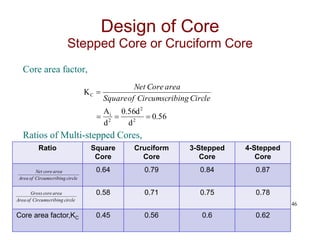
Core area factor,
Ratios of Multi-stepped Cores,
46
Design of Core
Stepped Core or Cruciform Core
56
.
0
d
d
56
.
0
d
A
K
2
2
2
i
C




Circle
bing
Circumscri
of
Square
area
Core
Net
Ratio Square
Core
Cruciform
Core
3-Stepped
Core
4-Stepped
Core
0.64 0.79 0.84 0.87
0.58 0.71 0.75 0.78
Core area factor,KC 0.45 0.56 0.6 0.62
circle
bing
Circumscri
of
Area
area
core
Net
circle
bing
Circumscri
of
Area
area
core
Gross
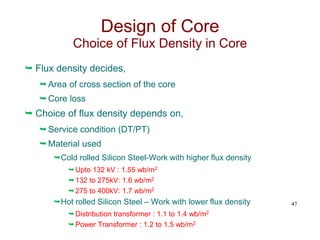
 Flux density decides,
Area of cross section of the core
Core loss
 Choice of flux density depends on,
Service condition (DT/PT)
Material used
Cold rolled Silicon Steel-Work with higher flux density
Upto 132 kV : 1.55 wb/m2
132 to 275kV: 1.6 wb/m2
275 to 400kV: 1.7 wb/m2
Hot rolled Silicon Steel – Work with lower flux density
Distribution transformer : 1.1 to 1.4 wb/m2
Power Transformer : 1.2 to 1.5 wb/m2
47
Design of Core
Choice of Flux Density in Core
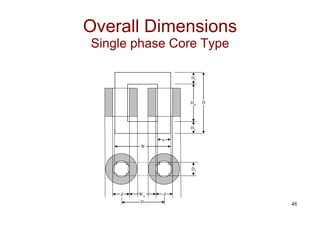
48
d
Ww
d
D
Hw
Hy
Hy
H
Dy
W
a
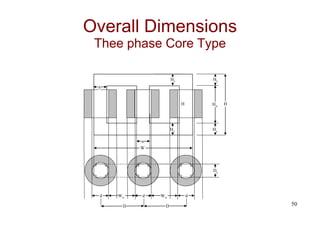
Overall Dimensions
Single phase Core Type
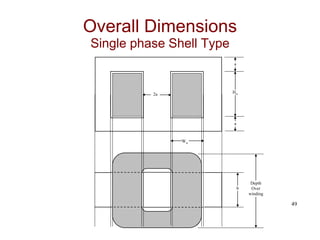
49
b
Ww
Hw
a
a
2a
Depth
Over
winding
Overall Dimensions
Single phase Shell Type
50
D
d
Ww
d
Hw
Hy
Hy
H
Dy
a
d
Ww
d
Hw
Hy
Hy
H
Dy
W
a
D
Overall Dimensions
Thee phase Core Type
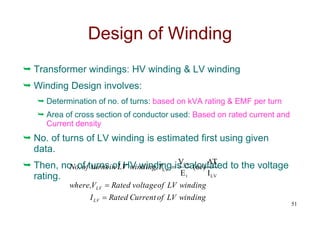
Design of Winding
 Transformer windings: HV winding & LV winding
 Winding Design involves:
 Determination of no. of turns: based on kVA rating & EMF per turn
 Area of cross section of conductor used: Based on rated current and
Current density
 No. of turns of LV winding is estimated first using given
data.
 Then, no. of turns of HV winding is calculated to the voltage
rating.
51
winding
LV
of
Current
Rated
I
winding
LV
of
voltage
Rated
V
where,
T
winding,
LV
in
turns
of
No.
LV
LV



LV
t
LV
LV
I
AT
)
or
(
E
V
52
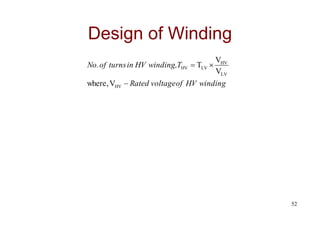
Design of Winding
winding
HV
of
voltage
Rated
T
winding,
HV
in
turns
of
No.



HV
LV
HV
LV
HV
V
,
where
V
V
T
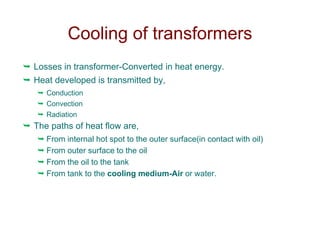
Cooling of transformers
 Losses in transformer-Converted in heat energy.
 Heat developed is transmitted by,
 Conduction
 Convection
 Radiation
 The paths of heat flow are,
 From internal hot spot to the outer surface(in contact with oil)
 From outer surface to the oil
 From the oil to the tank
 From tank to the cooling medium-Air or water.
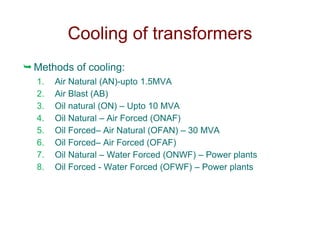
Methods of cooling:
1. Air Natural (AN)-upto 1.5MVA
2. Air Blast (AB)
3. Oil natural (ON) – Upto 10 MVA
4. Oil Natural – Air Forced (ONAF)
5. Oil Forced– Air Natural (OFAN) – 30 MVA
6. Oil Forced– Air Forced (OFAF)
7. Oil Natural – Water Forced (ONWF) – Power plants
8. Oil Forced - Water Forced (OFWF) – Power plants
Cooling of transformers
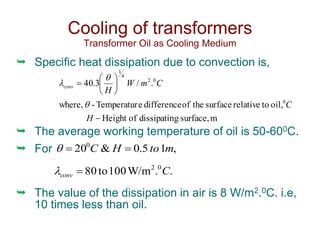
 Specific heat dissipation due to convection is,
 The average working temperature of oil is 50-600C.
 For
 The value of the dissipation in air is 8 W/m2.0C. i.e,
10 times less than oil.
Cooling of transformers
Transformer Oil as Cooling Medium
m
surface,
g
dissipatin
of
Height
oil,
to
relative
surface
the
of
difference
e
Temperatur
-
where,
.
/
3
.
40
0
0
2
4
1








H
C
C
m
W
H
conv



,
1
5
.
0
&
200
m
to
H
C 


.
.
W/m
100
to
80 0
2
C
conv 

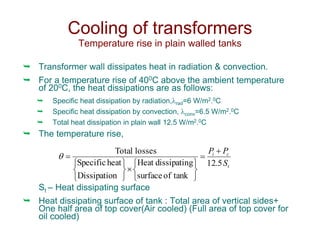
 Transformer wall dissipates heat in radiation & convection.
 For a temperature rise of 400C above the ambient temperature
of 200C, the heat dissipations are as follows:
 Specific heat dissipation by radiation,rad=6 W/m2.0C
 Specific heat dissipation by convection, conv=6.5 W/m2.0C
 Total heat dissipation in plain wall 12.5 W/m2.0C
 The temperature rise,
St – Heat dissipating surface
 Heat dissipating surface of tank : Total area of vertical sides+
One half area of top cover(Air cooled) (Full area of top cover for
oil cooled)
Cooling of transformers
Temperature rise in plain walled tanks
t
c
i
S
P
P
5
.
12
tank
of
surface
g
dissipatin
Heat
n
Dissipatio
heat
Specific
losses
Total 
















Design of tanks with cooling tubes
 Cooling tubes increases the heat dissipation
 Cooling tubes mounted on vertical sides of the
transformer would not proportional to increase in
area. Because, the tubes prevents the radiation
from the tank in screened surfaces.
 But the cooling tubes increase circulation of oil
and hence improve the convection
 Circulation is due to effective pressure heads
 Dissipation by convection is equal to that of 35%
of tube surface area. i.e., 35% tube area is added
to actual tube area.
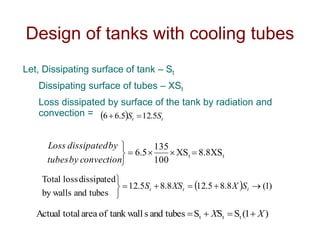
Let, Dissipating surface of tank – St
Dissipating surface of tubes – XSt
Loss dissipated by surface of the tank by radiation and
convection =
Design of tanks with cooling tubes
  t
t S
S 5
.
12
5
.
6
6 

  )
1
(
8
.
8
5
.
12
8
.
8
5
.
12
tubes
and
by walls
dissipated
loss
Total








t
t
t S
X
XS
S
t
t XS
8
.
8
XS
100
135
5
.
6 






convection
by
tubes
by
dissipated
Loss
)
1
(
S
S
S
tubes
and
s
tank wall
of
area
total
Actual t
t
t X
X 



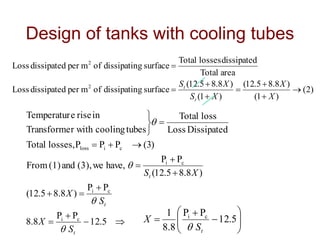
Design of tanks with cooling tubes
)
2
(
)
1
(
)
8
.
8
5
.
12
(
)
1
(
)
8
.
8
5
.
12
(
surface
g
dissipatin
of
m
per
dissipated
Loss
area
Total
dissipated
losses
Total
surface
g
dissipatin
of
m
per
dissipated
Loss
2
2








X
X
X
S
X
S
t
t

















5
.
12
P
P
8
.
8
P
P
)
8
.
8
5
.
12
(
)
8
.
8
5
.
12
(
P
P
have,
we
(3),
and
(1)
From
)
3
(
P
P
P
losses,
Total
Dissipated
Loss
loss
Total
tubes
cooling
r with
Transforme
in
rise
e
Temperatur
c
i
c
i
c
i
c
i
loss
t
t
t
S
X
S
X
X
S














 5
.
12
P
P
8
.
8
1 c
i
t
S
X

Design of tanks with cooling tubes
)
6
(
5
.
12
P
P
8
.
8
1
each tube
of
Area
tubes
of
area
Total
tubes,
of
number
Total
,
)
5
(
5
.
12
P
P
8
.
8
1
5
.
12
P
P
8
.
8
1
tubes
cooling
of
area
Total
c
i
c
i
c
i




































t
t
t
t
t
t
t
t
t
t
t
t
S
l
d
n
n
l
d
tubes
of
area
Surface
tubes
of
Diameter
d
tubes
of
Length
l
Let
S
S
S





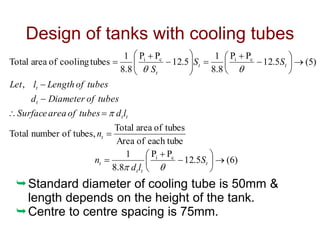
Standard diameter of cooling tube is 50mm &
length depends on the height of the tank.
Centre to centre spacing is 75mm.
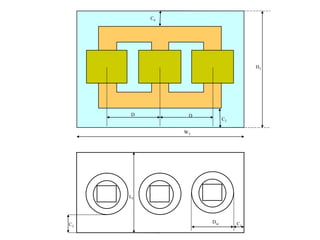
D D
WT
HT
C4
C3
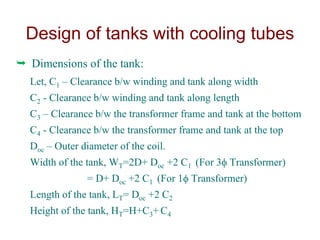
C1
Doc
C2
LT
 Dimensions of the tank:
Let, C1 – Clearance b/w winding and tank along width
C2 - Clearance b/w winding and tank along length
C3 – Clearance b/w the transformer frame and tank at the bottom
C4 - Clearance b/w the transformer frame and tank at the top
Doc – Outer diameter of the coil.
Width of the tank, WT=2D+ Doc +2 C1 (For 3 Transformer)
= D+ Doc +2 C1 (For 1 Transformer)
Length of the tank, LT= Doc +2 C2
Height of the tank, HT=H+C3+ C4
Design of tanks with cooling tubes
 Clearance on the sides depends on the voltage &
power ratings.
 Clearance at the top depends on the oil height above
the assembled transformer & space for mounting the
terminals and tap changer.
 Clearance at the bottom depends on the space
required for mounting the frame.
Design of tanks with cooling tubes
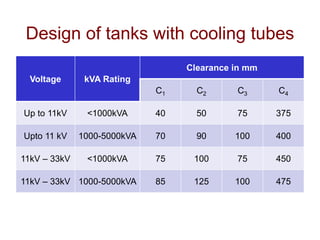
Voltage kVA Rating
Clearance in mm
C1 C2 C3 C4
Up to 11kV <1000kVA 40 50 75 375
Upto 11 kV 1000-5000kVA 70 90 100 400
11kV – 33kV <1000kVA 75 100 75 450
11kV – 33kV 1000-5000kVA 85 125 100 475
Design of tanks with cooling tubes
Estimation of No-load Current
No-load Current of Transformer:
Magnetizing Component
Depends on MMF required to establish required flux
Loss Component
Depends on iron loss
65
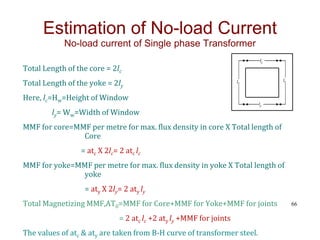
Total Length of the core = 2lc
Total Length of the yoke = 2ly
Here, lc=Hw=Height of Window
ly= Ww=Width of Window
MMF for core=MMF per metre for max. flux density in core X Total length of
Core
= atc X 2lc= 2 atc lc
MMF for yoke=MMF per metre for max. flux density in yoke X Total length of
yoke
= aty X 2ly= 2 aty ly
Total Magnetizing MMF,AT0=MMF for Core+MMF for Yoke+MMF for joints
= 2 atc lc +2 aty ly +MMF for joints
The values of atc & aty are taken from B-H curve of transformer steel.
66
Estimation of No-load Current
No-load current of Single phase Transformer
lC
lC
ly
ly
Max. value of magnetizing current=AT0/Tp
If the magnetizing current is sinusoidal then,
RMS value of magnetising current, Im=AT0/√2Tp
If the magnetizing current is not sinusoidal,
RMS value of magnetising current, Im=AT0/KpkTp
The loss component of no-load current, Il=Pi/Vp
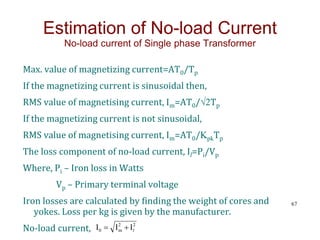
Where, Pi – Iron loss in Watts
Vp – Primary terminal voltage
Iron losses are calculated by finding the weight of cores and
yokes. Loss per kg is given by the manufacturer.
No-load current,
67
Estimation of No-load Current
No-load current of Single phase Transformer
2
2
m
0 I
I
I l


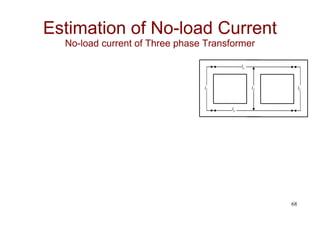
68
lC
lC
lC
ly
ly
Estimation of No-load Current
No-load current of Three phase Transformer
69
70
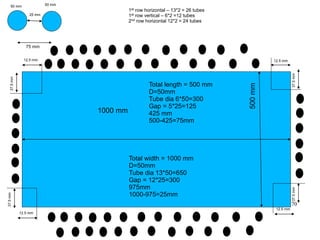
1000 mm
500
mm
75 mm
50 mm 50 mm
25 mm
Total width = 1000 mm
D=50mm
Tube dia 13*50=650
Gap = 12*25=300
975mm
1000-975=25mm
12.5 mm 12.5 mm
12.5 mm
12.5 mm
37.5
mm
37.5
mm
37.5
mm
37.5
mm
Total length = 500 mm
D=50mm
Tube dia 6*50=300
Gap = 5*25=125
425 mm
500-425=75mm
1st row horizontal – 13*2 = 26 tubes
1st row vertical – 6*2 =12 tubes
2nd row horizontal 12*2 = 24 tubes
71
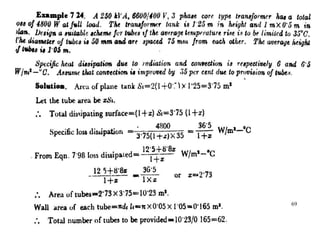
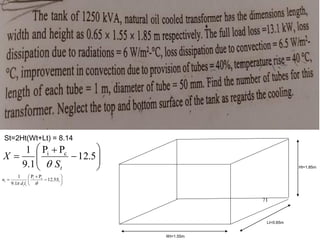
St=2Ht(Wt+Lt) = 8.14










 5
.
12
P
P
1
.
9
1 c
i
t
S
X









 t
t
t
t S
l
d
n 5
.
12
P
P
1
.
9
1 c
i


Ht=1.85m
Lt=0.65m
Wt=1.55m

Transformers design and coooling methods

  • 1.
  • 2.
    Introduction Constituents of transformer: i.Magnetic Circuit ii. Electric Circuit iii. Dielectric Circuit iv. Other accessories 2
  • 3.
    Classification or Types Transform ers Basedon Core Core Type Shell Type Based on transform er Ratio Step up Step Down Based on Service Distributio n Transform er Power Transform er 3
  • 4.
  • 5.
  • 6.
  • 7.
  • 8.
    Constructional Details The requirementsof magnetic material are,  High permeability  Low reluctance  High saturation flux density  Smaller area under B-H curve For small transformers, the laminations are in the form of E,I, C and O as shown in figure The percentage of silicon in the steel is about 3.5. Above this value the steel becomes very brittle and also very hard to cut 8
  • 9.
    Transformer Core Core typeConstruction Shell Type Construction 9
  • 10.
  • 11.
  • 12.
    Transformer Winding Types oftransformer windings are, Concentric Sandwich Disc Cross over Helical 12
  • 13.
  • 14.
  • 15.
    Insulations Dry type Transformers: Varnish Enamel Largesize Transformers: Unimpregnated paper Cloths Immersed in Transformer oil – insulation & coolent 15
  • 16.
    Comparison between Core &Shell Type Description Core Type Shell Type Construction Easy to assemble & Dismantle Complex Mechanical Strength Low High Leakage reactance Higher Smaller Cooling Better cooling of Winding Better cooling of Core Repair Easy Hard Applications High Voltage & Low output Low Voltages & Large Output 16
  • 17.
    Classification on Service DetailsDistribution transformer Power Transformer Capacity Upto 500kVA Above 500kVA Voltage rating 11,22,33kV/440V 400/33kV;220/11kV…etc., Connection Δ/Y, 3φ, 4 Wire Δ/Δ; Δ/Y, 3φ, 4 Wire Flux Density Upto 1.5 wb/m2 Upto 1.7 wb/m2 Current Density Upto 2.6 A/mm2 Upto 3.3 A/mm2 Load 100% for few Hrs, Part loadfor some time, No-load for few Hrs Nearly on Full load Ratio of Iron Loss to Cu loss 1:3 1:1 Regulation 4 to 9% 6 to 10% Cooling Self oil cooled Forced Oil Cooled 17
  • 18.
    Output Equation ofTransformer  It relates the rated kVA output to the area of core & window  The output kVA of a transformer depends on,  Flux Density (B) – related to Core area  Ampere Turns (AT) – related to Window area  Window – Space inside the core – to accommodate primary & secondary winding Let, T- No. of turns in transformer winding f – Frequency of supply Induced EMF/Turn , Et=E/T=4.44fφm ……. (1) 18
  • 19.
     Window ina 1φ transformer contains one primary & one secondary winding. Output Equation of Transformer ) 3 ( a I a I windings the both in same is ) ( Density Current ) 2 ( A K A window, in area Conductor A A factor,K Space Window Window of area Total Window in area Conductor factor,K Space Window s s p p w w c w c w w           19
  • 20.
    Output Equation ofTransformer      s s p p I a ; I a If we neglect magnetizing MMF, then (AT)primary = (AT)secondary AT=IpTp=IsTs  (4) Total Cu. Area in window, Ac=Cu.area of pry wdg + Cu.area of sec wdg     ) 5 ( AT 2 AT AT 1 I T I T 1 I T I T a T a T a T a T conductor sec of section - X of area X turns sec of . No conductor pry of section - X of area X turns pry of . No s s p p s s p p s s p p s s p p                                20
  • 21.
    Therefore, equating (2)& (5), kVA rating of 1φ transformer is given by, Output Equation of Transformer ) 6 ( A K 2 1 AT AT 2 A K w w w w      3 w w m 3 w w m 3 t t 3 - p p p p -3 p p -3 p p 10 A K f 22 . 2 10 A K 2 1 . f 44 . 4 ) 6 ( 10 AT E T E E ), 1 ( from 10 I T T E 10 I E 10 I V Q                               21
  • 22.
    We know that, Threephase transformer:  Each window has 2 primary & 2 Secondary windings.  Total Cu. Area in the window is given by, Output Equation of Transformer i m m i m m A B and A B     kVA 10 K A A B f 22 . 2 Q 3 w w i m       Ww Hw 4 A K AT A K AT 4 ), 7 ( & ) 2 ( Compare ) 7 ( AT 4 A a T 2 a T 2 A w w w w c s s p p c           22
  • 23.
    kVA rating of3φ transformer, Output Equation of Transformer kVA 10 K A A B f 33 . 3 10 A K 4 1 . f 44 . 4 3 10 AT E 10 I T T E 3 10 I E 3 Q 3 w w i m 3 w w m 3 t 3 - p p p p 3 p p                      23
  • 24.
    EMF per Turn Design of Xmer starts with the section of EMF/turn. Let, f 44 . 4 10 r Q f 44 . 4 10 r Q 10 f 44 . 4 r Q 10 r f 44 . 4 10 ) AT ( f 44 . 4 10 I T f 44 . 4 10 I V Q AT r loading Electric to loading magnetic Specific of Ratio 3 m 3 3 2 m 3 m m 3 m 3 p p m 3 p p m                                     24
  • 25.
    Q 10 r f 44 . 4 f 44 . 4 Q . 10 r f 44 . 4 f 44 . 4 f 44 . 4 10 r Q f 44 . 4 f 44 . 4 E , t . k . w 3 3 3 m t              Q K Et   EMF perTurn 3 10 r f 44 . 4 K , where     K depends on the type, service condition & method of construction of transformer. 25
  • 26.
    EMF per Turn TransformerType Value of K 1φ Shell Type 1.0 to 1.2 1φ Core Type 0.75 to 0.85 3φ Shell Type 1.2 to 1.3 3φ Core Type Distribution Xmer 0.45 to 0.5 3φ Core Type Power Xmer 0.6 to 0.7 26
  • 27.
    Optimum Design Transformer maybe designed to make one of the following quantitites as minimum. i. Total Volume ii. Total Weight iii. Total Cost iv. Total Losses  In general, these requirements are contradictory & it is normally possible to satisfy only one of them.  All these quantities vary with AT r m   27
  • 28.
    Optimum Design Design forMinimum Cost Let us consider a single phase transformer. kVA 10 K A A B f 22 . 2 Q 3 w w i m         w w c 3 c i m A K A kVA 10 A A B f 22 . 2 Q        Assuming that φ & B are constant, Ac.Ai – Constant Let, In optimum design, it aims to determining the minimum value of total cost. 2 A A K 2 1 AT A B AT r c w w i m m m         28 ) 1 ( M2   A A i c
  • 29.
    Optimum Design Design forMinimum Cost     c i m c i m A A B 2 2 A A B r ) 2 ( r B 2 A A B 2 A A r m c i m c i         β is the function of r alone [δ & Bm – Constant] From (1) & (2), 29     M A & M A c i   2 M  A A i c 
  • 30.
    30 Optimum Design Design forMinimum Cost Let, Ct - Total cost of transformer active materials Ci – Cost of iron Cc – Cost of conductor pi – Loss in iron/kg (W) pc – Loss in Copper/kg (W) li – Mean length of flux path in iron(m) Lmt – Mean length of turn of transformer winding (m) Gi – Weight of active iron (kg) Gc – Weight of Copper (kg) gi – Weight/m3 of iron gc – Weight/m3 of Copper c c i i c i t G c G c C C C    
  • 31.
    31 . ly respective copper and iron of ts cos specific c & c , where A g c A g c C c i c c c i i i t    mt i L l OptimumDesign Design for Minimum Cost     M g c M g c C c c i i t mt i L l Differeniating Ct with respect to β, 2 / 3 c c 2 / 1 i i t M g c 2 1 ) ( M g c 2 1 C d d        mt i L l For minimum cost, 0 C d d t   2 / 3 c c 2 / 1 i i M g c 2 1 ) ( M g c 2 1      mt i L l 1 c c i i g c g c    mt i L l i c c c i i A A g c g c mt i L l 
  • 32.
    32 c c c i i i A g c A g c mt iL l  Optimum Design Design for Minimum Cost c i c c i i C C G c G c   Hence for minimum cost, the cost of iron must be equal to the cost of copper. Similarly, For minimum volume of transformer, Volume of iron = Volume of Copper For minimum weight of transformer, Weight of iron = Weight of Conductor For minimum loss, Iron loss = I2R loss in conductor c i c i c c i i g g G G or g G g G   c i G G  c 2 i P P x 
  • 33.
    Optimum Design Design forMinimum Loss and Maximum Efficiency Total losses at full load = Pi+Pc At any fraction x of full load, total losses = Pi+x2Pc If output at a fraction of x of full load is xQ. Efficiency, Condition for maximum efficiency is, 33 c 2 i P x P xQ xQ    x 0 d d x   x               c 2 i c 2 c 2 c 2 i c c 2 i c c 2 i c 2 i c c 2 i P x P P x P x xQ P x P xQ x 2xP Q P x P xQ xQ 2xP Q Q P x P xQ P x P xQ xQ 2xP Q - Q P x P xQ x                       0 d d 2 x
  • 34.
    Variable losses =Constant losses for maximum efficiency 34 Optimum Design Design for Minimum Loss and Maximum Efficiency i c 2 c i c c i i 2 c c i i c i p p x G G or G p G p x G p G p P P   
  • 35.
    Design of Core Core type transformer : Rectangular/Square /Stepped cross section  Shell type transformer : Rectangular cross section 35
  • 36.
     For coretype distribution transformer & small power transformer for moderate & low voltages Rectangular coils are used.  For shell type, 36 Design of Core Rectangular Core 2 4 . 1 to Width Depth  3 2 to Core of Depth limb Central of Width 
  • 37.
     Used whencircular coils are required for high voltage distribution and power transformer.  Circular coils are preferred for their better mechanical strength.  Circle representing the inner surface of the tubular form carrying the windings (Circumscribing Circle) 37 Design of Core Square & Stepped Core 
  • 38.
     Dia ofCircumscribing circle is larger in Square core than Stepped core with the same area of cross section.  Thus the length of mean turn(Lmt) is reduced in stepped core and reduces the cost of copper and copper loss.  However, with large number of steps, a large number of different sizes of laminations are used. 38 Design of Core Square & Stepped Core
  • 39.
    Let, d -diameter of circumscribing circle a – side of square Diameter, Gross core area, Let the stacking factor, Sf=0.9. Net core area, 39 Design of Core Square Core 2 2 2 2 2 2 d a a a a a d       2 2 2 5 . 0 2 d A d a square of Area A gi gi           2 2 45 . 0 5 . 0 9 . 0 d d Ai   
  • 40.
     Gross corearea includes insulation area  Net core area excludes insulation area Area of Circumscribing circle is Ratio of net core area to Area of Circumscribing circle is Ratio of gross core area to Area of Circumscribing circle is 40 2 4 d  58 . 0 4 45 . 0 2 2  d d  64 . 0 4 5 . 0 2 2  d d  Design of Core Square Core
  • 41.
    Useful ratio indesign – Core area factor, 41 Design of Core Square Core 45 . 0 d d 45 . 0 d A K 2 2 2 i C     Circle bing Circumscri of Square area Core Net
  • 42.
    Let,a – Lengthof the rectangle b – breadth of the rectangle d – diameter of the circumscribing circle and diagonal of the rectangle. θ – Angle b/w the diagonal and length of the rectangle. 42 Design of Core Stepped Core or Cruciform Core θ d b b a a (a-b)/2 (a-b)/2  The max. core area for a given ‘d’ is obtained by the max value of ‘θ’  For max value of ‘θ’,  From the figure, 0 d dAgi              sin d b d b sin cos d a d a cos
  • 43.
    Two stepped corecan be divided in to 3 rectangles. Referring to the fig shown, 43 Design of Core Stepped Core or Cruciform Core θ d b b a a (a-b)/2 (a-b)/2 2 2 b ab 2 b ab ab b 2 ) b a ( 2 ab b 2 b a b 2 b a ab                          gi A area, core Gross On substituting ‘a’ and ‘b’ in the above equations,               2 2 2 gi 2 2 2 gi 2 gi sin d 2 sin d A sin d sin cos d 2 A ) sin d ( ) sin d )( cos d ( 2 A For max value of ‘θ’, 0 d dAgi  
  • 44.
    i.e., Therefore, if theθ=31.720, the dimensions ‘a’ & ‘b’ will give maximum area of core for a specified ‘d’. 44 Design of Core Stepped Core or Cruciform Core         0 1 1 2 2 2 2 gi 72 . 31 2 tan 2 1 2 tan 2 2 2 tan 2 2 cos 2 sin 2 sin 2 cos 2 cos sin 2 d 2 cos 2 d 0 cos sin 2 d 2 cos 2 d d dA                           d 53 . 0 ) 72 . 31 sin( d b sin d b d b sin d 85 . 0 ) 72 . 31 cos( d a cos d a d a cos 0 0                 
  • 45.
    Gross core area, Theratios, 45 2 2 2 gi 2 gi 2 gi d 56 . 0 d 618 . 0 9 . 0 , 9 . 0 d 618 . 0 A ) d 53 . 0 ( ) d 53 . 0 )( d 85 . 0 ( 2 A b ab 2 A           i i f A area Core Gross X factor Stacking A area, core Net S factor, stacking Let Design of Core Stepped Core or Cruciform Core 79 . 0 d 4 d 618 . 0 71 . 0 d 4 d 56 . 0 2 2 2 2       circle bing Circumscri of Area area core Gross circle bing Circumscri of Area area core Net
  • 46.
    Core area factor, Ratiosof Multi-stepped Cores, 46 Design of Core Stepped Core or Cruciform Core 56 . 0 d d 56 . 0 d A K 2 2 2 i C     Circle bing Circumscri of Square area Core Net Ratio Square Core Cruciform Core 3-Stepped Core 4-Stepped Core 0.64 0.79 0.84 0.87 0.58 0.71 0.75 0.78 Core area factor,KC 0.45 0.56 0.6 0.62 circle bing Circumscri of Area area core Net circle bing Circumscri of Area area core Gross
  • 47.
     Flux densitydecides, Area of cross section of the core Core loss  Choice of flux density depends on, Service condition (DT/PT) Material used Cold rolled Silicon Steel-Work with higher flux density Upto 132 kV : 1.55 wb/m2 132 to 275kV: 1.6 wb/m2 275 to 400kV: 1.7 wb/m2 Hot rolled Silicon Steel – Work with lower flux density Distribution transformer : 1.1 to 1.4 wb/m2 Power Transformer : 1.2 to 1.5 wb/m2 47 Design of Core Choice of Flux Density in Core
  • 48.
  • 49.
  • 50.
  • 51.
    Design of Winding Transformer windings: HV winding & LV winding  Winding Design involves:  Determination of no. of turns: based on kVA rating & EMF per turn  Area of cross section of conductor used: Based on rated current and Current density  No. of turns of LV winding is estimated first using given data.  Then, no. of turns of HV winding is calculated to the voltage rating. 51 winding LV of Current Rated I winding LV of voltage Rated V where, T winding, LV in turns of No. LV LV    LV t LV LV I AT ) or ( E V
  • 52.
  • 53.
    Cooling of transformers Losses in transformer-Converted in heat energy.  Heat developed is transmitted by,  Conduction  Convection  Radiation  The paths of heat flow are,  From internal hot spot to the outer surface(in contact with oil)  From outer surface to the oil  From the oil to the tank  From tank to the cooling medium-Air or water.
  • 54.
    Methods of cooling: 1.Air Natural (AN)-upto 1.5MVA 2. Air Blast (AB) 3. Oil natural (ON) – Upto 10 MVA 4. Oil Natural – Air Forced (ONAF) 5. Oil Forced– Air Natural (OFAN) – 30 MVA 6. Oil Forced– Air Forced (OFAF) 7. Oil Natural – Water Forced (ONWF) – Power plants 8. Oil Forced - Water Forced (OFWF) – Power plants Cooling of transformers
  • 55.
     Specific heatdissipation due to convection is,  The average working temperature of oil is 50-600C.  For  The value of the dissipation in air is 8 W/m2.0C. i.e, 10 times less than oil. Cooling of transformers Transformer Oil as Cooling Medium m surface, g dissipatin of Height oil, to relative surface the of difference e Temperatur - where, . / 3 . 40 0 0 2 4 1         H C C m W H conv    , 1 5 . 0 & 200 m to H C    . . W/m 100 to 80 0 2 C conv  
  • 56.
     Transformer walldissipates heat in radiation & convection.  For a temperature rise of 400C above the ambient temperature of 200C, the heat dissipations are as follows:  Specific heat dissipation by radiation,rad=6 W/m2.0C  Specific heat dissipation by convection, conv=6.5 W/m2.0C  Total heat dissipation in plain wall 12.5 W/m2.0C  The temperature rise, St – Heat dissipating surface  Heat dissipating surface of tank : Total area of vertical sides+ One half area of top cover(Air cooled) (Full area of top cover for oil cooled) Cooling of transformers Temperature rise in plain walled tanks t c i S P P 5 . 12 tank of surface g dissipatin Heat n Dissipatio heat Specific losses Total                 
  • 57.
    Design of tankswith cooling tubes  Cooling tubes increases the heat dissipation  Cooling tubes mounted on vertical sides of the transformer would not proportional to increase in area. Because, the tubes prevents the radiation from the tank in screened surfaces.  But the cooling tubes increase circulation of oil and hence improve the convection  Circulation is due to effective pressure heads  Dissipation by convection is equal to that of 35% of tube surface area. i.e., 35% tube area is added to actual tube area.
  • 58.
    Let, Dissipating surfaceof tank – St Dissipating surface of tubes – XSt Loss dissipated by surface of the tank by radiation and convection = Design of tanks with cooling tubes   t t S S 5 . 12 5 . 6 6     ) 1 ( 8 . 8 5 . 12 8 . 8 5 . 12 tubes and by walls dissipated loss Total         t t t S X XS S t t XS 8 . 8 XS 100 135 5 . 6        convection by tubes by dissipated Loss ) 1 ( S S S tubes and s tank wall of area total Actual t t t X X    
  • 59.
    Design of tankswith cooling tubes ) 2 ( ) 1 ( ) 8 . 8 5 . 12 ( ) 1 ( ) 8 . 8 5 . 12 ( surface g dissipatin of m per dissipated Loss area Total dissipated losses Total surface g dissipatin of m per dissipated Loss 2 2         X X X S X S t t                  5 . 12 P P 8 . 8 P P ) 8 . 8 5 . 12 ( ) 8 . 8 5 . 12 ( P P have, we (3), and (1) From ) 3 ( P P P losses, Total Dissipated Loss loss Total tubes cooling r with Transforme in rise e Temperatur c i c i c i c i loss t t t S X S X X S                5 . 12 P P 8 . 8 1 c i t S X 
  • 60.
    Design of tankswith cooling tubes ) 6 ( 5 . 12 P P 8 . 8 1 each tube of Area tubes of area Total tubes, of number Total , ) 5 ( 5 . 12 P P 8 . 8 1 5 . 12 P P 8 . 8 1 tubes cooling of area Total c i c i c i                                     t t t t t t t t t t t t S l d n n l d tubes of area Surface tubes of Diameter d tubes of Length l Let S S S      Standard diameter of cooling tube is 50mm & length depends on the height of the tank. Centre to centre spacing is 75mm.
  • 61.
  • 62.
     Dimensions ofthe tank: Let, C1 – Clearance b/w winding and tank along width C2 - Clearance b/w winding and tank along length C3 – Clearance b/w the transformer frame and tank at the bottom C4 - Clearance b/w the transformer frame and tank at the top Doc – Outer diameter of the coil. Width of the tank, WT=2D+ Doc +2 C1 (For 3 Transformer) = D+ Doc +2 C1 (For 1 Transformer) Length of the tank, LT= Doc +2 C2 Height of the tank, HT=H+C3+ C4 Design of tanks with cooling tubes
  • 63.
     Clearance onthe sides depends on the voltage & power ratings.  Clearance at the top depends on the oil height above the assembled transformer & space for mounting the terminals and tap changer.  Clearance at the bottom depends on the space required for mounting the frame. Design of tanks with cooling tubes
  • 64.
    Voltage kVA Rating Clearancein mm C1 C2 C3 C4 Up to 11kV <1000kVA 40 50 75 375 Upto 11 kV 1000-5000kVA 70 90 100 400 11kV – 33kV <1000kVA 75 100 75 450 11kV – 33kV 1000-5000kVA 85 125 100 475 Design of tanks with cooling tubes
  • 65.
    Estimation of No-loadCurrent No-load Current of Transformer: Magnetizing Component Depends on MMF required to establish required flux Loss Component Depends on iron loss 65
  • 66.
    Total Length ofthe core = 2lc Total Length of the yoke = 2ly Here, lc=Hw=Height of Window ly= Ww=Width of Window MMF for core=MMF per metre for max. flux density in core X Total length of Core = atc X 2lc= 2 atc lc MMF for yoke=MMF per metre for max. flux density in yoke X Total length of yoke = aty X 2ly= 2 aty ly Total Magnetizing MMF,AT0=MMF for Core+MMF for Yoke+MMF for joints = 2 atc lc +2 aty ly +MMF for joints The values of atc & aty are taken from B-H curve of transformer steel. 66 Estimation of No-load Current No-load current of Single phase Transformer lC lC ly ly
  • 67.
    Max. value ofmagnetizing current=AT0/Tp If the magnetizing current is sinusoidal then, RMS value of magnetising current, Im=AT0/√2Tp If the magnetizing current is not sinusoidal, RMS value of magnetising current, Im=AT0/KpkTp The loss component of no-load current, Il=Pi/Vp Where, Pi – Iron loss in Watts Vp – Primary terminal voltage Iron losses are calculated by finding the weight of cores and yokes. Loss per kg is given by the manufacturer. No-load current, 67 Estimation of No-load Current No-load current of Single phase Transformer 2 2 m 0 I I I l  
  • 68.
    68 lC lC lC ly ly Estimation of No-loadCurrent No-load current of Three phase Transformer
  • 69.
  • 70.
    70 1000 mm 500 mm 75 mm 50mm 50 mm 25 mm Total width = 1000 mm D=50mm Tube dia 13*50=650 Gap = 12*25=300 975mm 1000-975=25mm 12.5 mm 12.5 mm 12.5 mm 12.5 mm 37.5 mm 37.5 mm 37.5 mm 37.5 mm Total length = 500 mm D=50mm Tube dia 6*50=300 Gap = 5*25=125 425 mm 500-425=75mm 1st row horizontal – 13*2 = 26 tubes 1st row vertical – 6*2 =12 tubes 2nd row horizontal 12*2 = 24 tubes
  • 71.
    71 St=2Ht(Wt+Lt) = 8.14           5 . 12 P P 1 . 9 1 c i t S X           t t t t S l d n 5 . 12 P P 1 . 9 1 c i   Ht=1.85m Lt=0.65m Wt=1.55m