“IOT Based smart bus tracking system”
Rahul Wagh
9604068909
Instead of referring to GPS-enabled location information, we resort to more generally
available and energy efficient sensing resources, including cell tower signals, movement
statuses, audio recordings, etc., which bring less burden to the participatory party and
encourage their participation.
We develop a prototype system with different types of Android-based mobile phones and
comprehensively experiment with the NTU campus shuttle buses as well as Singapore
public buses over a 7-week period.
The evaluation results suggest that the proposed system achieves outstanding prediction
accuracy compared with those bus operator initiated and GPS supported solutions.
We further adopt our system and conduct quick trial experiments with London bus system
for 4 days, which suggests the easy deployment of our system and promising system
performance across cities.
At the same time, the proposed solution is more generally available and energy friendly.
Introduction
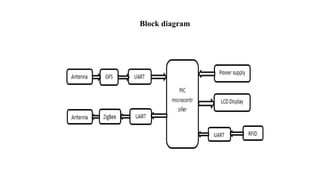
Block diagram
Block diagram explanation
• In this project PIC16F877A microcontroller is used for interfacing to various hardware
peripherals. The current design is an embedded application, which will continuously monitor a
moving Vehicle and report the status of the Vehicle on demand.
• For doing so a PIC16F877A microcontroller is interfaced serially to a ZigBee Modem and GPS
Receiver. A ZigBee modem is used to send the position (Latitude and Longitude) of the vehicle
from a remote place.
• The GPS modem will continuously give the data i.e. the latitude and longitude indicating the
position of the vehicle.
• The GPS modem gives many parameters as the output, but only the NMEA data coming out is
read and displayed on to the LCD.
• The same data is sent to the mobile at the other end from where the position of the vehicle is
demanded. An EEPROM is used to store the mobile number.
• The hardware interfaces to microcontroller are LCD display, GSM modem and GPS Receiver.
• The design uses RS-232 protocol for serial communication between the modems and the
microcontroller.
• A serial driver IC is used for converting TTL voltage 12 levels to RS-232
voltage levels.
• When the request by user is sent to the number at the modem, the system
automatically sends a return reply to that mobile indicating the position of the
vehicle in terms of latitude and longitude.
• As the Micro Controller, GPS and ZigBee take a sight of in depth knowledge,
they are explained in the next chapters.
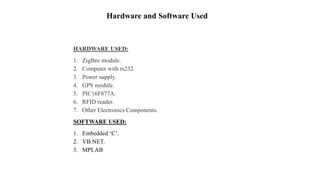
HARDWARE USED:
1. ZigBee module.
2. Computer with rs232.
3. Power supply.
4. GPS module.
5. PIC16F877A.
6. RFID reader.
7. Other Electronics Components.
SOFTWARE USED:
1. Embedded ‘C’.
2. VB.NET.
3. MPLAB
Hardware and Software Used
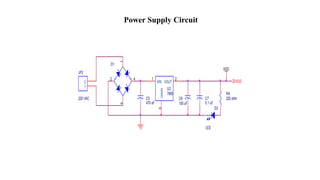
Power supply
Power Supply Circuit
VDD
VDD
C7
0.1 uF
JP2
220 VAC
1
2
- +
D1
1
4
3
2
U2
7805
1
3
2
VIN
GND
VOUT
C6
100 uF
C5
470 uF
R4
220 ohm
D2
LED
Power Supply – Circuit Description
• The operation of power supply circuits built using filters, rectifiers, and then voltage
regulators. Starting with an AC voltage, a steady DC voltage is obtained by
rectifying the AC voltage, Then filtering to a DC level, and finally, regulating to
obtain a desired fixed DC voltage. The regulation is usually obtained from an IC
voltage regulator Unit, which takes a DC voltage and provides a somewhat lower
DC voltage, Which remains the same even if the input DC voltage varies, or the
output Load connected to the DC voltage changes.
Microcontroller
About Microcontroller
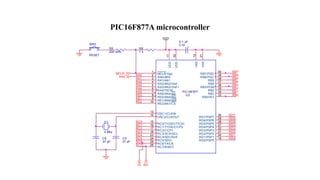
• PIC16F877A microcontroller is used for this project
• It is 8-bit Microcontroller
• System is RISC Architecture
• It has Small set of Instruction set
• It has 35-Instructions only
• Compatibility: avail 28/40 Pin ICs
Microcontroller overview
• Operating Speed Max 20 MHz, Voltage-(2-5.5)v
• Memory:
Flash Program 8Kx14 Words,
RAM 368 Bytes,
EEPROM Data Memory 256 Bytes
• Low power, High speed Flash/EEPROM Technology
Features of Microcontroller
• It has 5 Ports for Internal and External usage
• It has on chip Timers. 3 Timers are avail
• It has in built Analog to Digital Converter
• In built Multiplexer availability for signal Selection
• It has serial as well as Parallel Communication facilities
• In built Capture, Compare and Pulse width modulation
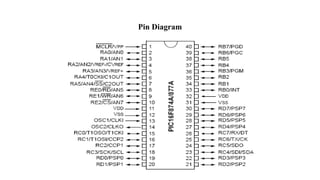
Pin Diagram
PIC16F877A microcontroller
VDD
MCLR
RXTX
RA0
RB7
RB6
RB5
RB4
RB3
RB2
RB1
RB0
RD7
RD6
RD5
RD4
RD3
RD2
RD1
RD0
RC2
RC3
RC4
RC5
RC6
RC7
RE2
RE1
RE0
RA5
RA4
RA3
RA2
RA1
RC0
RC1
RA0
C9
27 pF
C8
27 pF
C10
0.1 uF
PIC16F877
U3
1
2
3
4
5
6
11
32
12
31
7
8
9
10
13
14
15
16
17
18
19
20
33
34
35
36
37
38
39
40
28
29
30
21
22
24
25
26
27
23
MCLR/Vpp
RA0/AN0
RA1/AN1
RA2/AN2/Vref -
RA3/AN3/Vref +
RA4/T0CKI
VDD
VDD
VSS
VSS
RA5/AN4/SS
RE0/AN5/RD
RE1/AN6/WR
RE2/AN7/CS
OSC1/CLKIN
OSC2/CLKOUT
RC0/T1OSO/T1CKI
RC1/T1OSI/CCP2
RC2/CCP1
RC3/SCK/SCL
RD0/PSP0
RD1/PSP1
RB0/INT
RB1
RB2
RB3/PGM
RB4
RB5
RB6/PGC
RB7/PGD
RD5/PSP5
RD6/PSP6
RD7/PSP7
RD2/PSP2
RD3/PSP3
RC5/SDO
RC6/TX/CK
RC7/RX/DT
RD4/PSP4
RC4/SDI/SDA
Y1
4 Mhz
R6
1 k
R5
220 ohm
SW2
RESET
Zigbee Module
Zigbee module
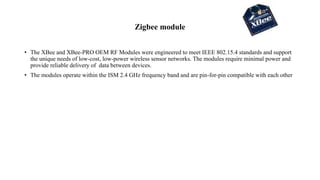
• The XBee and XBee-PRO OEM RF Modules were engineered to meet IEEE 802.15.4 standards and support
the unique needs of low-cost, low-power wireless sensor networks. The modules require minimal power and
provide reliable delivery of data between devices.
• The modules operate within the ISM 2.4 GHz frequency band and are pin-for-pin compatible with each other
© 2008 Pantech Solutions™ | All rights
reserved
IEEE 802.15.4 MAC
Applications
IEEE 802.15.4
2400 MHz
PHY
IEEE 802.15.4
868/915 MHz
PHY
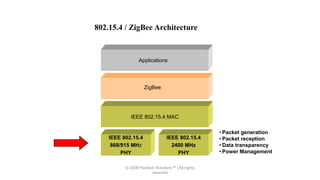
802.15.4 / ZigBee Architecture
ZigBee
• Packet generation
• Packet reception
• Data transparency
• Power Management
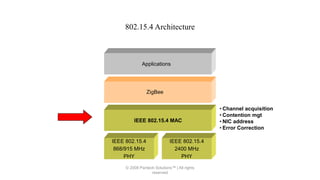
802.15.4 Architecture
IEEE 802.15.4 MAC
Applications
IEEE 802.15.4
2400 MHz
PHY
IEEE 802.15.4
868/915 MHz
PHY
• Channel acquisition
• Contention mgt
• NIC address
• Error Correction
ZigBee
© 2008 Pantech Solutions™ | All rights
reserved
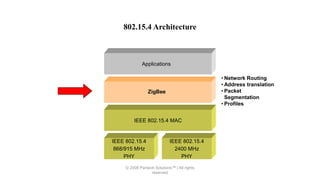
802.15.4 Architecture
IEEE 802.15.4 MAC
Applications
IEEE 802.15.4
2400 MHz
PHY
IEEE 802.15.4
868/915 MHz
PHY
• Network Routing
• Address translation
• Packet
Segmentation
• Profiles
ZigBee
© 2008 Pantech Solutions™ | All rights
reserved
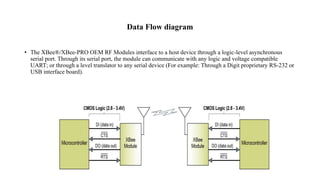
Data Flow diagram
• The XBee®/XBee-PRO OEM RF Modules interface to a host device through a logic-level asynchronous
serial port. Through its serial port, the module can communicate with any logic and voltage compatible
UART; or through a level translator to any serial device (For example: Through a Digit proprietary RS-232 or
USB interface board).
• We can use the EEPROM to store the previous Navigating positions up to 256 locations and we can
navigate up to N number of locations by increasing its memory.
• We can reduce the size of the kit by using GPS+GSM on the same module.
• We can increase the accuracy up to 3m by increasing the cost of the GPS receivers.
• We can use our kit for detection of bomb by connecting to the bomb detector.
• With the help of high sensitivity vibration sensors we can detect the accident.
• Whenever vehicle unexpectedly had an accident on the road with help of vibration sensor we can
detect the accident and we can send the location to the owner, hospital and police.
• We can use our kit to assist the traffic. By keeping the kits in the entire vehicles and by knowing the
locations of all the vehicles.
• If anybody steals our car we can easily find our car around the globe. By keeping vehicle
positioning vehicle on the vehicle.
Future Scope
REFERENCES:
1. Bus Transport in Singapore [Online].
Available:http://en.wikipedia.org/wiki/Bus_transport_in_Singapore
1. EZ-Link [Online]. Available: http://www.ezlink.com.sg
1. Octupus[Online]. Available: http://www.octopus.com.hk/home/en
1. Oyster [Online]. Available: https://oyster.tfl.gov.uk/oyster
1. PublicTransport@SG[Online]. Available : http://www.publictransport.sg/
1. Buses in London [Online]. Available: http://en.wikipedia.org/wiki/London_bus
1. Transport for London [Online]. Available: http://www.tfl.gov.uk/

Iot based smart bus tracking system

  • 1.
    “IOT Based smartbus tracking system” Rahul Wagh 9604068909
  • 2.
    Instead of referringto GPS-enabled location information, we resort to more generally available and energy efficient sensing resources, including cell tower signals, movement statuses, audio recordings, etc., which bring less burden to the participatory party and encourage their participation. We develop a prototype system with different types of Android-based mobile phones and comprehensively experiment with the NTU campus shuttle buses as well as Singapore public buses over a 7-week period. The evaluation results suggest that the proposed system achieves outstanding prediction accuracy compared with those bus operator initiated and GPS supported solutions. We further adopt our system and conduct quick trial experiments with London bus system for 4 days, which suggests the easy deployment of our system and promising system performance across cities. At the same time, the proposed solution is more generally available and energy friendly. Introduction
  • 3.
  • 4.
    Block diagram explanation •In this project PIC16F877A microcontroller is used for interfacing to various hardware peripherals. The current design is an embedded application, which will continuously monitor a moving Vehicle and report the status of the Vehicle on demand. • For doing so a PIC16F877A microcontroller is interfaced serially to a ZigBee Modem and GPS Receiver. A ZigBee modem is used to send the position (Latitude and Longitude) of the vehicle from a remote place. • The GPS modem will continuously give the data i.e. the latitude and longitude indicating the position of the vehicle. • The GPS modem gives many parameters as the output, but only the NMEA data coming out is read and displayed on to the LCD. • The same data is sent to the mobile at the other end from where the position of the vehicle is demanded. An EEPROM is used to store the mobile number. • The hardware interfaces to microcontroller are LCD display, GSM modem and GPS Receiver. • The design uses RS-232 protocol for serial communication between the modems and the microcontroller.
  • 5.
    • A serialdriver IC is used for converting TTL voltage 12 levels to RS-232 voltage levels. • When the request by user is sent to the number at the modem, the system automatically sends a return reply to that mobile indicating the position of the vehicle in terms of latitude and longitude. • As the Micro Controller, GPS and ZigBee take a sight of in depth knowledge, they are explained in the next chapters.
  • 6.
    HARDWARE USED: 1. ZigBeemodule. 2. Computer with rs232. 3. Power supply. 4. GPS module. 5. PIC16F877A. 6. RFID reader. 7. Other Electronics Components. SOFTWARE USED: 1. Embedded ‘C’. 2. VB.NET. 3. MPLAB Hardware and Software Used
  • 7.
  • 8.
    Power Supply Circuit VDD VDD C7 0.1uF JP2 220 VAC 1 2 - + D1 1 4 3 2 U2 7805 1 3 2 VIN GND VOUT C6 100 uF C5 470 uF R4 220 ohm D2 LED
  • 9.
    Power Supply –Circuit Description • The operation of power supply circuits built using filters, rectifiers, and then voltage regulators. Starting with an AC voltage, a steady DC voltage is obtained by rectifying the AC voltage, Then filtering to a DC level, and finally, regulating to obtain a desired fixed DC voltage. The regulation is usually obtained from an IC voltage regulator Unit, which takes a DC voltage and provides a somewhat lower DC voltage, Which remains the same even if the input DC voltage varies, or the output Load connected to the DC voltage changes.
  • 10.
  • 11.
    About Microcontroller • PIC16F877Amicrocontroller is used for this project • It is 8-bit Microcontroller • System is RISC Architecture • It has Small set of Instruction set • It has 35-Instructions only • Compatibility: avail 28/40 Pin ICs
  • 12.
    Microcontroller overview • OperatingSpeed Max 20 MHz, Voltage-(2-5.5)v • Memory: Flash Program 8Kx14 Words, RAM 368 Bytes, EEPROM Data Memory 256 Bytes • Low power, High speed Flash/EEPROM Technology
  • 13.
    Features of Microcontroller •It has 5 Ports for Internal and External usage • It has on chip Timers. 3 Timers are avail • It has in built Analog to Digital Converter • In built Multiplexer availability for signal Selection • It has serial as well as Parallel Communication facilities • In built Capture, Compare and Pulse width modulation
  • 14.
  • 15.
    PIC16F877A microcontroller VDD MCLR RXTX RA0 RB7 RB6 RB5 RB4 RB3 RB2 RB1 RB0 RD7 RD6 RD5 RD4 RD3 RD2 RD1 RD0 RC2 RC3 RC4 RC5 RC6 RC7 RE2 RE1 RE0 RA5 RA4 RA3 RA2 RA1 RC0 RC1 RA0 C9 27 pF C8 27pF C10 0.1 uF PIC16F877 U3 1 2 3 4 5 6 11 32 12 31 7 8 9 10 13 14 15 16 17 18 19 20 33 34 35 36 37 38 39 40 28 29 30 21 22 24 25 26 27 23 MCLR/Vpp RA0/AN0 RA1/AN1 RA2/AN2/Vref - RA3/AN3/Vref + RA4/T0CKI VDD VDD VSS VSS RA5/AN4/SS RE0/AN5/RD RE1/AN6/WR RE2/AN7/CS OSC1/CLKIN OSC2/CLKOUT RC0/T1OSO/T1CKI RC1/T1OSI/CCP2 RC2/CCP1 RC3/SCK/SCL RD0/PSP0 RD1/PSP1 RB0/INT RB1 RB2 RB3/PGM RB4 RB5 RB6/PGC RB7/PGD RD5/PSP5 RD6/PSP6 RD7/PSP7 RD2/PSP2 RD3/PSP3 RC5/SDO RC6/TX/CK RC7/RX/DT RD4/PSP4 RC4/SDI/SDA Y1 4 Mhz R6 1 k R5 220 ohm SW2 RESET
  • 16.
  • 17.
    Zigbee module • TheXBee and XBee-PRO OEM RF Modules were engineered to meet IEEE 802.15.4 standards and support the unique needs of low-cost, low-power wireless sensor networks. The modules require minimal power and provide reliable delivery of data between devices. • The modules operate within the ISM 2.4 GHz frequency band and are pin-for-pin compatible with each other
  • 18.
    © 2008 PantechSolutions™ | All rights reserved IEEE 802.15.4 MAC Applications IEEE 802.15.4 2400 MHz PHY IEEE 802.15.4 868/915 MHz PHY 802.15.4 / ZigBee Architecture ZigBee • Packet generation • Packet reception • Data transparency • Power Management
  • 19.
    802.15.4 Architecture IEEE 802.15.4MAC Applications IEEE 802.15.4 2400 MHz PHY IEEE 802.15.4 868/915 MHz PHY • Channel acquisition • Contention mgt • NIC address • Error Correction ZigBee © 2008 Pantech Solutions™ | All rights reserved
  • 20.
    802.15.4 Architecture IEEE 802.15.4MAC Applications IEEE 802.15.4 2400 MHz PHY IEEE 802.15.4 868/915 MHz PHY • Network Routing • Address translation • Packet Segmentation • Profiles ZigBee © 2008 Pantech Solutions™ | All rights reserved
  • 21.
    Data Flow diagram •The XBee®/XBee-PRO OEM RF Modules interface to a host device through a logic-level asynchronous serial port. Through its serial port, the module can communicate with any logic and voltage compatible UART; or through a level translator to any serial device (For example: Through a Digit proprietary RS-232 or USB interface board).
  • 22.
    • We canuse the EEPROM to store the previous Navigating positions up to 256 locations and we can navigate up to N number of locations by increasing its memory. • We can reduce the size of the kit by using GPS+GSM on the same module. • We can increase the accuracy up to 3m by increasing the cost of the GPS receivers. • We can use our kit for detection of bomb by connecting to the bomb detector. • With the help of high sensitivity vibration sensors we can detect the accident. • Whenever vehicle unexpectedly had an accident on the road with help of vibration sensor we can detect the accident and we can send the location to the owner, hospital and police. • We can use our kit to assist the traffic. By keeping the kits in the entire vehicles and by knowing the locations of all the vehicles. • If anybody steals our car we can easily find our car around the globe. By keeping vehicle positioning vehicle on the vehicle. Future Scope
  • 23.
    REFERENCES: 1. Bus Transportin Singapore [Online]. Available:http://en.wikipedia.org/wiki/Bus_transport_in_Singapore 1. EZ-Link [Online]. Available: http://www.ezlink.com.sg 1. Octupus[Online]. Available: http://www.octopus.com.hk/home/en 1. Oyster [Online]. Available: https://oyster.tfl.gov.uk/oyster 1. PublicTransport@SG[Online]. Available : http://www.publictransport.sg/ 1. Buses in London [Online]. Available: http://en.wikipedia.org/wiki/London_bus 1. Transport for London [Online]. Available: http://www.tfl.gov.uk/