© Oxford University Press 2007. All rights reserved. 1
Wireless LAN, Mobile Internet
Connectivity, and Personal Area Network
Lesson 10
Infrared Data Association (IrDA)
© Oxford University Press 2007. All rights reserved. 2
Infrared (IR) rays
• Invisible radiations of wavelength higher
than that of red
• An LED or a solid-state laser emits IR
rays when given 10–20 mA current from
a low power battery or power source
• When the 1s and 0s are transmitted, the
IR source current is modulated as per
the 1s and 0s
© Oxford University Press 2007. All rights reserved. 3
Direct line-of-sight IR
• Wavelength- 900 nm
• From an LED detected at the receiver
(photo-detector) to get the data
• The detector has 30? (?15?) window to
detect the incoming radiation
• Used for remote control of TV
© Oxford University Press 2007. All rights reserved. 4
IrDA (infrared data association)
• A protocol for personal communication
area network deploying infrared rays
© Oxford University Press 2007. All rights reserved. 5
IrDA Applications
• IR-based data transfer between a laptop
(computer) and mobile hand-held
PocketPC when the two come in vicinity
and line-of-sight of the IR receivers and
detectors in each of them
© Oxford University Press 2007. All rights reserved. 6
IrDA Applications
• Synchronization of PIM data (calendar,
email, business card, and text
messages) between a PC and mobile
device or a device at cradle and IR COM
port
© Oxford University Press 2007. All rights reserved. 7
Network characteristics
• Point to shoot communication from peer
to peer
© Oxford University Press 2007. All rights reserved. 8
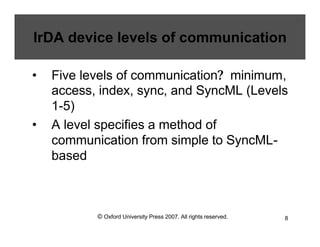
IrDA device levels of communication
• Five levels of communication? minimum,
access, index, sync, and SyncML (Levels
1-5)
• A level specifies a method of
communication from simple to SyncML-
based
© Oxford University Press 2007. All rights reserved. 9
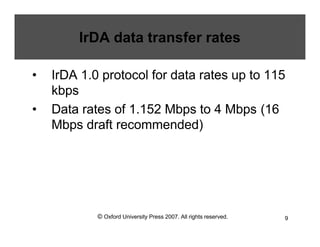
IrDA data transfer rates
• IrDA 1.0 protocol for data rates up to 115
kbps
• Data rates of 1.152 Mbps to 4 Mbps (16
Mbps draft recommended)
© Oxford University Press 2007. All rights reserved. 10
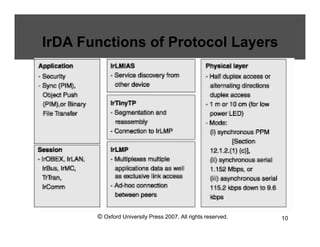
IrDA Functions of Protocol Layers
© Oxford University Press 2007. All rights reserved. 11
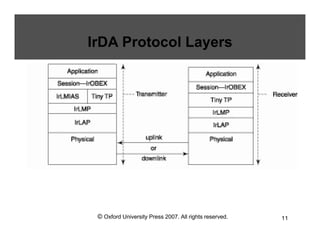
IrDA Protocol Layers
© Oxford University Press 2007. All rights reserved. 12
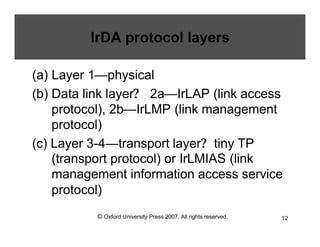
IrDA protocol layers
(a) Layer 1—physical
(b) Data link layer? 2a—IrLAP (link access
protocol), 2b—IrLMP (link management
protocol)
(c) Layer 3-4—transport layer? tiny TP
(transport protocol) or IrLMIAS (link
management information access service
protocol)
© Oxford University Press 2007. All rights reserved. 13
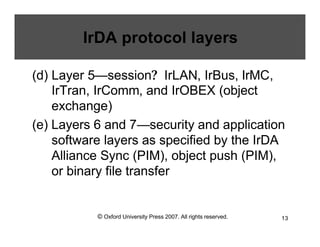
IrDA protocol layers
(d) Layer 5—session? IrLAN, IrBus, IrMC,
IrTran, IrComm, and IrOBEX (object
exchange)
(e) Layers 6 and 7—security and application
software layers as specified by the IrDA
Alliance Sync (PIM), object push (PIM),
or binary file transfer
© Oxford University Press 2007. All rights reserved. 14
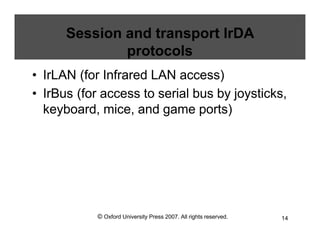
Session and transport IrDA
protocols
• IrLAN (for Infrared LAN access)
• IrBus (for access to serial bus by joysticks,
keyboard, mice, and game ports)
© Oxford University Press 2007. All rights reserved. 15
Session and transport IrDA
protocols
• IrMC (IrDA mobile communication and
telephony protocol)
• IrTran (IrDA transport protocol for image or
file transfers)
• IrComm [IrDA communication protocol by
emulating serial (for example RS232C
COM) or parallel port]
© Oxford University Press 2007. All rights reserved. 16
Object exchange IrDA protocols
• IrOBEX (for object exchange)
© Oxford University Press 2007. All rights reserved. 17
OBEX
• Supports security by encryption and
decryption at transmitter and receiver,
respectively
• Communicates and exchanges binary
data by establishing a client–server
network between two IR devices
© Oxford University Press 2007. All rights reserved. 18
OBEX client
• Makes a request and server returns the
response
• OBEX client and server either establish
connection-oriented connection before
data transmission
• Send requests and responses through
connectionless connection
© Oxford University Press 2007. All rights reserved. 19
Dissimilarity with Bluetooth
• Bluetooth for wireless short range
exchanges in mobile environment within
10 m network
• IrDA is for exchanges within a range of
one meter in the vicinity of line-of-sight
• IrDA has small form factor in radiation
pattern and has 30? (?15?) window
© Oxford University Press 2007. All rights reserved. 20
Comparison of Bluetooth and IrDA
• Network connection Latency—3 s for
Bluetooth and a few ms for IrDA
• Bit rate—1 Mbps for Bluetooth and 1.152
Mbps to 4 Mbps for IrDA
© Oxford University Press 2007. All rights reserved. 21
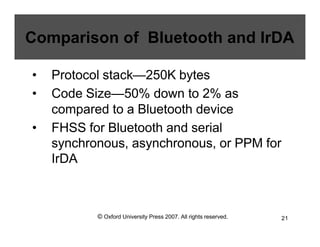
Comparison of Bluetooth and IrDA
• Protocol stack—250K bytes
• Code Size—50% down to 2% as
compared to a Bluetooth device
• FHSS for Bluetooth and serial
synchronous, asynchronous, or PPM for
IrDA
© Oxford University Press 2007. All rights reserved. 22
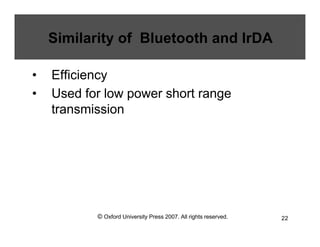
Similarity of Bluetooth and IrDA
• Efficiency
• Used for low power short range
transmission
© Oxford University Press 2007. All rights reserved. 23
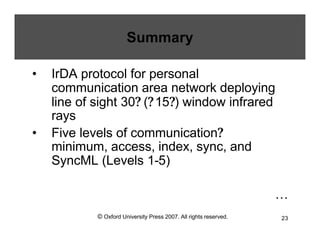
Summary
• IrDA protocol for personal
communication area network deploying
line of sight 30? (?15?) window infrared
rays
• Five levels of communication?
minimum, access, index, sync, and
SyncML (Levels 1-5)
…
© Oxford University Press 2007. All rights reserved. 24
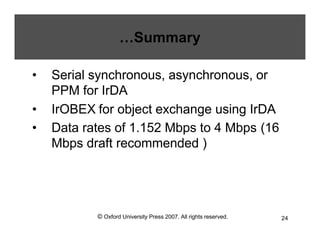
…Summary
• Serial synchronous, asynchronous, or
PPM for IrDA
• IrOBEX for object exchange using IrDA
• Data rates of 1.152 Mbps to 4 Mbps (16
Mbps draft recommended )
© Oxford University Press 2007. All rights reserved. 25
End of Lesson 10
Infrared Data Association (IrDA)

IRDA Infrared Data Association (IrDA)

  • 1.
    © Oxford UniversityPress 2007. All rights reserved. 1 Wireless LAN, Mobile Internet Connectivity, and Personal Area Network Lesson 10 Infrared Data Association (IrDA)
  • 2.
    © Oxford UniversityPress 2007. All rights reserved. 2 Infrared (IR) rays • Invisible radiations of wavelength higher than that of red • An LED or a solid-state laser emits IR rays when given 10–20 mA current from a low power battery or power source • When the 1s and 0s are transmitted, the IR source current is modulated as per the 1s and 0s
  • 3.
    © Oxford UniversityPress 2007. All rights reserved. 3 Direct line-of-sight IR • Wavelength- 900 nm • From an LED detected at the receiver (photo-detector) to get the data • The detector has 30? (?15?) window to detect the incoming radiation • Used for remote control of TV
  • 4.
    © Oxford UniversityPress 2007. All rights reserved. 4 IrDA (infrared data association) • A protocol for personal communication area network deploying infrared rays
  • 5.
    © Oxford UniversityPress 2007. All rights reserved. 5 IrDA Applications • IR-based data transfer between a laptop (computer) and mobile hand-held PocketPC when the two come in vicinity and line-of-sight of the IR receivers and detectors in each of them
  • 6.
    © Oxford UniversityPress 2007. All rights reserved. 6 IrDA Applications • Synchronization of PIM data (calendar, email, business card, and text messages) between a PC and mobile device or a device at cradle and IR COM port
  • 7.
    © Oxford UniversityPress 2007. All rights reserved. 7 Network characteristics • Point to shoot communication from peer to peer
  • 8.
    © Oxford UniversityPress 2007. All rights reserved. 8 IrDA device levels of communication • Five levels of communication? minimum, access, index, sync, and SyncML (Levels 1-5) • A level specifies a method of communication from simple to SyncML- based
  • 9.
    © Oxford UniversityPress 2007. All rights reserved. 9 IrDA data transfer rates • IrDA 1.0 protocol for data rates up to 115 kbps • Data rates of 1.152 Mbps to 4 Mbps (16 Mbps draft recommended)
  • 10.
    © Oxford UniversityPress 2007. All rights reserved. 10 IrDA Functions of Protocol Layers
  • 11.
    © Oxford UniversityPress 2007. All rights reserved. 11 IrDA Protocol Layers
  • 12.
    © Oxford UniversityPress 2007. All rights reserved. 12 IrDA protocol layers (a) Layer 1—physical (b) Data link layer? 2a—IrLAP (link access protocol), 2b—IrLMP (link management protocol) (c) Layer 3-4—transport layer? tiny TP (transport protocol) or IrLMIAS (link management information access service protocol)
  • 13.
    © Oxford UniversityPress 2007. All rights reserved. 13 IrDA protocol layers (d) Layer 5—session? IrLAN, IrBus, IrMC, IrTran, IrComm, and IrOBEX (object exchange) (e) Layers 6 and 7—security and application software layers as specified by the IrDA Alliance Sync (PIM), object push (PIM), or binary file transfer
  • 14.
    © Oxford UniversityPress 2007. All rights reserved. 14 Session and transport IrDA protocols • IrLAN (for Infrared LAN access) • IrBus (for access to serial bus by joysticks, keyboard, mice, and game ports)
  • 15.
    © Oxford UniversityPress 2007. All rights reserved. 15 Session and transport IrDA protocols • IrMC (IrDA mobile communication and telephony protocol) • IrTran (IrDA transport protocol for image or file transfers) • IrComm [IrDA communication protocol by emulating serial (for example RS232C COM) or parallel port]
  • 16.
    © Oxford UniversityPress 2007. All rights reserved. 16 Object exchange IrDA protocols • IrOBEX (for object exchange)
  • 17.
    © Oxford UniversityPress 2007. All rights reserved. 17 OBEX • Supports security by encryption and decryption at transmitter and receiver, respectively • Communicates and exchanges binary data by establishing a client–server network between two IR devices
  • 18.
    © Oxford UniversityPress 2007. All rights reserved. 18 OBEX client • Makes a request and server returns the response • OBEX client and server either establish connection-oriented connection before data transmission • Send requests and responses through connectionless connection
  • 19.
    © Oxford UniversityPress 2007. All rights reserved. 19 Dissimilarity with Bluetooth • Bluetooth for wireless short range exchanges in mobile environment within 10 m network • IrDA is for exchanges within a range of one meter in the vicinity of line-of-sight • IrDA has small form factor in radiation pattern and has 30? (?15?) window
  • 20.
    © Oxford UniversityPress 2007. All rights reserved. 20 Comparison of Bluetooth and IrDA • Network connection Latency—3 s for Bluetooth and a few ms for IrDA • Bit rate—1 Mbps for Bluetooth and 1.152 Mbps to 4 Mbps for IrDA
  • 21.
    © Oxford UniversityPress 2007. All rights reserved. 21 Comparison of Bluetooth and IrDA • Protocol stack—250K bytes • Code Size—50% down to 2% as compared to a Bluetooth device • FHSS for Bluetooth and serial synchronous, asynchronous, or PPM for IrDA
  • 22.
    © Oxford UniversityPress 2007. All rights reserved. 22 Similarity of Bluetooth and IrDA • Efficiency • Used for low power short range transmission
  • 23.
    © Oxford UniversityPress 2007. All rights reserved. 23 Summary • IrDA protocol for personal communication area network deploying line of sight 30? (?15?) window infrared rays • Five levels of communication? minimum, access, index, sync, and SyncML (Levels 1-5) …
  • 24.
    © Oxford UniversityPress 2007. All rights reserved. 24 …Summary • Serial synchronous, asynchronous, or PPM for IrDA • IrOBEX for object exchange using IrDA • Data rates of 1.152 Mbps to 4 Mbps (16 Mbps draft recommended )
  • 25.
    © Oxford UniversityPress 2007. All rights reserved. 25 End of Lesson 10 Infrared Data Association (IrDA)