© Oxford University Press 2007. All rights reserved. 1
Mobile Ad-hoc and Sensor Networks
Lesson 03
Mobile Ad-hoc Network (MANET)
Applications
© Oxford University Press 2007. All rights reserved. 2
Content Distribution and
Synchronization
• In an enterprise, there are a number of
Bluetooth-enabled mobile handheld
devices, PCs, laptops, and WiFi access-
points
• MANET used for content-distribution, PIM,
other information dissemination,
information fusion, and file sharing in the
enterprise
© Oxford University Press 2007. All rights reserved. 3
MANET nodes in multicast tree
topology
• Ddisseminate data packets and form a
multicasting network
• Clusters of the nodes used to give a
multicast tree topology in a MANET
© Oxford University Press 2007. All rights reserved. 4
Mesh Networking and Mobile Service
Provider Network
• Mesh-based mobile networks offer highly
dynamic autonomous topology segments
for the robust IP-compliant data services
within the mobile wireless
communication networks
• Inexpensive alternatives or improvement
to infrastructure-based cellular CDMA or
GSM mobile service provider
© Oxford University Press 2007. All rights reserved. 5
Mesh Network
• A multicast tree network differs from mesh
as it provides only a single path between a
sender and a receiver
• Mesh network many paths
© Oxford University Press 2007. All rights reserved. 6
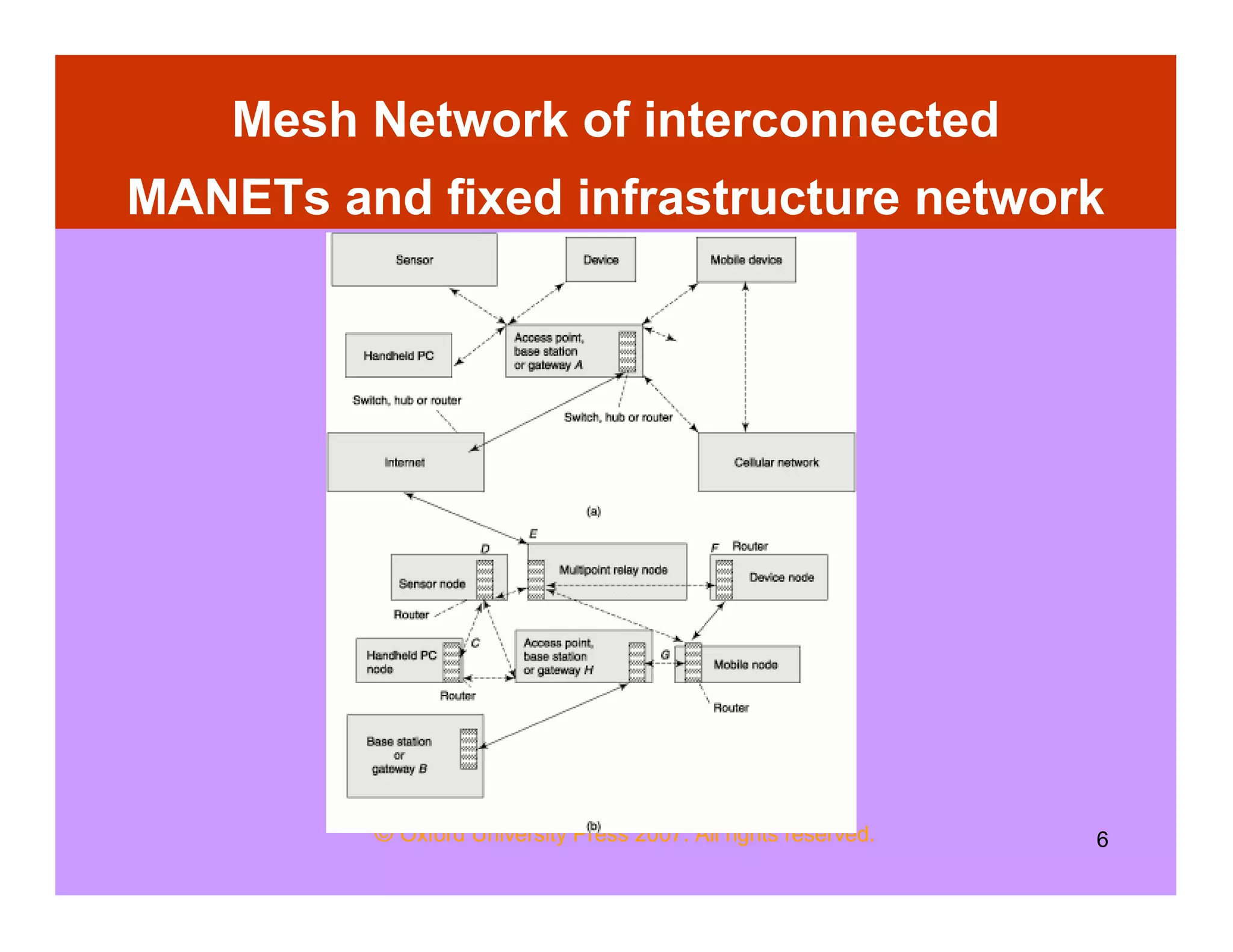
Mesh Network of interconnected
MANETs and fixed infrastructure network
© Oxford University Press 2007. All rights reserved. 7
Protocol for unified multicasting through
announcements (PUMA)
• A protocol that builds a mesh that
connects MANET nodes with each other
• On the other mesh provides multiple
paths between sender and receiver
nodes
© Oxford University Press 2007. All rights reserved. 8
Needs for PUMA
• MANETs have nodes which may be
mobile and the wireless links are error-
prone
• Certain packets may not be delivered to
receivers through a multicast tree
topology
• PUMA which send packets from senders
to receivers through multiple paths may
thus have a greater packet delivery ratio
© Oxford University Press 2007. All rights reserved. 9
Needs for PUMA
• However, in benign conditions (low
mobility and traffic load which leads to
lesser collisions), sending packets is not
needed and is a waste
• In such situations PUMA is able to
reduce the redundancy
• PUMA adapts the amount of redundancy
in the network depending on need
© Oxford University Press 2007. All rights reserved. 10
Image Acquisition, Processing and
Distribution using MANET
• Number of imaging devices forming a
MANETlow cost digital still camera
with a wireless network interface,
Wireless WebCam, mobile device
connected to a digital still camera, mobile
phones, and pocket PCs equipped with
an image acquisition sensor
© Oxford University Press 2007. All rights reserved. 11
Applications of Image Acquisition using
MANET
• Remote viewfinder by security personals
in an office
• Remote processing on a computer for a
video stream from wireless WebCam and
other devices
© Oxford University Press 2007. All rights reserved. 12
Applications of Image Acquisition
using MANET
• Image file transfer
• Messaging and data transmission to
remote devices using 802.11b (Section
1.1.5)
• Remote controlling.
© Oxford University Press 2007. All rights reserved. 13
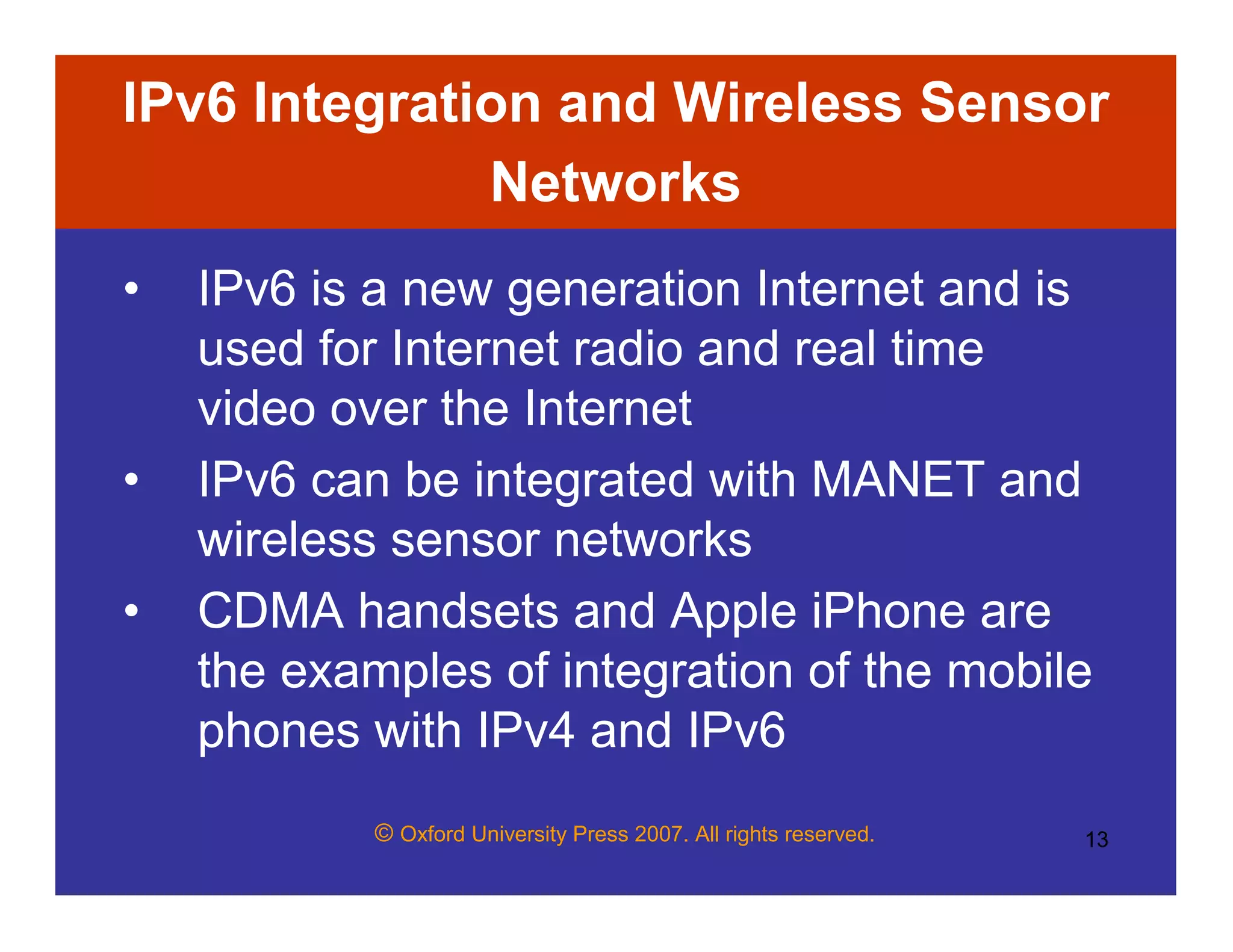
IPv6 Integration and Wireless Sensor
Networks
• IPv6 is a new generation Internet and is
used for Internet radio and real time
video over the Internet
• IPv6 can be integrated with MANET and
wireless sensor networks
• CDMA handsets and Apple iPhone are
the examples of integration of the mobile
phones with IPv4 and IPv6
© Oxford University Press 2007. All rights reserved. 14
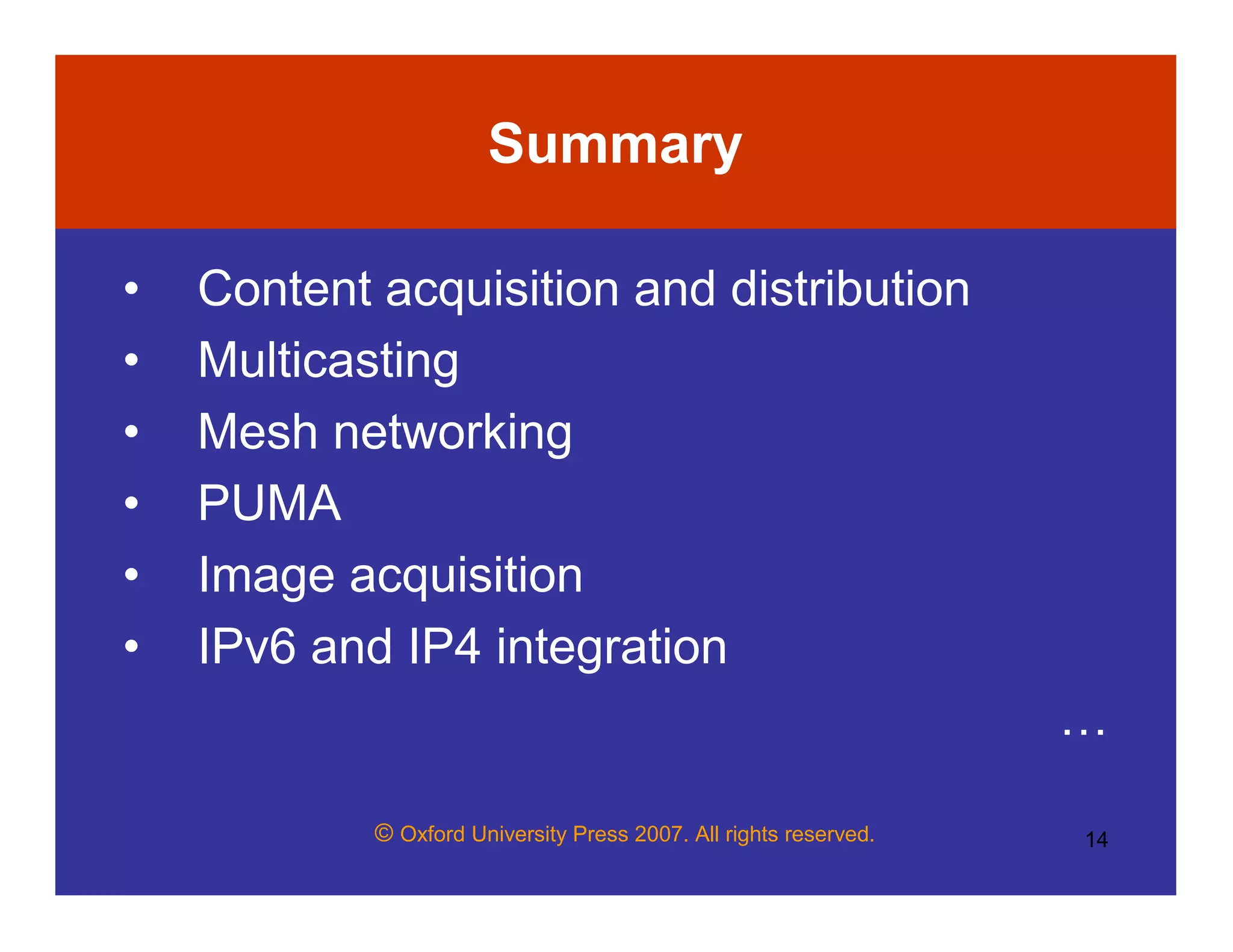
Summary
• Content acquisition and distribution
• Multicasting
• Mesh networking
• PUMA
• Image acquisition
• IPv6 and IP4 integration
…
© Oxford University Press 2007. All rights reserved. 15
End of Lesson 03
Mobile Ad-hoc Network Applications

Mobile Ad-hoc Network (MANET) Applications

  • 1.
    © Oxford UniversityPress 2007. All rights reserved. 1 Mobile Ad-hoc and Sensor Networks Lesson 03 Mobile Ad-hoc Network (MANET) Applications
  • 2.
    © Oxford UniversityPress 2007. All rights reserved. 2 Content Distribution and Synchronization • In an enterprise, there are a number of Bluetooth-enabled mobile handheld devices, PCs, laptops, and WiFi access- points • MANET used for content-distribution, PIM, other information dissemination, information fusion, and file sharing in the enterprise
  • 3.
    © Oxford UniversityPress 2007. All rights reserved. 3 MANET nodes in multicast tree topology • Ddisseminate data packets and form a multicasting network • Clusters of the nodes used to give a multicast tree topology in a MANET
  • 4.
    © Oxford UniversityPress 2007. All rights reserved. 4 Mesh Networking and Mobile Service Provider Network • Mesh-based mobile networks offer highly dynamic autonomous topology segments for the robust IP-compliant data services within the mobile wireless communication networks • Inexpensive alternatives or improvement to infrastructure-based cellular CDMA or GSM mobile service provider
  • 5.
    © Oxford UniversityPress 2007. All rights reserved. 5 Mesh Network • A multicast tree network differs from mesh as it provides only a single path between a sender and a receiver • Mesh network many paths
  • 6.
    © Oxford UniversityPress 2007. All rights reserved. 6 Mesh Network of interconnected MANETs and fixed infrastructure network
  • 7.
    © Oxford UniversityPress 2007. All rights reserved. 7 Protocol for unified multicasting through announcements (PUMA) • A protocol that builds a mesh that connects MANET nodes with each other • On the other mesh provides multiple paths between sender and receiver nodes
  • 8.
    © Oxford UniversityPress 2007. All rights reserved. 8 Needs for PUMA • MANETs have nodes which may be mobile and the wireless links are error- prone • Certain packets may not be delivered to receivers through a multicast tree topology • PUMA which send packets from senders to receivers through multiple paths may thus have a greater packet delivery ratio
  • 9.
    © Oxford UniversityPress 2007. All rights reserved. 9 Needs for PUMA • However, in benign conditions (low mobility and traffic load which leads to lesser collisions), sending packets is not needed and is a waste • In such situations PUMA is able to reduce the redundancy • PUMA adapts the amount of redundancy in the network depending on need
  • 10.
    © Oxford UniversityPress 2007. All rights reserved. 10 Image Acquisition, Processing and Distribution using MANET • Number of imaging devices forming a MANETlow cost digital still camera with a wireless network interface, Wireless WebCam, mobile device connected to a digital still camera, mobile phones, and pocket PCs equipped with an image acquisition sensor
  • 11.
    © Oxford UniversityPress 2007. All rights reserved. 11 Applications of Image Acquisition using MANET • Remote viewfinder by security personals in an office • Remote processing on a computer for a video stream from wireless WebCam and other devices
  • 12.
    © Oxford UniversityPress 2007. All rights reserved. 12 Applications of Image Acquisition using MANET • Image file transfer • Messaging and data transmission to remote devices using 802.11b (Section 1.1.5) • Remote controlling.
  • 13.
    © Oxford UniversityPress 2007. All rights reserved. 13 IPv6 Integration and Wireless Sensor Networks • IPv6 is a new generation Internet and is used for Internet radio and real time video over the Internet • IPv6 can be integrated with MANET and wireless sensor networks • CDMA handsets and Apple iPhone are the examples of integration of the mobile phones with IPv4 and IPv6
  • 14.
    © Oxford UniversityPress 2007. All rights reserved. 14 Summary • Content acquisition and distribution • Multicasting • Mesh networking • PUMA • Image acquisition • IPv6 and IP4 integration …
  • 15.
    © Oxford UniversityPress 2007. All rights reserved. 15 End of Lesson 03 Mobile Ad-hoc Network Applications