Unit 2
Inverters and Logic gates
Driving Large Capacitive Loads
Super Buffers
Driving Large Capacitive Loads
• Large capacitive loads arises when signals
must be propagated from the chip to off chip
destinations.
• Long buses
• CL >= 104
Cg(typically)
• This must be driven through low resistances,
• Else, will increase the delay (By increasing rise
and fall time), because, delay α CL
Contd..
• Three solutions
1. Cascading Inverters as drivers
2. Super Buffers
3. BiCMOS Drivers
Cascading Inverters as drivers
Contd..
• fopt= e (k +fopt )/ fopt
• k = Cd / Cg
Where Cd and Cg – Drain and Gate
Capacitance respectively.
• k – Varies according to technology
• Eg. For 1 um technology
• k = Cd / Cg = .0043 / .02 = 0.215
• Substitute different values for fopt in the above
equation and find the minimum value.
• fopt= 2.93 (approx = 3)
Graph to find the stage ratio value
Super Buffers
• Inverting buffer
• Non-inverting buffer
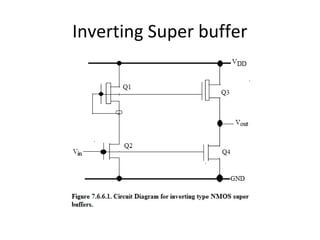
Inverting Super buffer
Operation
• Case (i) : Vin = 1
– Transistors T1 and T2 On
– Gate of T3 is pulled down to 0 (T3 = Off)
– T4 is On (Since the gate is connected to Vin)
– Hence the O/P is pulled down quickly.
Operation (Contd..)
• Case (ii) : Vin =0
– Transistor T2 is Off
– T4 is Off (Since the gate is connected to Vin)
– T3 is allowed to rise quickly to Vdd (On) as its gate
is connected Vdd by Transistor T1.
– As Vg is connected to Vdd and transistor assumes
twice the average gate to source voltage Vgs
(Since the channel exists already).
– Ids α Vgs (and hence charges the load quickly)
– Hence equal transition time for rise and fall time.
Non-Inverting Super Buffer
BiCMOS Drivers (Inverter)
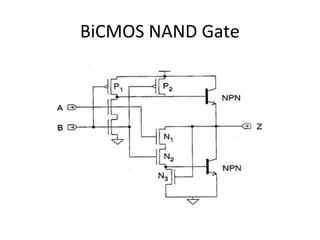
BiCMOS NAND Gate
BiCMOS Drivers
Effect of Temperature

Driving large capacitive loads

  • 1.
    Unit 2 Inverters andLogic gates Driving Large Capacitive Loads Super Buffers
  • 2.
    Driving Large CapacitiveLoads • Large capacitive loads arises when signals must be propagated from the chip to off chip destinations. • Long buses • CL >= 104 Cg(typically) • This must be driven through low resistances, • Else, will increase the delay (By increasing rise and fall time), because, delay α CL
  • 3.
    Contd.. • Three solutions 1.Cascading Inverters as drivers 2. Super Buffers 3. BiCMOS Drivers
  • 4.
  • 5.
    Contd.. • fopt= e(k +fopt )/ fopt • k = Cd / Cg Where Cd and Cg – Drain and Gate Capacitance respectively. • k – Varies according to technology • Eg. For 1 um technology • k = Cd / Cg = .0043 / .02 = 0.215 • Substitute different values for fopt in the above equation and find the minimum value. • fopt= 2.93 (approx = 3)
  • 6.
    Graph to findthe stage ratio value
  • 7.
    Super Buffers • Invertingbuffer • Non-inverting buffer
  • 8.
  • 9.
    Operation • Case (i): Vin = 1 – Transistors T1 and T2 On – Gate of T3 is pulled down to 0 (T3 = Off) – T4 is On (Since the gate is connected to Vin) – Hence the O/P is pulled down quickly.
  • 10.
    Operation (Contd..) • Case(ii) : Vin =0 – Transistor T2 is Off – T4 is Off (Since the gate is connected to Vin) – T3 is allowed to rise quickly to Vdd (On) as its gate is connected Vdd by Transistor T1. – As Vg is connected to Vdd and transistor assumes twice the average gate to source voltage Vgs (Since the channel exists already). – Ids α Vgs (and hence charges the load quickly) – Hence equal transition time for rise and fall time.
  • 11.
  • 12.
  • 13.
  • 14.
  • 16.