

PIPETTING AND LABORATORY
MATHEMATICS
ANTONIO F. LAUDE JR, RMT MPH
SCHOOL OF MEDICAL TECHNOLOGY
Pipetting Technique using Manual
Pipettes
 Develop good technique
 Through practice
 Improper pipetting – laboratory accidents
 Mouth pipetting – potential hazard
 Never acceptable
 Caustic reagents
 Contaminated specimens
 Poisonous solutions
Pipetting with Manual Pipettes
1. Check the pipette to ascertain its correct size.
2. Wearing protective gloves.
3. Place the tip of the pipette well below the surface
of the liquid to be pipetted.
4. Use aspirator bulb – pipette until the level of
liquid is well above the calibration mark
5. Quickly cover the suction opening at the top of the
pipette with the index finger
Pipetting with Manual Pipettes
6. Wipe the outside of the pipette dry with a piece of
gauze or tissue to remove excess fluid.
7. Hold the pipette in a vertical position with the
delivery tip against the inside of the original vessel.
Carefully allow the liquid in the pipette to drain by
gravity.
Miniscus it the concave or convex surface of a column
of liquid as seen in a laboratory pipette, buret, or
other measuring device.
Pipetting with Manual Pipettes
8. While still holding the pipette in a vertical position,
touch the tip of the pipette to the inside wall of the
receiving vessel.
Remove index finger, permit free drainage.
TD pipettes – small amount will remain in the delivery
tip.
Pipetting with Manual Pipettes
9. To be certain that the drainage is as complete as
possible, touch the delivery tip of the tip to another
area on the inside wall of the receiving vessel.
10. Remove the pipette from the receiving vessel, and
place it in appropriate place for washing.
Automatic Micropipettors
 Micropipettor – most common type of micropipette
used in many laboratories
 Allow repeated, accurate, reproducible delivery of
specimens, reagents, and other liquids requiring
measurement in small amounts.
 Delivery volume is selected by adjusting the settings
on the device.
 0.5 to 500 L – allow volume
Automatic Micropipettors
 Contain or deliver from 1 to 500 L
 Follow manufacturers instructions
Steps apply for use of a micropipettor
1. Attach the proper tip to the pipettor, and set the
delivery volume.
2. Depress the piston to a stop position on the
pipettor.
3. Place the tip into the solution, and allow the piston
to rise slowly back to its original position.
4. Some tips are wiped with a dry gauze at this step,
and some are not wiped. Follow the
manufacturer’s direction.
Steps apply for use of a micropipettor
5. Place the tip on the wall of the receiving vessel,
and depress the piston, first to stop position where the
liquid is allowed to drain, then to a second stop
position where the full dispensing of the liquid takes
place.
6. Dispose of the tip in the waste disposal receptacle.
Some pipettors automatically eject the used tips, thus
minimizing biohazard exposure.
Reading Meniscus
1. With a clear colorless solution, read the bottom of
the meniscus
2. With colored solutions, read the top fluid column.
3. Reading must be made with eye level to avoid
parallax error.
LABORATORY MATHEMATICS
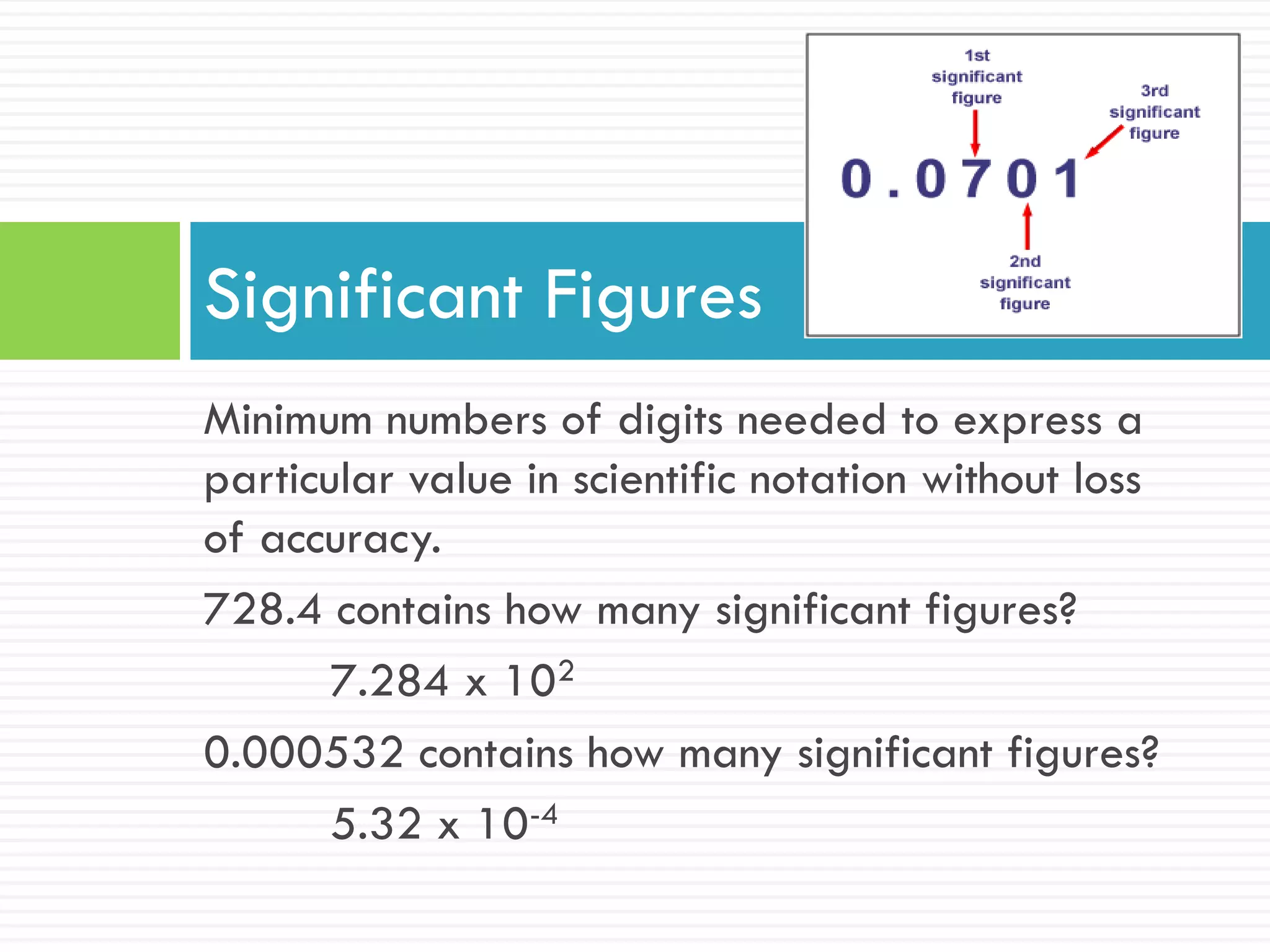
Minimum numbers of digits needed to express a
particular value in scientific notation without loss
of accuracy.
728.4 contains how many significant figures?
7.284 x 10²
0.000532 contains how many significant figures?
5.32 x 10⁻⁴
Significant Figures
Is equal to parts per 100 or the amount of solute
per 100 total units of solution
It is determined in the same manner regardless of
whether it is w/w, v/v or w/v units are used
Percent solution
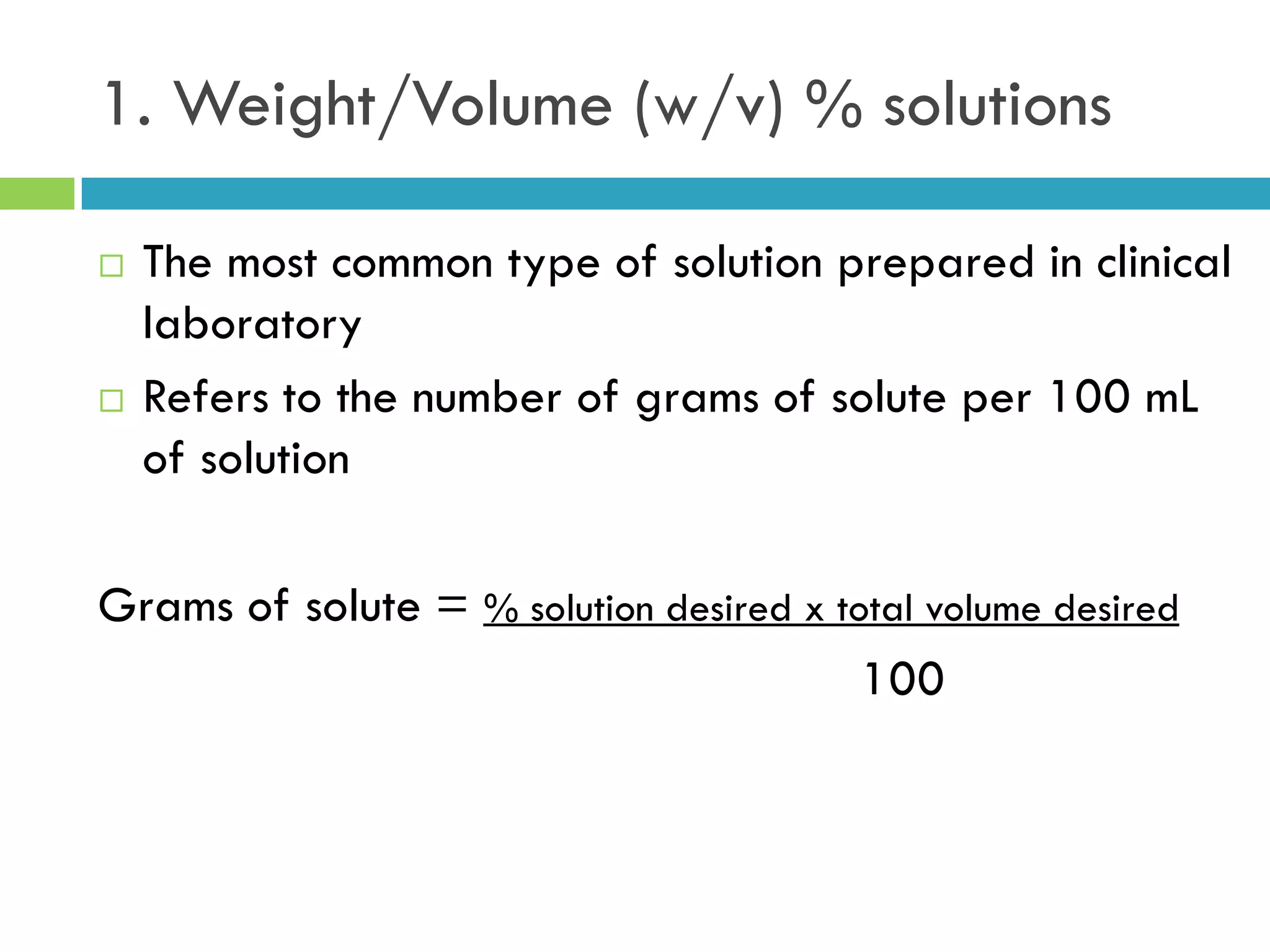
1. Weight/Volume (w/v) % solutions
 The most common type of solution prepared in clinical
laboratory
 Refers to the number of grams of solute per 100 mL
of solution
Grams of solute = % solution desired x total volume desired
100
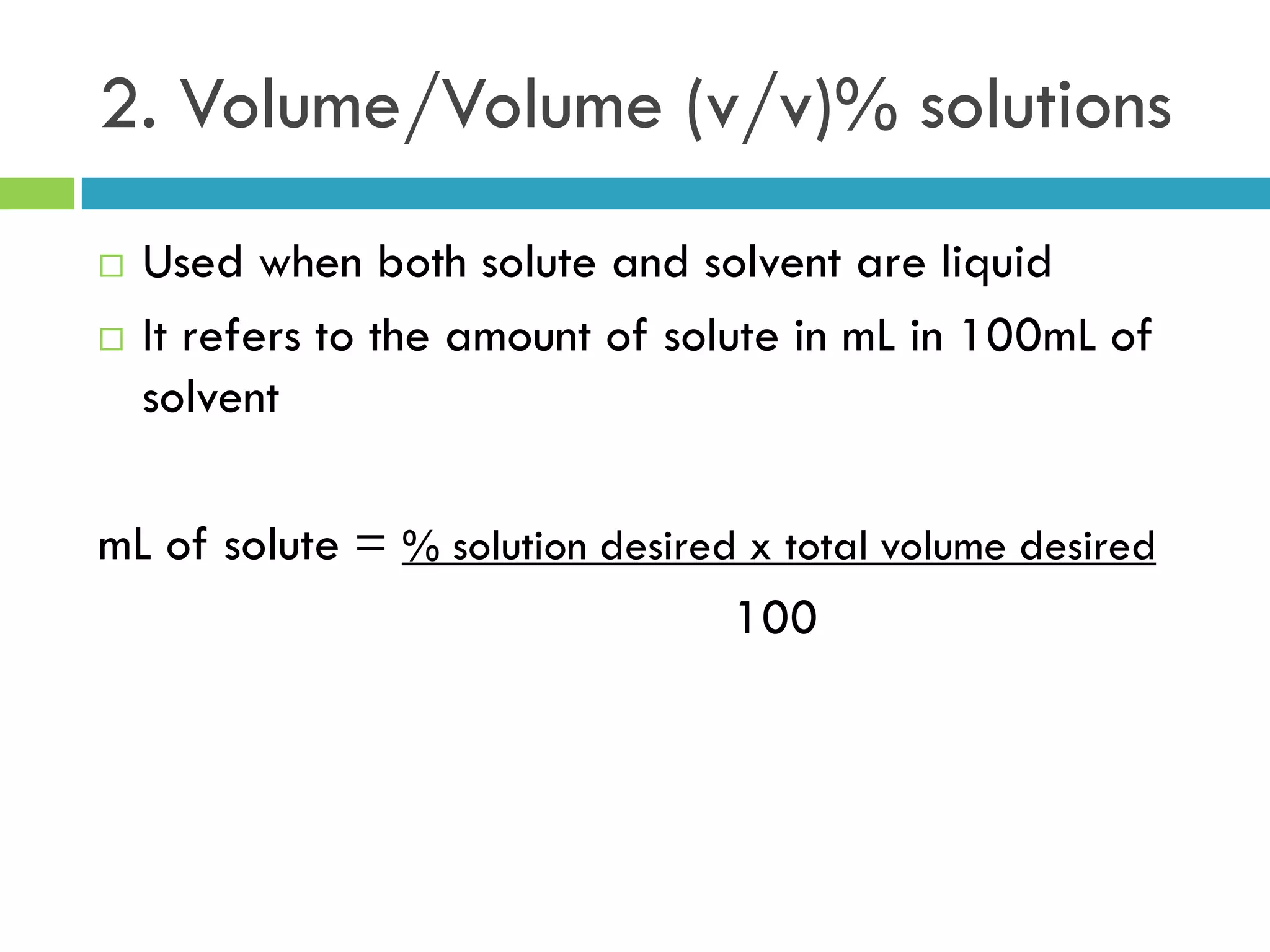
2. Volume/Volume (v/v)% solutions
 Used when both solute and solvent are liquid
 It refers to the amount of solute in mL in 100mL of
solvent
mL of solute = % solution desired x total volume desired
100
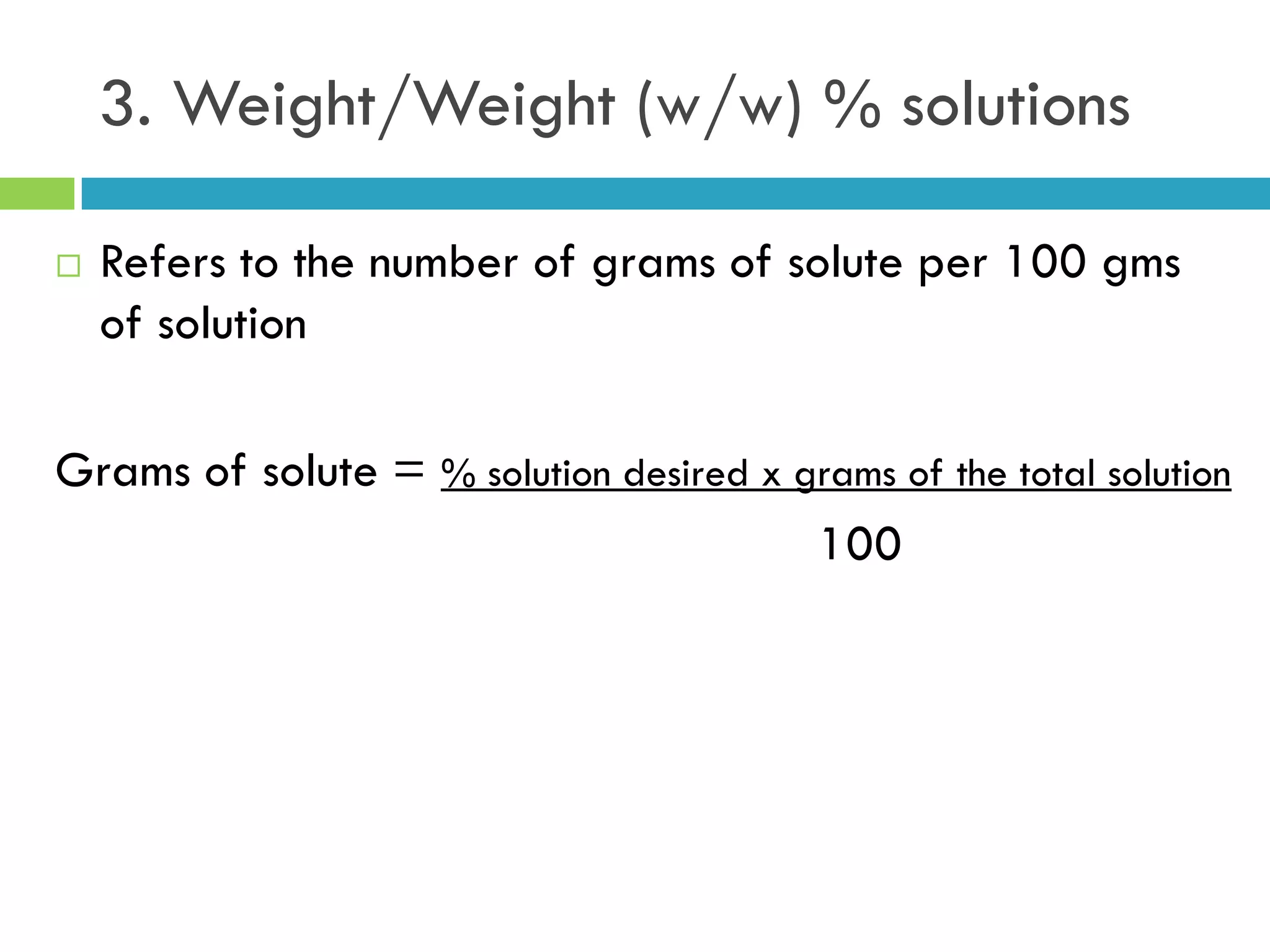
3. Weight/Weight (w/w) % solutions
 Refers to the number of grams of solute per 100 gms
of solution
Grams of solute = % solution desired x grams of the total solution
100
 When preparing concentrated acid solutions,
always add acid to water.
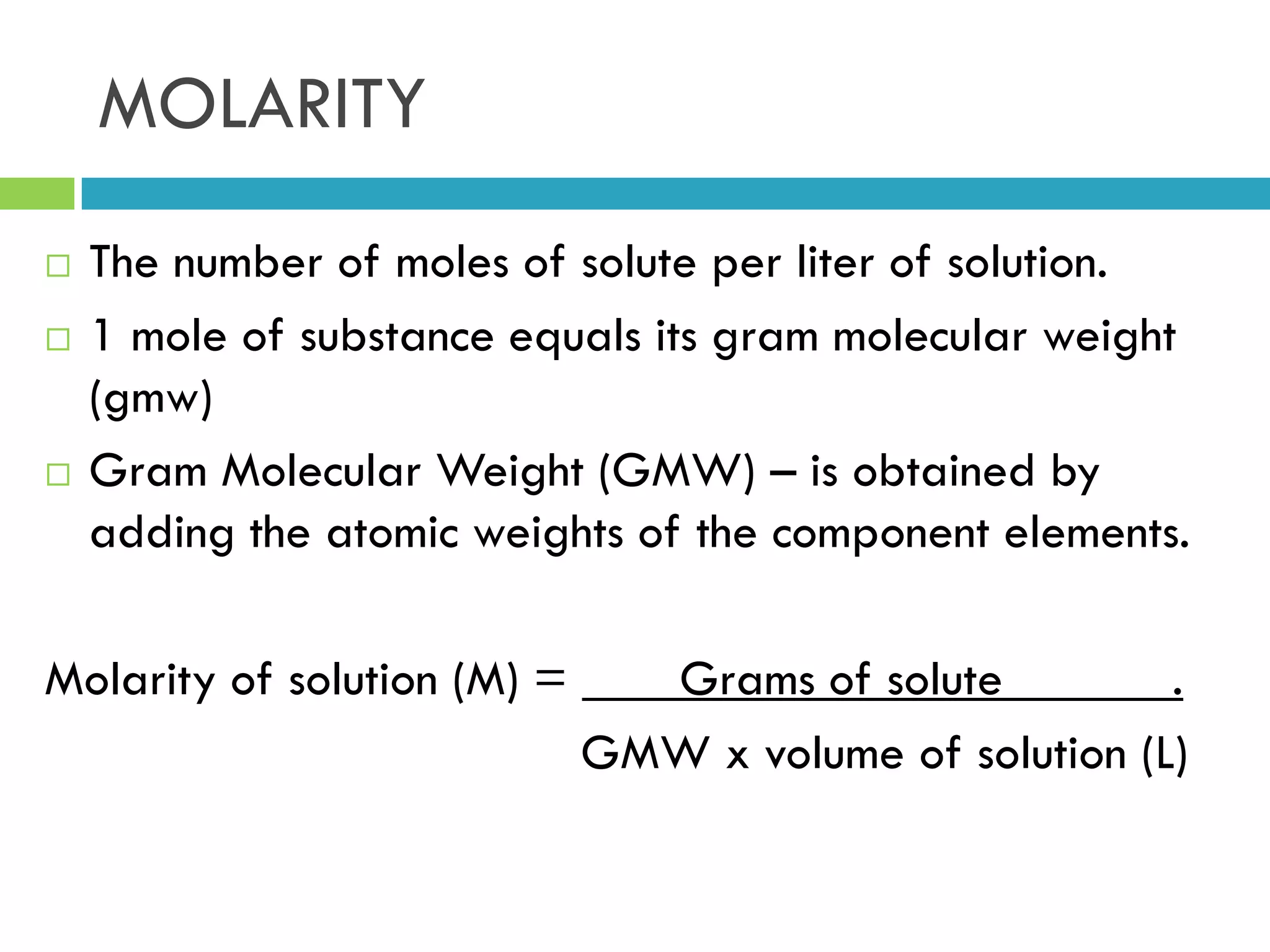
MOLARITY
 The number of moles of solute per liter of solution.
 1 mole of substance equals its gram molecular weight
(gmw)
 Gram Molecular Weight (GMW) – is obtained by
adding the atomic weights of the component elements.
Molarity of solution (M) = Grams of solute .
GMW x volume of solution (L)
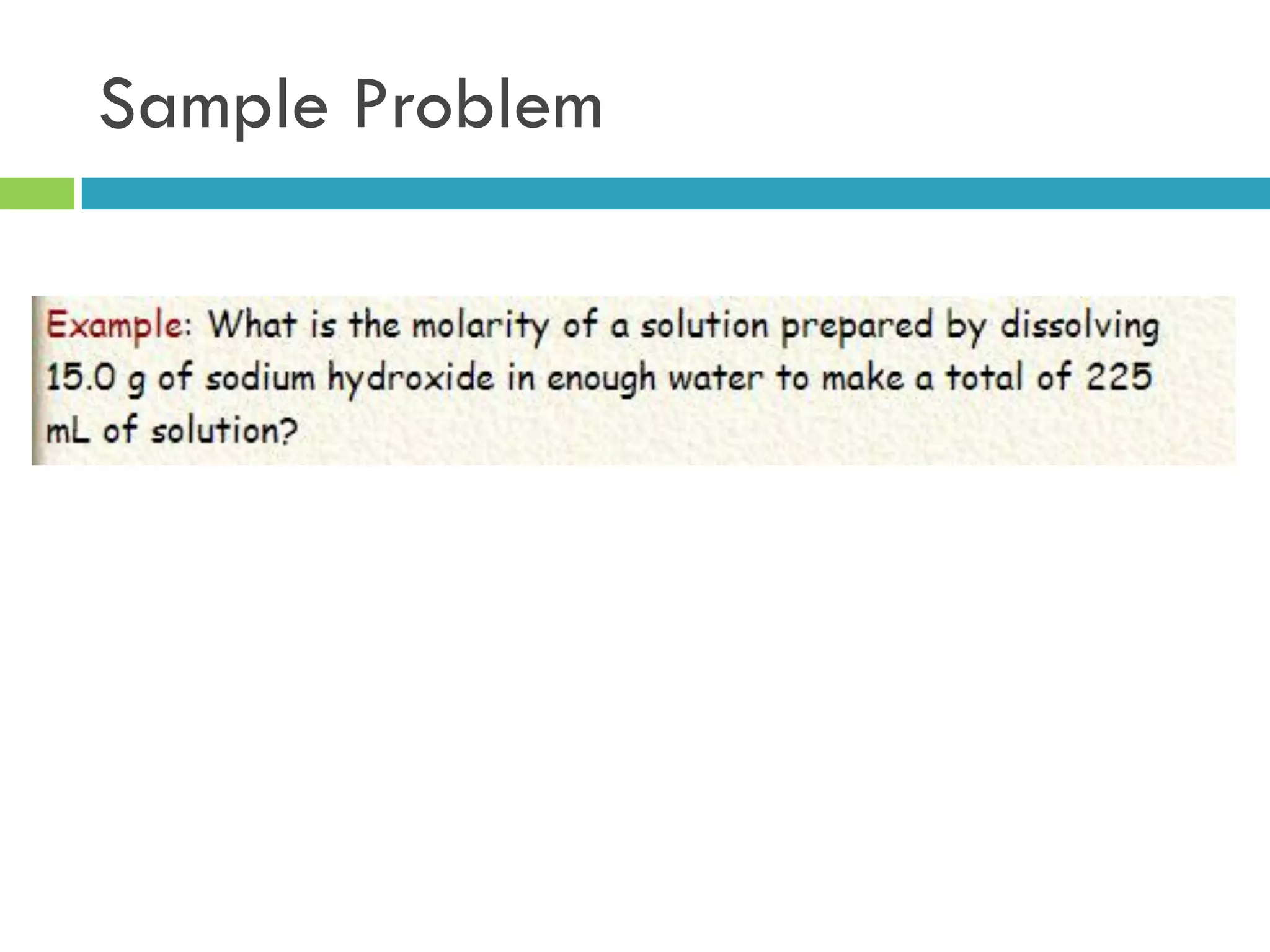
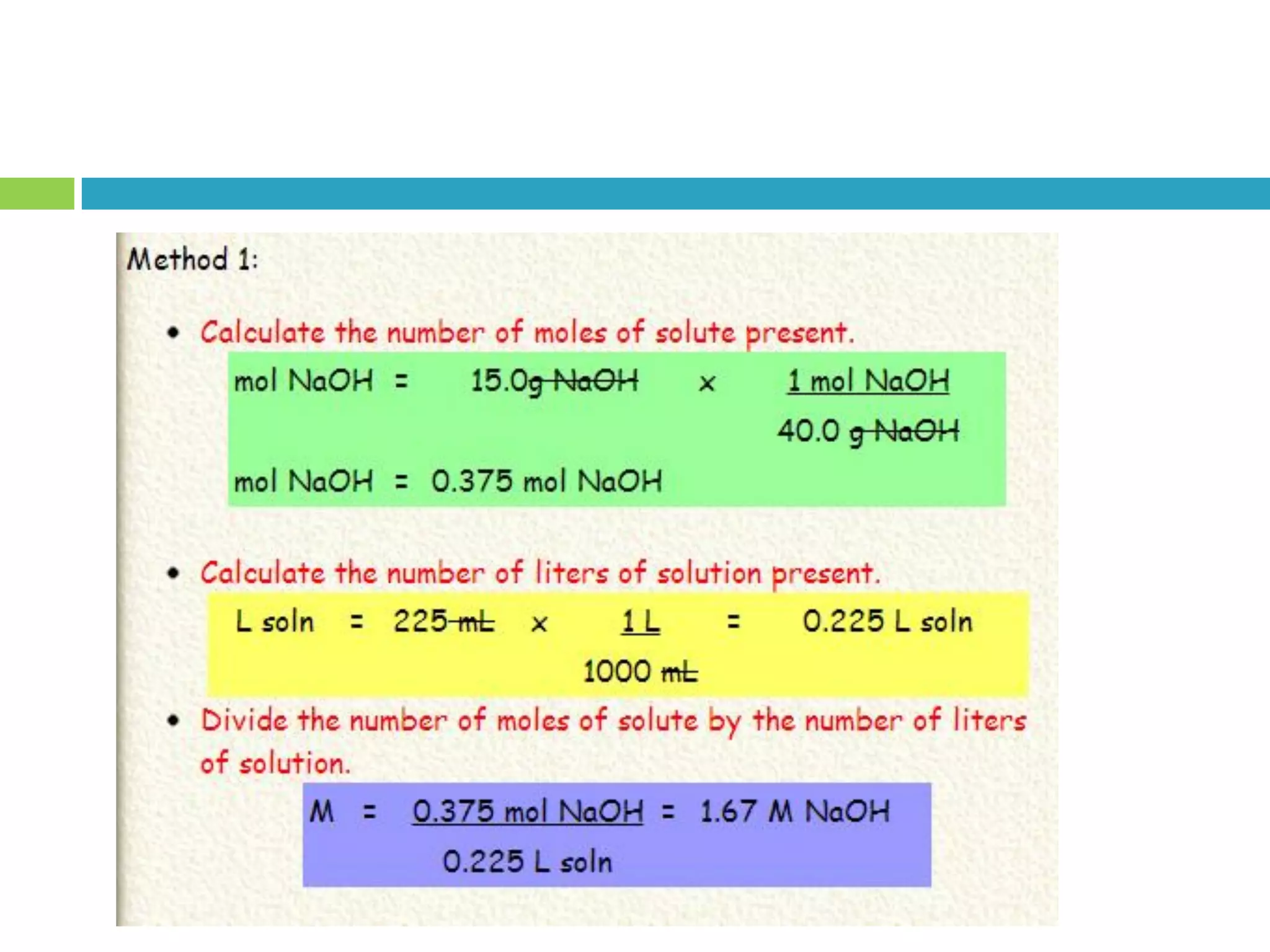
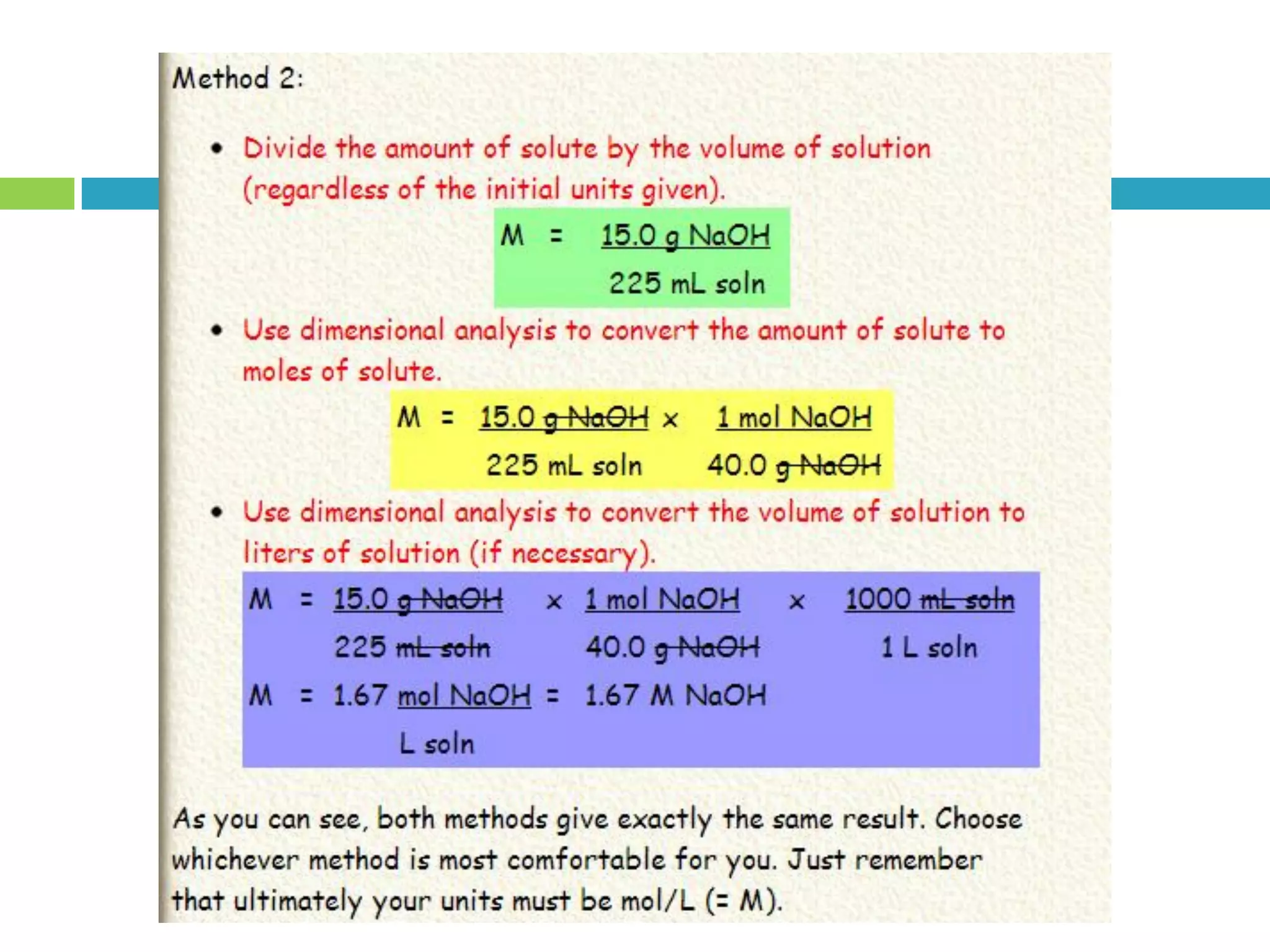
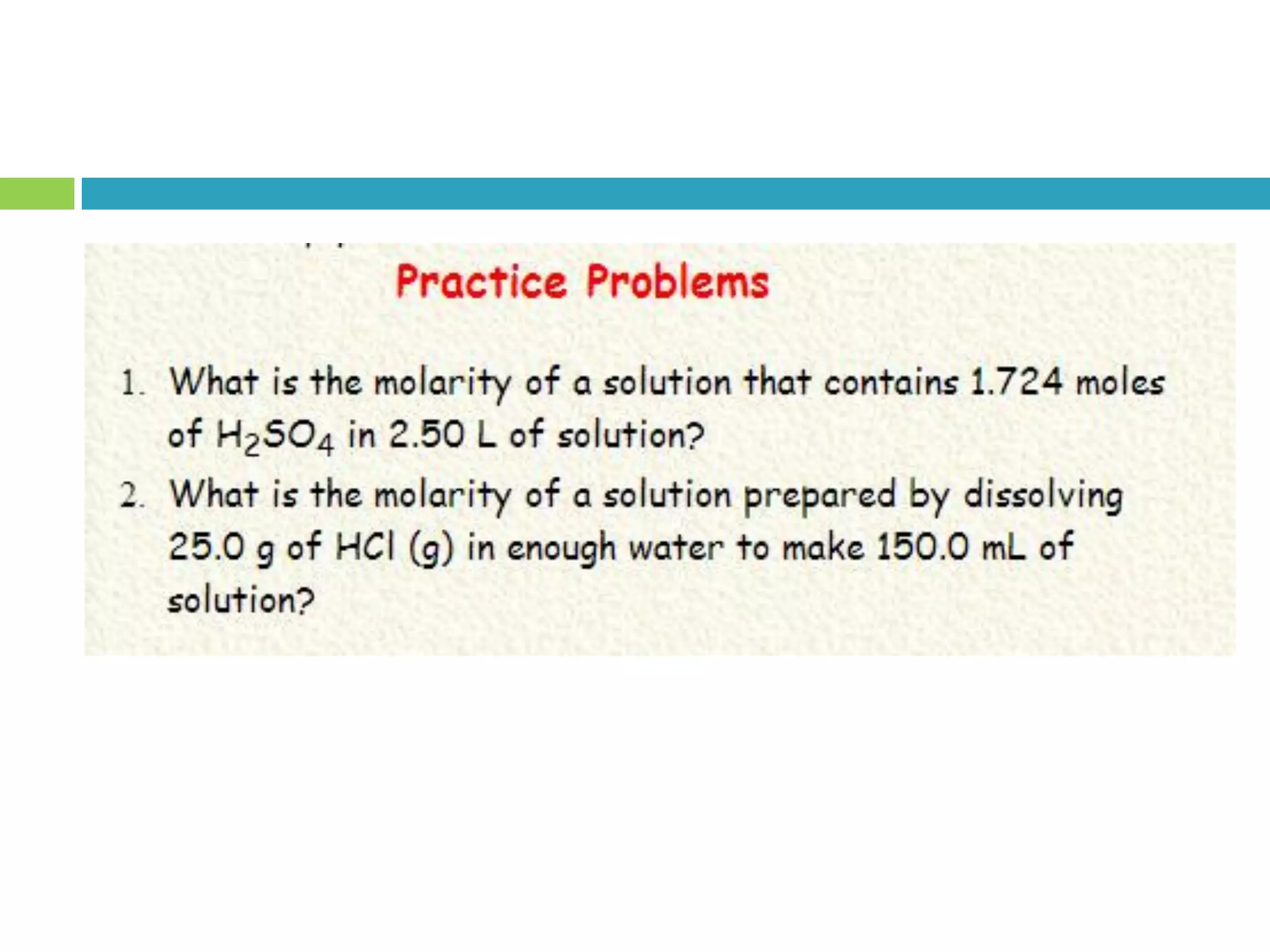
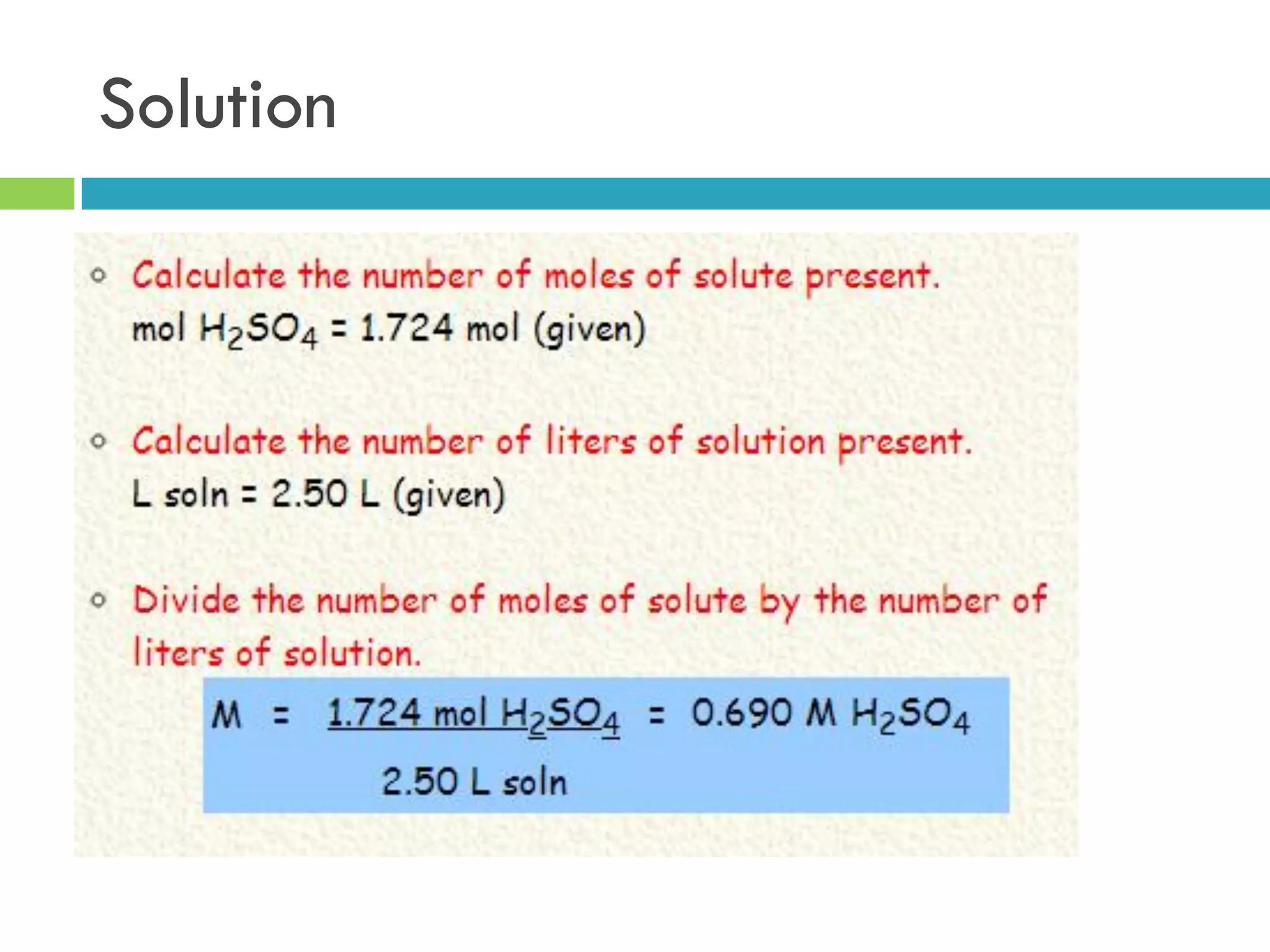
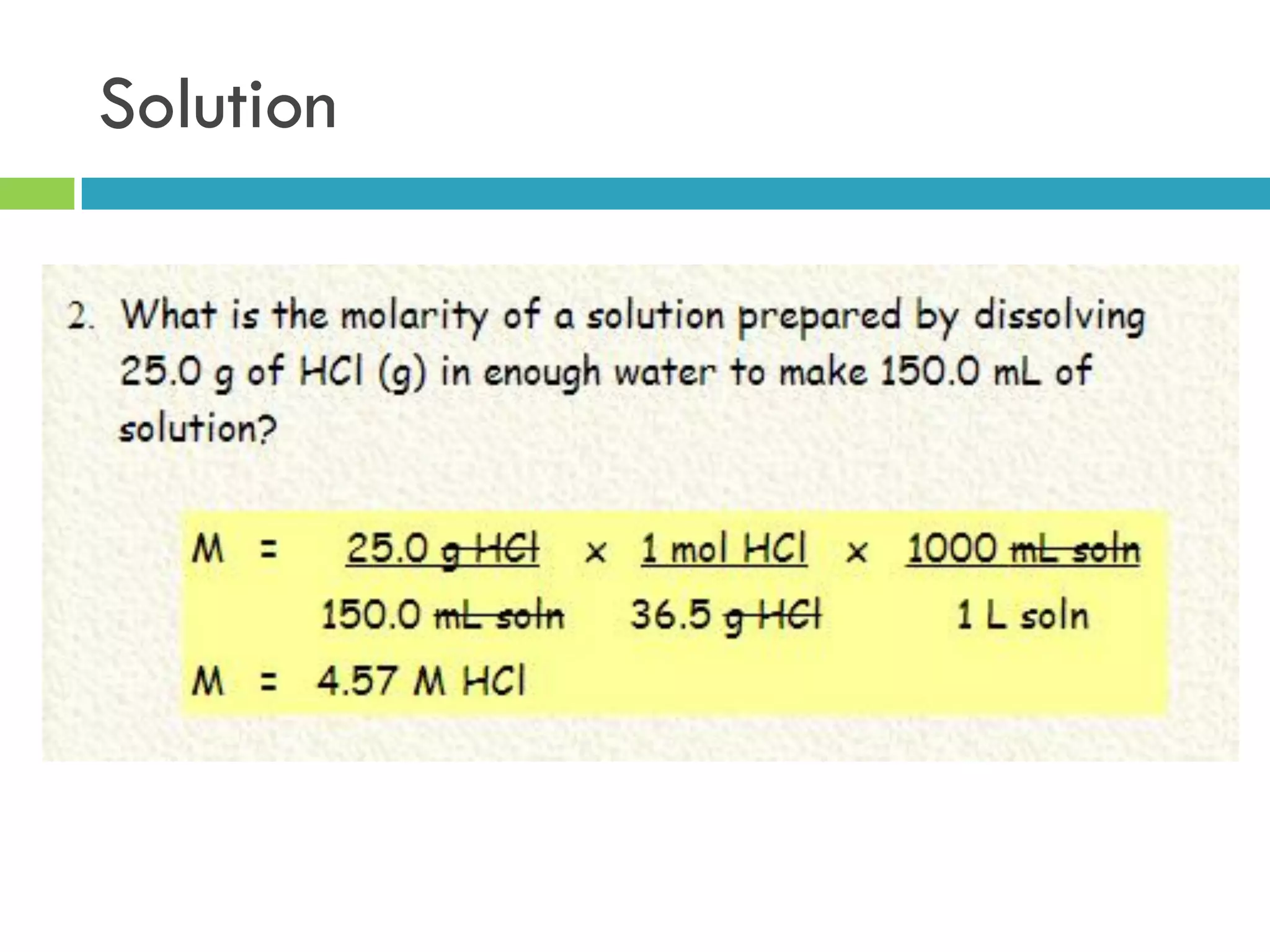
Sample Problem
Solution
Solution
MOLARITY
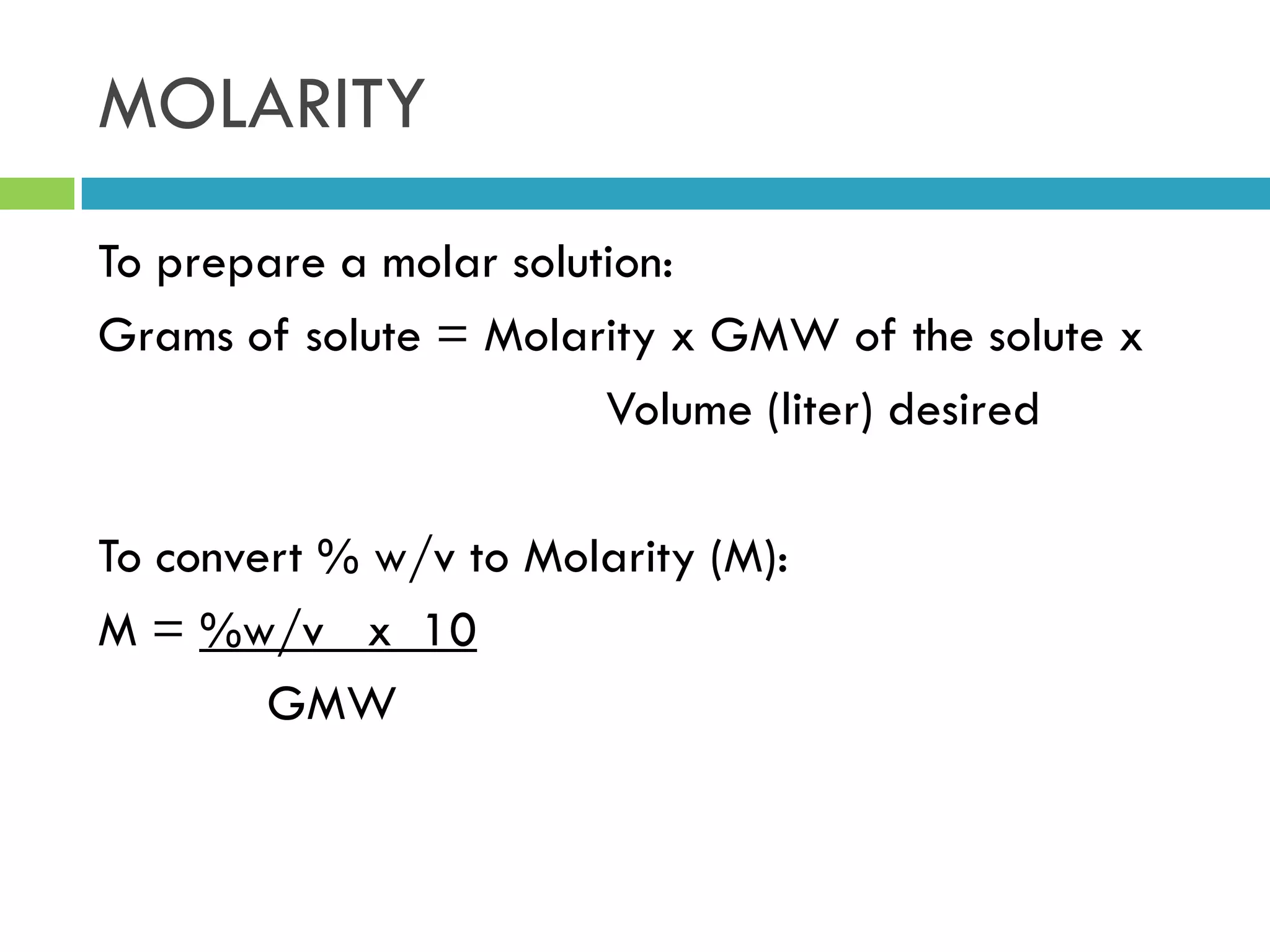
To prepare a molar solution:
Grams of solute = Molarity x GMW of the solute x
Volume (liter) desired
To convert % w/v to Molarity (M):
M = %w/v x 10
GMW
MOLARITY
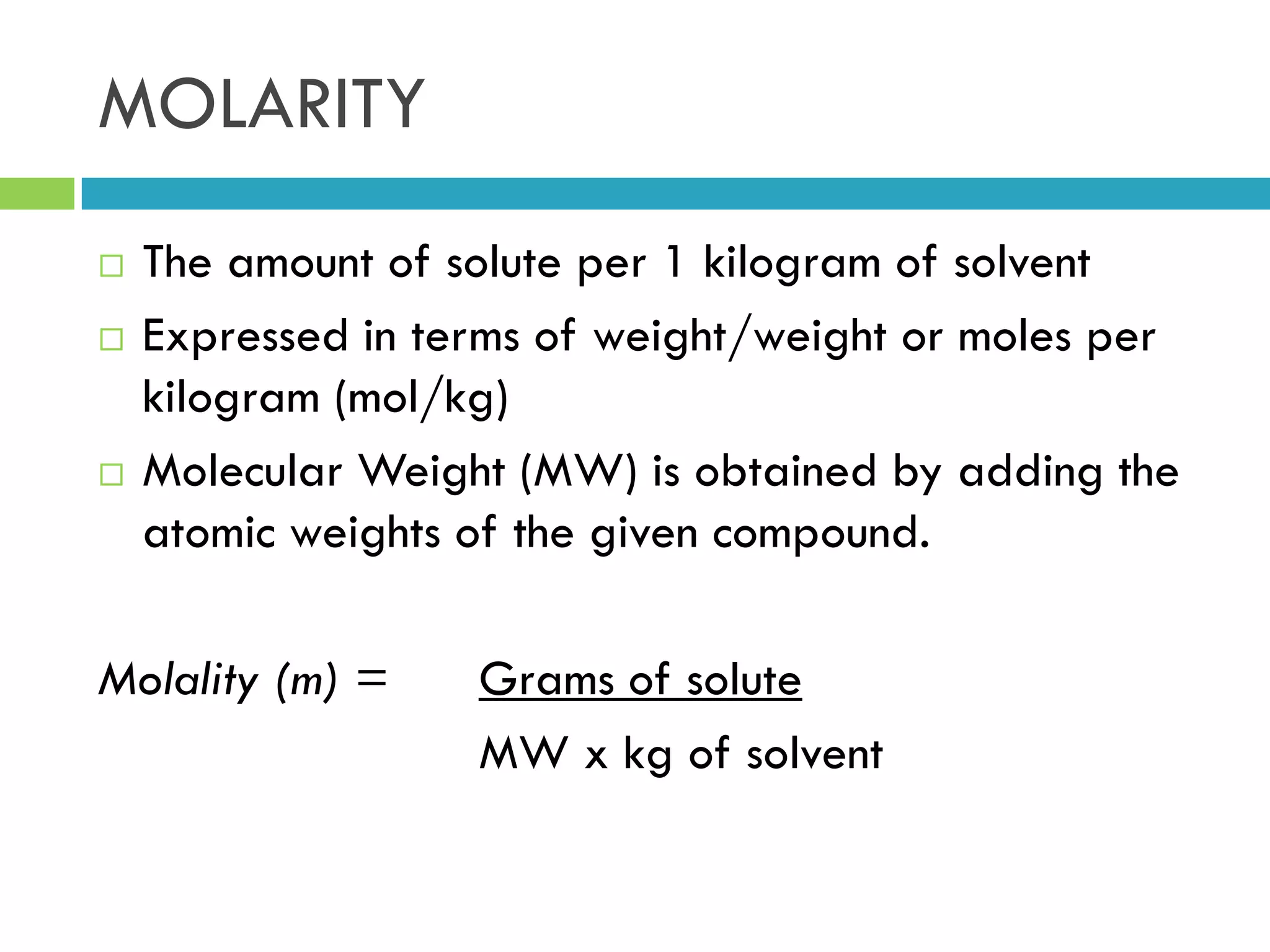
 The amount of solute per 1 kilogram of solvent
 Expressed in terms of weight/weight or moles per
kilogram (mol/kg)
 Molecular Weight (MW) is obtained by adding the
atomic weights of the given compound.
Molality (m) = Grams of solute
MW x kg of solvent
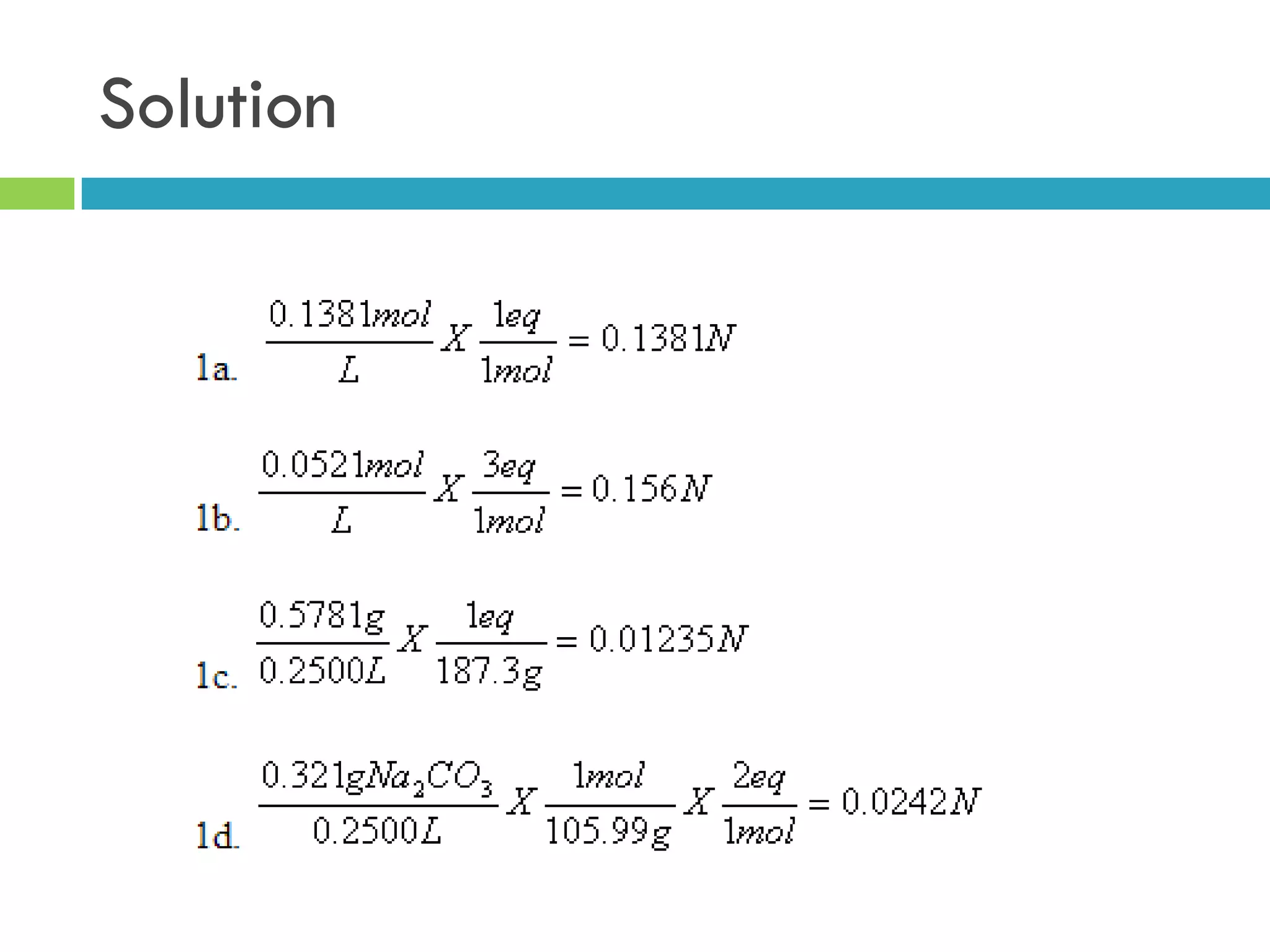
NORMALITY
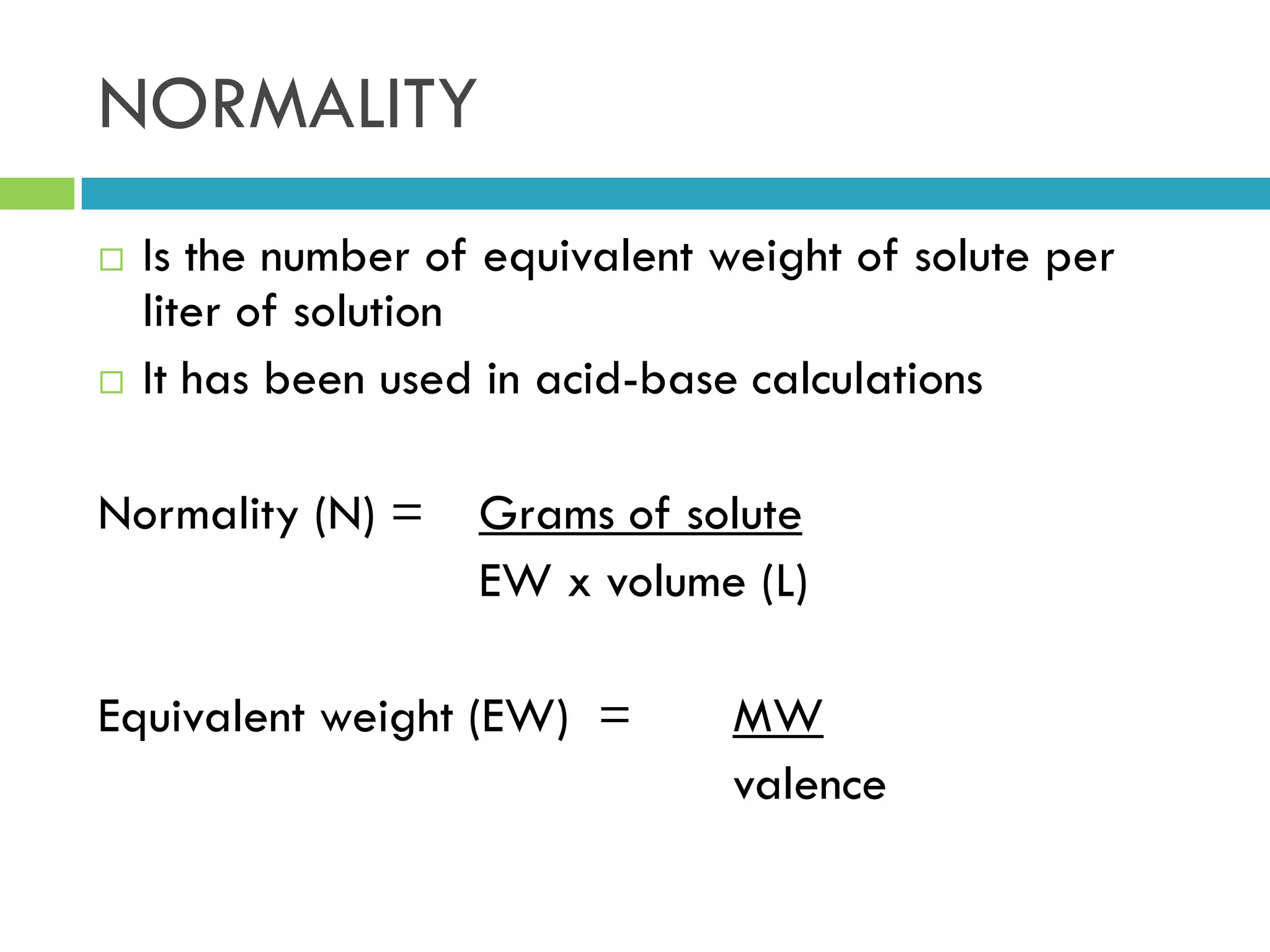
 Is the number of equivalent weight of solute per
liter of solution
 It has been used in acid-base calculations
Normality (N) = Grams of solute
EW x volume (L)
Equivalent weight (EW) = MW
valence
NORMALITY
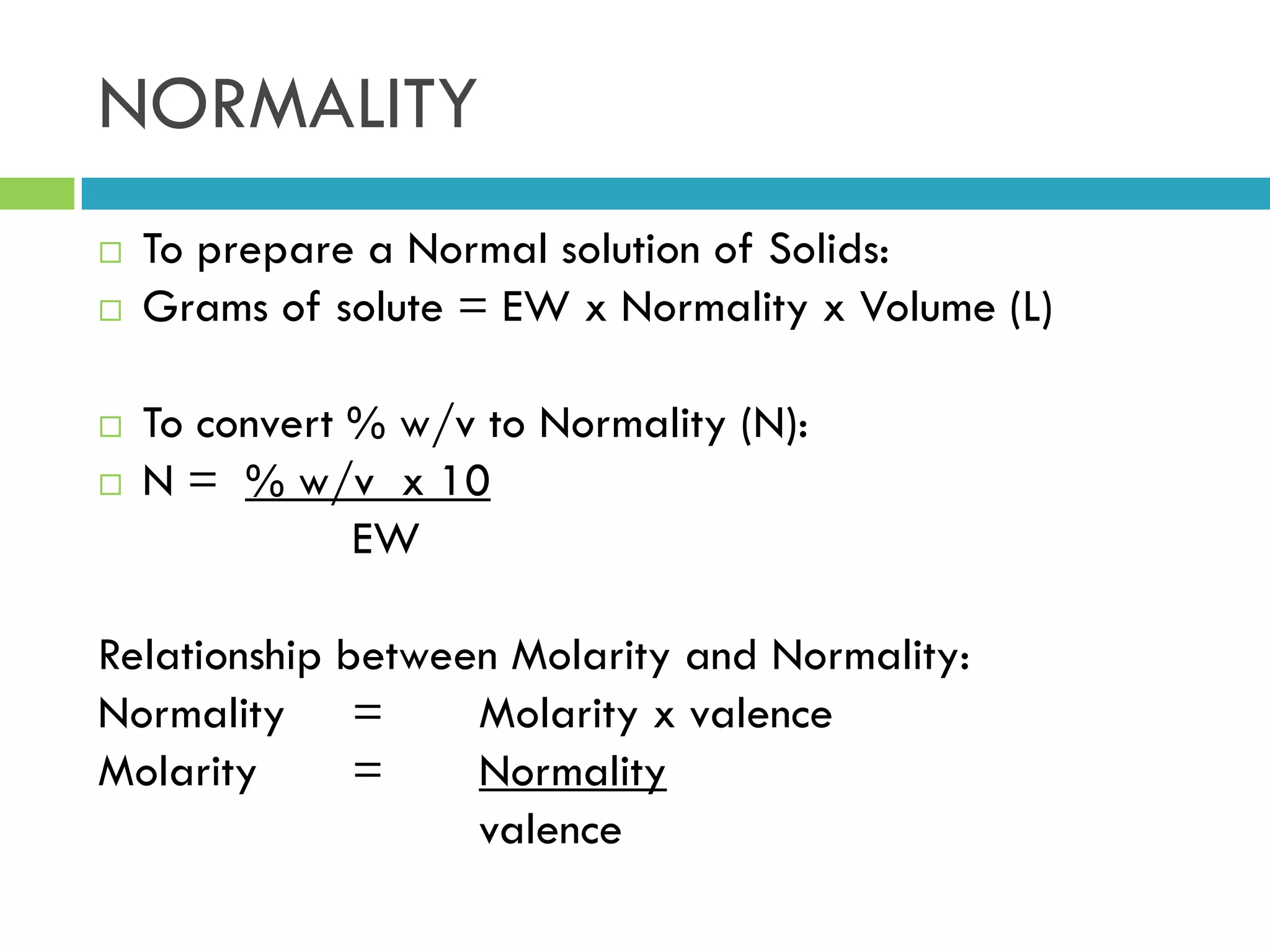
 To prepare a Normal solution of Solids:
 Grams of solute = EW x Normality x Volume (L)
 To convert % w/v to Normality (N):
 N = % w/v x 10
EW
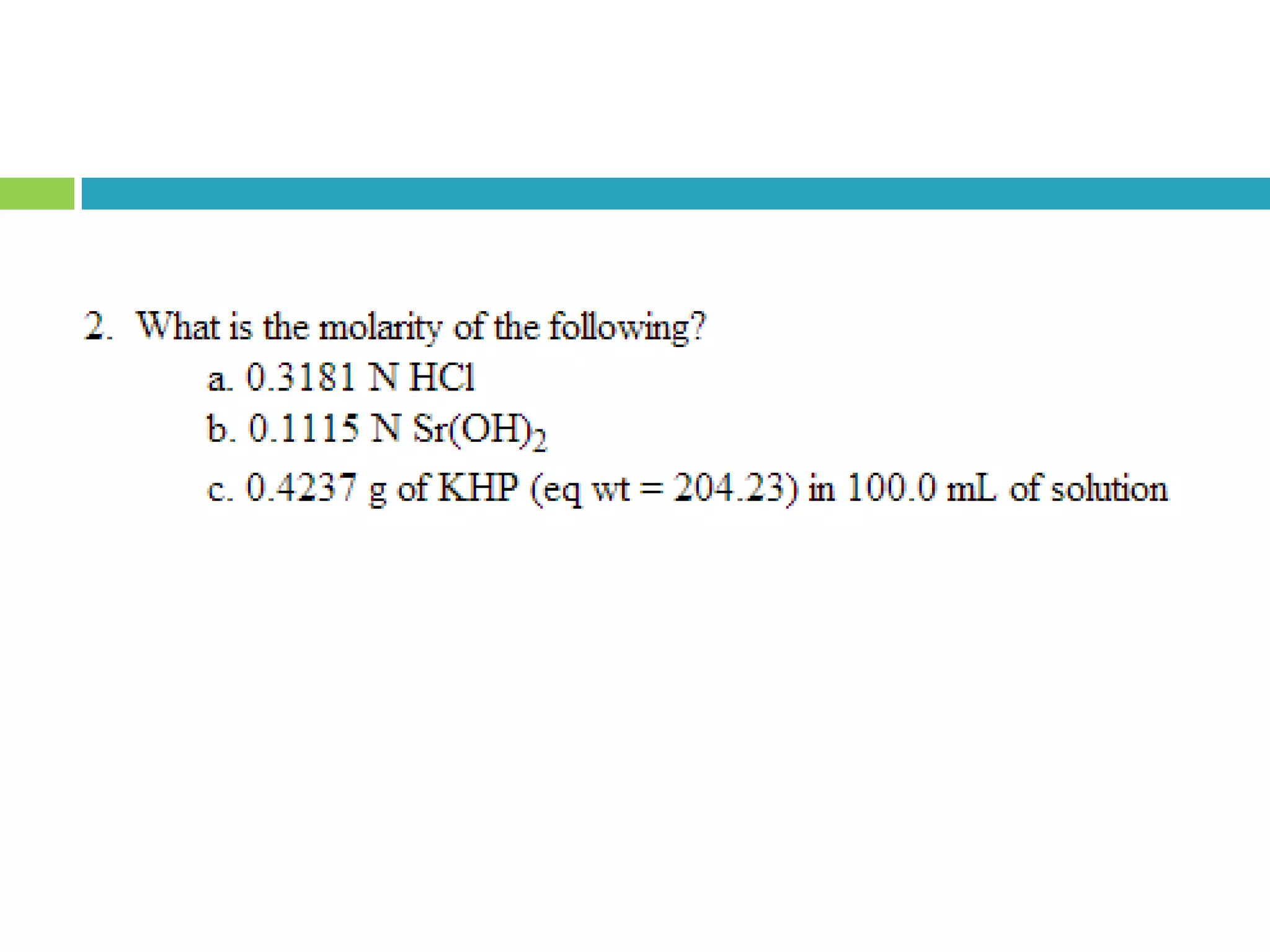
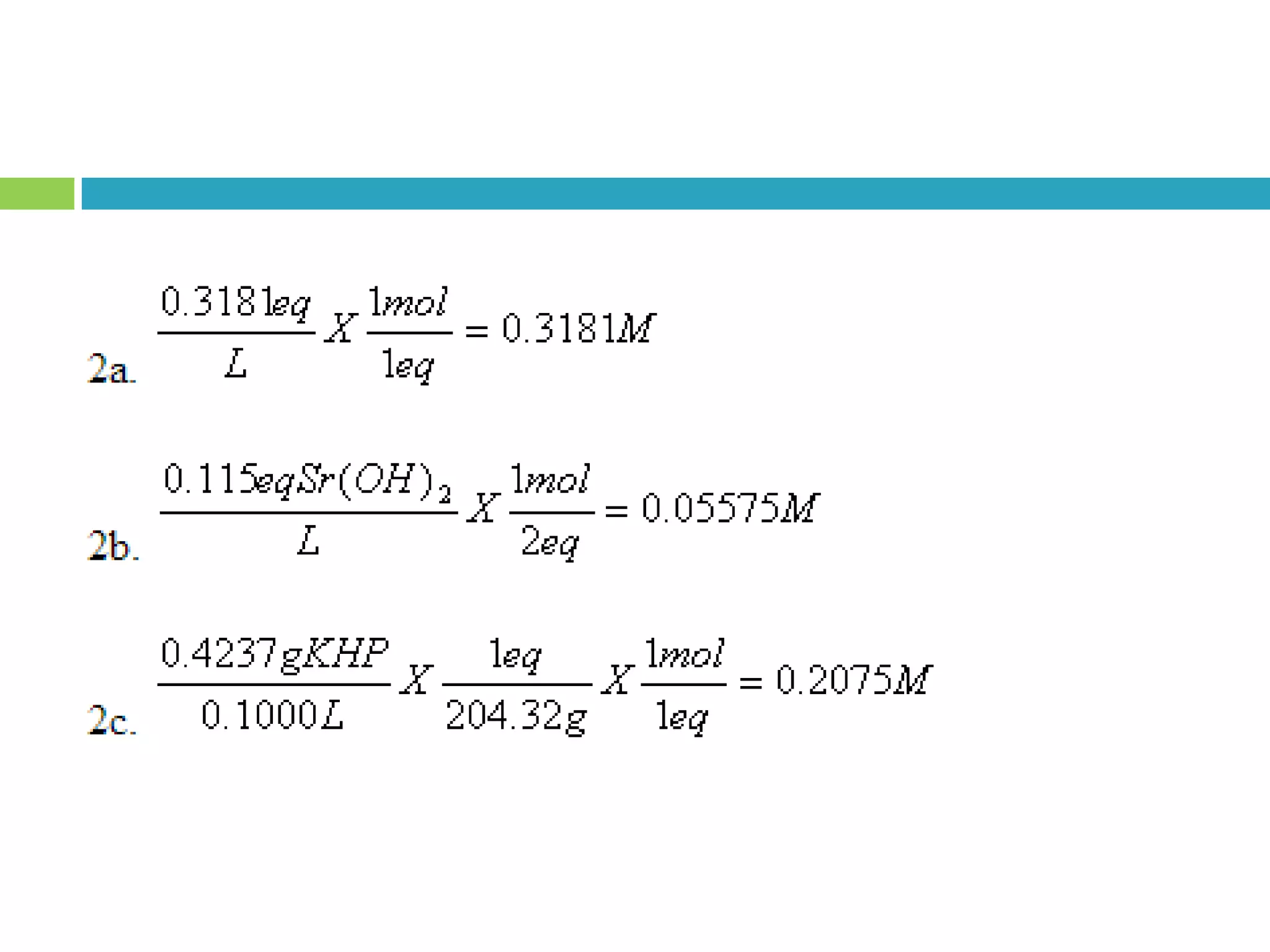
Relationship between Molarity and Normality:
Normality = Molarity x valence
Molarity = Normality
valence
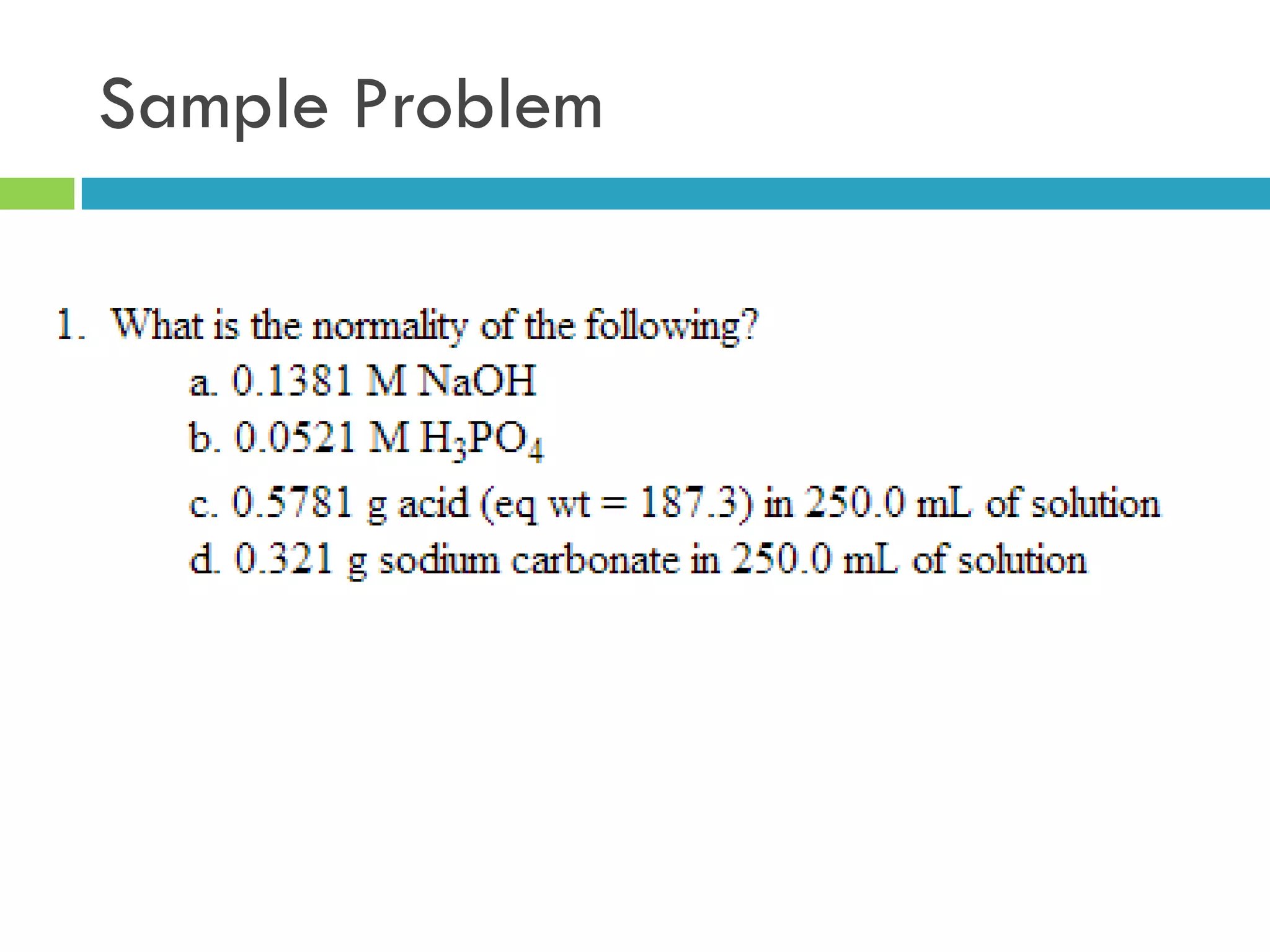
Sample Problem
Solution
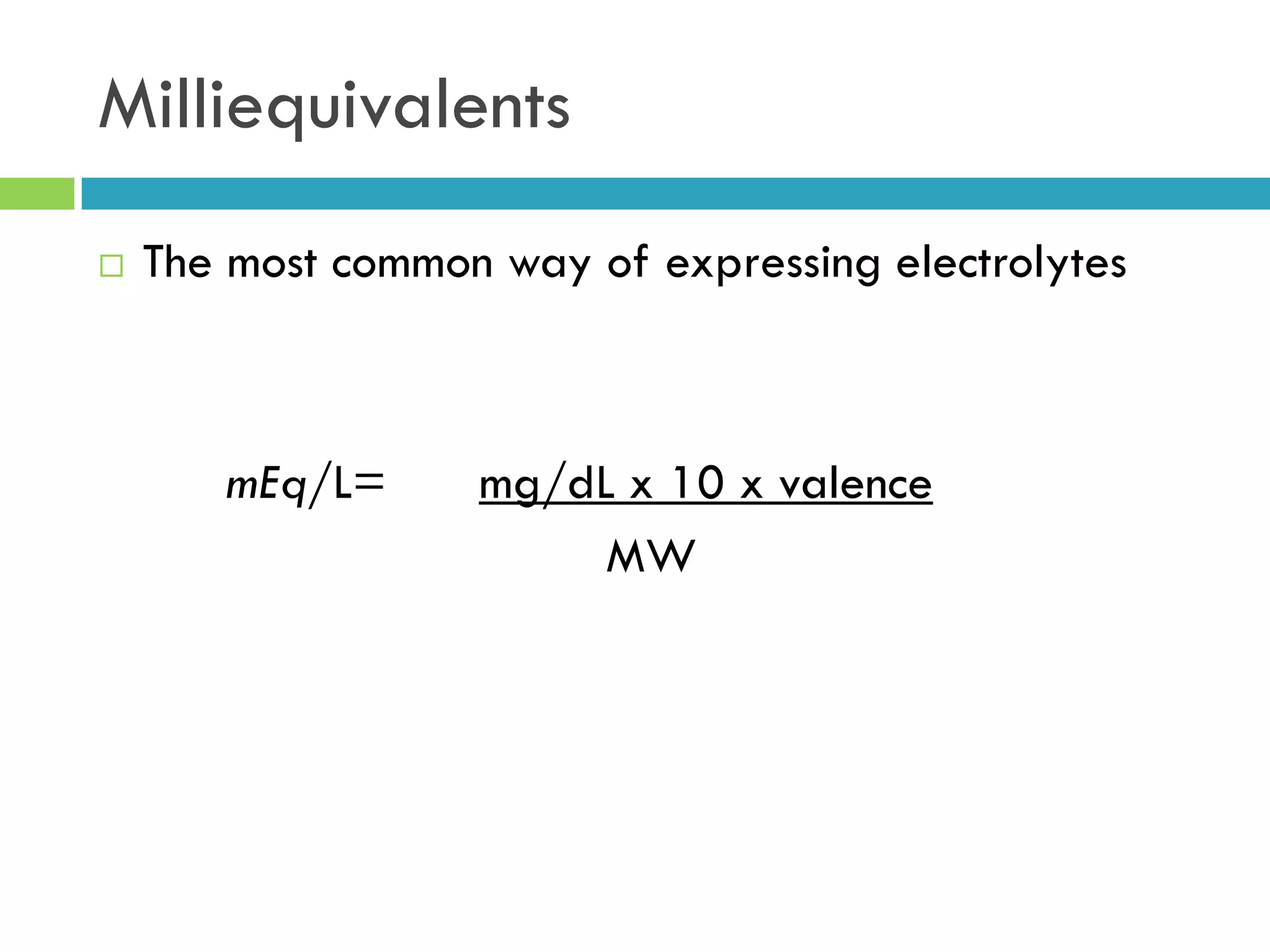
Milliequivalents
 The most common way of expressing electrolytes
mEq/L= mg/dL x 10 x valence
MW
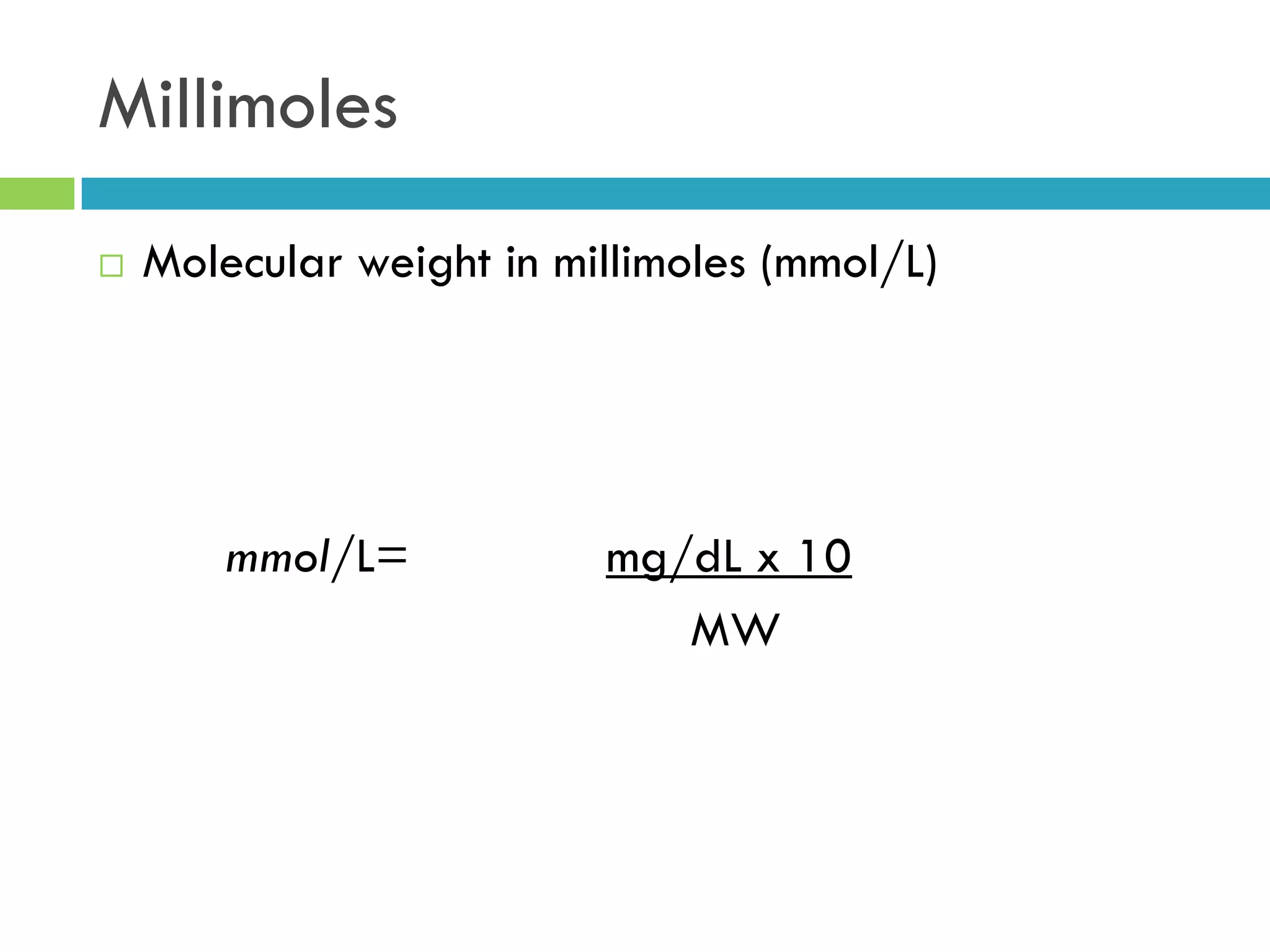
Millimoles
 Molecular weight in millimoles (mmol/L)
mmol/L= mg/dL x 10
MW
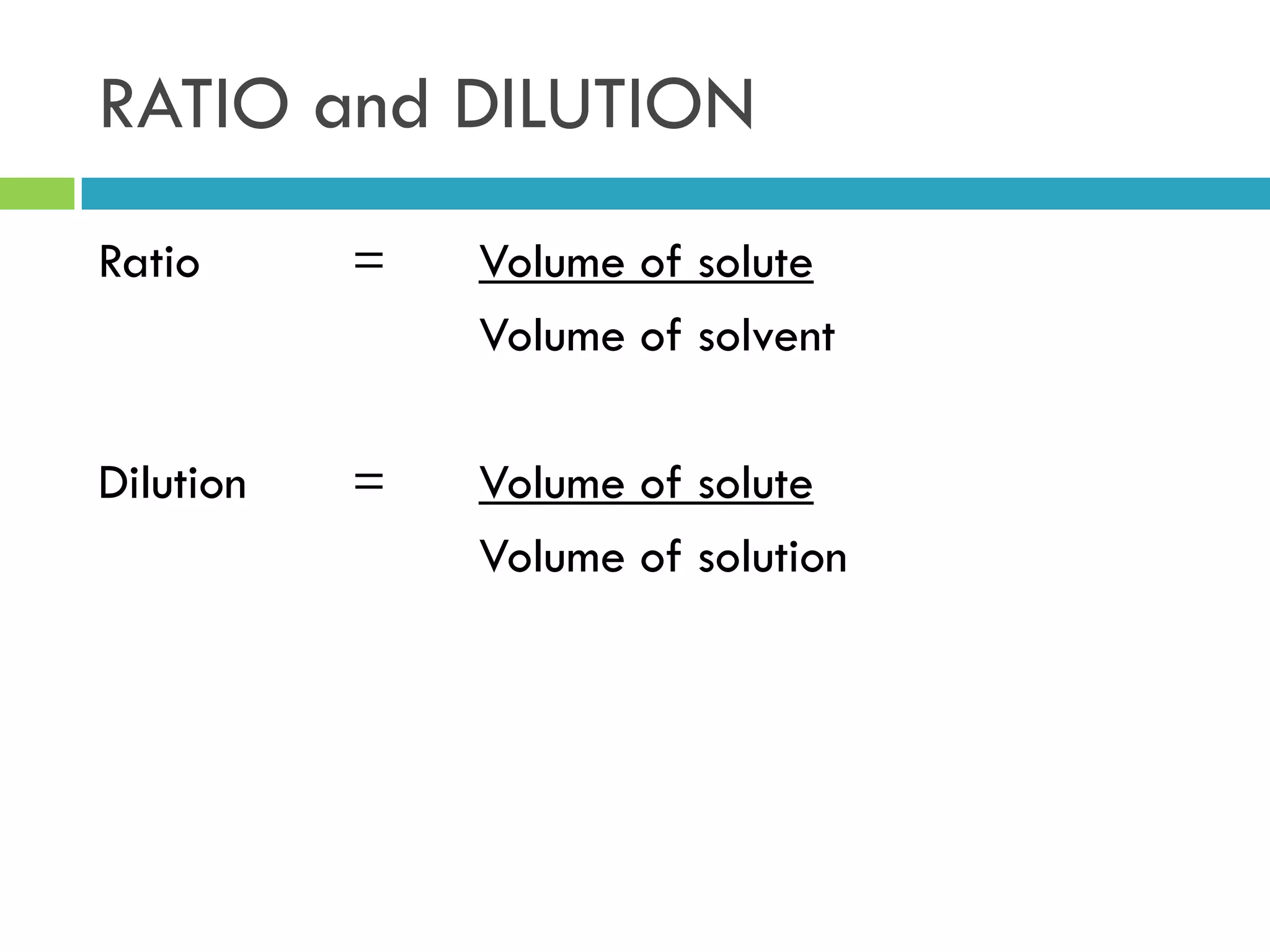
RATIO and DILUTION
Ratio = Volume of solute
Volume of solvent
Dilution = Volume of solute
Volume of solution
Represents the ratio of concentrated or stock
material to the total/ final volume of a solution
DILUTIONS
(volume increases, concentration decreases,
amount of solute remains the same)
DILUTIONS
3 Reasons for Doing Dilution
1. The concentration of material is HIGH to be
accurately measured.
2. Removal of undesirable substances like in PFF
(Protein-free filtrate) preparation
3. Preparation of working standard from stock
solution
Dilution factor
 The ration of a concentrated solution to the total
solution volume equals the dilution factor.
 Is made by adding the concentrated stock to a
diluent
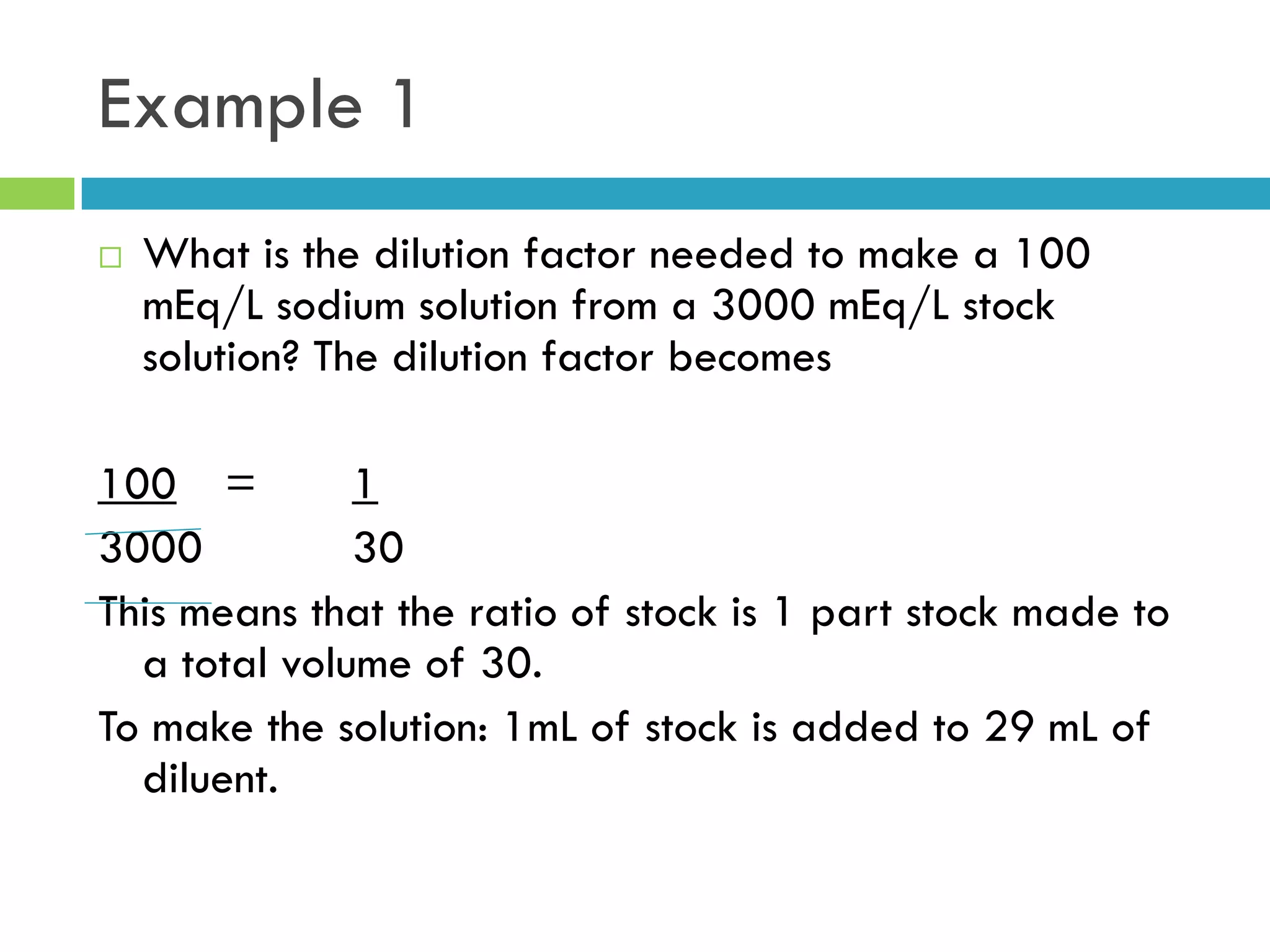
Example 1
 What is the dilution factor needed to make a 100
mEq/L sodium solution from a 3000 mEq/L stock
solution? The dilution factor becomes
100 = 1
3000 30
This means that the ratio of stock is 1 part stock made to
a total volume of 30.
To make the solution: 1mL of stock is added to 29 mL of
diluent.
 The sum of the amount of the stock material plus the
amount of diluent must equal the total volume or
dilution fraction denaminator.
 The dilution factor may be written as a fraction or
can be expressed as 1:30
 1/30 or 1:30 either may be used
Example 2
 If in the preceding example, 150 mL of the 100
mEq/L sodium solution was required,
 The dilution ratio stock to total volume must be
maintained.
 Set up a ratio between the desired total volume
and the dilution factor to determine the amount of
stock needed.
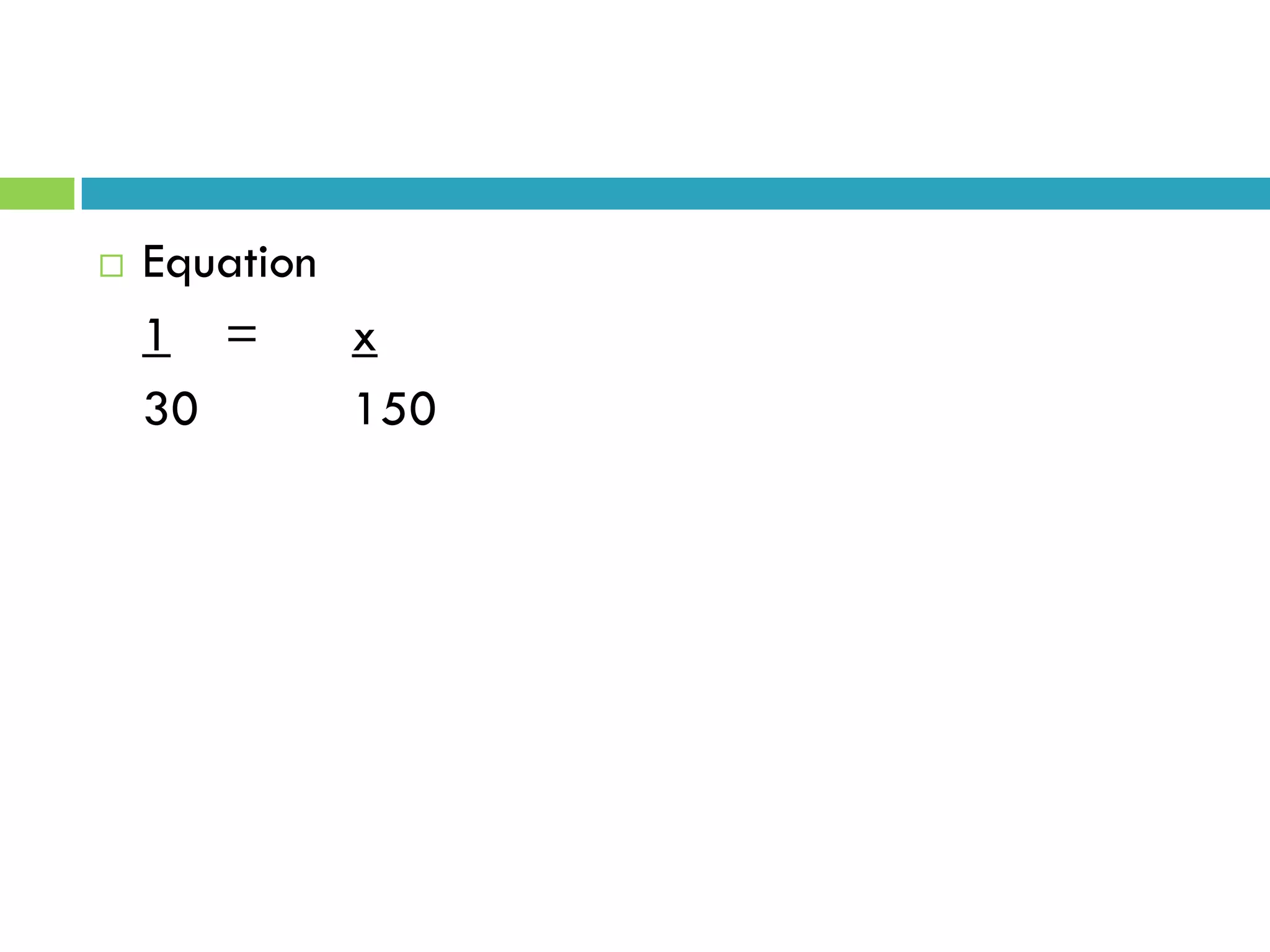
 Equation
1 = x
30 150
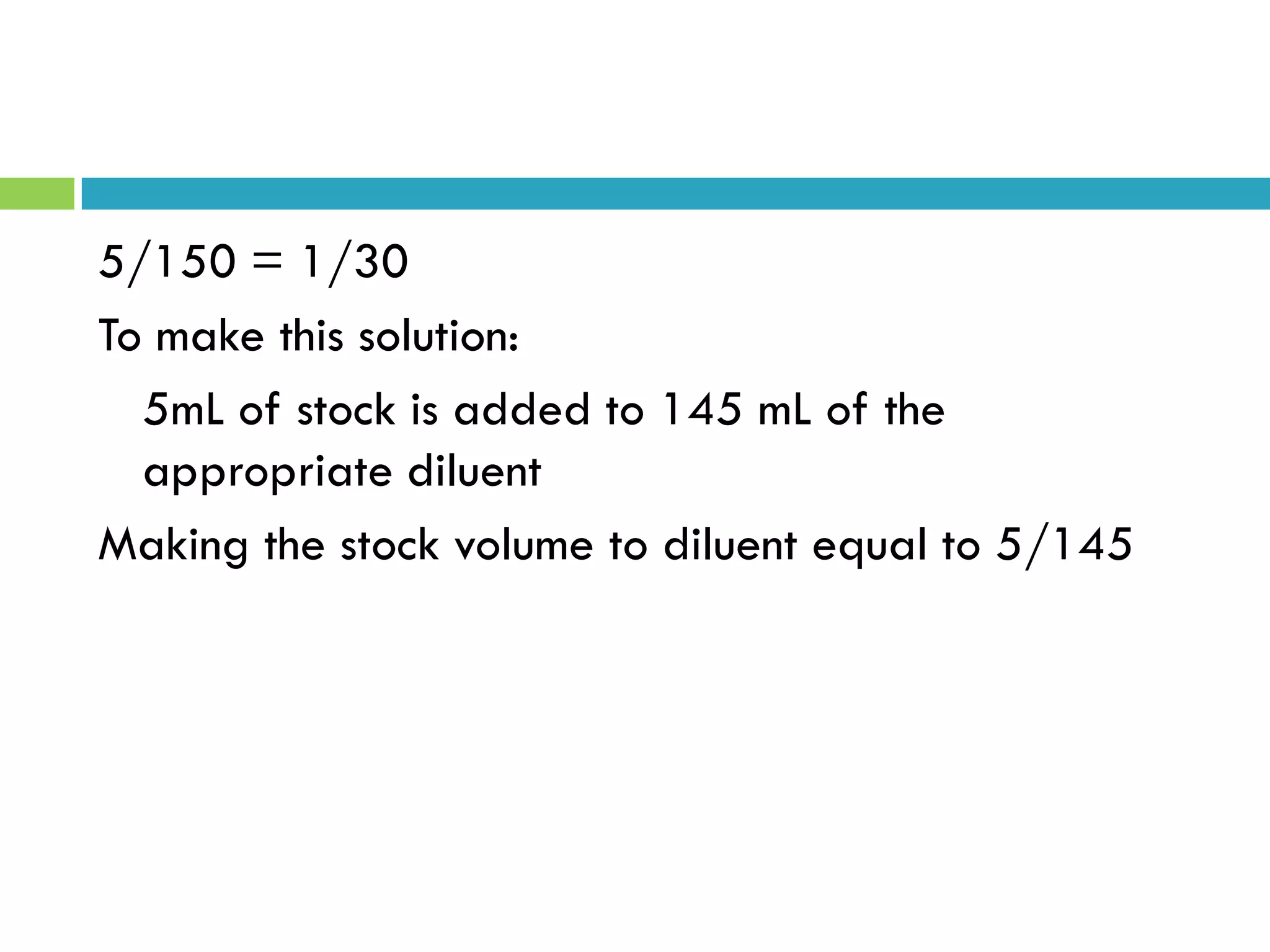
5/150 = 1/30
To make this solution:
5mL of stock is added to 145 mL of the
appropriate diluent
Making the stock volume to diluent equal to 5/145
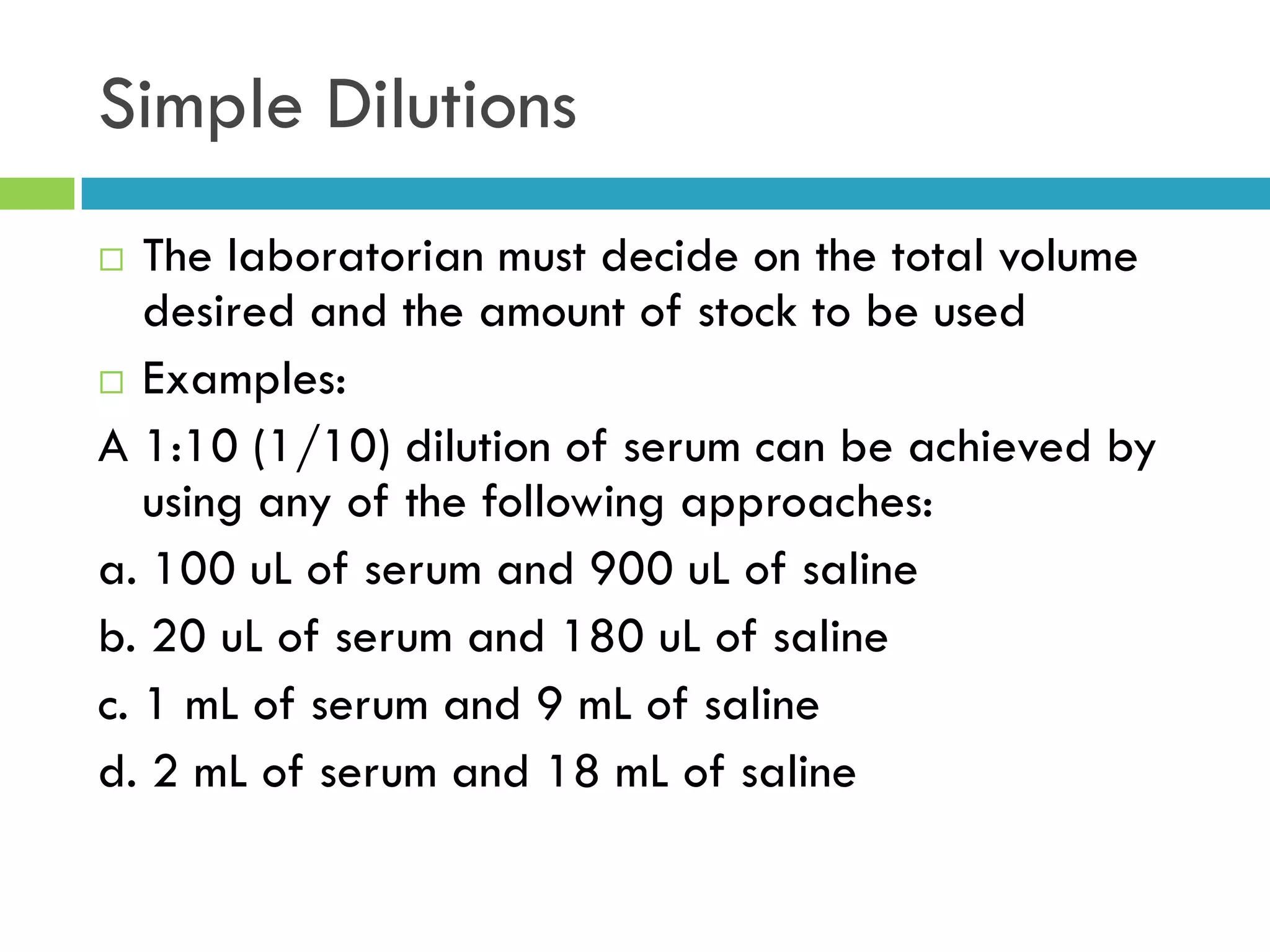
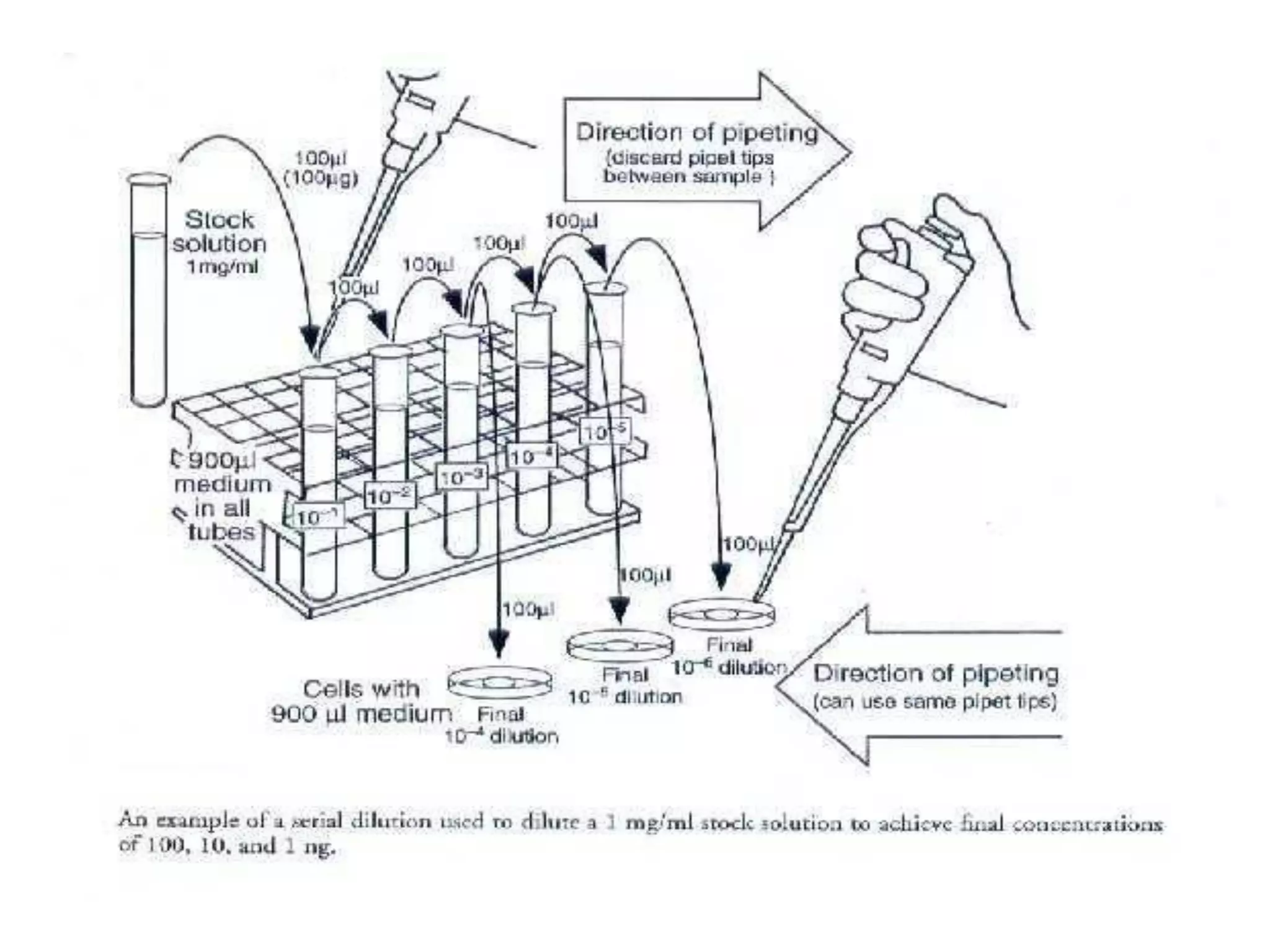
Simple Dilutions
 The laboratorian must decide on the total volume
desired and the amount of stock to be used
 Examples:
A 1:10 (1/10) dilution of serum can be achieved by
using any of the following approaches:
a. 100 uL of serum and 900 uL of saline
b. 20 uL of serum and 180 uL of saline
c. 1 mL of serum and 9 mL of saline
d. 2 mL of serum and 18 mL of saline
Dilution factor
 Is used to determine the concentration of a dilution
or stock material by multiplying the original
concentration by the dilution factor.
 When determining the original stock or undiluted
concentration, multiply the concentration of the
dilution by the dilution factor denominator.
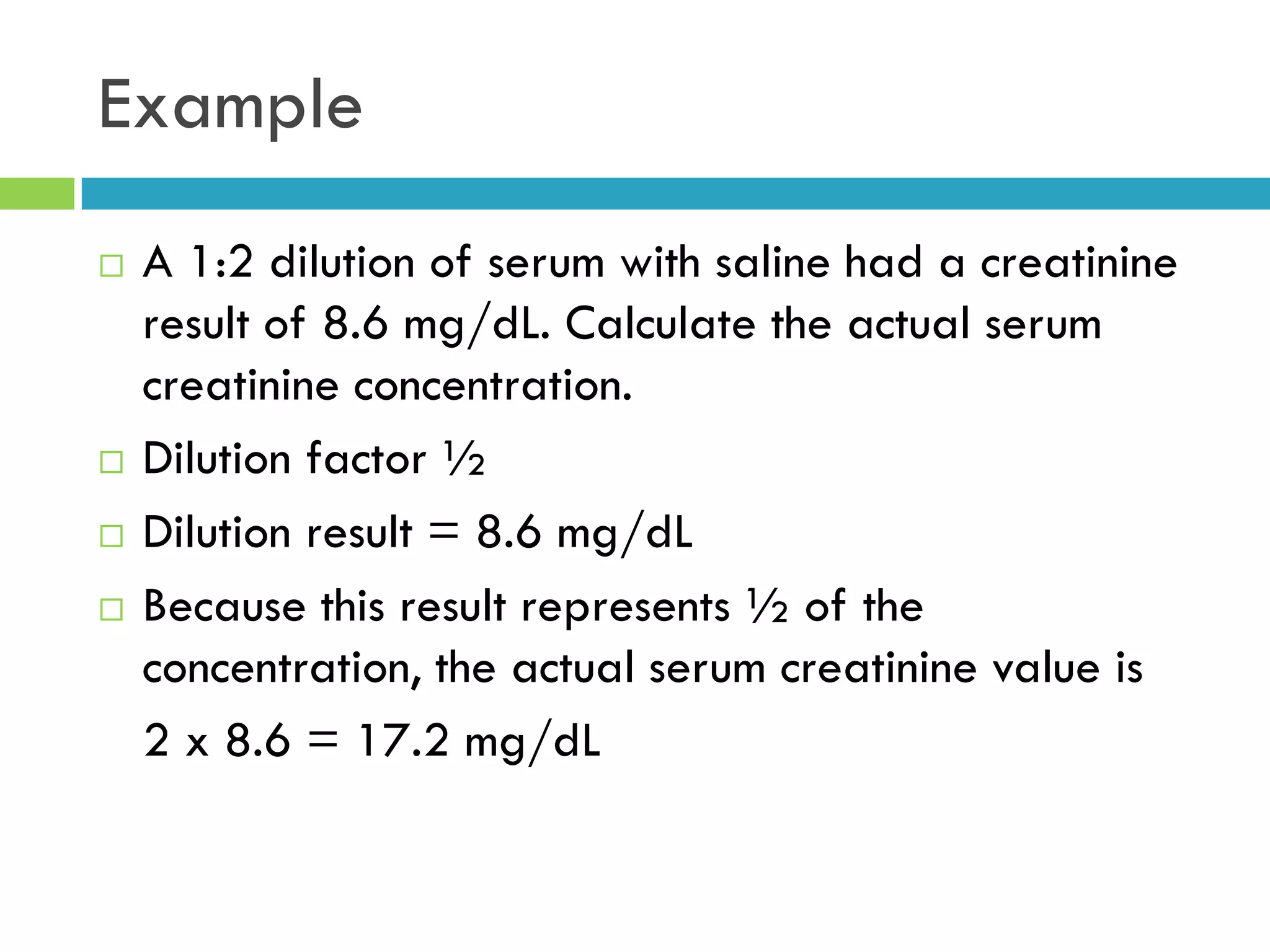
Example
 A 1:2 dilution of serum with saline had a creatinine
result of 8.6 mg/dL. Calculate the actual serum
creatinine concentration.
 Dilution factor ½
 Dilution result = 8.6 mg/dL
 Because this result represents ½ of the
concentration, the actual serum creatinine value is
2 x 8.6 = 17.2 mg/dL
IQC Lesson 5-2

IQC Lesson 5-2

  • 1.
    PIPETTING AND LABORATORY MATHEMATICS ANTONIOF. LAUDE JR, RMT MPH SCHOOL OF MEDICAL TECHNOLOGY
  • 2.
    Pipetting Technique usingManual Pipettes  Develop good technique  Through practice  Improper pipetting – laboratory accidents  Mouth pipetting – potential hazard  Never acceptable  Caustic reagents  Contaminated specimens  Poisonous solutions
  • 3.
    Pipetting with ManualPipettes 1. Check the pipette to ascertain its correct size. 2. Wearing protective gloves. 3. Place the tip of the pipette well below the surface of the liquid to be pipetted. 4. Use aspirator bulb – pipette until the level of liquid is well above the calibration mark 5. Quickly cover the suction opening at the top of the pipette with the index finger
  • 4.
    Pipetting with ManualPipettes 6. Wipe the outside of the pipette dry with a piece of gauze or tissue to remove excess fluid. 7. Hold the pipette in a vertical position with the delivery tip against the inside of the original vessel. Carefully allow the liquid in the pipette to drain by gravity. Miniscus it the concave or convex surface of a column of liquid as seen in a laboratory pipette, buret, or other measuring device.
  • 5.
    Pipetting with ManualPipettes 8. While still holding the pipette in a vertical position, touch the tip of the pipette to the inside wall of the receiving vessel. Remove index finger, permit free drainage. TD pipettes – small amount will remain in the delivery tip.
  • 6.
    Pipetting with ManualPipettes 9. To be certain that the drainage is as complete as possible, touch the delivery tip of the tip to another area on the inside wall of the receiving vessel. 10. Remove the pipette from the receiving vessel, and place it in appropriate place for washing.
  • 7.
    Automatic Micropipettors  Micropipettor– most common type of micropipette used in many laboratories  Allow repeated, accurate, reproducible delivery of specimens, reagents, and other liquids requiring measurement in small amounts.  Delivery volume is selected by adjusting the settings on the device.  0.5 to 500 L – allow volume
  • 8.
    Automatic Micropipettors  Containor deliver from 1 to 500 L  Follow manufacturers instructions
  • 9.
    Steps apply foruse of a micropipettor 1. Attach the proper tip to the pipettor, and set the delivery volume. 2. Depress the piston to a stop position on the pipettor. 3. Place the tip into the solution, and allow the piston to rise slowly back to its original position. 4. Some tips are wiped with a dry gauze at this step, and some are not wiped. Follow the manufacturer’s direction.
  • 10.
    Steps apply foruse of a micropipettor 5. Place the tip on the wall of the receiving vessel, and depress the piston, first to stop position where the liquid is allowed to drain, then to a second stop position where the full dispensing of the liquid takes place. 6. Dispose of the tip in the waste disposal receptacle. Some pipettors automatically eject the used tips, thus minimizing biohazard exposure.
  • 11.
    Reading Meniscus 1. Witha clear colorless solution, read the bottom of the meniscus 2. With colored solutions, read the top fluid column. 3. Reading must be made with eye level to avoid parallax error.
  • 12.
  • 13.
    Minimum numbers ofdigits needed to express a particular value in scientific notation without loss of accuracy. 728.4 contains how many significant figures? 7.284 x 10² 0.000532 contains how many significant figures? 5.32 x 10⁻⁴ Significant Figures
  • 14.
    Is equal toparts per 100 or the amount of solute per 100 total units of solution It is determined in the same manner regardless of whether it is w/w, v/v or w/v units are used Percent solution
  • 15.
    1. Weight/Volume (w/v)% solutions  The most common type of solution prepared in clinical laboratory  Refers to the number of grams of solute per 100 mL of solution Grams of solute = % solution desired x total volume desired 100
  • 16.
    2. Volume/Volume (v/v)%solutions  Used when both solute and solvent are liquid  It refers to the amount of solute in mL in 100mL of solvent mL of solute = % solution desired x total volume desired 100
  • 17.
    3. Weight/Weight (w/w)% solutions  Refers to the number of grams of solute per 100 gms of solution Grams of solute = % solution desired x grams of the total solution 100
  • 18.
     When preparingconcentrated acid solutions, always add acid to water.
  • 19.
    MOLARITY  The numberof moles of solute per liter of solution.  1 mole of substance equals its gram molecular weight (gmw)  Gram Molecular Weight (GMW) – is obtained by adding the atomic weights of the component elements. Molarity of solution (M) = Grams of solute . GMW x volume of solution (L)
  • 20.
  • 24.
  • 25.
  • 26.
    MOLARITY To prepare amolar solution: Grams of solute = Molarity x GMW of the solute x Volume (liter) desired To convert % w/v to Molarity (M): M = %w/v x 10 GMW
  • 27.
    MOLARITY  The amountof solute per 1 kilogram of solvent  Expressed in terms of weight/weight or moles per kilogram (mol/kg)  Molecular Weight (MW) is obtained by adding the atomic weights of the given compound. Molality (m) = Grams of solute MW x kg of solvent
  • 28.
    NORMALITY  Is thenumber of equivalent weight of solute per liter of solution  It has been used in acid-base calculations Normality (N) = Grams of solute EW x volume (L) Equivalent weight (EW) = MW valence
  • 29.
    NORMALITY  To preparea Normal solution of Solids:  Grams of solute = EW x Normality x Volume (L)  To convert % w/v to Normality (N):  N = % w/v x 10 EW Relationship between Molarity and Normality: Normality = Molarity x valence Molarity = Normality valence
  • 30.
  • 31.
  • 34.
    Milliequivalents  The mostcommon way of expressing electrolytes mEq/L= mg/dL x 10 x valence MW
  • 35.
    Millimoles  Molecular weightin millimoles (mmol/L) mmol/L= mg/dL x 10 MW
  • 36.
    RATIO and DILUTION Ratio= Volume of solute Volume of solvent Dilution = Volume of solute Volume of solution
  • 37.
    Represents the ratioof concentrated or stock material to the total/ final volume of a solution DILUTIONS
  • 38.
    (volume increases, concentrationdecreases, amount of solute remains the same) DILUTIONS
  • 39.
    3 Reasons forDoing Dilution 1. The concentration of material is HIGH to be accurately measured. 2. Removal of undesirable substances like in PFF (Protein-free filtrate) preparation 3. Preparation of working standard from stock solution
  • 40.
    Dilution factor  Theration of a concentrated solution to the total solution volume equals the dilution factor.  Is made by adding the concentrated stock to a diluent
  • 41.
    Example 1  Whatis the dilution factor needed to make a 100 mEq/L sodium solution from a 3000 mEq/L stock solution? The dilution factor becomes 100 = 1 3000 30 This means that the ratio of stock is 1 part stock made to a total volume of 30. To make the solution: 1mL of stock is added to 29 mL of diluent.
  • 42.
     The sumof the amount of the stock material plus the amount of diluent must equal the total volume or dilution fraction denaminator.  The dilution factor may be written as a fraction or can be expressed as 1:30  1/30 or 1:30 either may be used
  • 43.
    Example 2  Ifin the preceding example, 150 mL of the 100 mEq/L sodium solution was required,  The dilution ratio stock to total volume must be maintained.  Set up a ratio between the desired total volume and the dilution factor to determine the amount of stock needed.
  • 44.
  • 45.
    5/150 = 1/30 Tomake this solution: 5mL of stock is added to 145 mL of the appropriate diluent Making the stock volume to diluent equal to 5/145
  • 46.
    Simple Dilutions  Thelaboratorian must decide on the total volume desired and the amount of stock to be used  Examples: A 1:10 (1/10) dilution of serum can be achieved by using any of the following approaches: a. 100 uL of serum and 900 uL of saline b. 20 uL of serum and 180 uL of saline c. 1 mL of serum and 9 mL of saline d. 2 mL of serum and 18 mL of saline
  • 47.
    Dilution factor  Isused to determine the concentration of a dilution or stock material by multiplying the original concentration by the dilution factor.  When determining the original stock or undiluted concentration, multiply the concentration of the dilution by the dilution factor denominator.
  • 48.
    Example  A 1:2dilution of serum with saline had a creatinine result of 8.6 mg/dL. Calculate the actual serum creatinine concentration.  Dilution factor ½  Dilution result = 8.6 mg/dL  Because this result represents ½ of the concentration, the actual serum creatinine value is 2 x 8.6 = 17.2 mg/dL