The importance of water
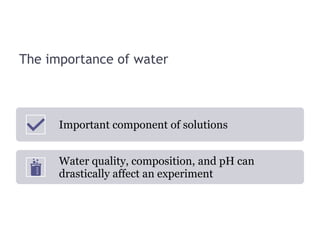
Important component of solutions
Water quality, composition, and pH can
drastically affect an experiment
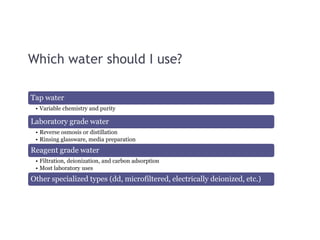
Which water should I use?
Tap water
• Variable chemistry and purity
Laboratory grade water
• Reverse osmosis or distillation
• Rinsing glassware, media preparation
Reagent grade water
• Filtration, deionization, and carbon adsorption
• Most laboratory uses
Other specialized types (dd, microfiltered, electrically deionized, etc.)
Solution terminology
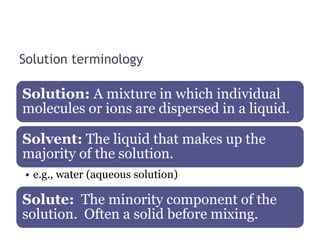
Solution: A mixture in which individual
molecules or ions are dispersed in a liquid.
Solvent: The liquid that makes up the
majority of the solution.
• e.g., water (aqueous solution)
Solute: The minority component of the
solution. Often a solid before mixing.
Measurements of concentration
In almost all cases, these are amount of solute per volume of SOLUTION.*
Weight-per-volume (e.g., mg/L)
Percent (parts per hundred)
PPT, PPM, PPB
Molar solutions
* [The exception is molal solutions (moles of solute per liter of solvent) but
we will not discuss them further in this class.]
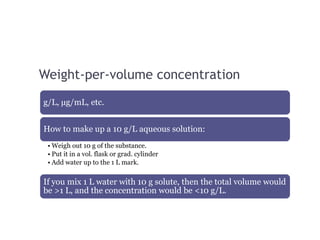
Weight-per-volume concentration
g/L, µg/mL, etc.
How to make up a 10 g/L aqueous solution:
• Weigh out 10 g of the substance.
• Put it in a vol. flask or grad. cylinder
• Add water up to the 1 L mark.
If you mix 1 L water with 10 g solute, then the total volume would
be >1 L, and the concentration would be <10 g/L.
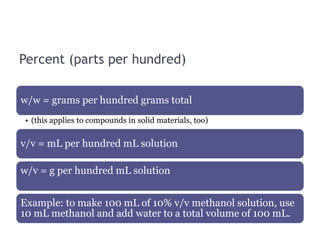
Percent (parts per hundred)
w/w = grams per hundred grams total
• (this applies to compounds in solid materials, too)
v/v = mL per hundred mL solution
w/v = g per hundred mL solution
Example: to make 100 mL of 10% v/v methanol solution, use
10 mL methanol and add water to a total volume of 100 mL.
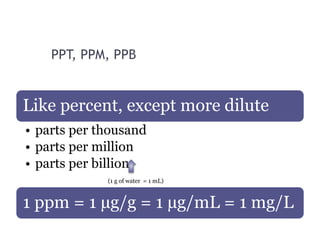
PPT, PPM, PPB
Like percent, except more dilute
• parts per thousand
• parts per million
• parts per billion
1 ppm = 1 µg/g = 1 µg/mL = 1 mg/L
(1 g of water = 1 mL)
Molar (M) Solutions
• 1 mole is 6x10²³ molecules.
• The mass of 1 mole of a compound is the
molecular weight (MW) of that compound
Definition: moles
of solute per liter
of solution
• Volume desired
• Concentration desired
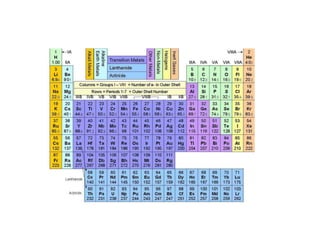
• Formula weight (FW)
(FW = MW + water of hydration, if any)
What you need
to know:
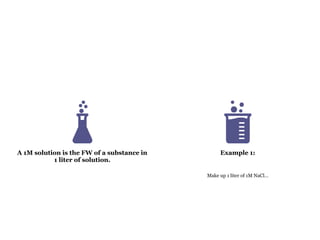
A 1M solution is the FW of a substance in
1 liter of solution.
Example 1:
Make up 1 liter of 1M NaCl…
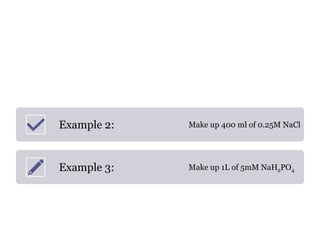
Example 2: Make up 400 ml of 0.25M NaCl
Example 3: Make up 1L of 5mM NaH2PO4
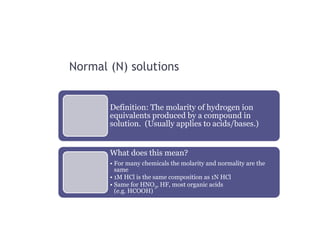
Normal (N) solutions
Definition: The molarity of hydrogen ion
equivalents produced by a compound in
solution. (Usually applies to acids/bases.)
What does this mean?
• For many chemicals the molarity and normality are the
same
• 1M HCl is the same composition as 1N HCl
• Same for HNO3, HF, most organic acids
(e.g. HCOOH)
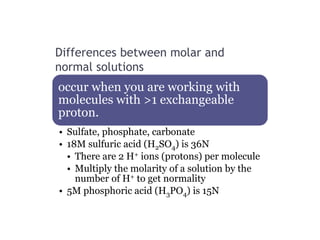
Differences between molar and
normal solutions
occur when you are working with
molecules with >1 exchangeable
proton.
• Sulfate, phosphate, carbonate
• 18M sulfuric acid (H2SO4) is 36N
• There are 2 H+ ions (protons) per molecule
• Multiply the molarity of a solution by the
number of H+ to get normality
• 5M phosphoric acid (H3PO4) is 15N
Dilution from one concentration to
another
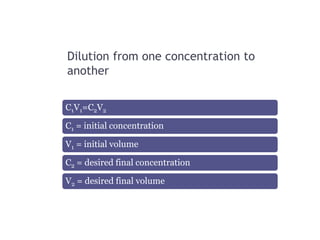
C1V1=C2V2
C1 = initial concentration
V1 = initial volume
C2 = desired final concentration
V2 = desired final volume
Examples
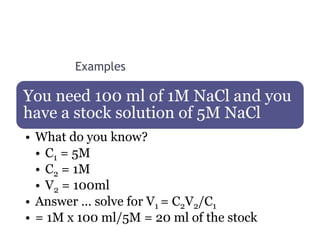
You need 100 ml of 1M NaCl and you
have a stock solution of 5M NaCl
• What do you know?
• C1 = 5M
• C2 = 1M
• V2 = 100ml
• Answer … solve for V1 = C2V2/C1
• = 1M x 100 ml/5M = 20 ml of the stock
Making very dilute solutions
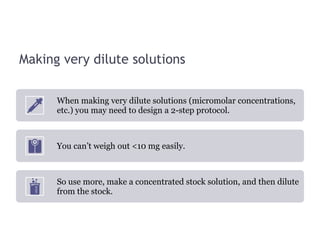
When making very dilute solutions (micromolar concentrations,
etc.) you may need to design a 2-step protocol.
You can’t weigh out <10 mg easily.
So use more, make a concentrated stock solution, and then dilute
from the stock.
One other complication
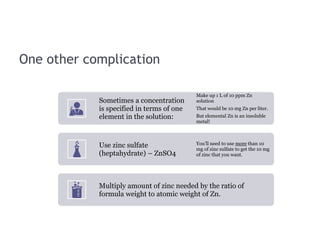
Sometimes a concentration
is specified in terms of one
element in the solution:
Make up 1 L of 10 ppm Zn
solution
That would be 10 mg Zn per liter.
But elemental Zn is an insoluble
metal!
Use zinc sulfate
(heptahydrate) – ZnSO4
You’ll need to use more than 10
mg of zinc sulfate to get the 10 mg
of zinc that you want.
Multiply amount of zinc needed by the ratio of
formula weight to atomic weight of Zn.
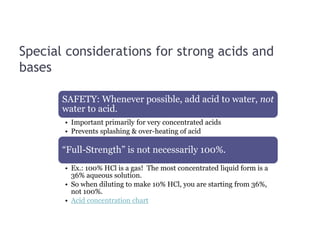
Special considerations for strong acids and
bases
SAFETY: Whenever possible, add acid to water, not
water to acid.
• Important primarily for very concentrated acids
• Prevents splashing & over-heating of acid
“Full-Strength” is not necessarily 100%.
• Ex.: 100% HCl is a gas! The most concentrated liquid form is a
36% aqueous solution.
• So when diluting to make 10% HCl, you are starting from 36%,
not 100%.
• Acid concentration chart
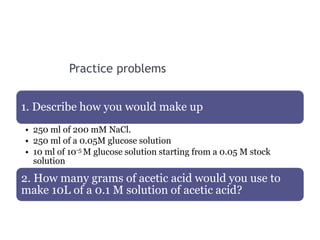
Practice problems
1. Describe how you would make up
• 250 ml of 200 mM NaCl.
• 250 ml of a 0.05M glucose solution
• 10 ml of 10-5 M glucose solution starting from a 0.05 M stock
solution
2. How many grams of acetic acid would you use to
make 10L of a 0.1 M solution of acetic acid?
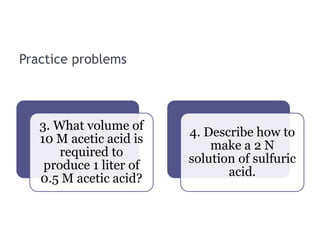
Practice problems
3. What volume of
10 M acetic acid is
required to
produce 1 liter of
0.5 M acetic acid?
4. Describe how to
make a 2 N
solution of sulfuric
acid.
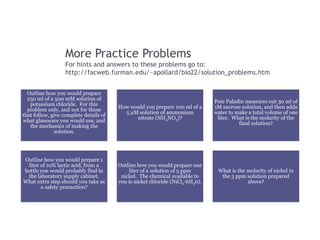
More Practice Problems
For hints and answers to these problems go to:
http://facweb.furman.edu/~apollard/bio22/solution_problems.htm
Outline how you would prepare
250 ml of a 500 mM solution of
potassium chloride. For this
problem only, and not for those
that follow, give complete details of
what glassware you would use, and
the mechanics of making the
solution.
How would you prepare 100 ml of a
5 µM solution of ammonium
nitrate (NH4NO3)?
Pete Paladin measures out 30 ml of
1M sucrose solution, and then adds
water to make a total volume of one
liter. What is the molarity of the
final solution?
Outline how you would prepare 1
liter of 10% lactic acid, from a
bottle you would probably find in
the laboratory supply cabinet.
What extra step should you take as
a safety precaution?
Outline how you would prepare one
liter of a solution of 5 ppm
nickel. The chemical available to
you is nickel chloride (NiCl2·6H20).
What is the molarity of nickel in
the 5 ppm solution prepared
above?

Solution chemistry, Molar and Normal solutions

  • 2.
    The importance ofwater Important component of solutions Water quality, composition, and pH can drastically affect an experiment
  • 3.
    Which water shouldI use? Tap water • Variable chemistry and purity Laboratory grade water • Reverse osmosis or distillation • Rinsing glassware, media preparation Reagent grade water • Filtration, deionization, and carbon adsorption • Most laboratory uses Other specialized types (dd, microfiltered, electrically deionized, etc.)
  • 4.
    Solution terminology Solution: Amixture in which individual molecules or ions are dispersed in a liquid. Solvent: The liquid that makes up the majority of the solution. • e.g., water (aqueous solution) Solute: The minority component of the solution. Often a solid before mixing.
  • 5.
    Measurements of concentration Inalmost all cases, these are amount of solute per volume of SOLUTION.* Weight-per-volume (e.g., mg/L) Percent (parts per hundred) PPT, PPM, PPB Molar solutions * [The exception is molal solutions (moles of solute per liter of solvent) but we will not discuss them further in this class.]
  • 6.
    Weight-per-volume concentration g/L, µg/mL,etc. How to make up a 10 g/L aqueous solution: • Weigh out 10 g of the substance. • Put it in a vol. flask or grad. cylinder • Add water up to the 1 L mark. If you mix 1 L water with 10 g solute, then the total volume would be >1 L, and the concentration would be <10 g/L.
  • 7.
    Percent (parts perhundred) w/w = grams per hundred grams total • (this applies to compounds in solid materials, too) v/v = mL per hundred mL solution w/v = g per hundred mL solution Example: to make 100 mL of 10% v/v methanol solution, use 10 mL methanol and add water to a total volume of 100 mL.
  • 8.
    PPT, PPM, PPB Likepercent, except more dilute • parts per thousand • parts per million • parts per billion 1 ppm = 1 µg/g = 1 µg/mL = 1 mg/L (1 g of water = 1 mL)
  • 9.
    Molar (M) Solutions •1 mole is 6x10²³ molecules. • The mass of 1 mole of a compound is the molecular weight (MW) of that compound Definition: moles of solute per liter of solution • Volume desired • Concentration desired • Formula weight (FW) (FW = MW + water of hydration, if any) What you need to know:
  • 10.
    A 1M solutionis the FW of a substance in 1 liter of solution. Example 1: Make up 1 liter of 1M NaCl…
  • 12.
    Example 2: Makeup 400 ml of 0.25M NaCl Example 3: Make up 1L of 5mM NaH2PO4
  • 13.
    Normal (N) solutions Definition:The molarity of hydrogen ion equivalents produced by a compound in solution. (Usually applies to acids/bases.) What does this mean? • For many chemicals the molarity and normality are the same • 1M HCl is the same composition as 1N HCl • Same for HNO3, HF, most organic acids (e.g. HCOOH)
  • 14.
    Differences between molarand normal solutions occur when you are working with molecules with >1 exchangeable proton. • Sulfate, phosphate, carbonate • 18M sulfuric acid (H2SO4) is 36N • There are 2 H+ ions (protons) per molecule • Multiply the molarity of a solution by the number of H+ to get normality • 5M phosphoric acid (H3PO4) is 15N
  • 15.
    Dilution from oneconcentration to another C1V1=C2V2 C1 = initial concentration V1 = initial volume C2 = desired final concentration V2 = desired final volume
  • 16.
    Examples You need 100ml of 1M NaCl and you have a stock solution of 5M NaCl • What do you know? • C1 = 5M • C2 = 1M • V2 = 100ml • Answer … solve for V1 = C2V2/C1 • = 1M x 100 ml/5M = 20 ml of the stock
  • 17.
    Making very dilutesolutions When making very dilute solutions (micromolar concentrations, etc.) you may need to design a 2-step protocol. You can’t weigh out <10 mg easily. So use more, make a concentrated stock solution, and then dilute from the stock.
  • 18.
    One other complication Sometimesa concentration is specified in terms of one element in the solution: Make up 1 L of 10 ppm Zn solution That would be 10 mg Zn per liter. But elemental Zn is an insoluble metal! Use zinc sulfate (heptahydrate) – ZnSO4 You’ll need to use more than 10 mg of zinc sulfate to get the 10 mg of zinc that you want. Multiply amount of zinc needed by the ratio of formula weight to atomic weight of Zn.
  • 19.
    Special considerations forstrong acids and bases SAFETY: Whenever possible, add acid to water, not water to acid. • Important primarily for very concentrated acids • Prevents splashing & over-heating of acid “Full-Strength” is not necessarily 100%. • Ex.: 100% HCl is a gas! The most concentrated liquid form is a 36% aqueous solution. • So when diluting to make 10% HCl, you are starting from 36%, not 100%. • Acid concentration chart
  • 20.
    Practice problems 1. Describehow you would make up • 250 ml of 200 mM NaCl. • 250 ml of a 0.05M glucose solution • 10 ml of 10-5 M glucose solution starting from a 0.05 M stock solution 2. How many grams of acetic acid would you use to make 10L of a 0.1 M solution of acetic acid?
  • 21.
    Practice problems 3. Whatvolume of 10 M acetic acid is required to produce 1 liter of 0.5 M acetic acid? 4. Describe how to make a 2 N solution of sulfuric acid.
  • 22.
    More Practice Problems Forhints and answers to these problems go to: http://facweb.furman.edu/~apollard/bio22/solution_problems.htm Outline how you would prepare 250 ml of a 500 mM solution of potassium chloride. For this problem only, and not for those that follow, give complete details of what glassware you would use, and the mechanics of making the solution. How would you prepare 100 ml of a 5 µM solution of ammonium nitrate (NH4NO3)? Pete Paladin measures out 30 ml of 1M sucrose solution, and then adds water to make a total volume of one liter. What is the molarity of the final solution? Outline how you would prepare 1 liter of 10% lactic acid, from a bottle you would probably find in the laboratory supply cabinet. What extra step should you take as a safety precaution? Outline how you would prepare one liter of a solution of 5 ppm nickel. The chemical available to you is nickel chloride (NiCl2·6H20). What is the molarity of nickel in the 5 ppm solution prepared above?