

Can Exclusive Politics Produce
Inclusive Development?
Ronald Umali Mendoza, PhD
AIM Policy Center
Mendoza, Beja, Venida and Yap. 2012.
“Inequality in democracy: Insights from an
empirical analysis of political dynasties in the
15th Philippine Congress”. Philippine Political
Science Journal 33(2):132-145.
http://papers.ssrn.com/sol3/papers.cfm?abstract_id=1969605
70% of the 15th Philippine Congress is dynastic; and dynasties
dominate all of the major political parties.
On average, there are more dynasties in regions with higher
poverty and lower human development.
Dynasties tend to be richer (higher SALNs) when one outlier is
removed among present non-dynasties (MP).
80% of the youngest Congressmen (age 26-40) are from dynastic
clans.
Political Dynasties and Poverty/Inequality
Empirical link between political dynasties and poverty/inequality:
•PREDATORY VIEW: Dynasties increase P/I -- If dynasties are associated with rent-seeking
and state capture, corruption and ineffective and poorly designed policies (e.g.
Proud’homme, 1995; Hutchcroft and Rocamora, 2003).
•STATIONARY BANDIT: Dynasties reduce P/I -- If dynasties have longer “runways” for reform
and are more firmly associated with socio-economic outcomes (e.g. Olson, 2003; Solon et
al, 2009; Dal Bo and Rossi, 2009).
•LONG RUNWAY FOR REFORMS: Dynasties are better able to pursue reforms with longer-
term gestation periods for results; policy stability and continuity that investors would prefer
Additional complexity:
•PATRONAGE: High P/I tends to increase dynastic prevalence: the poor vote for dynasties as
long as these are able to directly provide support during elections or in times of income shocks
(e.g. Coronel, 1998; Manacsa and Tan, 2005).
•SELF-PERPETUATION: Politicians are capable of developing dynasties: being in public office
affords politicians the opportunity and means to keep on winning or to increase their heirs’
chances of winning (e.g. Dal Bo et al, 2009; Querrubin 2010).
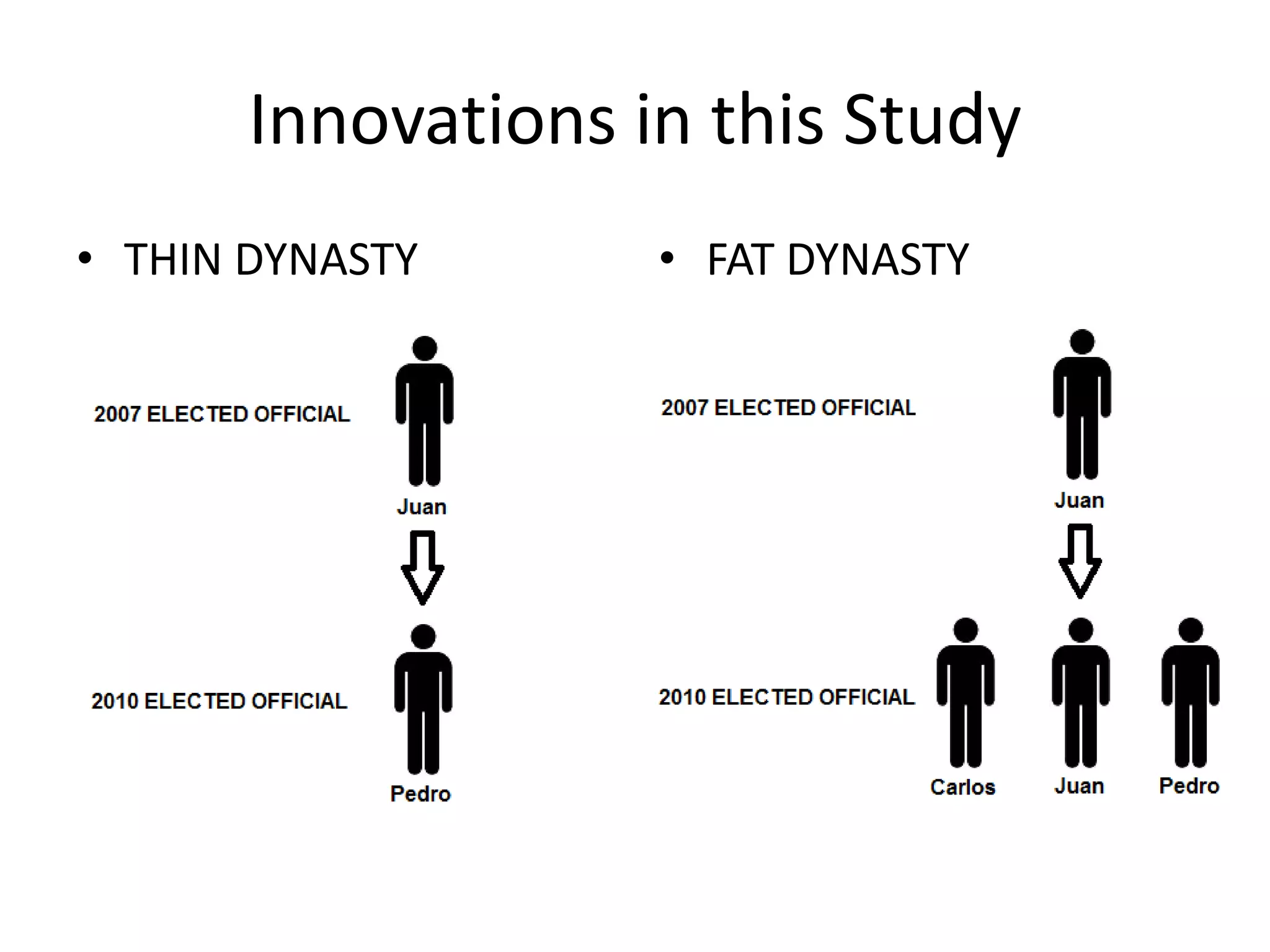
Innovations in this Study
• THIN DYNASTY • FAT DYNASTY
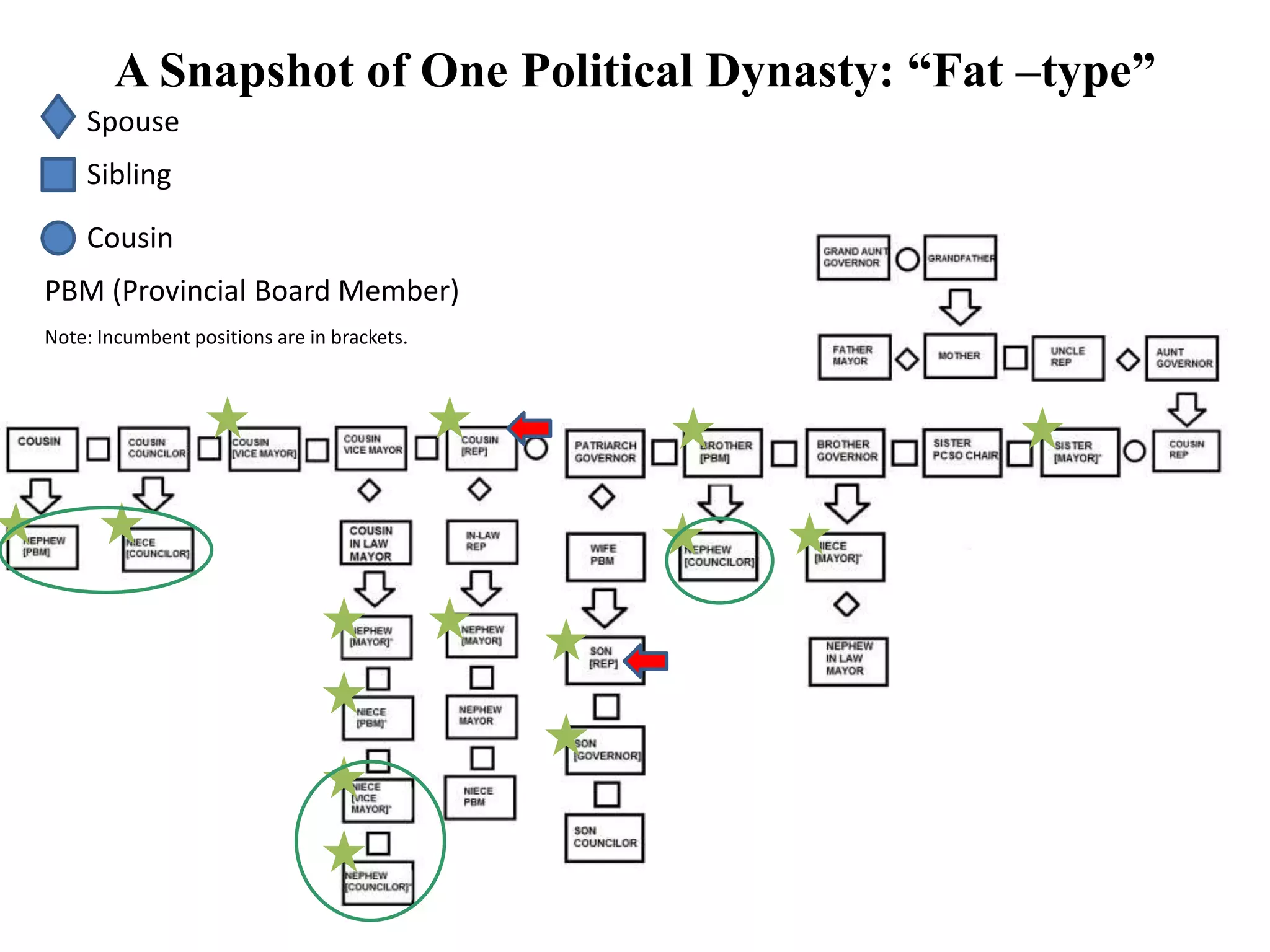
A Snapshot of One Political Dynasty: “Fat –type”
Sibling
Spouse
Cousin
PBM (Provincial Board Member)
Note: Incumbent positions are in brackets.
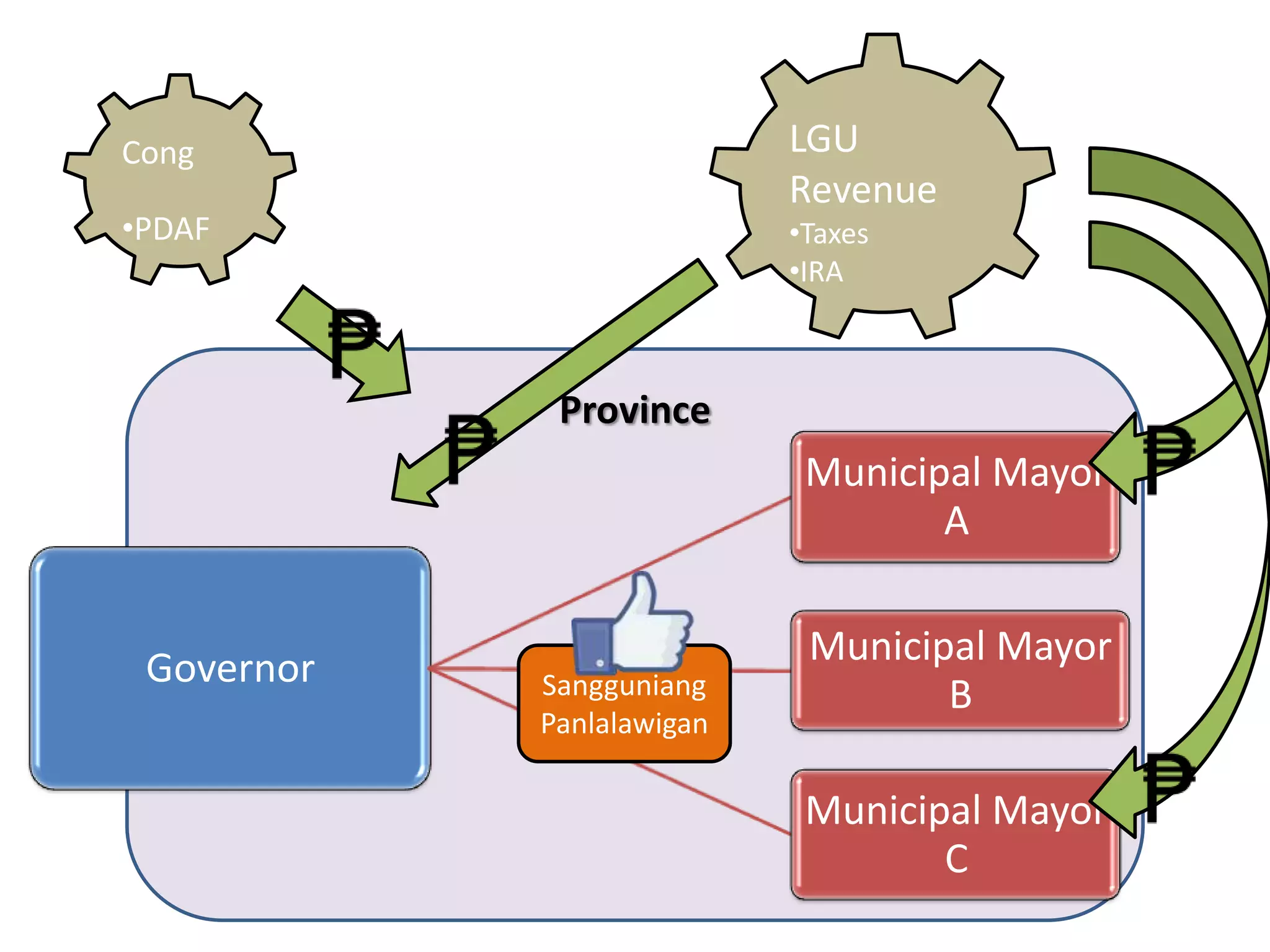
Province
LGU
Revenue
•Taxes
•IRA
Governor
Municipal Mayor
A
Municipal Mayor
B
Municipal Mayor
C
Cong
•PDAF
Sangguniang
Panlalawigan
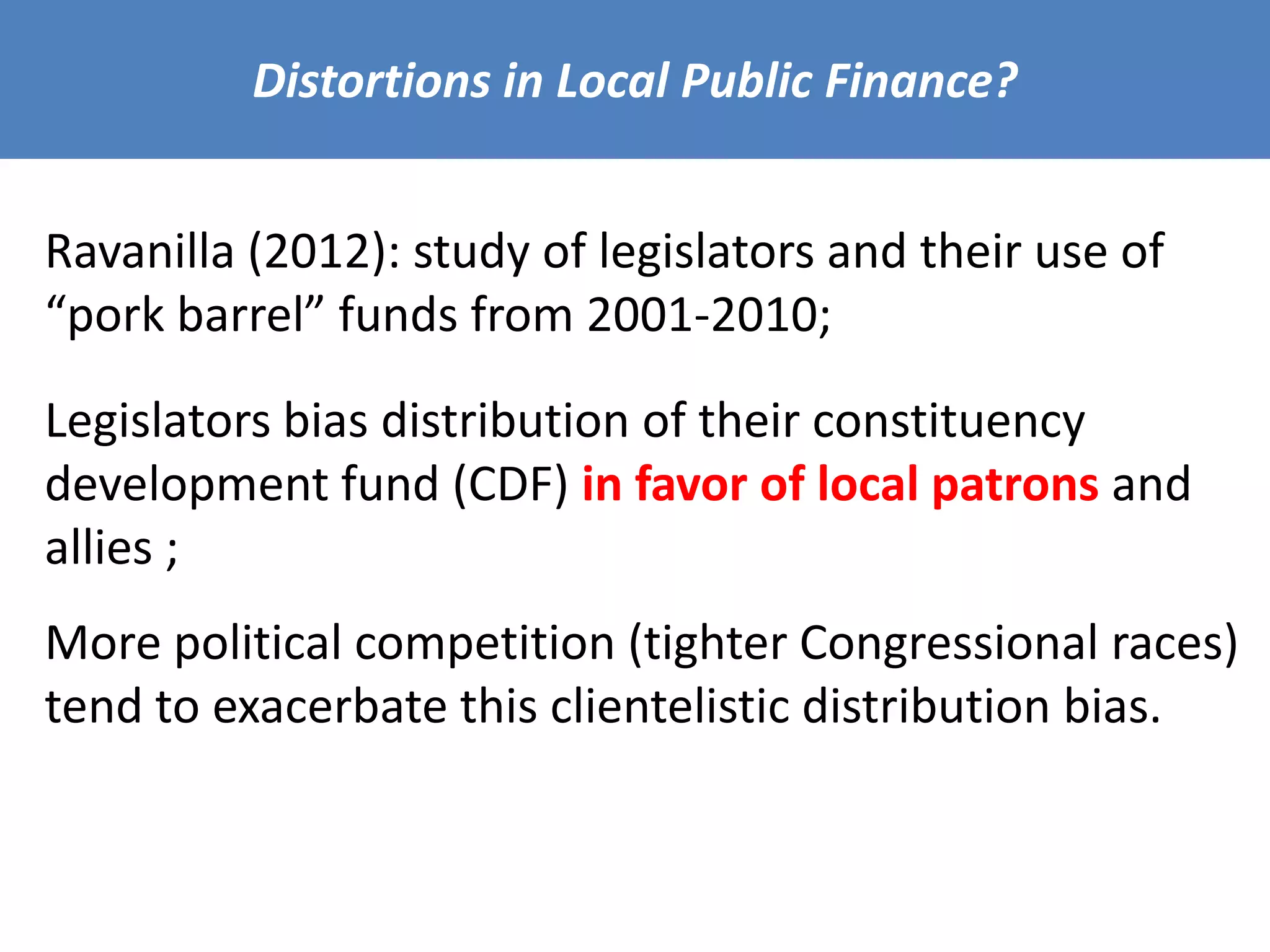
Distortions in Local Public Finance?
Ravanilla (2012): study of legislators and their use of
“pork barrel” funds from 2001-2010;
Legislators bias distribution of their constituency
development fund (CDF) in favor of local patrons and
allies ;
More political competition (tighter Congressional races)
tend to exacerbate this clientelistic distribution bias.
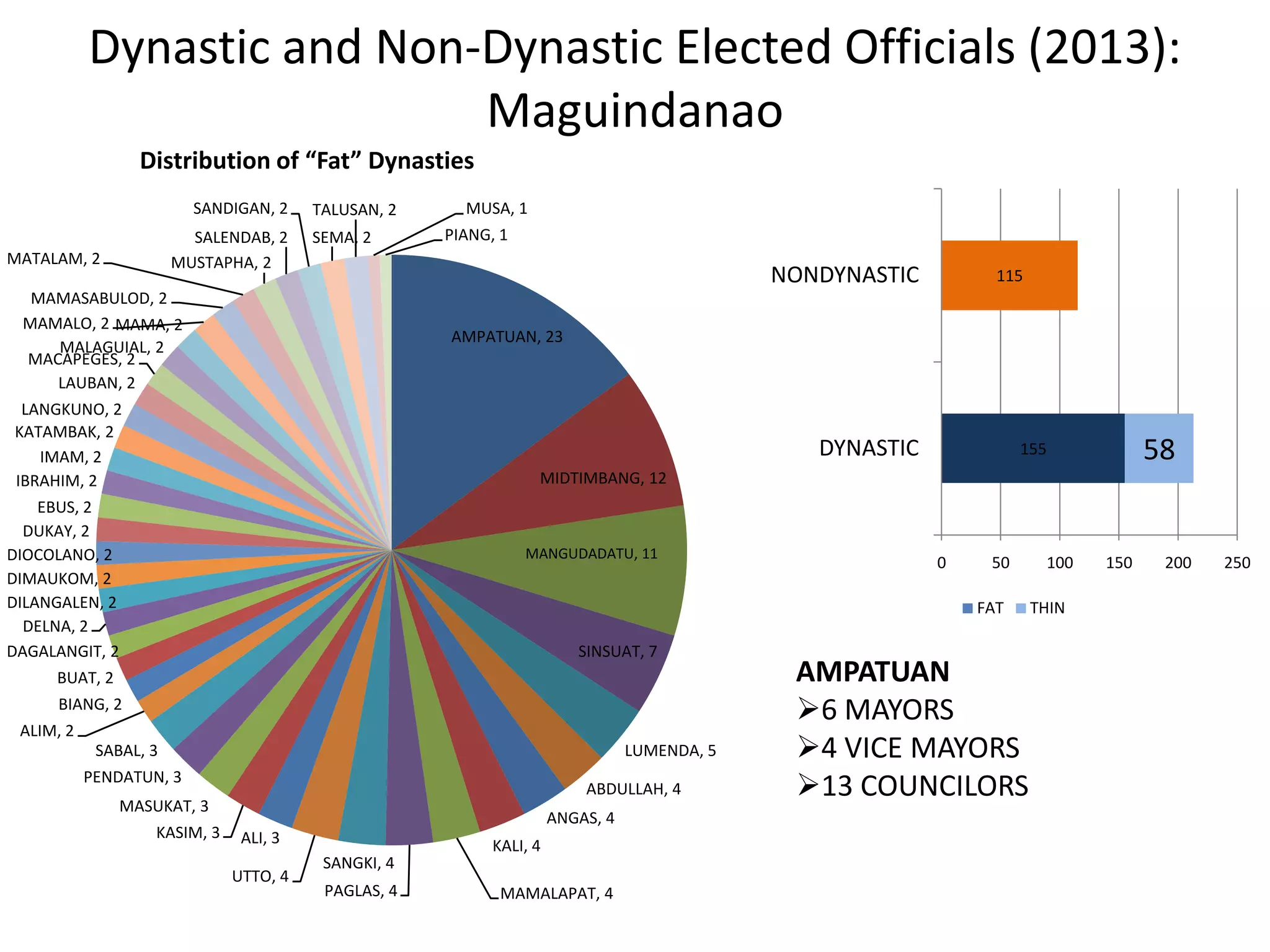
Dynastic and Non-Dynastic Elected Officials (2013):
Maguindanao
AMPATUAN
6 MAYORS
4 VICE MAYORS
13 COUNCILORS
AMPATUAN, 23
MIDTIMBANG, 12
MANGUDADATU, 11
SINSUAT, 7
LUMENDA, 5
ABDULLAH, 4
ANGAS, 4
KALI, 4
MAMALAPAT, 4PAGLAS, 4
SANGKI, 4
UTTO, 4
ALI, 3KASIM, 3
MASUKAT, 3
PENDATUN, 3
SABAL, 3
ALIM, 2
BIANG, 2
BUAT, 2
DAGALANGIT, 2
DELNA, 2
DILANGALEN, 2
DIMAUKOM, 2
DIOCOLANO, 2
DUKAY, 2
EBUS, 2
IBRAHIM, 2
IMAM, 2
KATAMBAK, 2
LANGKUNO, 2
LAUBAN, 2
MACAPEGES, 2
MALAGUIAL, 2
MAMA, 2MAMALO, 2
MAMASABULOD, 2
MATALAM, 2 MUSTAPHA, 2
SALENDAB, 2
SANDIGAN, 2
SEMA, 2
TALUSAN, 2 MUSA, 1
PIANG, 1
155
115
58
0 50 100 150 200 250
DYNASTIC
NONDYNASTIC
FAT THIN
Distribution of “Fat” Dynasties
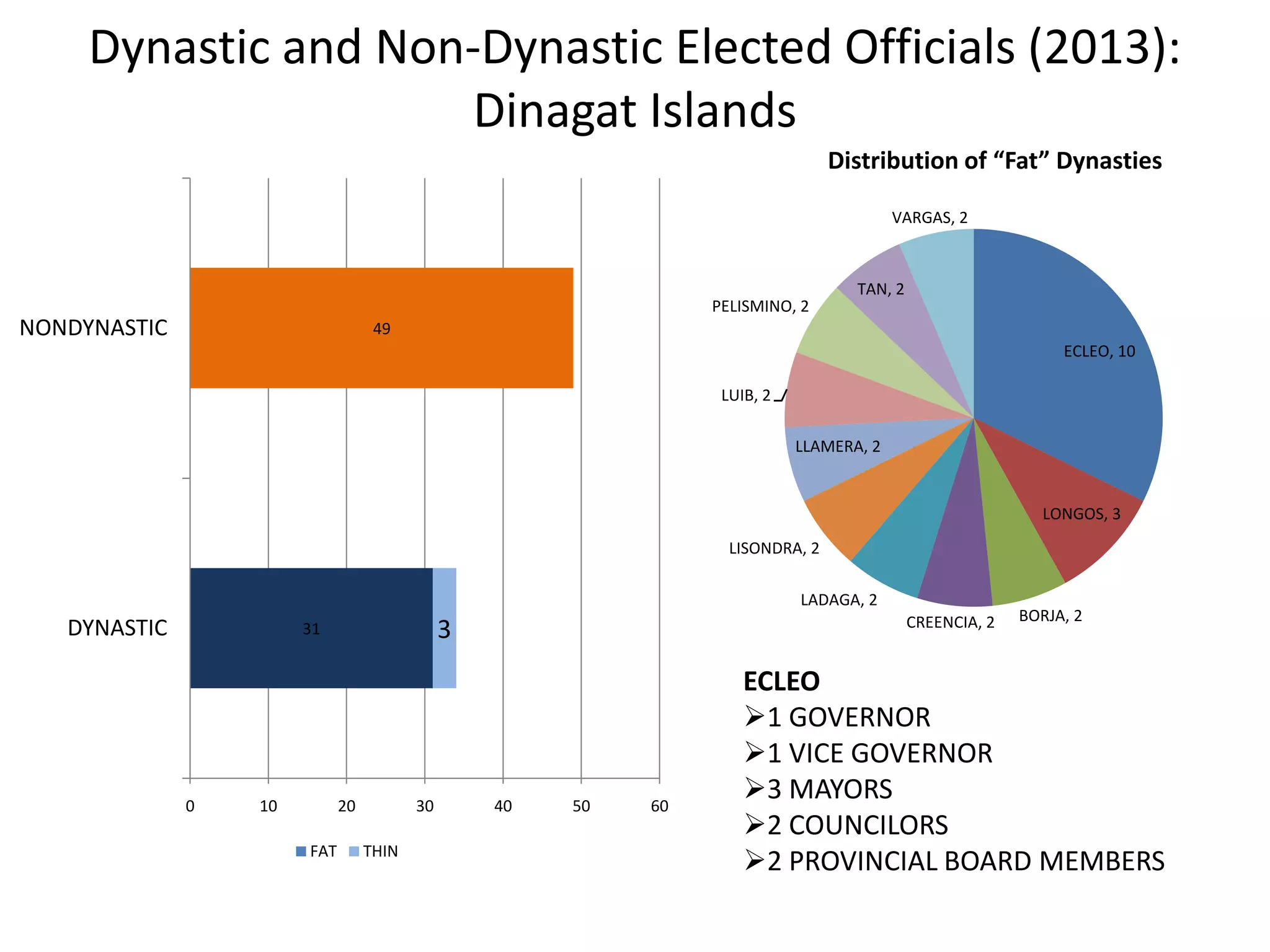
Dynastic and Non-Dynastic Elected Officials (2013):
Dinagat Islands
ECLEO
1 GOVERNOR
1 VICE GOVERNOR
3 MAYORS
2 COUNCILORS
2 PROVINCIAL BOARD MEMBERS
Distribution of “Fat” Dynasties
ECLEO, 10
LONGOS, 3
BORJA, 2CREENCIA, 2
LADAGA, 2
LISONDRA, 2
LLAMERA, 2
LUIB, 2
PELISMINO, 2
TAN, 2
VARGAS, 2
31
49
3
0 10 20 30 40 50 60
DYNASTIC
NONDYNASTIC
FAT THIN
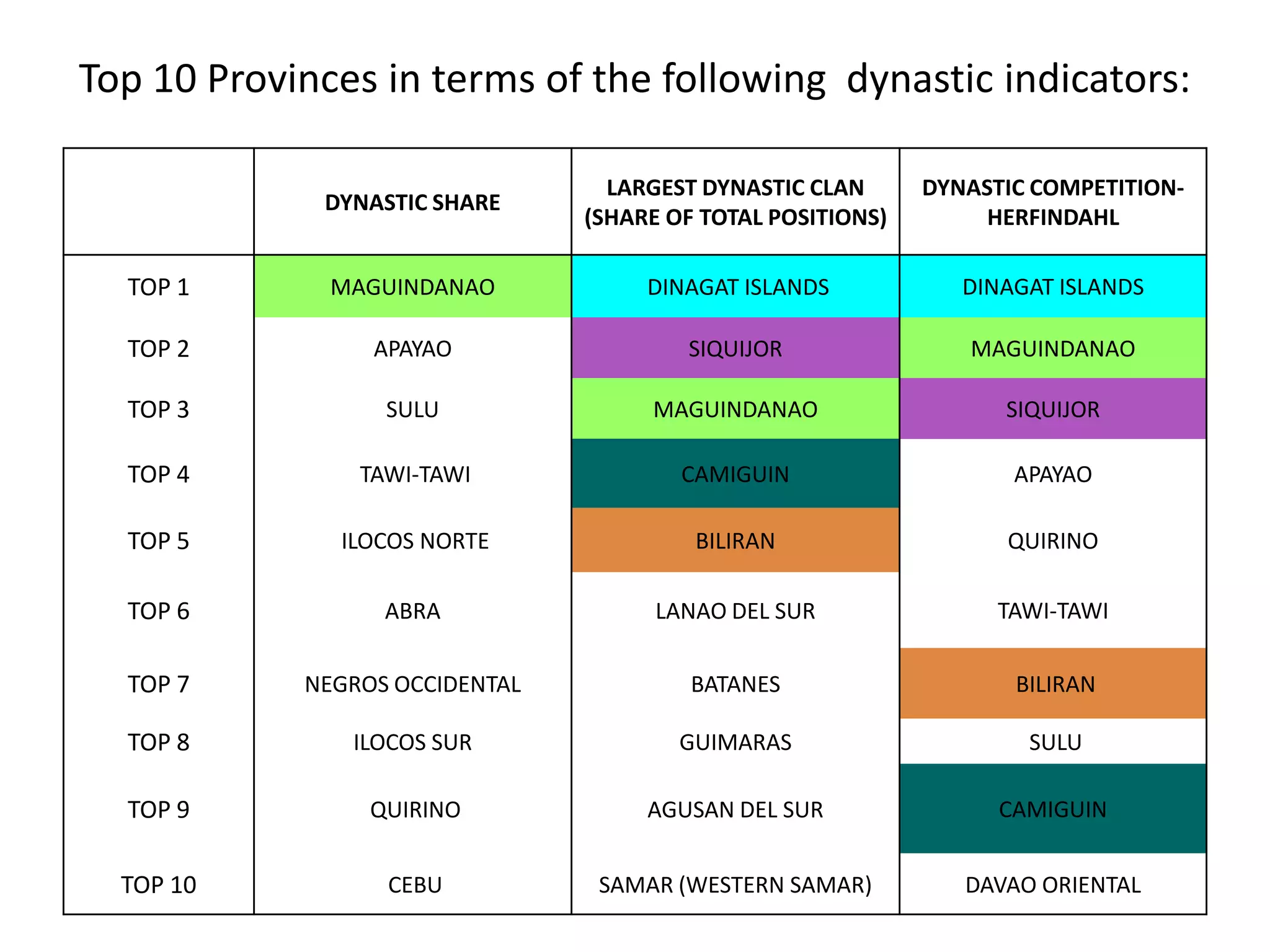
Top 10 Provinces in terms of the following dynastic indicators:
DYNASTIC SHARE
LARGEST DYNASTIC CLAN
(SHARE OF TOTAL POSITIONS)
DYNASTIC COMPETITION-
HERFINDAHL
TOP 1 MAGUINDANAO DINAGAT ISLANDS DINAGAT ISLANDS
TOP 2 APAYAO SIQUIJOR MAGUINDANAO
TOP 3 SULU MAGUINDANAO SIQUIJOR
TOP 4 TAWI-TAWI CAMIGUIN APAYAO
TOP 5 ILOCOS NORTE BILIRAN QUIRINO
TOP 6 ABRA LANAO DEL SUR TAWI-TAWI
TOP 7 NEGROS OCCIDENTAL BATANES BILIRAN
TOP 8 ILOCOS SUR GUIMARAS SULU
TOP 9 QUIRINO AGUSAN DEL SUR CAMIGUIN
TOP 10 CEBU SAMAR (WESTERN SAMAR) DAVAO ORIENTAL
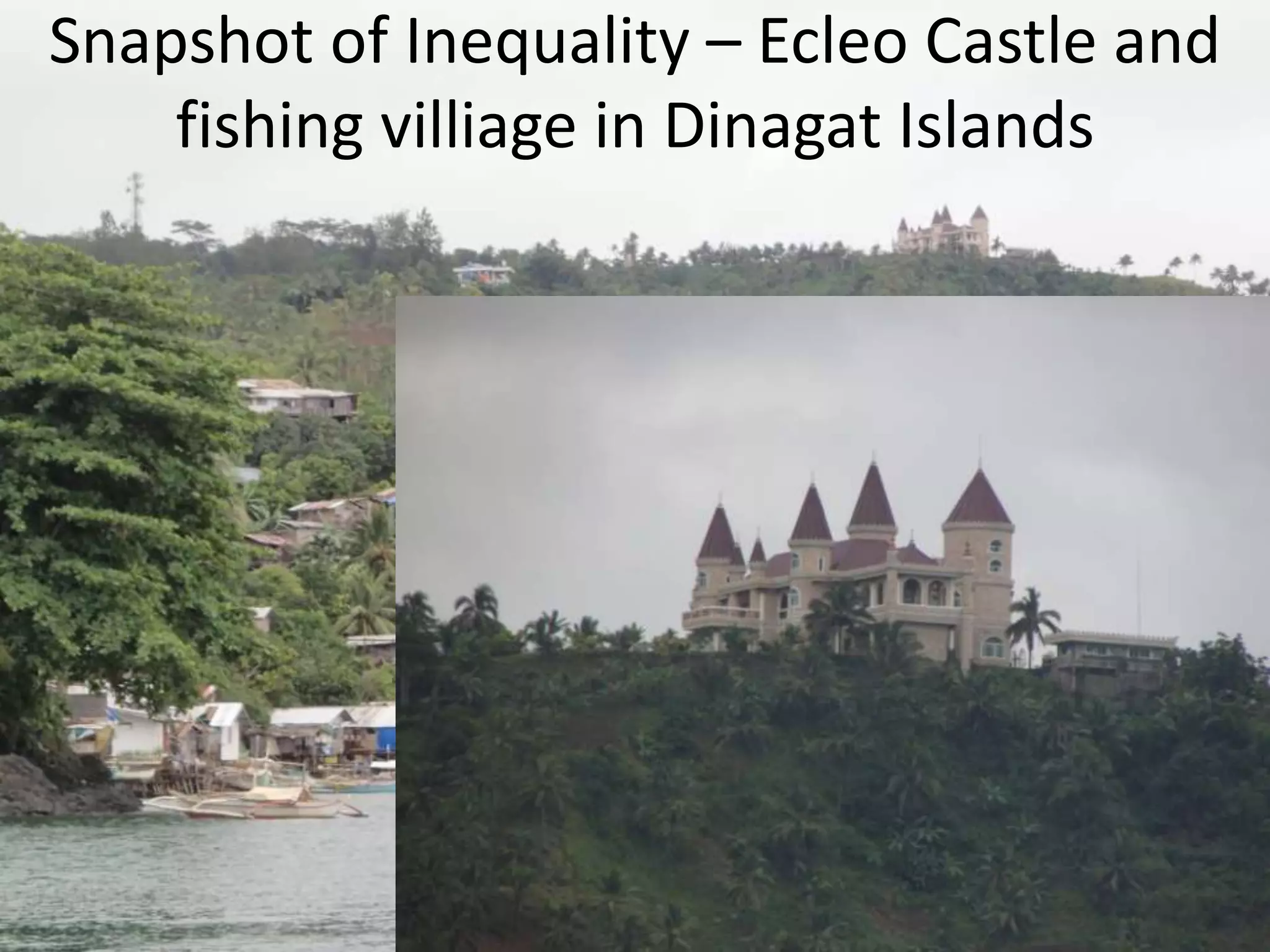
Snapshot of Inequality – Ecleo Castle and
fishing villiage in Dinagat Islands
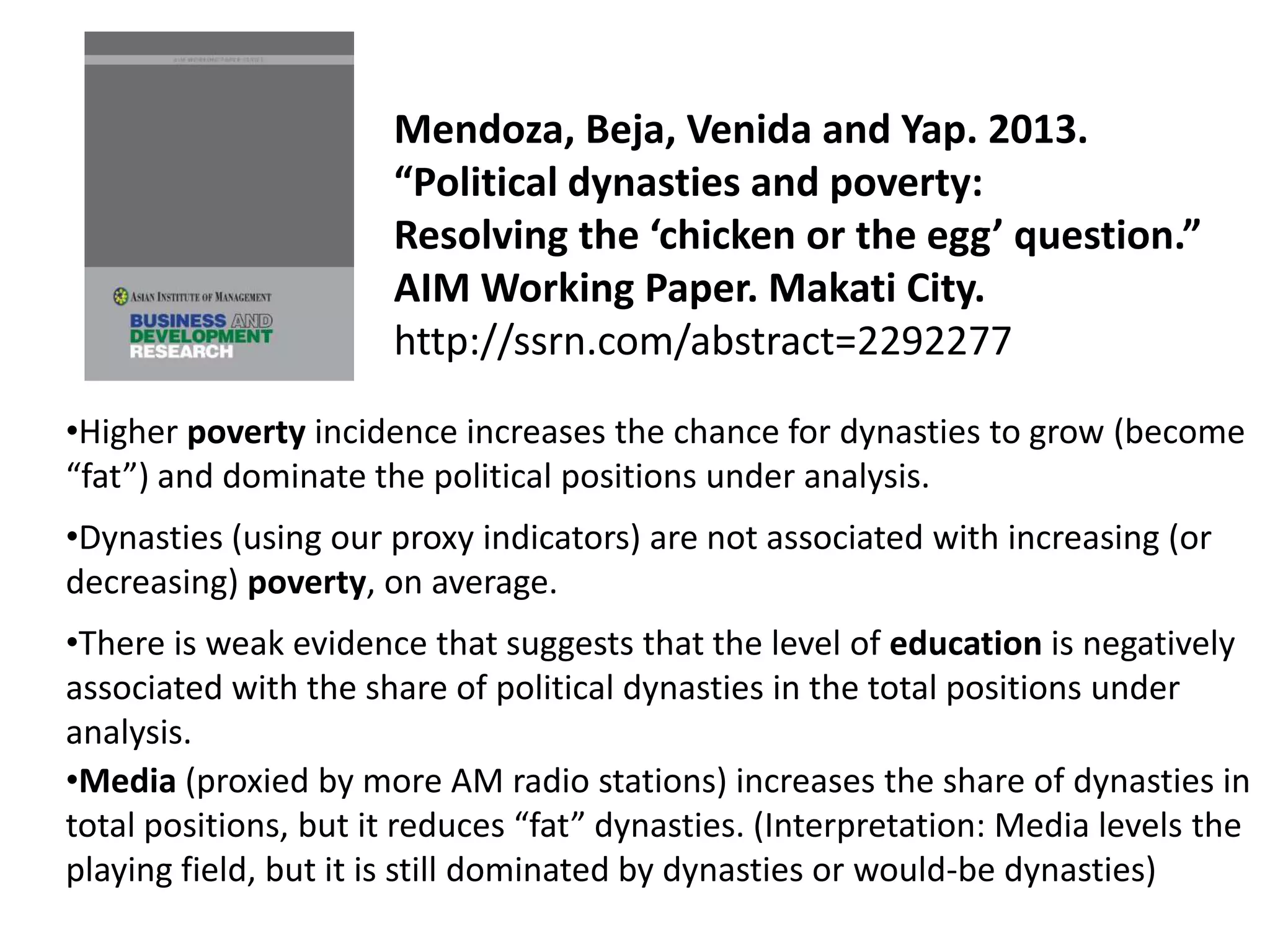
Mendoza, Beja, Venida and Yap. 2013.
“Political dynasties and poverty:
Resolving the ‘chicken or the egg’ question.”
AIM Working Paper. Makati City.
http://ssrn.com/abstract=2292277
•Media (proxied by more AM radio stations) increases the share of dynasties in
total positions, but it reduces “fat” dynasties. (Interpretation: Media levels the
playing field, but it is still dominated by dynasties or would-be dynasties)
•Higher poverty incidence increases the chance for dynasties to grow (become
“fat”) and dominate the political positions under analysis.
•There is weak evidence that suggests that the level of education is negatively
associated with the share of political dynasties in the total positions under
analysis.
•Dynasties (using our proxy indicators) are not associated with increasing (or
decreasing) poverty, on average.
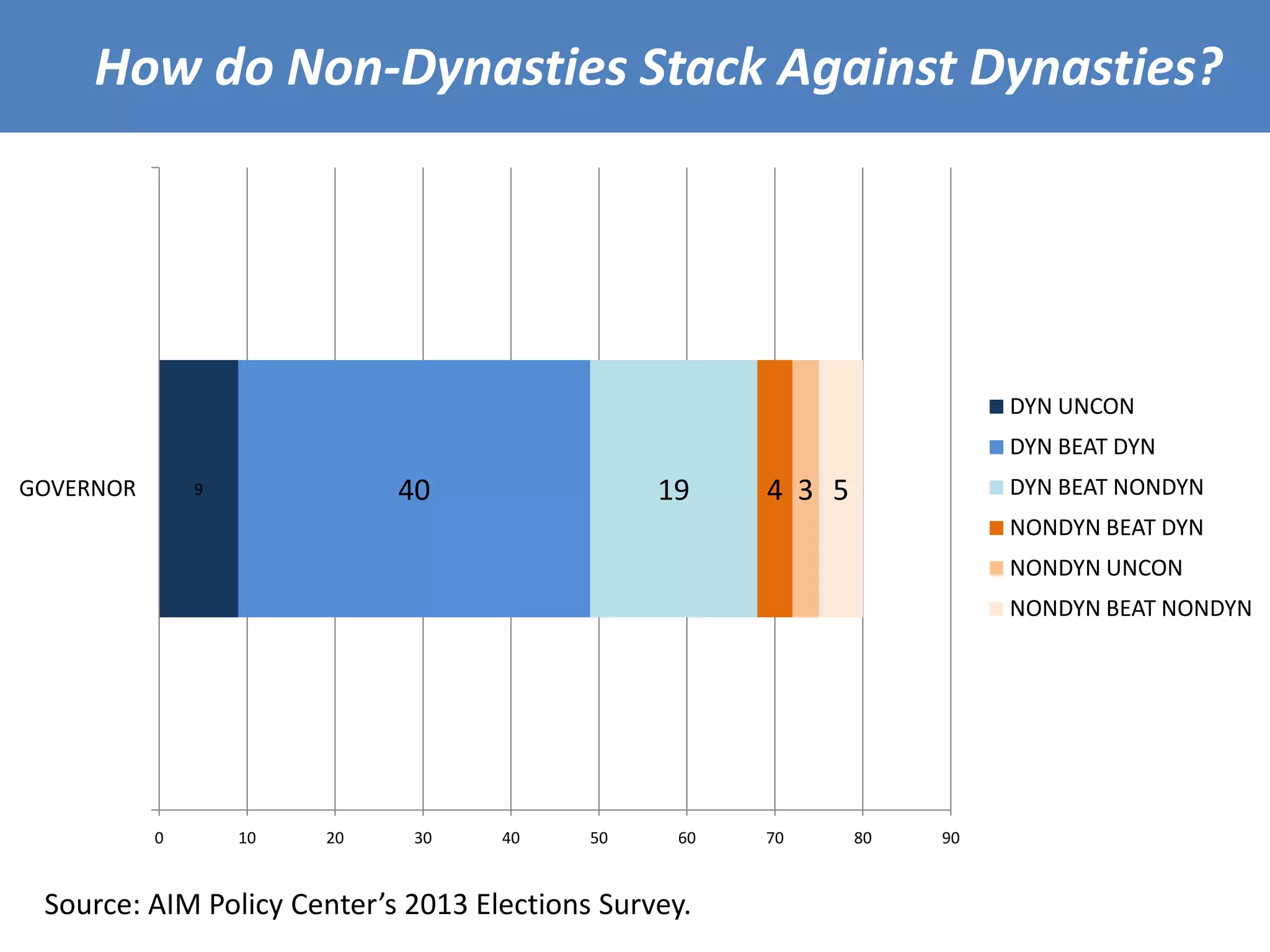
How do Non-Dynasties Stack Against Dynasties?
Source: AIM Policy Center’s 2013 Elections Survey.
9 40 19 4 3 5
0 10 20 30 40 50 60 70 80 90
GOVERNOR
DYN UNCON
DYN BEAT DYN
DYN BEAT NONDYN
NONDYN BEAT DYN
NONDYN UNCON
NONDYN BEAT NONDYN
Source: AIM Policy Center’s 2013 Elections Survey.
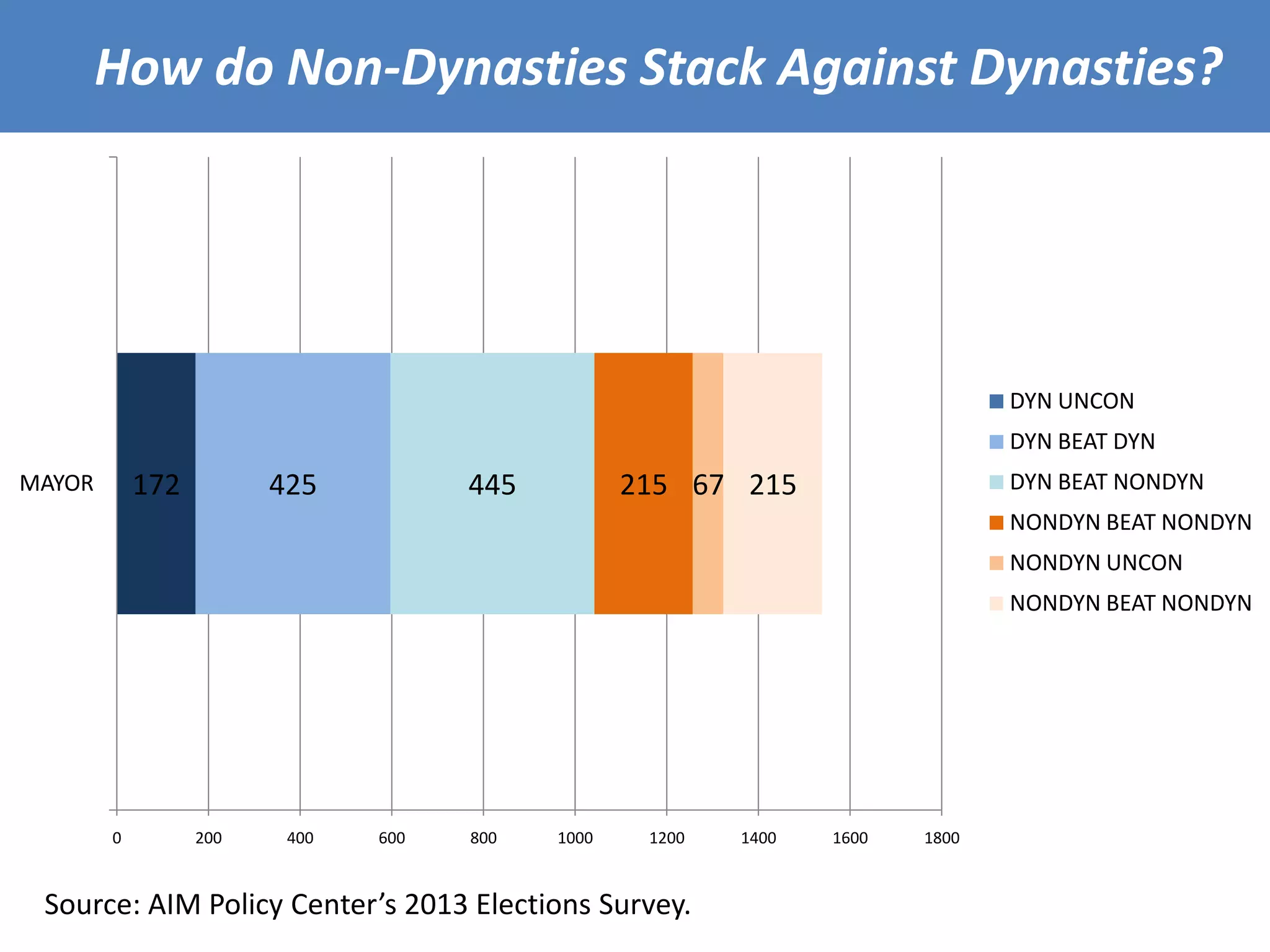
How do Non-Dynasties Stack Against Dynasties?
172 425 445 215 67 215
0 200 400 600 800 1000 1200 1400 1600 1800
MAYOR
DYN UNCON
DYN BEAT DYN
DYN BEAT NONDYN
NONDYN BEAT NONDYN
NONDYN UNCON
NONDYN BEAT NONDYN
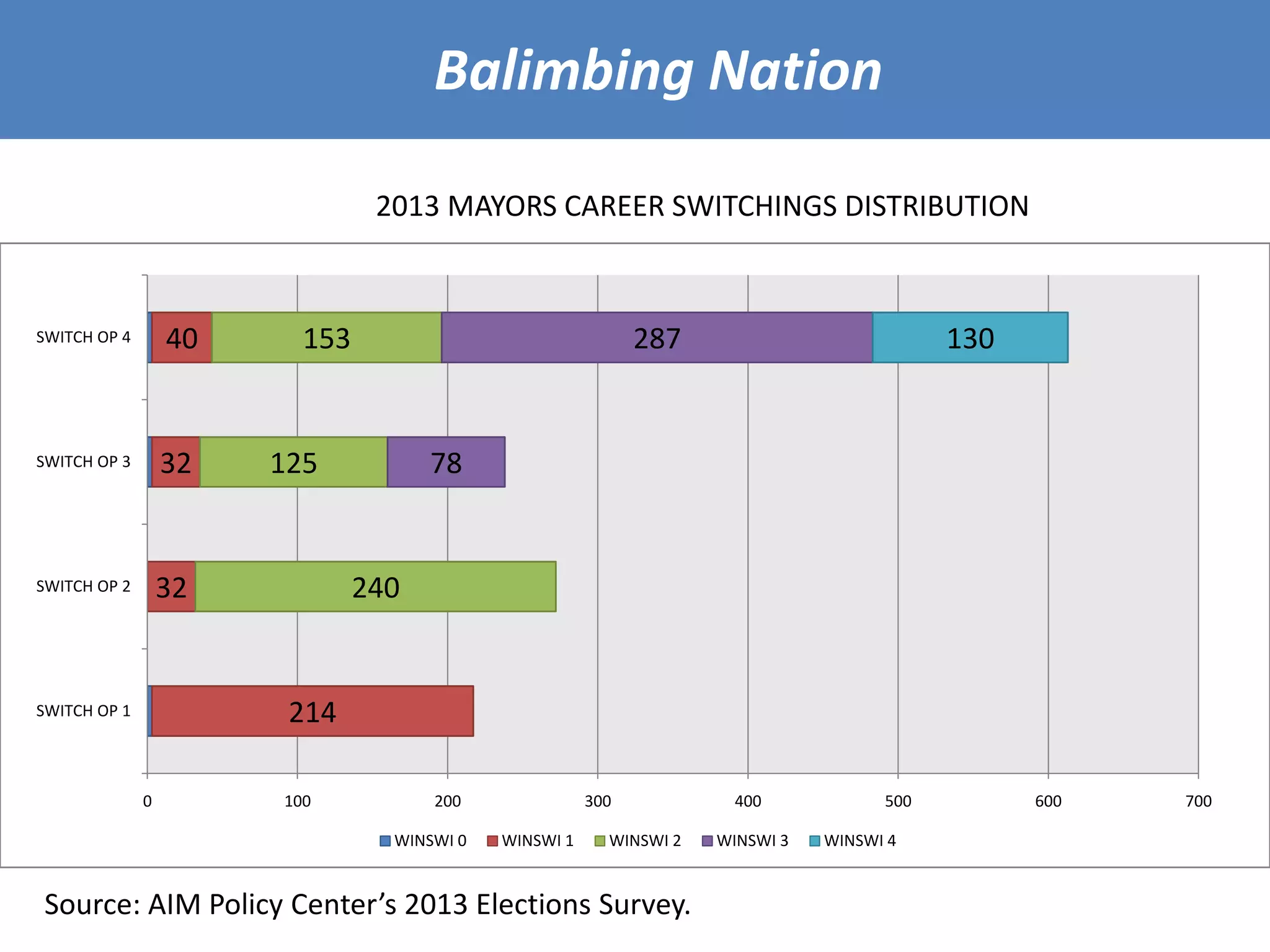
Balimbing Nation
Source: AIM Policy Center’s 2013 Elections Survey.
2013 MAYORS CAREER SWITCHINGS DISTRIBUTION
214
32
32
40
240
125
153
78
287 130
0 100 200 300 400 500 600 700
SWITCH OP 1
SWITCH OP 2
SWITCH OP 3
SWITCH OP 4
WINSWI 0 WINSWI 1 WINSWI 2 WINSWI 3 WINSWI 4
This presentation builds on: Mendoza, R.U., E.Beja, V.Venida and D.Yap. 2012. “An Empirical Analysis of
Political Dynasties in the 15th Congress.” Philippine Political Science Journal 33(2):132-145. This study is
conducted with the support of the Asian Institute of Management Scientific Research Foundation and
the Konrad Adenauer Foundation. The views expressed herein are the authors’ and these do not
necessarily reflect the views and policies of the Asian Institute of Management, and the Konrad
Adenauer Foundation.
DEMOCRACY AND INCLUSIVE GROWTH
AIM Policy Center / http://Policy.aim.edu
Presented during the Foundation for Economic Freedom’s Fellows Monthly Meeting
April 30, 2014, 7:00PM
Manila Golf and Country Club
Contact Details:
Foundation for Economic Freedom, Inc.
105 Philippine Social Science Center (PSSC)
Commonwealth Ave., Diliman, Quezon City
Telefax: (632) 4532375 (Main Office)
Tel No.: (632) 8939602 (Accounting)
Website: www.fef.org.ph
Email: fefphilippines@gmail.com / fef@fef.org.ph

Building an Inclusive Democracy

  • 1.
    Can Exclusive PoliticsProduce Inclusive Development? Ronald Umali Mendoza, PhD AIM Policy Center
  • 3.
    Mendoza, Beja, Venidaand Yap. 2012. “Inequality in democracy: Insights from an empirical analysis of political dynasties in the 15th Philippine Congress”. Philippine Political Science Journal 33(2):132-145. http://papers.ssrn.com/sol3/papers.cfm?abstract_id=1969605 70% of the 15th Philippine Congress is dynastic; and dynasties dominate all of the major political parties. On average, there are more dynasties in regions with higher poverty and lower human development. Dynasties tend to be richer (higher SALNs) when one outlier is removed among present non-dynasties (MP). 80% of the youngest Congressmen (age 26-40) are from dynastic clans.
  • 4.
    Political Dynasties andPoverty/Inequality Empirical link between political dynasties and poverty/inequality: •PREDATORY VIEW: Dynasties increase P/I -- If dynasties are associated with rent-seeking and state capture, corruption and ineffective and poorly designed policies (e.g. Proud’homme, 1995; Hutchcroft and Rocamora, 2003). •STATIONARY BANDIT: Dynasties reduce P/I -- If dynasties have longer “runways” for reform and are more firmly associated with socio-economic outcomes (e.g. Olson, 2003; Solon et al, 2009; Dal Bo and Rossi, 2009). •LONG RUNWAY FOR REFORMS: Dynasties are better able to pursue reforms with longer- term gestation periods for results; policy stability and continuity that investors would prefer Additional complexity: •PATRONAGE: High P/I tends to increase dynastic prevalence: the poor vote for dynasties as long as these are able to directly provide support during elections or in times of income shocks (e.g. Coronel, 1998; Manacsa and Tan, 2005). •SELF-PERPETUATION: Politicians are capable of developing dynasties: being in public office affords politicians the opportunity and means to keep on winning or to increase their heirs’ chances of winning (e.g. Dal Bo et al, 2009; Querrubin 2010).
  • 5.
    Innovations in thisStudy • THIN DYNASTY • FAT DYNASTY
  • 6.
    A Snapshot ofOne Political Dynasty: “Fat –type” Sibling Spouse Cousin PBM (Provincial Board Member) Note: Incumbent positions are in brackets.
  • 7.
  • 8.
    Distortions in LocalPublic Finance? Ravanilla (2012): study of legislators and their use of “pork barrel” funds from 2001-2010; Legislators bias distribution of their constituency development fund (CDF) in favor of local patrons and allies ; More political competition (tighter Congressional races) tend to exacerbate this clientelistic distribution bias.
  • 9.
    Dynastic and Non-DynasticElected Officials (2013): Maguindanao AMPATUAN 6 MAYORS 4 VICE MAYORS 13 COUNCILORS AMPATUAN, 23 MIDTIMBANG, 12 MANGUDADATU, 11 SINSUAT, 7 LUMENDA, 5 ABDULLAH, 4 ANGAS, 4 KALI, 4 MAMALAPAT, 4PAGLAS, 4 SANGKI, 4 UTTO, 4 ALI, 3KASIM, 3 MASUKAT, 3 PENDATUN, 3 SABAL, 3 ALIM, 2 BIANG, 2 BUAT, 2 DAGALANGIT, 2 DELNA, 2 DILANGALEN, 2 DIMAUKOM, 2 DIOCOLANO, 2 DUKAY, 2 EBUS, 2 IBRAHIM, 2 IMAM, 2 KATAMBAK, 2 LANGKUNO, 2 LAUBAN, 2 MACAPEGES, 2 MALAGUIAL, 2 MAMA, 2MAMALO, 2 MAMASABULOD, 2 MATALAM, 2 MUSTAPHA, 2 SALENDAB, 2 SANDIGAN, 2 SEMA, 2 TALUSAN, 2 MUSA, 1 PIANG, 1 155 115 58 0 50 100 150 200 250 DYNASTIC NONDYNASTIC FAT THIN Distribution of “Fat” Dynasties
  • 10.
    Dynastic and Non-DynasticElected Officials (2013): Dinagat Islands ECLEO 1 GOVERNOR 1 VICE GOVERNOR 3 MAYORS 2 COUNCILORS 2 PROVINCIAL BOARD MEMBERS Distribution of “Fat” Dynasties ECLEO, 10 LONGOS, 3 BORJA, 2CREENCIA, 2 LADAGA, 2 LISONDRA, 2 LLAMERA, 2 LUIB, 2 PELISMINO, 2 TAN, 2 VARGAS, 2 31 49 3 0 10 20 30 40 50 60 DYNASTIC NONDYNASTIC FAT THIN
  • 11.
    Top 10 Provincesin terms of the following dynastic indicators: DYNASTIC SHARE LARGEST DYNASTIC CLAN (SHARE OF TOTAL POSITIONS) DYNASTIC COMPETITION- HERFINDAHL TOP 1 MAGUINDANAO DINAGAT ISLANDS DINAGAT ISLANDS TOP 2 APAYAO SIQUIJOR MAGUINDANAO TOP 3 SULU MAGUINDANAO SIQUIJOR TOP 4 TAWI-TAWI CAMIGUIN APAYAO TOP 5 ILOCOS NORTE BILIRAN QUIRINO TOP 6 ABRA LANAO DEL SUR TAWI-TAWI TOP 7 NEGROS OCCIDENTAL BATANES BILIRAN TOP 8 ILOCOS SUR GUIMARAS SULU TOP 9 QUIRINO AGUSAN DEL SUR CAMIGUIN TOP 10 CEBU SAMAR (WESTERN SAMAR) DAVAO ORIENTAL
  • 12.
    Snapshot of Inequality– Ecleo Castle and fishing villiage in Dinagat Islands
  • 13.
    Mendoza, Beja, Venidaand Yap. 2013. “Political dynasties and poverty: Resolving the ‘chicken or the egg’ question.” AIM Working Paper. Makati City. http://ssrn.com/abstract=2292277 •Media (proxied by more AM radio stations) increases the share of dynasties in total positions, but it reduces “fat” dynasties. (Interpretation: Media levels the playing field, but it is still dominated by dynasties or would-be dynasties) •Higher poverty incidence increases the chance for dynasties to grow (become “fat”) and dominate the political positions under analysis. •There is weak evidence that suggests that the level of education is negatively associated with the share of political dynasties in the total positions under analysis. •Dynasties (using our proxy indicators) are not associated with increasing (or decreasing) poverty, on average.
  • 14.
    How do Non-DynastiesStack Against Dynasties? Source: AIM Policy Center’s 2013 Elections Survey. 9 40 19 4 3 5 0 10 20 30 40 50 60 70 80 90 GOVERNOR DYN UNCON DYN BEAT DYN DYN BEAT NONDYN NONDYN BEAT DYN NONDYN UNCON NONDYN BEAT NONDYN
  • 15.
    Source: AIM PolicyCenter’s 2013 Elections Survey. How do Non-Dynasties Stack Against Dynasties? 172 425 445 215 67 215 0 200 400 600 800 1000 1200 1400 1600 1800 MAYOR DYN UNCON DYN BEAT DYN DYN BEAT NONDYN NONDYN BEAT NONDYN NONDYN UNCON NONDYN BEAT NONDYN
  • 16.
    Balimbing Nation Source: AIMPolicy Center’s 2013 Elections Survey. 2013 MAYORS CAREER SWITCHINGS DISTRIBUTION 214 32 32 40 240 125 153 78 287 130 0 100 200 300 400 500 600 700 SWITCH OP 1 SWITCH OP 2 SWITCH OP 3 SWITCH OP 4 WINSWI 0 WINSWI 1 WINSWI 2 WINSWI 3 WINSWI 4
  • 17.
    This presentation buildson: Mendoza, R.U., E.Beja, V.Venida and D.Yap. 2012. “An Empirical Analysis of Political Dynasties in the 15th Congress.” Philippine Political Science Journal 33(2):132-145. This study is conducted with the support of the Asian Institute of Management Scientific Research Foundation and the Konrad Adenauer Foundation. The views expressed herein are the authors’ and these do not necessarily reflect the views and policies of the Asian Institute of Management, and the Konrad Adenauer Foundation. DEMOCRACY AND INCLUSIVE GROWTH AIM Policy Center / http://Policy.aim.edu
  • 18.
    Presented during theFoundation for Economic Freedom’s Fellows Monthly Meeting April 30, 2014, 7:00PM Manila Golf and Country Club Contact Details: Foundation for Economic Freedom, Inc. 105 Philippine Social Science Center (PSSC) Commonwealth Ave., Diliman, Quezon City Telefax: (632) 4532375 (Main Office) Tel No.: (632) 8939602 (Accounting) Website: www.fef.org.ph Email: fefphilippines@gmail.com / fef@fef.org.ph

Editor's Notes

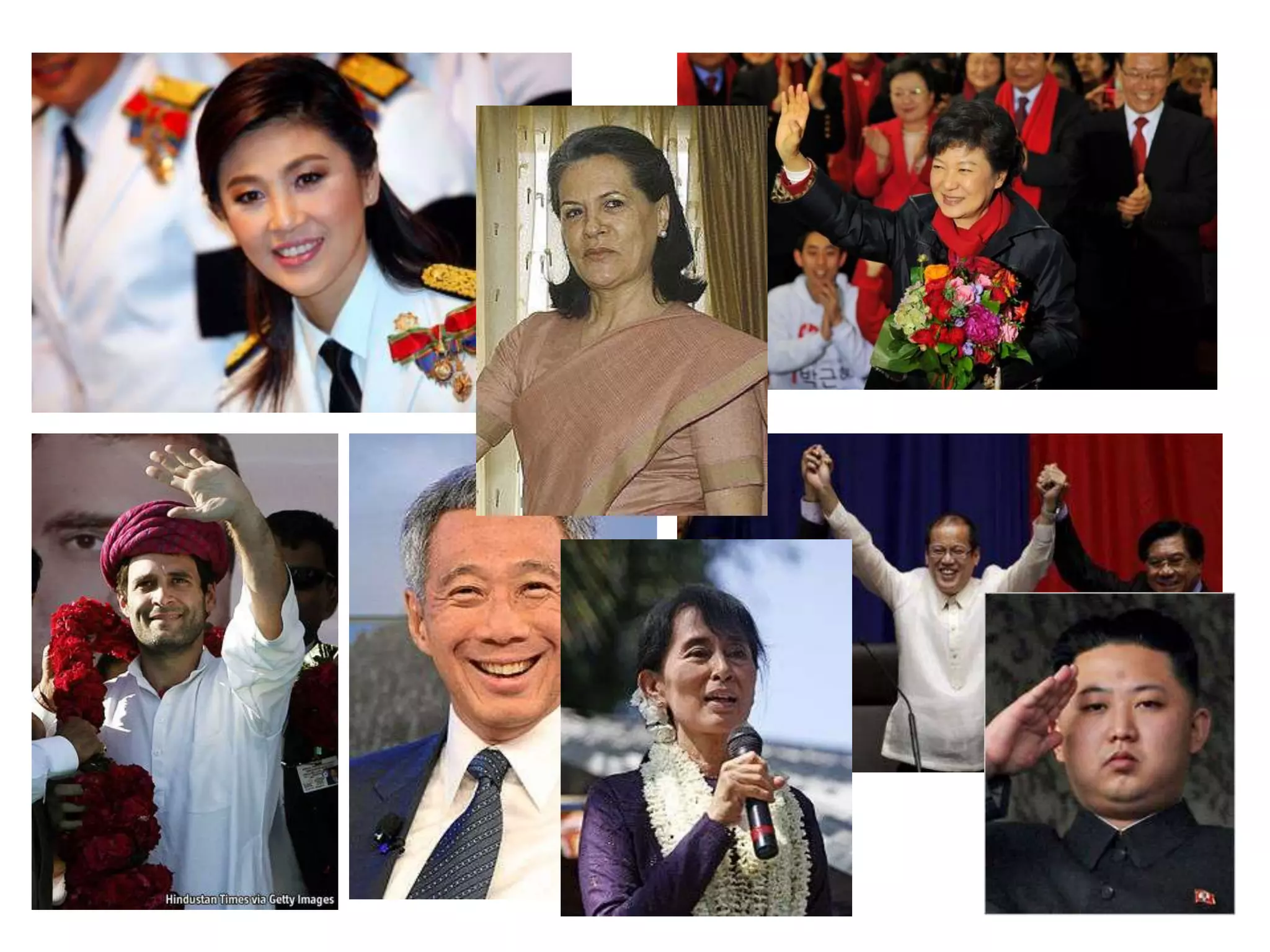
  • #2 Questions and comments on this presentation could be addressed to: POLICYCENTER@AIM.EDU.+AMDGCover photo source: http://www.examiner.com/article/photos-2010-elections-choosing-philippine-destiny-part-1**We acknowledge a similarly titled blog article on this topic by Mr. Ed Lingao of PCIJ. His article can be seen here: http://pcij.org/blog/2011/09/29/poverty-and-dynasties-the-chicken-or-the-egg
  • #3 Sources:Lee Hsien Loong (2004): http://www.google.com.ph/imgres?imgurl=http://upload.wikimedia.org/wikipedia/commons/thumb/e/e3/Lee_Hsien-Loong_-_World_Economic_Forum_Annual_Meeting_2012_cropped.jpg/220px-Lee_Hsien-Loong_-_World_Economic_Forum_Annual_Meeting_2012_cropped.jpg&imgrefurl=http://en.wikipedia.org/wiki/Lee_Hsien_Loong&h=175&w=116&sz=1&tbnid=zPd35pC3Xlt0_M:&tbnh=160&tbnw=106&zoom=1&usg=__v_Vov1nTs7pIq_PfYYvlNRhJ19I=&docid=Vu0haF8Zoc-IUM&itg=1&sa=X&ei=GLUJUZXFLIWiigfgyIH4BQ&ved=0CJMBEPwdMA4Pnoy (2010):Yingluck Shinawatra (2011): http://www.google.com.ph/imgres?imgurl=http://www.bloomberg.com/image/icF_WyPfUqhg.jpg&imgrefurl=http://www.bloomberg.com/news/2011-09-15/yingluck-visits-cambodia-as-thailand-seeks-to-mend-links-hurt-by-clashes.html&h=426&w=639&sz=79&tbnid=A-cdHox_tJMnFM:&tbnh=90&tbnw=135&zoom=1&usg=__lgzVqkvryXJVRsKmQPlfxD-pJWo=&docid=4NDaBFEHHzZ15M&sa=X&ei=f7MJUfX6F4aZiAeqk4DgCA&ved=0CEsQ9QEwBA&dur=4284Kim Jong Un (2011): http://www.google.com.ph/imgres?imgurl=http://graphics8.nytimes.com/images/2010/10/10/world/10korea2-span/10korea2-span-articleInline.jpg&imgrefurl=http://topics.nytimes.com/topics/reference/timestopics/people/k/kim_jongun/index.html&h=162&w=126&sz=1&tbnid=FHpYHnuHu_iNGM:&tbnh=162&tbnw=126&zoom=1&usg=__KL7DVJsfZwSV-iDc4VV1mupopNQ=&docid=SMoGSn7lCLk53M&itg=1&sa=X&ei=grcJUdrYHPCXiQfdnIGwBw&ved=0CIYBEPwdMAwPark (2012): http://www.google.com.ph/imgres?imgurl=http://i.telegraph.co.uk/multimedia/archive/02432/park-1_2432691b.jpg&imgrefurl=http://www.telegraph.co.uk/news/worldnews/asia/southkorea/9756649/Profile-South-Koreas-first-female-president-Park-Geun-Hye.html&h=387&w=620&sz=56&tbnid=SROgDYTRvdbRGM:&tbnh=90&tbnw=144&zoom=1&usg=__O_4aN2oIowDTlonovS26dkWMXjI=&docid=9yoxNolhzhuAZM&hl=en&sa=X&ei=ArMJUefIA66UiQfYhYH4Bg&ved=0CEgQ9QEwCQ&dur=366Sonia Gandhi (President of Indian National Congress 2010; widow of former PM Rajiv Gandhi): http://en.wikipedia.org/wiki/Sonia_GandhiRahulGandhi (Ruling Congress Party VP; Sonia Gandhi is President of Congress Party): http://www.economist.com/news/asia/21570703-rahul-gandhi-makes-move-last-his-path-power-may-be-helped-fighting-among
  • #4 The Mendoza et al (2012) study focused on the “dynasty3” definition in much of its analysis.Dynasty1: The share of legislators in the 15th Congress with kinship links to at least one legislator from the 12th, 13th or 14th Congress;Dynasty2: The share of legislators in the 15th Congress with kinship links to at least one legislator from the 12th, 13th or 14th Congress, or at least one local government official elected in 2001, 2004, or 2007;Dynasty3: The share of legislators in the 15th Congress with kinship links to at least one legislator in the 12th, 13th,14th or 15th Congress, or at least one local government official elected in 2001, 2004, 2007 or 2010.Dynasty*: The share of legislators in the 15th Congress with kinship links to at least one legislator from the 12th, 13th, or 14th Congresses, and at least one legislator from the 15th Congress, and at least one local government official elected in 2001, 2004, or 2007, and at least one local government official elected in 2010.
  • #5 Predatory view: state capture could lead to inefficiency or corruption; decentralization could lead to more entrenched control by local elites and political clans (Proud’homme, 1995)Stationary bandit view: elites have a greater incentive to improve socio-economic outcomes rather than pursue immediate plunder (Olson, 2003)
  • #7 The green circles identify the newest branches of the Singson family tree. The number of “Singsons” in office in this tree exceed the number of Singsons in the pie chart later on the presentation because those with asterisks are either Singson-Zaragoza, Singson-Medina or Singson-Goulart (Middle name Singson).
  • #9 Ravanilla (2012) study of data on 1631 municipalities and cities for 229 district based Congressmen during 2001-2010.CDF comprised of PDAF (Priority Development Assistance Funds) and DPWH-CA (DPWH Congressional Allocations)
  • #10 Despite dropping from 37 positions to 23 positions, the Ampatuan family still occupies the highest number of local government positions in Maguindanao
  • #11 It is of note that twoEcleos; mother and daughter fought for the governorship of Dinagat Islands. The mother prevailed. It is also of note that the Ecleos now hold the governor and vice governor posts of Dinagat Islands.
  • #12 Additional tablesLargest clan/s for each province (Provinces are arranged from highest to lowest in terms of the Largest Dynastic Clan (2010 positions) indicator)PROVINCECLANSDINAGAT ISLANDSEcleoSIQUIJORFuaMAGUINDANAOAmpatuanCAMIGUINRomualdoBILIRANEspinaLANAO DEL SURBalindongBATANESAbadILOCOS SURSingsonAGUSAN DEL SURPlazaGUIMARASNavaSAMAR (WESTERN SAMAR)TanLA UNIONOrtegaTAWI-TAWIAhaja, Omar, SahaliMARINDUQUELimQUIRINOAduca, Agustin, Cua, Pagbilao, YlananOCCIDENTAL MINDOROTria, VillarosaAGUSAN DEL NORTEAmanteDAVAO ORIENTALRabat, UyLANAO DEL NORTEDimaporoANTIQUEJavierAPAYAOAmid, Begtang, Bulut, PascuaBATAANGarciaSULULoongSURIGAO DEL SURPimentelAURORAAngara, BitongKALINGADickpus, MangaoangSARANGANIMartinez, YapNUEVA VIZCAYABalgosORIENTAL MINDOROUmaliRIZALSan JuanSORSOGONEscuderoMOUNTAIN PROVINCELacwasanNORTHERN SAMARTanAKLANMirafloresCAPIZCastroABRABernos, CardenasDAVAO DEL SURBautista, CagasSOUTHERN LEYTEMercadoCATANDUANESAbundo, Alberto, TevesIFUGAOBunnol, DulnuanMISAMIS ORIENTALEmano, LagbasTARLACYapBASILANAkbar, Kahallal, SahaliCOMPOSTELA VALLEYBrillantes, GonzagaDAVAO (DAVAO DEL NORTE)Del Rosario Uy,ISABELADySURIGAO DEL NORTEMatugasMASBATELanete, NagaSOUTH COTABATOLadot, LumayagSULTAN KUDARATGarcia, SakaluranBUKIDNONZubiriILOCOS NORTEAguinaldo, Marcos, NaluptaPALAWANAlvarezZAMBALESKhonghunBULACANSantosNEGROS ORIENTALArnaizROMBLONFirmalo, Madrid, MadronaCAVITERemullaZAMBOANGA SIBUGAYJalosjos, Olegario, Palmo, RamisoMISAMIS OCCIDENTALAlmonte, Animas, Dumanjug, Parojinog, Paylaga, Regalado, Tan, VillanuevaZAMBOANGA DEL SURCerillesCAGAYANVargasCOTABATO (NORTH COT.)Cadungon, Catamco, PinolALBAYAlsua, Gonzalez, Imperial, SalcedaCEBUGarciaNUEVA ECIJAJosonILOILOGarinBATANGASMendoza, ReyesNEGROS OCCIDENTALAlvarez, EscalanteEASTERN SAMARAbuda, Baldono, EvardonePAMPANGADavid, Flores, Naguit, PinedaCAMARINES SURFuentebellaQUEZONAlcala, SuarezLEYTEApostol, CariBOHOLChattoCAMARINES NORTEAguilar, Jalgalado, Magana, Padilla, Pajarillo, Parale, Pardo, RamonesLAGUNAChipeco, De Leon, EjercitoPANGASINANCalimlim, Celeste, Espino, ReyesBENGUETCanuto, Cosalan, Dangwa, Fianza  Members of Ampatuan clan who are currently in officeNAMEPOSITIONBONGBONG AMPATUANMAYOR (DATU HOFFER AMPATUAN)AKMAD AMPATUANMAYOR (DATU SALIBO)SAUD AMPATUANMAYOR (DATU SAUDI AMPATUAN)RESHAL AMPATUANMAYOR (DATU UNSAY)TAHIRODIN AMPATUANMAYOR (MAMASAPANO)YACOB AMPATUANMAYOR (RAJAH BUAYAN)ZAHARA AMPATUANMAYOR (SHARIFF AGUAK)ZANDRIA AMPATUANMAYOR (MUSTAPHA)DATU AMPATUANPROVINCIAL BOARD MEMBERSAJID AMPATUANPROVINCIAL BOARD MEMBERPUTI AMPATUANPROVINCIAL BOARD MEMBERKANOR AMPATUANVICE-MAYOR (DATU SALIBO)SAUDI AMPATUANVICE-MAYOR(DATU SAUDI AMPATUAN)AKMAD AMPATUANVICE-MAYOR (MAMASAPANO)SORAIDA AMPATUANVICE-MAYOR(PARANG)ANWAR AMPATUANVICE-MAYOR (SHARIFF AGUAK) Members of Singson clan who are currently in officeNAMEPOSITIONALLEN SINGSONMAYOR (CANDON CITY)RONALD SINGSONMEMBER, HOUSE OF REPRESENTATIVERYAN SINGSONMEMBER, HOUSE OF REPRESENTATIVEERIC SINGSONMEMBER, HOUSE OF REPRESENTATIVEJEREMIAS SINGSONPROVINCIAL BOARD MEMBERLUIS SINGSONPROVINCIAL GOVERNORALFONSO SINGSONVICE-MAYOR (CANDON CITY)RYAN SINGSONVICE-MAYOR (VIGAN CITY)  Members of Ecleo clan who are currently in officeNAMEPOSITIONALAN ECLEOMAYOR (BASILIA)GWENDOLYN ECLEOMAYOR (DINAGAT)ALLAN ECLEOMAYOR (SAN JOSE)RUBEN ECLEO, JRMEMBER, HOUSE OF REPRESENTATIVEROMEO ECLEOPROVINCIAL BOARD MEMBERJOSLYN ECLEOPROVINCIAL BOARD MEMBERGLENDA ECLEOPROVINCIAL GOVERNORRUBEN AL ECLEOVICE-MAYOR (CAGDIANAO) 
  • #14 The Mendoza et al (2012) study focused on the “dynasty3” definition in much of its analysis.Dynasty1: The share of legislators in the 15th Congress with kinship links to at least one legislator from the 12th, 13th or 14th Congress;Dynasty2: The share of legislators in the 15th Congress with kinship links to at least one legislator from the 12th, 13th or 14th Congress, or at least one local government official elected in 2001, 2004, or 2007;Dynasty3: The share of legislators in the 15th Congress with kinship links to at least one legislator in the 12th, 13th,14th or 15th Congress, or at least one local government official elected in 2001, 2004, 2007 or 2010.Dynasty*: The share of legislators in the 15th Congress with kinship links to at least one legislator from the 12th, 13th, or 14th Congresses, and at least one legislator from the 15th Congress, and at least one local government official elected in 2001, 2004, or 2007, and at least one local government official elected in 2010.
  • #18 +AMDGRUM