Lab Glass Cleaning
                .com
                 com


Advice
for clean and
residue-free
residue free
laboratory
equipment

                       © Dr. Weigert & DURAN Group 2012
Good practice– type of glass
                      .com


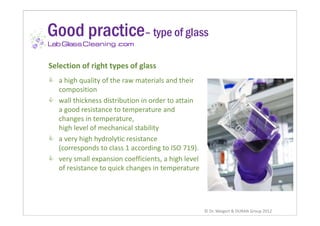
Selection of right types of glass
 a high quality of the raw materials and their
  composition
           ii
 wall thickness distribution in order to attain
  a good resistance to temperature and
    g                       p
  changes in temperature,
  high level of mechanical stability
 a very high hydrolytic resistance
  (corresponds to class 1 according to ISO 719).
 very small expansion coefficients, a high level
  of resistance to quick changes in temperature


                                                    © Dr. Weigert & DURAN Group 2012
Good practice– conformity to standards
                    .com


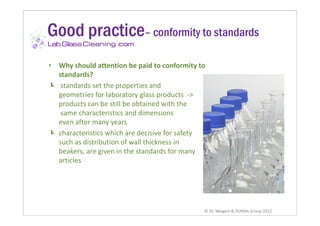
• Why should attention be paid to conformity to
  standards?
 standards set the properties and
  geometries for laboratory glass products ->
  products can be still be obtained with the
   same characteristics and dimensions
  even after many years
 characteristics which are decisive for safety
  such as distribution of wall thickness in
  beakers, are given in the standards for many
  articles


                                              © Dr. Weigert & DURAN Group 2012
Good practice– instruction for use
                      .com


•   What is important when selecting a glass item for use?

 before each use the glass surface should be
  checked for damage such as scratches,
  cracks or chips
 vessels should only b used when they are in
        l h ld l be            d h      h
  a flawless condition, this is particularly
  important for work under pressure or at high
  temperatures
 damaged glass may not be used for safety reasons.


                                                 © Dr. Weigert & DURAN Group 2012
Cleaning – cleaning process
                      .com


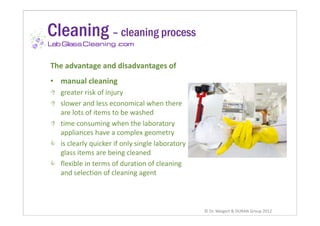
The advantage and disadvantages of
• manual cleaning
 greater risk of injury
 slower and less economical when there
  are lots of items to be washed
 time consuming when the laboratory
  appliances have a complex geometry
 is clearly quicker if only single laboratory
  glass items are being cleaned
 flexible in terms of duration of cleaning
  and selection of cleaning agent


                                                 © Dr. Weigert & DURAN Group 2012
Cleaning – cleaning process
                     .com


Advantages and disadvantages of
• cleaning in a washer/disinfector
 reduced breakage risk
 reduced risk if injury
 saves staff resources
 quicker and more economical for
  large quantities of items to be
  washed
 inflexible in terms of duration of
  cleaning and selection of cleaning
  agent


                                       © Dr. Weigert & DURAN Group 2012
Cleaning – type of soiling
                     .com


Type of soiling
• Organic soiling
   peptides/ proteins, fats/oils,
   carbohydrates/ polysaccharides,
   organic colourings, pigment residues
            colourings
   and felt tip residues, resins and
   paraffin


                                          © Dr. Weigert & DURAN Group 2012
Cleaning – type of soiling
                      .com


Type of soiling

• Inorganic soiling
      g           g
   carbonates, salts, metal oxides,
   watery solutions of inorganic acids
   (HCl,
   (HCl H2SO4)/
   alkali (NaOH, KOH),
   salt solutions
   (NaCl, NaNO3, FeCl2 etc.)


                                         © Dr. Weigert & DURAN Group 2012
Cleaning – type of soiling
                      .com


Type of soiling

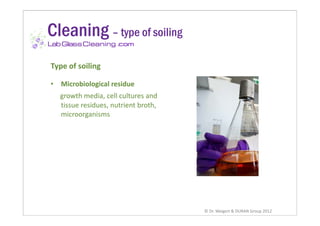
•   Microbiological residue
              g
    growth media, cell cultures and
    tissue residues, nutrient broth,
    microorganisms
       i        i


                                       © Dr. Weigert & DURAN Group 2012
Cleaning - cleaning agents
                      .com


Which cleaning agents are suitable for which soiling?
• Alkaline cleaning agents
 are suitable f th d t i and removal
         it bl for the denaturing d          l
  of residues which contain protein, fat and
  carbohydrates
• Acid cleaning agents
 are effective against inorganic salts,
  lime and other carbonates.
• Bleaching agents
 help with the removal of paints and with disinfection.


                                                 © Dr. Weigert & DURAN Group 2012
Cleaning - cleaning agents
                      .com


• What requirements must a cleaning agent meet?
 The selection is linked to the type of soiling to
  be
  b removed and th f
             d d the framework conditions (ti
                                   k    diti    (time,
  material properties and mechanical system, quality
   of water)
 fundamental requirements: • Which resources can be used?
 good ability to remove dirt         abrasive materials (steel wool)
 high dirt carrying capacity
       dirt-carrying                  must not be used -> these will
 suitable for most surfaces          cause surface damage to the
 good rinsing properties
  g           gp p                    glass
 not hazardous to health           soft sponges, cloths and brushes
 very cost-effective                 are suitable
 environmentally friendly

                                                 © Dr. Weigert & DURAN Group 2012
Cleaning – parameters of cleaning
                     .com


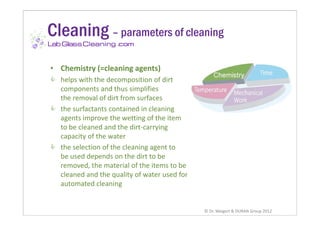
• Chemistry (=cleaning agents)
 helps with the decomposition of dirt
  components and th simplifies
             t    d thus i lifi
  the removal of dirt from surfaces
 the surfactants contained in cleaning
  agents improve the wetting of the item
  to be cleaned and the dirt-carrying
  capac ty o the ate
  capacity of t e water
 the selection of the cleaning agent to
  be used depends on the dirt to be
  removed,
  removed the material of the items to be
  cleaned and the quality of water used for
  automated cleaning


                                              © Dr. Weigert & DURAN Group 2012
Cleaning – parameters of cleaning
                     .com


• Temperature
 high temperatures can accelerate physical,
  chemical and enzymatic processes and
   h i l d              ti              d
  thus benefit removal of contaminations
 temperatures which are too high can,
 however, reduce enzyme activity
 Another disadvantage of excessive temperature
  is the
  i th conversion of carbonic acid contained i
                i    f b i        id    t i d in
  the water to carbonate via hydrogen carbonate
  which is then precipitated as a poorly soluble
  compound with the water hardening salts magnesium
  and calcium. This results in stubborn ‘lime deposits’.


                                                 © Dr. Weigert & DURAN Group 2012
Cleaning – parameters of cleaning
                    .com


• Time
 an extended reaction time for the
  cleaning solution makes th removal
   l    i      l ti     k the         l
  of dirt from the surface easier due
  to better swelling of the contaminants
  and a stronger chemical decomposition
  of the dirt components


                                           © Dr. Weigert & DURAN Group 2012
Cleaning – parameters of cleaning
                      .com


• Mechanics
 The use of mechanical agents such as the
  use of b h or pressurized water jets
         f brushes           d
  enables bonding forces between dirt
  and surface to be overcome so that
  dirt can then be removed more easily.

 Chemistry temperature, time and mechanics are the four components
  Chemistry, temperature
  of the so-called Sinner’s Circle which describes the mode of action of the
  cleaning process and which was named after the chemist Dr. Herbert
  Sinner.
  Sinner


                                                  © Dr. Weigert & DURAN Group 2012
Cleaning – Dr. Sinner´s Circle
               Sinner s
                      .com


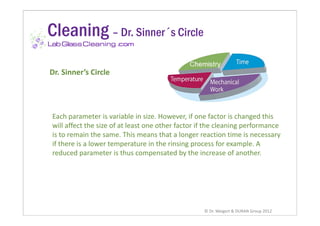
Dr. Sinner’s Circle


Each parameter is variable in size. However, if one factor is changed this
will affect the size of at least one other factor if the cleaning performance
is to remain the same. This means that a longer reaction time is necessary
if there is a lower temperature in the rinsing process for example. A
reduced parameter is thus compensated by the increase of another.


                                                   © Dr. Weigert & DURAN Group 2012
Cleaning – quality of water
                      .com


Quality of water
 defines
   • microbiological factors (germ count)
   • the degree of water hardness, given in °GH (German hardness)
      (magnesium and calcium ions in the water )
 If water with a high degree of hardness is used for cleaning, significant
  residues may be deposited on the cleaned surfaces
 Depending on the water quality (e.g. deionised water or softened water)
  different effects are achieved in combination with the used cleaning
  agents. These affect the material compatibility and the cleaning results.


                                                   © Dr. Weigert & DURAN Group 2012
Advice and Tips
                        .com

•   How can laboratory glass be stored correctly
    whilst saving as much space as possible?
•   Marking – what has to be observed?
•   How can stubborn residues be avoided?
•   How should the glass be disposed of?
•   What should you know about volumetric
    glassware?
•   How should you clean cover glass and slides?


    All this and more at :
    www.labglasscleaning.com

                                                   © Dr. Weigert & DURAN Group 2012
Laboratory Glass Cleaning
              .com


 From experts for experts –
        p           p
 © Dr. Weigert & DURAN Group 2012
   www.labglasscleaning.com
   Pictures by Karin Gerdes
   http://www.karingerdes.de
                               © Dr. Weigert & DURAN Group 2012

Lab glass cleaning

  • 1.
    Lab Glass Cleaning .com com Advice for clean and residue-free residue free laboratory equipment © Dr. Weigert & DURAN Group 2012
  • 2.
    Good practice– typeof glass .com Selection of right types of glass  a high quality of the raw materials and their composition ii  wall thickness distribution in order to attain a good resistance to temperature and g p changes in temperature, high level of mechanical stability  a very high hydrolytic resistance (corresponds to class 1 according to ISO 719).  very small expansion coefficients, a high level of resistance to quick changes in temperature © Dr. Weigert & DURAN Group 2012
  • 3.
    Good practice– conformityto standards .com • Why should attention be paid to conformity to standards?  standards set the properties and geometries for laboratory glass products -> products can be still be obtained with the same characteristics and dimensions even after many years  characteristics which are decisive for safety such as distribution of wall thickness in beakers, are given in the standards for many articles © Dr. Weigert & DURAN Group 2012
  • 4.
    Good practice– instructionfor use .com • What is important when selecting a glass item for use?  before each use the glass surface should be checked for damage such as scratches, cracks or chips  vessels should only b used when they are in l h ld l be d h h a flawless condition, this is particularly important for work under pressure or at high temperatures  damaged glass may not be used for safety reasons. © Dr. Weigert & DURAN Group 2012
  • 5.
    Cleaning – cleaningprocess .com The advantage and disadvantages of • manual cleaning  greater risk of injury  slower and less economical when there are lots of items to be washed  time consuming when the laboratory appliances have a complex geometry  is clearly quicker if only single laboratory glass items are being cleaned  flexible in terms of duration of cleaning and selection of cleaning agent © Dr. Weigert & DURAN Group 2012
  • 6.
    Cleaning – cleaningprocess .com Advantages and disadvantages of • cleaning in a washer/disinfector  reduced breakage risk  reduced risk if injury  saves staff resources  quicker and more economical for large quantities of items to be washed  inflexible in terms of duration of cleaning and selection of cleaning agent © Dr. Weigert & DURAN Group 2012
  • 7.
    Cleaning – typeof soiling .com Type of soiling • Organic soiling peptides/ proteins, fats/oils, carbohydrates/ polysaccharides, organic colourings, pigment residues colourings and felt tip residues, resins and paraffin © Dr. Weigert & DURAN Group 2012
  • 8.
    Cleaning – typeof soiling .com Type of soiling • Inorganic soiling g g carbonates, salts, metal oxides, watery solutions of inorganic acids (HCl, (HCl H2SO4)/ alkali (NaOH, KOH), salt solutions (NaCl, NaNO3, FeCl2 etc.) © Dr. Weigert & DURAN Group 2012
  • 9.
    Cleaning – typeof soiling .com Type of soiling • Microbiological residue g growth media, cell cultures and tissue residues, nutrient broth, microorganisms i i © Dr. Weigert & DURAN Group 2012
  • 10.
    Cleaning - cleaningagents .com Which cleaning agents are suitable for which soiling? • Alkaline cleaning agents  are suitable f th d t i and removal it bl for the denaturing d l of residues which contain protein, fat and carbohydrates • Acid cleaning agents  are effective against inorganic salts, lime and other carbonates. • Bleaching agents  help with the removal of paints and with disinfection. © Dr. Weigert & DURAN Group 2012
  • 11.
    Cleaning - cleaningagents .com • What requirements must a cleaning agent meet?  The selection is linked to the type of soiling to be b removed and th f d d the framework conditions (ti k diti (time, material properties and mechanical system, quality of water)  fundamental requirements: • Which resources can be used?  good ability to remove dirt abrasive materials (steel wool)  high dirt carrying capacity dirt-carrying must not be used -> these will  suitable for most surfaces cause surface damage to the  good rinsing properties g gp p glass  not hazardous to health  soft sponges, cloths and brushes  very cost-effective are suitable  environmentally friendly © Dr. Weigert & DURAN Group 2012
  • 12.
    Cleaning – parametersof cleaning .com • Chemistry (=cleaning agents)  helps with the decomposition of dirt components and th simplifies t d thus i lifi the removal of dirt from surfaces  the surfactants contained in cleaning agents improve the wetting of the item to be cleaned and the dirt-carrying capac ty o the ate capacity of t e water  the selection of the cleaning agent to be used depends on the dirt to be removed, removed the material of the items to be cleaned and the quality of water used for automated cleaning © Dr. Weigert & DURAN Group 2012
  • 13.
    Cleaning – parametersof cleaning .com • Temperature  high temperatures can accelerate physical, chemical and enzymatic processes and h i l d ti d thus benefit removal of contaminations  temperatures which are too high can,  however, reduce enzyme activity  Another disadvantage of excessive temperature is the i th conversion of carbonic acid contained i i f b i id t i d in the water to carbonate via hydrogen carbonate which is then precipitated as a poorly soluble compound with the water hardening salts magnesium and calcium. This results in stubborn ‘lime deposits’. © Dr. Weigert & DURAN Group 2012
  • 14.
    Cleaning – parametersof cleaning .com • Time  an extended reaction time for the cleaning solution makes th removal l i l ti k the l of dirt from the surface easier due to better swelling of the contaminants and a stronger chemical decomposition of the dirt components © Dr. Weigert & DURAN Group 2012
  • 15.
    Cleaning – parametersof cleaning .com • Mechanics  The use of mechanical agents such as the use of b h or pressurized water jets f brushes d enables bonding forces between dirt and surface to be overcome so that dirt can then be removed more easily.  Chemistry temperature, time and mechanics are the four components Chemistry, temperature of the so-called Sinner’s Circle which describes the mode of action of the cleaning process and which was named after the chemist Dr. Herbert Sinner. Sinner © Dr. Weigert & DURAN Group 2012
  • 16.
    Cleaning – Dr.Sinner´s Circle Sinner s .com Dr. Sinner’s Circle Each parameter is variable in size. However, if one factor is changed this will affect the size of at least one other factor if the cleaning performance is to remain the same. This means that a longer reaction time is necessary if there is a lower temperature in the rinsing process for example. A reduced parameter is thus compensated by the increase of another. © Dr. Weigert & DURAN Group 2012
  • 17.
    Cleaning – qualityof water .com Quality of water  defines • microbiological factors (germ count) • the degree of water hardness, given in °GH (German hardness) (magnesium and calcium ions in the water )  If water with a high degree of hardness is used for cleaning, significant residues may be deposited on the cleaned surfaces  Depending on the water quality (e.g. deionised water or softened water) different effects are achieved in combination with the used cleaning agents. These affect the material compatibility and the cleaning results. © Dr. Weigert & DURAN Group 2012
  • 18.
    Advice and Tips .com • How can laboratory glass be stored correctly whilst saving as much space as possible? • Marking – what has to be observed? • How can stubborn residues be avoided? • How should the glass be disposed of? • What should you know about volumetric glassware? • How should you clean cover glass and slides? All this and more at : www.labglasscleaning.com © Dr. Weigert & DURAN Group 2012
  • 19.
    Laboratory Glass Cleaning .com From experts for experts – p p © Dr. Weigert & DURAN Group 2012 www.labglasscleaning.com Pictures by Karin Gerdes http://www.karingerdes.de © Dr. Weigert & DURAN Group 2012