
Tips to Perform Pipette Calibration
• Pipettes are necessary equipment often used in chemical laboratories to measure
  and transfer specific amount of liquid.

• Pipettes are essentially narrow tube like equipment with a rubber bulb at the top.

• The tube is numbered from the top to the bottom mostly in increments of ten
  millimeters.

• Accuracy in pipette measurement is necessary as any discrepancy in reading can
  affect the result of chemical reaction.

• To ensure accuracy it is necessary to perform pipette calibration at regular
  intervals.

• Calibration of equipment is desirable even in the most advanced equipment as
  overtime several factors can affect the readings of measuring equipment.

• Calibration process helps to check whether or not the equipment is offering
  correct reading so that it can be rectified in time and efficiency of processes or
  laboratory test is maintained.
Given below are instructions to help you
    perform pipette calibration on your own.

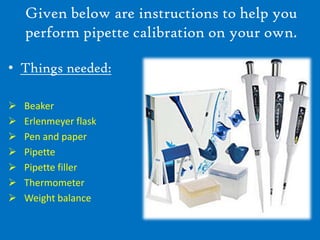
• Things needed:

   Beaker
   Erlenmeyer flask
   Pen and paper
   Pipette
   Pipette filler
   Thermometer
   Weight balance
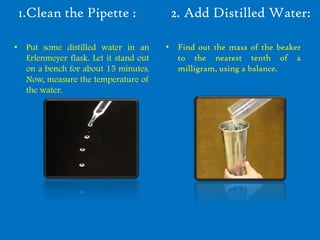
1.Clean the Pipette :                  2. Add Distilled Water:

• Put some distilled water in an       • Find out the mass of the beaker
  Erlenmeyer flask. Let it stand out     to the nearest tenth of a
  on a bench for about 15 minutes.       milligram, using a balance.
  Now, measure the temperature of
  the water.
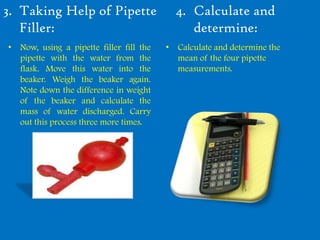
3. Taking Help of Pipette                  4. Calculate and
   Filler:                                    determine:
• Now, using a pipette filler fill the   • Calculate and determine the
  pipette with the water from the          mean of the four pipette
  flask. Move this water into the          measurements.
  beaker. Weigh the beaker again.
  Note down the difference in weight
  of the beaker and calculate the
  mass of water discharged. Carry
  out this process three more times.
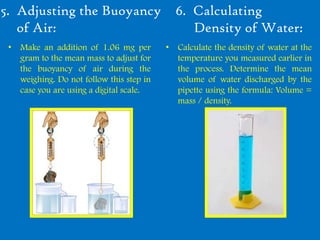
5. Adjusting the Buoyancy                   6. Calculating
   of Air:                                     Density of Water:
 • Make an addition of 1.06 mg per        • Calculate the density of water at the
   gram to the mean mass to adjust for      temperature you measured earlier in
   the buoyancy of air during the           the process. Determine the mean
   weighing. Do not follow this step in     volume of water discharged by the
   case you are using a digital scale.      pipette using the formula: Volume =
                                            mass / density.
It is important to ensure your laboratory is clean and
        organized when carrying out calibration.
You are not required to clean and dry the beaker following each of the
  four pipette measurements as doing this will only waste your time.
Take help of pipette calibration service provider
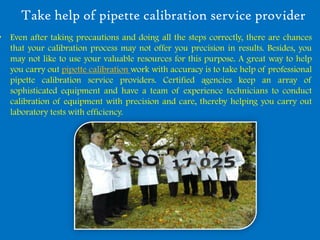
• Even after taking precautions and doing all the steps correctly, there are chances
  that your calibration process may not offer you precision in results. Besides, you
  may not like to use your valuable resources for this purpose. A great way to help
  you carry out pipette calibration work with accuracy is to take help of professional
  pipette calibration service providers. Certified agencies keep an array of
  sophisticated equipment and have a team of experience technicians to conduct
  calibration of equipment with precision and care, thereby helping you carry out
  laboratory tests with efficiency.
For Further Info Visit
www.RScalibration.com

Tips to Perform Pipette Calibration

  • 1.
    Tips to PerformPipette Calibration • Pipettes are necessary equipment often used in chemical laboratories to measure and transfer specific amount of liquid. • Pipettes are essentially narrow tube like equipment with a rubber bulb at the top. • The tube is numbered from the top to the bottom mostly in increments of ten millimeters. • Accuracy in pipette measurement is necessary as any discrepancy in reading can affect the result of chemical reaction. • To ensure accuracy it is necessary to perform pipette calibration at regular intervals. • Calibration of equipment is desirable even in the most advanced equipment as overtime several factors can affect the readings of measuring equipment. • Calibration process helps to check whether or not the equipment is offering correct reading so that it can be rectified in time and efficiency of processes or laboratory test is maintained.
  • 2.
    Given below areinstructions to help you perform pipette calibration on your own. • Things needed:  Beaker  Erlenmeyer flask  Pen and paper  Pipette  Pipette filler  Thermometer  Weight balance
  • 3.
    1.Clean the Pipette: 2. Add Distilled Water: • Put some distilled water in an • Find out the mass of the beaker Erlenmeyer flask. Let it stand out to the nearest tenth of a on a bench for about 15 minutes. milligram, using a balance. Now, measure the temperature of the water.
  • 4.
    3. Taking Helpof Pipette 4. Calculate and Filler: determine: • Now, using a pipette filler fill the • Calculate and determine the pipette with the water from the mean of the four pipette flask. Move this water into the measurements. beaker. Weigh the beaker again. Note down the difference in weight of the beaker and calculate the mass of water discharged. Carry out this process three more times.
  • 5.
    5. Adjusting theBuoyancy 6. Calculating of Air: Density of Water: • Make an addition of 1.06 mg per • Calculate the density of water at the gram to the mean mass to adjust for temperature you measured earlier in the buoyancy of air during the the process. Determine the mean weighing. Do not follow this step in volume of water discharged by the case you are using a digital scale. pipette using the formula: Volume = mass / density.
  • 6.
    It is importantto ensure your laboratory is clean and organized when carrying out calibration.
  • 7.
    You are notrequired to clean and dry the beaker following each of the four pipette measurements as doing this will only waste your time.
  • 8.
    Take help ofpipette calibration service provider • Even after taking precautions and doing all the steps correctly, there are chances that your calibration process may not offer you precision in results. Besides, you may not like to use your valuable resources for this purpose. A great way to help you carry out pipette calibration work with accuracy is to take help of professional pipette calibration service providers. Certified agencies keep an array of sophisticated equipment and have a team of experience technicians to conduct calibration of equipment with precision and care, thereby helping you carry out laboratory tests with efficiency.
  • 9.
    For Further InfoVisit www.RScalibration.com