1
Data Communications, Data
Networks, and the Internet
CEN 220/CIS 192 Advanced Data Communications and Networking
Data and Computer Communications, W. Stallings 9/E, Chapter 1
2
Data Communications
“The fundamental problem of communication is
that of reproducing at one point either exactly or
approximately a message selected at another
point.”
—The Mathematical Theory
of Communication,
Claude Shannon
3
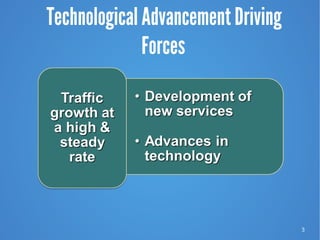
Technological Advancement Driving
Forces
4
Changes in Networking Technology
Emergence of hight-speed LANs
Corporate WAN needs
Digital electronics
5
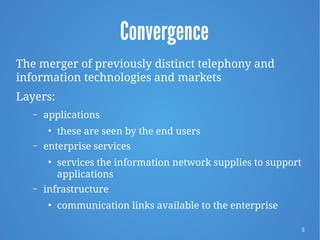
Convergence
The merger of previously distinct telephony and
information technologies and markets
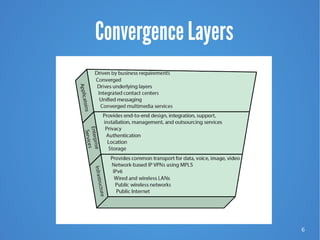
Layers:
– applications
●
these are seen by the end users
– enterprise services
●
services the information network supplies to support
applications
– infrastructure
●
communication links available to the enterprise
6
Convergence Layers
7
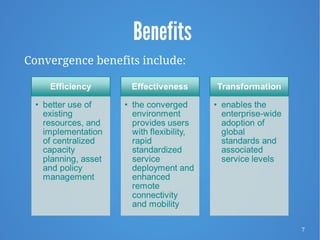
Benefits
Convergence benefits include:
8
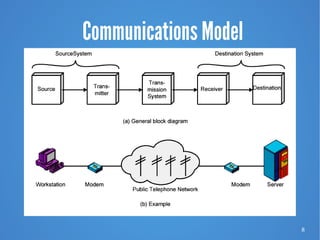
Communications Model
9
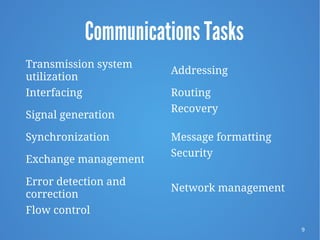
Communications Tasks
Transmission system
utilization
Addressing
Interfacing Routing
Signal generation
Recovery
Synchronization Message formatting
Exchange management
Security
Error detection and
correction
Network management
Flow control
10
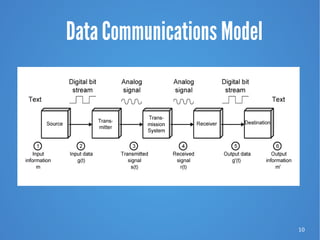
Data Communications Model
11
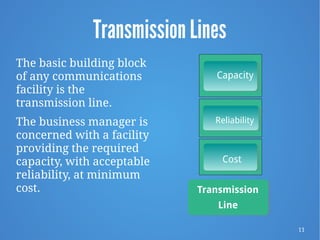
Transmission Lines
The basic building block
of any communications
facility is the
transmission line.
The business manager is
concerned with a facility
providing the required
capacity, with acceptable
reliability, at minimum
cost.
Capacity
Reliability
Cost
Transmission
Line
12
Transmission Lines
Two mediums currently driving the evolution of data
communications transmission are:
– Fiber optic transmission
– Wireless transmission
13
Networking
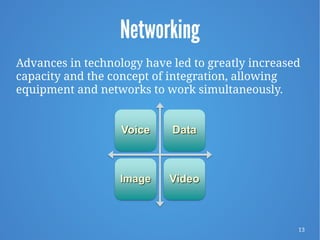
Advances in technology have led to greatly increased
capacity and the concept of integration, allowing
equipment and networks to work simultaneously.
14
LANs and WANs
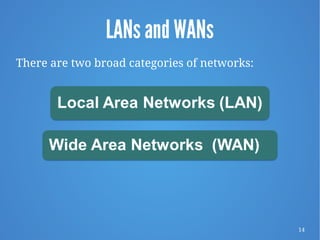
There are two broad categories of networks:
15
Wide Area Networks (WANs)
Span a large geographical area
Require the crossing of public right-of-ways
Rely in part on common carrier circuits
Typically consist of a number of interconnected
switching nodes
16
Wide Area Networks
Alternative technologies used include:
– Circuit switching
– Packet switching
– Frame relay
– Asynchronous Transfer Mode (ATM)
17
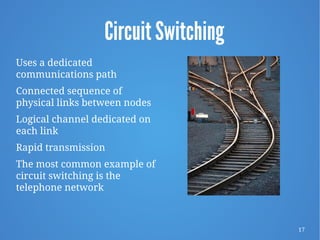
Circuit Switching
Uses a dedicated
communications path
Connected sequence of
physical links between nodes
Logical channel dedicated on
each link
Rapid transmission
The most common example of
circuit switching is the
telephone network
18
Packet Switching
Data are sent out in a sequence
of small chunks called packets
Packets are passed from node
to node along a path leading
from source to destination
Packet-switching networks are
commonly used for
terminal-to-terminal computer
and computer-to-computer
communications
19
Frame Relay
Developed to take advantage of high data rates and
low error rates
Operates at data rates of up to 2 Mbps
Rate of errors dramatically lowered thus reducing
overhead of packet-switching
20
Asynchronous Transfer Mode (ATM)
Referred to as cell relay
Culmination of circuit switching and packet
switching
Uses fixed-length packets called cells
Works in range of 10’s and 100’s of Mbps and in the
Gbps range
Data rate on each channel dynamically set on
demand
21
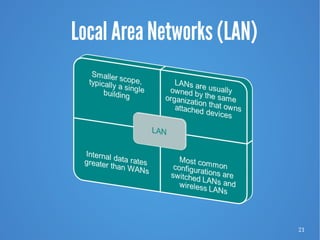
Local Area Networks (LAN)
22
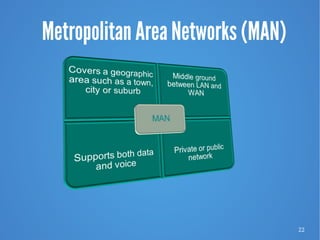
Metropolitan Area Networks (MAN)
23
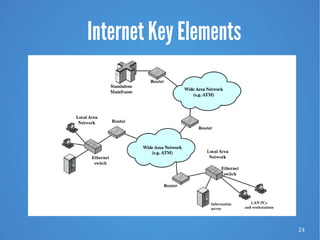
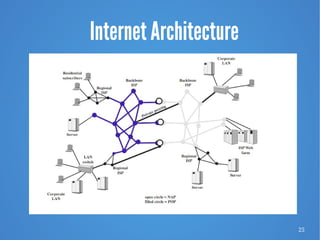
The Internet
Internet evolved from ARPANET
Developed to solve the dilemma of communicating
across arbitrary, multiple, packet-switched network
TCP/IP provides the foundation
24
Internet Key Elements
25
Internet Architecture
26
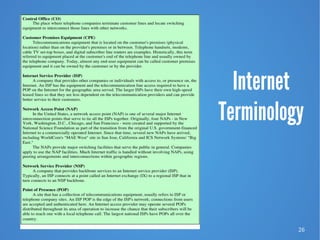
Internet
Terminology
27
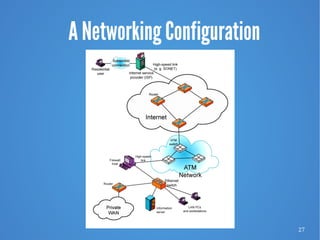
A Networking Configuration
28
Summary
Trends challenging data communications:
– traffic growth
– development of new services
– advances in technology
Transmission mediums
– fiber optic
– wireless
Network categories:
– WAN
– LAN
Internet
– evolved from the ARPANET
– TCP/IP foundation

Chapter 1 - Data Communications, Data Networks, and the Internet