1
IPv6 Overview
2008-01-07William.L
2
Agenda
Why IPv6?
IPv6 Features
IPv6 Addressing
IPv6 Header & Extension Header
Multicast Listener Discovery
Neighbor Discovery
Reference
3
Why IPv6?
4
Public address space becoming exhausted
Large routing tables for Internet backbone routers
Configuration could be simpler
IP-layer security is not required
Need better support for prioritized delivery
Problem with IPv4
5
IPv6 Features
6
Large address space
128-bit (16-byte) source and destination IP addresses.
With a much larger number of available addresses,
address-conservation techniques, such as the deployment
of NAT, are no longer necessary.
New header format
Designed to keep header overhead to a minimum.
Moving both non-essential fields and option fields to
extension headers that are placed after the IPv6 header.
Efficient and hierarchical addressing and routing
infrastructure
7
Stateless and stateful address configuration
To simplify host configuration, IPv6 supports both stateful
address configuration (in the presence of a DHCP server)
and stateless address configuration (in the absence of a
DHCP server).
Built -in security
IPSec architecture
Authentication— MD5 based
Confidentiality— DES, encrypt entire datagram or IP
payload
IPv6 Security header
Authentication Header
Encapsulating Security Payload (ESP)
Multicast support
Multicast support is mandatory.
8
Better support for QoS
New fields in the IPv6 header define how traffic is
identified and handled.
Traffic identification using a Flow Label field in the IPv6
header allows routers to identify and provide special
handling for packets belonging to a flow.
New protocol for neighboring node interaction
Based on ICMPv6 (Internet Control Message Protocol for
IPv6)
Manages the interaction of neighboring nodes (nodes on
the same link).
Extensibility
Can easily be extended for new features by adding
extension headers after the IPv6 header.
9
IPv6 Addressing
10
IPv6 Addressing Model
Addresses are assigned to interfaces
No change from IPv4 Model
Interface ‘expected’ to have multiple addresses
Introduces the concept of limited scope addresses
Link Local
UniqueLocal
Global
Addresses have lifetime
Valid and Preferred lifetime
11
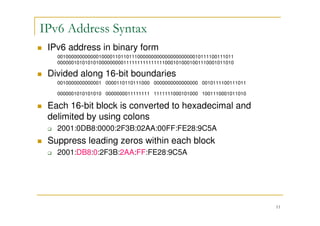
IPv6 Address Syntax
IPv6 address in binary form
0010000000000001000011011011100000000000000000000010111100111011
0000001010101010000000001111111111111110001010001001110001011010
Divided along 16-bit boundaries
0010000000000001 0000110110111000 0000000000000000 0010111100111011
0000001010101010 0000000011111111 1111111000101000 1001110001011010
Each 16-bit block is converted to hexadecimal and
delimited by using colons
2001:0DB8:0000:2F3B:02AA:00FF:FE28:9C5A
Suppress leading zeros within each block
2001:DB8:0:2F3B:2AA:FF:FE28:9C5A
12
Compressing Zeros
Typical IPv6 addresses contain long sequences of
zeros
A single contiguous sequence of 16-bit blocks set
to 0 can be compressed to “::”
Examples
FE80:0:0:0:2AA:FF:FE9A:4CA2 becomes
FE80::2AA:FF:FE9A:4CA2
FF02:0:0:0:0:0:0:2 becomes FF02::2
This mechanism can only be applied once!
2001:3600:0:0:3:0:0:1 2001:3600::3:0000:0000:1
OK
2001:3600:0:0:3:0:0:1 2001:3600::3::1 Wrong!
13
IPv6 Address Prefix
IPv6 Prefix representation
CIDR-Like notation used to specify prefix length
represented with the following notation :
ipv6-address / prefix-length
prefix-length is a decimal value specifying how many of
the left most contiguous bits of the address comprise the
prefix as in the following example: 3FFE:1234::/64
14
Unspecified address (like IPv4’s 0.0.0.0) [Ref.1]
::
Loop-back (like IPv4’s 127.0.0.1) [Ref.1]
0:0:0:0:0:0:0:1
or ::1
Represent an IPv4 address [Ref.1]
IPv4-compatible 0:0:0:0:0:0:199.182.20.17
or ::199.182.20.17
IPv4-mapped IPv4’s 192.0.2.128 is mapped to
IPv6’s ::ffff:c000:280
In web browser URL field
http://[2003:0:0:B3::1234]:8080/URI [Ref.2]
Other IPv6 Addresses’ Representation
15
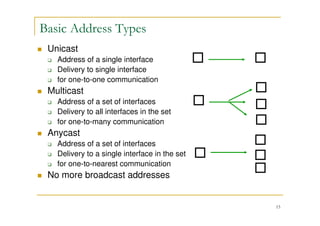
Basic Address Types
Unicast
Address of a single interface
Delivery to single interface
for one-to-one communication
Multicast
Address of a set of interfaces
Delivery to all interfaces in the set
for one-to-many communication
Anycast
Address of a set of interfaces
Delivery to a single interface in the set
for one-to-nearest communication
No more broadcast addresses
16
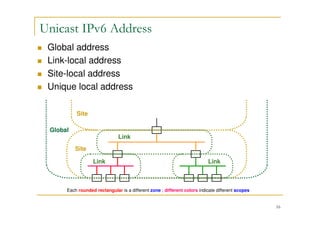
Unicast IPv6 Address
Global address
Link-local address
Site-local address
Unique local address
Link Link
Link
Site
Site
Global
Each rounded rectangular is a different zone ; different colors indicate different scopes
17
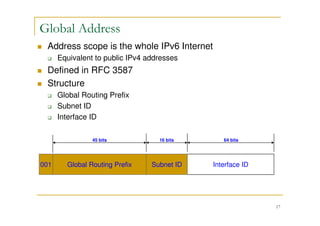
Global Address
Address scope is the whole IPv6 Internet
Equivalent to public IPv4 addresses
Defined in RFC 3587
Structure
Global Routing Prefix
Subnet ID
Interface ID
Interface ID
64 bits
Subnet ID
45 bits
001 Global Routing Prefix
16 bits
18
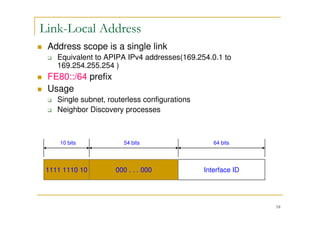
Link-Local Address
Address scope is a single link
Equivalent to APIPA IPv4 addresses(169.254.0.1 to
169.254.255.254 )
FE80::/64 prefix
Usage
Single subnet, routerless configurations
Neighbor Discovery processes
1111 1110 10 Interface ID
10 bits 64 bits
000 . . . 000
54 bits
19
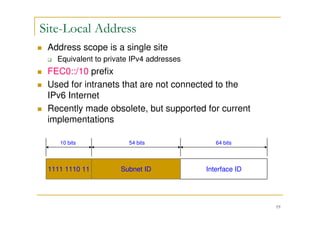
Site-Local Address
Address scope is a single site
Equivalent to private IPv4 addresses
FEC0::/10 prefix
Used for intranets that are not connected to the
IPv6 Internet
Recently made obsolete, but supported for current
implementations
1111 1110 11 Interface ID
10 bits 64 bits54 bits
Subnet ID
20
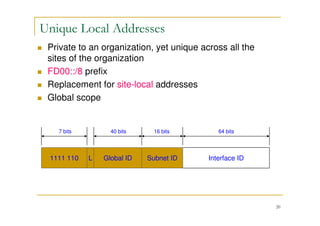
Unique Local Addresses
Private to an organization, yet unique across all the
sites of the organization
FD00::/8 prefix
Replacement for site-local addresses
Global scope
1111 110 Interface ID
7 bits 64 bits
Global ID
40 bits
Subnet ID
16 bits
L
21
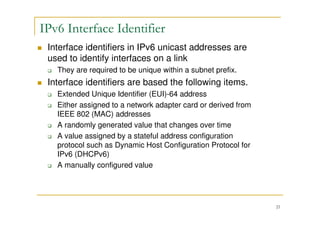
IPv6 Interface Identifier
Interface identifiers in IPv6 unicast addresses are
used to identify interfaces on a link
They are required to be unique within a subnet prefix.
Interface identifiers are based the following items.
Extended Unique Identifier (EUI)-64 address
Either assigned to a network adapter card or derived from
IEEE 802 (MAC) addresses
A randomly generated value that changes over time
A value assigned by a stateful address configuration
protocol such as Dynamic Host Configuration Protocol for
IPv6 (DHCPv6)
A manually configured value
22
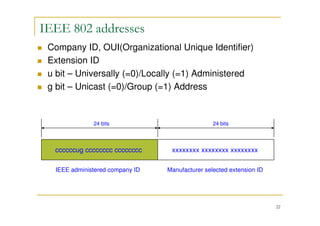
IEEE 802 addresses
Company ID, OUI(Organizational Unique Identifier)
Extension ID
u bit – Universally (=0)/Locally (=1) Administered
g bit – Unicast (=0)/Group (=1) Address
ccccccug cccccccc cccccccc
24 bits 24 bits
xxxxxxxx xxxxxxxx xxxxxxxx
IEEE administered company ID Manufacturer selected extension ID
23
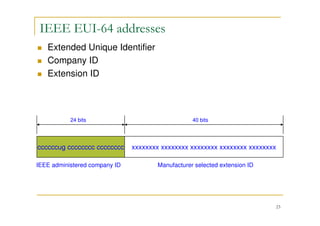
IEEE EUI-64 addresses
Extended Unique Identifier
Company ID
Extension ID
ccccccug cccccccc cccccccc
24 bits 40 bits
xxxxxxxx xxxxxxxx xxxxxxxx xxxxxxxx xxxxxxxx
IEEE administered company ID Manufacturer selected extension ID
24
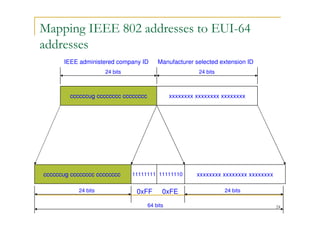
Mapping IEEE 802 addresses to EUI-64
addresses
ccccccug cccccccc cccccccc
24 bits 24 bits
xxxxxxxx xxxxxxxx xxxxxxxx
ccccccug cccccccc cccccccc
24 bits 24 bits
xxxxxxxx xxxxxxxx xxxxxxxx11111111 11111110
0xFF 0xFE
IEEE administered company ID Manufacturer selected extension ID
64 bits
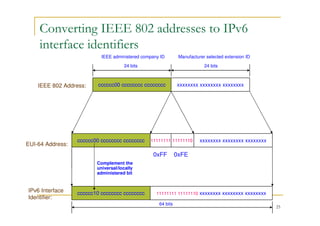
25
Converting IEEE 802 addresses to IPv6
interface identifiers
EUI-64 Address:
cccccc00 cccccccc cccccccc
24 bits 24 bits
xxxxxxxx xxxxxxxx xxxxxxxx
cccccc00 cccccccc cccccccc xxxxxxxx xxxxxxxx xxxxxxxx11111111 11111110
0xFF 0xFE
IEEE administered company ID Manufacturer selected extension ID
cccccc10 cccccccc cccccccc
64 bits
11111111 11111110 xxxxxxxx xxxxxxxx xxxxxxxxIPv6 Interface
Identifier:
IEEE 802 Address:
Complement the
universal/locally
administered bit
26
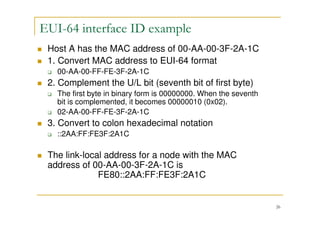
EUI-64 interface ID example
Host A has the MAC address of 00-AA-00-3F-2A-1C
1. Convert MAC address to EUI-64 format
00-AA-00-FF-FE-3F-2A-1C
2. Complement the U/L bit (seventh bit of first byte)
The first byte in binary form is 00000000. When the seventh
bit is complemented, it becomes 00000010 (0x02).
02-AA-00-FF-FE-3F-2A-1C
3. Convert to colon hexadecimal notation
::2AA:FF:FE3F:2A1C
The link-local address for a node with the MAC
address of 00-AA-00-3F-2A-1C is
FE80::2AA:FF:FE3F:2A1C
27
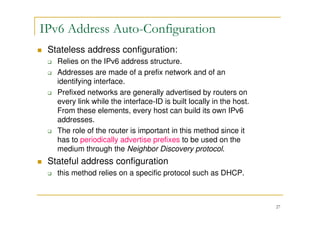
Stateless address configuration:
Relies on the IPv6 address structure.
Addresses are made of a prefix network and of an
identifying interface.
Prefixed networks are generally advertised by routers on
every link while the interface-ID is built locally in the host.
From these elements, every host can build its own IPv6
addresses.
The role of the router is important in this method since it
has to periodically advertise prefixes to be used on the
medium through the Neighbor Discovery protocol.
Stateful address configuration
this method relies on a specific protocol such as DHCP.
IPv6 Address Auto-Configuration
28
Current Allocated IPv6 Addresses (1/2)
Global Unicast 2000::/3
Unique Local Unicast FC00::/7
Reserved by IETF FE00::/9
Link Local Unicast FE80::/10
Reserved by IETF(Deprecated Site Local Unicast)
FEC0::/10
Multicast FF00::/8
Documentation purpose only(must not be routed)
2001:DB8::/32 [Ref.3]
6Bone Testing 3FFE::/16 [Ref.4]
6to4, specific to IPv4/IPv6 integration 2002::/16 [Ref.5]
Teredo 2001:0000::/32 [Ref.6]
29
The range of each RIR(Regional Internet registry)
[Ref.7]
APNIC(Asia Pacific) 2001:0200::/23
HINET-TW-20000208 2001:0238::/35
ARIN(American) 2001:0400::/23
RIPE(Europe, the Middle East and parts of Central Asia )
NCC 2001:0600::/23
Current Allocated IPv6 Addresses (2/2)
30
IPv6 Header &
Extension Header
31
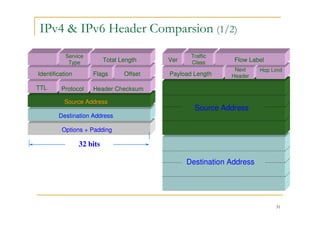
IPv4 & IPv6 Header Comparsion (1/2)
Ver IHL
Destination Address
Source Address
Ver Flow Label
Payload Length
Next
Header
Hop Limit
Traffic
Class
Service
Type
Identification Flags Offset
TTL Protocol Header Checksum
Source Address
Destination Address
Options + Padding
Total Length
32 bits
32
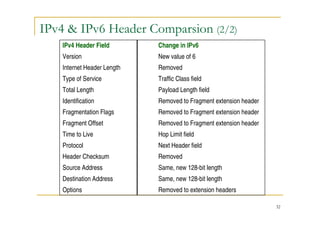
IPv4 & IPv6 Header Comparsion (2/2)
IPv4 Header Field Change in IPv6
Version New value of 6
Internet Header Length Removed
Type of Service Traffic Class field
Total Length Payload Length field
Identification Removed to Fragment extension header
Fragmentation Flags Removed to Fragment extension header
Fragment Offset Removed to Fragment extension header
Time to Live Hop Limit field
Protocol Next Header field
Header Checksum Removed
Source Address Same, new 128-bit length
Destination Address Same, new 128-bit length
Options Removed to extension headers
33
QoS support in IPv6
Flow Label [Ref.8]
20-bit field
To identify specific flows needing special QoS.
Quantitative promises (e.g., x bits per second), uses
RSVP(Resource ReSerVation Protocol) signaling
Traffic Class
8-bit field
To identify specific classes of packets needing special
QoS(DiffServ)
Qualitative promises (e.g., higher priority), no explicit
signaling
34
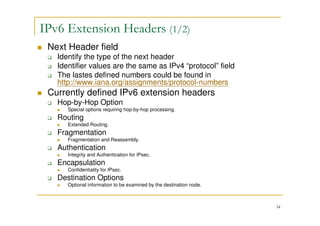
IPv6 Extension Headers (1/2)
Next Header field
Identify the type of the next header
Identifier values are the same as IPv4 “protocol” field
The lastes defined numbers could be found in
http://www.iana.org/assignments/protocol-numbers
Currently defined IPv6 extension headers
Hop-by-Hop Option
Special options requiring hop-by-hop processing.
Routing
Extended Routing.
Fragmentation
Fragmentation and Reassembly.
Authentication
Integrity and Authentication for IPsec.
Encapsulation
Confidentiality for IPsec.
Destination Options
Optional information to be examined by the destination node.
35
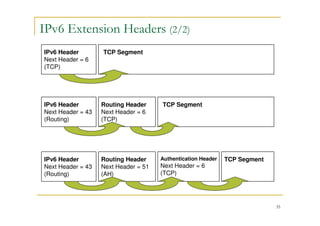
IPv6 Header
Next Header = 6
(TCP)
TCP Segment
IPv6 Header
Next Header = 43
(Routing)
TCP SegmentRouting Header
Next Header = 6
(TCP)
Authentication Header
Next Header = 6
(TCP)
IPv6 Header
Next Header = 43
(Routing)
Routing Header
Next Header = 51
(AH)
TCP Segment
IPv6 Extension Headers (2/2)
36
Multicast Listener Disconvery
37
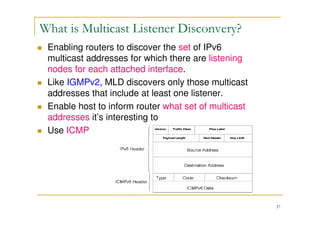
What is Multicast Listener Disconvery?
Enabling routers to discover the set of IPv6
multicast addresses for which there are listening
nodes for each attached interface.
Like IGMPv2, MLD discovers only those multicast
addresses that include at least one listener.
Enable host to inform router what set of multicast
addresses it’s interesting to
Use ICMP
38
ICMP Messages for MLD
Multicast Listener Query
Multicast router queries network to determine membership
in a host group
ICMPv6 type 130
Multicast Listener Report
Host declares membership in a host group
ICMPv6 type 131
Multicast Listener Done
Host declares that there might not be any more members
of a host group on a subnet
ICMPv6 type 132
39
Neighbor Discovery
40
What is Neighbor Discovery?
Node(Hosts and Routers) use ND to determinate
the link-layer addresses for neighbors known to
reside on attached links
Hosts also use ND to find neighboring router that
willing to forward packets on their behalf
Nodes use the protocol to actively keep track of
which neighbors are reachable and which are not,
and to detect changed link-layer addresses
Replace ARP, ICMP Router Discovery, and ICMP
Redirect used in IPv4
Use ICMP
41
ICMP Messages for Neighbor Discovery
Router Solicitation
Router Advertisement
Neighbor Solicitation
Neighbor Advertisement
Redirect
42
Neighbor Discovery Process (1/2)
Router discovery
Discover the local hosts on an attached link
Equivalent to ICMPv4 Router Discovery
Prefix discovery
Discovery the network prefix
Equivalent to ICMPv4 Address Mask Request/Reply
Parameter discovery
Discovery additional parameter(ex: link MTU, default hop
limit for outgoing packet)
Address autoconfiguration
Configure IP address for interfaces
Address resolution
Equivalent to ARP in IPv4
43
Next-hop determination
Destination address, or
Address of an on-link default router
Neighbor unreachable detection(NUD)
Duplicate address detection(DAD)
Determine that an address considered for use is not
already in use by a neighboring node
First-hop Redirect function
Inform a host of a better first-hop IPv6 address to reach a
destination
Equivalent to ICMPv4 Redirect
Neighbor Discovery Process (2/2)
44
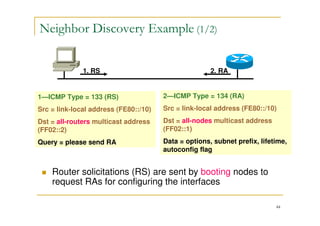
Neighbor Discovery Example (1/2)
Router solicitations (RS) are sent by booting nodes to
request RAs for configuring the interfaces
1—ICMP Type = 133 (RS)
Src = link-local address (FE80::/10)
Dst = all-routers multicast address
(FF02::2)
Query = please send RA
2. RA1. RS
2—ICMP Type = 134 (RA)
Src = link-local address (FE80::/10)
Dst = all-nodes multicast address
(FF02::1)
Data = options, subnet prefix, lifetime,
autoconfig flag
45
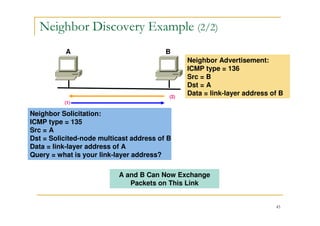
Neighbor Solicitation:
ICMP type = 135
Src = A
Dst = Solicited-node multicast address of B
Data = link-layer address of A
Query = what is your link-layer address?
Neighbor Advertisement:
ICMP type = 136
Src = B
Dst = A
Data = link-layer address of B
A and B Can Now Exchange
Packets on This Link
A B
(1)
(2)
Neighbor Discovery Example (2/2)
46
Reference
47
[1] RFC 4291 IP Version 6 Addressing Architecture
[2] RFC 2732:Format for Literal IPv6 Addresses in URL's
[3] RFC 3849 IPv6 Address Prefix Reserved for
Documentation
[4] RFC 3701 6bone (IPv6 Testing Address Allocation)
Phaseout
[5] RFC 3056 Connection of IPv6 Domains via IPv4
Clouds
[6] "Teredo: Tunneling IPv6 over UDP through NATs", C.
Huitema,
draft-huitema-v6ops-teredo-00.txt (Work inProgress),
June 2003.
[7] RIR Registry
[8] http://tools.ietf.org/id/draft-ietf-ipv6-flow-label-09.txt

IPv6 Overview

  • 1.
  • 2.
    2 Agenda Why IPv6? IPv6 Features IPv6Addressing IPv6 Header & Extension Header Multicast Listener Discovery Neighbor Discovery Reference
  • 3.
  • 4.
    4 Public address spacebecoming exhausted Large routing tables for Internet backbone routers Configuration could be simpler IP-layer security is not required Need better support for prioritized delivery Problem with IPv4
  • 5.
  • 6.
    6 Large address space 128-bit(16-byte) source and destination IP addresses. With a much larger number of available addresses, address-conservation techniques, such as the deployment of NAT, are no longer necessary. New header format Designed to keep header overhead to a minimum. Moving both non-essential fields and option fields to extension headers that are placed after the IPv6 header. Efficient and hierarchical addressing and routing infrastructure
  • 7.
    7 Stateless and statefuladdress configuration To simplify host configuration, IPv6 supports both stateful address configuration (in the presence of a DHCP server) and stateless address configuration (in the absence of a DHCP server). Built -in security IPSec architecture Authentication— MD5 based Confidentiality— DES, encrypt entire datagram or IP payload IPv6 Security header Authentication Header Encapsulating Security Payload (ESP) Multicast support Multicast support is mandatory.
  • 8.
    8 Better support forQoS New fields in the IPv6 header define how traffic is identified and handled. Traffic identification using a Flow Label field in the IPv6 header allows routers to identify and provide special handling for packets belonging to a flow. New protocol for neighboring node interaction Based on ICMPv6 (Internet Control Message Protocol for IPv6) Manages the interaction of neighboring nodes (nodes on the same link). Extensibility Can easily be extended for new features by adding extension headers after the IPv6 header.
  • 9.
  • 10.
    10 IPv6 Addressing Model Addressesare assigned to interfaces No change from IPv4 Model Interface ‘expected’ to have multiple addresses Introduces the concept of limited scope addresses Link Local UniqueLocal Global Addresses have lifetime Valid and Preferred lifetime
  • 11.
    11 IPv6 Address Syntax IPv6address in binary form 0010000000000001000011011011100000000000000000000010111100111011 0000001010101010000000001111111111111110001010001001110001011010 Divided along 16-bit boundaries 0010000000000001 0000110110111000 0000000000000000 0010111100111011 0000001010101010 0000000011111111 1111111000101000 1001110001011010 Each 16-bit block is converted to hexadecimal and delimited by using colons 2001:0DB8:0000:2F3B:02AA:00FF:FE28:9C5A Suppress leading zeros within each block 2001:DB8:0:2F3B:2AA:FF:FE28:9C5A
  • 12.
    12 Compressing Zeros Typical IPv6addresses contain long sequences of zeros A single contiguous sequence of 16-bit blocks set to 0 can be compressed to “::” Examples FE80:0:0:0:2AA:FF:FE9A:4CA2 becomes FE80::2AA:FF:FE9A:4CA2 FF02:0:0:0:0:0:0:2 becomes FF02::2 This mechanism can only be applied once! 2001:3600:0:0:3:0:0:1 2001:3600::3:0000:0000:1 OK 2001:3600:0:0:3:0:0:1 2001:3600::3::1 Wrong!
  • 13.
    13 IPv6 Address Prefix IPv6Prefix representation CIDR-Like notation used to specify prefix length represented with the following notation : ipv6-address / prefix-length prefix-length is a decimal value specifying how many of the left most contiguous bits of the address comprise the prefix as in the following example: 3FFE:1234::/64
  • 14.
    14 Unspecified address (likeIPv4’s 0.0.0.0) [Ref.1] :: Loop-back (like IPv4’s 127.0.0.1) [Ref.1] 0:0:0:0:0:0:0:1 or ::1 Represent an IPv4 address [Ref.1] IPv4-compatible 0:0:0:0:0:0:199.182.20.17 or ::199.182.20.17 IPv4-mapped IPv4’s 192.0.2.128 is mapped to IPv6’s ::ffff:c000:280 In web browser URL field http://[2003:0:0:B3::1234]:8080/URI [Ref.2] Other IPv6 Addresses’ Representation
  • 15.
    15 Basic Address Types Unicast Addressof a single interface Delivery to single interface for one-to-one communication Multicast Address of a set of interfaces Delivery to all interfaces in the set for one-to-many communication Anycast Address of a set of interfaces Delivery to a single interface in the set for one-to-nearest communication No more broadcast addresses
  • 16.
    16 Unicast IPv6 Address Globaladdress Link-local address Site-local address Unique local address Link Link Link Site Site Global Each rounded rectangular is a different zone ; different colors indicate different scopes
  • 17.
    17 Global Address Address scopeis the whole IPv6 Internet Equivalent to public IPv4 addresses Defined in RFC 3587 Structure Global Routing Prefix Subnet ID Interface ID Interface ID 64 bits Subnet ID 45 bits 001 Global Routing Prefix 16 bits
  • 18.
    18 Link-Local Address Address scopeis a single link Equivalent to APIPA IPv4 addresses(169.254.0.1 to 169.254.255.254 ) FE80::/64 prefix Usage Single subnet, routerless configurations Neighbor Discovery processes 1111 1110 10 Interface ID 10 bits 64 bits 000 . . . 000 54 bits
  • 19.
    19 Site-Local Address Address scopeis a single site Equivalent to private IPv4 addresses FEC0::/10 prefix Used for intranets that are not connected to the IPv6 Internet Recently made obsolete, but supported for current implementations 1111 1110 11 Interface ID 10 bits 64 bits54 bits Subnet ID
  • 20.
    20 Unique Local Addresses Privateto an organization, yet unique across all the sites of the organization FD00::/8 prefix Replacement for site-local addresses Global scope 1111 110 Interface ID 7 bits 64 bits Global ID 40 bits Subnet ID 16 bits L
  • 21.
    21 IPv6 Interface Identifier Interfaceidentifiers in IPv6 unicast addresses are used to identify interfaces on a link They are required to be unique within a subnet prefix. Interface identifiers are based the following items. Extended Unique Identifier (EUI)-64 address Either assigned to a network adapter card or derived from IEEE 802 (MAC) addresses A randomly generated value that changes over time A value assigned by a stateful address configuration protocol such as Dynamic Host Configuration Protocol for IPv6 (DHCPv6) A manually configured value
  • 22.
    22 IEEE 802 addresses CompanyID, OUI(Organizational Unique Identifier) Extension ID u bit – Universally (=0)/Locally (=1) Administered g bit – Unicast (=0)/Group (=1) Address ccccccug cccccccc cccccccc 24 bits 24 bits xxxxxxxx xxxxxxxx xxxxxxxx IEEE administered company ID Manufacturer selected extension ID
  • 23.
    23 IEEE EUI-64 addresses ExtendedUnique Identifier Company ID Extension ID ccccccug cccccccc cccccccc 24 bits 40 bits xxxxxxxx xxxxxxxx xxxxxxxx xxxxxxxx xxxxxxxx IEEE administered company ID Manufacturer selected extension ID
  • 24.
    24 Mapping IEEE 802addresses to EUI-64 addresses ccccccug cccccccc cccccccc 24 bits 24 bits xxxxxxxx xxxxxxxx xxxxxxxx ccccccug cccccccc cccccccc 24 bits 24 bits xxxxxxxx xxxxxxxx xxxxxxxx11111111 11111110 0xFF 0xFE IEEE administered company ID Manufacturer selected extension ID 64 bits
  • 25.
    25 Converting IEEE 802addresses to IPv6 interface identifiers EUI-64 Address: cccccc00 cccccccc cccccccc 24 bits 24 bits xxxxxxxx xxxxxxxx xxxxxxxx cccccc00 cccccccc cccccccc xxxxxxxx xxxxxxxx xxxxxxxx11111111 11111110 0xFF 0xFE IEEE administered company ID Manufacturer selected extension ID cccccc10 cccccccc cccccccc 64 bits 11111111 11111110 xxxxxxxx xxxxxxxx xxxxxxxxIPv6 Interface Identifier: IEEE 802 Address: Complement the universal/locally administered bit
  • 26.
    26 EUI-64 interface IDexample Host A has the MAC address of 00-AA-00-3F-2A-1C 1. Convert MAC address to EUI-64 format 00-AA-00-FF-FE-3F-2A-1C 2. Complement the U/L bit (seventh bit of first byte) The first byte in binary form is 00000000. When the seventh bit is complemented, it becomes 00000010 (0x02). 02-AA-00-FF-FE-3F-2A-1C 3. Convert to colon hexadecimal notation ::2AA:FF:FE3F:2A1C The link-local address for a node with the MAC address of 00-AA-00-3F-2A-1C is FE80::2AA:FF:FE3F:2A1C
  • 27.
    27 Stateless address configuration: Relieson the IPv6 address structure. Addresses are made of a prefix network and of an identifying interface. Prefixed networks are generally advertised by routers on every link while the interface-ID is built locally in the host. From these elements, every host can build its own IPv6 addresses. The role of the router is important in this method since it has to periodically advertise prefixes to be used on the medium through the Neighbor Discovery protocol. Stateful address configuration this method relies on a specific protocol such as DHCP. IPv6 Address Auto-Configuration
  • 28.
    28 Current Allocated IPv6Addresses (1/2) Global Unicast 2000::/3 Unique Local Unicast FC00::/7 Reserved by IETF FE00::/9 Link Local Unicast FE80::/10 Reserved by IETF(Deprecated Site Local Unicast) FEC0::/10 Multicast FF00::/8 Documentation purpose only(must not be routed) 2001:DB8::/32 [Ref.3] 6Bone Testing 3FFE::/16 [Ref.4] 6to4, specific to IPv4/IPv6 integration 2002::/16 [Ref.5] Teredo 2001:0000::/32 [Ref.6]
  • 29.
    29 The range ofeach RIR(Regional Internet registry) [Ref.7] APNIC(Asia Pacific) 2001:0200::/23 HINET-TW-20000208 2001:0238::/35 ARIN(American) 2001:0400::/23 RIPE(Europe, the Middle East and parts of Central Asia ) NCC 2001:0600::/23 Current Allocated IPv6 Addresses (2/2)
  • 30.
  • 31.
    31 IPv4 & IPv6Header Comparsion (1/2) Ver IHL Destination Address Source Address Ver Flow Label Payload Length Next Header Hop Limit Traffic Class Service Type Identification Flags Offset TTL Protocol Header Checksum Source Address Destination Address Options + Padding Total Length 32 bits
  • 32.
    32 IPv4 & IPv6Header Comparsion (2/2) IPv4 Header Field Change in IPv6 Version New value of 6 Internet Header Length Removed Type of Service Traffic Class field Total Length Payload Length field Identification Removed to Fragment extension header Fragmentation Flags Removed to Fragment extension header Fragment Offset Removed to Fragment extension header Time to Live Hop Limit field Protocol Next Header field Header Checksum Removed Source Address Same, new 128-bit length Destination Address Same, new 128-bit length Options Removed to extension headers
  • 33.
    33 QoS support inIPv6 Flow Label [Ref.8] 20-bit field To identify specific flows needing special QoS. Quantitative promises (e.g., x bits per second), uses RSVP(Resource ReSerVation Protocol) signaling Traffic Class 8-bit field To identify specific classes of packets needing special QoS(DiffServ) Qualitative promises (e.g., higher priority), no explicit signaling
  • 34.
    34 IPv6 Extension Headers(1/2) Next Header field Identify the type of the next header Identifier values are the same as IPv4 “protocol” field The lastes defined numbers could be found in http://www.iana.org/assignments/protocol-numbers Currently defined IPv6 extension headers Hop-by-Hop Option Special options requiring hop-by-hop processing. Routing Extended Routing. Fragmentation Fragmentation and Reassembly. Authentication Integrity and Authentication for IPsec. Encapsulation Confidentiality for IPsec. Destination Options Optional information to be examined by the destination node.
  • 35.
    35 IPv6 Header Next Header= 6 (TCP) TCP Segment IPv6 Header Next Header = 43 (Routing) TCP SegmentRouting Header Next Header = 6 (TCP) Authentication Header Next Header = 6 (TCP) IPv6 Header Next Header = 43 (Routing) Routing Header Next Header = 51 (AH) TCP Segment IPv6 Extension Headers (2/2)
  • 36.
  • 37.
    37 What is MulticastListener Disconvery? Enabling routers to discover the set of IPv6 multicast addresses for which there are listening nodes for each attached interface. Like IGMPv2, MLD discovers only those multicast addresses that include at least one listener. Enable host to inform router what set of multicast addresses it’s interesting to Use ICMP
  • 38.
    38 ICMP Messages forMLD Multicast Listener Query Multicast router queries network to determine membership in a host group ICMPv6 type 130 Multicast Listener Report Host declares membership in a host group ICMPv6 type 131 Multicast Listener Done Host declares that there might not be any more members of a host group on a subnet ICMPv6 type 132
  • 39.
  • 40.
    40 What is NeighborDiscovery? Node(Hosts and Routers) use ND to determinate the link-layer addresses for neighbors known to reside on attached links Hosts also use ND to find neighboring router that willing to forward packets on their behalf Nodes use the protocol to actively keep track of which neighbors are reachable and which are not, and to detect changed link-layer addresses Replace ARP, ICMP Router Discovery, and ICMP Redirect used in IPv4 Use ICMP
  • 41.
    41 ICMP Messages forNeighbor Discovery Router Solicitation Router Advertisement Neighbor Solicitation Neighbor Advertisement Redirect
  • 42.
    42 Neighbor Discovery Process(1/2) Router discovery Discover the local hosts on an attached link Equivalent to ICMPv4 Router Discovery Prefix discovery Discovery the network prefix Equivalent to ICMPv4 Address Mask Request/Reply Parameter discovery Discovery additional parameter(ex: link MTU, default hop limit for outgoing packet) Address autoconfiguration Configure IP address for interfaces Address resolution Equivalent to ARP in IPv4
  • 43.
    43 Next-hop determination Destination address,or Address of an on-link default router Neighbor unreachable detection(NUD) Duplicate address detection(DAD) Determine that an address considered for use is not already in use by a neighboring node First-hop Redirect function Inform a host of a better first-hop IPv6 address to reach a destination Equivalent to ICMPv4 Redirect Neighbor Discovery Process (2/2)
  • 44.
    44 Neighbor Discovery Example(1/2) Router solicitations (RS) are sent by booting nodes to request RAs for configuring the interfaces 1—ICMP Type = 133 (RS) Src = link-local address (FE80::/10) Dst = all-routers multicast address (FF02::2) Query = please send RA 2. RA1. RS 2—ICMP Type = 134 (RA) Src = link-local address (FE80::/10) Dst = all-nodes multicast address (FF02::1) Data = options, subnet prefix, lifetime, autoconfig flag
  • 45.
    45 Neighbor Solicitation: ICMP type= 135 Src = A Dst = Solicited-node multicast address of B Data = link-layer address of A Query = what is your link-layer address? Neighbor Advertisement: ICMP type = 136 Src = B Dst = A Data = link-layer address of B A and B Can Now Exchange Packets on This Link A B (1) (2) Neighbor Discovery Example (2/2)
  • 46.
  • 47.
    47 [1] RFC 4291IP Version 6 Addressing Architecture [2] RFC 2732:Format for Literal IPv6 Addresses in URL's [3] RFC 3849 IPv6 Address Prefix Reserved for Documentation [4] RFC 3701 6bone (IPv6 Testing Address Allocation) Phaseout [5] RFC 3056 Connection of IPv6 Domains via IPv4 Clouds [6] "Teredo: Tunneling IPv6 over UDP through NATs", C. Huitema, draft-huitema-v6ops-teredo-00.txt (Work inProgress), June 2003. [7] RIR Registry [8] http://tools.ietf.org/id/draft-ietf-ipv6-flow-label-09.txt