CHEMICAL BONDING Dr Sharipah Ruzaina Syed Aris srsa_July2009
3 main types of  Bonding Ionic Bonding/Ionic bond Covalent Bonding Dative or coordinate bond A chemical bond is a strong attractive force that exists between atoms in a substance srsa_July2009
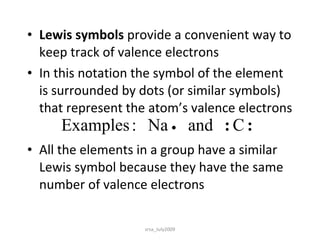
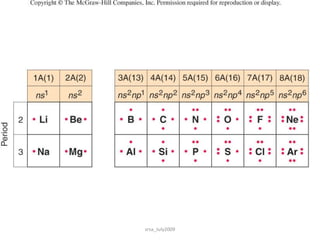
Lewis symbols  provide a convenient way to keep track of valence electrons In this notation the symbol of the element is surrounded by dots (or similar symbols) that represent the atom’s valence electrons  All the elements in a group have a similar Lewis symbol because they have the same number of valence electrons srsa_July2009
srsa_July2009
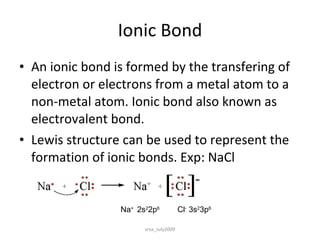
Ionic Bond An ionic bond is formed by the transfering of electron or electrons from a metal atom to a non-metal atom. Ionic bond also known as electrovalent bond. Lewis structure can be used to represent the formation of ionic bonds. Exp: NaCl Na +  2s 2 2p 6   Cl -  3s 2 3p 6 srsa_July2009
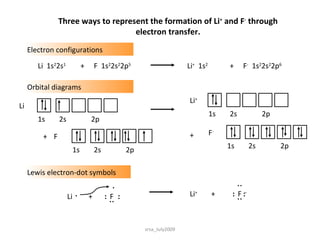
Electron configurations Li  1s 2 2s 1 Orbital diagrams Lewis electron-dot symbols + F  1s 2 2s 2 2p 5 Li +   1s 2 Three ways to represent the formation of Li +  and F -  through electron transfer. srsa_July2009 + F -   1s 2 2s 2 2p 6 Li 1s 2s 2p F 1s 2s 2p + Li + 1s 2s 2p F - 1s 2s 2p + . + F : : : Li . Li + + F  - : : : :
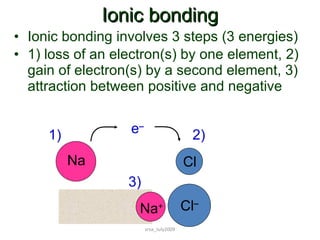
Ionic bonding Ionic bonding involves 3 steps (3 energies) 1) loss of an electron(s) by one element, 2) gain of electron(s) by a second element, 3) attraction between positive and negative srsa_July2009 Cl – Na + Cl – Na Cl e – 1) 2) 3) Na +
Exercise:  aluminium fluoride AlF 3  magnesium chloride MgCl 2  srsa_July2009 [  O  ] 2– [Mg] 2+ O Mg
Physical Properties of Ionic Bond Hard and brittle crystalline solids High melting and boiling points Soluble in water (polar solvent) Good electrical conductor in molten forms and in aqueous solutions but insulators in solid forms. srsa_July2009
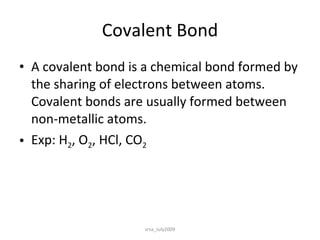
Covalent Bond A covalent bond is a chemical bond formed by the sharing of electrons between atoms. Covalent bonds are usually formed between non-metallic atoms. Exp: H 2 , O 2 , HCl, CO 2 srsa_July2009
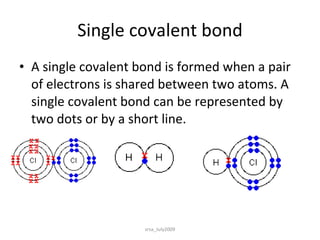
Single covalent bond A single covalent bond is formed when a pair of electrons is shared between two atoms. A single covalent bond can be represented by two dots or by a short line. srsa_July2009
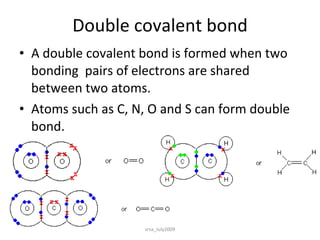
Double covalent bond A double covalent bond is formed when two bonding  pairs of electrons are shared between two atoms. Atoms such as C, N, O and S can form double bond. srsa_July2009
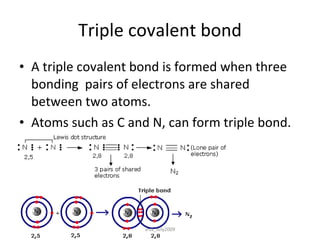
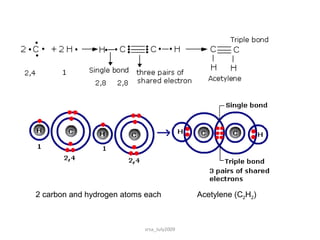
Triple covalent bond A triple covalent bond is formed when three bonding  pairs of electrons are shared between two atoms. Atoms such as C and N, can form triple bond. srsa_July2009
2 carbon and hydrogen atoms each          Acetylene (C 2 H 2 )  srsa_July2009
Physical properties of covalent compounds Low melting and boiling points: The covalent molecules in the crystal are held together by the weak van der Waals forces. Insoluble in water but soluble in nonpolar solvents. Electrical insulators: when melted, neutral molecules and atoms are released and they are not attracted to any electrode. srsa_July2009
Draw a Lewis structure for each of the following molecules: H 2   N 2  O 2   F 2 H 2 O NH 3 srsa_July2009
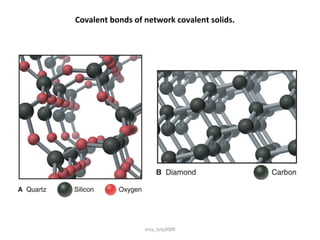
Covalent bonds of network covalent solids. srsa_July2009
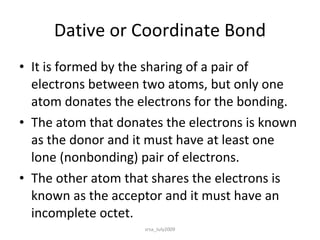
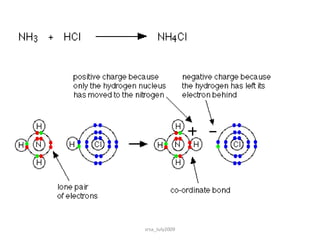
Dative or Coordinate Bond It is formed by the sharing of a pair of electrons between two atoms, but only one atom donates the electrons for the bonding. The atom that donates the electrons is known as the donor and it must have at least one lone (nonbonding) pair of electrons.  The other atom that shares the electrons is known as the acceptor and it must have an incomplete octet. srsa_July2009
srsa_July2009
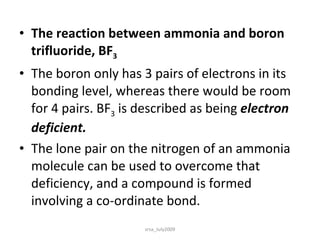
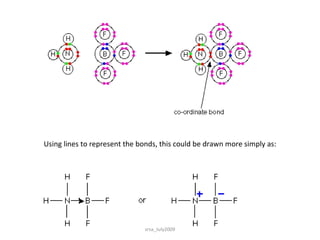
The reaction between ammonia and boron trifluoride, BF 3 The boron only has 3 pairs of electrons in its bonding level, whereas there would be room for 4 pairs. BF 3  is described as being  electron deficient. The lone pair on the nitrogen of an ammonia molecule can be used to overcome that deficiency, and a compound is formed involving a co-ordinate bond. srsa_July2009
Using lines to represent the bonds, this could be drawn more simply as: srsa_July2009
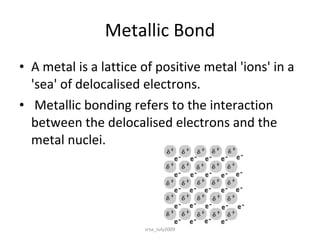
Metallic Bond A metal is a lattice of positive metal 'ions' in a 'sea' of delocalised electrons. Metallic bonding refers to the interaction between the delocalised electrons and the metal nuclei.  srsa_July2009
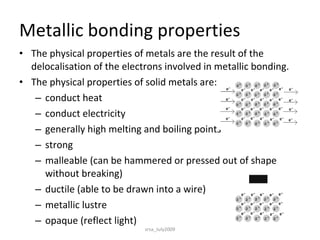
Metallic bonding properties The physical properties of metals are the result of the delocalisation of the electrons involved in metallic bonding.  The physical properties of solid metals are:  conduct heat  conduct electricity  generally high melting and boiling points  strong  malleable (can be hammered or pressed out of shape without breaking)  ductile (able to be drawn into a wire)  metallic lustre  opaque (reflect light)  srsa_July2009

Chemical bonding

  • 1.
    CHEMICAL BONDING DrSharipah Ruzaina Syed Aris srsa_July2009
  • 2.
    3 main typesof Bonding Ionic Bonding/Ionic bond Covalent Bonding Dative or coordinate bond A chemical bond is a strong attractive force that exists between atoms in a substance srsa_July2009
  • 3.
    Lewis symbols provide a convenient way to keep track of valence electrons In this notation the symbol of the element is surrounded by dots (or similar symbols) that represent the atom’s valence electrons All the elements in a group have a similar Lewis symbol because they have the same number of valence electrons srsa_July2009
  • 4.
  • 5.
    Ionic Bond Anionic bond is formed by the transfering of electron or electrons from a metal atom to a non-metal atom. Ionic bond also known as electrovalent bond. Lewis structure can be used to represent the formation of ionic bonds. Exp: NaCl Na + 2s 2 2p 6 Cl - 3s 2 3p 6 srsa_July2009
  • 6.
    Electron configurations Li 1s 2 2s 1 Orbital diagrams Lewis electron-dot symbols + F 1s 2 2s 2 2p 5 Li + 1s 2 Three ways to represent the formation of Li + and F - through electron transfer. srsa_July2009 + F - 1s 2 2s 2 2p 6 Li 1s 2s 2p F 1s 2s 2p + Li + 1s 2s 2p F - 1s 2s 2p + . + F : : : Li . Li + + F - : : : :
  • 7.
    Ionic bonding Ionicbonding involves 3 steps (3 energies) 1) loss of an electron(s) by one element, 2) gain of electron(s) by a second element, 3) attraction between positive and negative srsa_July2009 Cl – Na + Cl – Na Cl e – 1) 2) 3) Na +
  • 8.
    Exercise: aluminiumfluoride AlF 3 magnesium chloride MgCl 2 srsa_July2009 [ O ] 2– [Mg] 2+ O Mg
  • 9.
    Physical Properties ofIonic Bond Hard and brittle crystalline solids High melting and boiling points Soluble in water (polar solvent) Good electrical conductor in molten forms and in aqueous solutions but insulators in solid forms. srsa_July2009
  • 10.
    Covalent Bond Acovalent bond is a chemical bond formed by the sharing of electrons between atoms. Covalent bonds are usually formed between non-metallic atoms. Exp: H 2 , O 2 , HCl, CO 2 srsa_July2009
  • 11.
    Single covalent bondA single covalent bond is formed when a pair of electrons is shared between two atoms. A single covalent bond can be represented by two dots or by a short line. srsa_July2009
  • 12.
    Double covalent bondA double covalent bond is formed when two bonding pairs of electrons are shared between two atoms. Atoms such as C, N, O and S can form double bond. srsa_July2009
  • 13.
    Triple covalent bondA triple covalent bond is formed when three bonding pairs of electrons are shared between two atoms. Atoms such as C and N, can form triple bond. srsa_July2009
  • 14.
    2 carbon andhydrogen atoms each         Acetylene (C 2 H 2 ) srsa_July2009
  • 15.
    Physical properties ofcovalent compounds Low melting and boiling points: The covalent molecules in the crystal are held together by the weak van der Waals forces. Insoluble in water but soluble in nonpolar solvents. Electrical insulators: when melted, neutral molecules and atoms are released and they are not attracted to any electrode. srsa_July2009
  • 16.
    Draw a Lewisstructure for each of the following molecules: H 2 N 2 O 2 F 2 H 2 O NH 3 srsa_July2009
  • 17.
    Covalent bonds ofnetwork covalent solids. srsa_July2009
  • 18.
    Dative or CoordinateBond It is formed by the sharing of a pair of electrons between two atoms, but only one atom donates the electrons for the bonding. The atom that donates the electrons is known as the donor and it must have at least one lone (nonbonding) pair of electrons. The other atom that shares the electrons is known as the acceptor and it must have an incomplete octet. srsa_July2009
  • 19.
  • 20.
    The reaction betweenammonia and boron trifluoride, BF 3 The boron only has 3 pairs of electrons in its bonding level, whereas there would be room for 4 pairs. BF 3 is described as being electron deficient. The lone pair on the nitrogen of an ammonia molecule can be used to overcome that deficiency, and a compound is formed involving a co-ordinate bond. srsa_July2009
  • 21.
    Using lines torepresent the bonds, this could be drawn more simply as: srsa_July2009
  • 22.
    Metallic Bond Ametal is a lattice of positive metal 'ions' in a 'sea' of delocalised electrons. Metallic bonding refers to the interaction between the delocalised electrons and the metal nuclei. srsa_July2009
  • 23.
    Metallic bonding propertiesThe physical properties of metals are the result of the delocalisation of the electrons involved in metallic bonding. The physical properties of solid metals are: conduct heat conduct electricity generally high melting and boiling points strong malleable (can be hammered or pressed out of shape without breaking) ductile (able to be drawn into a wire) metallic lustre opaque (reflect light) srsa_July2009

Editor's Notes