Introduction to
bonding
• Bondingis the force of attraction that holds
atoms together in a compound or material.
• Atoms bond to achieve stability by filling their
outermost electron shells.
4.
Importance of bonding
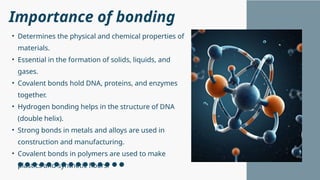
•Determines the physical and chemical properties of
materials.
• Essential in the formation of solids, liquids, and
gases.
• Covalent bonds hold DNA, proteins, and enzymes
together.
• Hydrogen bonding helps in the structure of DNA
(double helix).
• Strong bonds in metals and alloys are used in
construction and manufacturing.
• Covalent bonds in polymers are used to make
plastics and synthetic fibers.
5.
Types of bonding
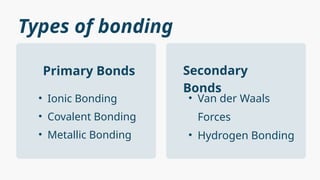
•Ionic Bonding
• Covalent Bonding
• Metallic Bonding
Primary Bonds Secondary
Bonds
• Van der Waals
Forces
• Hydrogen Bonding
6.
Primary
Bonding Definition:
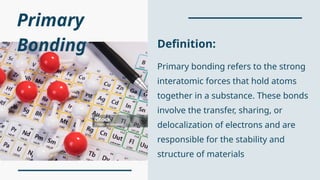
Primary bondingrefers to the strong
interatomic forces that hold atoms
together in a substance. These bonds
involve the transfer, sharing, or
delocalization of electrons and are
responsible for the stability and
structure of materials
7.
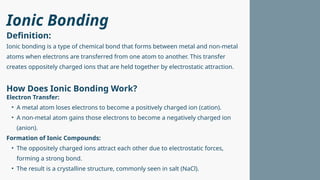
Ionic Bonding
Ionic bondingis a type of chemical bond that forms between metal and non-metal
atoms when electrons are transferred from one atom to another. This transfer
creates oppositely charged ions that are held together by electrostatic attraction.
Electron Transfer:
• A metal atom loses electrons to become a positively charged ion (cation).
• A non-metal atom gains those electrons to become a negatively charged ion
(anion).
Formation of Ionic Compounds:
• The oppositely charged ions attract each other due to electrostatic forces,
forming a strong bond.
• The result is a crystalline structure, commonly seen in salt (NaCl).
Definition:
How Does Ionic Bonding Work?
8.
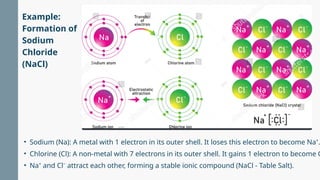
• Sodium (Na):A metal with 1 electron in its outer shell. It loses this electron to become Na⁺.
• Chlorine (Cl): A non-metal with 7 electrons in its outer shell. It gains 1 electron to become C
• Na⁺ and Cl⁻ attract each other, forming a stable ionic compound (NaCl - Table Salt).
Example:
Formation of
Sodium
Chloride
(NaCl)
9.
Properties of IonicCompounds:
Common Examples of Ionic Compounds:
• High Melting and Boiling Points – Strong ionic bonds require a lot of
energy to break.
• Hard but Brittle – Ionic crystals are hard but can shatter if force is
applied.
• Soluble in Water – Ionic compounds dissolve in water, breaking into ions.
• Conduct Electricity in Solution or Molten State – Ions are free to move
in liquid form, allowing electrical conduction.
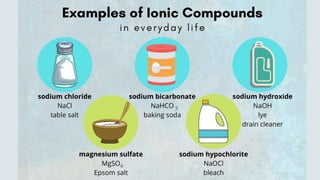
• Sodium Chloride (NaCl) – Table salt
• Calcium Fluoride (CaF₂) – Used in toothpaste
• Magnesium Oxide (MgO) – Used in ceramics
11.
Covalent
Bonding
Covalent bonding isa type of chemical bond where two or more non-
metal atoms share electrons to achieve stability. Instead of transferring
electrons (like in ionic bonding), atoms share electrons to complete
their outer shells.
• Atoms want to achieve a full outer electron shell (usually 8
electrons, following the Octet Rule).
• Since non-metals have similar electronegativities, they cannot easily
gain or lose electrons. Instead, they share electrons.
• This sharing creates a strong bond between the atoms.
Definition:
How Does Covalent Bonding Work?
12.
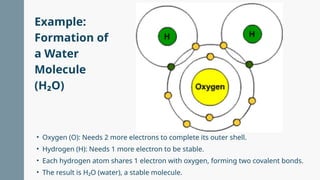
• Oxygen (O):Needs 2 more electrons to complete its outer shell.
• Hydrogen (H): Needs 1 more electron to be stable.
• Each hydrogen atom shares 1 electron with oxygen, forming two covalent bonds.
• The result is H₂O (water), a stable molecule.
Example:
Formation of
a Water
Molecule
(H₂O)
13.
Properties of CovalentCompounds:
Common Examples of Covalent
Compounds:
• Low Melting and Boiling Points – Weak forces between molecules make them easy to
separate.
• Poor Conductors of Electricity – No free-moving charged particles (except in some special
cases like graphite).
• Exist as Gases, Liquids, or Soft Solids – Unlike ionic compounds, many covalent compounds
exist in gaseous or liquid form.
• Insoluble or Partially Soluble in Water – Some covalent compounds do not dissolve in water
(e.g., oil), while others do (e.g., sugar).
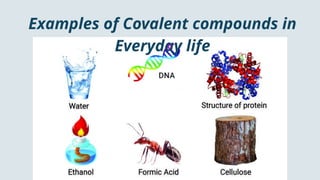
• Oxygen (O₂) – Essential for respiration
• Carbon Dioxide (CO₂) – Used by plants in photosynthesis
• Methane (CH₄) – A major component of natural gas
• Diamond (C) & Graphite (C) – Both made of carbon but with
different structures
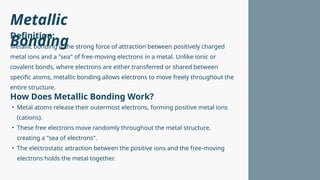
Metallic
Bonding
Metallic bonding isthe strong force of attraction between positively charged
metal ions and a "sea" of free-moving electrons in a metal. Unlike ionic or
covalent bonds, where electrons are either transferred or shared between
specific atoms, metallic bonding allows electrons to move freely throughout the
entire structure.
• Metal atoms release their outermost electrons, forming positive metal ions
(cations).
• These free electrons move randomly throughout the metal structure,
creating a "sea of electrons".
• The electrostatic attraction between the positive ions and the free-moving
electrons holds the metal together.
Definition:
How Does Metallic Bonding Work?
16.
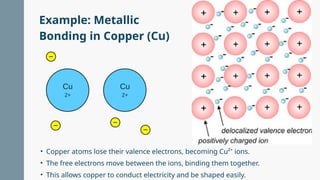
• Copper atomslose their valence electrons, becoming Cu²⁺ ions.
• The free electrons move between the ions, binding them together.
• This allows copper to conduct electricity and be shaped easily.
Example: Metallic
Bonding in Copper (Cu)
17.
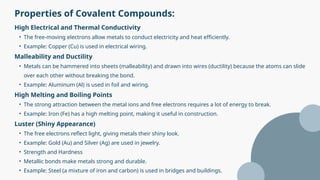
Properties of CovalentCompounds:
High Electrical and Thermal Conductivity
• The free-moving electrons allow metals to conduct electricity and heat efficiently.
• Example: Copper (Cu) is used in electrical wiring.
Malleability and Ductility
• Metals can be hammered into sheets (malleability) and drawn into wires (ductility) because the atoms can slide
over each other without breaking the bond.
• Example: Aluminum (Al) is used in foil and wiring.
High Melting and Boiling Points
• The strong attraction between the metal ions and free electrons requires a lot of energy to break.
• Example: Iron (Fe) has a high melting point, making it useful in construction.
Luster (Shiny Appearance)
• The free electrons reflect light, giving metals their shiny look.
• Example: Gold (Au) and Silver (Ag) are used in jewelry.
• Strength and Hardness
• Metallic bonds make metals strong and durable.
• Example: Steel (a mixture of iron and carbon) is used in bridges and buildings.
Conclusion
• Primary bondsare essential for material properties.
• Understanding them helps in material selection and engineering.
• Applications range from everyday items to advanced technologies