




Topic Name :
Resting Membrane
Potential
Submitted by :
Hafiz Muhammad Waseem
Roll No. mcf-1901171
Class : MSc Zoology
Submitted to :
Mam Razia Bashir
Submitted Date : 16-01-2
Contents
 Introduction
 History
 Define RMP
 Measurement RMP
 Ion gated channels
 Movement of ion
 Sodium potassium ATPase Pump
 Conduction velocities vary widely among neuron
 Salutatory conduction
 References
History
 Resting current in nerve were measure and
describe by Julius Bernsteinin 1902
 He proposed a ‘ A Membrane Theory ’’
 that explain the resting potential of nerve
and muscle as diffusion potential
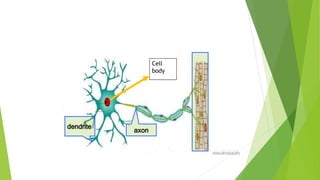
Introduction of neuron
a) dendrites - input
b) cell body – “decision making”; graded
potential
c) axon - transmits action potential
Define
 The difference in charge with more positive out
side and more negative ions inside
 A resting neuron is not conducting a nerve
impels
 Fluid inside PM –vet outside PM +vet charge
 All cells have a resting potential
 But neuron and muscle cells are specialized
transmit and resting potential rapidly
dendrite
axon
Cell
body
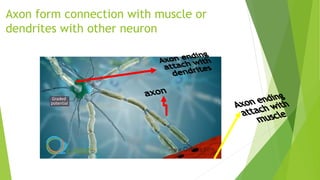
Axon form connection with muscle or
dendrites with other neuron
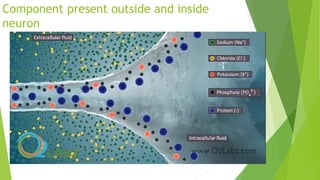
Component present outside and inside
neuron
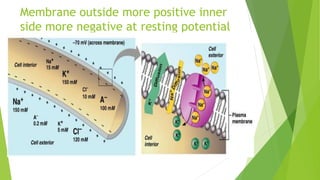
Membrane outside more positive inner
side more negative at resting potential
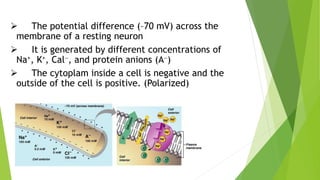
 The potential difference (–70 mV) across the
membrane of a resting neuron
 It is generated by different concentrations of
Na+, K+, Cal, and protein anions (A)
 The cytoplam inside a cell is negative and the
outside of the cell is positive. (Polarized)
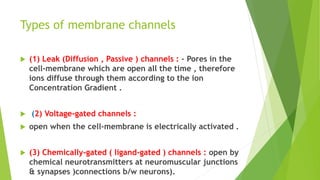
Types of membrane channels
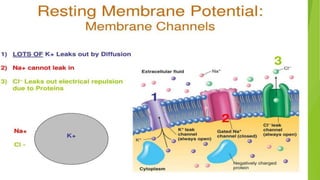
 (1) Leak (Diffusion , Passive ) channels : - Pores in the
cell-membrane which are open all the time , therefore
ions diffuse through them according to the ion
Concentration Gradient .
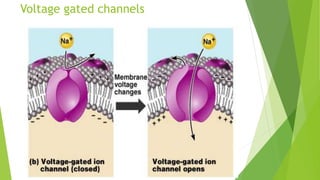
 (2) Voltage-gated channels :
 open when the cell-membrane is electrically activated .
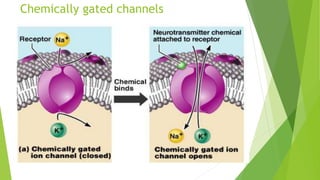
 (3) Chemically-gated ( ligand-gated ) channels : open by
chemical neurotransmitters at neuromuscular junctions
& synapses )connections b/w neurons).
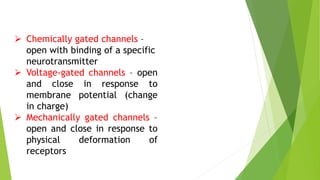
 Chemically gated channels –
open with binding of a specific
neurotransmitter
 Voltage-gated channels – open
and close in response to
membrane potential (change
in charge)
 Mechanically gated channels –
open and close in response to
physical deformation of
receptors
Chemically gated channels
Voltage gated channels
Closed Mechanically gated channels
Open mechanically gated channels when
pressure apply
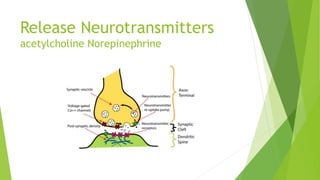
Release Neurotransmitters
acetylcholine Norepinephrine
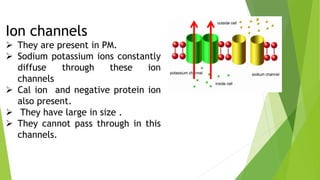
Ion channels
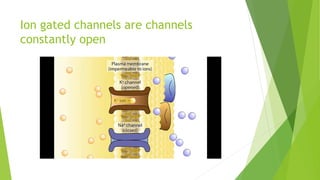
 They are present in PM.
 Sodium potassium ions constantly
diffuse through these ion
channels
 Cal ion and negative protein ion
also present.
 They have large in size .
 They cannot pass through in this
channels.
Ion gated channels are channels
constantly open
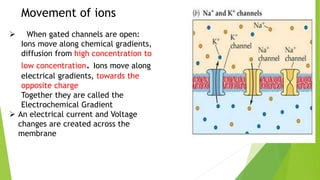
Movement of ions
 When gated channels are open:
Ions move along chemical gradients,
diffusion from high concentration to
low concentration. Ions move along
electrical gradients, towards the
opposite charge
Together they are called the
Electrochemical Gradient
 An electrical current and Voltage
changes are created across the
membrane
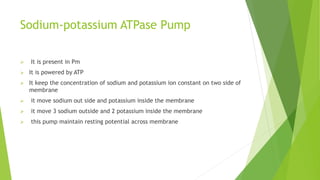
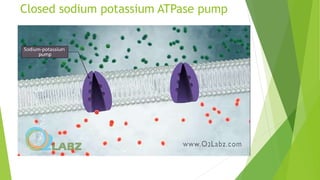
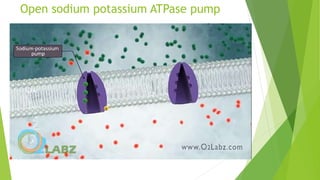
Sodium-potassium ATPase Pump
 It is present in Pm
 It is powered by ATP
 It keep the concentration of sodium and potassium ion constant on two side of
membrane
 it move sodium out side and potassium inside the membrane
 it move 3 sodium outside and 2 potassium inside the membrane
 this pump maintain resting potential across membrane
Closed sodium potassium ATPase pump
Open sodium potassium ATPase pump
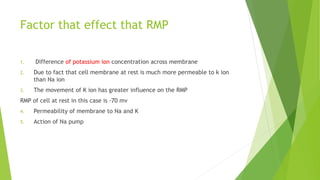
Factor that effect that RMP
1. Difference of potassium ion concentration across membrane
2. Due to fact that cell membrane at rest is much more permeable to k ion
than Na ion
3. The movement of K ion has greater influence on the RMP
RMP of cell at rest in this case is -70 mv
4. Permeability of membrane to Na and K
5. Action of Na pump
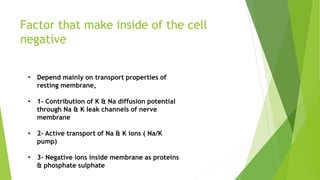
Factor that make inside of the cell
negative
• Depend mainly on transport properties of
resting membrane,
• 1- Contribution of K & Na diffusion potential
through Na & K leak channels of nerve
membrane
• 2- Active transport of Na & K ions ( Na/K
pump)
• 3- Negative ions inside membrane as proteins
& phosphate sulphate
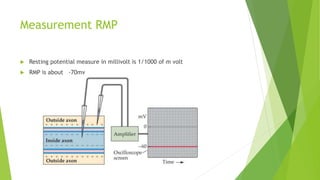
Measurement RMP
 Resting potential measure in millivolt is 1/1000 of m volt
 RMP is about -70mv
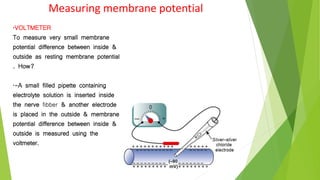
•VOLTMETER
To measure very small membrane
potential difference between inside &
outside as resting membrane potential
. How?
•-A small filled pipette containing
electrolyte solution is inserted inside
the nerve fibber & another electrode
is placed in the outside & membrane
potential difference between inside &
outside is measured using the
voltmeter.
Measuring membrane potential
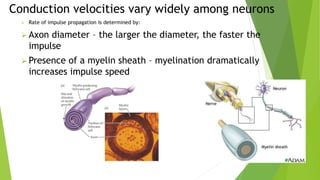
Conduction velocities vary widely among neurons
 Rate of impulse propagation is determined by:
 Axon diameter – the larger the diameter, the faster the
impulse
 Presence of a myelin sheath – myelination dramatically
increases impulse speed
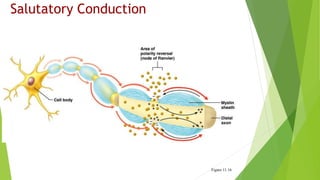
Salutatory Conduction
Figure 11.16
References
Bennett, Tom, PowerPoint slides, 3/23/05
Jack, Pasternak J. An Introduction to Human
Molecular Genetics. 2nd ed. New Jersey:
Wiley-Liss, 2005.
FOR YOUR PATIENCE

Resting membrane potential

  • 1.
    Topic Name : RestingMembrane Potential Submitted by : Hafiz Muhammad Waseem Roll No. mcf-1901171 Class : MSc Zoology Submitted to : Mam Razia Bashir Submitted Date : 16-01-2
  • 2.
    Contents  Introduction  History Define RMP  Measurement RMP  Ion gated channels  Movement of ion  Sodium potassium ATPase Pump  Conduction velocities vary widely among neuron  Salutatory conduction  References
  • 3.
    History  Resting currentin nerve were measure and describe by Julius Bernsteinin 1902  He proposed a ‘ A Membrane Theory ’’  that explain the resting potential of nerve and muscle as diffusion potential
  • 4.
    Introduction of neuron a)dendrites - input b) cell body – “decision making”; graded potential c) axon - transmits action potential
  • 5.
    Define  The differencein charge with more positive out side and more negative ions inside  A resting neuron is not conducting a nerve impels  Fluid inside PM –vet outside PM +vet charge  All cells have a resting potential  But neuron and muscle cells are specialized transmit and resting potential rapidly
  • 6.
  • 7.
    Axon form connectionwith muscle or dendrites with other neuron
  • 8.
    Component present outsideand inside neuron
  • 9.
    Membrane outside morepositive inner side more negative at resting potential
  • 10.
     The potentialdifference (–70 mV) across the membrane of a resting neuron  It is generated by different concentrations of Na+, K+, Cal, and protein anions (A)  The cytoplam inside a cell is negative and the outside of the cell is positive. (Polarized)
  • 12.
    Types of membranechannels  (1) Leak (Diffusion , Passive ) channels : - Pores in the cell-membrane which are open all the time , therefore ions diffuse through them according to the ion Concentration Gradient .  (2) Voltage-gated channels :  open when the cell-membrane is electrically activated .  (3) Chemically-gated ( ligand-gated ) channels : open by chemical neurotransmitters at neuromuscular junctions & synapses )connections b/w neurons).
  • 13.
     Chemically gatedchannels – open with binding of a specific neurotransmitter  Voltage-gated channels – open and close in response to membrane potential (change in charge)  Mechanically gated channels – open and close in response to physical deformation of receptors
  • 14.
  • 15.
  • 16.
  • 17.
    Open mechanically gatedchannels when pressure apply
  • 18.
  • 19.
    Ion channels  Theyare present in PM.  Sodium potassium ions constantly diffuse through these ion channels  Cal ion and negative protein ion also present.  They have large in size .  They cannot pass through in this channels.
  • 20.
    Ion gated channelsare channels constantly open
  • 21.
    Movement of ions When gated channels are open: Ions move along chemical gradients, diffusion from high concentration to low concentration. Ions move along electrical gradients, towards the opposite charge Together they are called the Electrochemical Gradient  An electrical current and Voltage changes are created across the membrane
  • 22.
    Sodium-potassium ATPase Pump It is present in Pm  It is powered by ATP  It keep the concentration of sodium and potassium ion constant on two side of membrane  it move sodium out side and potassium inside the membrane  it move 3 sodium outside and 2 potassium inside the membrane  this pump maintain resting potential across membrane
  • 23.
  • 24.
  • 25.
    Factor that effectthat RMP 1. Difference of potassium ion concentration across membrane 2. Due to fact that cell membrane at rest is much more permeable to k ion than Na ion 3. The movement of K ion has greater influence on the RMP RMP of cell at rest in this case is -70 mv 4. Permeability of membrane to Na and K 5. Action of Na pump
  • 26.
    Factor that makeinside of the cell negative • Depend mainly on transport properties of resting membrane, • 1- Contribution of K & Na diffusion potential through Na & K leak channels of nerve membrane • 2- Active transport of Na & K ions ( Na/K pump) • 3- Negative ions inside membrane as proteins & phosphate sulphate
  • 27.
    Measurement RMP  Restingpotential measure in millivolt is 1/1000 of m volt  RMP is about -70mv
  • 28.
    •VOLTMETER To measure verysmall membrane potential difference between inside & outside as resting membrane potential . How? •-A small filled pipette containing electrolyte solution is inserted inside the nerve fibber & another electrode is placed in the outside & membrane potential difference between inside & outside is measured using the voltmeter. Measuring membrane potential
  • 29.
    Conduction velocities varywidely among neurons  Rate of impulse propagation is determined by:  Axon diameter – the larger the diameter, the faster the impulse  Presence of a myelin sheath – myelination dramatically increases impulse speed
  • 30.
  • 31.
    References Bennett, Tom, PowerPointslides, 3/23/05 Jack, Pasternak J. An Introduction to Human Molecular Genetics. 2nd ed. New Jersey: Wiley-Liss, 2005.
  • 32.