HAP
SEM 2
Nervous system
 The nervous system detects and responds to changes inside and outside the body.
 Together with the endocrine system, it controls many vital aspects of
body function and maintains homeostasis.
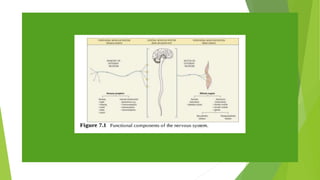
 The nervous system consists of the brain, the spinal cord, and peripheral nerves.
 Rapid communication between different parts of the body.
 The nervous system consists of neurones, which conduct nerve impulses and are supported by
unique connective tissue cells known as neuroglia.
 There are vast numbers of cells, 1 trillion (1012) glial cells and ten times fewer (1011)
neurones.
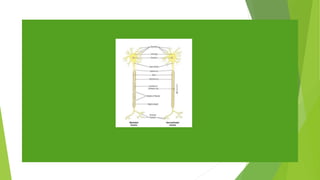
 Each neurone consists of a cell body and its processes, one axon and many dendrites.
 Neurones are commonly referred to as nerve cells.
 Bundles of axons bound together are called nerves.
 Neurones cannot divide, and they need a continuous supply of oxygen and glucose for survival.
 Neurones can only synthesise chemical energy (ATP) from glucose.
Neuroglia:
 Neuroglia are smaller than neurons, and they are 5 to 25 times more
numerous.
 Neuroglia does not generate or propagate action potentials, and they can
multiply and divide in the mature nervous system.
 Brain tumors derived from glia, called gliomas
 Six types of neuroglia,
 four—astrocytes, oligodendrocytes, microglia, and ependymal cells—are
found only in the CNS.
 The remaining two types—Schwann cells and satellite cells—are present in the
PNS.
 Astrocytes:
 These star-shaped cells have many processes and are the largest and
most numerous of the neuroglia. There are two types of astrocytes-
 Protoplasmic and fibrous
 The functions of astrocytes include the following:
1. Astrocytes contain microfilaments that give them considerable
strength, which enables them to support neurons.
2. Astrocytes may also play a role in learning and memory by
influencing the formation of neural synapses
 Neurones generate and transmit electrical impulses called action potentials.
 The initial strength of the impulse is maintained throughout the length of the neurone.
 Some neurones initiate nerve impulses while others act as ‘relay stations’ where
impulses are passed on and sometimes redirected.
 OLIGODENDROCYTES: are responsible for forming and maintaining the myelin sheath around CNS
axons.
 MICROGLIAL CELLS OR MICROGLIA : These neuroglia are small cells with slender processes that
give off numerous spinelike projections.
 Microglial cells or microglia function as phagocytes.
 Ependymal cells are cuboidal to columnar cells arranged in a single
 layer that possess microvilli and cilia.
 These cells line the ventricles of the brain and the central canal of the spinal cord (spaces filled
with cerebrospinal fluid, which protects and nourishes the brain and spinal
Neuroglia of the PNS:
 SCHWANN CELLS These cells encircle PNS axons. Like oligodendro- cytes, they
form the myelin sheath around axons.
 SATELLITE CELLS These flat cells surround the cell bodies of neurons of PNS
ganglia . Regulate the exchanges of materials between
 neuronal cell bodies and interstitial fluid.
CLASSIFICATION OF NERVE FIBERS:
1.Based on function, nerves are classified as
 Motor, sensory and secretomotor,
2.Based on myelination: myelinated and unmyelinated.
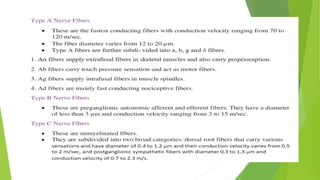
3.Erlanger and Gasser Classification:
 which is based mainly on their diameter and conduction velocity.
Broadly fibers are classified into three categories: A, B and C.
4.Numerical Classification
Sensory nerve fibers are typed into Ia, Ib, II, III and IV.
 PROPERTIES OF NERVE FIBERS
 Important properties of the nerve fibres are as follows:
 1. Excitability
 2. Conductivity
 3. Un fatigability
 4. Refractory period
 5. All-or-none law
 6. Summation
 7. Accommodation
 Excitability :
 • Excitability is the property by virtue of which cells or tissues respond to changes in the
external or internal environments.
 • It is due to the disturbances in the ionic equilibrium across the receptive zone of cell
membrane.
 Factors Affecting Excitability
 1. Strength and duration of the stimulus
 2. Effect of extracellular Ca++
 Conductivity :
 • On stimulation, action potential is generated in the nerve fibre, which is propagated
along its entire length to the axon terminal
 Un fatigability :
 • Nerve fibres cannot be fatigued, even when they are stimulated continuously.
This is because the nerve fibres primarily conduct impulses (propagation of action
potential) that do not involve expenditure of energy (ATP)
 Refractory period:
 The refractory period in a neuron occurs after an action potential and generally
lasts one millisecond.
 All- or – none law:
 The all-or-none law is a principle that states that the strength of a response of a
nerve cell or muscle fiber is not dependent upon the strength of the stimulus. If a
stimulus is above a certain threshold, a nerve or muscle fiber will fire.
 Summation
 Subthreshold stimuli are applied in rapid succession, they are summated and they
produce an action potential.
 • This property is called summation
 Accommodation
 • Application of continuous stimuli may decrease the excitability of the nerve fiber,
a phenomenon called accommodation.

ELECTROPHYSIOLOGY, ACTION
POTENTIAL,
NERVE IMPULSE :
 Electrical signals in neurons:
 (1) Graded potentials (described shortly) are used for short-distance communication only.
 (2) Action potentials (also described shortly) allow communication over long distances within
the body.
 Recall that an action potential in a muscle fiber is called a muscle action potential.
 An action potential occurs in a neuron (nerve cell), it is called a nerve
 action potential (nerve impulse).
 An action potential (AP) or impulse is a sequence of rapidly occurring events that decrease and
reverse the membrane potential and then eventually restore it to the resting state.
 An action potential has two main phases: a depolarizing phase and a repolarizing phase
 Ion channels:
 When ion channels are open, they allow specific ions to move across the plasma membrane,
down their electrochemical gradient—a concentration (chemical) difference plus an electrical
difference.
 Leakage Channels : The gates of leakage channels randomly alternate
between open and closed positions.(K>Na)
 Ligand-gated Ion Channels : opens and closes in response to a specific
chemical stimulus.(Neurotransmitters)
 Mechanically Gated Channels:mechanical stimulation
ie, sound waves,touch or pressure
 Voltage Gated Channels : Response to membrane
potential
 ELectrophysiology of Neurons:
• The intracellular and extracellular fluid in the nervous system contains many charged ions like Na+,
K+, Ca++, Cl- etc.
• The presence of these ions imparts an electric potential inside the cell and outside the cell.
• Membrane Potential (Transmembrane Potential, Membrane Voltage) is the difference of voltage
between inside the cell membrane and outside the cell membrane.
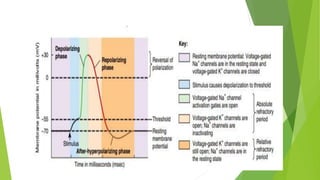
• The resting membrane potential is -70mv.
• Nerve impulse (Action Potential) is generated by a change in ion concentrations across the cell
membrane.
• The three phases in which action potential takes place are,
1. Depolarization.
2. Repolarization
3. Hyperpolarization.
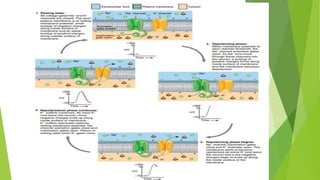
1. Depolarization:
• On a receiving stimulus the Na+ ion channels open causing entry of Na+ ions inside the cell.
• As Na+ ions are positively charged, the resting membrane potential now starts shifting to “0”.
• When the membrane potential reaches “-55mv” it is said that the “Action Potential is generated or threshold is
generated”.
• Due to the higher concentration gradient of Na+ ions the membrane potential reaches upto “+30mv”.
• Depolarization means shifting of membrane potential from” -70mv to 0”.
2. Repolarization:
• As the membrane potential reaches “+30mv” it causes the opening of “K+” ion channels.
• The K+ ions start leaving the cell to extracellular fluid ( Concentration of K+ ions is less outside the cell).
• The loss of K+ ions causes the membrane potential to come down.
• The opening of K+ ion channels is slower at the same time the Na+ ion channels start getting inactivated.
• Due to this the membrane potential drops to its resting stage i.e -70mv.
• The return of membrane potential to -70 mv is called “Repolarization”
 Refractory Period :
 The period of time aft er an action potential begins during which an excitable cell cannot
generate another action potential in response to a normal threshold stimulus is called the
refractory period
3. Hyperpolarization:
• Due to the slow closing of K+ ion channels the further loss of positivity the membrane potential lowers more to -
90mv.
• Hyperpolarization means dropping of membrane potential to -90mv.
• After closing of K+ ion channels the membrane potential comes back to its resting stage and is now ready to receive new
stimulus.
NERVE IMPULSE
 A nerve Impulse is defined as a wave of electrical chemical changes across the neuron that helps
in the generation of the action potential in response to the stimulus.
 This transmission of a nerve impulse across the neuron membrane as a result of a change in
membrane potential is known as Nerve impulse conduction.
 Mechanism of Nerve Impulse Conduction
 Nerve impulse conduction is a major process occurring in the body responsible for
organized functions of the body. So, for the conduction of nerve impulses, there are two
mechanisms:
1. Continuous conduction:Continuous nerve impulse conduction occurs in non-myelinated
axons. The action potential travels along the entire length of the axon.
2.Saltatory conduction:Saltatory is faster than continuous conduction and occurs in
myelinated neurons.
 Factors Affecting the Speed of Nerve Impulse
 The following are some major factors that affect the speed of nerve impulses:
1. Myelin Sheath
2. Axon Diameter
3. Temperature
 RECEPTORS
 Receptors are sensory (afferent) nerve endings that terminate in
periphery as bare unmyelinated endings or in the form of specialized
capsulated structures.
 Receptors give response to the stimulus. When stimulated, receptors
produce a series of impulses, which are transmitted through the afferent
nerves
 Neurotransmitters released from a presynaptic neuron bind to
neurotransmitter receptors in the plasma membrane of a postsynaptic
cell.
 Neurotransmitter receptors are classified as either ionotropic receptors or
metabotropic receptors based on whether the neurotransmitter binding
site and the ion channel are components of the same protein or are
components of different proteins
 Ionotropic Receptors
 ▪ An ionotropic receptor is a type of neurotransmitter receptor that contains a neurotransmitter
binding site and an ion channel.
 ▪ In the absence of neurotransmitter (the ligand), the ion channel component of the ionotropic
receptor is closed.
 ▪ When the correct neurotransmitter binds to the ionotropic receptor, the ion channel opens, and an
EPSP or IPSP occurs in the postsynaptic cell.
 Excitatory postsynaptic potential (EPSP), Inhibitory postsynaptic potential (IPSP).
 ➢ Many excitatory neurotransmitters bind to ionotropic receptors that contain cation channels.
EPSPs result from opening these cation channels.
 ➢ When cation channels open, they allow passage of the three most plentiful cations (Na, K, and
Ca2) through the postsynaptic cell membrane, but Na inflow is greater than either Ca2 inflow or K
outflow and the inside of the postsynaptic cell becomes less negative (depolarized).
 ➢ Many inhibitory neurotransmitters bind to ionotropic receptors that contain chloride channels.
IPSPs result from opening these Cl channels.
 ➢ When Cl channels open, a larger number of chloride ions diffuse inward. The inward flow of Cl
ions causes the inside of the postsynaptic cell to become more negative (hyperpolarized).
 Metabotropic Receptors
 ▪ A metabotropic receptor is a type of neurotransmitter receptor that
contains a neurotransmitter binding site, but lacks an ion channel as part
of its structure.
 ▪ However, a metabotropic receptor is coupled to a separate ion channel
by a type of membrane protein called a G protein.
 ➢ When a neurotransmitter binds to a metabotropic receptor, the G
protein either directly opens (or closes) the ion channel or it may act
indirectly by activating another molecule, a “second messenger,” in the
cytosol, which in turn opens (or closes) the ion channel.
 SYNAPSE :
 Synapse is the junction between two neurons. It is not an anatomical
continuation.
 But, it is only a physiological continuity between two nerve cells.
 At a synapse between neurons, the neuron sending the signal is called
the presynaptic neuron, and the neuron receiving the message is called
the postsynaptic neuron
 2 TYPES:
 Electrical synapses
 Chemical synapses
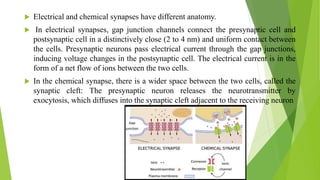
 Electrical and chemical synapses have different anatomy.
 In electrical synapses, gap junction channels connect the presynaptic cell and
postsynaptic cell in a distinctively close (2 to 4 nm) and uniform contact between
the cells. Presynaptic neurons pass electrical current through the gap junctions,
inducing voltage changes in the postsynaptic cell. The electrical current is in the
form of a net flow of ions between the two cells.
 In the chemical synapse, there is a wider space between the two cells, called the
synaptic cleft: The presynaptic neuron releases the neurotransmitter by
exocytosis, which diffuses into the synaptic cleft adjacent to the receiving neuron
Neurotransmitters.
 The chemical signalling molecules secreted by neurons are
called neurotransmitters.
 Neurotransmitters are located in a part of the neuron called the axon
terminal.
 They’re stored within thin-walled sacs called synaptic vesicles.
 Each vesicle can contain thousands of neurotransmitter molecules.
 As a message or signal travels along a nerve cell, the electrical charge
of the signal causes the vesicles of neurotransmitters to fuse with the
nerve cell membrane at the very edge of the cell.
 The neurotransmitters, which now carry the message, are then released
from the axon terminal into a fluid-filled space that’s between one nerve
cell and the next target cell (another nerve cell, muscle cell or gland).
 Types:
 Excitatory:glutamate,epinephrine
 Inhibitory: Gamma-aminobutyric acid (GABA), glycine and serotonin
 Modulatory :
1. Amino acid neurotransmitter: Glutamate,GABA,Glycine. These
neurotransmitters are involved in most functions of your nervous
system
2. Monoamines neurotranmitters:Monoamines neurotransmitters
regulate consciousness, cognition, attention and emotion.
Serotonin,Histamine,Dopamine,Epinephrine,Norepinephrine
3. Peptide neurotransmitters: Endorphins. Endorphins are your body’s
natural pain reliever. They play a role in our perception of pain
HAP 1 anatomy physiology and pathophysio

HAP 1 anatomy physiology and pathophysio

  • 1.
  • 2.
    Nervous system  Thenervous system detects and responds to changes inside and outside the body.  Together with the endocrine system, it controls many vital aspects of body function and maintains homeostasis.  The nervous system consists of the brain, the spinal cord, and peripheral nerves.  Rapid communication between different parts of the body.
  • 4.
     The nervoussystem consists of neurones, which conduct nerve impulses and are supported by unique connective tissue cells known as neuroglia.  There are vast numbers of cells, 1 trillion (1012) glial cells and ten times fewer (1011) neurones.  Each neurone consists of a cell body and its processes, one axon and many dendrites.  Neurones are commonly referred to as nerve cells.  Bundles of axons bound together are called nerves.  Neurones cannot divide, and they need a continuous supply of oxygen and glucose for survival.  Neurones can only synthesise chemical energy (ATP) from glucose.
  • 5.
    Neuroglia:  Neuroglia aresmaller than neurons, and they are 5 to 25 times more numerous.  Neuroglia does not generate or propagate action potentials, and they can multiply and divide in the mature nervous system.  Brain tumors derived from glia, called gliomas  Six types of neuroglia,  four—astrocytes, oligodendrocytes, microglia, and ependymal cells—are found only in the CNS.  The remaining two types—Schwann cells and satellite cells—are present in the PNS.
  • 6.
     Astrocytes:  Thesestar-shaped cells have many processes and are the largest and most numerous of the neuroglia. There are two types of astrocytes-  Protoplasmic and fibrous  The functions of astrocytes include the following: 1. Astrocytes contain microfilaments that give them considerable strength, which enables them to support neurons. 2. Astrocytes may also play a role in learning and memory by influencing the formation of neural synapses
  • 8.
     Neurones generateand transmit electrical impulses called action potentials.  The initial strength of the impulse is maintained throughout the length of the neurone.  Some neurones initiate nerve impulses while others act as ‘relay stations’ where impulses are passed on and sometimes redirected.
  • 9.
     OLIGODENDROCYTES: areresponsible for forming and maintaining the myelin sheath around CNS axons.  MICROGLIAL CELLS OR MICROGLIA : These neuroglia are small cells with slender processes that give off numerous spinelike projections.  Microglial cells or microglia function as phagocytes.  Ependymal cells are cuboidal to columnar cells arranged in a single  layer that possess microvilli and cilia.  These cells line the ventricles of the brain and the central canal of the spinal cord (spaces filled with cerebrospinal fluid, which protects and nourishes the brain and spinal
  • 10.
    Neuroglia of thePNS:  SCHWANN CELLS These cells encircle PNS axons. Like oligodendro- cytes, they form the myelin sheath around axons.  SATELLITE CELLS These flat cells surround the cell bodies of neurons of PNS ganglia . Regulate the exchanges of materials between  neuronal cell bodies and interstitial fluid.
  • 11.
    CLASSIFICATION OF NERVEFIBERS: 1.Based on function, nerves are classified as  Motor, sensory and secretomotor, 2.Based on myelination: myelinated and unmyelinated. 3.Erlanger and Gasser Classification:  which is based mainly on their diameter and conduction velocity. Broadly fibers are classified into three categories: A, B and C. 4.Numerical Classification Sensory nerve fibers are typed into Ia, Ib, II, III and IV.
  • 13.
     PROPERTIES OFNERVE FIBERS  Important properties of the nerve fibres are as follows:  1. Excitability  2. Conductivity  3. Un fatigability  4. Refractory period  5. All-or-none law  6. Summation  7. Accommodation
  • 14.
     Excitability : • Excitability is the property by virtue of which cells or tissues respond to changes in the external or internal environments.  • It is due to the disturbances in the ionic equilibrium across the receptive zone of cell membrane.  Factors Affecting Excitability  1. Strength and duration of the stimulus  2. Effect of extracellular Ca++  Conductivity :  • On stimulation, action potential is generated in the nerve fibre, which is propagated along its entire length to the axon terminal
  • 15.
     Un fatigability:  • Nerve fibres cannot be fatigued, even when they are stimulated continuously. This is because the nerve fibres primarily conduct impulses (propagation of action potential) that do not involve expenditure of energy (ATP)  Refractory period:  The refractory period in a neuron occurs after an action potential and generally lasts one millisecond.  All- or – none law:  The all-or-none law is a principle that states that the strength of a response of a nerve cell or muscle fiber is not dependent upon the strength of the stimulus. If a stimulus is above a certain threshold, a nerve or muscle fiber will fire.
  • 16.
     Summation  Subthresholdstimuli are applied in rapid succession, they are summated and they produce an action potential.  • This property is called summation  Accommodation  • Application of continuous stimuli may decrease the excitability of the nerve fiber, a phenomenon called accommodation.
  • 17.
  • 18.
     Electrical signalsin neurons:  (1) Graded potentials (described shortly) are used for short-distance communication only.  (2) Action potentials (also described shortly) allow communication over long distances within the body.  Recall that an action potential in a muscle fiber is called a muscle action potential.  An action potential occurs in a neuron (nerve cell), it is called a nerve  action potential (nerve impulse).  An action potential (AP) or impulse is a sequence of rapidly occurring events that decrease and reverse the membrane potential and then eventually restore it to the resting state.  An action potential has two main phases: a depolarizing phase and a repolarizing phase
  • 19.
     Ion channels: When ion channels are open, they allow specific ions to move across the plasma membrane, down their electrochemical gradient—a concentration (chemical) difference plus an electrical difference.  Leakage Channels : The gates of leakage channels randomly alternate between open and closed positions.(K>Na)  Ligand-gated Ion Channels : opens and closes in response to a specific chemical stimulus.(Neurotransmitters)  Mechanically Gated Channels:mechanical stimulation ie, sound waves,touch or pressure  Voltage Gated Channels : Response to membrane potential
  • 20.
     ELectrophysiology ofNeurons: • The intracellular and extracellular fluid in the nervous system contains many charged ions like Na+, K+, Ca++, Cl- etc. • The presence of these ions imparts an electric potential inside the cell and outside the cell. • Membrane Potential (Transmembrane Potential, Membrane Voltage) is the difference of voltage between inside the cell membrane and outside the cell membrane. • The resting membrane potential is -70mv. • Nerve impulse (Action Potential) is generated by a change in ion concentrations across the cell membrane. • The three phases in which action potential takes place are, 1. Depolarization. 2. Repolarization 3. Hyperpolarization.
  • 21.
    1. Depolarization: • Ona receiving stimulus the Na+ ion channels open causing entry of Na+ ions inside the cell. • As Na+ ions are positively charged, the resting membrane potential now starts shifting to “0”. • When the membrane potential reaches “-55mv” it is said that the “Action Potential is generated or threshold is generated”. • Due to the higher concentration gradient of Na+ ions the membrane potential reaches upto “+30mv”. • Depolarization means shifting of membrane potential from” -70mv to 0”.
  • 22.
    2. Repolarization: • Asthe membrane potential reaches “+30mv” it causes the opening of “K+” ion channels. • The K+ ions start leaving the cell to extracellular fluid ( Concentration of K+ ions is less outside the cell). • The loss of K+ ions causes the membrane potential to come down. • The opening of K+ ion channels is slower at the same time the Na+ ion channels start getting inactivated. • Due to this the membrane potential drops to its resting stage i.e -70mv. • The return of membrane potential to -70 mv is called “Repolarization”
  • 23.
     Refractory Period:  The period of time aft er an action potential begins during which an excitable cell cannot generate another action potential in response to a normal threshold stimulus is called the refractory period
  • 24.
    3. Hyperpolarization: • Dueto the slow closing of K+ ion channels the further loss of positivity the membrane potential lowers more to - 90mv. • Hyperpolarization means dropping of membrane potential to -90mv. • After closing of K+ ion channels the membrane potential comes back to its resting stage and is now ready to receive new stimulus.
  • 27.
    NERVE IMPULSE  Anerve Impulse is defined as a wave of electrical chemical changes across the neuron that helps in the generation of the action potential in response to the stimulus.  This transmission of a nerve impulse across the neuron membrane as a result of a change in membrane potential is known as Nerve impulse conduction.
  • 28.
     Mechanism ofNerve Impulse Conduction  Nerve impulse conduction is a major process occurring in the body responsible for organized functions of the body. So, for the conduction of nerve impulses, there are two mechanisms: 1. Continuous conduction:Continuous nerve impulse conduction occurs in non-myelinated axons. The action potential travels along the entire length of the axon. 2.Saltatory conduction:Saltatory is faster than continuous conduction and occurs in myelinated neurons.  Factors Affecting the Speed of Nerve Impulse  The following are some major factors that affect the speed of nerve impulses: 1. Myelin Sheath 2. Axon Diameter 3. Temperature
  • 29.
     RECEPTORS  Receptorsare sensory (afferent) nerve endings that terminate in periphery as bare unmyelinated endings or in the form of specialized capsulated structures.  Receptors give response to the stimulus. When stimulated, receptors produce a series of impulses, which are transmitted through the afferent nerves  Neurotransmitters released from a presynaptic neuron bind to neurotransmitter receptors in the plasma membrane of a postsynaptic cell.  Neurotransmitter receptors are classified as either ionotropic receptors or metabotropic receptors based on whether the neurotransmitter binding site and the ion channel are components of the same protein or are components of different proteins
  • 30.
     Ionotropic Receptors ▪ An ionotropic receptor is a type of neurotransmitter receptor that contains a neurotransmitter binding site and an ion channel.  ▪ In the absence of neurotransmitter (the ligand), the ion channel component of the ionotropic receptor is closed.  ▪ When the correct neurotransmitter binds to the ionotropic receptor, the ion channel opens, and an EPSP or IPSP occurs in the postsynaptic cell.  Excitatory postsynaptic potential (EPSP), Inhibitory postsynaptic potential (IPSP).  ➢ Many excitatory neurotransmitters bind to ionotropic receptors that contain cation channels. EPSPs result from opening these cation channels.  ➢ When cation channels open, they allow passage of the three most plentiful cations (Na, K, and Ca2) through the postsynaptic cell membrane, but Na inflow is greater than either Ca2 inflow or K outflow and the inside of the postsynaptic cell becomes less negative (depolarized).  ➢ Many inhibitory neurotransmitters bind to ionotropic receptors that contain chloride channels. IPSPs result from opening these Cl channels.  ➢ When Cl channels open, a larger number of chloride ions diffuse inward. The inward flow of Cl ions causes the inside of the postsynaptic cell to become more negative (hyperpolarized).
  • 31.
     Metabotropic Receptors ▪ A metabotropic receptor is a type of neurotransmitter receptor that contains a neurotransmitter binding site, but lacks an ion channel as part of its structure.  ▪ However, a metabotropic receptor is coupled to a separate ion channel by a type of membrane protein called a G protein.  ➢ When a neurotransmitter binds to a metabotropic receptor, the G protein either directly opens (or closes) the ion channel or it may act indirectly by activating another molecule, a “second messenger,” in the cytosol, which in turn opens (or closes) the ion channel.
  • 32.
     SYNAPSE : Synapse is the junction between two neurons. It is not an anatomical continuation.  But, it is only a physiological continuity between two nerve cells.  At a synapse between neurons, the neuron sending the signal is called the presynaptic neuron, and the neuron receiving the message is called the postsynaptic neuron  2 TYPES:  Electrical synapses  Chemical synapses
  • 33.
     Electrical andchemical synapses have different anatomy.  In electrical synapses, gap junction channels connect the presynaptic cell and postsynaptic cell in a distinctively close (2 to 4 nm) and uniform contact between the cells. Presynaptic neurons pass electrical current through the gap junctions, inducing voltage changes in the postsynaptic cell. The electrical current is in the form of a net flow of ions between the two cells.  In the chemical synapse, there is a wider space between the two cells, called the synaptic cleft: The presynaptic neuron releases the neurotransmitter by exocytosis, which diffuses into the synaptic cleft adjacent to the receiving neuron
  • 34.
    Neurotransmitters.  The chemicalsignalling molecules secreted by neurons are called neurotransmitters.  Neurotransmitters are located in a part of the neuron called the axon terminal.  They’re stored within thin-walled sacs called synaptic vesicles.  Each vesicle can contain thousands of neurotransmitter molecules.  As a message or signal travels along a nerve cell, the electrical charge of the signal causes the vesicles of neurotransmitters to fuse with the nerve cell membrane at the very edge of the cell.  The neurotransmitters, which now carry the message, are then released from the axon terminal into a fluid-filled space that’s between one nerve cell and the next target cell (another nerve cell, muscle cell or gland).
  • 35.
     Types:  Excitatory:glutamate,epinephrine Inhibitory: Gamma-aminobutyric acid (GABA), glycine and serotonin  Modulatory : 1. Amino acid neurotransmitter: Glutamate,GABA,Glycine. These neurotransmitters are involved in most functions of your nervous system 2. Monoamines neurotranmitters:Monoamines neurotransmitters regulate consciousness, cognition, attention and emotion. Serotonin,Histamine,Dopamine,Epinephrine,Norepinephrine 3. Peptide neurotransmitters: Endorphins. Endorphins are your body’s natural pain reliever. They play a role in our perception of pain