ASSIGNMENT
ON
ION CHANNEL RECEPTOR
SUBMITTED BY: SUBMITTED TO:
MARY MELNA Dr. Kunjbihari Sulakhiya
Sir
ENROLL NO:
1801024022
 Pore forming transmembrane proteins
associated with transport of specific ions in or
out of the cells.
 Highly selective in type of ion transported
(exceptions are there).
 Very high rate of ion transfer.
 Ions are transported across electrochemical
gradient.
 Passive mechanism.
 Conductance of nerve impulse,generation of
action potential,synaptic ransmission.
 Cardiac,skeletal and smooth muscle
contraction.
 Epithelial Transport of Nutrients and ions.
 T-cell activation (immune regulation).
 Pancreatic β-cells insulin release.
On the basis
of gating.
Voltage Gated
ion channels
Ligand Gated
Ion Channels
Other Gating
1.Voltage Gated Ion Channels
Open and close in response to membrane potential.
2.Ligand Gated Ion Channels
Open in response to specific ligand molecules binding
to the extracellular domain of the receptor protein.
3.Other Gatings
Indirect signaling,mechano-gated ion channels,light
gated channels
 Voltage sensitive
 Conformational change in response to the potential
gradient.
 Generally ion specific.
 Important for excitable cells like neurons.
 Role in regulation of depolarization and polarization of
neuronal membrane during an action potential.
 Distributed along the axon and soma of the neurons.
Voltage gated ion channels are made up of
three basic parts :
1.The transmembrane pores
2.Voltage Sensor
3.Selectivity Filter
Contains different subunits:
α subunit and other auxillary subunits
 Voltage Gated Sodium Channels
(9 membrane ,responsible for membrane depolarization in
action potential generation).
 Voltage Gated Calcium Channels
(10 members ,play an important role in both linking muscle
excitation with contraction as well as neuronal excitation
with transmitter release).
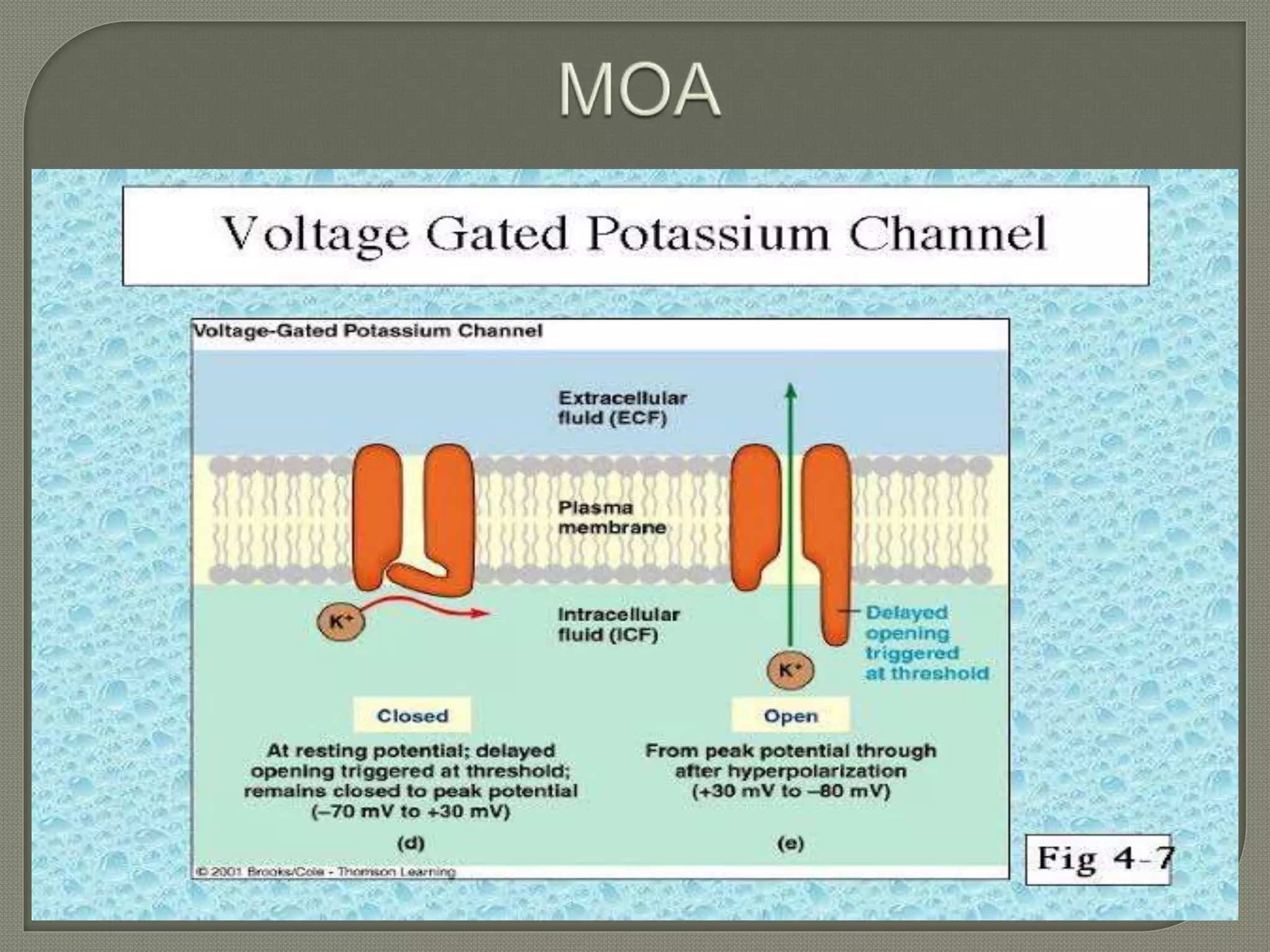
 Voltage Gated Potassium Channels
(40 members ,role in repolarisation of cell membrane after
action potential)
 Transient receptor Potential Channels
(28 types ,some of them are voltage gated,named after their
role in Drosophila phototransduction).
 Hyperpolarisation-activated cyclic nucleotide-gated
channels
(pacemaking channels in the heart,sensitive to cAMP, CGMP
that alter the voltage sensitivity of the channels)
 Voltage Sensitive Proton Channels
(helps in acid extrusion from cell,phagocytosis,strongly PH
regulated)
Voltage Gated Sodium Channels
Voltage Gated Calcium Channels
Transient receptor Potential Channels
Hyperpolarization-activated cyclic nucleotide-gated channels
Voltage Sensitive Proton Channels
 Group of transmembrane ion channels that allow the passing
of several ions upon the binding of specific chemical
messenger like neurotransmitters.
 Two domains :transmembrane domain including channel pore
,Extracellular domain including Ligand binding site.
 Function:Conversion of presynaptic chemical signal quickly
and effectively into post-synaptic electrical signal.
 Three super families:cys-Loop Receptors,Ionotropic
Glutamate Receptor,ATP Gated Channels.
 Characteristic loop formed by a disulfide bond
between two cystine residues in the N terminal
extracellular domain.
 Provides specificity for :
Acetylcholine,sertonin,glycine,glutamate and γ-
aminobutyric acid (GABA) in vertebrates.
 Structural elements are well conserved,with a large
extracellular domain(ECD) haboring an alpha-helix
and 10 beta-strands.
 Bind to NT glutamate.
 Consists of a tetramer.
 Each subunit consists of extracellular amino
terminal domain,an extracellular ligand binding
domain,a transmembrane domain.
 Each subunit of the tetramer has a binding site
for glutamate.
Bind to ATP in order to open.
They form trimers with two transmembrane
helices per subunit and both the C and N
terminate on the intracellular side.
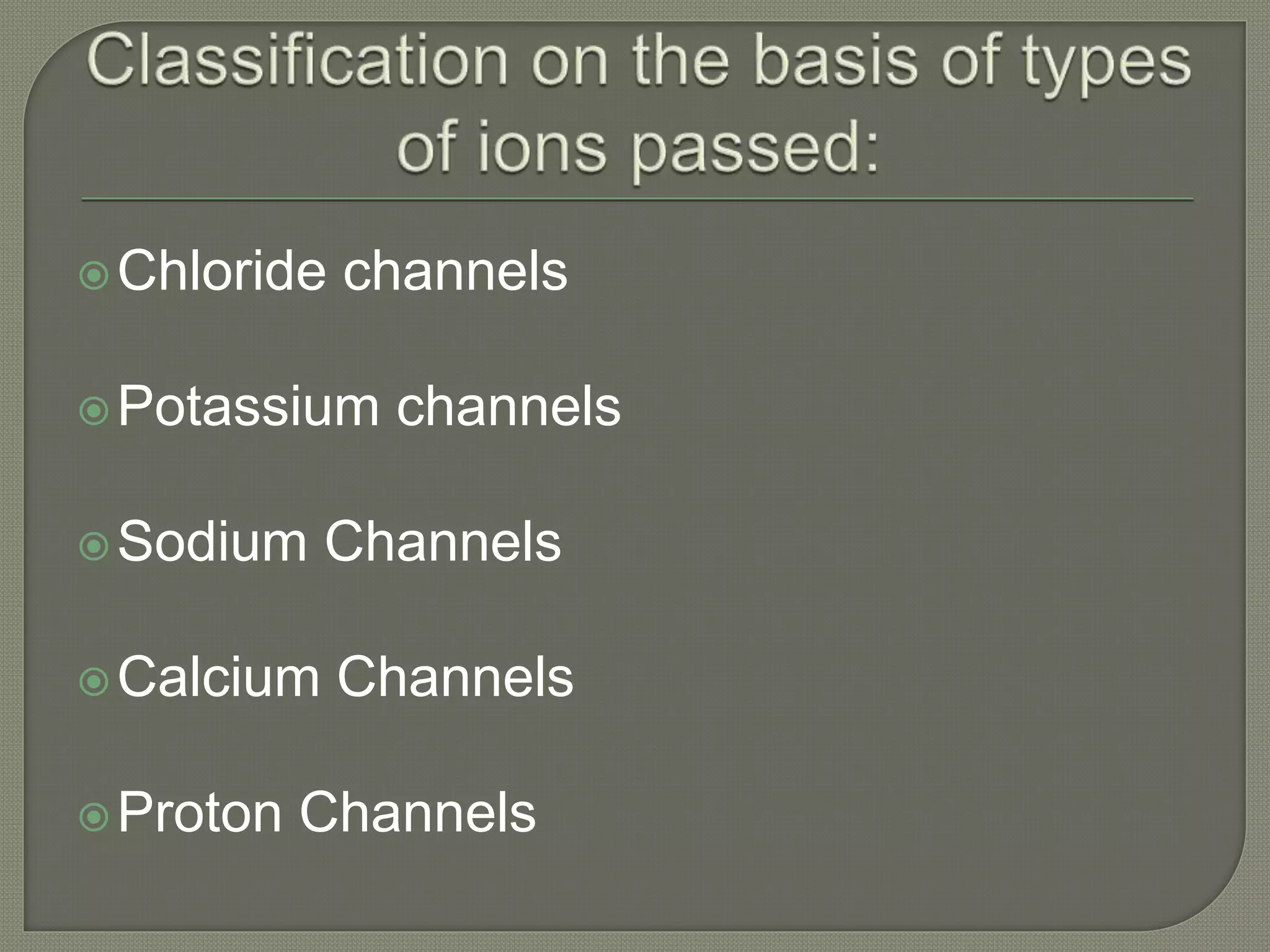
Chloride channels
Potassium channels
Sodium Channels
Calcium Channels
Proton Channels
Plasma Membrane Channels
Examples- Voltage-Gated potassium
channels,Sodium Channels,Calcium
Channels and Chloride Channels.
Intracellular Channels
Example- ER Channels, Mitochondrial
Channels.
 Ion channels are varied widely and play a wide range
of critical biological functions.
 55 different medical conditions have been attributed to
ion channel dysfunction.
 Owning to these conditions,13.4% of all drugs are
targeted to ion channels (second highest after
GPCRs).
 Worldwide sale of ion channel drugs(estimate)>$12
billion.
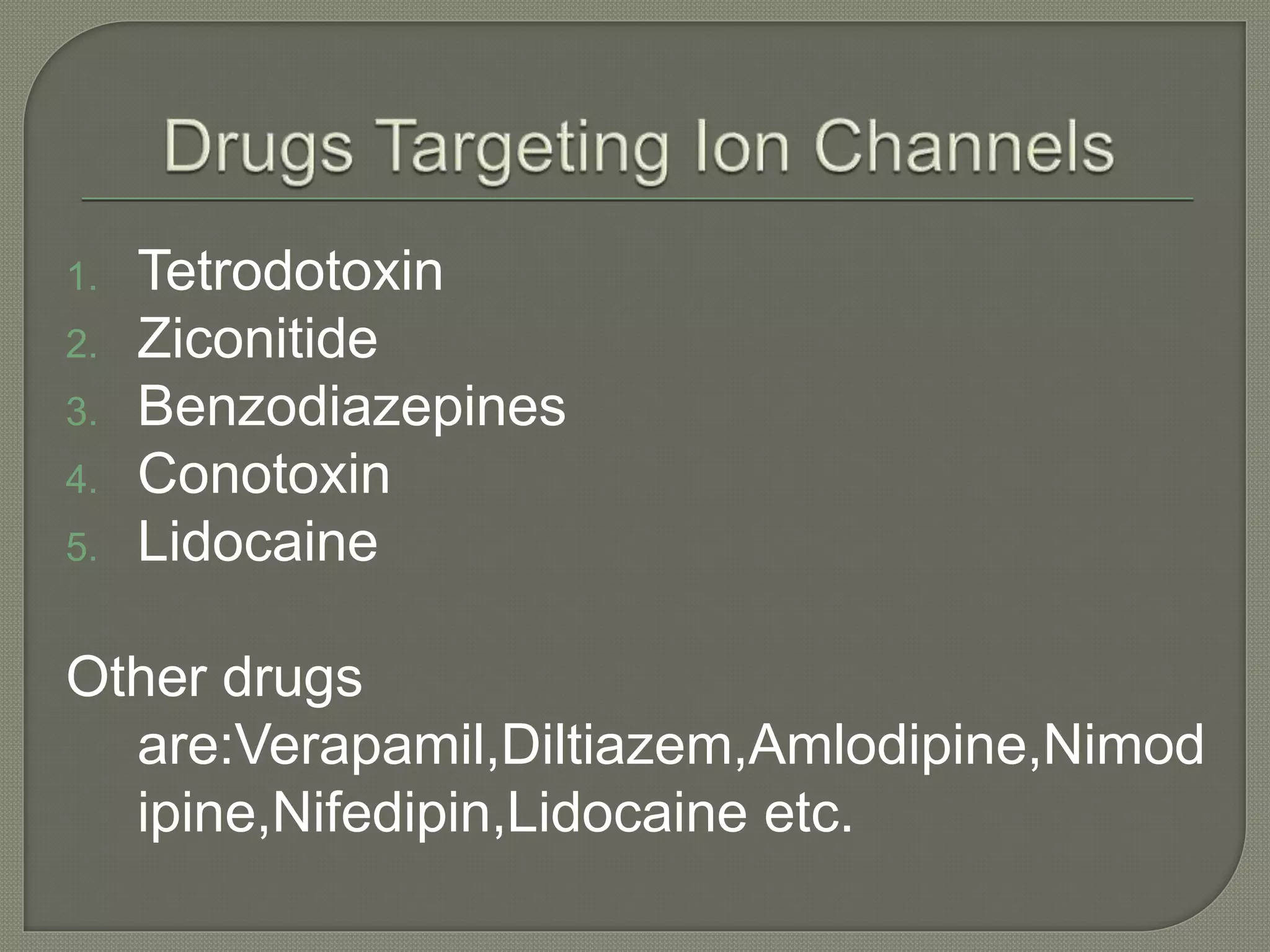
1. Tetrodotoxin
2. Ziconitide
3. Benzodiazepines
4. Conotoxin
5. Lidocaine
Other drugs
are:Verapamil,Diltiazem,Amlodipine,Nimod
ipine,Nifedipin,Lidocaine etc.
 Channelopathies
 Cystic fibrosis is caused by mutations in the
CFTR gene,which is a Chloride Channel.
 Brugada syndrome is another ventricular
arrhythmia caused by voltage-gated sodium
channel gene mutations.
 Shaker gene mutations, ataxia etc.
1. Which of the following statements is true about transmembrane electrical
potential?
a) The chemical gradient drives Cl– and K+ inwards
b) The electrical gradient drives Na+ and Ca+2 inwards
c) The chemical gradient drives Na+ and Ca+2 inwards and K+ outward
d) The chemical gradient drives Cl– and K+ outwards
Answer: c
Explanation: The chemical gradient drives Na+ and Ca+2 inwards and K+ outward,
electrical gradient drives Cl–.
2. The receptor channels for which of the following are gated by extracellular
ligands?
a) Glycine
b) IP3
c) cAMP
d) cGMP
Answer: a
Explanation: The receptor channels for glycine are gated by extracellular ligands.
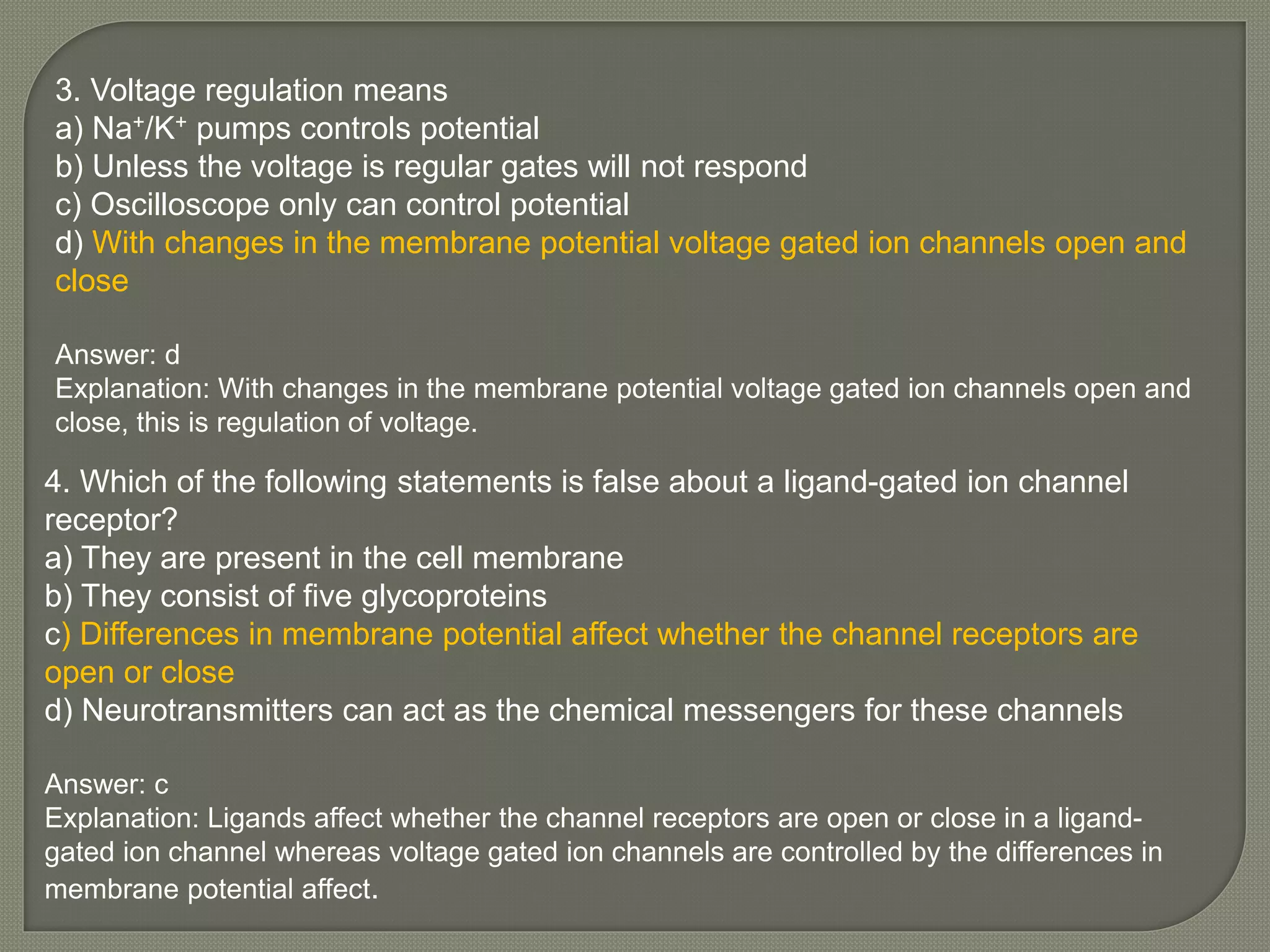
3. Voltage regulation means
a) Na+/K+ pumps controls potential
b) Unless the voltage is regular gates will not respond
c) Oscilloscope only can control potential
d) With changes in the membrane potential voltage gated ion channels open and
close
Answer: d
Explanation: With changes in the membrane potential voltage gated ion channels open and
close, this is regulation of voltage.
4. Which of the following statements is false about a ligand-gated ion channel
receptor?
a) They are present in the cell membrane
b) They consist of five glycoproteins
c) Differences in membrane potential affect whether the channel receptors are
open or close
d) Neurotransmitters can act as the chemical messengers for these channels
Answer: c
Explanation: Ligands affect whether the channel receptors are open or close in a ligand-
gated ion channel whereas voltage gated ion channels are controlled by the differences in
membrane potential affect.
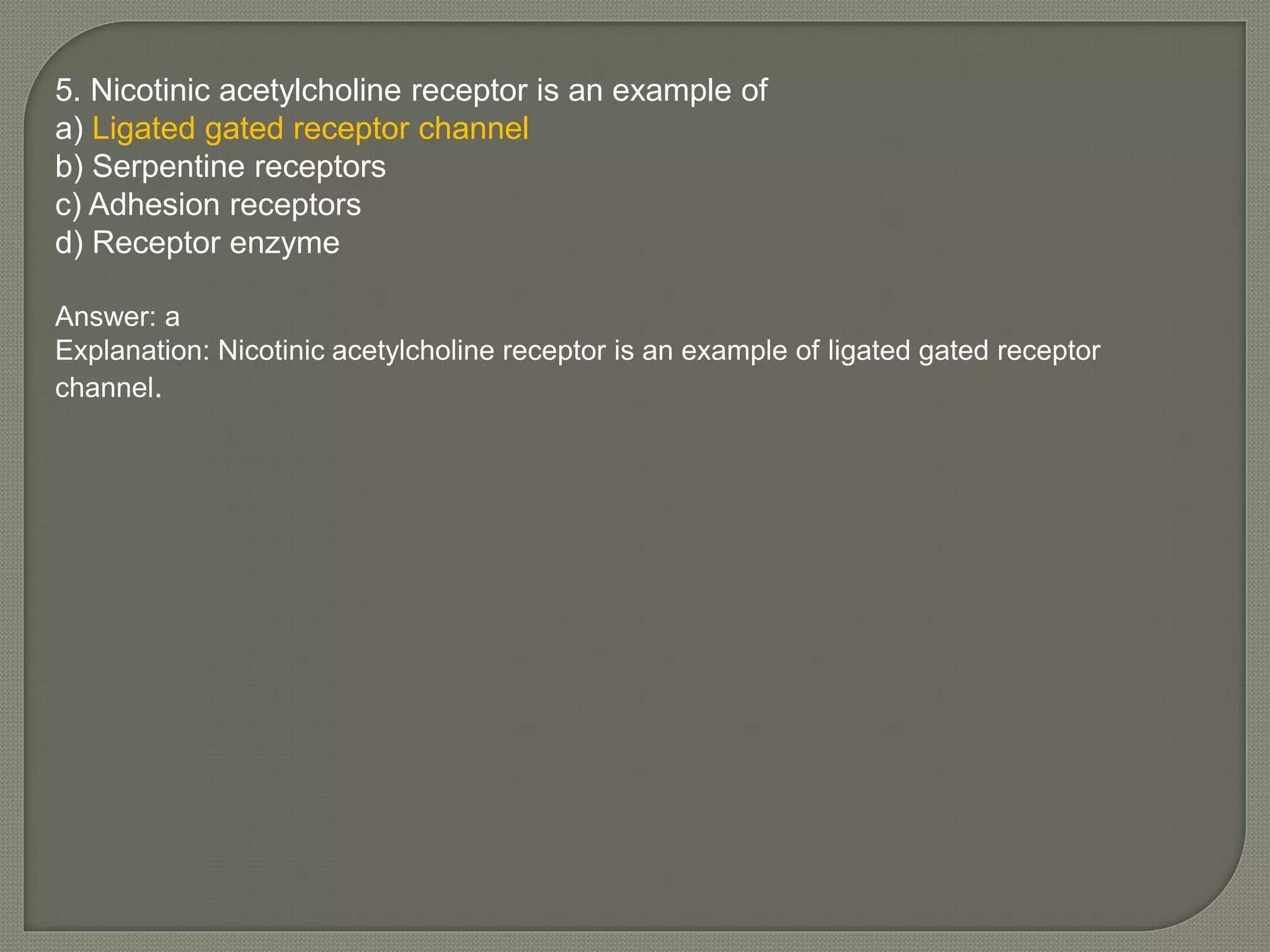
5. Nicotinic acetylcholine receptor is an example of
a) Ligated gated receptor channel
b) Serpentine receptors
c) Adhesion receptors
d) Receptor enzyme
Answer: a
Explanation: Nicotinic acetylcholine receptor is an example of ligated gated receptor
channel.

Ion channel RECEPTOR

  • 1.
    ASSIGNMENT ON ION CHANNEL RECEPTOR SUBMITTEDBY: SUBMITTED TO: MARY MELNA Dr. Kunjbihari Sulakhiya Sir ENROLL NO: 1801024022
  • 2.
     Pore formingtransmembrane proteins associated with transport of specific ions in or out of the cells.  Highly selective in type of ion transported (exceptions are there).  Very high rate of ion transfer.  Ions are transported across electrochemical gradient.  Passive mechanism.
  • 3.
     Conductance ofnerve impulse,generation of action potential,synaptic ransmission.  Cardiac,skeletal and smooth muscle contraction.  Epithelial Transport of Nutrients and ions.  T-cell activation (immune regulation).  Pancreatic β-cells insulin release.
  • 4.
    On the basis ofgating. Voltage Gated ion channels Ligand Gated Ion Channels Other Gating
  • 5.
    1.Voltage Gated IonChannels Open and close in response to membrane potential. 2.Ligand Gated Ion Channels Open in response to specific ligand molecules binding to the extracellular domain of the receptor protein. 3.Other Gatings Indirect signaling,mechano-gated ion channels,light gated channels
  • 6.
     Voltage sensitive Conformational change in response to the potential gradient.  Generally ion specific.  Important for excitable cells like neurons.  Role in regulation of depolarization and polarization of neuronal membrane during an action potential.  Distributed along the axon and soma of the neurons.
  • 7.
    Voltage gated ionchannels are made up of three basic parts : 1.The transmembrane pores 2.Voltage Sensor 3.Selectivity Filter Contains different subunits: α subunit and other auxillary subunits
  • 9.
     Voltage GatedSodium Channels (9 membrane ,responsible for membrane depolarization in action potential generation).  Voltage Gated Calcium Channels (10 members ,play an important role in both linking muscle excitation with contraction as well as neuronal excitation with transmitter release).  Voltage Gated Potassium Channels (40 members ,role in repolarisation of cell membrane after action potential)
  • 10.
     Transient receptorPotential Channels (28 types ,some of them are voltage gated,named after their role in Drosophila phototransduction).  Hyperpolarisation-activated cyclic nucleotide-gated channels (pacemaking channels in the heart,sensitive to cAMP, CGMP that alter the voltage sensitivity of the channels)  Voltage Sensitive Proton Channels (helps in acid extrusion from cell,phagocytosis,strongly PH regulated)
  • 11.
  • 12.
  • 14.
  • 15.
    Hyperpolarization-activated cyclic nucleotide-gatedchannels Voltage Sensitive Proton Channels
  • 16.
     Group oftransmembrane ion channels that allow the passing of several ions upon the binding of specific chemical messenger like neurotransmitters.  Two domains :transmembrane domain including channel pore ,Extracellular domain including Ligand binding site.  Function:Conversion of presynaptic chemical signal quickly and effectively into post-synaptic electrical signal.  Three super families:cys-Loop Receptors,Ionotropic Glutamate Receptor,ATP Gated Channels.
  • 17.
     Characteristic loopformed by a disulfide bond between two cystine residues in the N terminal extracellular domain.  Provides specificity for : Acetylcholine,sertonin,glycine,glutamate and γ- aminobutyric acid (GABA) in vertebrates.  Structural elements are well conserved,with a large extracellular domain(ECD) haboring an alpha-helix and 10 beta-strands.
  • 18.
     Bind toNT glutamate.  Consists of a tetramer.  Each subunit consists of extracellular amino terminal domain,an extracellular ligand binding domain,a transmembrane domain.  Each subunit of the tetramer has a binding site for glutamate.
  • 19.
    Bind to ATPin order to open. They form trimers with two transmembrane helices per subunit and both the C and N terminate on the intracellular side.
  • 21.
    Chloride channels Potassium channels SodiumChannels Calcium Channels Proton Channels
  • 22.
    Plasma Membrane Channels Examples-Voltage-Gated potassium channels,Sodium Channels,Calcium Channels and Chloride Channels. Intracellular Channels Example- ER Channels, Mitochondrial Channels.
  • 23.
     Ion channelsare varied widely and play a wide range of critical biological functions.  55 different medical conditions have been attributed to ion channel dysfunction.  Owning to these conditions,13.4% of all drugs are targeted to ion channels (second highest after GPCRs).  Worldwide sale of ion channel drugs(estimate)>$12 billion.
  • 24.
    1. Tetrodotoxin 2. Ziconitide 3.Benzodiazepines 4. Conotoxin 5. Lidocaine Other drugs are:Verapamil,Diltiazem,Amlodipine,Nimod ipine,Nifedipin,Lidocaine etc.
  • 25.
     Channelopathies  Cysticfibrosis is caused by mutations in the CFTR gene,which is a Chloride Channel.  Brugada syndrome is another ventricular arrhythmia caused by voltage-gated sodium channel gene mutations.  Shaker gene mutations, ataxia etc.
  • 27.
    1. Which ofthe following statements is true about transmembrane electrical potential? a) The chemical gradient drives Cl– and K+ inwards b) The electrical gradient drives Na+ and Ca+2 inwards c) The chemical gradient drives Na+ and Ca+2 inwards and K+ outward d) The chemical gradient drives Cl– and K+ outwards Answer: c Explanation: The chemical gradient drives Na+ and Ca+2 inwards and K+ outward, electrical gradient drives Cl–. 2. The receptor channels for which of the following are gated by extracellular ligands? a) Glycine b) IP3 c) cAMP d) cGMP Answer: a Explanation: The receptor channels for glycine are gated by extracellular ligands.
  • 28.
    3. Voltage regulationmeans a) Na+/K+ pumps controls potential b) Unless the voltage is regular gates will not respond c) Oscilloscope only can control potential d) With changes in the membrane potential voltage gated ion channels open and close Answer: d Explanation: With changes in the membrane potential voltage gated ion channels open and close, this is regulation of voltage. 4. Which of the following statements is false about a ligand-gated ion channel receptor? a) They are present in the cell membrane b) They consist of five glycoproteins c) Differences in membrane potential affect whether the channel receptors are open or close d) Neurotransmitters can act as the chemical messengers for these channels Answer: c Explanation: Ligands affect whether the channel receptors are open or close in a ligand- gated ion channel whereas voltage gated ion channels are controlled by the differences in membrane potential affect.
  • 29.
    5. Nicotinic acetylcholinereceptor is an example of a) Ligated gated receptor channel b) Serpentine receptors c) Adhesion receptors d) Receptor enzyme Answer: a Explanation: Nicotinic acetylcholine receptor is an example of ligated gated receptor channel.