PRESENTEDBY:SAKSHI KUMARI
Secondyear: BSCIN MEDICAL
TECHNOLOGYIN RADIOLOGY
 Some chemical compound undergo subtle
structural changes when exposed to
EMR(visible light,uv radiation or xray
),these changes are not immediately
visible rather is visible after certain
chemical reaction,exposed material
respond differently from unexposed
material,this chemical nature of material
is known as photographic effect.
 The chemical reaction needed to make
invisible image visible is photographic
development.
 Silver halides-have regular 3d or lattice
structure.
 Like common salt they also have ionic bond.
 Chemical properties;relatively stabledont
suffer from chemical breakdown. But if
reducing agent used can be converted into
metallic silver.
 Therefore we can say that photographic
development is a chemical reduction.
 Invisible structural changes occur.
 Case 1-xray photon emerges from the crystal
unscathed-no change occus in crystal
structure.
 Case 2-xray photon gets absorbed and causes
electron release as a result of interaction
with bromine.
 Free electron gets lodged in low energy
elcetron trap near surface of crystal as
sensetivity speck and the latter is produced
by the intoduction of impurity.
 An invisible image fromed from exposure of
radiation .
 Latent image becomes visible image upon
photographic development.
 Gurney mott theory and mitchell theory to
explain latent image.
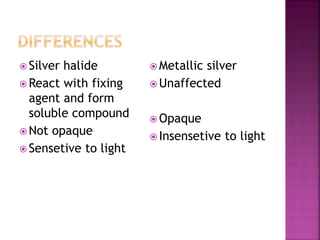
 Silver halide
 React with fixing
agent and form
soluble compound
 Not opaque
 Sensetive to light
 Metallic silver
 Unaffected
 Opaque
 Insensetive to light
 Emulsion is microscopic crystal of silver
halide in gelatin.
 Coated onto a supporting later of
transparent plastic known as base.
 Gelatin – liquid or solid gelly,act as
suspending media and binding agent for
silver halide.
 Transpent ,clumping,penetrating agentuniformityholding
capability,unreactive are properties of gelatin.
 Image produced as aresult of exposure to
light.
 To ensure efficient absorption;
 (1)close packing of silver halide grain.
 (2)increase the size of halide grain.
 (3)increase the thickness of emulsion layer.
 (4)Modifying the shape of halide grain.
 Most common type of film in xray department.
 Both sided emulsion and both sided intensifying
screen.Two image produces as a result of
exposure from both sides but base is thin sp both
image are
 Advantage ;
 Increased sensetivity and identical.increased
image contrast,
 Disadvantage ;
 Loss of image quality and economic reasons.
identical.increased image contrat
 In this emulsion emulsion side is coated only
to one side of its base with one intensifying
screen.
 They must only be loadedinto a cassette with
their emulsion side in contact
withintensifying screen ,manufacturer cuts a
small notch onto one edge of each film.
 Image are produced as a result of direct xray
exposureno longer used in departments but
in intra oral dental radiography and in
foreign body detection it is still used.
 Its design features;
 Duplitization-to gain the benefit of maximum
film emulsion.
 Sensitizers-enable additional sensitivity to
direct xray exposure.
Photographic principles

Photographic principles

  • 1.
    PRESENTEDBY:SAKSHI KUMARI Secondyear: BSCINMEDICAL TECHNOLOGYIN RADIOLOGY
  • 2.
     Some chemicalcompound undergo subtle structural changes when exposed to EMR(visible light,uv radiation or xray ),these changes are not immediately visible rather is visible after certain chemical reaction,exposed material respond differently from unexposed material,this chemical nature of material is known as photographic effect.  The chemical reaction needed to make invisible image visible is photographic development.
  • 3.
     Silver halides-haveregular 3d or lattice structure.  Like common salt they also have ionic bond.  Chemical properties;relatively stabledont suffer from chemical breakdown. But if reducing agent used can be converted into metallic silver.  Therefore we can say that photographic development is a chemical reduction.
  • 4.
     Invisible structuralchanges occur.  Case 1-xray photon emerges from the crystal unscathed-no change occus in crystal structure.  Case 2-xray photon gets absorbed and causes electron release as a result of interaction with bromine.  Free electron gets lodged in low energy elcetron trap near surface of crystal as sensetivity speck and the latter is produced by the intoduction of impurity.
  • 5.
     An invisibleimage fromed from exposure of radiation .  Latent image becomes visible image upon photographic development.  Gurney mott theory and mitchell theory to explain latent image.
  • 6.
     Silver halide React with fixing agent and form soluble compound  Not opaque  Sensetive to light  Metallic silver  Unaffected  Opaque  Insensetive to light
  • 7.
     Emulsion ismicroscopic crystal of silver halide in gelatin.  Coated onto a supporting later of transparent plastic known as base.  Gelatin – liquid or solid gelly,act as suspending media and binding agent for silver halide.  Transpent ,clumping,penetrating agentuniformityholding capability,unreactive are properties of gelatin.
  • 8.
     Image producedas aresult of exposure to light.  To ensure efficient absorption;  (1)close packing of silver halide grain.  (2)increase the size of halide grain.  (3)increase the thickness of emulsion layer.  (4)Modifying the shape of halide grain.
  • 9.
     Most commontype of film in xray department.  Both sided emulsion and both sided intensifying screen.Two image produces as a result of exposure from both sides but base is thin sp both image are  Advantage ;  Increased sensetivity and identical.increased image contrast,  Disadvantage ;  Loss of image quality and economic reasons. identical.increased image contrat
  • 10.
     In thisemulsion emulsion side is coated only to one side of its base with one intensifying screen.  They must only be loadedinto a cassette with their emulsion side in contact withintensifying screen ,manufacturer cuts a small notch onto one edge of each film.
  • 11.
     Image areproduced as a result of direct xray exposureno longer used in departments but in intra oral dental radiography and in foreign body detection it is still used.  Its design features;  Duplitization-to gain the benefit of maximum film emulsion.  Sensitizers-enable additional sensitivity to direct xray exposure.