2
3
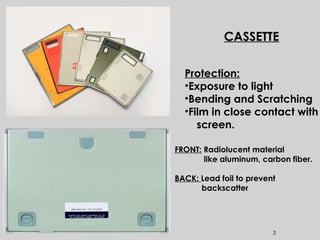
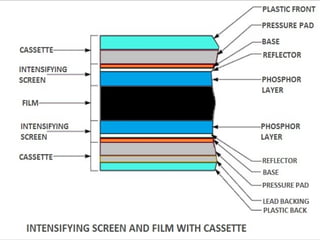
CASSETTE
Protection:
•Exposure to light
•Bending and Scratching
•Film in close contact with
screen.
FRONT: Radiolucent material
like aluminum, carbon fiber.
BACK: Lead foil to prevent
backscatter
4
5
6
INTENSIFYING SCREENS
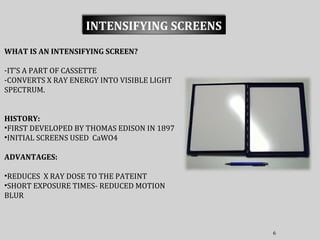
WHAT IS AN INTENSIFYING SCREEN?
-IT’S A PART OF CASSETTE
-CONVERTS X RAY ENERGY INTO VISIBLE LIGHT
SPECTRUM.
HISTORY:
•FIRST DEVELOPED BY THOMAS EDISON IN 1897
•INITIAL SCREENS USED CaWO4
ADVANTAGES:
•REDUCES X RAY DOSE TO THE PATEINT
•SHORT EXPOSURE TIMES- REDUCED MOTION
BLUR
7
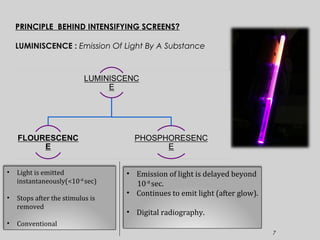
PRINCIPLE BEHIND INTENSIFYING SCREENS?
LUMINISCENCE : Emission Of Light By A Substance
• Light is emitted
instantaneously(<10-8
sec)
• Stops after the stimulus is
removed
• Conventional
• Emission of light is delayed beyond
10-8
sec.
• Continues to emit light (after glow).
• Digital radiography.
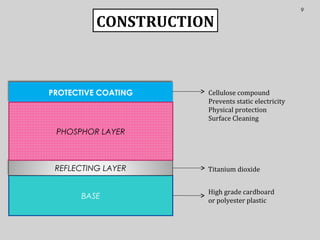
9
BASE
PROTECTIVE COATING
REFLECTING LAYER
PHOSPHOR LAYER
CONSTRUCTION
High grade cardboard
or polyester plastic
Titanium dioxide
Cellulose compound
Prevents static electricity
Physical protection
Surface Cleaning
10
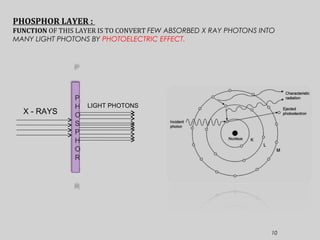
PHOSPHOR LAYER :
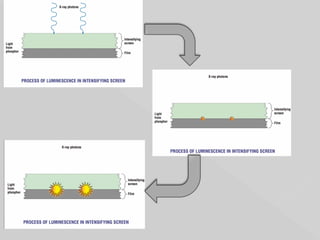
FUNCTION OF THIS LAYER IS TO CONVERT FEW ABSORBED X RAY PHOTONS INTO
MANY LIGHT PHOTONS BY PHOTOELECTRIC EFFECT.
P
H
O
S
P
H
O
R
X - RAYS
LIGHT PHOTONS
11
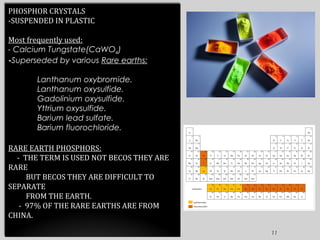
PHOSPHOR CRYSTALS
-SUSPENDED IN PLASTIC
Most frequently used:
- Calcium Tungstate(CaWO4)
-Superseded by various Rare earths:
Lanthanum oxybromide.
Lanthanum oxysulfide.
Gadolinium oxysulfide.
Yttrium oxysulfide.
Barium lead sulfate.
Barium fluorochloride.
RARE EARTH PHOSPHORS:
- THE TERM IS USED NOT BECOS THEY ARE
RARE
BUT BECOS THEY ARE DIFFICULT TO
SEPARATE
FROM THE EARTH.
- 97% OF THE RARE EARTHS ARE FROM
CHINA.
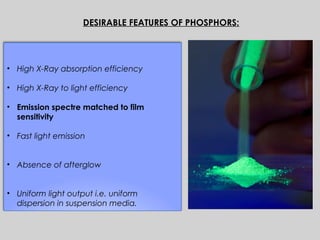
• High X-Ray absorption efficiency
• High X-Ray to light efficiency
• Emission spectre matched to film
sensitivity
• Fast light emission
• Absence of afterglow
• Uniform light output i.e. uniform
dispersion in suspension media.
DESIRABLE FEATURES OF PHOSPHORS:
13
DEPEND ON:
1)Thickness of the phosphor layer.
2) Size of the phosphor crystals.
3) Presence or absence of light-absorbing dye in the phosphor layer.
4) Phosphor conversion efficiency.
SPEED OF THE SCREENS
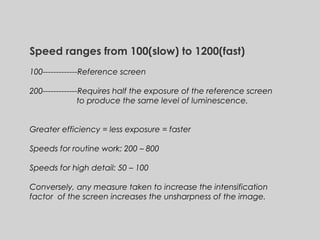
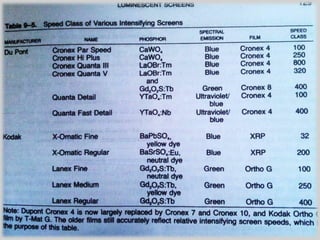
Speed ranges from 100(slow) to 1200(fast)
100-------------Reference screen
200-------------Requires half the exposure of the reference screen
to produce the same level of luminescence.
Greater efficiency = less exposure = faster
Speeds for routine work: 200 – 800
Speeds for high detail: 50 – 100
Conversely, any measure taken to increase the intensification
factor of the screen increases the unsharpness of the image.
15
16
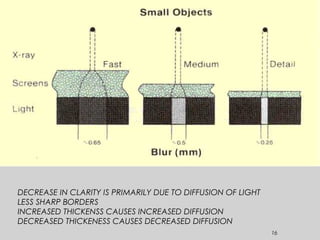
DECREASE IN CLARITY IS PRIMARILY DUE TO DIFFUSION OF LIGHT
LESS SHARP BORDERS
INCREASED THICKENSS CAUSES INCREASED DIFFUSION
DECREASED THICKENESS CAUSES DECREASED DIFFUSION
17
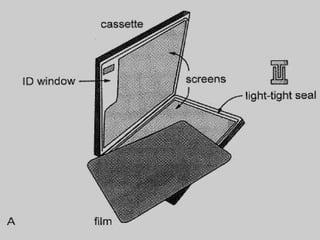
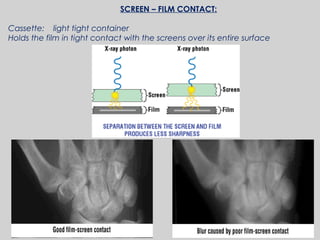
SCREEN – FILM CONTACT:
Cassette: light tight container
Holds the film in tight contact with the screens over its entire surface
18
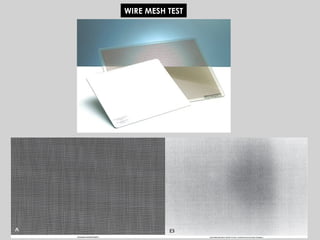
WIRE MESH TEST
19
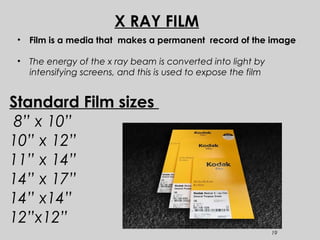
Standard Film sizes
8” x 10”
10” x 12”
11” x 14”
14” x 17”
14” x14”
12”x12”
• Film is a media that makes a permanent record of the image
• The energy of the x ray beam is converted into light by
intensifying screens, and this is used to expose the film
X RAY FILM
20
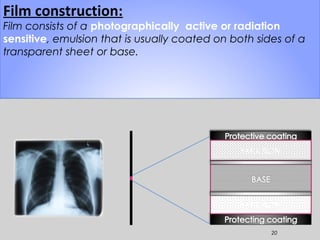
Film construction:
Film consists of a photographically active or radiation
sensitive, emulsion that is usually coated on both sides of a
transparent sheet or base.
EMULSION
EMULSION
21
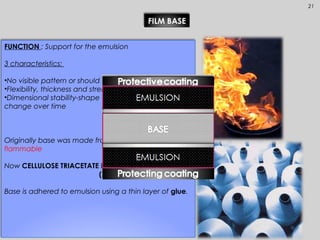
FUNCTION : Support for the emulsion
3 characteristics:
•No visible pattern or should not absorb light
•Flexibility, thickness and strength-ease of processing
•Dimensional stability-shape and size should not
change over time
Originally base was made from CELLULOSE NITRATE –
flammable
Now CELLULOSE TRIACETATE BASE and POLYESTER
(DMT and Ethylene glycol)
Base is adhered to emulsion using a thin layer of glue.
FILM BASE
22
EMULSION
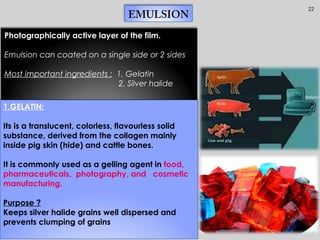
1.GELATIN:
Its is a translucent, colorless, flavourless solid
substance, derived from the collagen mainly
inside pig skin (hide) and cattle bones.
It is commonly used as a gelling agent in food,
pharmaceuticals, photography, and cosmetic
manufacturing.
Purpose ?
Keeps silver halide grains well dispersed and
prevents clumping of grains
Photographically active layer of the film.
Emulsion can coated on a single side or 2 sides
Most important ingredients : 1. Gelatin
2. Silver halide
23
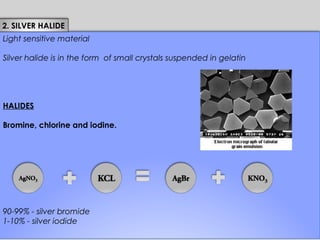
Light sensitive material
Silver halide is in the form of small crystals suspended in gelatin
HALIDES
Bromine, chlorine and iodine.
90-99% - silver bromide
1-10% - silver iodide
2. SILVER HALIDE
24
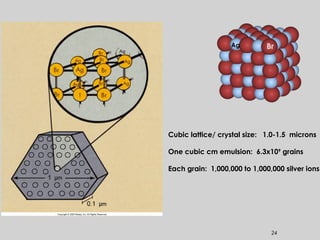
Ag Br
Cubic lattice/ crystal size: 1.0-1.5 microns
One cubic cm emulsion: 6.3x10⁹
grains
Each grain: 1,000,000 to 1,000,000 silver ions
25
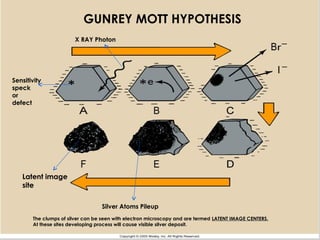
GUNREY MOTT HYPOTHESIS
Sensitivity
speck
or
defect
X RAY Photon
Silver Atoms Pileup
Latent image
site
The clumps of silver can be seen with electron microscopy and are termed LATENT IMAGE CENTERS.
At these sites developing process will cause visible silver deposit.
26
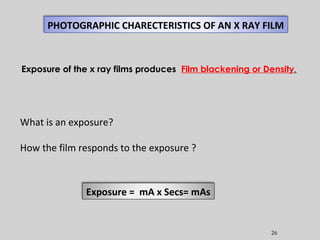
PHOTOGRAPHIC CHARECTERISTICS OF AN X RAY FILM
What is an exposure?
How the film responds to the exposure ?
Exposure = mA x Secs= mAs
Exposure of the x ray films produces Film blackening or Density.
27
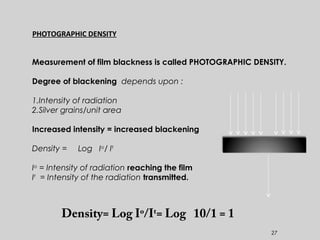
PHOTOGRAPHIC DENSITY
Measurement of film blackness is called PHOTOGRAPHIC DENSITY.
Degree of blackening depends upon :
1.Intensity of radiation
2.Silver grains/unit area
Increased intensity = increased blackening
Density = Log Io
/ It
Io
= Intensity of radiation reaching the film
It
= Intensity of the radiation transmitted.
Density= Log Io
/It
= Log 10/1 = 1
28
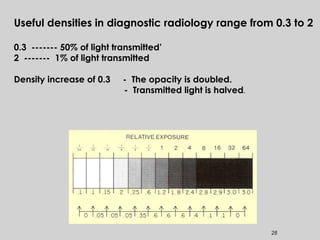
Useful densities in diagnostic radiology range from 0.3 to 2
0.3 ------- 50% of light transmitted’
2 ------- 1% of light transmitted
Density increase of 0.3 - The opacity is doubled.
- Transmitted light is halved.
29
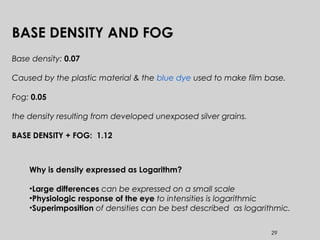
BASE DENSITY AND FOG
Base density: 0.07
Caused by the plastic material & the blue dye used to make film base.
Fog: 0.05
the density resulting from developed unexposed silver grains.
BASE DENSITY + FOG: 1.12
Why is density expressed as Logarithm?
•Large differences can be expressed on a small scale
•Physiologic response of the eye to intensities is logarithmic
•Superimposition of densities can be best described as logarithmic.
30
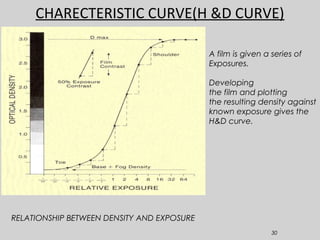
CHARECTERISTIC CURVE(H &D CURVE)
RELATIONSHIP BETWEEN DENSITY AND EXPOSURE
A film is given a series of
Exposures.
Developing
the film and plotting
the resulting density against
known exposure gives the
H&D curve.
31
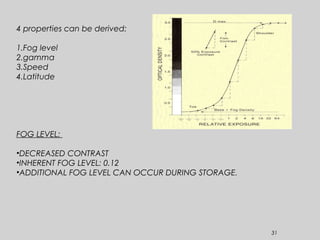
4 properties can be derived:
1.Fog level
2.gamma
3.Speed
4.Latitude
FOG LEVEL:
•DECREASED CONTRAST
•INHERENT FOG LEVEL: 0.12
•ADDITIONAL FOG LEVEL CAN OCCUR DURING STORAGE.
32
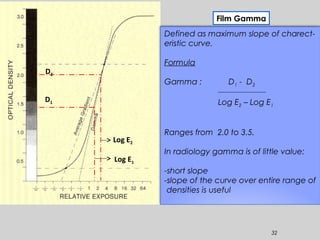
Film Gamma
Defined as maximum slope of charect-
eristic curve.
Formula
Gamma : D1 - D2
Log E2 – Log E1
Ranges from 2.0 to 3.5.
In radiology gamma is of little value:
-short slope
-slope of the curve over entire range of
densities is useful
D1
D2
Log E1
Log E2
33
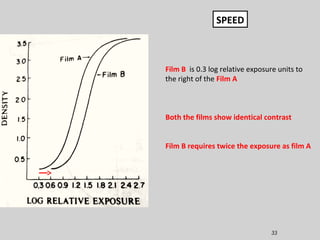
SPEED
Film B is 0.3 log relative exposure units to
the right of the Film A
Both the films show identical contrast
Film B requires twice the exposure as film A
34
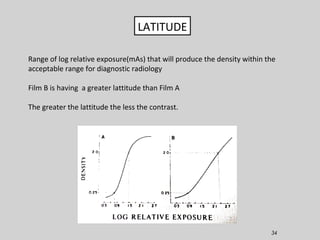
LATITUDE
Range of log relative exposure(mAs) that will produce the density within the
acceptable range for diagnostic radiology
Film B is having a greater lattitude than Film A
The greater the lattitude the less the contrast.
35
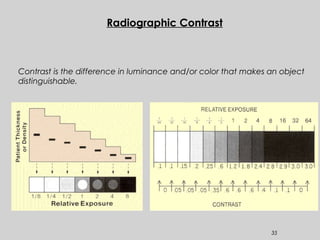
Radiographic Contrast
Contrast is the difference in luminance and/or color that makes an object
distinguishable.
36
37
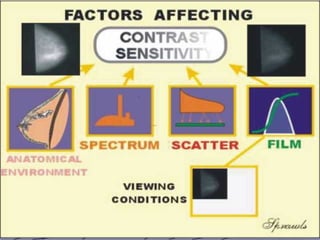
Radiographic contrast depends on
1.Subject contrast
2.Film contrast
Subject contrast is affected by:
1. Thickness of the subject.
2. Density and atomic differences
of the subject.
3. Radiation energy (kVp).
4. Contrast material.
5. Scatter radiation
Film contrast is affected by:
1.Film gamma
2.Screen or Direct exposure
3.Film density
4.Film processing
38
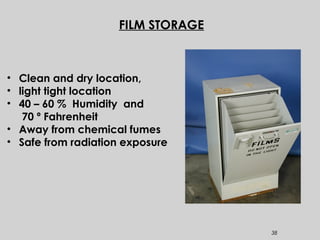
FILM STORAGE
• Clean and dry location,
• light tight location
• 40 – 60 % Humidity and
70 º Fahrenheit
• Away from chemical fumes
• Safe from radiation exposure
39
Why x ray image is viewed as a transparency?
Why can’t it be printed on a paper and viewed ?
40
References:
Christensen’s Physics of Diagnostic Radiology
41

Intensifying screens & films

  • 2.
  • 3.
    3 CASSETTE Protection: •Exposure to light •Bendingand Scratching •Film in close contact with screen. FRONT: Radiolucent material like aluminum, carbon fiber. BACK: Lead foil to prevent backscatter
  • 4.
  • 5.
  • 6.
    6 INTENSIFYING SCREENS WHAT ISAN INTENSIFYING SCREEN? -IT’S A PART OF CASSETTE -CONVERTS X RAY ENERGY INTO VISIBLE LIGHT SPECTRUM. HISTORY: •FIRST DEVELOPED BY THOMAS EDISON IN 1897 •INITIAL SCREENS USED CaWO4 ADVANTAGES: •REDUCES X RAY DOSE TO THE PATEINT •SHORT EXPOSURE TIMES- REDUCED MOTION BLUR
  • 7.
    7 PRINCIPLE BEHIND INTENSIFYINGSCREENS? LUMINISCENCE : Emission Of Light By A Substance • Light is emitted instantaneously(<10-8 sec) • Stops after the stimulus is removed • Conventional • Emission of light is delayed beyond 10-8 sec. • Continues to emit light (after glow). • Digital radiography.
  • 9.
    9 BASE PROTECTIVE COATING REFLECTING LAYER PHOSPHORLAYER CONSTRUCTION High grade cardboard or polyester plastic Titanium dioxide Cellulose compound Prevents static electricity Physical protection Surface Cleaning

  • 10.
    10 PHOSPHOR LAYER : FUNCTIONOF THIS LAYER IS TO CONVERT FEW ABSORBED X RAY PHOTONS INTO MANY LIGHT PHOTONS BY PHOTOELECTRIC EFFECT. P H O S P H O R X - RAYS LIGHT PHOTONS
  • 11.
    11 PHOSPHOR CRYSTALS -SUSPENDED INPLASTIC Most frequently used: - Calcium Tungstate(CaWO4) -Superseded by various Rare earths: Lanthanum oxybromide. Lanthanum oxysulfide. Gadolinium oxysulfide. Yttrium oxysulfide. Barium lead sulfate. Barium fluorochloride. RARE EARTH PHOSPHORS: - THE TERM IS USED NOT BECOS THEY ARE RARE BUT BECOS THEY ARE DIFFICULT TO SEPARATE FROM THE EARTH. - 97% OF THE RARE EARTHS ARE FROM CHINA.
  • 12.
    • High X-Rayabsorption efficiency • High X-Ray to light efficiency • Emission spectre matched to film sensitivity • Fast light emission • Absence of afterglow • Uniform light output i.e. uniform dispersion in suspension media. DESIRABLE FEATURES OF PHOSPHORS:
  • 13.
    13 DEPEND ON: 1)Thickness ofthe phosphor layer. 2) Size of the phosphor crystals. 3) Presence or absence of light-absorbing dye in the phosphor layer. 4) Phosphor conversion efficiency. SPEED OF THE SCREENS
  • 14.
    Speed ranges from100(slow) to 1200(fast) 100-------------Reference screen 200-------------Requires half the exposure of the reference screen to produce the same level of luminescence. Greater efficiency = less exposure = faster Speeds for routine work: 200 – 800 Speeds for high detail: 50 – 100 Conversely, any measure taken to increase the intensification factor of the screen increases the unsharpness of the image.
  • 15.
  • 16.
    16 DECREASE IN CLARITYIS PRIMARILY DUE TO DIFFUSION OF LIGHT LESS SHARP BORDERS INCREASED THICKENSS CAUSES INCREASED DIFFUSION DECREASED THICKENESS CAUSES DECREASED DIFFUSION
  • 17.
    17 SCREEN – FILMCONTACT: Cassette: light tight container Holds the film in tight contact with the screens over its entire surface
  • 18.
  • 19.
    19 Standard Film sizes 8”x 10” 10” x 12” 11” x 14” 14” x 17” 14” x14” 12”x12” • Film is a media that makes a permanent record of the image • The energy of the x ray beam is converted into light by intensifying screens, and this is used to expose the film X RAY FILM
  • 20.
    20 Film construction: Film consistsof a photographically active or radiation sensitive, emulsion that is usually coated on both sides of a transparent sheet or base. EMULSION EMULSION
  • 21.
    21 FUNCTION : Supportfor the emulsion 3 characteristics: •No visible pattern or should not absorb light •Flexibility, thickness and strength-ease of processing •Dimensional stability-shape and size should not change over time Originally base was made from CELLULOSE NITRATE – flammable Now CELLULOSE TRIACETATE BASE and POLYESTER (DMT and Ethylene glycol) Base is adhered to emulsion using a thin layer of glue. FILM BASE
  • 22.
    22 EMULSION 1.GELATIN: Its is atranslucent, colorless, flavourless solid substance, derived from the collagen mainly inside pig skin (hide) and cattle bones. It is commonly used as a gelling agent in food, pharmaceuticals, photography, and cosmetic manufacturing. Purpose ? Keeps silver halide grains well dispersed and prevents clumping of grains Photographically active layer of the film. Emulsion can coated on a single side or 2 sides Most important ingredients : 1. Gelatin 2. Silver halide
  • 23.
    23 Light sensitive material Silverhalide is in the form of small crystals suspended in gelatin HALIDES Bromine, chlorine and iodine. 90-99% - silver bromide 1-10% - silver iodide 2. SILVER HALIDE
  • 24.
    24 Ag Br Cubic lattice/crystal size: 1.0-1.5 microns One cubic cm emulsion: 6.3x10⁹ grains Each grain: 1,000,000 to 1,000,000 silver ions
  • 25.
    25 GUNREY MOTT HYPOTHESIS Sensitivity speck or defect XRAY Photon Silver Atoms Pileup Latent image site The clumps of silver can be seen with electron microscopy and are termed LATENT IMAGE CENTERS. At these sites developing process will cause visible silver deposit.
  • 26.
    26 PHOTOGRAPHIC CHARECTERISTICS OFAN X RAY FILM What is an exposure? How the film responds to the exposure ? Exposure = mA x Secs= mAs Exposure of the x ray films produces Film blackening or Density.
  • 27.
    27 PHOTOGRAPHIC DENSITY Measurement offilm blackness is called PHOTOGRAPHIC DENSITY. Degree of blackening depends upon : 1.Intensity of radiation 2.Silver grains/unit area Increased intensity = increased blackening Density = Log Io / It Io = Intensity of radiation reaching the film It = Intensity of the radiation transmitted. Density= Log Io /It = Log 10/1 = 1
  • 28.
    28 Useful densities indiagnostic radiology range from 0.3 to 2 0.3 ------- 50% of light transmitted’ 2 ------- 1% of light transmitted Density increase of 0.3 - The opacity is doubled. - Transmitted light is halved.
  • 29.
    29 BASE DENSITY ANDFOG Base density: 0.07 Caused by the plastic material & the blue dye used to make film base. Fog: 0.05 the density resulting from developed unexposed silver grains. BASE DENSITY + FOG: 1.12 Why is density expressed as Logarithm? •Large differences can be expressed on a small scale •Physiologic response of the eye to intensities is logarithmic •Superimposition of densities can be best described as logarithmic.
  • 30.
    30 CHARECTERISTIC CURVE(H &DCURVE) RELATIONSHIP BETWEEN DENSITY AND EXPOSURE A film is given a series of Exposures. Developing the film and plotting the resulting density against known exposure gives the H&D curve.
  • 31.
    31 4 properties canbe derived: 1.Fog level 2.gamma 3.Speed 4.Latitude FOG LEVEL: •DECREASED CONTRAST •INHERENT FOG LEVEL: 0.12 •ADDITIONAL FOG LEVEL CAN OCCUR DURING STORAGE.
  • 32.
    32 Film Gamma Defined asmaximum slope of charect- eristic curve. Formula Gamma : D1 - D2 Log E2 – Log E1 Ranges from 2.0 to 3.5. In radiology gamma is of little value: -short slope -slope of the curve over entire range of densities is useful D1 D2 Log E1 Log E2
  • 33.
    33 SPEED Film B is0.3 log relative exposure units to the right of the Film A Both the films show identical contrast Film B requires twice the exposure as film A
  • 34.
    34 LATITUDE Range of logrelative exposure(mAs) that will produce the density within the acceptable range for diagnostic radiology Film B is having a greater lattitude than Film A The greater the lattitude the less the contrast.
  • 35.
    35 Radiographic Contrast Contrast isthe difference in luminance and/or color that makes an object distinguishable.
  • 36.
  • 37.
    37 Radiographic contrast dependson 1.Subject contrast 2.Film contrast Subject contrast is affected by: 1. Thickness of the subject. 2. Density and atomic differences of the subject. 3. Radiation energy (kVp). 4. Contrast material. 5. Scatter radiation Film contrast is affected by: 1.Film gamma 2.Screen or Direct exposure 3.Film density 4.Film processing
  • 38.
    38 FILM STORAGE • Cleanand dry location, • light tight location • 40 – 60 % Humidity and 70 º Fahrenheit • Away from chemical fumes • Safe from radiation exposure
  • 39.
    39 Why x rayimage is viewed as a transparency? Why can’t it be printed on a paper and viewed ?
  • 40.
  • 41.