ATTENUATION
Dr. ARCHANA KOSHY
The reduction in the intensity of an
Xray beam as it traverses matter
either by absorption or deflection of
photons from the beam .
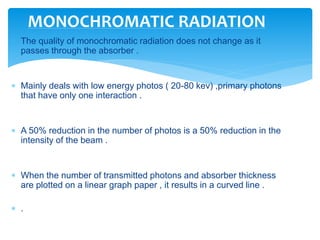
 The quality of monochromatic radiation does not change as it
passes through the absorber .
 Mainly deals with low energy photos ( 20-80 kev) ,primary photons
that have only one interaction .
 A 50% reduction in the number of photos is a 50% reduction in the
intensity of the beam .
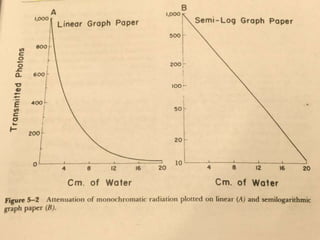
 When the number of transmitted photons and absorber thickness
are plotted on a linear graph paper , it results in a curved line .
 .
MONOCHROMATIC RADIATION
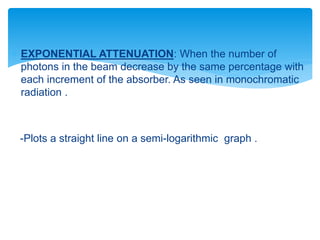
 EXPONENTIAL ATTENUATION: When the number of
photons in the beam decrease by the same percentage with
each increment of the absorber. As seen in monochromatic
radiation .
-Plots a straight line on a semi-logarithmic graph .
 Measure of the quantity of radiation attenuated by a given thickness of
an absorber .
 Name is determined by the units used to measure the thickness of the
absorber .
 (i) LINEAR ATTENUATION COEFFICENT
 (ii) MASS ATTENUATION COEFFICIENT
ATTENUATION COEFFICIENTS
 Most important for diagnostic radiology .
 Quantitative measurement of attenuation per centimeter of the
absorber.
 Is for monochromatic radiation and is specific for both the energy
of the xray beam and the type of absorber .
 When the energy of the radiation is increased,the number of Xrays
that are attenuated decreases , and so does the linear attenuation
co efficient
Linear attenuation coefficient (µ)
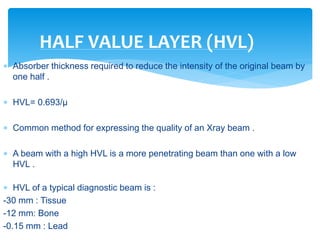
 Absorber thickness required to reduce the intensity of the original beam by
one half .
 HVL= 0.693/µ
 Common method for expressing the quality of an Xray beam .
 A beam with a high HVL is a more penetrating beam than one with a low
HVL .
 HVL of a typical diagnostic beam is :
-30 mm : Tissue
-12 mm: Bone
-0.15 mm : Lead
HALF VALUE LAYER (HVL)
 Quantitates the attenuation of materials independent of their
physical state .
 Obtained by dividing the linear attenuation coefficient by the density
.
MASS ATTENUATION COEFFICIENT : µ/Þ
 Unit – g/cm²
 Mass attenuation coefficient is independent of the density of the
absorber
MASS ATTENUATION
COEFFICIENT
 (I) Energy of the radiation
 (II) Density
 (III) Atomic number
 (IV) Electrons per gram
FACTORS AFFECTING ATTENUATION
 Elements with higher atomic number are denser than elements with lower
atomic numbers
 Few Exceptions : Gold( Z=79 , Þ= 19.3)
Lead (Z=82 , Þ= 11.0)
 No relationship between atomic number and density when different physical
states of matter are involved .
-Water – Effective atomic number – 7.4 (in all three forms of
Ice,liquid ,vapour despite its varying density.)
DENSITY AND ATOMIC NUMBER
Density and electrons per gram
 Density depends on volume ( weight/Volume ) , hence there is no
relationship between density and electrons per gram .
 A gram of water has the same number of electrons , irrespective of whether
they are compressed together in a 1 cm cube as a liquid or spread out as
vapour .
Atomic number and electrons per gram
 Electrons per gram is a function of the neutrons in an atom .
 If there are no neutrons, there will be 6.0 x 10²³ electrons
 Hydrogen has twice as many electrons as any other element .
 Elements with low atomic numbers have more e/g than those with higher
atomic number .
 Determines the percentage of each type of basic interaction .
 With extremely low energy radiation (20keV) , PHOTOELECTRIC
ATTENUATION predominates irrespective of the atomic number of the
absorber .
 Attenuation is always greater when the photoelectric effect predominates .
 As the radiation energy increases , Compton scattering predominates until
eventually it replaces photoelectric reaction .
EFFECTS OF ENERGY AND
ATOMIC NUMBER
 The linear attenuation co efficient is the the collective sum of the
contributions from COHERENT,COMPTON and PHOTOELECTRIC
reactions .
 For water, the Mean attenuation and the linear coefficient are the same
because the density of water is 1 g/cm³
 Energy has a direct effect on attenuation .
 The percentage of transmitted photons increase as the energy of the
beam increases .
 Binding energy of the K shell electron .
 As radiation energy increases, xray transmission increases with decreased
attenuation .
.
 But as a paradox , with higher high atomic number absorbers, transmission
may decrease .
 Abrupt change in the likelihood of a photoelectric reaction as the radiation
energy reaches the binding energy of an inner shell electron .
K – EDGE
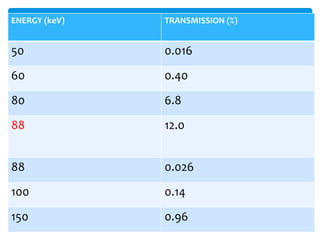
ENERGY (keV) TRANSMISSION (%)
50 0.016
60 0.40
80 6.8
88 12.0
88 0.026
100 0.14
150 0.96
 When maximum Xray absorption is desired, the K-edge of an
absorber should be closely matched to the energy of the Xray beam .
 For low energy radiation(30-35 kVp) , xeroradiography emoloys
Selenium ( K edge 12.7 ) as the Xray absorber

 High energy radiation ,Tungsten with a K edge of 59.5keV is a much
better absorber .
 Tissue density is one of the most important factors in Xray
attenuation .
 If the density of a material is doubled, attenuation doubles
.
Effects of density
 From a clinical radiology point of view, Density determines
the number of electrons that will be present in a given
thickness and this determines the X-ray attenuation .
 The number of e/g can be calculated by
No = NZ/A
No=Number of electrons per
N=Avogadro’s number(6.02 x 10²³)
Z=Atomic number
A=Atomic weight
Effects of electrons /grams
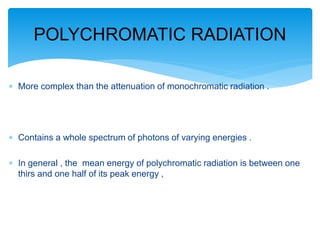
 More complex than the attenuation of monochromatic radiation .
 Contains a whole spectrum of photons of varying energies .
 In general , the mean energy of polychromatic radiation is between one
thirs and one half of its peak energy ,
POLYCHROMATIC RADIATION
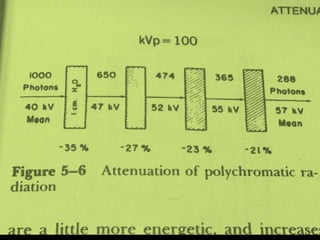
 As polychromatic radiation passes through the absorber
 Transmitted photons undergo a change in both quantity and quality
 Number of photons decrease because some are deflected and
absorbed out of the beam .
 Quality also changes because the lower energy photons are readily
attenuated than the higher energy photons .
 The photons in an xray beam enter a patient with
uniform distribution and emerge in a specific pattern of
distribution .
 Transmitted and attenuated photons are equally
important .
 Image formation depends on a differential attenuation
between tissues .
APPLICATIONS OF DIAGNOSTIC
RADIOLOGY
 The primary radiation passes through the patient
unchanged or is completely removed from the useful
beam .
 Scatter radiation detracts from film quality and
contributes from film quality .
 With thick parts such as the abdomen , only 1% of the
photons in the initial beam reach the film .
 The rest are attenuated, the majority by compton
scattering .
SCATTER RADIATION
 (1) Kilovoltage
 (2) Part thickness
 (3) Field size
FACTORS AFFECTING
SCATTERING RADIATION
FIELD SIZE
Most important factor in the production of scatter
radiation .
 A narrow beam irradiates only a small volume of tissue
, so it generates only a small number of scattered
photons .
 Most of them miss the film because they have a large
angle of escape .
 As the Xray field is enlarged , the quantity of scatter
radiation increases rapidly at first and then gradually
tapers off until it reaches a plateau .
PART THICKNESS
-The total number of photons keeps increasing as the part becomes
thicker , but photons originating in the upper layers of the patient do
not have sufficient energy to reach the film .
KILOVOLTAGE
• In the low energy range –extremely little scatter radiation is
produced .
• As the radiation energy increases-so does the scatter radiation .
• Unlike field size and part thickness, the plateau is not as well
defined
• This is due to the increasing beam energy that causes more
photons scatter in the forward direction allowing them to
penetrate greater thicknesses of tissue to reach the film
archi

Attenuation

  • 1.
  • 2.
    The reduction inthe intensity of an Xray beam as it traverses matter either by absorption or deflection of photons from the beam .
  • 3.
     The qualityof monochromatic radiation does not change as it passes through the absorber .  Mainly deals with low energy photos ( 20-80 kev) ,primary photons that have only one interaction .  A 50% reduction in the number of photos is a 50% reduction in the intensity of the beam .  When the number of transmitted photons and absorber thickness are plotted on a linear graph paper , it results in a curved line .  . MONOCHROMATIC RADIATION
  • 4.
     EXPONENTIAL ATTENUATION:When the number of photons in the beam decrease by the same percentage with each increment of the absorber. As seen in monochromatic radiation . -Plots a straight line on a semi-logarithmic graph .
  • 7.
     Measure ofthe quantity of radiation attenuated by a given thickness of an absorber .  Name is determined by the units used to measure the thickness of the absorber .  (i) LINEAR ATTENUATION COEFFICENT  (ii) MASS ATTENUATION COEFFICIENT ATTENUATION COEFFICIENTS
  • 8.
     Most importantfor diagnostic radiology .  Quantitative measurement of attenuation per centimeter of the absorber.  Is for monochromatic radiation and is specific for both the energy of the xray beam and the type of absorber .  When the energy of the radiation is increased,the number of Xrays that are attenuated decreases , and so does the linear attenuation co efficient Linear attenuation coefficient (µ)
  • 9.
     Absorber thicknessrequired to reduce the intensity of the original beam by one half .  HVL= 0.693/µ  Common method for expressing the quality of an Xray beam .  A beam with a high HVL is a more penetrating beam than one with a low HVL .  HVL of a typical diagnostic beam is : -30 mm : Tissue -12 mm: Bone -0.15 mm : Lead HALF VALUE LAYER (HVL)
  • 10.
     Quantitates theattenuation of materials independent of their physical state .  Obtained by dividing the linear attenuation coefficient by the density . MASS ATTENUATION COEFFICIENT : µ/Þ  Unit – g/cm²  Mass attenuation coefficient is independent of the density of the absorber MASS ATTENUATION COEFFICIENT
  • 11.
     (I) Energyof the radiation  (II) Density  (III) Atomic number  (IV) Electrons per gram FACTORS AFFECTING ATTENUATION
  • 12.
     Elements withhigher atomic number are denser than elements with lower atomic numbers  Few Exceptions : Gold( Z=79 , Þ= 19.3) Lead (Z=82 , Þ= 11.0)  No relationship between atomic number and density when different physical states of matter are involved . -Water – Effective atomic number – 7.4 (in all three forms of Ice,liquid ,vapour despite its varying density.) DENSITY AND ATOMIC NUMBER
  • 13.
    Density and electronsper gram  Density depends on volume ( weight/Volume ) , hence there is no relationship between density and electrons per gram .  A gram of water has the same number of electrons , irrespective of whether they are compressed together in a 1 cm cube as a liquid or spread out as vapour . Atomic number and electrons per gram  Electrons per gram is a function of the neutrons in an atom .  If there are no neutrons, there will be 6.0 x 10²³ electrons  Hydrogen has twice as many electrons as any other element .  Elements with low atomic numbers have more e/g than those with higher atomic number .
  • 14.
     Determines thepercentage of each type of basic interaction .  With extremely low energy radiation (20keV) , PHOTOELECTRIC ATTENUATION predominates irrespective of the atomic number of the absorber .  Attenuation is always greater when the photoelectric effect predominates .  As the radiation energy increases , Compton scattering predominates until eventually it replaces photoelectric reaction . EFFECTS OF ENERGY AND ATOMIC NUMBER
  • 15.
     The linearattenuation co efficient is the the collective sum of the contributions from COHERENT,COMPTON and PHOTOELECTRIC reactions .  For water, the Mean attenuation and the linear coefficient are the same because the density of water is 1 g/cm³  Energy has a direct effect on attenuation .  The percentage of transmitted photons increase as the energy of the beam increases .
  • 16.
     Binding energyof the K shell electron .  As radiation energy increases, xray transmission increases with decreased attenuation . .  But as a paradox , with higher high atomic number absorbers, transmission may decrease .  Abrupt change in the likelihood of a photoelectric reaction as the radiation energy reaches the binding energy of an inner shell electron . K – EDGE
  • 17.
    ENERGY (keV) TRANSMISSION(%) 50 0.016 60 0.40 80 6.8 88 12.0 88 0.026 100 0.14 150 0.96
  • 19.
     When maximumXray absorption is desired, the K-edge of an absorber should be closely matched to the energy of the Xray beam .  For low energy radiation(30-35 kVp) , xeroradiography emoloys Selenium ( K edge 12.7 ) as the Xray absorber   High energy radiation ,Tungsten with a K edge of 59.5keV is a much better absorber .
  • 20.
     Tissue densityis one of the most important factors in Xray attenuation .  If the density of a material is doubled, attenuation doubles . Effects of density
  • 21.
     From aclinical radiology point of view, Density determines the number of electrons that will be present in a given thickness and this determines the X-ray attenuation .  The number of e/g can be calculated by No = NZ/A No=Number of electrons per N=Avogadro’s number(6.02 x 10²³) Z=Atomic number A=Atomic weight Effects of electrons /grams
  • 22.
     More complexthan the attenuation of monochromatic radiation .  Contains a whole spectrum of photons of varying energies .  In general , the mean energy of polychromatic radiation is between one thirs and one half of its peak energy , POLYCHROMATIC RADIATION
  • 23.
     As polychromaticradiation passes through the absorber  Transmitted photons undergo a change in both quantity and quality  Number of photons decrease because some are deflected and absorbed out of the beam .  Quality also changes because the lower energy photons are readily attenuated than the higher energy photons .
  • 26.
     The photonsin an xray beam enter a patient with uniform distribution and emerge in a specific pattern of distribution .  Transmitted and attenuated photons are equally important .  Image formation depends on a differential attenuation between tissues . APPLICATIONS OF DIAGNOSTIC RADIOLOGY
  • 27.
     The primaryradiation passes through the patient unchanged or is completely removed from the useful beam .  Scatter radiation detracts from film quality and contributes from film quality .  With thick parts such as the abdomen , only 1% of the photons in the initial beam reach the film .  The rest are attenuated, the majority by compton scattering . SCATTER RADIATION
  • 28.
     (1) Kilovoltage (2) Part thickness  (3) Field size FACTORS AFFECTING SCATTERING RADIATION
  • 29.
    FIELD SIZE Most importantfactor in the production of scatter radiation .  A narrow beam irradiates only a small volume of tissue , so it generates only a small number of scattered photons .  Most of them miss the film because they have a large angle of escape .  As the Xray field is enlarged , the quantity of scatter radiation increases rapidly at first and then gradually tapers off until it reaches a plateau .
  • 31.
    PART THICKNESS -The totalnumber of photons keeps increasing as the part becomes thicker , but photons originating in the upper layers of the patient do not have sufficient energy to reach the film . KILOVOLTAGE • In the low energy range –extremely little scatter radiation is produced . • As the radiation energy increases-so does the scatter radiation . • Unlike field size and part thickness, the plateau is not as well defined • This is due to the increasing beam energy that causes more photons scatter in the forward direction allowing them to penetrate greater thicknesses of tissue to reach the film
  • 32.

Editor's Notes

  • #2 Quantity and wuality are 2 words used to descruibe the xray beams . Quantity number of phjtododn snf wualkity refers to theit renrgies .
  • #3 Because it is ameasure of change in xray intensity deopends both on wuantity and wuakity of xray beam. Mono – onloy quantity
  • #4 Consists of mainly primary photons that have only one interaction , If we begin with photons of 60 kev , then the tranmistted photons will all have the same energy . The number will be reduced but their quality qwill not be changed ,
  • #6 A beam of 1000 photons is directed at a water phantom. The intensity of the beam is decreased to 800 photons by the first centimeter of water , which is an attenuation of 20 % , subsequently the second centimeter decreases it to 640 which is 20 % less than the previons
  • #7 Linear graph _ initial portion of the curve is steep because more photons are removed from the beam by the first few centimetres of the absorber . After the beam has passed through many centimetres of water , only a few pohotons remain . Straight line because??
  • #8 Four are desc but only 2 are imp
  • #9 Tells us how much attenuation we can expect from a certain thickness of tissue , praqctical ans usefdul co efficient . Water,fat and air all have different linear attenuation coefficients . And the size changes as the energy changes .
  • #10 Calculationg a LAC is not of much practical use to a radio . But if we use the tables that show the laC of most substances thenaccordinly we can derive the number of transmitted pohotons for a whole variety of photon energies and the thickness that we should choose .
  • #11 For example : water in all three states , have the same mass attenuation coefficient . Obtained by dividing the LA by the denisty
  • #12 On e involves the nature of the radiation , and three involve the vomposition of matter \ Increasing the radiation energy increases the number of trasnmitted photons ( decreases attenuation ) Increasing the rest , decreases the number of transmitted photons ,and increases attenuation \
  • #14 If elements did not have neutrons , all materials would have 6 x 10 23 electrons .
  • #16 Attenuation decreases as the radiation enegry decreases . Photoelectroc attenuation ceases at 100 kev , as energu increases . Even when all attenuatrion is from compton scattering , the percentage of transmitted photons icreases as the energy of the beam increases . A laregr percentage ph photons is tranmistted with a 150 kev than with a 100 kev ,
  • #17 A phoiton cannot eject an electron unless it has more energy than the elctron s binding energy . A lower energy photon is more likely to be transmitted than a higer energy photon.
  • #18 Percent transmission of monochromatic radiatiation through 1 mm of lead . 88 kev – binding energy of the K shell electron With a radiation energy just below the K edge , a fairly percentage of the photons are being transmitted (12%) , while just above the K edge , transmission drops to nearly zero .
  • #19 Tin is a better absorber of xrays than lead between 29 and 88 kev Tin attenuates more radiation per unit weight than lead . \ A lighter tin apron gives the same protection as a standard lead apron . Or u can use the same weight of tin for the apron and more protection . Most photons in a polychromatic beam are less energetic than the 88 kev shell binding energy of lead .
  • #20 Iodine and Barium have ideal k shell binding energies (32,32 Kev ) approximately the same as the mean energy of most diagnostic xray beams .
  • #21 Denisty determines the number of electrons present in a given thickness so it dteremines the tissue s stopiing power The relationship between denisty and attenuation is linear .
  • #22 The number of protons and electrons are the same so the only factor it deoends on are the umber of n eutrons For example Hydrogen Leas has more neutrons than electrons , so it has fewer electrons per gram than oxygen .
  • #23 Consists of photons of varying energies the most energetic of which is determined by the peak kilovoltage used to generqate the beam .
  • #24 In contrast to monochromatic radiation AS the low energy photons are removed from the beam , the mean energy of the remianing photons increases . \
  • #25 1000 photons having a mean energy of 40 kev . \firstr cm of water reduces the number of photons by 35 % and increases their mean energy to 47 kv Second cenitmenter reduces the number of photons by 27 %, becausae now thw other photons arew a little more energetic and increases their energy to 52 kv . If this process is continues long enough , the mean energy of the beam will approach its peak energy .
  • #26 The initaial slope of polychr is steelp because many low energy photons are attenuate by the first few centimetresof water Eventualy as a the mean energy approaches peak energy the clope of the curve becomes similar to mono
  • #27 Transimrted and attenuated photons are equally important If all photons awere uniform,y tansmitted then the picture would be iuniformly BLACk and vice versa white . Some tissues attenuate more xrays thsn other tissues and this differenitation is what determines the amount ofd contrast in the xray image . At low photon energy levels most of the differenc eoccurs by phtoelectrioc and higher up by compton until only a background of compton is left .
  • #28 The primary radiaition carries the xray image . Several factora determine the imporotance of scatter radiation . The rays that reach the film produce blackning All undesirable radiation is referred to as secondary radiation includes photons and electrons that might contribute to film fog .
  • #29 Scatter rad is max with high kvp technioques , large fields and thick parts –which is unfortunately what we suusally deal with .
  • #31 As uc an see the escape angle is much larger than the narrow angle encompassed by the primary beam ,Thus the qty of scatter radiation from a narrow beam is small to begin with and most of it never reaches the film
  • #33 Arch