AUTHOR’S PROFILE
ohd Esa, completed M.E. (Power Electronics systems) from
Muffakham Jah College of Engineering and Technology,
Banjarahills, Hyderabad in 2018. He received his B.E degree from
Osmania University, Hyderabad. He was awarded gold medal twice for
standing first in B.E. III/IV and B.E. IV/IV from Matrusri Engineering
College, Sayeedabad, Hyderabad. He has published 12 research papers in
various journals and conferences. He is Member of International Association of Engineers
(IAENG), Hong Kong. His research of interests includes Multi level inverters and Multipliers.
He is currently working as Junior Research Fellow.
TRAINED IN FOLLOWING INSTITUTES
Master of Engineering
Power Electronic Systems
(2016-2018)
Muffakham Jah College of
Engineering and Technology
Bachelor of Engineering
Electrical & Electronics Engineering
(2011-2015)
Matrusri Engineering College
Saidabad, Hyderabad
Intermediate Public Exam
Maths,Physics,Chemistry
(2009-2011)
Narayana Junior College
Santosh Nagar,Hyderabad
Secondary School Certificate
English Medium
(1996-2009)
St.Xaviers High School
Madannapet,Hyderabad
DV Engineer Trainee
VLSI Front End (FPGA)
(2018-2019)
Vedic School of VLSI Design
Khairtabad,Hyderabad
PLC-SCADA
ATI(AVTS)
Advanced Training Institute
Vidhyanagar,Hyderabad
CONNECT WITH ME
Orcid Wikipedia Website LinkedIn Slideshare
Scopus Id Figshare Google Scholar Academia Researcher Id
M
MULTILEVEL INVERTER & MULTIPLIERS 3/26/2020
MOHD ESA 1
MULTILEVEL INVERTER & MULTIPLIERS 3/26/2020
MOHD ESA 2
MULTILEVEL INVERTER & MULTIPLIERS 3/26/2020
MOHD ESA 3
MULTILEVEL INVERTER & MULTIPLIERS 3/26/2020
MOHD ESA 4
MULTILEVEL INVERTER & MULTIPLIERS 3/26/2020
MOHD ESA 5
MULTILEVEL INVERTER & MULTIPLIERS 3/26/2020
MOHD ESA 6
MULTILEVEL INVERTER & MULTIPLIERS 3/26/2020
MOHD ESA 7
MULTILEVEL INVERTER & MULTIPLIERS 3/26/2020
MOHD ESA 8
International Research Journal of Engineering and Technology (IRJET) e-ISSN: 2395-0056
Volume: 04 Issue: 10 | Oct -2017 www.irjet.net p-ISSN: 2395-0072
© 2017, IRJET | Impact Factor value: 5.181 | ISO 9001:2008 Certified Journal | Page 391
THD analysis of SPWM & THPWM Controlled Three phase Voltage
Source Inverter
Mohd Esa1 and Mohd Abdul Muqeem Nawaz2
1,2M.E. Student, EED, Muffakham Jah College of Engineering and Technology, Hyderabad, India
---------------------------------------------------------------------***---------------------------------------------------------------------
Abstract –The aim of this paper is to determine the Total
harmonic distortion (THD) of three phase voltage source
inverter (VSI) fed R-L load. The modulation Techniques usedis
Sinusoidal pulse width modulation (SPWM) and third
harmonic pulse width modulation (THPWM). The Carrier
frequency is varied to analyze its effect on Current THD and
Voltage THD.This paper also presents the comparison of
SPWM and THPWM controlled Inverter in terms of THD. The
simulation result shows THPWMhasbetter performancewhen
compared to SPWM. The simulation of circuit is done by using
MATLAB/Simulink.
Key Words: SPWM, THPWM, THD, Carrier Frequency.
1. INTRODUCTION
1.1 Stepped & PWM Inverters
Inverter converts input DC voltage into a.c. output voltage.
Three phase inverters are normally used for high power
applications [1].The applications of inverters include
uninterrupted power supply (UPS), a.c. motor speed
controllers etc. Voltage source inverter is capable of
supplying variable frequency variable voltage for speed
control of induction motors.VSI can be operated as stepped
wave inverter or a pulse width modulated (PWM) inverter.
For stepped wave inverter Output voltage can be varied by
varying input DC voltage. When input voltage is DC, variable
DC input voltage is obtained by connecting a chopper
between DC supply and inverter. When input voltage is a.c.,
variable DC input is obtained by connecting a controlled
rectifier between a.c. supply and inverter. The disadvantage
of stepped wave inverterislargeharmonicsoflowfrequency
in output voltage. Due to this low frequency harmonics, the
motor losses are increased at all speeds causing derating of
Motor. Harmonics content in induction motor current
increases at low speeds. The above drawbacks are
eliminated by using Pulse Width Modulated(PWM)inverter.
Harmonics and losses get reduced in PWM inverters.
For PWM inverter output voltage and frequency can be
controlled without external control. When input voltage is
DC, it is directly connected to PWM inverter. When the input
voltage is a.c., DC is obtained by connecting a diode bridge
rectifier and output of rectifier is connected to PWM
inverter.PWM basedinverterisconsideredinthis paper over
stepped wave inverter because of its harmonics reduction
ability.
1.2 Control Strategies
Various PWM control strategies have been developed in the
past two decades [2].To obtain variation of output voltage
and frequency PWM control strategies such as Sinusoidal
pulse width modulation (SPWM),Third harmonic pulse
width modulation (THPWM), Space vector pulse width
modulation(SVPWM) and 60° PWM are most commonly
used for three phase inverters. SPWM is simplest of all the
above PWM techniques. It was introduced by schonung and
stemmler in 1964[3]. The required signals for gates of
inverter are generated by comparing reference sine wave
and triangular carrier signal in SPWM technique. In 1975
Buja developed THPWM technique.THPWM is implemented
in same manner as SPWM the difference is thatreference a.c.
waveform is not sinusoidal but consists of bothfundamental
component and third harmonic component[1],[4]. The
advantages of PWM techniques are that they are easy to
implement and control, reduces lower order harmonics
[5].SPWM and THPWM techniques are analyzed and
compared in terms of harmonics in this paper.
1.3 Total harmonic distortion
Harmonic distortion is caused bynonlineardevicesinpower
system. A nonlinear device is one in which current is not
proportional to applied voltage.IEEE Standard 519-1992
recommends the requirements for harmonic control in
electrical power systems [6]. Thequalityof Outputvoltage of
inverter strongly related to total harmonic distortion
[7].THD is the measure of effective value of harmonic
components of a distorted waveform.
Where h is characteristic harmonic order, is harmonic
voltage and is fundamental voltage.
International Research Journal of Engineering and Technology (IRJET) e-ISSN: 2395-0056
Volume: 04 Issue: 10 | Oct -2017 www.irjet.net p-ISSN: 2395-0072
© 2017, IRJET | Impact Factor value: 5.181 | ISO 9001:2008 Certified Journal | Page 392
Where h is characteristic harmonic order, is harmonic
current and is fundamental current.
Fast Fourier transform (FFT) is used to do the spectral
analysis of phase voltage and current of inverter output and
used as useful tool for THD calculations. The algorithm
requires a large amount of calculations but with MATLAB
simulation software, calculations are done easily.
2. SINUSOIDAL & THIRD HARMONIC PWM TECHNIQUES
2.1 Sinusoidal pulse width Modulation
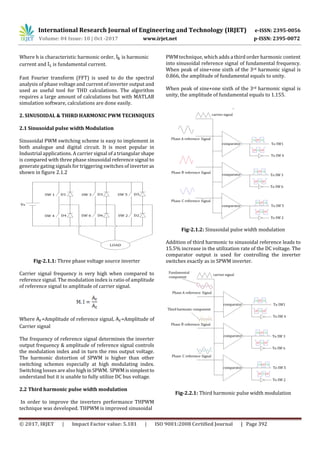
Sinusoidal PWM switching scheme is easy to implement in
both analogue and digital circuit. It is most popular in
Industrial applications. A carrier signal of a triangular shape
is compared with three phase sinusoidal reference signal to
generate gating signals for triggering switches of inverter as
shown in figure 2.1.2
Fig-2.1.1: Three phase voltage source inverter
Carrier signal frequency is very high when compared to
reference signal. The modulation index is ratio of amplitude
of reference signal to amplitude of carrier signal.
Where =Amplitude of reference signal, =Amplitude of
Carrier signal
The frequency of reference signal determines the inverter
output frequency & amplitude of reference signal controls
the modulation index and in turn the rms output voltage.
The harmonic distortion of SPWM is higher than other
switching schemes especially at high modulating index.
Switching losses are also high inSPWM. SPWMissimplestto
understand but it is unable to fully utilize DC bus voltage.
2.2 Third harmonic pulse width modulation
In order to improve the inverters performance THPWM
technique was developed. THPWM is improved sinusoidal
PWM technique, which adds a third order harmonic content
into sinusoidal reference signal of fundamental frequency.
When peak of sine+one sixth of the 3rd harmonic signal is
0.866, the amplitude of fundamental equals to unity.
When peak of sine+one sixth of the 3rd harmonic signal is
unity, the amplitude of fundamental equals to 1.155.
.
Fig-2.1.2: Sinusoidal pulse width modulation
Addition of third harmonic to sinusoidal reference leads to
15.5% increase in the utilization rate of the DC voltage. The
comparator output is used for controlling the inverter
switches exactly as in SPWM inverter.
Fig-2.2.1: Third harmonic pulse width modulation
International Research Journal of Engineering and Technology (IRJET) e-ISSN: 2395-0056
Volume: 04 Issue: 10 | Oct -2017 www.irjet.net p-ISSN: 2395-0072
© 2017, IRJET | Impact Factor value: 5.181 | ISO 9001:2008 Certified Journal | Page 393
3. SIMULATION & THD ANALYSIS OF SPWM &
THPWM CONTROLLED VSI
3.1 Simulation of SPWM & THPWM controlled VSI
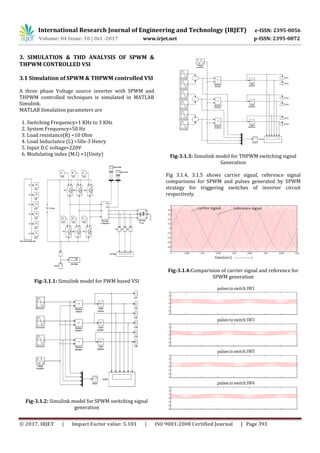
A three phase Voltage source inverter with SPWM and
THPWM controlled techniques is simulated in MATLAB
Simulink.
MATLAB Simulation parameters are
1. Switching Frequency=1 KHz to 3 KHz
2. System Frequency=50 Hz
3. Load resistance(R) =10 Ohm
4. Load Inductance (L) =50e-3 Henry
5. Input D.C voltage=220V
6. Modulating index (M.I) =1(Unity)
Fig-3.1.1: Simulink model for PWM based VSI
Fig-3.1.2: Simulink model for SPWM switching signal
generation
Fig-3.1.3: Simulink model for THPWM switching signal
Generation
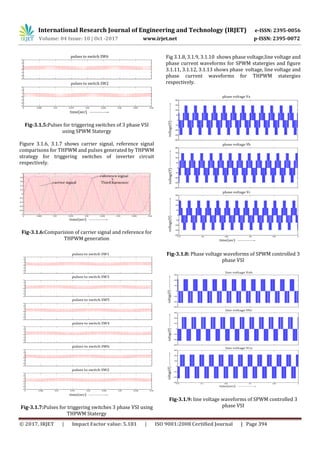
Fig 3.1.4, 3.1.5 shows carrier signal, reference signal
comparisons for SPWM and pulses generated by SPWM
strategy for triggering switches of inverter circuit
respectively.
Fig-3.1.4:Comparision of carrier signal and reference for
SPWM generation
International Research Journal of Engineering and Technology (IRJET) e-ISSN: 2395-0056
Volume: 04 Issue: 10 | Oct -2017 www.irjet.net p-ISSN: 2395-0072
© 2017, IRJET | Impact Factor value: 5.181 | ISO 9001:2008 Certified Journal | Page 394
Fig-3.1.5:Pulses for triggering switches of 3 phase VSI
using SPWM Statergy
Figure 3.1.6, 3.1.7 shows carrier signal, reference signal
comparisons for THPWM and pulses generated by THPWM
strategy for triggering switches of inverter circuit
respectively.
Fig-3.1.6:Comparision of carrier signal and reference for
THPWM generation
Fig-3.1.7:Pulses for triggering switches 3 phase VSI using
THPWM Statergy
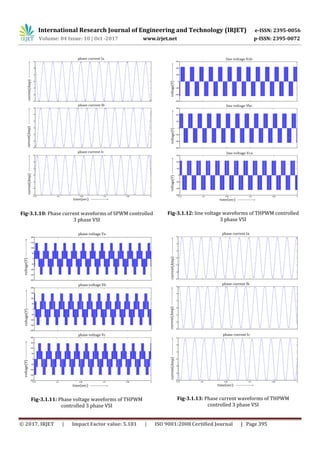
Fig 3.1.8, 3.1.9, 3.1.10 shows phase voltage,line voltage and
phase current waveforms for SPWM statergies and figure
3.1.11, 3.1.12, 3.1.13 shows phase voltage, line voltage and
phase current waveforms for THPWM statergies
respectively.
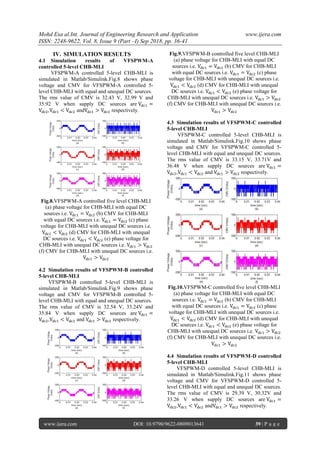
Fig-3.1.8: Phase voltage waveforms of SPWM controlled 3
phase VSI
Fig-3.1.9: line voltage waveforms of SPWM controlled 3
phase VSI
International Research Journal of Engineering and Technology (IRJET) e-ISSN: 2395-0056
Volume: 04 Issue: 10 | Oct -2017 www.irjet.net p-ISSN: 2395-0072
© 2017, IRJET | Impact Factor value: 5.181 | ISO 9001:2008 Certified Journal | Page 395
Fig-3.1.10: Phase current waveforms of SPWM controlled
3 phase VSI
Fig-3.1.11: Phase voltage waveforms of THPWM
controlled 3 phase VSI
Fig-3.1.12: line voltage waveforms of THPWM controlled
3 phase VSI
Fig-3.1.13: Phase current waveforms of THPWM
controlled 3 phase VSI
International Research Journal of Engineering and Technology (IRJET) e-ISSN: 2395-0056
Volume: 04 Issue: 10 | Oct -2017 www.irjet.net p-ISSN: 2395-0072
© 2017, IRJET | Impact Factor value: 5.181 | ISO 9001:2008 Certified Journal | Page 396
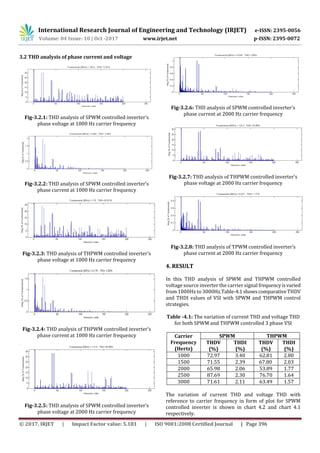
3.2 THD analysis of phase current and voltage
Fig-3.2.1: THD analysis of SPWM controlled inverter’s
phase voltage at 1000 Hz carrier frequency
Fig-3.2.2: THD analysis of SPWM controlled inverter’s
phase current at 1000 Hz carrier frequency
Fig-3.2.3: THD analysis of THPWM controlled inverter’s
phase voltage at 1000 Hz carrier frequency
Fig-3.2.4: THD analysis of THPWM controlled inverter’s
phase current at 1000 Hz carrier frequency
Fig-3.2.5: THD analysis of SPWM controlled inverter’s
phase voltage at 2000 Hz carrier frequency
Fig-3.2.6: THD analysis of SPWM controlled inverter’s
phase current at 2000 Hz carrier frequency
Fig-3.2.7: THD analysis of THPWM controlled inverter’s
phase voltage at 2000 Hz carrier frequency
Fig-3.2.8: THD analysis of TPWM controlled inverter’s
phase current at 2000 Hz carrier frequency
4. RESULT
In this THD analysis of SPWM and THPWM controlled
voltage source inverter the carrier signal frequencyisvaried
from 1000Hz to 3000Hz.Table-4.1showscomparativeTHDV
and THDI values of VSI with SPWM and THPWM control
strategies.
Table -4.1: The variation of current THD and voltage THD
for both SPWM and THPWM controlled 3 phase VSI
Carrier
Frequency
(Hertz)
SPWM THPWM
THDV
(%)
THDI
(%)
THDV
(%)
THDI
(%)
1000 72.97 3.40 62.81 2.80
1500 71.55 2.39 67.80 2.03
2000 65.98 2.06 53.89 1.77
2500 87.69 2.30 76.70 1.64
3000 71.61 2.11 63.49 1.57
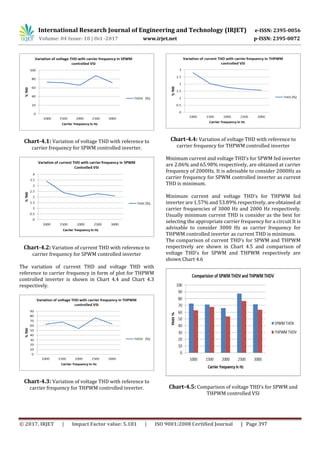
The variation of current THD and voltage THD with
reference to carrier frequency in form of plot for SPWM
controlled inverter is shown in chart 4.2 and chart 4.1
respectively.
International Research Journal of Engineering and Technology (IRJET) e-ISSN: 2395-0056
Volume: 04 Issue: 10 | Oct -2017 www.irjet.net p-ISSN: 2395-0072
© 2017, IRJET | Impact Factor value: 5.181 | ISO 9001:2008 Certified Journal | Page 397
Chart-4.1: Variation of voltage THD with reference to
carrier frequency for SPWM controlled inverter.
Chart-4.2: Variation of current THD with reference to
carrier frequency for SPWM controlled inverter
The variation of current THD and voltage THD with
reference to carrier frequency in form of plot for THPWM
controlled inverter is shown in Chart 4.4 and Chart 4.3
respectively.
Chart-4.3: Variation of voltage THD with reference to
carrier frequency for THPWM controlled inverter.
Chart-4.4: Variation of voltage THD with reference to
carrier frequency for THPWM controlled inverter
Minimum current and voltage THD’s for SPWM fed inverter
are 2.06% and 65.98% respectively, are obtained at carrier
frequency of 2000Hz. It is advisable to consider 2000Hz as
carrier frequency for SPWM controlled inverter as current
THD is minimum.
Minimum current and voltage THD’s for THPWM fed
inverter are 1.57% and 53.89% respectively, areobtainedat
carrier frequencies of 3000 Hz and 2000 Hz respectively.
Usually minimum current THD is consider as the best for
selecting the appropriate carrier frequency for a circuit It is
advisable to consider 3000 Hz as carrier frequency for
THPWM controlled inverter as current THD is minimum.
The comparison of current THD’s for SPWM and THPWM
respectively are shown in Chart 4.5 and comparison of
voltage THD’s for SPWM and THPWM respectively are
shown Chart 4.6
Chart-4.5: Comparison of voltage THD’s for SPWM and
THPWM controlled VSI
International Research Journal of Engineering and Technology (IRJET) e-ISSN: 2395-0056
Volume: 04 Issue: 10 | Oct -2017 www.irjet.net p-ISSN: 2395-0072
© 2017, IRJET | Impact Factor value: 5.181 | ISO 9001:2008 Certified Journal | Page 398
Chart-4.6: Comparison of current THD’s for SPWM and
THPWM controlled VSI
5. CONCLUSIONS
A three phase VSI has been implemented with SPWM and
THPWM control strategies. Analysis of current THD and
voltage THD is done at carrier frequencies from 1000Hz to
3000Hz.Simulation results of SPWM controlled inverterand
THPWM controlled inverter are compared. From chart 4.5
and chart 4.6 it can be concluded that THPWM provides
better quality of output voltage and current whencompared
to SPWM controlled inverter i.e. both current THD and
voltage THD is lesser in case of THPWM.Although there is
variation in current THD and Voltage THD with variation in
Carrier frequency, it is clear that current THD is well below
5% as specified by IEEE standards in both SPWM & THPWM
inverters.
REFERENCES
[1] Muhammad H. Rashid, “Power Electronics-Circuits,
Devices and Applications” Pearson Education Incorporated,
2005.
[2] R.K. Pongiannan, and N. Yadaiah, “FPGA Based Three
Phase Sinusoidal PWM VVVF Controller,” IEEE ICEES
(International Conference on Electrical Energy Systems), pp.
34-39, 2011.
[3] J.Y. Lee, and Y.Y. Sun, “A New SPWM Inverter with
Minimum Filter Requirement, International Journal of
Electronics, Vol. 64, No. 5, pp. 815-826, 1988.
[4] Berrezzek Farid and Omeiri Amar, “A Study of New
Techniques of Controlled PWM Inverters” European Journal
of Scientific Research, Vol.32, No.1, 2009.
[5] Mahesh A. Patel, Ankit R. Patel, Dhaval R. Vyas and Ketul
M.Patel, “Use of PWM Techniques for Power Quality
Improvement” International Journal of Recent Trends in
Engineering, Vol. 1, No. 4, May 2009.
[6] "IEEE Recommended Practices and Requirements for
Harmonic Control in Electrical Power Systems," IEEE Std
519-1992.
[7] M. Baumann and J. W. Kolar, "Comparative evaluation of
modulation methods for a three-phase/switch buck power
factor corrector concerning the input capacitor voltage
ripple," in Power Electronics Specialists Conference, 2001.
PESC. 2001 IEEE 32nd Annual, 2001, pp. 1327-1332 vol. 3.
BIOGRAPHIES
Mohd Esa is currently pursuing M.E.
(Power Electronics systems) from
Muffakham Jah College of Engineering
and Technology,Hyderabad. HeReceived
his B.E degree from Osmania University,
Hyderabad. He is Member of
International Association of Engineers
(IAENG), Hong Kong. His research of interests includes
Multi level inverters and electric drives.
Mohd Abdul Muqeem Nawaz, was Born
in Hyderabad, India in 1994.He received
his B.E degree from Osmania University;
He is currently pursuing M.E (Power
Electronicssystems)fromMuffakhamJah
College of Engineering and Technology,
Hyderabad. He is Member of
International Association of Engineers (IAENG), Hong
Kong. His research interests include power electronics,
FACTS devices and power electronics applications to
power systems.
International Research Journal of Engineering and Technology (IRJET) e-ISSN: 2395-0056
Volume: 04 Issue: 10 | Oct -2017 www.irjet.net p-ISSN: 2395-0072
© 2017, IRJET | Impact Factor value: 6.171 | ISO 9001:2008 Certified Journal | Page 1687
Harmonic Analysis of Three level Flying Capacitor Inverter
Mohd Esa1, Mohd Abdul Muqeem Nawaz2 & Syeda Naheed3
1,2,3M.E. Student, EED, Muffakham Jah College of Engineering and Technology, Hyderabad, India
---------------------------------------------------------------------***---------------------------------------------------------------------
Abstract –The aim of this paper is to determine the Total
harmonic distortion (THD) of three phase three level flying
capacitor inverter fed star connected R-L load. The
modulation Techniques used is Phase Disposition Sinusoidal
pulse width modulation (PD-SPWM) and Phase Opposition
Disposition Sinusoidal pulse width modulation (POD-
SPWM).The Modulation index is varied to analyze its effect on
Current THD and Voltage THD.This paper also presents the
comparison of PD-SPWM and POD-SPWM controlled Flying
capacitor Inverter in terms of THD. The simulation result
shows that PD-SPWM has betterperformance whencompared
to POD-SPWM. The simulation of circuit is done by using
MATLAB/Simulink.
Key Words: PD-SPWM, POD-PWM,THD,ModulationIndex.
1. INTRODUCTION
1.1 Multilevel Inverters
Multilevel inverters have drawn tremendous interest in
power industry owing to their advantages such as higher
efficiency, lower common modevoltage,lowervoltagestress
on power switches, lower dv/dt ratio, no EMI problems & its
suitability for high voltage and high current applications
[1].There are three types of multilevel inverters. They are
Diode clamped or Neutral clamped, Flying capacitor or
Capacitor clamped &. Cascaded Hbridgemultilevel inverters
[2]-[3].During the 1980s the development of the Multilevel
Converters did not move much forward. Onlyafterten years,
at the turn of the decade, finally appeared articlesabout new
applications, e.g. nuclear fusion, and new control methods.
The next turning point came at the beginning of the 1990s
when Meynard and Foch (1992) presented the flying
capacitor converter as a multilevel chopper and a multilevel
inverter.
Fig-1.1.1: Classification of Multilevel Inverter
The FCMLI is considered For THD analysis in this paper
because it is easier to increase number of levels in this
inverter than the diode clamped multilevel inverters. The
advantage of FCMLI is that it can control both real and
reactive power flow.
1.2 Multilevel Inverter PWM Strategies
PWM control strategies are development to reducetheTotal
Harmonic Distortion [4].PWM strategies used in
conventional inverters can be modified to use in MLI.The
advent of multilevel inverter PWM modulation
methodologies can be classified according to switching
frequency as shown in figure 1.2.1
Fig-1.2.1: Classification of Multilevel Inverter PWM
Strategies
There are several Multi carrier based High frequency
techniques such as i) Phase disposition PWM (PDPWM) ii)
Phase Opposition DispositionPWM (PODPWM)iii)Alternate
Phase Opposition Disposition PWM (APODPWM) iv) Phase
Shift PWM (PSPWM) v) Alternate Phase Shift PWM
(APSPWM) vi) CarrierOverLapPWM(COPWM)vii)Variable
Frequency PWM (VFPWM) viii) Alternate Variable
Frequency PWM (AVFPWM).In multilevel Inverters
modulation index is defined as follows
In this Paper, PD and POD SPWM strategies are considered
for triggering switches of three level flying capacitor
inverter.
International Research Journal of Engineering and Technology (IRJET) e-ISSN: 2395-0056
Volume: 04 Issue: 10 | Oct -2017 www.irjet.net p-ISSN: 2395-0072
© 2017, IRJET | Impact Factor value: 6.171 | ISO 9001:2008 Certified Journal | Page 1688
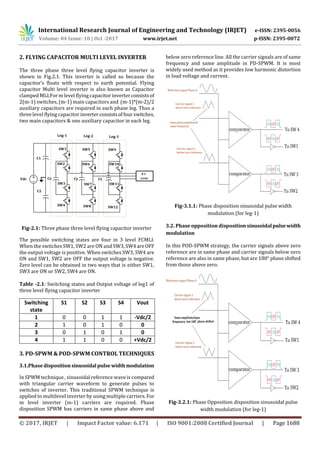
2. FLYING CAPACITOR MULTI LEVEL INVERTER
The three phase three level flying capacitor inverter is
shown in Fig.2.1. This inverter is called so because the
capacitor’s floats with respect to earth potential. Flying
capacitor Multi level inverter is also known as Capacitor
clamped MLI.For m level flying capacitor inverterconsistsof
2(m-1) switches, (m-1) main capacitors and (m-1)*(m-2)/2
auxiliary capacitors are required in each phase leg. Thus a
three level flying capacitor inverterconsistsoffour switches,
two main capacitors & one auxiliary capacitor in each leg.
Fig-2.1: Three phase three level flying capacitor inverter
The possible switching states are four in 3 level FCMLI.
When the switches SW1, SW2 are ON and SW3, SW4areOFF
the output voltage is positive. When switches SW3, SW4 are
ON and SW1, SW2 are OFF the output voltage is negative.
Zero level can be obtained in two ways that is either SW1,
SW3 are ON or SW2, SW4 are ON.
Table -2.1: Switching states and Output voltage of leg1 of
three level flying capacitor inverter
Switching
state
S1 S2 S3 S4 Vout
1 0 0 1 1 -Vdc/2
2 1 0 1 0 0
3 0 1 0 1 0
4 1 1 0 0 +Vdc/2
3. PD-SPWM & POD-SPWM CONTROL TECHNIQUES
3.1.Phasedispositionsinusoidal pulsewidth modulation
In SPWM technique , sinusoidal reference wave is compared
with triangular carrier waveform to generate pulses to
switches of inverter. This traditional SPWM technique is
applied to multilevel inverter by using multiple carriers. For
m level inverter (m-1) carriers are required. Phase
disposition SPWM has carriers in same phase above and
below zero reference line. All the carrier signals are of same
frequency and same amplitude in PD-SPWM. It is most
widely used method as it provides low harmonic distortion
in load voltage and current.
Fig-3.1.1: Phase disposition sinusoidal pulse width
modulation (for leg-1)
3.2. Phase opposition disposition sinusoidalpulsewidth
modulation
In this POD-SPWM strategy, the carrier signals above zero
reference are in same phase and carrier signals below zero
reference are also in same phase, but are 180° phase shifted
from those above zero.
Fig-3.2.1: Phase Opposition disposition sinusoidal pulse
width modulation (for leg-1)
International Research Journal of Engineering and Technology (IRJET) e-ISSN: 2395-0056
Volume: 04 Issue: 10 | Oct -2017 www.irjet.net p-ISSN: 2395-0072
© 2017, IRJET | Impact Factor value: 6.171 | ISO 9001:2008 Certified Journal | Page 1689
4. SIMULATION & THD ANALYSIS OF PD-SPWM &
POD-SPWM CONTROLLED THREE PHASE THREE
LEVEL FLYING CAPACITOR INVERTER
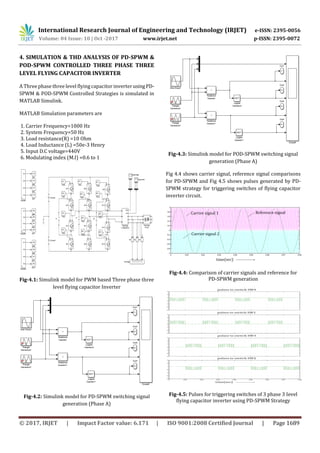
A Three phase three level flying capacitor inverter usingPD-
SPWM & POD-SPWM Controlled Strategies is simulated in
MATLAB Simulink.
MATLAB Simulation parameters are
1. Carrier Frequency=1000 Hz
2. System Frequency=50 Hz
3. Load resistance(R) =10 Ohm
4. Load Inductance (L) =50e-3 Henry
5. Input D.C voltage=440V
6. Modulating index (M.I) =0.6 to 1
Fig-4.1: Simulink model for PWM based Three phase three
level flying capacitor Inverter
Fig-4.2: Simulink model for PD-SPWM switching signal
generation (Phase A)
Fig-4.3: Simulink model for POD-SPWM switching signal
generation (Phase A)
Fig 4.4 shows carrier signal, reference signal comparisons
for PD-SPWM and Fig 4.5 shows pulses generated by PD-
SPWM strategy for triggering switches of flying capacitor
inverter circuit.
Fig-4.4: Comparison of carrier signals and reference for
PD-SPWM generation
Fig-4.5: Pulses for triggering switches of 3 phase 3 Ievel
flying capacitor inverter using PD-SPWM Strategy
International Research Journal of Engineering and Technology (IRJET) e-ISSN: 2395-0056
Volume: 04 Issue: 10 | Oct -2017 www.irjet.net p-ISSN: 2395-0072
© 2017, IRJET | Impact Factor value: 6.171 | ISO 9001:2008 Certified Journal | Page 1690
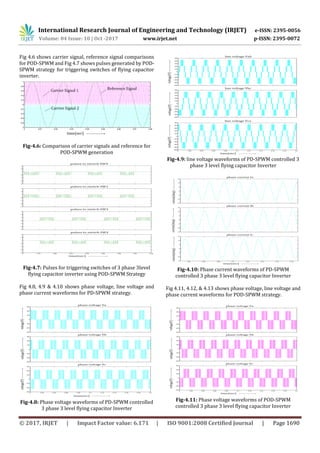
Fig 4.6 shows carrier signal, reference signal comparisons
for POD-SPWM and Fig 4.7 shows pulses generated by POD-
SPWM strategy for triggering switches of flying capacitor
inverter.
Fig-4.6: Comparison of carrier signals and reference for
POD-SPWM generation
Fig-4.7: Pulses for triggering switches of 3 phase 3Ievel
flying capacitor inverter using POD-SPWM Strategy
Fig 4.8, 4.9 & 4.10 shows phase voltage, line voltage and
phase current waveforms for PD-SPWM strategy.
Fig-4.8: Phase voltage waveforms of PD-SPWM controlled
3 phase 3 level flying capacitor Inverter
Fig-4.9: line voltage waveforms of PD-SPWM controlled 3
phase 3 level flying capacitor Inverter
Fig-4.10: Phase current waveforms of PD-SPWM
controlled 3 phase 3 level flying capacitor Inverter
Fig 4.11, 4.12, & 4.13 shows phase voltage, line voltage and
phase current waveforms for POD-SPWM strategy.
Fig-4.11: Phase voltage waveforms of POD-SPWM
controlled 3 phase 3 level flying capacitor Inverter
International Research Journal of Engineering and Technology (IRJET) e-ISSN: 2395-0056
Volume: 04 Issue: 10 | Oct -2017 www.irjet.net p-ISSN: 2395-0072
© 2017, IRJET | Impact Factor value: 6.171 | ISO 9001:2008 Certified Journal | Page 1691
Fig-4.12: Line voltage waveforms of POD-SPWM
controlled 3 phase 3 level flying capacitor Inverter
Fig-4.13: Phase current waveforms of POD-SPWM
controlled 3 phase 3 level flying capacitor Inverter
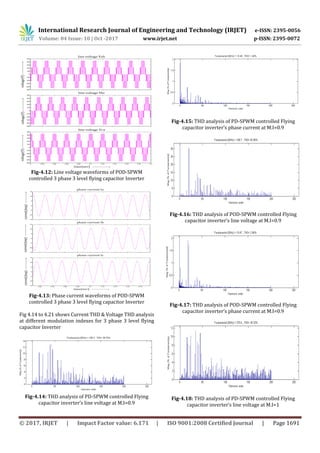
Fig 4.14 to 4.21 shows Current THD & Voltage THD analysis
at different modulation indexes for 3 phase 3 level flying
capacitor Inverter
Fig-4.14: THD analysis of PD-SPWM controlled Flying
capacitor inverter’s line voltage at M.I=0.9
Fig-4.15: THD analysis of PD-SPWM controlled Flying
capacitor inverter’s phase current at M.I=0.9
Fig-4.16: THD analysis of POD-SPWM controlled Flying
capacitor inverter’s line voltage at M.I=0.9
Fig-4.17: THD analysis of POD-SPWM controlled Flying
capacitor inverter’s phase current at M.I=0.9
Fig-4.18: THD analysis of PD-SPWM controlled Flying
capacitor inverter’s line voltage at M.I=1
International Research Journal of Engineering and Technology (IRJET) e-ISSN: 2395-0056
Volume: 04 Issue: 10 | Oct -2017 www.irjet.net p-ISSN: 2395-0072
© 2017, IRJET | Impact Factor value: 6.171 | ISO 9001:2008 Certified Journal | Page 1692
Fig-4.19: THD analysis of PD-SPWM controlled Flying
capacitor inverter’s phase current at M.I=1
Fig-4.20: THD analysis of POD-SPWM controlled Flying
capacitor inverter’s line voltage at M.I=1
Fig-4.21: THD analysis of POD-SPWM controlled Flying
capacitor inverter’s phase current at M.I=1
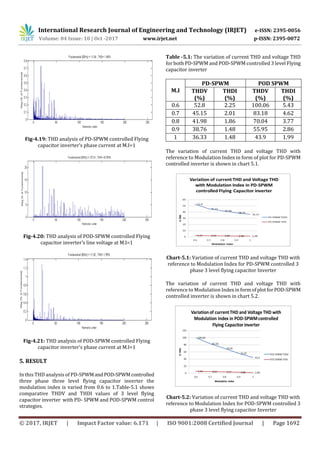
5. RESULT
In this THD analysis of PD-SPWMandPOD-SPWMcontrolled
three phase three level flying capacitor inverter the
modulation index is varied from 0.6 to 1.Table-5.1 shows
comparative THDV and THDI values of 3 level flying
capacitor inverter with PD- SPWM and POD-SPWM control
strategies.
Table -5.1: The variation of current THD and voltage THD
for both PD-SPWM and POD-SPWM controlled 3 level Flying
capacitor inverter
M.I
PD-SPWM POD SPWM
THDV
(%)
THDI
(%)
THDV
(%)
THDI
(%)
0.6 52.8 2.25 100.06 5.43
0.7 45.15 2.01 83.18 4.62
0.8 41.98 1.86 70.04 3.77
0.9 38.76 1.48 55.95 2.86
1 36.33 1.48 43.9 1.99
The variation of current THD and voltage THD with
reference to Modulation Index in form of plot for PD-SPWM
controlled inverter is shown in chart 5.1.
Chart-5.1: Variation of current THD and voltage THD with
reference to Modulation Index for PD-SPWM controlled 3
phase 3 level flying capacitor Inverter
The variation of current THD and voltage THD with
reference to Modulation IndexinformofplotforPOD-SPWM
controlled inverter is shown in chart 5.2.
Chart-5.2: Variation of current THD and voltage THD with
reference to Modulation Index for POD-SPWM controlled 3
phase 3 level flying capacitor Inverter
International Research Journal of Engineering and Technology (IRJET) e-ISSN: 2395-0056
Volume: 04 Issue: 10 | Oct -2017 www.irjet.net p-ISSN: 2395-0072
© 2017, IRJET | Impact Factor value: 6.171 | ISO 9001:2008 Certified Journal | Page 1693
From the chart 5.1 and 5.2 it is observed that as the
modulation index increases both current THD and Voltage
THD decreases. The comparison of voltage THD for PD-
SPWM and POD-SPWM controlled 3 phase 3 level flying
capacitor inverter is shown in chart 5.3 & the comparison of
current THD for PD-SPWM and POD-SPWM controlled 3
phase 3 level flying capacitor inverter is shown in chart 5.4
Chart-5.3: Comparison of voltage THD’s for PD-SPWM &
POD-SPWM controlled 3 level Flying capacitor inverter
Chart-5.4: Comparison of current THD’s for PD-SPWM &
POD-SPWM controlled 3 level Flying capacitor inverter
6. CONCLUSION
A three phase three level flying capacitor inverter has been
implemented with PD-SPWM and POD-SPWM control
strategies. Analysis of current THD and voltage THD is done
at Modulation index from 0.6 to 1(Unity). Simulation results
of PD-SPWM controlled flying capacitor inverter and POD
SPWM controlled flying capacitor inverter are compared.
From chart 5.3 and chart 5.4 it can be concluded that PD-
SPWM provides better quality of output voltage and current
when compared to POD-SPWM controlled inverter i.e. both
current THD and voltage THD is lesser in case of PD-SPWM.
REFERENCES
[1] Muhammad H. Rashid-“Power Electronics-Circuits,
Devices and Applications” Pearson Education Incorporated,
2005.
[2] Tolbert. L. M and Pend. F. Z -“Multilevel Converter as a
Utility Interface forRenewableEnergySystems”,IEEEPower
Engineering Society Meeting, Vol. 2, pp. 1271- 1274, 2000.
[3]BK Bose-“Power electronics-An emerging technology”
IEEE Transactions on Industrial Electronics, vol.36,no.3, pp.
403–12, Aug 1989.
[4] Mohd Esa and Mohd Abdul Muqeem Nawaz, "THD
analysis of SPWM & THPWM ControlledThreephaseVoltage
Source Inverter", International Research Journal of
Engineering and Technology (IRJET), vol.04,no.10,pp.391-
398, 2017.
BIOGRAPHIES
Mohd Esa is currently pursuing M.E.
(Power Electronics systems) from
Muffakham Jah CollegeofEngineeringand
Technology, Hyderabad. He Received his
B.E degree from Osmania University,
Hyderabad. He is Member of International
Association of Engineers (IAENG), Hong
Kong. His research of interests includes Multi level
inverters and electric drives.
Mohd Abdul Muqeem Nawaz, was Born in
Hyderabad, India in 1994.He received his
B.E degree from Osmania University;Heis
currently pursuing M.E (Power
Electronics systems) from Muffakham Jah
College of Engineering and Technology,
Hyderabad. He is Member of International
Association of Engineers (IAENG), HongKong. Hisresearch
interests include power electronics, FACTS devices and
power electronics applications to power systems.
International Research Journal of Engineering and Technology (IRJET) e-ISSN: 2395-0056
Volume: 04 Issue: 10 | Oct -2017 www.irjet.net p-ISSN: 2395-0072
© 2017, IRJET | Impact Factor value: 6.171 | ISO 9001:2008 Certified Journal | Page 1694
Syeda Naheed is currently pursuing M.E.
(Power Electronics systems) from
Muffakham Jah College of Engineering
and Technology, Hyderabad. She
Received her B.Tech. Degree from
Jawaharlal Nehru Technological
University, Hyderabad. Her area of
Interest includes power electronics and drives
Common Mode Voltage reduction in Diode Clamped
MLI using Phase Disposition SPWM Technique
Mr.Mohd Esa
M.E. Student, Department of Electrical Engg.
M.J.C.E.T., Hyderabad, India
zmohdesa@gmail.com
Mr.J.E.Muralidhar
Associate Professor, Department of Electrical Engg.
M.J.C.E.T., Hyderabad, India
muralidhareed@mjcollege.ac.in
Abstract—The aim of this paper is to reduce the Common
Mode Voltage (CMV) in the Diode Clamped Multilevel Inverter
(DCMLI).Three phase star connected RL load is connected to
DCMLI. The common mode voltage exists between star point of
load & system ground. Premature failure of bearings of
Induction Motor (IM) is caused by CMV and is necessary to
reduce. In this paper, Phase Disposition Sinusoidal Pulse Width
Modulation (PD SPWM) technique is used for reduction of CMV
and LC filter is used for reduction of Harmonics.MATLAB
Simulink is used for the simulation of circuit. Total Harmonic
Distortion (THD) and CMV are investigated.
Keywords—CMV,THD,PD SPWM,DCMLI
I. INTRODUCTION
In high power & high voltage applications, Multilevel
Inverters (MLI) have attracted more attention due to their
advantages such as lesser CMV, lesser voltage stress on
switches and low dv/dt ratio [1].The conventional pulse width
modulated voltage source inverter has the problem of presence
of more harmonics when compared to multilevel inverters.
They main drawback of CMV is that it give rise to shaft
voltage & bearing currents [2], [3].CMV and THD must be
reduced for better operation of IM drives. Some methods for
reduction of CMV are application of common mode choke,
dual bridge inverters [4], four leg inverters [5], & improved
modulation strategies [6].CMV can be reduced in MLI by
applying proper control strategy. Switching states in MLI is
more in number so the output voltage is stepped in smaller
increments. This mitigates harmonics at low switching
frequencies thus decreasing the losses in switches. Leakage
current gets decreased as dv/dt is low in MLI.CMV gets
reduced in MLI, which avoids failure of bearing [7].
The concept of multilevel began with the 3- level converter
which is often known as neutral point converter. Here
converter refers to the power flow in both the directions i.e.
from D.C. to a.c. called as inverter and from a.c. to D.C. called
as rectifier. The commercially existing MLI types are Diode
Clamped (DC-MLI) or Neutral-Point Clamped (NPC-MLI)
[8], Flying Capacitor (FC-MLI) or Capacitor Clamped &
Cascaded H-bridge multilevel inverter (CHB-MLI). Though
CHB-MLI was invented in 1975 it found its application in
1990, hence DC-MLI was considered as first generation of
multilevel inverters. DC-MLI was the first one that made it
possible to produce an output voltage from only one D.C.
source. All devices in DC-MLI are switched at the
fundamental frequency thus its efficiency is high & when
number of levels of DC-MLI increases, harmonic content in
output voltage gets low enough to avoid need of filters but
disadvantage of DC-MLI is requirement of excessive
clamping diodes when numbers of levels are high.
The Flying Capacitor Multilevel Inverter is an alternative
to DC-MLI.Flying capacitor MLI uses capacitors for
clamping.FC-MLI is used in various high power applications
because it is easy to increase number of levels in FC-MLI than
the DC-MLI.For m-level, flying capacitor inverter consists of
2× (m-1) switches, (m-1) main capacitors and (m-1) × (m-2)/2
auxiliary capacitors in each leg [9].FC-MLI can control both
active & reactive power flow but for active power
transmission, switching frequency & switching losses are
more.
Cascaded H-bridge MLI is also recognized as Multicell
inverter. In CHB-MLI topology output voltage is the sum of
all of the individual H-bridge outputs because a.c. output of
each H-bridge is connected in series [10]. For m-level inverter
number of cells required is (m-1)/2.The components used are
less, because clamping diodes or clamping capacitors are not
required in this topology. The drawback of CHB-MLI is that
each H-bridge requires separate D.C. sources.
Inverter’s output voltage can be controlled by various
modulation techniques. The classifications of these techniques
are based on fundamental switching frequency and high
switching frequency. Modulation techniques based on
fundamental switching frequencies are Space Vector Control
& Selective Harmonic Elimination [11]. High switching based
methods are Sinusoidal Pulse Width Modulation (SPWM),
Selective Harmonic Elimination (SHE-PWM), Space Vector
Modulation (SVM).These PWM techniques are easy to
implement and control, and they reduce lower order
harmonics.SPWM is simplest of all the above techniques. In
1964, SPWM was introduced by schonung and
stemmler.SPWM technique does not require any computations
and is very popular in industrial applications.Multi carrier
techniques based on classical SPWM has been developed.
279978-1-5386-3695-4$31.00 c 2018 IEEE
Phase shifting and level shifting are major techniques of
Multicarrier SPWM. The Multi carrier based High frequency
techniques are
Phase Shift PWM (PSPWM)
Alternate Phase Shift PWM (APSPWM)
Phase Disposition PWM (PDPWM)
Phase Opposition Disposition PWM (PODPWM)
Alternate Phase Opposition Disposition PWM
(APODPWM)
Carrier Over Lap PWM (COPWM)
Variable Frequency PWM (VFPWM)
Alternate Variable Frequency PWM (AVFPWM).
These techniques are helpful to reduce THD and CMV
in multilevel inverters [6]. In this paper, CMV and THD
reduction in DCMLI using PDSPWM is presented.
II. COMMON MODE VOLTAGE
A. Definition:
Voltage that exists between neutral-point of wye
connected load & system ground is known as common mode
voltage (or) voltage between star point of load and input D.C.
midpoint (or) The CMV is defined as the voltage potential
difference between the mid-point of the D.C. link capacitors
and the star point of the load network. Mathematical
expression for CMV is shown in equation (1).
(1)
Where , , are the phase voltages. is common
mode voltage. A generalized drive system is represented in
fig. 1.
Fig.1. A generalized drive system
It has been observed that each switching state has its own
related CMV level.CMV has different values of ± 6 or
± for conventional three phase two level inverter based
on the inverter’s switching state selected.
B. Effects of common mode voltage:
a) Regardless of number of legs & levels, high
amplitude & high frequency CMV exists always in
pulse width modulated inverters because of its
switching operation which results in common mode
current (CMC) through parasitic capacitors between
inverter, loads & ground respectively. This CMC
cause’s mal operation of inverter control system as it
is a source of EMI noise.
b) Shaft voltages on the rotor are caused by pulse width
modulated inverters because of CMV.Premature
failure of IM bearings is caused when this shaft
voltage exceeds the voltage limit of bearings
lubricant.CMV is required to reduce by choosing
specific reduction technique.
C. Reduction methods for common mode voltage:
Few methods to combat CMV are represented in fig.2.
Fig. 2.CMV reduction techniques
Extra leg is used in four leg inverter which is connected to star
point of load to reduce CMV but in four leg inverter switching
scheme becomes complex. In reducing electromagnetic
interference, eliminating CMV and bearing currents of motor
the Dual Bridge Inverter (DBI) topology is more effective. In
DBI topology, two parallel inverters with reverse polarities is
connected to double winding motor to eliminate CMV.Size
and cost are disadvantage for this CMV reduction technique.
In this paper, Multicarrier based Phase Disposition SPWM
technique is used to reduce CMV.
280 4th International Conference on Electrical Energy Systems (ICEES)
III. TOTAL HARMONIC DISTORTION
THD is the measure of effective value of harmonic
components of a distorted waveform. Presence of nonlinear
devices in power system is cause of harmonic distortion.IEEE
Standard 519-1992 recommends the requirements for
harmonic control in electrical power systems. Inverter’s output
voltage quality strongly related to total harmonic distortion. A
mathematical expression for THD is shown in equation (2).
(2)
Where h is harmonic order, is harmonic voltage, and is
fundamental voltage. To do the THD analysis of output
voltage of inverter Fast Fourier transform (FFT) is used. The
algorithm requires a large amount of calculations but with
MATLAB simulation software, calculations are done easily.
In this paper THD is also reduced along with CMV in PD
SPWM controlled DCMLI.
IV. DIODE CLAMPED MULTILEVEL INVERTER
In 1981,DCMLI was proposed by Nabae et al., DC-MLI is
also known as Neutral-Point Clamped Inverter (NPC-MLI)
[8].The m-level inverter leg contains (m-1) D.C. bus
capacitors, 2×(m-1) switches & required clamping diodes are
(m-1) × (m-2).
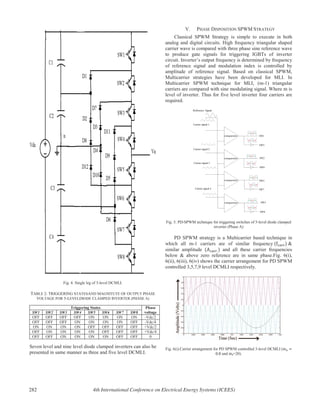
A. 3-level Diode clamped Inverter
Power circuit of single leg of 3- level DCMLI is shown in
fig. 3. In each leg it requires 4 switches. Total of twelve
switches are required in three phase 3 level DCMLI. SW1,
SW2 are IGBTs in upper half of the first leg and SW3, SW4
are IGBTs in lower half of the first leg and it has two
clamping diodes in each leg. Main capacitors required are two.
The operation of 3-level DCMLI is as follows. When switch
SW1, SW2 are ON and SW3, SW4 are OFF output phase
voltage is /2.When SW2, SW3 are ON and SW1, SW4 are
OFF output phase voltage is zero. When SW3 and SW4 are
ON and SW1, SW2 are OFF output phase voltage is /2.
Table 1 shows the triggering states and output phase voltage
magnitude for phase A of 3- level diode clamped inverter.
Requirement of the clamping diodes increases as inverter’s
output voltage level increases which makes this topology
bulky.
TABLE 1: TRIGGERING STATES AND MAGNITUTE OF OUTPUT PHASE
VOLTAGE FOR 3-LEVEL DIODE CLAMPED INVERTER (PHASE A)
Triggering States Phase
VoltageSW1 SW2 SW3 SW4
OFF OFF ON ON -Vdc/2
OFF ON ON OFF 0
ON ON OFF OFF +Vdc/2
Fig. 3. Single leg of 3- level DCMLI.
B. 5-level Diode clamped Inverter
Power circuit of single leg of 5-level DCMLI is shown
in Fig.4.It needs eight switches in each leg. There are total 24
switches in three phase five level DCMLI.SW1, SW2, SW3 &
SW4 are IGBTs in upper half of the first leg and SW5, SW6,
SW7 & SW8 are the IGBTs in lower half of the first leg, five
level diode clamped inverter has 12 clamping diodes in each
leg. Main capacitors required are four. Thus for three phase
five level DCMLI has 36 clamping diodes. Table 2 shows
triggering states to synthesize five level phase output voltage.
The steps to produce the 5- level phase voltages are as
follows.
Switch ON,IGBTs from SW1 to SW4 for an output
phase voltage
Switch ON, IGBTs from SW2 to SW5 for an output
phase voltage
Switch ON, IGBTs from SW3 to SW6 for an output
phase voltage
Switch ON, IGBTs from SW4 to SW7 for an output
phase voltage
Switch ON, IGBTs from SW5 to SW8 for an output
phase voltage
4th International Conference on Electrical Energy Systems (ICEES) 281
Fig. 4. Single leg of 5-level DCMLI.
TABLE 2: TRIGGERING STATESAND MAGNITUTE OF OUTPUT PHASE
VOLTAGE FOR 5-LEVELDIODE CLAMPED INVERTER (PHASE A)
Triggering States Phase
voltageSW1 SW2 SW3 SW4 SW5 SW6 SW7 SW8
OFF OFF OFF OFF ON ON ON ON -Vdc/2
OFF OFF OFF ON ON ON ON OFF -Vdc/4
ON ON ON ON OFF OFF OFF OFF +Vdc/2
OFF ON ON ON ON OFF OFF OFF +Vdc/4
OFF OFF ON ON ON ON OFF OFF 0
Seven level and nine level diode clamped inverters can also be
presented in same manner as three and five level DCMLI.
V. PHASE DISPOSITION SPWM STRATEGY
Classical SPWM Strategy is simple to execute in both
analog and digital circuits. High frequency triangular shaped
carrier wave is compared with three phase sine reference wave
to produce gate signals for triggering IGBTs of inverter
circuit. Inverter’s output frequency is determined by frequency
of reference signal and modulation index is controlled by
amplitude of reference signal. Based on classical SPWM,
Multicarrier strategies have been developed for MLI. In
Multicarrier SPWM technique for MLI, (m-1) triangular
carriers are compared with sine modulating signal. Where m is
level of inverter. Thus for five level inverter four carriers are
required.
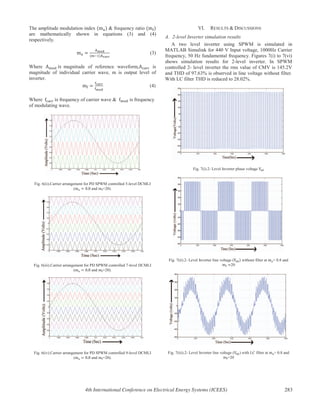
Fig. 5. PD-SPWM technique for triggering switches of 5-level diode clamped
inverter (Phase A)
PD SPWM strategy is a Multicarrier based technique in
which all m-1 carriers are of similar frequency &
similar amplitude and all these carrier frequencies
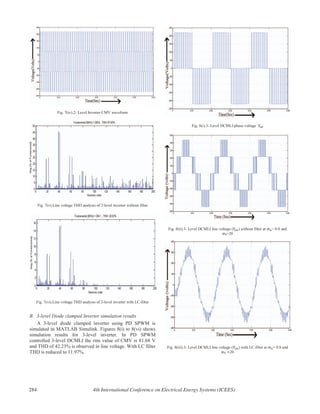
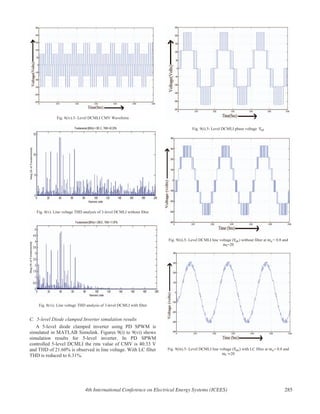
below & above zero reference are in same phase.Fig. 6(i),
6(ii), 6(iii), 6(iv) shows the carrier arrangement for PD SPWM
controlled 3,5,7,9 level DCMLI respectively.
Fig. 6(i).Carrier arrangement for PD SPWM controlled 3-level DCMLI (
and =20).
282 4th International Conference on Electrical Energy Systems (ICEES)
The amplitude modulation index & frequency ratio
are mathematically shown in equations (3) and (4)
respectively.
(3)
Where magnitude of reference waveform, is
magnitude of individual carrier wave, m is output level of
inverter.
(4)
Where frequency of carrier wave & is frequency
of modulating wave.
Fig. 6(ii).Carrier arrangement for PD SPWM controlled 5-level DCMLI
( and =20).
Fig. 6(iii).Carrier arrangement for PD SPWM controlled 7-level DCMLI
( and =20).
Fig. 6(iv).Carrier arrangement for PD SPWM controlled 9-level DCMLI
( and =20).
VI. RESULTS & DISCUSSIONS
A. 2-level Inverter simulation results
A two level inverter using SPWM is simulated in
MATLAB Simulink for 440 V Input voltage, 1000Hz Carrier
frequency, 50 Hz fundamental frequency. Figures 7(i) to 7(vi)
shows simulation results for 2-level inverter. In SPWM
controlled 2- level inverter the rms value of CMV is 145.2V
and THD of 97.63% is observed in line voltage without filter.
With LC filter THD is reduced to 28.02%.
Fig. 7(i).2- Level Inverter phase voltage
Fig. 7(ii).2- Level Inverter line voltage ( without filter at = 0.8 and
20
Fig. 7(iii).2- Level Inverter line voltage ( ) with LC filter at = 0.8 and
=20
4th International Conference on Electrical Energy Systems (ICEES) 283
Fig. 7(iv).2- Level Inverter CMV waveform
Fig. 7(v).Line voltage THD analysis of 2-level inverter without filter
Fig. 7(vi).Line voltage THD analysis of 2-level inverter with LC-filter
B. 3-level Diode clamped Inverter simulation results
A 3-level diode clamped inverter using PD SPWM is
simulated in MATLAB Simulink. Figures 8(i) to 8(vi) shows
simulation results for 3-level inverter. In PD SPWM
controlled 3-level DCMLI the rms value of CMV is 81.68 V
and THD of 42.23% is observed in line voltage. With LC filter
THD is reduced to 11.97%.
Fig. 8(i).3- Level DCMLI phase voltage
Fig. 8(ii).3- Level DCMLI line voltage ( ) without filter at = 0.8 and
=20
Fig. 8(iii).3- Level DCMLI line voltage ( with LC filter at = 0.8 and
20
284 4th International Conference on Electrical Energy Systems (ICEES)
Fig. 8(iv).3- Level DCMLI CMV Waveform
Fig. 8(v). Line voltage THD analysis of 3-level DCMLI without filter
Fig. 8(vi). Line voltage THD analysis of 3-level DCMLI with filter
C. 5-level Diode clamped Inverter simulation results
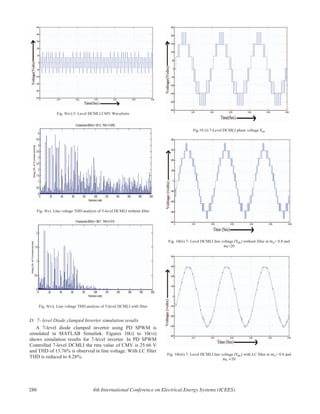
A 5-level diode clamped inverter using PD SPWM is
simulated in MATLAB Simulink. Figures 9(i) to 9(vi) shows
simulation results for 5-level inverter. In PD SPWM
controlled 5-level DCMLI the rms value of CMV is 40.33 V
and THD of 21.60% is observed in line voltage. With LC filter
THD is reduced to 6.31%.
Fig. 9(i).5- Level DCMLI phase voltage
Fig. 9(ii).5- Level DCMLI line voltage ( ) without filter at = 0.8 and
=20
Fig. 9(iii).5- Level DCMLI line voltage ( with LC filter at = 0.8 and
20
4th International Conference on Electrical Energy Systems (ICEES) 285
Fig. 9(iv).5- Level DCMLI CMV Waveform
Fig. 9(v). Line voltage THD analysis of 5-level DCMLI without filter
Fig. 9(vi). Line voltage THD analysis of 5-level DCMLI with filter
D. 7- level Diode clamped Inverter simulation results
A 7-level diode clamped inverter using PD SPWM is
simulated in MATLAB Simulink. Figures 10(i) to 10(vi)
shows simulation results for 7-level inverter. In PD SPWM
Controlled 7-level DCMLI the rms value of CMV is 25.66 V
and THD of 13.76% is observed in line voltage. With LC filter
THD is reduced to 4.28%.
Fig.10 (i).7-Level DCMLI phase voltage
Fig. 10(ii).7- Level DCMLI line voltage ( ) without filter at = 0.8 and
=20
Fig. 10(iii).7- Level DCMLI line voltage ( with LC filter at = 0.8 and
20
286 4th International Conference on Electrical Energy Systems (ICEES)
Fig. 10(iv).7-Level DCMLI CMV Waveform
Fig. 10(v). Line voltage THD analysis of 7-level DCMLI without filter
Fig. 10(vi). Line voltage THD analysis of 7-level DCMLI with filter
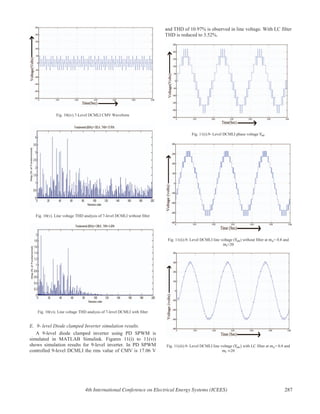
E. 9- level Diode clamped Inverter simulation results.
A 9-level diode clamped inverter using PD SPWM is
simulated in MATLAB Simulink. Figures 11(i) to 11(vi)
shows simulation results for 9-level inverter. In PD SPWM
controlled 9-level DCMLI the rms value of CMV is 17.06 V
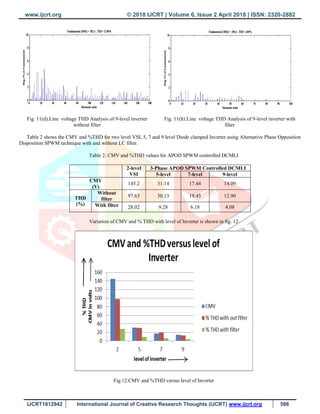
and THD of 10.97% is observed in line voltage. With LC filter
THD is reduced to 3.52%.
Fig. 11(i).9- Level DCMLI phase voltage
Fig. 11(ii).9- Level DCMLI line voltage ( ) without filter at = 0.8 and
=20
Fig. 11(iii).9- Level DCMLI line voltage ( with LC filter at = 0.8 and
20
4th International Conference on Electrical Energy Systems (ICEES) 287
Fig. 11(iv).9-Level DCMLI CMV waveform
Fig. 11(v).Line voltage THD analysis of 9-level DCMLI without filter
Fig. 11(vi).Line voltage THD analysis of 9-level DCMLI with LC filter
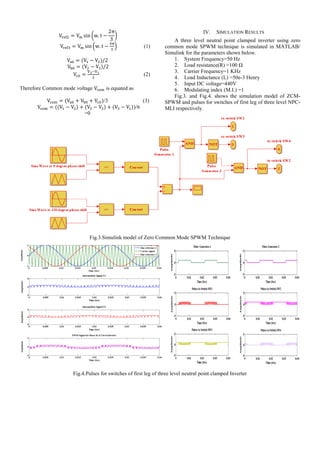
Table 3 shows the CMV and %THD for two level VSI, 3, 5, 7
and 9 level Diode clamped Inverter using Phase Disposition
SPWM technique with and without LC filter.
TABLE 3: CMV AND %THD VALUES FOR PD SPWM CONTROLLED
DCMLI
2-level
VSI
3-Phase PD SPWM Controlled DCMLI
3-level 5-level 7-level 9-level
CMV
(V)
145.2 81.68 40.33 25.66 17.06
THD
(%)
Without
filter
97.63 42.23 21.60 13.76 10.97
With
filter
28.02 11.97 6.31 4.28 3.52
Variation of CMV and % THD with level of Inverter is shown
in fig. 12.
Fig.12.Variation of CMV and THD with level of Inverter
From the fig. 12 it can be witnessed that as CMV and %THD
reduces with increase in inverter’s level, nature of output
voltage gets improved which reduces total harmonic distortion
by decreasing lower order harmonics. Table 3 clearly shows
that as the level of inverter increases, number of steps in
output voltage increases which reduces CMV.
VII. CONCLUSION
Diode clamped multilevel inverter for three, five, seven and
nine level using PD SPWM is simulated in Matlab/Simulink
software.Table-3 evidently shows that two level inverter
produces high %THD & CMV which causes high leakage
current & premature failure of IM bearing. From simulation
results it can be concluded that CMV can be reduced in
DCMLI by employing PD-SPWM strategy. DCMLI reduces
CMV by reducing dv/dt in output voltage and thus flow of
leakage current in motor gets reduced [12].
288 4th International Conference on Electrical Energy Systems (ICEES)
APPENDIX
MATLAB/Simulink Parameters:
1. Input Voltage =440V
2. Load R=100 Ohms, L=50e-3 Henry
3. System frequency=50Hz
4. Switching frequency
5. Amplitude Modulation Index 0.8
6. Frequency Modulation Index
7. LC filter: L=5.7e-3 Henry, C=3.45e-6 Farad
REFERENCES
[1] M.H. Rashid,“Power Electronics Circuits, Devices & Applications”
Pearson Education Incorporated, 2005.
[2] Jay M.Erdman,R.J.Kerkman,D.W.Schlegel & G.L.Skibinski , “Effect
of PWM Inverters on A.C. Motor Bearing currents and Shaft voltages,”
I.E.E.E. Trans. on Ind. App., Vol.32, No. 2 , pp.250-
259,MAR/APR,1996.
[3] Doyle Busse,Jay Eradman,R.J.Kerkman,Dave Schlegel & Gary
Skibinski , “System Electrical Parameters and their effects on Bearing
currents,” I.E.E.E. Trans. on Ind. App. ,Vol.33, No.2, pp. 577-583,
MAR/APR ,1997.
[4] R.S. Kanchan, P.N. Tekwani, M.R. Baiju, K. Gopakumar and A. Pittet,
“3-level Inverter configuration with Common Mode Voltage elimination
for Induction Motor Drive,” I.E.E. Proceedings- Elec. Power App., Vol.
152, No. 2, pp.261-270, MAR 2005.
[5] Alexander L. Julian, Giovanna Oriti, and Thomas A. Lipo, “Elimination
of Common Mode Voltage in 3-Phase Sinusoidal Power Converters,”
I.E.E.E. Transactions on Power Electronics Vol.14,No.5 , pp.982-989
,SEPT 1999.
[6] M.M.Renge and H.M.Suryawanshi , “ Multilevel Inverter to Reduce
Common Mode Voltage in A.C. Motor Drives Using SPWM
Technique.” pp.21-27,Journal of Power Electronics, Vol. 11, No. 1, JAN
2011.
[7] M.M.Renge and H.M.Suryawanshi , “5-Level Diode Clamped Inverter
to Eliminate Common Mode Voltage & Reduce dv/dt in Medium
Voltage Rating Induction Motor Drives.”, I.E.E.E. Trans. on Power
Electronics ,Vol.23 , No. 4 , pp.1598-1607,JUL,2008.
[8] A.Nabae, I. Takahashi, H.Akagi‘A new Neutral Point CIamped PWM
Inverter’’ I.E.E.E. Trans. on Ind. App., Vol. IA-I7, No.5,pp.518-52
SEPT/OCT,1981.
[9] T. A Meynard, H. Foch, “Multilevel conversion: High voltage Choppers
& voltage source inverters”,I.E.E.E.-Power Electronics Specialists Conf.
Rec., pp.397-403,1992.
[10] P. W. Hammond, “A new approach to enhance power quality for
medium voltage A.C. drives”,I.E.E.E. Trans. on Ind. App., vol. 33, no. I,
pp. 202-208, JAN./FEB 1997.
[11] M.H.Rashid,“Power Electronics Hand book ” , Edition,Butterworth-
heinemann,pp.399-400
[12] Atanda k Raji and Mohamed T E Kahn, “Investigation of common
mode voltage and ground leakage current of grid connected transformer
less PV inverter topology” Journal of Energy in Southern Africa ,Vol 26
No 1 February 2015.
4th International Conference on Electrical Energy Systems (ICEES) 289
Mr.Mohd Esa
M.E. Student, Electrical Engg. Dept.
Muffakham Jah College of Engg. & Tech.
Hyderabad, India
zmohdesa@gmail.com
Mr.J.E.Muralidhar
Associate Professor, Electrical Engg. Dept.
Muffakham Jah College of Engg. & Tech.
Hyderabad, India
muralidhareed@mjcollege.ac.in
Abstract—This paper aims to reduce the Common Mode
Voltage (CMV) in the Diode Clamped Multilevel Inverter
(DCMLI). Three phase wye connected R-L load is connected to
DCMLI. The common mode voltage exists between neutral point
of wye connected load and ground of system.CMV causes
premature failure of bearings of induction motor & is essential to
reduce.CMV is reduced in this paper by using Phase Opposition
Disposition SPWM technique. A comparative study of three, five,
seven and nine level DCMLI in terms of THD and CMV has been
presented. The effect of a passive LC filter on THD was
studied.The simulation of circuit is carried out by using
MATLAB/Simulink. Simulation result showed reduction in THD
and CMV by using POD-SPWM controlled higher level
Inverters.
Keywords—CMV,THD,POD SPWM,DCMLI
I. INTRODUCTION
Inverter converts D.C. input voltage to a.c. output
voltage of desired magnitude and frequency [1]-[4]. The two-
level inverter can create only two different output voltages
i.e.,+ V /2 or −V /2 when inverter’s D.C. input voltage is
V . The concept of Multilevel Inverter (MLI) does not depend
on just two levels of voltage to create an a.c. signal. Instead
several levels of voltages are added to each other to create a
smoother stepped waveform. High speed switching is used in
MLI [5]. MLI found its applications in industrial motor drives,
utility interfaces for renewable energy systems, flexible a.c.
transmission systems(FACTS), high voltage direct current
transmission (HVDC), and traction drives systems [6]-[9]. The
advantages of multilevel Inverters when compared with
conventional 2-level converter are less harmonic distortion in
output voltages, low dv/dt [10].CMV is less in MLI when
compared to two level VSI.CMV results in high leakage
current and premature failure of motor bearing take place so it
is required to reduce. Various modulation strategies based
methods to reduce CMV are MLI using Active Zero State
PWM (AZSPWM) [11],MLI using Remote State PWM
(RSPWM) [12],MLI using Near State PWM (NSPWM)
[13],MLI using SPWM technique[14],MLI using Space vector
modulation[15] and MLI using Modified space vector
modulation topology. Extra hardware circuitry based methods
to reduce CMV are
• Dual bridge inverter
• Four leg Inverter
• Properly designed dv/dt filter &
• Common mode chokes.
The concept of multilevel inverters (MLI) has been
introduced since mid-1970. The term multilevel coined with
the three level inverter. Afterwards, numerous multilevel
inverter topologies continue to develop, especially in the last
two decades. There are several types of multilevel Inverters.
The three main types of multilevel Inverters are Diode
Clamped Multilevel Inverter (DC-MLI), Flying Capacitor
Multilevel Inverter (FC-MLI) or Capacitor clamped MLI and
Cascaded H-bridges multilevel Inverter (CHB-MLI). First
multilevel inverter (MLI) was cascaded H bridge inverter
designed in 1975 but it found its application in 1990, therefore
DC-MLI was considered as first generation of multilevel
technology. The advantages of DC-MLI are as follows:
• Inverter efficiency is high because all devices are
switched at fundamental frequency.
• Harmonic content in output voltage is low when
compared to conventional two level inverter.
• The capacitance requirement of the inverter is
lessened due to all phases sharing a common DC
link.
• The control method is simple.
DC-MLI requires excessive clamping diodes when number of
levels is high and it is difficult to control the real power flow
of individual converter in multi converter systems. DC-MLI
founds its applications in High power medium voltage
variable speed drives, interface between HVDC transmission
line and a.c. transmission line.
In 1992, Meynard and Foch proposed flying capacitor MLI.
The structure of this inverter is similar to that of the DC-MLI
Common Mode Voltage reduction in Diode
Clamped MLI using Phase Opposition Disposition
SPWM Technique
International Conference on Electrical, Electronics, Computers, Communication, Mechanical and Computing (EECCMC)
Page 355 of 470
978-1-5386-4304-4/18/$31.00 ©2018 IEEE
except that instead of using clamping diodes, it uses capacitors
as its name implies. This topology has a ladder structure of
D.C. side capacitors, where the voltage on each capacitor
differs from that of the next capacitor. The voltage increment
between two adjacent capacitor legs gives the size of the
voltage steps in the output waveform. For, m level flying
capacitor inverter 2×(m-1) switches, (m-1) main capacitors
and (m-1)×(m-2)/2 auxiliary capacitors are required in each
leg[21].The advantages of FC-MLI are as follows:
• Large amount of storage capacitors can provide
capabilities during power outages.
• Like the Diode clamped inverter with more levels,
the harmonic content is low.
• Both real and reactive power flow can be controlled.
FC-MLI needs excessive number of storage capacitors when
number of levels is high. High level inverters are more
difficult to package with bulky power capacitors & are more
expensive, Inverter control is difficult & are expensive too.
Efficiency is reduced for real power transmission.
Fig.1. Classification of Inverters
The third topology is Cascaded H bridge multilevel
inverter. The cascaded multilevel inverter is based on the
series connection of single leg or double leg (H bridges)
inverters with separate D.C. sources. The a.c. output of each
H-bridge is connected in series such that the synthesized
output voltage is the sum of all of the individual H-bridge
outputs. For m-level inverter number of cells required is (m-
1)/2. The advantages of CHB-MLI are as follows:
• Less components are required in CHB-MLI when
compared with DC-MLI and FC-MLI to achieve
same number of voltage levels.
• In order to reduce switching losses & device stress
soft switching techniques can be used.
CHB-MLI requires separate D.C. sources for real power
conversions, there by restricting its applications.
Different modulation techniques exist to control the
output voltage of inverter. The modulating signal based
techniques are Sinusoidal PWM, Third harmonic injection
PWM,Space vector PWM and Modified space vector
PWM.The Multicarrier PWM techniques are Phase
Disposition PWM,Phase Opposition Disposition
PWM,Alternative Phase Opposition Disposition PWM.
Fig.2. Classification of Modulation Techniques
In this paper,Common Mode Voltage and Total Harmonic
Distortion reduction in DC-MLI using Phase Opposition
Disposition Sinusoidal Pulse Width Modulation is presented.
II. COMMON MODE VOLTAGE
The common mode voltage is defined as the potential of
the star point of the load with respect to the center of the D.C.
bus of the inverter (or) The common mode voltage (CMV) of
the three-phase system is defined as the voltage potential
difference between the star point of the load network and the
mid-point of the D.C. link capacitors (or) Common mode
voltage is voltage between neutral point of star connected load
and system ground. Mathematical expression for CMV is
shown in equation (1).
								CMV = V = (1)
Where	V ,V , V are the voltages between ground to phase.
V is voltage between neutral of motor and system ground. A
generalized drive system is represented in fig. 3.
Fig.3. A generalized drive system
International Conference on Electrical, Electronics, Computers, Communication, Mechanical and Computing (EECCMC)
Page 356 of 470
CMV is having drawbacks such as leakage current
flowing through stray capacitors between motor windings &
frame, Radiated and conducted electromagnetic interference,
shaft voltages and resulting bearing currents, breakdown of
motor insulation. To overcome this drawbacks CMV is
reduced using POD SPWM controlled DCMLI.
III. TOTAL HARMONIC DISTORTION
The Total harmonic distortion is a measure of closeness
in shape between a waveform and its fundamental component
is defined as in equation (2).
THD= ( ∑ V, ,… ) (2)
THD is a performance parameter which measures the quality
of inverter output. Presence of nonlinear devices in power
system is cause of harmonic distortion. The requirements for
harmonic control in electrical power systems recommends in
IEEE Standard 519-1992. In this paper, THD is also reduced
along with CMV in POD SPWM controlled DCMLI & the
effect of a passive LC filter on THD was studied.
IV. DIODE CLAMPED MULTILEVEL INVERTER
Diode clamped Inverter (DC-MLI) is also recognized
as neutral point clamped inverter (NPC-MLI). A m- level
diode clamped inverter typically consists of (m-1) capacitors,
2× (m-1) switching devices and (m-1) × (m-2) clamping
diodes in each limb.
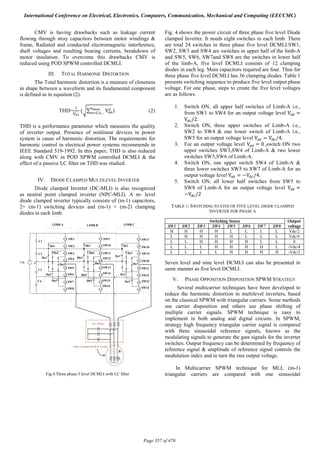
Fig.4.Three phase 5 level DCMLI with LC filter
Fig. 4.shows the power circuit of three phase five level Diode
clamped Inverter. It needs eight switches in each limb. There
are total 24 switches in three phase five level DCMLI.SW1,
SW2, SW3 and SW4 are switches in upper half of the limb-A
and SW5, SW6, SW7and SW8 are the switches in lower half
of the limb-A, five level DCMLI consists of 12 clamping
diodes in each leg. Main capacitors required are four. Thus for
three phase five level DCMLI has 36 clamping diodes. Table 1
presents switching sequence to produce five level output phase
voltage. For one phase, steps to create the five level voltages
are as follows.
1. Switch ON, all upper half switches of Limb-A i.e.,
from SW1 to SW4 for an output voltage level V =
V /2.
2. Switch ON, three upper switches of Limb-A i.e.,
SW2 to SW4 & one lower switch of Limb-A i.e.,
SW5 for an output voltage level V = V /4.
3. For an output voltage level V = 0	,switch ON two
upper switches SW3,SW4 of Limb-A & two lower
switches SW5,SW6 of Limb-A.
4. Switch ON, one upper switch SW4 of Limb-A &
three lower switches SW5 to SW7 of Limb-A for an
output voltage level	V = −V /4.
5. Switch ON, all lower half switches from SW5 to
SW8 of Limb-A for an output voltage level V =
−V /2	
TABLE 1: SWITCHING STATES OF FIVE LEVEL DIODE CLAMPED
INVERTER FOR PHASE A
Switching States Output
voltageSW1 SW2 SW3 SW4 SW5 SW6 SW7 SW8
H H H H L L L L Vdc/2
L H H H H L L L Vdc/4
L L H H H H L L 0
L L L H H H H L -Vdc/4
L L L L H H H H -Vdc/2
Seven level and nine level DCMLI can also be presented in
same manner as five level DCMLI.
V. PHASE OPPOSITION DISPOSITION SPWM STRATEGY
Several multicarrier techniques have been developed to
reduce the harmonic distortion in multilevel inverters, based
on the classical SPWM with triangular carriers. Some methods
use carrier disposition and others use phase shifting of
multiple carrier signals. SPWM technique is easy to
implement in both analog and digital circuits. In SPWM,
strategy high frequency triangular carrier signal is compared
with three sinusoidal reference signals, known as the
modulating signals to generate the gate signals for the inverter
switches. Output frequency can be determined by frequency of
reference signal & amplitude of reference signal controls the
modulation index and in turn the rms output voltage.
In Multicarrier SPWM technique for MLI, (m-1)
triangular carriers are compared with one sinusoidal
International Conference on Electrical, Electronics, Computers, Communication, Mechanical and Computing (EECCMC)
Page 357 of 470
modulating signal. Where m is output level of inverter. Thus
for five level inverter four carriers are required.
Fig. 5. POD-SPWM technique for triggering switches of five level diode
clamped inverter (Phase A)
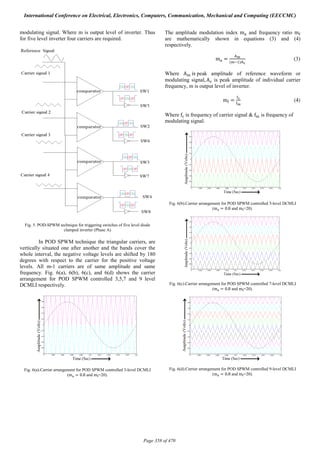
In POD SPWM technique the triangular carriers, are
vertically situated one after another and the bands cover the
whole interval, the negative voltage levels are shifted by 180
degrees with respect to the carrier for the positive voltage
levels. All m-1 carriers are of same amplitude and same
frequency. Fig. 6(a), 6(b), 6(c), and 6(d) shows the carrier
arrangement for POD SPWM controlled 3,5,7 and 9 level
DCMLI respectively.
Fig. 6(a).Carrier arrangement for POD SPWM controlled 3-level DCMLI
(m = 0.8 and m =20).
The amplitude modulation index m and frequency ratio m
are mathematically shown in equations (3) and (4)
respectively.
				m =
( )
(3)
Where A 	is	peak amplitude of reference waveform or
modulating signal, A is peak amplitude of individual carrier
frequency, m is output level of inverter.
							m = 																																													(4)
Where f 	is	frequency of carrier signal & f is frequency of
modulating signal.
Fig. 6(b).Carrier arrangement for POD SPWM controlled 5-level DCMLI
(m = 0.8 and m =20).
Fig. 6(c).Carrier arrangement for POD SPWM controlled 7-level DCMLI
(m = 0.8 and m =20).
Fig. 6(d).Carrier arrangement for POD SPWM controlled 9-level DCMLI
(m = 0.8 and m =20).
International Conference on Electrical, Electronics, Computers, Communication, Mechanical and Computing (EECCMC)
Page 358 of 470
VI. SIMULATION RESULTS
A. Conventional Two level Inverter simulation results
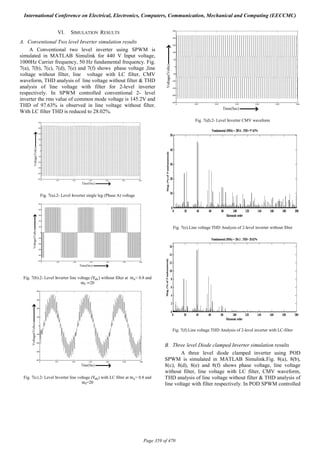
A Conventional two level inverter using SPWM is
simulated in MATLAB Simulink for 440 V Input voltage,
1000Hz Carrier frequency, 50 Hz fundamental frequency. Fig.
7(a), 7(b), 7(c), 7(d), 7(e) and 7(f) shows phase voltage ,line
voltage without filter, line voltage with LC filter, CMV
waveform, THD analysis of line voltage without filter & THD
analysis of line voltage with filter for 2-level inverter
respectively. In SPWM controlled conventional 2- level
inverter the rms value of common mode voltage is 145.2V and
THD of 97.63% is observed in line voltage without filter.
With LC filter THD is reduced to 28.02%.
Fig. 7(a).2- Level Inverter single leg (Phase A) voltage
Fig. 7(b).2- Level Inverter line voltage (V ) without filter at 	m = 0.8 and
m =20
Fig. 7(c).2- Level Inverter line voltage (V ) with LC filter at m = 0.8 and
m =20
Fig. 7(d).2- Level Inverter CMV waveform
Fig. 7(e).Line voltage THD Analysis of 2-level inverter without filter
Fig. 7(f).Line voltage THD Analysis of 2-level inverter with LC-filter
B. Three level Diode clamped Inverter simulation results
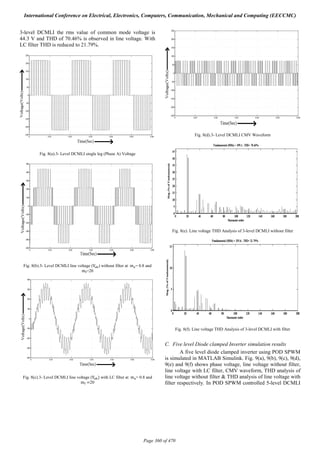
A three level diode clamped inverter using POD
SPWM is simulated in MATLAB Simulink.Fig. 8(a), 8(b),
8(c), 8(d), 8(e) and 8(f) shows phase voltage, line voltage
without filter, line voltage with LC filter, CMV waveform,
THD analysis of line voltage without filter & THD analysis of
line voltage with filter respectively. In POD SPWM controlled
International Conference on Electrical, Electronics, Computers, Communication, Mechanical and Computing (EECCMC)
Page 359 of 470
3-level DCMLI the rms value of common mode voltage is
44.3 V and THD of 70.46% is observed in line voltage. With
LC filter THD is reduced to 21.79%.
Fig. 8(a).3- Level DCMLI single leg (Phase A) Voltage
Fig. 8(b).3- Level DCMLI line voltage (V ) without filter at 	m = 0.8 and
m =20
Fig. 8(c).3- Level DCMLI line voltage (V ) with LC filter at 	m = 0.8 and
m =20
Fig. 8(d).3- Level DCMLI CMV Waveform
Fig. 8(e). Line voltage THD Analysis of 3-level DCMLI without filter
Fig. 8(f). Line voltage THD Analysis of 3-level DCMLI with filter
C. Five level Diode clamped Inverter simulation results
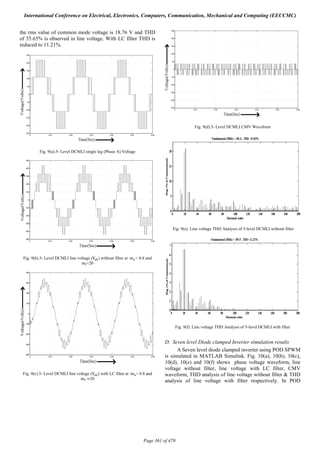
A five level diode clamped inverter using POD SPWM
is simulated in MATLAB Simulink. Fig. 9(a), 9(b), 9(c), 9(d),
9(e) and 9(f) shows phase voltage, line voltage without filter,
line voltage with LC filter, CMV waveform, THD analysis of
line voltage without filter & THD analysis of line voltage with
filter respectively. In POD SPWM controlled 5-level DCMLI
International Conference on Electrical, Electronics, Computers, Communication, Mechanical and Computing (EECCMC)
Page 360 of 470
the rms value of common mode voltage is 18.76 V and THD
of 35.65% is observed in line voltage. With LC filter THD is
reduced to 11.21%.
Fig. 9(a).5- Level DCMLI single leg (Phase A) Voltage
Fig. 9(b).5- Level DCMLI line voltage (V ) without filter at 	m = 0.8 and
m =20
Fig. 9(c).5- Level DCMLI line voltage (V ) with LC filter at 	m = 0.8 and
m =20
Fig. 9(d).5- Level DCMLI CMV Waveform
Fig. 9(e). Line voltage THD Analysis of 5-level DCMLI without filter
Fig. 9(f). Line voltage THD Analysis of 5-level DCMLI with filter
D. Seven level Diode clamped Inverter simulation results
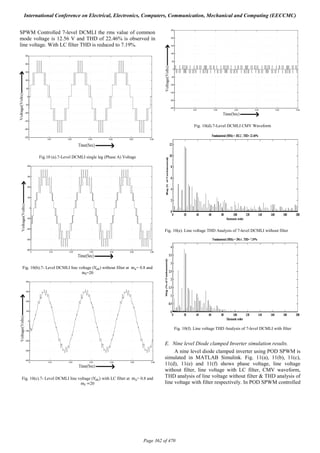
A Seven level diode clamped inverter using POD SPWM
is simulated in MATLAB Simulink. Fig. 10(a), 10(b), 10(c),
10(d), 10(e) and 10(f) shows phase voltage waveform, line
voltage without filter, line voltage with LC filter, CMV
waveform, THD analysis of line voltage without filter & THD
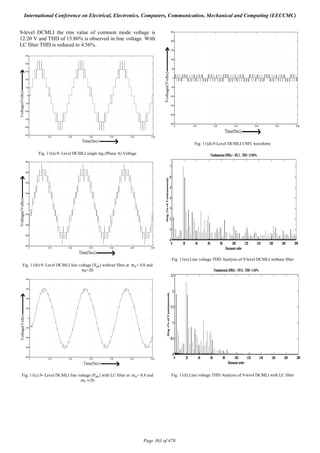
analysis of line voltage with filter respectively. In POD
International Conference on Electrical, Electronics, Computers, Communication, Mechanical and Computing (EECCMC)
Page 361 of 470
SPWM Controlled 7-level DCMLI the rms value of common
mode voltage is 12.56 V and THD of 22.46% is observed in
line voltage. With LC filter THD is reduced to 7.19%.
Fig.10 (a).7-Level DCMLI single leg (Phase A) Voltage
Fig. 10(b).7- Level DCMLI line voltage (V ) without filter at 	m = 0.8 and
m =20
Fig. 10(c).7- Level DCMLI line voltage (V ) with LC filter at 	m = 0.8 and
m =20
Fig. 10(d).7-Level DCMLI CMV Waveform
Fig. 10(e). Line voltage THD Analysis of 7-level DCMLI without filter
Fig. 10(f). Line voltage THD Analysis of 7-level DCMLI with filter
E. Nine level Diode clamped Inverter simulation results.
A nine level diode clamped inverter using POD SPWM is
simulated in MATLAB Simulink. Fig. 11(a), 11(b), 11(c),
11(d), 11(e) and 11(f) shows phase voltage, line voltage
without filter, line voltage with LC filter, CMV waveform,
THD analysis of line voltage without filter & THD analysis of
line voltage with filter respectively. In POD SPWM controlled
International Conference on Electrical, Electronics, Computers, Communication, Mechanical and Computing (EECCMC)
Page 362 of 470
9-level DCMLI the rms value of common mode voltage is
12.20 V and THD of 13.86% is observed in line voltage. With
LC filter THD is reduced to 4.56%.
Fig. 11(a).9- Level DCMLI single leg (Phase A) Voltage
Fig. 11(b).9- Level DCMLI line voltage (V ) without filter at 	m = 0.8 and
m =20
Fig. 11(c).9- Level DCMLI line voltage (V ) with LC filter at 	m = 0.8 and
m =20
Fig. 11(d).9-Level DCMLI CMV waveform
Fig. 11(e).Line voltage THD Analysis of 9-level DCMLI without filter
Fig. 11(f).Line voltage THD Analysis of 9-level DCMLI with LC filter
International Conference on Electrical, Electronics, Computers, Communication, Mechanical and Computing (EECCMC)
Page 363 of 470
Table 2 shows the CMV and %THD for two level VSI, 3, 5, 7
and 9 level Diode clamped Inverter using Phase Opposition
Disposition SPWM technique with and without LC filter.
TABLE 2: CMV AND %THD VALUES FOR POD SPWM CONTROLLED
DCMLI
2-level
VSI
3-Phase POD SPWM Controlled DCMLI
3-level 5-level 7-level 9-level
CMV
(V)
145.2 44.3 18.76 12.56 12.20
THD
(%)
Without
filter
97.63 70.46 35.65 22.46 13.86
With
filter
28.02 21.79 11.21 7.19 4.56
Variation of CMV and % THD with level of Inverter is shown
in fig. 12.
Fig.12.Variation of CMV and THD with level of Inverter
From the fig. 12 it can be noticed that CMV and %THD
decreases with increase in level of the inverter as increase in
level improves the nature of output voltage waveform,
approaching to sinusoidal shape which in turn reduces lower
order harmonics. The number of steps in the output voltage
increases as the level increases which reduces rate of rise of
voltage.CMV and %THD reduces as step size reduces.
VII. CONCLUSION
POD SPWM controlled DCMLI for three, five, seven and nine
level is simulated in Matlab/Simulink software.Table-2 clearly
shows that two level inverter produces high CMV and THD
which causes high leakage current and premature failure of
motor bearing . A comparative study of three level, five level,
seven level and nine level DCMLI in terms of THD and CMV
shows as level of the inverter increases CMV and %THD
decreases. The simulation output gives a conclusion that by
employing POD SPWM technique to DCMLI, CMV can be
reduced. POD SPWM controlled DCMLI also reduces dv/dt
in its output voltage and therefore CMV and thus flow of
leakage current in motor bearing reduced.
APPENDIX
Parameters Used for Simulation:
1. Input D.C.Voltage V =440V
2. Load R=100 Ohms, L=50e-3 Henry
3. Fundamental frequency=50Hz
4. Carrier frequency f = 1000Hz
5. Amplitude Modulation Index, m = 0.8
6. Frequency Modulation Index, m = 20
7. LC filter: L=5.7e-3 Henry, C=3.45e-6 Farad
REFERENCES
[1] G. Prem Sunder, B. Shanthi, A. Lamehi Nachiappan and S. P. Natrajan,
“Performance Analysis of modified CHB MLI using various carrier
modulation schemes”, IJESA, vol. 3, no. 5, (2013), pp. 310-316.
[2] F. Z. Peng and J. S. Lai, “Multilevel converters, A new breed of power
Electronics converters”, IEEE Trans Industries Application, vol. 32,
(1996), pp. 509-517.
[3] K. Jagdish, “THD Analysis for different levels of cascade multilevel
inverter for industrials applications”, IJETAE, (2012), pp. 20-30.
[4] M. Kavitha, A. Arunkumar, N. Gokulnath and S. Arun, “New cascaded
H-bridge multilevel inverter topology with reduced number of switches
and sources”, JEEE, vol. 2, no. 6, (2012), pp. 26-36.
[5] D. Grahame Holmes, Thomas A. Lipo, “Pulse Width Modulation For
Power Converters”, WILEY INTERSCIENCE,2003.
[6] Michail Vasiladiotis, “Analysis, Implementation and Experimental
Evaluation of Control Systems for a Modular Multilevel Converter”,
Master Thesis, KTH-EME, 2009.
[7] Zhang Jingzhe, “Analysis of a Cascade Voltage Source Multilevel
Converter for a High Power Motor Drive”,Master Thesis, KTH-EME,
2008.
[8] Cristian Sandu, Nicoleta Carnu and Valentin Constantin Costea,
“Medium Voltage Modular Multi-Level Inverter”, Master Thesis,
Aalborg University, 2008.
[9] A. Antonopoulos, L Ängquist and H.P. Nee, “On Dynamics and
Voltage Control of the Modular Multilevel Converter”, European Power
Electronics Conference (EPE), Barcelona, Spain, September 8-10, 2009
[10] A. Mokhberdoran and A. Ajami, “Symmetric and Asymmetric Design
and Implementation of New Cascaded Multilevel Inverter Topology”,
IEEE Transactions on Power Electronics, vol. 29, no. 12, pp. 6712-6724,
2014.
[11] Y.S. Lai and F.S. Shyu, “Optimal common-mode voltage reduction
PWMtechnique for inverter control with consideration of the dead-time
effects-part I:basic development,” IEEE Trans. on Industry Applications,
vol 40, pp.1605-1612, November/December 2004.
[12] M. Cacciato, A. Consoli, G. Scarcella, and A. Testa, “Reduction of
commonmode currents in PWM inverter motor drives,” IEEE Trans. on
Industry Applications, vol. 35, pp. 469-476, March/April 1999.
[13] E. Ün and A.M. Hava, “A near state PWM method with reduced
switching frequency and reduced common mode voltage for three-phase
voltage source inverters,” in Proc. IEEE-IEMDC’07, 2007, pp. 235-240.
[14] P. G. Shewane, S. Gaigowal, B. Rane, “Multicarrier Based SPWM
Modulation for Diode Clamped MLI to reduce CMV and THD”,
Power,Automation and Communication [INPAC-2014], International
Conference at Amravati on 6-8 OCT.2014, pp. 50-
54,DOI:10.1109/INPAC.2014.6981134, IEEE.
[15] Sk. Moin Ahmed, Haitham Abu-Rub, Zainal Salam, “Common Mode
Voltage Elimination in a Three-to-Five-Phase Dual Matrix Converter
Feeding a Five-Phase Open-End Drive Using Space-Vector Modulation
Technique”,IEEE TRANSACTIONS ON INDUSTRIAL
ELECTRONICS,VOL. 62, NO. 10, OCTOBER 2015.
International Conference on Electrical, Electronics, Computers, Communication, Mechanical and Computing (EECCMC)
Page 364 of 470
www.ijcrt.org © 2018 IJCRT | Volume 6, Issue 2 April 2018 | ISSN: 2320-2882
IJCRT1812942 International Journal of Creative Research Thoughts (IJCRT) www.ijcrt.org 579
Common Mode Voltage reduction in Diode Clamped
MLI using Alternative Phase Opposition Disposition
SPWM Technique
1
Mohd Esa, 2
J.E.Muralidhar
1
M.E. Student, 2
Associate Professor
1,2
Electrical Engineering Department
1, 2
Muffakham Jah College of Engineering and Technology, Hyderabad, India
Abstract: The main objective of this paper is to reduce the Common Mode Voltage (CMV) in the Diode Clamped Multilevel Inverter
(DCMLI).Three phase Y-connected RL load is connected to DCMLI. The common mode voltage exists between neutral point of Y-
connected load and system ground.CMV causes premature failure of bearings of induction motor and is essential to reduce. In this
paper, Alternative Phase Opposition Disposition SPWM technique is used to reduce common mode voltage. Two level, five level,
seven level and nine level DCMLI are compared in terms of THD and CMV.The effect of a passive LC filter on THD was studied.
The simulation of circuit is carried out by using MATLAB/Simulink. Simulation result portrays reduction in THD and CMV by using
APOD-SPWM controlled higher level Inverters.
IndexTerms - CMV, THD, APOD SPWM, DCMLI
I. INTRODUCTION
CMV is define as voltage between neutral point of the load and the dc midpoint or the voltage between neutral point of load and the
system ground or the common mode voltage is defined as the potential of the star point of the load with respect to the center of the D.C.
bus of the inverter (or) the common mode voltage (CMV) of the 3-phase system is defined as the voltage potential difference between
the star point of the load network and the mid-point of the D.C. link capacitors[1].
CMV= ∑ (1)
Where are the voltages between ground to phase.CMV is zero in purely sinusoidal three phase system but VSI is non-
pure sinusoidal system thus it develops CMV. CMV results in high leakage current and premature failure of motor bearing so it is
required to reduce [2], [3]. Some modulation techniques based approaches to reduce CMV are MLI using SPWM technique, MLI
using Space Vector PWM technique, MLI using Modified space vector modulation technique, predictive current control method, on
zero state modulation techniques. In this paper, APOD- SPWM is used to reduce common mode voltage.
Fig.1.Schematic of single pole of MLI by a
switch [5]
Fig.2.Typical output voltage of 5
level MLI [5]
www.ijcrt.org © 2018 IJCRT | Volume 6, Issue 2 April 2018 | ISSN: 2320-2882
IJCRT1812942 International Journal of Creative Research Thoughts (IJCRT) www.ijcrt.org 580
The idea of multilevel inverters has been introduced in 1975 with invention of cascaded H-Bridge MLI.The term multilevel began
with 3- level inverter. Afterwards numerous multilevel inverter topologies have been developed .Three different MLI topologies that
have been proposed are diode clamped or neutral point clamped, flying capacitor and cascaded H-Bridge or multicell MLI [4]. In
addition, several control strategies have been developed. The series connected capacitors constitute the energy tank for the inverter,
providing some nodes to which MLI can be connected. Each capacitor has the same voltage ,which is given by
(2)
Where m denotes the number of levels. The term level refers to number of nodes to which the inverter can be accessible. An m-level
inverter needs m-1 capacitors. Figure 2 shows the schematic of a pole in MLI.Pole is regarded as a single-pole, multi-throw switch.
Desired output can be obtained by connecting the switch to one node at a time.
Different modulation techniques exist to trigger switches of inverter circuit. The commonly used modulation techniques are as
follows
 Sinusoidal pulse width modulation (SPWM) [6]
 Third harmonic PWM (THPWM)
 Space vector PWM (SVPWM) [7]
 Modified Space vector PWM (MSVPWM)
The most popular method of controlling inverter‟s output voltage is SPWM technique.SPWM is a carrier based pulse width
modulation method in which predefined modulation signal is used to determine output voltages. Sinusoidal modulation signal is used
in SPWM technique. The gating signal in SPWM is generated by comparing a reference signal of sine shape with a triangular carrier
wave.
Fig.3.Comparision of reference and carrier signal in SPWM generation
The width of each pulse varied proportionally to amplitude of a sine wave. The output frequency of a inverter can be found by using
the frequency of reference signal. The rms output voltage can be controlled by modulation index and intern modulation index is
controlled by peak amplitude.SPWM method results in reduction of THD for output voltage.SPWM technique is effective modulation
technique and it does not require any additional components and eliminates lower order harmonics easily. Carrier based SPWM
techniques are classified as follows
 Single carrier based SPWM technique
 Multi carrier based SPWM technique
Single carrier SPWM technique is used for 2-level inverter whereas multi carrier SPWM technique is used in Multi-level
inverters. Multi carrier SPWM technique is further classified as follows
 Phase shift SPWM technique
 Level shifted SPWM technique
 Hybrid SPWM technique
Level shifted SPWM technique is further classified as follows
 Phase Disposition (PD)
 Phase Opposition Disposition (POD)
 Alterative Phase Opposition Disposition (APOD)
Alternative phase opposition disposition SPWM is used to reduce common mode voltage in Diode clamped MLI.
www.ijcrt.org © 2018 IJCRT | Volume 6, Issue 2 April 2018 | ISSN: 2320-2882
IJCRT1812942 International Journal of Creative Research Thoughts (IJCRT) www.ijcrt.org 581
II. DIODE CLAMPED MULTILEVEL INVERTER
Diode clamped Inverter (DC-MLI) is also known as neutral point clamped inverter (NPC-MLI). A m level diode clamped inverter
typically consists of (m-1) capacitors on the D.C. bus and produces m levels on the phase voltage. The m- level inverter leg requires (m-
1) capacitors, 2× (m-1) switching devices and (m-1) × (m-2) clamping diodes [8].
Fig.4.Three phase 5 level DCMLI
For one phase, steps to synthesize the five level voltages are as follows.
1. Turn on all upper half switches of Limb-A i.e., from SW1 to SW4 for an output voltage level
2. Turn on three upper switches of Limb-A i.e., SW2 to SW4 and one lower switch of Limb-A i.e., SW5 for an output voltage
level
3. For an output voltage level ,turn on two upper switches SW3 and SW4 of Limb-A and two lower switches SW5 and
SW6 of Limb-A.
4. Turn on one upper switch SW4 of Limb-A and three lower switches SW5 to SW7 of Limb-A for an output voltage
level .
5. Turn on all lower half switches from SW5 to SW8 of Limb-A for an output voltage level
Table 1: Switching states of five level diode clamped inverter for phase A
Switching States Output
voltageSW1 SW2 SW3 SW4 SW5 SW6 SW7 SW8
High High High High Low Low Low Low Vdc/2
Low High High High High Low Low Low Vdc/4
Low Low High High High High Low Low 0
Low Low Low High High High High Low -Vdc/4
Low Low Low Low High High High High -Vdc/2
Seven level and nine level diode clamped inverters can also be presented in same manner as five level DCMLI
www.ijcrt.org © 2018 IJCRT | Volume 6, Issue 2 April 2018 | ISSN: 2320-2882
IJCRT1812942 International Journal of Creative Research Thoughts (IJCRT) www.ijcrt.org 582
III. ALTERNATIVE PHASE OPPOSITION DISPOSITION SPWM STRATEGY
In APOD-SPWM technique the carrier signal of same amplitude are phase displaced from each other by 180° from its neighboring
carrier signals, This carriers are compared with sinusoidal signal for producing pulse signals to trigger gates of switches used in
DCMLI.For m-level output, (m-1) carrier signals are phase disposed by 180 degrees to its neighboring carrier waveform [9]. Fig. 6(a),
6(b), and 6(c) shows the carrier arrangement for APOD SPWM controlled 5, 7 and 9 level DCMLI respectively
Fig. 5. APOD-SPWM technique for triggering switches of five level diode clamped inverter (Phase A)
The amplitude modulation index and frequency ratio are mathematically shown in equations (3) and (4) respectively.
(3)
Where peak to peak amplitude of reference waveform or modulating signal, is peak to peak amplitude of individual carrier
frequency, m is output level of inverter.
 
Where frequency of carrier signal & is frequency of modulating signal.
Fig. 6(a).Carrier arrangement for APOD SPWM controlled 5-
level DCMLI ( and =20).
Fig. 6(b).Carrier arrangement for APOD SPWM controlled 7-
level DCMLI ( and =20).
Fig. 6(c).Carrier arrangement for APOD SPWM controlled 9-level DCMLI ( and =20).
www.ijcrt.org © 2018 IJCRT | Volume 6, Issue 2 April 2018 | ISSN: 2320-2882
IJCRT1812942 International Journal of Creative Research Thoughts (IJCRT) www.ijcrt.org 583
IV. SIMULATION RESULTS
The Simulation of APOD-SPWM controlled DCMLI for five, seven and nine level is carried out in Matlab/Simulink software.
Figures 7(a), 7(b), 7(c), 7(d) presents phase voltage for 2-level, 5-level, 7-level, 9-level inverter respectively and figures 8(a), 8(b),
8(c), 8(d) presents line voltage without filter for 2-level, 5-level, 7-level, 9-level inverter respectively.
Fig. 7(a).2- Level Inverter Phase voltage
Fig. 7(b).5- Level DCMLI Phase Voltage
Fig.7 (c).7-Level DCMLI Phase Voltage
Fig. 7(d).9- Level DCMLI Phase Voltage
Fig. 8(a).2- Level Inverter line voltage without filter
Fig. 8(b).5- Level Inverter line voltage without filter
Fig. 8(c).7- Level Inverter line voltage without filter
Fig. 8(d).9- Level Inverter line voltage without filter
www.ijcrt.org © 2018 IJCRT | Volume 6, Issue 2 April 2018 | ISSN: 2320-2882
IJCRT1812942 International Journal of Creative Research Thoughts (IJCRT) www.ijcrt.org 584
Figures 9(a), 9(b), 9(c), 9(d) presents line voltage with filter for 2-level, 5-level, 7-level, 9-level inverter respectively and figure 10(a),
10(b), 10(c), 10(d) presents CMV waveform for 2-level, 5-level, 7-level, 9-level inverter respectively.
Fig. 9(a).2- Level Inverter line with LC filter
Fig. 9(b).5- Level Inverter line voltage with LC filter
Fig. 9(c).7- Level Inverter line voltage with LC filter
Fig. 10(a).2- Level Inverter CMV waveform
Fig. 10(b).5- Level DCMLI CMV Waveform
Fig. 10(c).7-Level DCMLI CMV Waveform
www.ijcrt.org © 2018 IJCRT | Volume 6, Issue 2 April 2018 | ISSN: 2320-2882
IJCRT1812942 International Journal of Creative Research Thoughts (IJCRT) www.ijcrt.org 585
Fig. 9(d).9- Level Inverter line voltage with LC filter Fig. 10(d).9-Level DCMLI CMV waveform
Figure 11(a), 11(b), 11(c), 11(d) presents THD analysis without filter for 2-level, 5-level, 7-level, 9-level inverter respectively and
figure 11(e), 11(f), 11(g), 11(h) presents THD analysis with LC filter for 2-level, 5-level, 7-level, 9-level inverter respectively.
Fig. 11(a).Line voltage THD Analysis of 2-level inverter
without filter
Fig. 11(b). Line voltage THD Analysis of 5-level inverter
without filter
Fig. 11(c). Line voltage THD Analysis of 7-level inverter
without filter
Fig. 11(e).Line voltage THD Analysis of 2-level inverter with
filter
Fig. 11(f).Line voltage THD Analysis of 5-level inverter with
filter
Fig. 11(g).Line voltage THD Analysis of 7-level inverter with
filter
www.ijcrt.org © 2018 IJCRT | Volume 6, Issue 2 April 2018 | ISSN: 2320-2882
IJCRT1812942 International Journal of Creative Research Thoughts (IJCRT) www.ijcrt.org 586
Fig. 11(d).Line voltage THD Analysis of 9-level inverter
without filter
Fig. 11(h).Line voltage THD Analysis of 9-level inverter with
filter
Table 2 shows the CMV and %THD for two level VSI, 5, 7 and 9 level Diode clamped Inverter using Alternative Phase Opposition
Disposition SPWM technique with and without LC filter.
Table 2: CMV and %THD values for APOD SPWM controlled DCMLI
2-level
VSI
3-Phase APOD SPWM Controlled DCMLI
5-level 7-level 9-level
CMV
(V)
145.2 31.14 17.44 14.09
THD
(%)
Without
filter
97.63 30.13 19.45 12.90
With filter 28.02 9.28 6.18 4.08
Variation of CMV and % THD with level of Inverter is shown in fig. 12
Fig.12.CMV and %THD versus level of Inverter
www.ijcrt.org © 2018 IJCRT | Volume 6, Issue 2 April 2018 | ISSN: 2320-2882
IJCRT1812942 International Journal of Creative Research Thoughts (IJCRT) www.ijcrt.org 587
V.CONCLUSION
APOD SPWM controlled DCMLI for five, seven & nine level is simulated in Matlab/Simulink software. It is cleared from fig. 12
that CMV and %THD decreases with increase in level of the inverter. Increase in level improves the nature of output voltage waveform,
approaching to sine shape which in turn lessens lower order harmonics. The number of steps in the output voltage increases as the level
increases which reduces rate of rise of voltage.CMV and %THD reduces as size of step reduces.
REFERENCES
[1] E. Un and A. M. Hava, “A Near State PWM Method with Reduced Switching Losses and Reduced Common Mode Voltage for
3-Phase Voltage Source Inverters,” Industry Applications, I.E.E.E. transactions on, vol. 45, pp. 782-793, 2009
[2] Min Zhang, “Investigation of Switching Schemes for 3-phase Four Leg Voltage Source Inverters”, A thesis submitted for the
degree of Doctor of Philosophy June, 2013, School of Electrical and Electronic Engineering,Newcastle University
[3] Anuradha V.Jadhav and Mrs.P.V.Kapoor, “Reduction of Common Mode Voltage using Multilevel Inverter”, Energy Efficient
Technologies for Sustainability [ICEETS],pp.586-590,06 October 2016,DOI: 10.1109/ICEETS.2016.7583822,I.E.E.E.
[4] T. Cunnyngham. Cascade Multilevel Inverters for Hybrid-Electric Vehicle Applications with Variant DC Sources. Master‟s
thesis, The University of Tennessee, 2001.
[5] Muhammad H. Rashid,“Power Electronics-Circuits, Devices and Applications” Pearson Education Incorporated, 2005.
[6] P. G. Shewane, S. Gaigowal, B. Rane, “Multicarrier Based SPWM Modulation for Diode Clamped MLI to reduce CMV and
THD”, Power,Automation and Communication [INPAC-2014], International Conference at Amravati on 6-8 OCT.2014, pp. 50-
54,DOI:10.1109/INPAC.2014.6981134, IEEE.
[7] Sk. Moin Ahmed, Haitham Abu-Rub, Zainal Salam, “Common Mode Voltage Elimination in a Three-to-Five-Phase Dual Matrix
Converter Feeding a Five-Phase Open-End Drive Using Space-Vector Modulation Technique”,IEEE TRANSACTIONS ON
INDUSTRIAL ELECTRONICS,VOL. 62, NO. 10, OCTOBER 2015.
[8] A.Nabae, I. Takahashi, H.Akagi„A new Neutral Point CIamped PWM Inverter‟‟ I.E.E.E. transactions on Industry applications, Vol.
IA-I7, No.5,pp.518-52 September/October,1981.
[9] McGrath, B.P.; Holmes, D.G.; “Multicarrier PWM strategies for Multilevel Inverters,” Industrial Electronics, I.E.E.E. transactions,
vol.49, no.4, pp. 858- 867, August 2002 ,DOI:10.1109/TIE.2002.801073
Elimination of Common Mode Voltage in
Neutral Point Clamped MLI using ZCM-SPWM
Technique
Mohd Esa
M.E. Student, EED
M.J.C.E.T., Hyderabad
zmohdesa@gmail.com
Ahmed Maaz
Assistant Professor, EED
N.S.A.K.C.E.T., Hyderabad
hmdmaaz58@gmail.com
Mohd Abdul Rahman Uzair
Associate Professor, EED
N.S.A.K.C.E.T., Hyderabad
as_uzair2003@yahoo.co.in
Abstract— The main aim of this paper is to eliminate the
Common Mode Voltage (CMV). CMV is the voltage between
neutral point of a Y connected RL load & ground of the system.
This paper focuses on the CMV in inverter circuits. The effects of
this voltage is damage to bearings of motor, unexpected ground
fault trips, erratic behavior of VFDs, premature motor insulation
failure and cable damage.CMV is having drawbacks such as
leakage current flowing through the stray capacitors between
motor windings and frame, electromagnetic interference, shaft
voltages, bearing currents and break down of motor
insulation.CMV can be reduced by external circuit methods such
as use of common mode choke, properly designed dv/dt filter,
isolation transformer, active filters, passive filters, dual bridge
inverter and four leg inverters. In this paper, CMV is eliminated
in 3-level Neutral Point Clamped (NPC) inverter using Zero
Common Mode (ZCM) SPWM Technique. The simulation of
circuit is carried out by using MATLAB/Simulink software.
Keywords— NPC-MLI, ZCM-SPWM, CMV
I. INTRODUCTION
he conventional PWM voltage source inverters have
least devices, simple circuit topology & control. Their
main drawbacks are existence of harmonics close to the
switching frequency [1]. They also have a main problem of
CMV which gives rise to shaft voltages & bearing currents
[2], [3]. Bearing currents and shaft voltages have been
recognized since 1924.The main cause for this was
asymmetric flux distribution inside the motor which leads to
an induced voltage across the rotor shaft [4],[5]. At low
frequency, chances of occurrence of this fault is very less.
Before 1980 it was supposed that the bearing current problems
are mainly due to electromagnetic induction. It becomes a
prominent problem after the application of recently developed
semiconductor devices in drives [6].For better operation of
induction motor CMV must be reduced. It is very important to
reduce CMV itself or to limit this voltage to within certain
bounds. Some of the approaches to reduce CMV are
application of different types of filters [7], dual bridge
inverters [8], four leg inverters [9], by improving modulation
techniques [10], [11] etc. A multilevel inverter can reduce as
well as eliminate the CMV. The concept of multilevel
originated with the three-level converter which is often known
as neutral-point converter. Here converter mentions to the
power flow in both the directions i.e. from dc to ac called as
inverter and from ac to dc called as rectifier. The
commercially existing multilevel inverter topologies are diode
clamped (DC-MLI) or neutral point clamped (NPC-MLI),
flying capacitor or capacitor clamped (CC-MLI) & Cascaded
H bridge inverter or multicell inverter. Though cascade
multilevel inverter was designed in 1975 it found its
application in 1990, therefore NPC-MLI was considered as
first generation of multilevel technology. NPC-MLI was the
first one that made it possible to produce an output voltage
from only single dc source. The efficiency of NPC-MLI is
high because all devices are switched at the fundamental
frequency & when number of levels is high enough, harmonic
content is low enough to avoid need of filters but excessive
clamping diodes are required when numbers of levels are high.
Capacitor clamped multilevel inverter is an alternative to
NPC-MLI.Capacitor clamped MLI uses capacitors for
clamping. It is easier to increase number of levels in CC-MLI
than the NPC-MLI that is why it is progressively used in
numerous high power applications. For x level, capacitor
clamped inverter consists of 2× (x-1) switches, (x-1) main
capacitors and (x-1) × (x-2)/2 auxiliary capacitors are essential
in each leg. In CC-MLI both real and reactive power flow can
be controlled but switching frequency and switching losses are
high for real power transmission [12].In multicell inverter
topology, ac output of each H-bridge is connected in series
such that the synthesized output voltage waveform is the sum
of all of the individual H-bridge outputs. For x level, inverter
number of cells required is (x-1)/2.Clamping diodes or
capacitors are not required thus components used are less in
this topology but separate dc sources are required for each H-
bridge.
To control the output voltage of inverter different
modulation strategies exists. These strategies can be classified
according to fundamental switching frequency & high
switching frequency. Modulation techniques based on
fundamental switching frequencies are selective harmonic
elimination & space vector control. High switching based
methods are Sinusoidal Pulse Width Modulation (SPWM)
[13], Selective Harmonic Elimination (SHE-PWM), Space
Vector Modulation (SVM). These PWM techniques are easy
T
to implement and they reduce lower order harmonics.SPWM
is simplest of all the above control strategies.Schonung and
stemmler introduced SPWM Technique in 1964.SPWM
technique does not require any calculations and is most
popular in industrial applications.
Multi carrier techniques based on classical SPWM has
been developed. Phase shifting and level shifting are major
techniques of multicarrier SPWM. The multi carrier based
high frequency techniques are a) Phase disposition (PD-
SPWM) b) Phase Opposition Disposition (POD-SPWM) c)
Alternate Phase Opposition Disposition (APOD-SPWM) d)
Phase Shift (PS-SPWM) e) Alternate Phase Shift (APS-
SPWM) f) Carrier Overlap (CO-SPWM) g) Variable
Frequency (VF-SPWM) h) Alternate Variable Frequency
(AVF-SPWM) [14].These strategies are useful to reduce CMV
in multilevel inverters.
Dual bridge inverter topology has proved to be effective
in eliminating the CMV and motor bearing currents, as well as
in reducing EMI.Dual bridge inverter approach is based on
feeding a suitably connected double winding motor by two
parallel inverter units having opposite polarities. Size and cost
are disadvantage for this CMV reduction technique.
Fig.1. A 3-level NPC-MLI
Control strategy based CMV reduction techniques are
multilevel inverter using SPWM technique, multilevel inverter
using space vector technique, multilevel inverter using
modified space vector modulation & multilevel inverter using
active common mode elimination modulation technique. In
this paper, ZCM-SPWM technique is used to eliminate CMV
II. OPERATION OF 3-LEVEL NPC-MLI
NPC-MLI was proposed by Nabae et al., in 1981.A x
level neutral point clamped inverter typically consists of (x-1)
capacitors on the dc bus and produces x levels on the phase
voltage. The x- level inverter leg requires 2× (x-1) switching
devices and (x-1) × (x-2) clamping diodes [15].
TABLE I: SWITCHING STATES OF THREE LEVEL NEUTRAL POINT
CLAMPED INVERTER
Switching States Output
voltageSW1 SW2 SW3 SW4
H H L L /2
L H H L 0
L L H H -
It needs four switches in each leg. There are total twelve
switches in three phase three level NPC-MLI.SW1 and SW2
are switches in upper half of the first leg and SW3 and SW4
are the switches in lower half of the first leg and it has two
clamping diodes in each leg. Main capacitors required are two.
The operation of three level neutral point clamped inverter
(Phase R) is as follows. When switch SW1 and SW2 are high,
output voltage is /2.When SW2 and SW3 are high, output
voltage is zero. When SW3 and SW4 are high, output voltage
is /2 [16].
III. ZCM-SPWM TECHNIQUE
This technique employs one triangle carrier signal & three
balanced sinusoidal modulation signal. At first, two of the
three modulation signals are compared with the carrier signal
resulting in two intermediate PWM signals for one phase.
Then, subtraction of this two intermediate signals produces the
PWM signal for the same phase. The same algorithm should
be applied to the other two phases. It is important to note that
this SPWM scheme guarantees that the switching happens
only among those states with zero common-mode voltage.
Fig.2.Switching states of three level NPC-MLI
A 3-level NPC-MLI has 27 states. Among this states there are
seven states that will result in zero common mode voltages.
They are (PON), (PNO), (OPN), (NOP), (NPO), (ONP) and
(OOO).It is obvious that common mode voltage of NPC-MLI
is zero for all the above seven states. So by limiting the
switching states only to those listed above, a 3-level NPC-MLI
will not guarantee CMV [17].
To summarize we have the following equations
( )
( ) (1)
(2)
Therefore Common mode voltage is equated as
/3 (3)
/6
=0
IV. SIMULATION RESULTS
A three level neutral point clamped inverter using zero
common mode SPWM technique is simulated in MATLAB/
Simulink for the parameters shown below.
1. System Frequency=50 Hz
2. Load resistance(R) =100 Ω
3. Carrier Frequency=1 KHz
4. Load Inductance (L) =50e-3 Henry
5. Input DC voltage=440V
6. Modulating index (M.I.) =1
Fig.3. and Fig.4. shows the simulation model of ZCM-
SPWM and pulses for switches of first leg of three level NPC-
MLI respectively.
Fig.3.Simulink model of Zero Common Mode SPWM Technique
Fig.4.Pulses for switches of first leg of three level neutral point clamped Inverter
Fig.5.Phase voltage of 3-level NPC-MLI Fig.6.Line voltage of 3-level NPC-MLI
Fig.7.CMV output using ZCM-SPWM Technique
Fig.5. shows phase voltage of three level neutral point
clamped inverter and Fig.6. presents line voltage of three level
neutral point clamped inverter using ZCM-SPWM
technique.CMV using ZCM-SPWM technique is shown in
Fig.7.
V. CONCLUSION
A three phase three level neutral point clamped inverter is
implemented in MATLAB/Simulink software using zero
common mode-sinusoidal pulse width modulation technique
for RL load. Simulation result shows that by using ZCM-
SPWM technique CMV is eliminated.
ACKNOWLEDGEMENT
Corresponding author Mohd Esa would like to extend his
gratitude and thanks to Mr.J.E.Muralidhar, Associate
Professor, EED, MJCET for his guidance, motivation, creative
ideas and support.
REFERENCES
[1] G.Bhuvaneswari and Nagaraju, “Multi-Level Inverters –
A Comparative Study,” IETE Journal of Research,
Vol.51, No. 2,pp.141-153, March-April 2005.
[2] Jay M.Erdman,R.J.Kerkman,D.W.Schlegel and
G.L.Skibinski , “Effect of PWM Inverters on AC Motor
Bearing currents and Shaft Voltages,” IEEE Transactions
on Industry Applications, Vol.32, No. 2 , pp.250- 259 ,
March/April 1996.
[3] Doyle Busse, Jay Eradman, R.J.Kerkman, Dave Schlegel
and Gary Skibinski , “System Electrical Parameters and
Their Effects on Bearing Currents,” IEEE Transactions on
Industry Applications ,Vol- 33, No.2, pp. 577-583,
March/April1997.
[4] S.Chen and T.A.Lipo, “Sources of Induction Motor
Bearing Currents Caused by PWM Inverters”, IEEE
Transactions on Energy Conversio, Vol. 11, No. 1, pp.
25-32, Mar. 1996.
[5] Doyle Busse, Jay Erdmann, R.J.Kerkman, Dave Schlegel
and Gary Skibinski, “Bearing Currents and Their
Relationship to PWM Drives” , IEEE Transactions on
Power Electronics, Vol. 12, N0. 2, pp.243-252, Mar.1997.
[6] S.Chen, T, A.Lipo and D.Fitzgerald, “Modeling of Motor
Bearing Currents in PWM Inverter Drives”, IEEE
Transactions on Industry Applications, Vol. 32, No.6, pp.
1365-1370, November/December, 1996.
[7] H.Akagi and S.Tamura , “ A Passive EMI Filter for
Eliminating both Bearing Current and Ground Leakage
Current from an Inverter-Driven Motor, ” IEEE
Transactions on Power Electronics Vol.21,No.5 ,
pp.1459-1469 ,September 2006.
[8] R.S. Kanchan, P.N. Tekwani, M.R. Baiju, K. Gopakumar
and A. Pittet, “Three-level Inverter Configuration with
Common Mode Voltage Elimination for Induction Motor
Drive,” IEE Proc.- Electr. Power Appl., Vol. 152, No. 2,
pp.261-270, March 2005
[9] Alexander L. Julian, Giovanna Oriti, and Thomas A.
Lipo, “Elimination of Common-Mode Voltage in Three-
Phase Sinusoidal Power Converters,” IEEE Transactions
on Power Electronics Vol.14,No.5 , pp.982-989
,September 1999.
[10]M.M.Renge and H.M.Suryawanshi , “ Multilevel Inverter
to Reduce Common Mode Voltage in AC Motor Drives
Using SPWM Technique.” pp.21-27,Journal of Power
Electronics, Vol. 11, No. 1, January 2011
[11]M.M.Renge and H.M.Suryawanshi , “Five-Level Diode
Clamped Inverter to Eliminate Common Mode Voltage
and Reduce dv/dt in Medium Voltage Rating Induction
Motor Drives.”, IEEE Transactions on Power Electronics
,Vol.23 , No. 4 , pp.1598-1607,July,2008.
[12]Mohd Esa, Mohd Abdul Muqeem Nawaz and Syeda
Naheed, " Harmonic Analysis of Three level Flying
Capacitor Inverter ", International Research Journal of
Engineering and Technology (IRJET), vol. 04, no. 10, pp.
1687-1694, 2017.
[13]Mohd Esa and Mohd Abdul Muqeem Nawaz, "THD
analysis of SPWM & THPWM Controlled Three phase
Voltage Source Inverter", International Research Journal
of Engineering and Technology (IRJET), vol. 04, no. 10,
pp. 391-398, 2017.
[14]Mohd Esa and J.E.Muralidhar, "Investigation of
Common Mode Voltage in 5-level Diode Clamped MLI
using carrier based SPWM Techniques", International
Journal of Creative Research Thoughts (IJCRT), ISSN:
2320-2882, Volume.6, Issue 1, Page No pp.395-399,
February 2018
[15]M. Esa and J. E. Muralidhar, "Common Mode Voltage
reduction in Diode Clamped MLI using Phase Disposition
SPWM Technique," 2018 4th International Conference on
Electrical Energy Systems (ICEES), Chennai, India, 2018,
pp. 279-289. doi: 10.1109/ICEES.2018.8442411
[16]Mohd Esa and J.E.Muralidhar, "Common Mode
Voltage reduction in Diode Clamped MLI using
Alternative Phase Opposition Disposition SPWM
Technique", International Journal of Creative Research
Thoughts (IJCRT), ISSN: 2320-2882, Volume.6, Issue 2,
Page No pp.579-587, April-2018.
[17] Haoran Zhang,Annette von Jouanne,Shaoan Dai,Alan
k.Wallace and Fei Wang,”Multilevel Inverter Modulation
Schemes to Eliminate Common-Mode Voltages”,
IEEE Transactions on industry applications,vol.
36,no.6,November/December 2000.
www.ijcrt.org © 2017 IJCRT | National Conference Proceeding NTSET Feb 2018 | ISSN: 2320-2882
National Conference On Trends In Science, Engineering & Technology by Matrusri Engineering College & IJCRT
IJCRTNTSE081 International Journal of Creative Research Thoughts (IJCRT) www.ijcrt.org 395
INVESTIGATION OF COMMON MODE
VOLTAGE IN 5-LEVEL DIODE CLAMPED MLI
USING CARRIER BASED SPWM TECHNIQUES
Mohd Esa1
, J.E.Muralidhar2
1
M.E Student, Department of EEE, MJCET, Hyderabad
2
Associate Professor, Department of EEE, MJCET, Hyderabad
1
zmohdesa@gmail.com
Abstract: The main aim of this paper is to investigate the Common Mode Voltage (CMV) and Total Harmonic Distortion (THD) in
five level Diode Clamped Inverter using Carrier based SPWM techniques. The common mode voltage exists between neutral point of
star connected load and system ground. Various Carrier based SPWM techniques used to analyze CMV and THD in this paper are
Phase Disposition (PD) strategy, Phase Opposition Disposition (POD) strategy, Alternative Phase Opposition Disposition (APOD)
strategy, Carrier Overlap Phase Disposition (COPD) Strategy, Carrier Overlap Phase Opposition Disposition (COPOD) strategy and
Carrier Overlap Alternative Phase Opposition Disposition (COAPOD) strategy.RL load is connected to inverter circuit for analysis
purpose and Simulation is performed using MATLAB/Simulink Software.
IndexTerms: CMV, DCMLI, SPWM Techniques
I. INTRODUCTION
Common mode voltage is the voltage between neutral point of load and system ground [1] (or) voltage between star point of load
and D.C. midpoint (or) The common mode voltage (CMV) of the three-phase system is defined as the voltage potential difference
between the star point of the load network and the mid-point of the D.C. link capacitors[2].CMV always exists in PWM converters
regardless of number of levels and legs because of its switching operation. The high frequency and high amplitude CMV produced by
PWM inverter causes common mode current (CMC) via parasitic capacitor components between converter, loads, cables and ground
respectively. This CMC could be a source of consequent electromagnetic interference (EMI) noise & it may result in mal operation of
converter control system [3].CMV produced by PWM inverters induces shaft voltages on the rotor, when this shaft voltage exceeds
voltage limit of the lubricant in the bearings, results in large bearing currents, and this cause’s premature failure of bearings of
induction motor [4]. Multilevel inverter is one of the options to reduce this problem [5]. This paper is an attempt to investigate CMV
in 5-level Diode clamped Inverter using carrier based SPWM techniques.
Fig.2(a).Line voltage waveform for 5-level DCMLI
Fig.1.Five level DCMLI Fig.2(b).Phase voltage waveform for 5-level DCMLI
www.ijcrt.org © 2017 IJCRT | National Conference Proceeding NTSET Feb 2018 | ISSN: 2320-2882
National Conference On Trends In Science, Engineering & Technology by Matrusri Engineering College & IJCRT
IJCRTNTSE081 International Journal of Creative Research Thoughts (IJCRT) www.ijcrt.org 396
II. CARRIER BASED SPWM TECHNIQUES
To control the output voltage of inverter different modulation strategies exists [6].The main modulation techniques are Sinusoidal
Pulse Width Modulation (SPWM) [7], Space Vector Pulse Width Modulation and Selective Harmonic Elimination Pulse Width
Modulation (SHEPWM).SPWM is simplest of all the above techniques. It was introduced by Schonung and Stemmler in 1964[8].In
carrier based SPWM technique for MLI, (m-1) triangular carriers are compared with one sinusoidal modulating signal. Where m is
output level of inverter. Thus for five level inverter four carriers are required [9]. The carrier based SPWM techniques are classified
according to non-overlapping carrier SPWM strategies and overlapping Carrier SPWM strategies.
Non overlapping carrier based SPWM Techniques are classified as follows
1. Phase Disposition (PD): All the carrier signals of same frequency, amplitude and phase, but having different DC offset
occupy levels one above the other are compared with a single sinusoidal modulating signal. All carriers above and below zero
reference are in same phase in PD SPWM technique [10].
2. Phase Opposition Disposition (POD): This method also contains carrier signals one above the other with same frequency,
amplitude but differ in phase, the carrier signals above reference zero voltage are in 180 degree out of phase with the carrier
signals below the zero reference voltage [10].
3. Alternative Phase Opposition Disposition (APOD): In APOD-SPWM technique the carrier signal of same amplitude are phase
displaced from each other by 180° from its neighboring carrier signals.
Overlapping carrier based SPWM Techniques are classified as follows
1. Carrier Overlapped Phase Disposition (COPD): Carriers in this technique overlapped each other such that overlapping carrier
distance between each carrier is half of the amplitude of carrier signal. In COPD all overlapped carriers are in same phase.
2. Carrier Overlapped Phase Opposition Disposition (COPOD): Carriers are divided equally into two groups according to
positive/negative average levels. In this type two groups are opposite in phase with each other while keeping in phase within
the group.
3. Carrier Overlapped Alternative Phase Opposition Disposition (COAPOD): Amplitude of carriers are overlapped with
neighbouring carriers phase shifted by 180 degrees from each other.
III. RESULTS & DISCUSSIONS
A 5-level diode clamped inverter using PD, POD, APOD, COPD, COPOD, COAPOD SPWM techniques is simulated in
MATLAB Simulink. Figure 3 and figure 4 shows simulation results for PD SPWM and POD SPWM Controlled 5-level inverter. In
PD SPWM controlled 5-level DCMLI the rms value of CMV is 40.33 V and THD of 39.30% is observed in phase voltage. In POD
SPWM controlled 5- level DCMLI the rms value of CMV is 18.76 and THD of 38.53% is observed in phase voltage.
(a) (b) (a) (b)
(c) (d) (c) (d)
Fig.3.PD-SPWM Controlled five level DCMLI (a) Carrier
arrangement (b) Phase Voltage (c) CMV waveform (d)
Harmonic Spectrum
Fig.4.POD-SPWM Controlled five level DCMLI (a)
Carrier arrangement (b) Phase Voltage (c) CMV
waveform (d) Harmonic Spectrum
www.ijcrt.org © 2017 IJCRT | National Conference Proceeding NTSET Feb 2018 | ISSN: 2320-2882
National Conference On Trends In Science, Engineering & Technology by Matrusri Engineering College & IJCRT
IJCRTNTSE081 International Journal of Creative Research Thoughts (IJCRT) www.ijcrt.org 397
Figure 5 and figure 6 shows simulation results for APOD SPWM and COPD SPWM Controlled 5-level inverter. In APOD SPWM
controlled 5-level DCMLI the rms value of CMV is 31.14 V and THD of 39.34% is observed in phase voltage. In COPD SPWM
controlled 5- level DCMLI the rms value of CMV is 56.89 and THD of 43.45% is observed in phase voltage
(a) (b) (a) (b)
(c) (d) (c) (d)
Fig.5.APOD-SPWM Controlled five level DCMLI (a) Carrier
arrangement (b) Phase Voltage (c) CMV waveform (d)
Harmonic Spectrum
Fig.6.COPD Controlled five level DCMLI (a) Carrier
arrangement (b) Phase Voltage (c) CMV waveform (d)
Harmonic Spectrum
Figure 7 and figure 8 shows simulation results for COPOD and COAPODSPWM Controlled 5-level inverter. In COPOD SPWM
controlled 5-level DCMLI the rms value of CMV is 31.46 V and THD of 39.56 % is observed in phase voltage. In COAPOD SPWM
controlled 5- level DCMLI the rms value of CMV is 21.35 and THD of 37.57 % is observed in phase voltage
(a) (b) (a) (b)
(c) (d) (c) (d)
Fig.7.COPOD Controlled five level DCMLI (a) Carrier
arrangement (b) Phase Voltage (c) CMV waveform (d)
Harmonic Spectrum
Fig.8.COAPOD Controlled five level DCMLI (a) Carrier
arrangement (b) Phase Voltage (c) CMV waveform (d)
Harmonic Spectrum
www.ijcrt.org © 2017 IJCRT | National Conference Proceeding NTSET Feb 2018 | ISSN: 2320-2882
National Conference On Trends In Science, Engineering & Technology by Matrusri Engineering College & IJCRT
IJCRTNTSE081 International Journal of Creative Research Thoughts (IJCRT) www.ijcrt.org 398
Table 2 shows CMV and %THD of 5-level Diode Clamped Inverter for 440V input DC voltage, 50Hz System frequency, 1000 Hz
switching frequency. Load resistance and Inductance of 100 Ohms and 50e-3 Henry are considered for analysis.
Table 2: CMV and %THD of 5-level DCMLI from different SPWM Methods
Method CMV(V) THD (%)
PD 40.33 39.30
POD 18.76 38.53
APOD 31.14 39.34
COPD 56.89 43.45
COPOD 31.46 39.56
COAPOD 21.35 37.57
Figure 9 shows variation of CMV and %THD for various SPWM Techniques. It can be clearly observed that POD SPWM controlled
5-level DCMLI has less CMV when compared to other SPWM techniques and THD is less in COAPOD controlled 5-level DCMLI.
Fig.9. Variation of CMV and %THD for various SPWM Techniques
IV. CONCLUSION
Five level Diode clamped inverter using Phase Disposition, Phase Opposition Disposition, Alternative Phase Opposition
Disposition, Carrier Overlapped Phase Disposition, Carrier Overlapped Phase Opposition Disposition and Carrier Overlapped
Alternative Phase Opposition Disposition SPWM techniques is simulated in MATLAB/Simulink Software. Simulation results
evidently shows that 5-level DCMLI using POD SPWM technique produces less CMV and COAPOD SPWM technique produces less
%THD in phase voltage. Shaft voltage and Bearing currents are also less in POD SPWM technique since they depends on CMV.Thus
POD SPWM technique is considered as best option for better operation of IM drives from above discussed techniques.
REFERENCES
[1] P. G. Shewane, S. Gaigowal, B. Rane, “Multicarrier Based SPWM Modulation for Diode Clamped MLI to reduce CMV and
THD”,Power, Automation and Communication [INPAC-2014], International Conference at Amravati on 6-8 OCT.2014, pp. 50-
54,DOI:10.1109/INPAC.2014.6981134, IEEE.
[2] E. Un and A. M. Hava, “A Near-State PWM Method With Reduced Switching Losses and Reduced Common-Mode Voltage for
Three-Phase Voltage Source Inverters,” Industry Applications, IEEE Transactions on, vol. 45, pp. 782-793, 2009.
[3] Min Zhang, “Investigation of Switching Schemes for Three-phase Four-Leg Voltage Source Inverters”, A thesis submitted for the
degree of Doctor of Philosophy June, 2013, School of Electrical and Electronic Engineering, Newcastle University
[4] Anuradha V.Jadhav and Mrs.P.V.Kapoor, “Reduction of common mode voltage using Multilevel Inverter”, Energy Efficient
Technologies for Sustainability [ICEETS], pp.586-590, 06 October 2016,DOI:10.1109/ICEETS.2016.7583822,IEEE.
www.ijcrt.org © 2017 IJCRT | National Conference Proceeding NTSET Feb 2018 | ISSN: 2320-2882
National Conference On Trends In Science, Engineering & Technology by Matrusri Engineering College & IJCRT
IJCRTNTSE081 International Journal of Creative Research Thoughts (IJCRT) www.ijcrt.org 399
[5] M.M.Renge and H.M.Suryawanshi, “Multilevel Inverter to Reduce Common Mode Voltage in AC Motor Drives Using SPWM
Technique.”pp.21-27, Journal of Power Electronics, Vol. 11, No. 1, January 2011.
[6] Muhammad H. Rashid, “Power Electronics Hand book”, fourth edition, Butterworth-Heinemann, pp.399-400.
[7] Mohd Esa and Mohd Abdul Muqeem Nawaz, "THD analysis of SPWM & THPWM Controlled Three phase Voltage Source
Inverter", International Research Journal of Engineering and Technology (IRJET), vol. 04, no. 10, pp. 391-398, 2017.
[8] J.Y. Lee, and Y.Y. Sun, “A New SPWM Inverter with Minimum Filter Requirement’’, International Journal of Electronics, Vol.
64, No. 5, pp.815-826, 1988.
[9] McGrath, B.P.; Holmes, D.G.; "Multicarrier PWM strategies for multilevel inverters," Industrial Electronics, IEEE Transactions
on, vol.49, no.4, pp. 858- 867, Aug 2002 DOI:10.1109/TIE.2002.801073.
[10] Mohd Esa, Mohd Abdul Muqeem Nawaz and Syeda Naheed," Harmonic Analysis of Three level Flying Capacitor Inverter ",
International Research Journal of Engineering and Technology (IRJET), vol. 04, no. 10, pp. 1687- 1694, 2017.
Mohd Esa al.Int. Journal of Engineering Research and Application www.ijera.com
ISSN: 2248-9622, Vol. 8, Issue 9 (Part –I) Sep 2018, pp. 36-41
www.ijera.com DOI: 10.9790/9622-0809013641 36 | P a g e
CMV analysis of 5-level Cascaded H-Bridge MLI with equal and
unequal DC sources using Variable Frequency SPWM Techniques
Mohd Esa*, Mohd Abdul Muqeem Nawaz** and Naheed***
*(Electrical Engineering Department, MJCET, Hyderabad-34
** (Electrical Engineering Department, MJCET, Hyderabad-34
*** (Electrical Engineering Department, MJCET, Hyderabad-34
Corresponding Author : Mohd Esa
ABSTRACT
This paper, investigates the Common Mode Voltage (CMV)between neutral point of the star connected RL load
and system ground.CMV also known as zero sequence voltage results in adverse effects like bearing currents,
shaft voltages and electromagnetic interference.CMV also causes premature failure of bearings of induction
motor and is necessary to reduce. In this paper, Variable Frequency Sinusoidal Pulse Width Modulation
(VFSPWM) techniques are used to investigate CMV in Cascaded H-Bridge Multilevel Inverter (CHB-MLI).
Comparison of 5-level CHB-MLI with equal and unequal DC sources in terms of CMV is also presented.
Simulation of circuit is carried out in MATLAB environment.
Keywords–CMV, CHB-MLI, VFSPWM
---------------------------------------------------------------------------------------------------------------------------------------
Date of Submission: 25-08-2018 Date of Acceptance: 08-09-2018
---------------------------------------------------------------------------------------------------------------------------------------
I. INTRODUCTION
Three phase inverters are normally used for
high power applications. The main function of the
inverter is to generate an ac voltage from a dc source
voltage [1].In recent years multi-level inverters are
used in high power and high voltage
applications.The multilevel inverter output voltage
has fewer harmonics compared to the conventional
inverter.
Multilevel inverters include an arrangement
of semiconductors devices and dc voltage sources to
generate a stepped output voltage waveform.
Multilevel inverters have drawn incredible interest in
power industry due to their advantages such as
higher efficiency, less common mode voltage, less
voltage stress on power switches, less dv/dt ratio, no
EMI problems and its suitability for high voltage and
high current applications [2].
The operations, power ratings, efficiency
&applications of multilevel inverter depends majorly
on its topology. The most commonly known
multilevel inverter topologies are Diode clamped
Multilevel Inverter [3], Flying capacitor Multilevel
Inverter [4], Cascaded-bridge Multilevel Inverter
[5].Fig.1 shows classification of multilevel inverters.
By combining these topologies with one another,
hybrid inverter topologies have also been developed.
In order to control MLI‟s, SPWM technique is used.
In SPWM technique, triangular shaped high
frequency carrier signal is compared with three
phase sinusoidal reference signal to generate gating
signals for triggering switches of inverter circuit.
Fig.1.Classification of Multilevel Inverters
The frequency of reference signal
determines the inverter output frequency &
amplitude of reference signal controls the
modulation index and in turn the rms output voltage
[6]. The classification of SPWM techniques is
shown in fig.2.In Multicarrier PWM technique for
MLI, (m-1) triangular carriers are compared with
sinusoidal modulating signal. Where m is output
level of inverter. Thus for five level inverter four
carriers are required.
RESEARCH ARTICLE OPEN ACCESS
Mohd Esa al.Int. Journal of Engineering Research and Application www.ijera.com
ISSN: 2248-9622, Vol. 8, Issue 9 (Part –I) Sep 2018, pp. 36-41
www.ijera.com DOI: 10.9790/9622-0809013641 37 | P a g e
Fig.2.Classification of SPWM Techniques
The main drawback of conventional two
level inverter is higher common mode voltage which
can be reduced by using multilevel inverters. The
voltage between system ground and load neutral is
CMV.Equation (1) shows mathematical form of
CMV [7], [8].
CMV= (1)
Where are phase voltages
CMV= ∑
PWM inverter produces high frequency and high
amplitude CMV, which induces „shaft voltages‟ on
the rotor. Thus CMV is responsible for premature
failure of bearing of induction motor when supplied
from fast switching power components, so it is
necessary to reduce CMV by selecting specific
method [9].
In this paper, CMV is investigated in 5-level
CHB-MLI using VF-SPWM Techniques. Load of
R=100 Ohms and L=50e-3 Henry is considered.
II. CASCADED H-BRIDGE MLI
Cascaded H-Bridge multilevel inverter is
also known as multi-cell inverter. In this topology,
H-bridges with separate DC sources are connected in
series. For m level inverter number of cells required
is (m-1)/2.This topology requires less number of
components as there are no extra clamping diodes or
capacitors. The CHB-MLIs are best suited for
medium and high power applications, this is possible
because these MLIs has better harmonic spectrum at
low switching frequencies.
The source of bridges HB1, HB3 and HB5 is
Vdc1.The source of bridges HB4, HB6 and HB2 is
Vdc2.when magnitude of voltage source given to
HB1, HB3, HB5, HB4, HB6 and HB2 are equal then
Vdc1=Vdc2=Vdc.The principle of operation for Phase
A is shown in table 1.
Table 1: Switching states and output voltage for
leg-1 of three phase 5-level CHB-MLI with
equal voltage sources
When magnitude of voltage source given to
HB1, HB3, HB5is greater than HB4, HB6 and HB2
then Vdc1>Vdc2.When magnitude of voltage source
given to HB1, HB3, HB5 is lesser than HB4, HB6 and
HB2 then Vdc1<Vdc2. In such cases CHB-MLI is said
to be supplied from unequal DC source. Switching
pulses are given in similar manner as given in case
of CHB-MLI with equal sources. In this paper, both
CHB-MLI with equal and unequal DC sources are
compared in terms of CMV.
Fig.3.Three phase 5-level CHB-MLI
Mohd Esa al.Int. Journal of Engineering Research and Application www.ijera.com
ISSN: 2248-9622, Vol. 8, Issue 9 (Part –I) Sep 2018, pp. 36-41
www.ijera.com DOI: 10.9790/9622-0809013641 38 | P a g e
III. VARIABLE FREQUENCY SPWM
TECHNIQUES
3.1 VFSPWM-A Technique
In VFSPWM-A technique, the frequency of
triangular carrier signals which generates pulses
when compared with reference sine wave to trigger
switches S11, S15, S17 and S13 is 2000 Hz and the
frequency of triangular carrier signals which
generates pulses when compared with reference sine
wave to trigger switches S18, S14, S12 and S16 is
1000 Hz. Principle is same to generate pulses for
triggering switches of other two phases. Modulation
Index is 0.9.Modulation Index is calculated
mathematically from equation (2)
M.I= (2)
Where Am is amplitude of modulating signal and Acr
is amplitude of carrier signal.
Fig.4.Carrier arrangement for VFSPWM-A
controlled 5-level CHB-MLI
3.2 VFSPWM-B Technique
In VFSPWM-B technique, the frequency of
triangular carrier signals which generates pulses
when compared with reference sine wave to trigger
switches S18, S14, S12 and S16 is 2000 Hz and the
frequency of triangular carrier signals which
generates pulses when compared with reference sine
wave to trigger switches S11, S15, S17 and S13 is
1000 Hz. Principle is same to generate pulses for
triggering switches of other two phases.Fig.5 shows
carrier arrangement for VFSPWM-B controlled 5-
level CHB-MLI
Fig.5.Carrier arrangement for VFSPWM-B
controlled 5-level CHB-MLI
3.3 VFSPWM-C Technique
In VFSPWM-C technique, the frequency of
triangular carrier signals which generates pulses
when compared with reference sine wave to trigger
switches S11, S15, S12 and S16 is 2000 Hz and the
frequency of triangular carrier signals which
generates pulses when compared with reference sine
wave to trigger switches S18, S14, S17 and S13 is
1000 Hz. Principle is same to generate pulses for
triggering switches of other two phases.Fig.6 shows
carrier arrangement for VFSPWM-C controlled 5-
level CHB-MLI.
Fig.6.Carrier arrangement for VFSPWM-C
controlled 5-level CHB-MLI
3.4 VFSPWM-D Technique
In VFSPWM-D technique, the frequency of
triangular carrier signals which generates pulses
when compared with reference sine wave to trigger
switches S18, S14, S17 and S13 is 2000 Hz and the
frequency of triangular carrier signals which
generates pulses when compared with reference sine
wave to trigger switches S11, S15, S12 and S16 is
1000 Hz. Principle is same to generate pulses for
triggering switches of other two phases.Fig.7 shows
carrier arrangement for VFSPWM-D controlled 5-
level CHB-MLI.
Fig.7. Carrier arrangement for VFSPWM-D
controlled 5-level CHB-MLI
Mohd Esa al.Int. Journal of Engineering Research and Application www.ijera.com
ISSN: 2248-9622, Vol. 8, Issue 9 (Part –I) Sep 2018, pp. 36-41
www.ijera.com DOI: 10.9790/9622-0809013641 39 | P a g e
IV. SIMULATION RESULTS
4.1 Simulation results of VFSPWM-A
controlled 5-level CHB-MLI
VFSPWM-A controlled 5-level CHB-MLI is
simulated in Matlab/Simulink.Fig.8 shows phase
voltage and CMV for VFSPWM-A controlled 5-
level CHB-MLI with equal and unequal DC sources.
The rms value of CMV is 32.43 V, 32.99 V and
35.92 V when supply DC sources are
, and respectively.
Fig.8.VFSPWM-A controlled five level CHB-MLI
(a) phase voltage for CHB-MLI with equal DC
sources i.e. (b) CMV for CHB-MLI
with equal DC sources i.e. (c) phase
voltage for CHB-MLI with unequal DC sources i.e.
(d) CMV for CHB-MLI with unequal
DC sources i.e. (e) phase voltage for
CHB-MLI with unequal DC sources i.e.
(f) CMV for CHB-MLI with unequal DC sources i.e.
4.2 Simulation results of VFSPWM-B controlled
5-level CHB-MLI
VFSPWM-B controlled 5-level CHB-MLI is
simulated in Matlab/Simulink.Fig.9 shows phase
voltage and CMV for VFSPWM-B controlled 5-
level CHB-MLI with equal and unequal DC sources.
The rms value of CMV is 32.54 V, 33.24V and
35.84 V when supply DC sources are
, and respectively.
Fig.9.VFSPWM-B controlled five level CHB-MLI
(a) phase voltage for CHB-MLI with equal DC
sources i.e. (b) CMV for CHB-MLI
with equal DC sources i.e. (c) phase
voltage for CHB-MLI with unequal DC sources i.e.
(d) CMV for CHB-MLI with unequal
DC sources i.e. (e) phase voltage for
CHB-MLI with unequal DC sources i.e.
(f) CMV for CHB-MLI with unequal DC sources i.e.
4.3 Simulation results of VFSPWM-C controlled
5-level CHB-MLI
VFSPWM-C controlled 5-level CHB-MLI is
simulated in Matlab/Simulink.Fig.10 shows phase
voltage and CMV for VFSPWM-C controlled 5-
level CHB-MLI with equal and unequal DC sources.
The rms value of CMV is 33.15 V, 33.71V and
36.48 V when supply DC sources are
, and respectively.
Fig.10.VFSPWM-C controlled five level CHB-MLI
(a) phase voltage for CHB-MLI with equal DC
sources i.e. (b) CMV for CHB-MLI
with equal DC sources i.e. (c) phase
voltage for CHB-MLI with unequal DC sources i.e.
(d) CMV for CHB-MLI with unequal
DC sources i.e. (e) phase voltage for
CHB-MLI with unequal DC sources i.e.
(f) CMV for CHB-MLI with unequal DC sources i.e.
4.4 Simulation results of VFSPWM-D controlled
5-level CHB-MLI
VFSPWM-D controlled 5-level CHB-MLI is
simulated in Matlab/Simulink.Fig.11 shows phase
voltage and CMV for VFSPWM-D controlled 5-
level CHB-MLI with equal and unequal DC sources.
The rms value of CMV is 29.39 V, 30.32V and
33.26 V when supply DC sources are
, and respectively.
Mohd Esa al.Int. Journal of Engineering Research and Application www.ijera.com
ISSN: 2248-9622, Vol. 8, Issue 9 (Part –I) Sep 2018, pp. 36-41
www.ijera.com DOI: 10.9790/9622-0809013641 40 | P a g e
Fig.11.VFSPWM-D controlled five level CHB-MLI
(a) phase voltage for CHB-MLI with equal DC
sources i.e. (b) CMV for CHB-MLI
with equal DC sources i.e. (c) phase
voltage for CHB-MLI with unequal DC sources i.e.
(d) CMV for CHB-MLI with unequal
DC sources i.e. (e) phase voltage for
CHB-MLI with unequal DC sources i.e.
(f) CMV for CHB-MLI with unequal DC sources i.e.
Table 2: CMV for VFSPWM controlled 5-level
CHB-MLI
V. CONCLUSION
A five level CHB-MLI has been simulated
in Matlab/Simulink software using VFSPWM-A,
VFSPWM-B, VFSPWM-C and VFSPWM-D
Techniques. CHB-MLI with equal and unequal DC
voltage source are compared and obtained CMV
values are tabulated. From table 2 it can be clearly
viewed that CMV is lesser in case of VFSPWM-D
technique when compared with other techniques
discussed. It can also be evident from table 2 that
CMV is lesser in case of CHB-MLI with equal
voltage sources when compared to CHB-MLI with
unequal voltage sources.
REFERENCES
Journal Papers:
[1]. Mohd Esa and Mohd Abdul Muqeem Nawaz,
"THD analysis of SPWM & THPWM
Controlled Three phase Voltage Source
Inverter", International Research Journal of
Engineering and Technology (IRJET), vol.
04, no. 10, pp. 391-398, 2017.
[2]. Mohd Esa and J.E.Muralidhar, "Common
Mode Voltage reduction in Diode Clamped
MLI using Alternative Phase Opposition
Disposition SPWM Technique", International
Journal of Creative Research Thoughts
(IJCRT), ISSN: 2320-2882, Volume.6, Issue
2, Page No pp.579-587, April-2018.
[3]. Mohd Esa and
J.E.Muralidhar, "Investigation of Common
Mode Voltage in 5-level Diode Clamped MLI
using carrier based SPWM Techniques",
International Journal of Creative Research
Thoughts (IJCRT), ISSN: 2320-2882,
Volume.6, Issue 1, Page No pp.395-399,
February 2018.
[4]. Mohd Esa, Mohd Abdul Muqeem Nawaz and
Syeda Naheed, "Harmonic Analysis of Three
level Flying Capacitor Inverter", International
Research Journal of Engineering and
Technology (IRJET), vol. 04, no. 10, pp.
1687-1694, 2017.
[5]. G. Prem Sunder, B. Shanthi, A. Lamehi
Nachiappan and S. P. Natrajan, “Performance
Analysis of modified CHB MLI using various
carrier modulation schemes”, IJESA, vol. 3,
no. 5, (2013), pp. 310-316.
[6]. B.P.Mcgrath and D.G Holmes “Multi carrier
PWM strategies for multilevel inverter” IEEE
Transaction on Industrial Electronics, Volume
49, Issue 4, Aug 2002, pp. 858-867
Proceedings Papers:
[7]. A. V. Jadhav, P. V. Kapoor and M. M. Renge,
"Reduction of common mode voltage in
motor drive application using multilevel
inverter," 2017 International Conference on
Energy, Communication, Data Analytics and
Soft Computing (ICECDS), Chennai, 2017,
pp.721-724.
[8]. A. V. Jadhav and P. V. Kapoor, "Reduction of
common mode voltage using multilevel
inverter," 2016 International Conference on
Energy Efficient Technologies for
Mohd Esa al.Int. Journal of Engineering Research and Application www.ijera.com
ISSN: 2248-9622, Vol. 8, Issue 9 (Part –I) Sep 2018, pp. 36-41
www.ijera.com DOI: 10.9790/9622-0809013641 41 | P a g e
Sustainability (ICEETS),Nagercoil, 2016, pp.
586-590.doi: 10.1109/ICEETS.2016.7583822
[9]. M. Esa and J. E. Muralidhar, "Common Mode
Voltage reduction in Diode Clamped MLI
using Phase Disposition SPWM Technique,"
2018 4th International Conference on
Electrical Energy Systems (ICEES), Chennai,
India, 2018, pp. 279-289. doi:
10.1109/ICEES.2018.8442411
Mohd Esa "CMV analysis of 5-level Cascaded H-Bridge MLI with equal and unequal DC
sources using Variable frequency SPWM Techniques "International Journal of Engineering
Research and Applications (IJERA) , vol. 8, no.9, 2018, pp 36-41
Study and Simulation of Liao’s Simplified Single-
Phase Five Level Inverter Topology
Mr.Mohd Esa, Mr.Mohd Abdul Muqeem Nawaz and Ms.Naheed
M.E. Students, Electrical Engineering Department.
M.J.C.E.T., Hyderabad, India
zmohdesa@gmail.com, muqeem4036@gmail.com, naheedsyed.9@gmail.com
Abstract— The objective of this paper is to study a simplified
single phase five level inverter topology with reduced number of
switches proposed by Liao. Single phase multilevel inverters are
the emerging power conversion technology used for micro-grid
applications. The main problem faced by multilevel inverters is
number of switches required which leads to higher switching
losses. In order to reduce conversion losses, the crucial thing is to
save costs and size by reducing the power semiconductor devices.
This paper witnesses the harmonic analysis of the Liao’s
simplified MLI topology using MATLAB Simulation software.
Keywords— DC/AC power conversion, Simplified MLI
I. INTRODUCTION
Multi-Level Inverters (MLI) have gained much attention for
past few years due to wide applications in electrical drives &
distributed power systems. Multilevel inverter performance is
high compared to the conventional two level inverters owing
to their advantages such as reduced harmonic distortion and
less electromagnetic interference [1]. MLI can generate near
sinusoidal voltages. MLI gives more sinusoidal form of ac
output from dc sources like solar cells, fuel cells & batteries.
Such ac output can be directly interfaced to the ac grid. MLI’s
can operate at both fundamental switching frequency and high
switching frequency PWM techniques [2].
Fig.1.Liao’s Simplified Five level Inverter Topology
The topologies of MLIs are classified into three types: the
flying capacitor inverter (FC-MLI) [3], the diode clamped
inverter (DC-MLI) and cascaded H-bridge inverter (CHB-
MLI).The main drawbacks of these MLI topologies are
increased number of switches, complex pulse width
modulation control & balancing of capacitor voltages. In order
to reduce conversion losses, size and cost of inverter circuit,
number of switches should be reduced. This reduction of
switches is obtained by Liao’s simplified MLI topology which
is discussed in this paper. Single phase simplified five level
inverter is shown in Fig.1.This topology consists of six power
switches two less than the Cascaded H Bridge MLI with eight
power switches which significantly reduces the power circuit
complexity. In this paper, Liao’s simplified MLI is simulated
and studied in terms of harmonics.
II. PRINCIPLE OF OPERATION
In the operation of Liao’s simplified single phase inverter
topology it is assumed that both input dc voltages are equal i.e.
. The switches operates
at high switching frequency whereas switches
operates at line frequency [4]. Table I shows switching
combinations that generate the required five output levels.
TABLE I: SWITCHING STATES AND MAGNITUDE OF OUTPUT
VOLTAGE
Switching States
2 OFF ON OFF ON OFF ON
OFF ON ON ON OFF OFF
ON ON OFF OFF OFF ON
0 ON ON ON OFF OFF OFF
0 OFF OFF OFF ON ON ON
- ON OFF OFF OFF ON ON
- OFF OFF ON ON ON OFF
-2 ON OFF ON OFF ON OFF
Steps to create the five level voltages using Liao’s Simplified
MLI are as follows
1. Maximum positive output voltage i.e. 2 : When
switches , and are ON, the voltage applied
to the RL load is 2 .
2. Half-level positive output voltage i.e. : This output
condition can be obtained by two different switching
combinations. One switching combination is such
that switches and are ON; the other is
such that switches and are ON. During
this operating stage, the voltage applied to the RL
Load is .
3. Zero output voltage i.e. 0: This output condition can
be obtained by either of the two switching states.
Once the left or right switching leg is ON, the load
will be short-circuited and the voltage applied to the
RL load is zero.
Fig.2.Single Phase 5-level output waveform
4. Half-level negative output voltage i.e. - : This
output condition can be obtained by either of the two
different switching combinations. One switching
combination is such that switches , and are
ON; the other is such that switches , and
are ON.
5. Maximum negative output voltage i.e. - : When
the switches , and are ON, the voltage
applied to the RL load is -2 .
The switching loss of this topology is less when compared to
other conventional MLI’s and thus overall conversion
efficiency is improved.
III. MODULATION TECHNIQUE
Phase Disposition PWM switching scheme is easy to
implement in both analogue and digital circuit [5]. It is most
popular in Industrial applications. The modulation technique
used to trigger switches of Liao’s simplified single phase five
level inverter uses two reference waveforms and two carrier
waveforms. Carrier signal frequency is very high when
compared to reference signal. Modulation logic for Liao’s
simplified single phase five level inverter is shown in Fig.3.
Fig.4 and Fig.5(a)-5(f). shows carrier/reference signals
arrangement and pulses to switches of Liao’s simplified single
phase five level inverter respectively. The phase disposition
PWM control scheme is used to generate switching signals
and to produce five output-voltage levels i.e.
0, .
Two comparators are used in this scheme with identical
carrier signals to provide high-frequency switching signals for
switches The pulses generated by
comparing reference signal-1 and carrier signal-1 is provided
to switches and and the pulses generated by comparing
reference signal-2 and carrier signal-2 is provided to switches
and .A separate pulse generator is used to provide
pulses at line frequency to switches and . The quality
of output voltage of inverter strongly related to Total
Harmonic Distortion (THD) .THD is the measure of effective
value of harmonic components of a distorted waveform [6]. In
this paper, using PD-PWM technique harmonic analysis of
Liao’s simplified single-phase five level inverter topology is
carried.
Fig.3.Modulation logic for Liao’s simplified single phase five
level inverter
Fig.4. Carrier/reference signals arrangement
Fig.5(a)-5(f).Pulses to switches of Liao’s simplified single
phase five level inverter
IV. SIMULATION RESULTS
A single phase Liao’s simplified five level inverter with
PD-PWM technique is simulated in Matlab and Simulink
Software. MATLAB Simulation parameters are
1. Carrier Frequency=500 Hz
2. Line Frequency=50 Hz
3. Load resistance(R) =100 Ohms
4. Load Inductance (L) =250e-3 Henry
5. Input D.C voltage=
6. Modulating index (M.I) =1(Unity)
Fig.6 shows simulink model for PD-PWM based single phase
Liao’s simplified five level inverter and Fig.7 shows output
voltage and current waveforms. Harmonic analysis is carried
out and simulation results shows that THD for output voltage
is 26.06% and THD for output current is 1.88%. Fig.8 and
Fig.9 shows harmonic spectrum for output voltage and current
respectively.
Fig.6.Simulink model for PD-PWM based single phase Liao’s
simplified five level inverter
Fig.7. Simulated output waveforms for PD-PWM based single
phase Liao’s simplified five level inverter (a) voltage (b)
current
Liao’s simplified single phase five level inverter requires less
components when compared to other MLI
topologies.Comparision of Liao’s simplified single phase five
level inverter with other available topologies in terms of total
components required is tabulated in Table II.
Fig.8.Harmonic Spectrum of output voltage
Fig.9.Harmonic Spectrum of output current
From Table II it is clear that by using Liao’s MLI one can
generate five level output with less components. This inverter
generates five level output using two DC supply sources, six
main switches and six main diodes. A total of only fourteen
devices are required which is less than any other topology
tabulated.
TABLE II: COMPARISON OF LIAO’S SIMPLIFIED INVERTER WITH
OTHER TOPOLOGIES
Components
Single Phase Five Level
Inverter Topology
DC-
MLI
FC-
MLI
CHB-
MLI
Liao’s
MLI
DC bus capacitors 4 4 2 2
Main switches 8 8 8 6
Main diodes 8 8 8 6
Clamping diodes 12 0 0 0
Flying capacitors 0 6 0 0
Total component count 32 26 18 14
V. CONCLUSION
Liao’s simplified single phase 5-level inverter topology is
studied and simulated in MATLAB/Simulink software.
Harmonic analysis is carried out and simulation result clearly
shows that current THD is 1.88% and Voltage THD is
26.06%. Comparison of Liao’s MLI with DC-MLI, FC-MLI
and CHB-MLI is presented in terms of components required.
Table II shows that Liao’s simplified MLI produces a
significant reduction in the number of power devices required
to implement multilevel output.
References
[1] Mohd Esa, Mohd Abdul Muqeem Nawaz and Syeda Naheed, "
Harmonic Analysis of Three level Flying Capacitor Inverter ",
International Research Journal of Engineering and Technology (IRJET),
vol. 04, no. 10, pp. 1687-1694, 2017.
[2] Mohd Esa and J.E.Muralidhar, "Investigation of Common Mode
Voltage in 5-level Diode Clamped MLI using carrier based SPWM
Techniques", International Journal of Creative Research Thoughts
(IJCRT), ISSN: 2320-2882, Volume.6, Issue 1, Page No pp.395-399,
February 2018.
[3] Mohd Esa and J.E.Muralidhar,"Common Mode Voltage reduction in
Diode Clamped MLI using Alternative Phase Opposition Disposition
SPWM Technique", International Journal of Creative Research
Thoughts (IJCRT), ISSN: 2320-2882, Volume.6, Issue 2, Page No
pp.579-587, April-2018.
[4] Y. H. Liao and C. M. Lai, " Newly-Constructed Simplified Single-Phase
Multistring Multilevel Inverter Topology for Distributed Energy
Resources ",IEEE Transactions on Power Electronics, vol. 26, no. 9, pp.
2386-2392, Sept., 2011.
[5] M. Esa and J. E. Muralidhar, "Common Mode Voltage reduction in
Diode Clamped MLI using Phase Disposition SPWM Technique," 2018
4th International Conference on Electrical Energy Systems (ICEES),
Chennai, India, 2018, pp. 279-289. doi: 10.1109/ICEES.2018.8442411
[6] Mohd Esa and Mohd Abdul Muqeem Nawaz, "THD analysis of SPWM
& THPWM Controlled Three phase Voltage Source Inverter",
International Research Journal of Engineering and Technology (IRJET),
vol. 04, no. 10, pp. 391-398, 2017.
Study and Simulation of Seven Level - Ten Switch
Inverter Topology
Mohd Esa1
and Syed Abdul Moiz1
1
Electrical Engineering Department, Muffakham Jah College of Engineering and
Technology, Banjarahills, Hyderabad, India
{zmohdesa,moizsyed206}@gmail.com
Abstract. Compared to conventional two-level inverter, multilevel inverter
performance is high because of their reduced harmonic distortion, less
electromagnetic interference, reduced common mode voltage and higher dc link
voltages. However complex pulse width modulation control, balancing of
capacitor voltages & increased number of switches are main drawbacks of
multilevel inverter.This paper focuses on study and simulation of single phase
seven level inverter topology using only ten switches. This paper also presents
two different control techniques for seven level-ten switch inverter topology.R-
load is connected to inverter and simulation is performed using
MATLAB/Simulink Software.
Keywords: Multilevel Inverter, Power electronics, SPWM Techniques.
1 Introduction
In recent research, there has been an extensive increase in interest to multilevel power
conversion. The introduction of new inverter topologies & unique modulation
techniques was involved in recent research studies. However, the most commonly
used multi-level inverter topologies are multi-cell inverter [1], diode clamped inverter
[2]-[5] and capacitor clamped inverter [6]. Some applications for these inverters
include industrial drives, flexible ac transmission systems [7], traction applications in
the transport industry and grid integration of non-conventional energy sources.
The seven level-ten switch topology is a symmetrical topology since the values of
all voltage sources are the same. However, there are several asymmetrical topologies
that need voltage sources of different values. This asymmetry results in the need of dc
voltage sources having a specific relation between them and also the difference in
rating of the semiconductor switches. This paper, presents study and simulation of a
new multilevel inverter topology named reversing voltage (RV) [8]. This topology
requires less number of components compared to conventional topologies. It is also
more efficient since the inverter has a component which operates the switching power
devices at line frequency. Therefore, there is no need for all switches to work in high
frequency which leads to simpler and more reliable control of the inverter. Two
different control techniques are used in this paper to drive the inverter .The simulation
results of the seven level-ten switch inverter topology are presented.
International Journal of Research
Volume VIII, Issue I, January/2019
ISSN NO:2236-6124
Page No:798
2 Seven Level-Ten Switch Inverter
Output voltage is separated into two parts in this hybrid multilevel inverter topology.
One part is named “level generator” and is responsible for level generation in positive
polarity. High-frequency switches are required in this part to produce required levels.
The other part is called “polarity generator” and is responsible for generating the
polarity of the output voltage. Polarity generator operates at line frequency. This
topology merges the two parts (low frequency & high frequency) to produce the
multilevel voltage output. In order to generate a complete multilevel output, the
positive levels are generated by the level generator (high-frequency part), and then,
this part is fed to a polarity generator (full-bridge inverter), which will generate the
required polarity for the output. This will reduce number of the semiconductor
switches which were responsible to generate the output voltage levels in negative and
positive polarities.
Fig. 1. Seven Level-Ten Switch Inverter or Reversing Voltage Topology
The number of possible switching states to control the inverter is four. The
required output positive voltage levels produced by the level generator are as follows:
1) Zero output level: Switches S2, S4, S6 are ON which short circuits the input
of the polarity generator results in the generation of zero voltage.
2) One-third positive output level: Switches S2, S4, S5 are ON, all other high
frequency controlled switches are OFF results in the generation of +Vdc/3.
3) Two-third positive output level: Switches S2, S3 are ON, all other high
frequency controlled switches are OFF results in the generation of +2Vdc/3.
4) Maximum positive output level: Switch S1 is ON, all other high frequency
controlled switches are OFF results in the generation of +Vdc.
International Journal of Research
Volume VIII, Issue I, January/2019
ISSN NO:2236-6124
Page No:799
3 SPWM-A Control Technique
In order to produce seven levels by SPWM-A control technique, one reference
sinusoidal and three triangular carrier signals are required. In this paper, SPWM-A is
implemented for its simplicity. Carriers in this method have definite offset from each
other and do not have any coincidence. They are also in phase with each other. The
reference signal and three carriers for SPWM-A are shown in Fig. 3(a).
Fig. 2. Simulink model for SPWM-A Technique
Fig. 3(a)-3(g). Carrier/reference signal arrangement and pulses to switches of seven level ten
switch inverter using SPWM-A Technique
International Journal of Research
Volume VIII, Issue I, January/2019
ISSN NO:2236-6124
Page No:800
4 SPWM-B Control Technique
In SPWM-B control technique, the reference signals have the same amplitude and
same frequency equal to line frequency. They are in phase with each other with an
offset value equal to the magnitude of the carrier signal. Three reference signals will
be compared with the carrier signal to generate pulses for switches of inverter circuit.
Fig. 4. Simulink model for SPWM-B Technique
Fig. 5(a)-5(g). Carrier/reference signal arrangement and pulses to switches of seven level ten
switch inverter using SPWM-B Technique
International Journal of Research
Volume VIII, Issue I, January/2019
ISSN NO:2236-6124
Page No:801
The modulation index for a inverter is defined as the ratio of amplitude of the
reference signal to the amplitude of carrier signal. The modulation index for SPWM-
B technique is redefined to be M.I.=Ar/(3*Ac),where Ac is peak to peak value of
carrier signal and Ar is peak to peak value of the reference signal.
5 Simulation Results
The seven level-ten switch inverter is simulated using 1000Hz carrier frequency,
50Hz reference frequency, Unity modulation index and value of each voltage source
is 110V.Fig.6 (a)-6(d) shows output voltage waveforms of seven level-ten switch
inverter using both SPWM-A and SPWM-B techniques.
Fig.6. (a) Output voltage waveform of level generator using SPWM-A technique. (b) Output
voltage waveform of polarity generator using SPWM-A technique. (c) Output voltage
waveform of level generator using SPWM-B technique. (d) Output voltage waveform of
polarity generator using SPWM-B technique.
6 Conclusion
Seven level-ten switch inverter is simulated in MATLAB and Simulink software
using both SPWM-A and SPWM-B techniques. This inverter topology has superior
performance, offering improved output waveforms over conventional topology in
terms of number of switches required, control system and reliability. In the mentioned
topology, the switching operation is separated into high and low-frequency parts. This
will add up to the efficiency of the converter as well as reducing the size and cost of
the Inverter.
International Journal of Research
Volume VIII, Issue I, January/2019
ISSN NO:2236-6124
Page No:802
References
1. Mohd Esa, Mohd Abdul Muqeem Nawaz and Naheed, “CMV analysis of 5-level Cascaded
H-Bridge MLI with equal and unequal DC sources using Variable frequency SPWM
Techniques” International Journal of Engineering Research and Applications (IJERA) , vol.
8, no.9, 2018, pp 36-41.doi: 10.9790/9622-0809053641
2. Mohd Esa and J. E. Muralidhar, “Common Mode Voltage reduction in Diode Clamped MLI
using Phase Disposition SPWM Technique,” 4th International Conference on Electrical
Energy Systems (ICEES), Chennai, India, 2018, pp. 279-289. doi:
10.1109/ICEES.2018.8442411
3. Mohd Esa and J. E. Muralidhar, “Common Mode Voltage reduction in Diode Clamped MLI
using Phase Opposition Disposition SPWM Technique,” International Conference on
Electrical, Electronics, Computers, Communication, Mechanical and Computing
(EECCMC),Vellore District, Tamil Nadu, India, Jan 2018, pp.355-364.
4. Mohd Esa and J.E.Muralidhar, “Common Mode Voltage reduction in Diode Clamped MLI
using Alternative Phase Opposition Disposition SPWM Technique”, International Journal of
Creative Research Thoughts (IJCRT), ISSN: 2320-2882, Vol.6, Issue 2, Page No pp.579-
587, April-2018.
5. Mohd Esa and J.E.Muralidhar, “Investigation of Common Mode Voltage in 5-level Diode
Clamped MLI using carrier based SPWM Techniques”, National Conference on Trends in
Science, Engineering & Technology (NTSET) Proceedings- International Journal of
Creative Research Thoughts (IJCRT), ISSN: 2320-2882, Volume.6, Issue 1, Page No
pp.395-399, February 2018.
6. Mohd Esa, Mohd Abdul Muqeem Nawaz and Syeda Naheed, “Harmonic Analysis of Three
level Flying Capacitor Inverter”, International Research Journal of Engineering and
Technology (IRJET), Vol. 04, No. 10,pp. 1687-1694, 2017.
7. N. Seki and H. Uchino, “Converter configurations and switching frequency for a GTO
reactive power compensator,” IEEE Trans. Ind. Appl., vol. 33, no. 4, pp. 1011–1018,
Jul./Aug. 1997.
8. E. Najafi, and A. H. M. Yatim, “Design and Implementation of a New Multilevel Inverter
Topology,” IEEE Trans. Ind. Electron., vol. 59, no. 11, pp. 4148-4154, Nov. 2012.
International Journal of Research
Volume VIII, Issue I, January/2019
ISSN NO:2236-6124
Page No:803
RTL Verification and FPGA Implementation of 4x4
Vedic Multiplier
Mohd Esa , Konasagar Achyut and Chandrajeet Singh
Abstract. The objective of this paper is to study 4x4 Vedic multiplier.
Multiplication is an important fundamental function in arithmetic operations.
Vedic multiplier using Urdhva-Tiryagbyam sutra is predominant in
performance evaluation of parameters such as power, area & delay. This paper
presents design, verification and FPGA implementation of Vedic multiplier.
Verification is carried out in Questa Sim 10.4e using System Verilog HVL and
design is carried out in Xilinx ISE Design Suite 14.7 using Verilog HDL
environment.
Keywords: Vedic Multiplier, HVL, HDL, RTL, FPGA.
1 Introduction
inary number system uses only zero‟s and one‟s. Just like decimal system,
binary possesses every arithmetic operation. A binary multiplier is any such
electronic circuit used in digital electronics to multiply two binary numbers
[1]. Unlike the decimal base ten, binary multiplication is done in binary base two. The
concept of Vedic multiplier has been acquired from the Vedic mathematics in which
there are several methods to operate with the number systems.Urdhva-Triyagbhyam
sutra is one among those Vedic methods which helps to follow general formula
applicable to all cases in multiplication. The meaning of Urdhva-Triyagbhyam is
vertically and crosswise.
This paper presents the design and verification of 4x4 bit Vedic multiplier
using HDL and HVL respectively, which helps us to justify that design is working
without any bugs or errors. This paper also presents implementation of Vedic
multiplier in Field Programming Gate Array.FPGAs are semiconductor devices that
are based around a matrix of configurable logic blocks connected via programmable
interconnects. FPGAs can be reprogrammed to desired application or functionality
requirements after manufacturing.
2 Ripple Carry Adder
As the name of the circuit itself represents that the carry is rippled to a
succeeding part. The combination of full adders whose carry output is propagated as a
B
Parishodh Journal
Volume IX , Issue III , March/2020
ISSN NO:2347-6648
Page No:772
carry input to the succeeding full adder is called as a Ripple Carry Adder. The
addition of two binary numbers in parallel implies that all the bits of addend and
augend are available for computation at the same time [2].
Fig.1. Ripple Carry Adder logic circuit
Table 1.Ripple Carry Adder truth table
In this work, three ripple carry adders are used in which the first bits from addend and
augend binary numbers are computed by half adders and rest with full adders to form
a complete ripple addition. The truth table for various possible combinations of ripple
carry adder is shown table 1.
3 Urdhva Triyagbhyam Sutra
Mathematics is mother of all sciences, it is full of mysteries and magic.
Ancient Indians were able to understand these mysteries and developed simple keys
to solve them. The ancient system of Vedic maths was introduced by Swami Bharati
Krishna Tirthaji. His work includes various methods of calculations and this in turn
Indians named it as Vedic mathematics [3].
This paper presents multiplication operation done over two 4-bit binary
numbers through the Urdhva-Triyagbhyam technique. As usual the multiplication has
a multiplier and a multiplicand, but the method of multiplication is done by
multiplying first two bits of multiplicand and multiplier followed by cross
multiplication of side numbers of multiplicand with numbers in multiplier, finally the
last digits are multiplied parallelly to complete the multiplication process. This
method can be observed as shown in the fig.2 for two bit binary numbers. To perform
this in digital logic the block diagram of two bit Vedic multiplier is shown in fig.3.
Parishodh Journal
Volume IX , Issue III , March/2020
ISSN NO:2347-6648
Page No:773
Fig.2. 2x2 Multiplication Flow Fig.3. Logic Diagram of 2x2 Vedic Multiplier
Now, since our paper presents the work of four bit binary multiplication we have
formed a circuit which follows the same method as two bit binary multiplication. The
structure of four bit binary multiplication its dot diagram is shown in fig.4 and fig.5
respectively.
Fig.4. Mathematical structure of 4x4 Vedic
multiplier
Fig.5. Dot diagram of 4x4 Vedic multiplier
By the help of two bit Vedic multiplier we are able to construct four bit Vedic
multiplier which includes ripple carry adders to add the bits parallely.
Parishodh Journal
Volume IX , Issue III , March/2020
ISSN NO:2347-6648
Page No:774
Fig.6. Architecture of 4x4 Vedic Multiplier
4 Simulation results
Simulation provides an effective way to investigate the design which can be
easily rectified by means of EDA tools. Fig.7 shows simulation waveforms of inputs
as well as output using Verilog HDL & fig.8 shows RTL schematic of Vedic
Multiplier.
Fig. 7. Simulation output of 4x4 Vedic Multiplier (Using Verilog)
Parishodh Journal
Volume IX , Issue III , March/2020
ISSN NO:2347-6648
Page No:775
Fig.8. RTL schematic of Vedic Multiplier
Verification is carried out using object oriented programming concept in System
Verilog hardware verification language and design is justified error free using
functional coverage concept. Fig.10 shows the 100% functional coverage report for
different random inputs.
Fig.9. Verification of Vedic Multiplier by generating random inputs (Using System Verilog)
Parishodh Journal
Volume IX , Issue III , March/2020
ISSN NO:2347-6648
Page No:776
Fig.10.Coverage report of Vedic Multiplier using SV environment
FPGA board results for two binary numbers “0101” and “0111” which equals
“00100011” can be observed in fig.11 where pins from LD0 to LD7 indicates eight
bits, if any of LD pin is seems to be glowing it represents logic „1‟ else logic „0‟.
Fig.11.FPGA implementation of 4x4 Vedic multiplier
Parishodh Journal
Volume IX , Issue III , March/2020
ISSN NO:2347-6648
Page No:777
5 Conclusion
In this paper, we have studied about multiplication of two 4-bit binary
numbers using Vedic multiplier. Vedic multiplier is designed by means of HDL. After
successful simulation of the required design it has been verified for its functionality
using HVL with functional coverage. From fig.7 and fig.9 it concludes that design is
meeting the expected result covering all the verification scenarios explicitly. Also
Vedic multiplier is successfully implemented in FPGA.
References
1. Mohd Esa and Konasagar Achyut, “Design and Verification of 4x4 Wallace Tree
Multiplier”, International Journal of Analytical and Experimental Modal Analysis
(IJAEMA), Volume 11, Issue 10, October 2019, pp. 657-660.
2. M. Morris Mano, Michael D. Ciletti, “Digital Design”, Pearson Education Inc., pp. 143-
154.
3. Krishnaveni D. and Umarani T.G.,“VLSI Implementation of Vedic Multiplier With
Reduced Delay”, International Journal of Advanced Technology & Engineering
Research (IJATER), Volume 2, Issue 4, July 2012, pp.10-14.
Profiles
Mohd Esa completed M.E. (Power Electronics systems) from Muffakham Jah
College of Engineering and Technology, Banjarahills, Hyderabad in 2018. He
received his B.E degree from Matrusri Engineering College, Hyderabad in
2015. He was awarded gold medal twice for standing first in B.E. III/IV and
B.E. IV/IV from Matrusri Engineering College, Sayeedabad, Hyderabad. He
has published 11 research papers in various journals and conferences.His
research of interests includes Multi level inverters and Multipliers. He is trained VLSI Design
Engineer.
Konasagar Achyut is trained in VLSI Front End RTL Design and
Verification and he received his Bachelor of Technology degree from dept. of
Electronics & Computer Engineering from J.B. Institute of Engineering &
Technology, Hyderabad. Being devoted towards science and technology, he is
an active member in IEEE, United States and also in International Association
of Engineers (IAENG), Hong Kong. His area of interest lies in RTL Design,
IP Verification, Chip Planning and FPGA Prototyping.
Chandrajeet Singh is trained in VLSI Front End RTL Design Engineer. He
received his Bachelor of Technology Degree in 2015 specialized in
Electronics and Communication Engineering, from BITS College, Bhopal
(Affiliated to RGPV, Bhopal).His research of interest includes Encryption
Standards, Double Hash algorithm and Polar codes.
Parishodh Journal
Volume IX , Issue III , March/2020
ISSN NO:2347-6648
Page No:778
Design and Verification of 4 X 4 Wallace Tree
Multiplier
Mohd Esa and Konasagar Achyut
Abstract. The aim of this paper is to study 4x4 Wallace tree multiplier. In high
performance processing units & computing systems, multiplication of two
binary numbers is primitive and most frequently used arithmetic operation.
Wallace tree multiplier is area efficient & high speed multiplier. This paper
presents design and verification of Wallace tree multiplier. Design is carried out
in Xilinx ISE Design Suite 14.7 using Verilog HDL and verification is carried
out in Questa Sim 10.4e using System Verilog HVL environment.
Keywords: Wallace Multiplier, HVL, HDL, RTL.
1 Introduction
echnology is growing rapidly and being developed since years, today human is
totally dependent on technology over the entire range of things. All these
things which are manufactured and brought to market has its own
disadvantages & advantages with its scaled reliability, product designers keep the
three metaphoric terms constantly in the vision and improve them year by year: Area,
Speed and Power. This paper is the entirety of the multiplication done in digital
electronics by means of binary system.
Binary arithmetic consists of subtraction, multiplication, addition & division.
This paper is all about designing and verifying the functionality of Wallace tree
multiplier. A binary number system has only 1 and 0 as digits. Multipliers play a
necessary role in today’s digital signal processing and various other applications.
Wallace tree multiplier is structured hardware implementation of digital circuit which
multiplies two integers as formulated by Chris Wallace, an Australian computer
scientist in 1964. The prominent components used in this multiplier are:
(a) Full Adder:
Combinational logic is a concept in which two or more input states describe one or
more output states. Design of a full adder [1], First, we must create a truth table
showing the various input and output values for all the possible cases. Fig.1 shows the
logical diagram having three inputs A, B, Cin and two outputs, Sum and Cout. There
are eight possible cases for three inputs, and for each case the desired output values
are listed. For example the case A = T, B = F and Cin = T. The full adder must add
these three bits to produce a sum of F and a carry (Cout) of T [2]. Two half adders and
T
The International journal of analytical and experimental modal analysis
Volume XI, Issue X, October/2019
ISSN NO: 0886-9367
Page No:655
OR gate can be combined to make a full adder as shown in fig.1. Table 1 shows that
there are four cases where sum is to be a T and four cases where sum is F [3].
Table 1.Full adder truth table
Input Output
A B Cin Sum Cout
F F F F F
F T F T F
T F F T F
T T F F T
F F T T F
F T T F T
T F T F T
T T T T T
Fig. 1. Logic diagram of full adder
(b) Half Adder:
Full adder operates on three inputs to produce a sum and a carry output. In some
cases, a circuit is needed that will perform addition of only two input bits, to produce
a sum and a carry output.
Table 2.Half adder truth table
Input Output
A B Sum Cout
F F F F
T T F T
T F T F
F T T F Fig. 2. Logic diagram of half adder
An example would be the addition of LSB position of two binary numbers where
there is no carry input to be added. A special logic circuit can be designed to take two
input bits, A & B, and to produce sum and carry (Cout) outputs. This circuit is called
half adder whose task is similar to that of a full adder except that it functions on only
two bits. The simplest half adder design includes an XOR gate for sum and an AND
gate for Cout. The input variables of half adder are called augend and addend bits.
With the emergence of Large Scale Integration, engineers are able to put
thousands of gates on a single chip. At this instance design process started getting
very difficult and engineers sensed the need to automate the process. Electronic
Design Automation (EDA) techniques began to emerge. Because of the complexity of
the circuits it wasn’t possible to verify these circuits on breadboard and analyse it
The International journal of analytical and experimental modal analysis
Volume XI, Issue X, October/2019
ISSN NO: 0886-9367
Page No:656
accurately. Thus HDLs came into existence [4]. The Verilog Hardware description
Language (HDL) became the most extensively used language for hardware
description. Verification is intended to be fundamentally different activity than
design. This splitting has led to development of narrow focused language for
verification.
2 Wallace Tree Multiplier
The initial step is the formation of partial products by multiplying each bit from the
multiplier to same bit position of multiplicand. Secondly, groups of three adjacent
rows are collected. Each group of three rows is reduced by using half adders and full
adders.
Fig. 3. Operation of 4x4 Wallace Tree Multiplier
Half adders are used in each column where there are two bits whereas full adders are
used in each column where there are three bits, any single bit in column is passed to
next stage in the same column without any operation. This reduction procedure is
repeated in each successive stage until only two rows remain. In the final stage, the
remaining two rows are added. After completing all the three stages we get 8 bit of
output as shown in fig.5.
Fig.4.Block diagram of Wallace Tree Multiplier
The International journal of analytical and experimental modal analysis
Volume XI, Issue X, October/2019
ISSN NO: 0886-9367
Page No:657
Fig. 5. Wallace Tree Multiplier using full and half adders
3 Design and Verification Results
Simulation provides an efficient way to analyze the design which can be easily
rectified by means of EDA tools. Fig.6 shows simulation waveforms of inputs as well
as output using Verilog HDL & Fig.7 shows RTL schematic of Wallace Multiplier.
Fig. 6. Simulation output of 4x4 Wallace Tree Multiplier (Using Verilog)
The International journal of analytical and experimental modal analysis
Volume XI, Issue X, October/2019
ISSN NO: 0886-9367
Page No:658
Fig.7. RTL schematic of Wallace Tree Multiplier.
The International journal of analytical and experimental modal analysis
Volume XI, Issue X, October/2019
ISSN NO: 0886-9367
Page No:659
Verification is carried out using object oriented programming concept in system
verilog hardware verification language and design is justified error free using
functional coverage. Fig. 9 shows the 100% functional coverage report for different
random inputs.
Fig.8. Verification of Wallace Tree Multiplier by generating random inputs
Fig.9.Coverage report of Wallace Tree Multiplier using SV environment
The International journal of analytical and experimental modal analysis
Volume XI, Issue X, October/2019
ISSN NO: 0886-9367
Page No:660
4 Conclusion
In this paper we have studied about multiplication of two 4-bit binary numbers using
Wallace Tree Multiplier. Wallace Tree Multiplier is designed by means of HDL.
After successful simulation of the required design it has been verified for its
functionality using HVL with functional coverage. From Fig.6 and Fig.8 it concludes
that design is meeting the expected result covering all the verification scenarios
explicitly.
References
1. Ronald J. Tocci, Neal S. Widmer, Gregory L. Moss, “Digital Systems, Principles &
Applications,” Pearson Education, Inc., 2007, pp. 239-240.
2. Ms. Asha K A, Mr. Kunjan D. Shinde, “Analysis, Design and Implementation of Full
adder for Systolic Array Based Architectures – A VLSI Based Approach,” IOSR Journal
of VLSI and Signal Processing (IOSR-JVSP) Volume 6, Issue 3, Ver.1(May.-Jun. 2016),
pp. 74.
3. Shital Baghel, Pranay Kumar Rahi, Nishant Yadav, “CMOS Half Adder Design &
Simulation Using Different Foundry,” IJISET – International Journal of Innovative
Science, Engineering & Technology, Vol. 2 Issue 3, March 2015, pp. 195.
4. Samir Palnitkar, “Verilog HDL, A Guide to Digital Design and Synthesis, IEEE 1364-
2001 Compliant,” Pearson India Education Services Pvt. Ltd., pp. 45-46.
Biographies
Mohd Esa completed M.E. (Power Electronics systems) from Muffakham
Jah College of Engineering and Technology, Banjarahills, Hyderabad in
2018. He received his B.E degree from Matrusri Engineering College,
Hyderabad in 2015. He was awarded gold medal twice for standing first
in B.E. III/IV and B.E. IV/IV from Matrusri Engineering College,
Sayeedabad, Hyderabad. He has published 10 research papers in various
journals and conferences.His research of interests includes Multi level
inverters and electric drives. He is trained VLSI Design Engineer.
Konasagar Achyut is trained in VLSI Front End RTL Design and
Verification, and he received his Bachelor of Technology degree in 2018,
Electronics & Computer Engineering from J.B. Institute of Engineering
& Technology, Hyderabad. Being devoted towards science and
technology, he is an active member in Institute of Electrical and
Electronics Engineering (IEEE), United States and also in International
Association of Engineers (IAENG), Hong Kong. His area of interest lies
in IP verification, chip planning and FPGA designing.
The International journal of analytical and experimental modal analysis
Volume XI, Issue X, October/2019
ISSN NO: 0886-9367
Page No:661
Multilevel Inverter and Multipliers

Multilevel Inverter and Multipliers

  • 2.
    AUTHOR’S PROFILE ohd Esa,completed M.E. (Power Electronics systems) from Muffakham Jah College of Engineering and Technology, Banjarahills, Hyderabad in 2018. He received his B.E degree from Osmania University, Hyderabad. He was awarded gold medal twice for standing first in B.E. III/IV and B.E. IV/IV from Matrusri Engineering College, Sayeedabad, Hyderabad. He has published 12 research papers in various journals and conferences. He is Member of International Association of Engineers (IAENG), Hong Kong. His research of interests includes Multi level inverters and Multipliers. He is currently working as Junior Research Fellow. TRAINED IN FOLLOWING INSTITUTES Master of Engineering Power Electronic Systems (2016-2018) Muffakham Jah College of Engineering and Technology Bachelor of Engineering Electrical & Electronics Engineering (2011-2015) Matrusri Engineering College Saidabad, Hyderabad Intermediate Public Exam Maths,Physics,Chemistry (2009-2011) Narayana Junior College Santosh Nagar,Hyderabad Secondary School Certificate English Medium (1996-2009) St.Xaviers High School Madannapet,Hyderabad DV Engineer Trainee VLSI Front End (FPGA) (2018-2019) Vedic School of VLSI Design Khairtabad,Hyderabad PLC-SCADA ATI(AVTS) Advanced Training Institute Vidhyanagar,Hyderabad CONNECT WITH ME Orcid Wikipedia Website LinkedIn Slideshare Scopus Id Figshare Google Scholar Academia Researcher Id M
  • 3.
    MULTILEVEL INVERTER &MULTIPLIERS 3/26/2020 MOHD ESA 1
  • 4.
    MULTILEVEL INVERTER &MULTIPLIERS 3/26/2020 MOHD ESA 2
  • 5.
    MULTILEVEL INVERTER &MULTIPLIERS 3/26/2020 MOHD ESA 3
  • 6.
    MULTILEVEL INVERTER &MULTIPLIERS 3/26/2020 MOHD ESA 4
  • 7.
    MULTILEVEL INVERTER &MULTIPLIERS 3/26/2020 MOHD ESA 5
  • 8.
    MULTILEVEL INVERTER &MULTIPLIERS 3/26/2020 MOHD ESA 6
  • 9.
    MULTILEVEL INVERTER &MULTIPLIERS 3/26/2020 MOHD ESA 7
  • 10.
    MULTILEVEL INVERTER &MULTIPLIERS 3/26/2020 MOHD ESA 8
  • 11.
    International Research Journalof Engineering and Technology (IRJET) e-ISSN: 2395-0056 Volume: 04 Issue: 10 | Oct -2017 www.irjet.net p-ISSN: 2395-0072 © 2017, IRJET | Impact Factor value: 5.181 | ISO 9001:2008 Certified Journal | Page 391 THD analysis of SPWM & THPWM Controlled Three phase Voltage Source Inverter Mohd Esa1 and Mohd Abdul Muqeem Nawaz2 1,2M.E. Student, EED, Muffakham Jah College of Engineering and Technology, Hyderabad, India ---------------------------------------------------------------------***--------------------------------------------------------------------- Abstract –The aim of this paper is to determine the Total harmonic distortion (THD) of three phase voltage source inverter (VSI) fed R-L load. The modulation Techniques usedis Sinusoidal pulse width modulation (SPWM) and third harmonic pulse width modulation (THPWM). The Carrier frequency is varied to analyze its effect on Current THD and Voltage THD.This paper also presents the comparison of SPWM and THPWM controlled Inverter in terms of THD. The simulation result shows THPWMhasbetter performancewhen compared to SPWM. The simulation of circuit is done by using MATLAB/Simulink. Key Words: SPWM, THPWM, THD, Carrier Frequency. 1. INTRODUCTION 1.1 Stepped & PWM Inverters Inverter converts input DC voltage into a.c. output voltage. Three phase inverters are normally used for high power applications [1].The applications of inverters include uninterrupted power supply (UPS), a.c. motor speed controllers etc. Voltage source inverter is capable of supplying variable frequency variable voltage for speed control of induction motors.VSI can be operated as stepped wave inverter or a pulse width modulated (PWM) inverter. For stepped wave inverter Output voltage can be varied by varying input DC voltage. When input voltage is DC, variable DC input voltage is obtained by connecting a chopper between DC supply and inverter. When input voltage is a.c., variable DC input is obtained by connecting a controlled rectifier between a.c. supply and inverter. The disadvantage of stepped wave inverterislargeharmonicsoflowfrequency in output voltage. Due to this low frequency harmonics, the motor losses are increased at all speeds causing derating of Motor. Harmonics content in induction motor current increases at low speeds. The above drawbacks are eliminated by using Pulse Width Modulated(PWM)inverter. Harmonics and losses get reduced in PWM inverters. For PWM inverter output voltage and frequency can be controlled without external control. When input voltage is DC, it is directly connected to PWM inverter. When the input voltage is a.c., DC is obtained by connecting a diode bridge rectifier and output of rectifier is connected to PWM inverter.PWM basedinverterisconsideredinthis paper over stepped wave inverter because of its harmonics reduction ability. 1.2 Control Strategies Various PWM control strategies have been developed in the past two decades [2].To obtain variation of output voltage and frequency PWM control strategies such as Sinusoidal pulse width modulation (SPWM),Third harmonic pulse width modulation (THPWM), Space vector pulse width modulation(SVPWM) and 60° PWM are most commonly used for three phase inverters. SPWM is simplest of all the above PWM techniques. It was introduced by schonung and stemmler in 1964[3]. The required signals for gates of inverter are generated by comparing reference sine wave and triangular carrier signal in SPWM technique. In 1975 Buja developed THPWM technique.THPWM is implemented in same manner as SPWM the difference is thatreference a.c. waveform is not sinusoidal but consists of bothfundamental component and third harmonic component[1],[4]. The advantages of PWM techniques are that they are easy to implement and control, reduces lower order harmonics [5].SPWM and THPWM techniques are analyzed and compared in terms of harmonics in this paper. 1.3 Total harmonic distortion Harmonic distortion is caused bynonlineardevicesinpower system. A nonlinear device is one in which current is not proportional to applied voltage.IEEE Standard 519-1992 recommends the requirements for harmonic control in electrical power systems [6]. Thequalityof Outputvoltage of inverter strongly related to total harmonic distortion [7].THD is the measure of effective value of harmonic components of a distorted waveform. Where h is characteristic harmonic order, is harmonic voltage and is fundamental voltage.
  • 12.
    International Research Journalof Engineering and Technology (IRJET) e-ISSN: 2395-0056 Volume: 04 Issue: 10 | Oct -2017 www.irjet.net p-ISSN: 2395-0072 © 2017, IRJET | Impact Factor value: 5.181 | ISO 9001:2008 Certified Journal | Page 392 Where h is characteristic harmonic order, is harmonic current and is fundamental current. Fast Fourier transform (FFT) is used to do the spectral analysis of phase voltage and current of inverter output and used as useful tool for THD calculations. The algorithm requires a large amount of calculations but with MATLAB simulation software, calculations are done easily. 2. SINUSOIDAL & THIRD HARMONIC PWM TECHNIQUES 2.1 Sinusoidal pulse width Modulation Sinusoidal PWM switching scheme is easy to implement in both analogue and digital circuit. It is most popular in Industrial applications. A carrier signal of a triangular shape is compared with three phase sinusoidal reference signal to generate gating signals for triggering switches of inverter as shown in figure 2.1.2 Fig-2.1.1: Three phase voltage source inverter Carrier signal frequency is very high when compared to reference signal. The modulation index is ratio of amplitude of reference signal to amplitude of carrier signal. Where =Amplitude of reference signal, =Amplitude of Carrier signal The frequency of reference signal determines the inverter output frequency & amplitude of reference signal controls the modulation index and in turn the rms output voltage. The harmonic distortion of SPWM is higher than other switching schemes especially at high modulating index. Switching losses are also high inSPWM. SPWMissimplestto understand but it is unable to fully utilize DC bus voltage. 2.2 Third harmonic pulse width modulation In order to improve the inverters performance THPWM technique was developed. THPWM is improved sinusoidal PWM technique, which adds a third order harmonic content into sinusoidal reference signal of fundamental frequency. When peak of sine+one sixth of the 3rd harmonic signal is 0.866, the amplitude of fundamental equals to unity. When peak of sine+one sixth of the 3rd harmonic signal is unity, the amplitude of fundamental equals to 1.155. . Fig-2.1.2: Sinusoidal pulse width modulation Addition of third harmonic to sinusoidal reference leads to 15.5% increase in the utilization rate of the DC voltage. The comparator output is used for controlling the inverter switches exactly as in SPWM inverter. Fig-2.2.1: Third harmonic pulse width modulation
  • 13.
    International Research Journalof Engineering and Technology (IRJET) e-ISSN: 2395-0056 Volume: 04 Issue: 10 | Oct -2017 www.irjet.net p-ISSN: 2395-0072 © 2017, IRJET | Impact Factor value: 5.181 | ISO 9001:2008 Certified Journal | Page 393 3. SIMULATION & THD ANALYSIS OF SPWM & THPWM CONTROLLED VSI 3.1 Simulation of SPWM & THPWM controlled VSI A three phase Voltage source inverter with SPWM and THPWM controlled techniques is simulated in MATLAB Simulink. MATLAB Simulation parameters are 1. Switching Frequency=1 KHz to 3 KHz 2. System Frequency=50 Hz 3. Load resistance(R) =10 Ohm 4. Load Inductance (L) =50e-3 Henry 5. Input D.C voltage=220V 6. Modulating index (M.I) =1(Unity) Fig-3.1.1: Simulink model for PWM based VSI Fig-3.1.2: Simulink model for SPWM switching signal generation Fig-3.1.3: Simulink model for THPWM switching signal Generation Fig 3.1.4, 3.1.5 shows carrier signal, reference signal comparisons for SPWM and pulses generated by SPWM strategy for triggering switches of inverter circuit respectively. Fig-3.1.4:Comparision of carrier signal and reference for SPWM generation
  • 14.
    International Research Journalof Engineering and Technology (IRJET) e-ISSN: 2395-0056 Volume: 04 Issue: 10 | Oct -2017 www.irjet.net p-ISSN: 2395-0072 © 2017, IRJET | Impact Factor value: 5.181 | ISO 9001:2008 Certified Journal | Page 394 Fig-3.1.5:Pulses for triggering switches of 3 phase VSI using SPWM Statergy Figure 3.1.6, 3.1.7 shows carrier signal, reference signal comparisons for THPWM and pulses generated by THPWM strategy for triggering switches of inverter circuit respectively. Fig-3.1.6:Comparision of carrier signal and reference for THPWM generation Fig-3.1.7:Pulses for triggering switches 3 phase VSI using THPWM Statergy Fig 3.1.8, 3.1.9, 3.1.10 shows phase voltage,line voltage and phase current waveforms for SPWM statergies and figure 3.1.11, 3.1.12, 3.1.13 shows phase voltage, line voltage and phase current waveforms for THPWM statergies respectively. Fig-3.1.8: Phase voltage waveforms of SPWM controlled 3 phase VSI Fig-3.1.9: line voltage waveforms of SPWM controlled 3 phase VSI
  • 15.
    International Research Journalof Engineering and Technology (IRJET) e-ISSN: 2395-0056 Volume: 04 Issue: 10 | Oct -2017 www.irjet.net p-ISSN: 2395-0072 © 2017, IRJET | Impact Factor value: 5.181 | ISO 9001:2008 Certified Journal | Page 395 Fig-3.1.10: Phase current waveforms of SPWM controlled 3 phase VSI Fig-3.1.11: Phase voltage waveforms of THPWM controlled 3 phase VSI Fig-3.1.12: line voltage waveforms of THPWM controlled 3 phase VSI Fig-3.1.13: Phase current waveforms of THPWM controlled 3 phase VSI
  • 16.
    International Research Journalof Engineering and Technology (IRJET) e-ISSN: 2395-0056 Volume: 04 Issue: 10 | Oct -2017 www.irjet.net p-ISSN: 2395-0072 © 2017, IRJET | Impact Factor value: 5.181 | ISO 9001:2008 Certified Journal | Page 396 3.2 THD analysis of phase current and voltage Fig-3.2.1: THD analysis of SPWM controlled inverter’s phase voltage at 1000 Hz carrier frequency Fig-3.2.2: THD analysis of SPWM controlled inverter’s phase current at 1000 Hz carrier frequency Fig-3.2.3: THD analysis of THPWM controlled inverter’s phase voltage at 1000 Hz carrier frequency Fig-3.2.4: THD analysis of THPWM controlled inverter’s phase current at 1000 Hz carrier frequency Fig-3.2.5: THD analysis of SPWM controlled inverter’s phase voltage at 2000 Hz carrier frequency Fig-3.2.6: THD analysis of SPWM controlled inverter’s phase current at 2000 Hz carrier frequency Fig-3.2.7: THD analysis of THPWM controlled inverter’s phase voltage at 2000 Hz carrier frequency Fig-3.2.8: THD analysis of TPWM controlled inverter’s phase current at 2000 Hz carrier frequency 4. RESULT In this THD analysis of SPWM and THPWM controlled voltage source inverter the carrier signal frequencyisvaried from 1000Hz to 3000Hz.Table-4.1showscomparativeTHDV and THDI values of VSI with SPWM and THPWM control strategies. Table -4.1: The variation of current THD and voltage THD for both SPWM and THPWM controlled 3 phase VSI Carrier Frequency (Hertz) SPWM THPWM THDV (%) THDI (%) THDV (%) THDI (%) 1000 72.97 3.40 62.81 2.80 1500 71.55 2.39 67.80 2.03 2000 65.98 2.06 53.89 1.77 2500 87.69 2.30 76.70 1.64 3000 71.61 2.11 63.49 1.57 The variation of current THD and voltage THD with reference to carrier frequency in form of plot for SPWM controlled inverter is shown in chart 4.2 and chart 4.1 respectively.
  • 17.
    International Research Journalof Engineering and Technology (IRJET) e-ISSN: 2395-0056 Volume: 04 Issue: 10 | Oct -2017 www.irjet.net p-ISSN: 2395-0072 © 2017, IRJET | Impact Factor value: 5.181 | ISO 9001:2008 Certified Journal | Page 397 Chart-4.1: Variation of voltage THD with reference to carrier frequency for SPWM controlled inverter. Chart-4.2: Variation of current THD with reference to carrier frequency for SPWM controlled inverter The variation of current THD and voltage THD with reference to carrier frequency in form of plot for THPWM controlled inverter is shown in Chart 4.4 and Chart 4.3 respectively. Chart-4.3: Variation of voltage THD with reference to carrier frequency for THPWM controlled inverter. Chart-4.4: Variation of voltage THD with reference to carrier frequency for THPWM controlled inverter Minimum current and voltage THD’s for SPWM fed inverter are 2.06% and 65.98% respectively, are obtained at carrier frequency of 2000Hz. It is advisable to consider 2000Hz as carrier frequency for SPWM controlled inverter as current THD is minimum. Minimum current and voltage THD’s for THPWM fed inverter are 1.57% and 53.89% respectively, areobtainedat carrier frequencies of 3000 Hz and 2000 Hz respectively. Usually minimum current THD is consider as the best for selecting the appropriate carrier frequency for a circuit It is advisable to consider 3000 Hz as carrier frequency for THPWM controlled inverter as current THD is minimum. The comparison of current THD’s for SPWM and THPWM respectively are shown in Chart 4.5 and comparison of voltage THD’s for SPWM and THPWM respectively are shown Chart 4.6 Chart-4.5: Comparison of voltage THD’s for SPWM and THPWM controlled VSI
  • 18.
    International Research Journalof Engineering and Technology (IRJET) e-ISSN: 2395-0056 Volume: 04 Issue: 10 | Oct -2017 www.irjet.net p-ISSN: 2395-0072 © 2017, IRJET | Impact Factor value: 5.181 | ISO 9001:2008 Certified Journal | Page 398 Chart-4.6: Comparison of current THD’s for SPWM and THPWM controlled VSI 5. CONCLUSIONS A three phase VSI has been implemented with SPWM and THPWM control strategies. Analysis of current THD and voltage THD is done at carrier frequencies from 1000Hz to 3000Hz.Simulation results of SPWM controlled inverterand THPWM controlled inverter are compared. From chart 4.5 and chart 4.6 it can be concluded that THPWM provides better quality of output voltage and current whencompared to SPWM controlled inverter i.e. both current THD and voltage THD is lesser in case of THPWM.Although there is variation in current THD and Voltage THD with variation in Carrier frequency, it is clear that current THD is well below 5% as specified by IEEE standards in both SPWM & THPWM inverters. REFERENCES [1] Muhammad H. Rashid, “Power Electronics-Circuits, Devices and Applications” Pearson Education Incorporated, 2005. [2] R.K. Pongiannan, and N. Yadaiah, “FPGA Based Three Phase Sinusoidal PWM VVVF Controller,” IEEE ICEES (International Conference on Electrical Energy Systems), pp. 34-39, 2011. [3] J.Y. Lee, and Y.Y. Sun, “A New SPWM Inverter with Minimum Filter Requirement, International Journal of Electronics, Vol. 64, No. 5, pp. 815-826, 1988. [4] Berrezzek Farid and Omeiri Amar, “A Study of New Techniques of Controlled PWM Inverters” European Journal of Scientific Research, Vol.32, No.1, 2009. [5] Mahesh A. Patel, Ankit R. Patel, Dhaval R. Vyas and Ketul M.Patel, “Use of PWM Techniques for Power Quality Improvement” International Journal of Recent Trends in Engineering, Vol. 1, No. 4, May 2009. [6] "IEEE Recommended Practices and Requirements for Harmonic Control in Electrical Power Systems," IEEE Std 519-1992. [7] M. Baumann and J. W. Kolar, "Comparative evaluation of modulation methods for a three-phase/switch buck power factor corrector concerning the input capacitor voltage ripple," in Power Electronics Specialists Conference, 2001. PESC. 2001 IEEE 32nd Annual, 2001, pp. 1327-1332 vol. 3. BIOGRAPHIES Mohd Esa is currently pursuing M.E. (Power Electronics systems) from Muffakham Jah College of Engineering and Technology,Hyderabad. HeReceived his B.E degree from Osmania University, Hyderabad. He is Member of International Association of Engineers (IAENG), Hong Kong. His research of interests includes Multi level inverters and electric drives. Mohd Abdul Muqeem Nawaz, was Born in Hyderabad, India in 1994.He received his B.E degree from Osmania University; He is currently pursuing M.E (Power Electronicssystems)fromMuffakhamJah College of Engineering and Technology, Hyderabad. He is Member of International Association of Engineers (IAENG), Hong Kong. His research interests include power electronics, FACTS devices and power electronics applications to power systems.
  • 19.
    International Research Journalof Engineering and Technology (IRJET) e-ISSN: 2395-0056 Volume: 04 Issue: 10 | Oct -2017 www.irjet.net p-ISSN: 2395-0072 © 2017, IRJET | Impact Factor value: 6.171 | ISO 9001:2008 Certified Journal | Page 1687 Harmonic Analysis of Three level Flying Capacitor Inverter Mohd Esa1, Mohd Abdul Muqeem Nawaz2 & Syeda Naheed3 1,2,3M.E. Student, EED, Muffakham Jah College of Engineering and Technology, Hyderabad, India ---------------------------------------------------------------------***--------------------------------------------------------------------- Abstract –The aim of this paper is to determine the Total harmonic distortion (THD) of three phase three level flying capacitor inverter fed star connected R-L load. The modulation Techniques used is Phase Disposition Sinusoidal pulse width modulation (PD-SPWM) and Phase Opposition Disposition Sinusoidal pulse width modulation (POD- SPWM).The Modulation index is varied to analyze its effect on Current THD and Voltage THD.This paper also presents the comparison of PD-SPWM and POD-SPWM controlled Flying capacitor Inverter in terms of THD. The simulation result shows that PD-SPWM has betterperformance whencompared to POD-SPWM. The simulation of circuit is done by using MATLAB/Simulink. Key Words: PD-SPWM, POD-PWM,THD,ModulationIndex. 1. INTRODUCTION 1.1 Multilevel Inverters Multilevel inverters have drawn tremendous interest in power industry owing to their advantages such as higher efficiency, lower common modevoltage,lowervoltagestress on power switches, lower dv/dt ratio, no EMI problems & its suitability for high voltage and high current applications [1].There are three types of multilevel inverters. They are Diode clamped or Neutral clamped, Flying capacitor or Capacitor clamped &. Cascaded Hbridgemultilevel inverters [2]-[3].During the 1980s the development of the Multilevel Converters did not move much forward. Onlyafterten years, at the turn of the decade, finally appeared articlesabout new applications, e.g. nuclear fusion, and new control methods. The next turning point came at the beginning of the 1990s when Meynard and Foch (1992) presented the flying capacitor converter as a multilevel chopper and a multilevel inverter. Fig-1.1.1: Classification of Multilevel Inverter The FCMLI is considered For THD analysis in this paper because it is easier to increase number of levels in this inverter than the diode clamped multilevel inverters. The advantage of FCMLI is that it can control both real and reactive power flow. 1.2 Multilevel Inverter PWM Strategies PWM control strategies are development to reducetheTotal Harmonic Distortion [4].PWM strategies used in conventional inverters can be modified to use in MLI.The advent of multilevel inverter PWM modulation methodologies can be classified according to switching frequency as shown in figure 1.2.1 Fig-1.2.1: Classification of Multilevel Inverter PWM Strategies There are several Multi carrier based High frequency techniques such as i) Phase disposition PWM (PDPWM) ii) Phase Opposition DispositionPWM (PODPWM)iii)Alternate Phase Opposition Disposition PWM (APODPWM) iv) Phase Shift PWM (PSPWM) v) Alternate Phase Shift PWM (APSPWM) vi) CarrierOverLapPWM(COPWM)vii)Variable Frequency PWM (VFPWM) viii) Alternate Variable Frequency PWM (AVFPWM).In multilevel Inverters modulation index is defined as follows In this Paper, PD and POD SPWM strategies are considered for triggering switches of three level flying capacitor inverter.
  • 20.
    International Research Journalof Engineering and Technology (IRJET) e-ISSN: 2395-0056 Volume: 04 Issue: 10 | Oct -2017 www.irjet.net p-ISSN: 2395-0072 © 2017, IRJET | Impact Factor value: 6.171 | ISO 9001:2008 Certified Journal | Page 1688 2. FLYING CAPACITOR MULTI LEVEL INVERTER The three phase three level flying capacitor inverter is shown in Fig.2.1. This inverter is called so because the capacitor’s floats with respect to earth potential. Flying capacitor Multi level inverter is also known as Capacitor clamped MLI.For m level flying capacitor inverterconsistsof 2(m-1) switches, (m-1) main capacitors and (m-1)*(m-2)/2 auxiliary capacitors are required in each phase leg. Thus a three level flying capacitor inverterconsistsoffour switches, two main capacitors & one auxiliary capacitor in each leg. Fig-2.1: Three phase three level flying capacitor inverter The possible switching states are four in 3 level FCMLI. When the switches SW1, SW2 are ON and SW3, SW4areOFF the output voltage is positive. When switches SW3, SW4 are ON and SW1, SW2 are OFF the output voltage is negative. Zero level can be obtained in two ways that is either SW1, SW3 are ON or SW2, SW4 are ON. Table -2.1: Switching states and Output voltage of leg1 of three level flying capacitor inverter Switching state S1 S2 S3 S4 Vout 1 0 0 1 1 -Vdc/2 2 1 0 1 0 0 3 0 1 0 1 0 4 1 1 0 0 +Vdc/2 3. PD-SPWM & POD-SPWM CONTROL TECHNIQUES 3.1.Phasedispositionsinusoidal pulsewidth modulation In SPWM technique , sinusoidal reference wave is compared with triangular carrier waveform to generate pulses to switches of inverter. This traditional SPWM technique is applied to multilevel inverter by using multiple carriers. For m level inverter (m-1) carriers are required. Phase disposition SPWM has carriers in same phase above and below zero reference line. All the carrier signals are of same frequency and same amplitude in PD-SPWM. It is most widely used method as it provides low harmonic distortion in load voltage and current. Fig-3.1.1: Phase disposition sinusoidal pulse width modulation (for leg-1) 3.2. Phase opposition disposition sinusoidalpulsewidth modulation In this POD-SPWM strategy, the carrier signals above zero reference are in same phase and carrier signals below zero reference are also in same phase, but are 180° phase shifted from those above zero. Fig-3.2.1: Phase Opposition disposition sinusoidal pulse width modulation (for leg-1)
  • 21.
    International Research Journalof Engineering and Technology (IRJET) e-ISSN: 2395-0056 Volume: 04 Issue: 10 | Oct -2017 www.irjet.net p-ISSN: 2395-0072 © 2017, IRJET | Impact Factor value: 6.171 | ISO 9001:2008 Certified Journal | Page 1689 4. SIMULATION & THD ANALYSIS OF PD-SPWM & POD-SPWM CONTROLLED THREE PHASE THREE LEVEL FLYING CAPACITOR INVERTER A Three phase three level flying capacitor inverter usingPD- SPWM & POD-SPWM Controlled Strategies is simulated in MATLAB Simulink. MATLAB Simulation parameters are 1. Carrier Frequency=1000 Hz 2. System Frequency=50 Hz 3. Load resistance(R) =10 Ohm 4. Load Inductance (L) =50e-3 Henry 5. Input D.C voltage=440V 6. Modulating index (M.I) =0.6 to 1 Fig-4.1: Simulink model for PWM based Three phase three level flying capacitor Inverter Fig-4.2: Simulink model for PD-SPWM switching signal generation (Phase A) Fig-4.3: Simulink model for POD-SPWM switching signal generation (Phase A) Fig 4.4 shows carrier signal, reference signal comparisons for PD-SPWM and Fig 4.5 shows pulses generated by PD- SPWM strategy for triggering switches of flying capacitor inverter circuit. Fig-4.4: Comparison of carrier signals and reference for PD-SPWM generation Fig-4.5: Pulses for triggering switches of 3 phase 3 Ievel flying capacitor inverter using PD-SPWM Strategy
  • 22.
    International Research Journalof Engineering and Technology (IRJET) e-ISSN: 2395-0056 Volume: 04 Issue: 10 | Oct -2017 www.irjet.net p-ISSN: 2395-0072 © 2017, IRJET | Impact Factor value: 6.171 | ISO 9001:2008 Certified Journal | Page 1690 Fig 4.6 shows carrier signal, reference signal comparisons for POD-SPWM and Fig 4.7 shows pulses generated by POD- SPWM strategy for triggering switches of flying capacitor inverter. Fig-4.6: Comparison of carrier signals and reference for POD-SPWM generation Fig-4.7: Pulses for triggering switches of 3 phase 3Ievel flying capacitor inverter using POD-SPWM Strategy Fig 4.8, 4.9 & 4.10 shows phase voltage, line voltage and phase current waveforms for PD-SPWM strategy. Fig-4.8: Phase voltage waveforms of PD-SPWM controlled 3 phase 3 level flying capacitor Inverter Fig-4.9: line voltage waveforms of PD-SPWM controlled 3 phase 3 level flying capacitor Inverter Fig-4.10: Phase current waveforms of PD-SPWM controlled 3 phase 3 level flying capacitor Inverter Fig 4.11, 4.12, & 4.13 shows phase voltage, line voltage and phase current waveforms for POD-SPWM strategy. Fig-4.11: Phase voltage waveforms of POD-SPWM controlled 3 phase 3 level flying capacitor Inverter
  • 23.
    International Research Journalof Engineering and Technology (IRJET) e-ISSN: 2395-0056 Volume: 04 Issue: 10 | Oct -2017 www.irjet.net p-ISSN: 2395-0072 © 2017, IRJET | Impact Factor value: 6.171 | ISO 9001:2008 Certified Journal | Page 1691 Fig-4.12: Line voltage waveforms of POD-SPWM controlled 3 phase 3 level flying capacitor Inverter Fig-4.13: Phase current waveforms of POD-SPWM controlled 3 phase 3 level flying capacitor Inverter Fig 4.14 to 4.21 shows Current THD & Voltage THD analysis at different modulation indexes for 3 phase 3 level flying capacitor Inverter Fig-4.14: THD analysis of PD-SPWM controlled Flying capacitor inverter’s line voltage at M.I=0.9 Fig-4.15: THD analysis of PD-SPWM controlled Flying capacitor inverter’s phase current at M.I=0.9 Fig-4.16: THD analysis of POD-SPWM controlled Flying capacitor inverter’s line voltage at M.I=0.9 Fig-4.17: THD analysis of POD-SPWM controlled Flying capacitor inverter’s phase current at M.I=0.9 Fig-4.18: THD analysis of PD-SPWM controlled Flying capacitor inverter’s line voltage at M.I=1
  • 24.
    International Research Journalof Engineering and Technology (IRJET) e-ISSN: 2395-0056 Volume: 04 Issue: 10 | Oct -2017 www.irjet.net p-ISSN: 2395-0072 © 2017, IRJET | Impact Factor value: 6.171 | ISO 9001:2008 Certified Journal | Page 1692 Fig-4.19: THD analysis of PD-SPWM controlled Flying capacitor inverter’s phase current at M.I=1 Fig-4.20: THD analysis of POD-SPWM controlled Flying capacitor inverter’s line voltage at M.I=1 Fig-4.21: THD analysis of POD-SPWM controlled Flying capacitor inverter’s phase current at M.I=1 5. RESULT In this THD analysis of PD-SPWMandPOD-SPWMcontrolled three phase three level flying capacitor inverter the modulation index is varied from 0.6 to 1.Table-5.1 shows comparative THDV and THDI values of 3 level flying capacitor inverter with PD- SPWM and POD-SPWM control strategies. Table -5.1: The variation of current THD and voltage THD for both PD-SPWM and POD-SPWM controlled 3 level Flying capacitor inverter M.I PD-SPWM POD SPWM THDV (%) THDI (%) THDV (%) THDI (%) 0.6 52.8 2.25 100.06 5.43 0.7 45.15 2.01 83.18 4.62 0.8 41.98 1.86 70.04 3.77 0.9 38.76 1.48 55.95 2.86 1 36.33 1.48 43.9 1.99 The variation of current THD and voltage THD with reference to Modulation Index in form of plot for PD-SPWM controlled inverter is shown in chart 5.1. Chart-5.1: Variation of current THD and voltage THD with reference to Modulation Index for PD-SPWM controlled 3 phase 3 level flying capacitor Inverter The variation of current THD and voltage THD with reference to Modulation IndexinformofplotforPOD-SPWM controlled inverter is shown in chart 5.2. Chart-5.2: Variation of current THD and voltage THD with reference to Modulation Index for POD-SPWM controlled 3 phase 3 level flying capacitor Inverter
  • 25.
    International Research Journalof Engineering and Technology (IRJET) e-ISSN: 2395-0056 Volume: 04 Issue: 10 | Oct -2017 www.irjet.net p-ISSN: 2395-0072 © 2017, IRJET | Impact Factor value: 6.171 | ISO 9001:2008 Certified Journal | Page 1693 From the chart 5.1 and 5.2 it is observed that as the modulation index increases both current THD and Voltage THD decreases. The comparison of voltage THD for PD- SPWM and POD-SPWM controlled 3 phase 3 level flying capacitor inverter is shown in chart 5.3 & the comparison of current THD for PD-SPWM and POD-SPWM controlled 3 phase 3 level flying capacitor inverter is shown in chart 5.4 Chart-5.3: Comparison of voltage THD’s for PD-SPWM & POD-SPWM controlled 3 level Flying capacitor inverter Chart-5.4: Comparison of current THD’s for PD-SPWM & POD-SPWM controlled 3 level Flying capacitor inverter 6. CONCLUSION A three phase three level flying capacitor inverter has been implemented with PD-SPWM and POD-SPWM control strategies. Analysis of current THD and voltage THD is done at Modulation index from 0.6 to 1(Unity). Simulation results of PD-SPWM controlled flying capacitor inverter and POD SPWM controlled flying capacitor inverter are compared. From chart 5.3 and chart 5.4 it can be concluded that PD- SPWM provides better quality of output voltage and current when compared to POD-SPWM controlled inverter i.e. both current THD and voltage THD is lesser in case of PD-SPWM. REFERENCES [1] Muhammad H. Rashid-“Power Electronics-Circuits, Devices and Applications” Pearson Education Incorporated, 2005. [2] Tolbert. L. M and Pend. F. Z -“Multilevel Converter as a Utility Interface forRenewableEnergySystems”,IEEEPower Engineering Society Meeting, Vol. 2, pp. 1271- 1274, 2000. [3]BK Bose-“Power electronics-An emerging technology” IEEE Transactions on Industrial Electronics, vol.36,no.3, pp. 403–12, Aug 1989. [4] Mohd Esa and Mohd Abdul Muqeem Nawaz, "THD analysis of SPWM & THPWM ControlledThreephaseVoltage Source Inverter", International Research Journal of Engineering and Technology (IRJET), vol.04,no.10,pp.391- 398, 2017. BIOGRAPHIES Mohd Esa is currently pursuing M.E. (Power Electronics systems) from Muffakham Jah CollegeofEngineeringand Technology, Hyderabad. He Received his B.E degree from Osmania University, Hyderabad. He is Member of International Association of Engineers (IAENG), Hong Kong. His research of interests includes Multi level inverters and electric drives. Mohd Abdul Muqeem Nawaz, was Born in Hyderabad, India in 1994.He received his B.E degree from Osmania University;Heis currently pursuing M.E (Power Electronics systems) from Muffakham Jah College of Engineering and Technology, Hyderabad. He is Member of International Association of Engineers (IAENG), HongKong. Hisresearch interests include power electronics, FACTS devices and power electronics applications to power systems.
  • 26.
    International Research Journalof Engineering and Technology (IRJET) e-ISSN: 2395-0056 Volume: 04 Issue: 10 | Oct -2017 www.irjet.net p-ISSN: 2395-0072 © 2017, IRJET | Impact Factor value: 6.171 | ISO 9001:2008 Certified Journal | Page 1694 Syeda Naheed is currently pursuing M.E. (Power Electronics systems) from Muffakham Jah College of Engineering and Technology, Hyderabad. She Received her B.Tech. Degree from Jawaharlal Nehru Technological University, Hyderabad. Her area of Interest includes power electronics and drives
  • 27.
    Common Mode Voltagereduction in Diode Clamped MLI using Phase Disposition SPWM Technique Mr.Mohd Esa M.E. Student, Department of Electrical Engg. M.J.C.E.T., Hyderabad, India zmohdesa@gmail.com Mr.J.E.Muralidhar Associate Professor, Department of Electrical Engg. M.J.C.E.T., Hyderabad, India muralidhareed@mjcollege.ac.in Abstract—The aim of this paper is to reduce the Common Mode Voltage (CMV) in the Diode Clamped Multilevel Inverter (DCMLI).Three phase star connected RL load is connected to DCMLI. The common mode voltage exists between star point of load & system ground. Premature failure of bearings of Induction Motor (IM) is caused by CMV and is necessary to reduce. In this paper, Phase Disposition Sinusoidal Pulse Width Modulation (PD SPWM) technique is used for reduction of CMV and LC filter is used for reduction of Harmonics.MATLAB Simulink is used for the simulation of circuit. Total Harmonic Distortion (THD) and CMV are investigated. Keywords—CMV,THD,PD SPWM,DCMLI I. INTRODUCTION In high power & high voltage applications, Multilevel Inverters (MLI) have attracted more attention due to their advantages such as lesser CMV, lesser voltage stress on switches and low dv/dt ratio [1].The conventional pulse width modulated voltage source inverter has the problem of presence of more harmonics when compared to multilevel inverters. They main drawback of CMV is that it give rise to shaft voltage & bearing currents [2], [3].CMV and THD must be reduced for better operation of IM drives. Some methods for reduction of CMV are application of common mode choke, dual bridge inverters [4], four leg inverters [5], & improved modulation strategies [6].CMV can be reduced in MLI by applying proper control strategy. Switching states in MLI is more in number so the output voltage is stepped in smaller increments. This mitigates harmonics at low switching frequencies thus decreasing the losses in switches. Leakage current gets decreased as dv/dt is low in MLI.CMV gets reduced in MLI, which avoids failure of bearing [7]. The concept of multilevel began with the 3- level converter which is often known as neutral point converter. Here converter refers to the power flow in both the directions i.e. from D.C. to a.c. called as inverter and from a.c. to D.C. called as rectifier. The commercially existing MLI types are Diode Clamped (DC-MLI) or Neutral-Point Clamped (NPC-MLI) [8], Flying Capacitor (FC-MLI) or Capacitor Clamped & Cascaded H-bridge multilevel inverter (CHB-MLI). Though CHB-MLI was invented in 1975 it found its application in 1990, hence DC-MLI was considered as first generation of multilevel inverters. DC-MLI was the first one that made it possible to produce an output voltage from only one D.C. source. All devices in DC-MLI are switched at the fundamental frequency thus its efficiency is high & when number of levels of DC-MLI increases, harmonic content in output voltage gets low enough to avoid need of filters but disadvantage of DC-MLI is requirement of excessive clamping diodes when numbers of levels are high. The Flying Capacitor Multilevel Inverter is an alternative to DC-MLI.Flying capacitor MLI uses capacitors for clamping.FC-MLI is used in various high power applications because it is easy to increase number of levels in FC-MLI than the DC-MLI.For m-level, flying capacitor inverter consists of 2× (m-1) switches, (m-1) main capacitors and (m-1) × (m-2)/2 auxiliary capacitors in each leg [9].FC-MLI can control both active & reactive power flow but for active power transmission, switching frequency & switching losses are more. Cascaded H-bridge MLI is also recognized as Multicell inverter. In CHB-MLI topology output voltage is the sum of all of the individual H-bridge outputs because a.c. output of each H-bridge is connected in series [10]. For m-level inverter number of cells required is (m-1)/2.The components used are less, because clamping diodes or clamping capacitors are not required in this topology. The drawback of CHB-MLI is that each H-bridge requires separate D.C. sources. Inverter’s output voltage can be controlled by various modulation techniques. The classifications of these techniques are based on fundamental switching frequency and high switching frequency. Modulation techniques based on fundamental switching frequencies are Space Vector Control & Selective Harmonic Elimination [11]. High switching based methods are Sinusoidal Pulse Width Modulation (SPWM), Selective Harmonic Elimination (SHE-PWM), Space Vector Modulation (SVM).These PWM techniques are easy to implement and control, and they reduce lower order harmonics.SPWM is simplest of all the above techniques. In 1964, SPWM was introduced by schonung and stemmler.SPWM technique does not require any computations and is very popular in industrial applications.Multi carrier techniques based on classical SPWM has been developed. 279978-1-5386-3695-4$31.00 c 2018 IEEE
  • 28.
    Phase shifting andlevel shifting are major techniques of Multicarrier SPWM. The Multi carrier based High frequency techniques are Phase Shift PWM (PSPWM) Alternate Phase Shift PWM (APSPWM) Phase Disposition PWM (PDPWM) Phase Opposition Disposition PWM (PODPWM) Alternate Phase Opposition Disposition PWM (APODPWM) Carrier Over Lap PWM (COPWM) Variable Frequency PWM (VFPWM) Alternate Variable Frequency PWM (AVFPWM). These techniques are helpful to reduce THD and CMV in multilevel inverters [6]. In this paper, CMV and THD reduction in DCMLI using PDSPWM is presented. II. COMMON MODE VOLTAGE A. Definition: Voltage that exists between neutral-point of wye connected load & system ground is known as common mode voltage (or) voltage between star point of load and input D.C. midpoint (or) The CMV is defined as the voltage potential difference between the mid-point of the D.C. link capacitors and the star point of the load network. Mathematical expression for CMV is shown in equation (1). (1) Where , , are the phase voltages. is common mode voltage. A generalized drive system is represented in fig. 1. Fig.1. A generalized drive system It has been observed that each switching state has its own related CMV level.CMV has different values of ± 6 or ± for conventional three phase two level inverter based on the inverter’s switching state selected. B. Effects of common mode voltage: a) Regardless of number of legs & levels, high amplitude & high frequency CMV exists always in pulse width modulated inverters because of its switching operation which results in common mode current (CMC) through parasitic capacitors between inverter, loads & ground respectively. This CMC cause’s mal operation of inverter control system as it is a source of EMI noise. b) Shaft voltages on the rotor are caused by pulse width modulated inverters because of CMV.Premature failure of IM bearings is caused when this shaft voltage exceeds the voltage limit of bearings lubricant.CMV is required to reduce by choosing specific reduction technique. C. Reduction methods for common mode voltage: Few methods to combat CMV are represented in fig.2. Fig. 2.CMV reduction techniques Extra leg is used in four leg inverter which is connected to star point of load to reduce CMV but in four leg inverter switching scheme becomes complex. In reducing electromagnetic interference, eliminating CMV and bearing currents of motor the Dual Bridge Inverter (DBI) topology is more effective. In DBI topology, two parallel inverters with reverse polarities is connected to double winding motor to eliminate CMV.Size and cost are disadvantage for this CMV reduction technique. In this paper, Multicarrier based Phase Disposition SPWM technique is used to reduce CMV. 280 4th International Conference on Electrical Energy Systems (ICEES)
  • 29.
    III. TOTAL HARMONICDISTORTION THD is the measure of effective value of harmonic components of a distorted waveform. Presence of nonlinear devices in power system is cause of harmonic distortion.IEEE Standard 519-1992 recommends the requirements for harmonic control in electrical power systems. Inverter’s output voltage quality strongly related to total harmonic distortion. A mathematical expression for THD is shown in equation (2). (2) Where h is harmonic order, is harmonic voltage, and is fundamental voltage. To do the THD analysis of output voltage of inverter Fast Fourier transform (FFT) is used. The algorithm requires a large amount of calculations but with MATLAB simulation software, calculations are done easily. In this paper THD is also reduced along with CMV in PD SPWM controlled DCMLI. IV. DIODE CLAMPED MULTILEVEL INVERTER In 1981,DCMLI was proposed by Nabae et al., DC-MLI is also known as Neutral-Point Clamped Inverter (NPC-MLI) [8].The m-level inverter leg contains (m-1) D.C. bus capacitors, 2×(m-1) switches & required clamping diodes are (m-1) × (m-2). A. 3-level Diode clamped Inverter Power circuit of single leg of 3- level DCMLI is shown in fig. 3. In each leg it requires 4 switches. Total of twelve switches are required in three phase 3 level DCMLI. SW1, SW2 are IGBTs in upper half of the first leg and SW3, SW4 are IGBTs in lower half of the first leg and it has two clamping diodes in each leg. Main capacitors required are two. The operation of 3-level DCMLI is as follows. When switch SW1, SW2 are ON and SW3, SW4 are OFF output phase voltage is /2.When SW2, SW3 are ON and SW1, SW4 are OFF output phase voltage is zero. When SW3 and SW4 are ON and SW1, SW2 are OFF output phase voltage is /2. Table 1 shows the triggering states and output phase voltage magnitude for phase A of 3- level diode clamped inverter. Requirement of the clamping diodes increases as inverter’s output voltage level increases which makes this topology bulky. TABLE 1: TRIGGERING STATES AND MAGNITUTE OF OUTPUT PHASE VOLTAGE FOR 3-LEVEL DIODE CLAMPED INVERTER (PHASE A) Triggering States Phase VoltageSW1 SW2 SW3 SW4 OFF OFF ON ON -Vdc/2 OFF ON ON OFF 0 ON ON OFF OFF +Vdc/2 Fig. 3. Single leg of 3- level DCMLI. B. 5-level Diode clamped Inverter Power circuit of single leg of 5-level DCMLI is shown in Fig.4.It needs eight switches in each leg. There are total 24 switches in three phase five level DCMLI.SW1, SW2, SW3 & SW4 are IGBTs in upper half of the first leg and SW5, SW6, SW7 & SW8 are the IGBTs in lower half of the first leg, five level diode clamped inverter has 12 clamping diodes in each leg. Main capacitors required are four. Thus for three phase five level DCMLI has 36 clamping diodes. Table 2 shows triggering states to synthesize five level phase output voltage. The steps to produce the 5- level phase voltages are as follows. Switch ON,IGBTs from SW1 to SW4 for an output phase voltage Switch ON, IGBTs from SW2 to SW5 for an output phase voltage Switch ON, IGBTs from SW3 to SW6 for an output phase voltage Switch ON, IGBTs from SW4 to SW7 for an output phase voltage Switch ON, IGBTs from SW5 to SW8 for an output phase voltage 4th International Conference on Electrical Energy Systems (ICEES) 281
  • 30.
    Fig. 4. Singleleg of 5-level DCMLI. TABLE 2: TRIGGERING STATESAND MAGNITUTE OF OUTPUT PHASE VOLTAGE FOR 5-LEVELDIODE CLAMPED INVERTER (PHASE A) Triggering States Phase voltageSW1 SW2 SW3 SW4 SW5 SW6 SW7 SW8 OFF OFF OFF OFF ON ON ON ON -Vdc/2 OFF OFF OFF ON ON ON ON OFF -Vdc/4 ON ON ON ON OFF OFF OFF OFF +Vdc/2 OFF ON ON ON ON OFF OFF OFF +Vdc/4 OFF OFF ON ON ON ON OFF OFF 0 Seven level and nine level diode clamped inverters can also be presented in same manner as three and five level DCMLI. V. PHASE DISPOSITION SPWM STRATEGY Classical SPWM Strategy is simple to execute in both analog and digital circuits. High frequency triangular shaped carrier wave is compared with three phase sine reference wave to produce gate signals for triggering IGBTs of inverter circuit. Inverter’s output frequency is determined by frequency of reference signal and modulation index is controlled by amplitude of reference signal. Based on classical SPWM, Multicarrier strategies have been developed for MLI. In Multicarrier SPWM technique for MLI, (m-1) triangular carriers are compared with sine modulating signal. Where m is level of inverter. Thus for five level inverter four carriers are required. Fig. 5. PD-SPWM technique for triggering switches of 5-level diode clamped inverter (Phase A) PD SPWM strategy is a Multicarrier based technique in which all m-1 carriers are of similar frequency & similar amplitude and all these carrier frequencies below & above zero reference are in same phase.Fig. 6(i), 6(ii), 6(iii), 6(iv) shows the carrier arrangement for PD SPWM controlled 3,5,7,9 level DCMLI respectively. Fig. 6(i).Carrier arrangement for PD SPWM controlled 3-level DCMLI ( and =20). 282 4th International Conference on Electrical Energy Systems (ICEES)
  • 31.
    The amplitude modulationindex & frequency ratio are mathematically shown in equations (3) and (4) respectively. (3) Where magnitude of reference waveform, is magnitude of individual carrier wave, m is output level of inverter. (4) Where frequency of carrier wave & is frequency of modulating wave. Fig. 6(ii).Carrier arrangement for PD SPWM controlled 5-level DCMLI ( and =20). Fig. 6(iii).Carrier arrangement for PD SPWM controlled 7-level DCMLI ( and =20). Fig. 6(iv).Carrier arrangement for PD SPWM controlled 9-level DCMLI ( and =20). VI. RESULTS & DISCUSSIONS A. 2-level Inverter simulation results A two level inverter using SPWM is simulated in MATLAB Simulink for 440 V Input voltage, 1000Hz Carrier frequency, 50 Hz fundamental frequency. Figures 7(i) to 7(vi) shows simulation results for 2-level inverter. In SPWM controlled 2- level inverter the rms value of CMV is 145.2V and THD of 97.63% is observed in line voltage without filter. With LC filter THD is reduced to 28.02%. Fig. 7(i).2- Level Inverter phase voltage Fig. 7(ii).2- Level Inverter line voltage ( without filter at = 0.8 and 20 Fig. 7(iii).2- Level Inverter line voltage ( ) with LC filter at = 0.8 and =20 4th International Conference on Electrical Energy Systems (ICEES) 283
  • 32.
    Fig. 7(iv).2- LevelInverter CMV waveform Fig. 7(v).Line voltage THD analysis of 2-level inverter without filter Fig. 7(vi).Line voltage THD analysis of 2-level inverter with LC-filter B. 3-level Diode clamped Inverter simulation results A 3-level diode clamped inverter using PD SPWM is simulated in MATLAB Simulink. Figures 8(i) to 8(vi) shows simulation results for 3-level inverter. In PD SPWM controlled 3-level DCMLI the rms value of CMV is 81.68 V and THD of 42.23% is observed in line voltage. With LC filter THD is reduced to 11.97%. Fig. 8(i).3- Level DCMLI phase voltage Fig. 8(ii).3- Level DCMLI line voltage ( ) without filter at = 0.8 and =20 Fig. 8(iii).3- Level DCMLI line voltage ( with LC filter at = 0.8 and 20 284 4th International Conference on Electrical Energy Systems (ICEES)
  • 33.
    Fig. 8(iv).3- LevelDCMLI CMV Waveform Fig. 8(v). Line voltage THD analysis of 3-level DCMLI without filter Fig. 8(vi). Line voltage THD analysis of 3-level DCMLI with filter C. 5-level Diode clamped Inverter simulation results A 5-level diode clamped inverter using PD SPWM is simulated in MATLAB Simulink. Figures 9(i) to 9(vi) shows simulation results for 5-level inverter. In PD SPWM controlled 5-level DCMLI the rms value of CMV is 40.33 V and THD of 21.60% is observed in line voltage. With LC filter THD is reduced to 6.31%. Fig. 9(i).5- Level DCMLI phase voltage Fig. 9(ii).5- Level DCMLI line voltage ( ) without filter at = 0.8 and =20 Fig. 9(iii).5- Level DCMLI line voltage ( with LC filter at = 0.8 and 20 4th International Conference on Electrical Energy Systems (ICEES) 285
  • 34.
    Fig. 9(iv).5- LevelDCMLI CMV Waveform Fig. 9(v). Line voltage THD analysis of 5-level DCMLI without filter Fig. 9(vi). Line voltage THD analysis of 5-level DCMLI with filter D. 7- level Diode clamped Inverter simulation results A 7-level diode clamped inverter using PD SPWM is simulated in MATLAB Simulink. Figures 10(i) to 10(vi) shows simulation results for 7-level inverter. In PD SPWM Controlled 7-level DCMLI the rms value of CMV is 25.66 V and THD of 13.76% is observed in line voltage. With LC filter THD is reduced to 4.28%. Fig.10 (i).7-Level DCMLI phase voltage Fig. 10(ii).7- Level DCMLI line voltage ( ) without filter at = 0.8 and =20 Fig. 10(iii).7- Level DCMLI line voltage ( with LC filter at = 0.8 and 20 286 4th International Conference on Electrical Energy Systems (ICEES)
  • 35.
    Fig. 10(iv).7-Level DCMLICMV Waveform Fig. 10(v). Line voltage THD analysis of 7-level DCMLI without filter Fig. 10(vi). Line voltage THD analysis of 7-level DCMLI with filter E. 9- level Diode clamped Inverter simulation results. A 9-level diode clamped inverter using PD SPWM is simulated in MATLAB Simulink. Figures 11(i) to 11(vi) shows simulation results for 9-level inverter. In PD SPWM controlled 9-level DCMLI the rms value of CMV is 17.06 V and THD of 10.97% is observed in line voltage. With LC filter THD is reduced to 3.52%. Fig. 11(i).9- Level DCMLI phase voltage Fig. 11(ii).9- Level DCMLI line voltage ( ) without filter at = 0.8 and =20 Fig. 11(iii).9- Level DCMLI line voltage ( with LC filter at = 0.8 and 20 4th International Conference on Electrical Energy Systems (ICEES) 287
  • 36.
    Fig. 11(iv).9-Level DCMLICMV waveform Fig. 11(v).Line voltage THD analysis of 9-level DCMLI without filter Fig. 11(vi).Line voltage THD analysis of 9-level DCMLI with LC filter Table 3 shows the CMV and %THD for two level VSI, 3, 5, 7 and 9 level Diode clamped Inverter using Phase Disposition SPWM technique with and without LC filter. TABLE 3: CMV AND %THD VALUES FOR PD SPWM CONTROLLED DCMLI 2-level VSI 3-Phase PD SPWM Controlled DCMLI 3-level 5-level 7-level 9-level CMV (V) 145.2 81.68 40.33 25.66 17.06 THD (%) Without filter 97.63 42.23 21.60 13.76 10.97 With filter 28.02 11.97 6.31 4.28 3.52 Variation of CMV and % THD with level of Inverter is shown in fig. 12. Fig.12.Variation of CMV and THD with level of Inverter From the fig. 12 it can be witnessed that as CMV and %THD reduces with increase in inverter’s level, nature of output voltage gets improved which reduces total harmonic distortion by decreasing lower order harmonics. Table 3 clearly shows that as the level of inverter increases, number of steps in output voltage increases which reduces CMV. VII. CONCLUSION Diode clamped multilevel inverter for three, five, seven and nine level using PD SPWM is simulated in Matlab/Simulink software.Table-3 evidently shows that two level inverter produces high %THD & CMV which causes high leakage current & premature failure of IM bearing. From simulation results it can be concluded that CMV can be reduced in DCMLI by employing PD-SPWM strategy. DCMLI reduces CMV by reducing dv/dt in output voltage and thus flow of leakage current in motor gets reduced [12]. 288 4th International Conference on Electrical Energy Systems (ICEES)
  • 37.
    APPENDIX MATLAB/Simulink Parameters: 1. InputVoltage =440V 2. Load R=100 Ohms, L=50e-3 Henry 3. System frequency=50Hz 4. Switching frequency 5. Amplitude Modulation Index 0.8 6. Frequency Modulation Index 7. LC filter: L=5.7e-3 Henry, C=3.45e-6 Farad REFERENCES [1] M.H. Rashid,“Power Electronics Circuits, Devices & Applications” Pearson Education Incorporated, 2005. [2] Jay M.Erdman,R.J.Kerkman,D.W.Schlegel & G.L.Skibinski , “Effect of PWM Inverters on A.C. Motor Bearing currents and Shaft voltages,” I.E.E.E. Trans. on Ind. App., Vol.32, No. 2 , pp.250- 259,MAR/APR,1996. [3] Doyle Busse,Jay Eradman,R.J.Kerkman,Dave Schlegel & Gary Skibinski , “System Electrical Parameters and their effects on Bearing currents,” I.E.E.E. Trans. on Ind. App. ,Vol.33, No.2, pp. 577-583, MAR/APR ,1997. [4] R.S. Kanchan, P.N. Tekwani, M.R. Baiju, K. Gopakumar and A. Pittet, “3-level Inverter configuration with Common Mode Voltage elimination for Induction Motor Drive,” I.E.E. Proceedings- Elec. Power App., Vol. 152, No. 2, pp.261-270, MAR 2005. [5] Alexander L. Julian, Giovanna Oriti, and Thomas A. Lipo, “Elimination of Common Mode Voltage in 3-Phase Sinusoidal Power Converters,” I.E.E.E. Transactions on Power Electronics Vol.14,No.5 , pp.982-989 ,SEPT 1999. [6] M.M.Renge and H.M.Suryawanshi , “ Multilevel Inverter to Reduce Common Mode Voltage in A.C. Motor Drives Using SPWM Technique.” pp.21-27,Journal of Power Electronics, Vol. 11, No. 1, JAN 2011. [7] M.M.Renge and H.M.Suryawanshi , “5-Level Diode Clamped Inverter to Eliminate Common Mode Voltage & Reduce dv/dt in Medium Voltage Rating Induction Motor Drives.”, I.E.E.E. Trans. on Power Electronics ,Vol.23 , No. 4 , pp.1598-1607,JUL,2008. [8] A.Nabae, I. Takahashi, H.Akagi‘A new Neutral Point CIamped PWM Inverter’’ I.E.E.E. Trans. on Ind. App., Vol. IA-I7, No.5,pp.518-52 SEPT/OCT,1981. [9] T. A Meynard, H. Foch, “Multilevel conversion: High voltage Choppers & voltage source inverters”,I.E.E.E.-Power Electronics Specialists Conf. Rec., pp.397-403,1992. [10] P. W. Hammond, “A new approach to enhance power quality for medium voltage A.C. drives”,I.E.E.E. Trans. on Ind. App., vol. 33, no. I, pp. 202-208, JAN./FEB 1997. [11] M.H.Rashid,“Power Electronics Hand book ” , Edition,Butterworth- heinemann,pp.399-400 [12] Atanda k Raji and Mohamed T E Kahn, “Investigation of common mode voltage and ground leakage current of grid connected transformer less PV inverter topology” Journal of Energy in Southern Africa ,Vol 26 No 1 February 2015. 4th International Conference on Electrical Energy Systems (ICEES) 289
  • 38.
    Mr.Mohd Esa M.E. Student,Electrical Engg. Dept. Muffakham Jah College of Engg. & Tech. Hyderabad, India zmohdesa@gmail.com Mr.J.E.Muralidhar Associate Professor, Electrical Engg. Dept. Muffakham Jah College of Engg. & Tech. Hyderabad, India muralidhareed@mjcollege.ac.in Abstract—This paper aims to reduce the Common Mode Voltage (CMV) in the Diode Clamped Multilevel Inverter (DCMLI). Three phase wye connected R-L load is connected to DCMLI. The common mode voltage exists between neutral point of wye connected load and ground of system.CMV causes premature failure of bearings of induction motor & is essential to reduce.CMV is reduced in this paper by using Phase Opposition Disposition SPWM technique. A comparative study of three, five, seven and nine level DCMLI in terms of THD and CMV has been presented. The effect of a passive LC filter on THD was studied.The simulation of circuit is carried out by using MATLAB/Simulink. Simulation result showed reduction in THD and CMV by using POD-SPWM controlled higher level Inverters. Keywords—CMV,THD,POD SPWM,DCMLI I. INTRODUCTION Inverter converts D.C. input voltage to a.c. output voltage of desired magnitude and frequency [1]-[4]. The two- level inverter can create only two different output voltages i.e.,+ V /2 or −V /2 when inverter’s D.C. input voltage is V . The concept of Multilevel Inverter (MLI) does not depend on just two levels of voltage to create an a.c. signal. Instead several levels of voltages are added to each other to create a smoother stepped waveform. High speed switching is used in MLI [5]. MLI found its applications in industrial motor drives, utility interfaces for renewable energy systems, flexible a.c. transmission systems(FACTS), high voltage direct current transmission (HVDC), and traction drives systems [6]-[9]. The advantages of multilevel Inverters when compared with conventional 2-level converter are less harmonic distortion in output voltages, low dv/dt [10].CMV is less in MLI when compared to two level VSI.CMV results in high leakage current and premature failure of motor bearing take place so it is required to reduce. Various modulation strategies based methods to reduce CMV are MLI using Active Zero State PWM (AZSPWM) [11],MLI using Remote State PWM (RSPWM) [12],MLI using Near State PWM (NSPWM) [13],MLI using SPWM technique[14],MLI using Space vector modulation[15] and MLI using Modified space vector modulation topology. Extra hardware circuitry based methods to reduce CMV are • Dual bridge inverter • Four leg Inverter • Properly designed dv/dt filter & • Common mode chokes. The concept of multilevel inverters (MLI) has been introduced since mid-1970. The term multilevel coined with the three level inverter. Afterwards, numerous multilevel inverter topologies continue to develop, especially in the last two decades. There are several types of multilevel Inverters. The three main types of multilevel Inverters are Diode Clamped Multilevel Inverter (DC-MLI), Flying Capacitor Multilevel Inverter (FC-MLI) or Capacitor clamped MLI and Cascaded H-bridges multilevel Inverter (CHB-MLI). First multilevel inverter (MLI) was cascaded H bridge inverter designed in 1975 but it found its application in 1990, therefore DC-MLI was considered as first generation of multilevel technology. The advantages of DC-MLI are as follows: • Inverter efficiency is high because all devices are switched at fundamental frequency. • Harmonic content in output voltage is low when compared to conventional two level inverter. • The capacitance requirement of the inverter is lessened due to all phases sharing a common DC link. • The control method is simple. DC-MLI requires excessive clamping diodes when number of levels is high and it is difficult to control the real power flow of individual converter in multi converter systems. DC-MLI founds its applications in High power medium voltage variable speed drives, interface between HVDC transmission line and a.c. transmission line. In 1992, Meynard and Foch proposed flying capacitor MLI. The structure of this inverter is similar to that of the DC-MLI Common Mode Voltage reduction in Diode Clamped MLI using Phase Opposition Disposition SPWM Technique International Conference on Electrical, Electronics, Computers, Communication, Mechanical and Computing (EECCMC) Page 355 of 470 978-1-5386-4304-4/18/$31.00 ©2018 IEEE
  • 39.
    except that insteadof using clamping diodes, it uses capacitors as its name implies. This topology has a ladder structure of D.C. side capacitors, where the voltage on each capacitor differs from that of the next capacitor. The voltage increment between two adjacent capacitor legs gives the size of the voltage steps in the output waveform. For, m level flying capacitor inverter 2×(m-1) switches, (m-1) main capacitors and (m-1)×(m-2)/2 auxiliary capacitors are required in each leg[21].The advantages of FC-MLI are as follows: • Large amount of storage capacitors can provide capabilities during power outages. • Like the Diode clamped inverter with more levels, the harmonic content is low. • Both real and reactive power flow can be controlled. FC-MLI needs excessive number of storage capacitors when number of levels is high. High level inverters are more difficult to package with bulky power capacitors & are more expensive, Inverter control is difficult & are expensive too. Efficiency is reduced for real power transmission. Fig.1. Classification of Inverters The third topology is Cascaded H bridge multilevel inverter. The cascaded multilevel inverter is based on the series connection of single leg or double leg (H bridges) inverters with separate D.C. sources. The a.c. output of each H-bridge is connected in series such that the synthesized output voltage is the sum of all of the individual H-bridge outputs. For m-level inverter number of cells required is (m- 1)/2. The advantages of CHB-MLI are as follows: • Less components are required in CHB-MLI when compared with DC-MLI and FC-MLI to achieve same number of voltage levels. • In order to reduce switching losses & device stress soft switching techniques can be used. CHB-MLI requires separate D.C. sources for real power conversions, there by restricting its applications. Different modulation techniques exist to control the output voltage of inverter. The modulating signal based techniques are Sinusoidal PWM, Third harmonic injection PWM,Space vector PWM and Modified space vector PWM.The Multicarrier PWM techniques are Phase Disposition PWM,Phase Opposition Disposition PWM,Alternative Phase Opposition Disposition PWM. Fig.2. Classification of Modulation Techniques In this paper,Common Mode Voltage and Total Harmonic Distortion reduction in DC-MLI using Phase Opposition Disposition Sinusoidal Pulse Width Modulation is presented. II. COMMON MODE VOLTAGE The common mode voltage is defined as the potential of the star point of the load with respect to the center of the D.C. bus of the inverter (or) The common mode voltage (CMV) of the three-phase system is defined as the voltage potential difference between the star point of the load network and the mid-point of the D.C. link capacitors (or) Common mode voltage is voltage between neutral point of star connected load and system ground. Mathematical expression for CMV is shown in equation (1). CMV = V = (1) Where V ,V , V are the voltages between ground to phase. V is voltage between neutral of motor and system ground. A generalized drive system is represented in fig. 3. Fig.3. A generalized drive system International Conference on Electrical, Electronics, Computers, Communication, Mechanical and Computing (EECCMC) Page 356 of 470
  • 40.
    CMV is havingdrawbacks such as leakage current flowing through stray capacitors between motor windings & frame, Radiated and conducted electromagnetic interference, shaft voltages and resulting bearing currents, breakdown of motor insulation. To overcome this drawbacks CMV is reduced using POD SPWM controlled DCMLI. III. TOTAL HARMONIC DISTORTION The Total harmonic distortion is a measure of closeness in shape between a waveform and its fundamental component is defined as in equation (2). THD= ( ∑ V, ,… ) (2) THD is a performance parameter which measures the quality of inverter output. Presence of nonlinear devices in power system is cause of harmonic distortion. The requirements for harmonic control in electrical power systems recommends in IEEE Standard 519-1992. In this paper, THD is also reduced along with CMV in POD SPWM controlled DCMLI & the effect of a passive LC filter on THD was studied. IV. DIODE CLAMPED MULTILEVEL INVERTER Diode clamped Inverter (DC-MLI) is also recognized as neutral point clamped inverter (NPC-MLI). A m- level diode clamped inverter typically consists of (m-1) capacitors, 2× (m-1) switching devices and (m-1) × (m-2) clamping diodes in each limb. Fig.4.Three phase 5 level DCMLI with LC filter Fig. 4.shows the power circuit of three phase five level Diode clamped Inverter. It needs eight switches in each limb. There are total 24 switches in three phase five level DCMLI.SW1, SW2, SW3 and SW4 are switches in upper half of the limb-A and SW5, SW6, SW7and SW8 are the switches in lower half of the limb-A, five level DCMLI consists of 12 clamping diodes in each leg. Main capacitors required are four. Thus for three phase five level DCMLI has 36 clamping diodes. Table 1 presents switching sequence to produce five level output phase voltage. For one phase, steps to create the five level voltages are as follows. 1. Switch ON, all upper half switches of Limb-A i.e., from SW1 to SW4 for an output voltage level V = V /2. 2. Switch ON, three upper switches of Limb-A i.e., SW2 to SW4 & one lower switch of Limb-A i.e., SW5 for an output voltage level V = V /4. 3. For an output voltage level V = 0 ,switch ON two upper switches SW3,SW4 of Limb-A & two lower switches SW5,SW6 of Limb-A. 4. Switch ON, one upper switch SW4 of Limb-A & three lower switches SW5 to SW7 of Limb-A for an output voltage level V = −V /4. 5. Switch ON, all lower half switches from SW5 to SW8 of Limb-A for an output voltage level V = −V /2 TABLE 1: SWITCHING STATES OF FIVE LEVEL DIODE CLAMPED INVERTER FOR PHASE A Switching States Output voltageSW1 SW2 SW3 SW4 SW5 SW6 SW7 SW8 H H H H L L L L Vdc/2 L H H H H L L L Vdc/4 L L H H H H L L 0 L L L H H H H L -Vdc/4 L L L L H H H H -Vdc/2 Seven level and nine level DCMLI can also be presented in same manner as five level DCMLI. V. PHASE OPPOSITION DISPOSITION SPWM STRATEGY Several multicarrier techniques have been developed to reduce the harmonic distortion in multilevel inverters, based on the classical SPWM with triangular carriers. Some methods use carrier disposition and others use phase shifting of multiple carrier signals. SPWM technique is easy to implement in both analog and digital circuits. In SPWM, strategy high frequency triangular carrier signal is compared with three sinusoidal reference signals, known as the modulating signals to generate the gate signals for the inverter switches. Output frequency can be determined by frequency of reference signal & amplitude of reference signal controls the modulation index and in turn the rms output voltage. In Multicarrier SPWM technique for MLI, (m-1) triangular carriers are compared with one sinusoidal International Conference on Electrical, Electronics, Computers, Communication, Mechanical and Computing (EECCMC) Page 357 of 470
  • 41.
    modulating signal. Wherem is output level of inverter. Thus for five level inverter four carriers are required. Fig. 5. POD-SPWM technique for triggering switches of five level diode clamped inverter (Phase A) In POD SPWM technique the triangular carriers, are vertically situated one after another and the bands cover the whole interval, the negative voltage levels are shifted by 180 degrees with respect to the carrier for the positive voltage levels. All m-1 carriers are of same amplitude and same frequency. Fig. 6(a), 6(b), 6(c), and 6(d) shows the carrier arrangement for POD SPWM controlled 3,5,7 and 9 level DCMLI respectively. Fig. 6(a).Carrier arrangement for POD SPWM controlled 3-level DCMLI (m = 0.8 and m =20). The amplitude modulation index m and frequency ratio m are mathematically shown in equations (3) and (4) respectively. m = ( ) (3) Where A is peak amplitude of reference waveform or modulating signal, A is peak amplitude of individual carrier frequency, m is output level of inverter. m = (4) Where f is frequency of carrier signal & f is frequency of modulating signal. Fig. 6(b).Carrier arrangement for POD SPWM controlled 5-level DCMLI (m = 0.8 and m =20). Fig. 6(c).Carrier arrangement for POD SPWM controlled 7-level DCMLI (m = 0.8 and m =20). Fig. 6(d).Carrier arrangement for POD SPWM controlled 9-level DCMLI (m = 0.8 and m =20). International Conference on Electrical, Electronics, Computers, Communication, Mechanical and Computing (EECCMC) Page 358 of 470
  • 42.
    VI. SIMULATION RESULTS A.Conventional Two level Inverter simulation results A Conventional two level inverter using SPWM is simulated in MATLAB Simulink for 440 V Input voltage, 1000Hz Carrier frequency, 50 Hz fundamental frequency. Fig. 7(a), 7(b), 7(c), 7(d), 7(e) and 7(f) shows phase voltage ,line voltage without filter, line voltage with LC filter, CMV waveform, THD analysis of line voltage without filter & THD analysis of line voltage with filter for 2-level inverter respectively. In SPWM controlled conventional 2- level inverter the rms value of common mode voltage is 145.2V and THD of 97.63% is observed in line voltage without filter. With LC filter THD is reduced to 28.02%. Fig. 7(a).2- Level Inverter single leg (Phase A) voltage Fig. 7(b).2- Level Inverter line voltage (V ) without filter at m = 0.8 and m =20 Fig. 7(c).2- Level Inverter line voltage (V ) with LC filter at m = 0.8 and m =20 Fig. 7(d).2- Level Inverter CMV waveform Fig. 7(e).Line voltage THD Analysis of 2-level inverter without filter Fig. 7(f).Line voltage THD Analysis of 2-level inverter with LC-filter B. Three level Diode clamped Inverter simulation results A three level diode clamped inverter using POD SPWM is simulated in MATLAB Simulink.Fig. 8(a), 8(b), 8(c), 8(d), 8(e) and 8(f) shows phase voltage, line voltage without filter, line voltage with LC filter, CMV waveform, THD analysis of line voltage without filter & THD analysis of line voltage with filter respectively. In POD SPWM controlled International Conference on Electrical, Electronics, Computers, Communication, Mechanical and Computing (EECCMC) Page 359 of 470
  • 43.
    3-level DCMLI therms value of common mode voltage is 44.3 V and THD of 70.46% is observed in line voltage. With LC filter THD is reduced to 21.79%. Fig. 8(a).3- Level DCMLI single leg (Phase A) Voltage Fig. 8(b).3- Level DCMLI line voltage (V ) without filter at m = 0.8 and m =20 Fig. 8(c).3- Level DCMLI line voltage (V ) with LC filter at m = 0.8 and m =20 Fig. 8(d).3- Level DCMLI CMV Waveform Fig. 8(e). Line voltage THD Analysis of 3-level DCMLI without filter Fig. 8(f). Line voltage THD Analysis of 3-level DCMLI with filter C. Five level Diode clamped Inverter simulation results A five level diode clamped inverter using POD SPWM is simulated in MATLAB Simulink. Fig. 9(a), 9(b), 9(c), 9(d), 9(e) and 9(f) shows phase voltage, line voltage without filter, line voltage with LC filter, CMV waveform, THD analysis of line voltage without filter & THD analysis of line voltage with filter respectively. In POD SPWM controlled 5-level DCMLI International Conference on Electrical, Electronics, Computers, Communication, Mechanical and Computing (EECCMC) Page 360 of 470
  • 44.
    the rms valueof common mode voltage is 18.76 V and THD of 35.65% is observed in line voltage. With LC filter THD is reduced to 11.21%. Fig. 9(a).5- Level DCMLI single leg (Phase A) Voltage Fig. 9(b).5- Level DCMLI line voltage (V ) without filter at m = 0.8 and m =20 Fig. 9(c).5- Level DCMLI line voltage (V ) with LC filter at m = 0.8 and m =20 Fig. 9(d).5- Level DCMLI CMV Waveform Fig. 9(e). Line voltage THD Analysis of 5-level DCMLI without filter Fig. 9(f). Line voltage THD Analysis of 5-level DCMLI with filter D. Seven level Diode clamped Inverter simulation results A Seven level diode clamped inverter using POD SPWM is simulated in MATLAB Simulink. Fig. 10(a), 10(b), 10(c), 10(d), 10(e) and 10(f) shows phase voltage waveform, line voltage without filter, line voltage with LC filter, CMV waveform, THD analysis of line voltage without filter & THD analysis of line voltage with filter respectively. In POD International Conference on Electrical, Electronics, Computers, Communication, Mechanical and Computing (EECCMC) Page 361 of 470
  • 45.
    SPWM Controlled 7-levelDCMLI the rms value of common mode voltage is 12.56 V and THD of 22.46% is observed in line voltage. With LC filter THD is reduced to 7.19%. Fig.10 (a).7-Level DCMLI single leg (Phase A) Voltage Fig. 10(b).7- Level DCMLI line voltage (V ) without filter at m = 0.8 and m =20 Fig. 10(c).7- Level DCMLI line voltage (V ) with LC filter at m = 0.8 and m =20 Fig. 10(d).7-Level DCMLI CMV Waveform Fig. 10(e). Line voltage THD Analysis of 7-level DCMLI without filter Fig. 10(f). Line voltage THD Analysis of 7-level DCMLI with filter E. Nine level Diode clamped Inverter simulation results. A nine level diode clamped inverter using POD SPWM is simulated in MATLAB Simulink. Fig. 11(a), 11(b), 11(c), 11(d), 11(e) and 11(f) shows phase voltage, line voltage without filter, line voltage with LC filter, CMV waveform, THD analysis of line voltage without filter & THD analysis of line voltage with filter respectively. In POD SPWM controlled International Conference on Electrical, Electronics, Computers, Communication, Mechanical and Computing (EECCMC) Page 362 of 470
  • 46.
    9-level DCMLI therms value of common mode voltage is 12.20 V and THD of 13.86% is observed in line voltage. With LC filter THD is reduced to 4.56%. Fig. 11(a).9- Level DCMLI single leg (Phase A) Voltage Fig. 11(b).9- Level DCMLI line voltage (V ) without filter at m = 0.8 and m =20 Fig. 11(c).9- Level DCMLI line voltage (V ) with LC filter at m = 0.8 and m =20 Fig. 11(d).9-Level DCMLI CMV waveform Fig. 11(e).Line voltage THD Analysis of 9-level DCMLI without filter Fig. 11(f).Line voltage THD Analysis of 9-level DCMLI with LC filter International Conference on Electrical, Electronics, Computers, Communication, Mechanical and Computing (EECCMC) Page 363 of 470
  • 47.
    Table 2 showsthe CMV and %THD for two level VSI, 3, 5, 7 and 9 level Diode clamped Inverter using Phase Opposition Disposition SPWM technique with and without LC filter. TABLE 2: CMV AND %THD VALUES FOR POD SPWM CONTROLLED DCMLI 2-level VSI 3-Phase POD SPWM Controlled DCMLI 3-level 5-level 7-level 9-level CMV (V) 145.2 44.3 18.76 12.56 12.20 THD (%) Without filter 97.63 70.46 35.65 22.46 13.86 With filter 28.02 21.79 11.21 7.19 4.56 Variation of CMV and % THD with level of Inverter is shown in fig. 12. Fig.12.Variation of CMV and THD with level of Inverter From the fig. 12 it can be noticed that CMV and %THD decreases with increase in level of the inverter as increase in level improves the nature of output voltage waveform, approaching to sinusoidal shape which in turn reduces lower order harmonics. The number of steps in the output voltage increases as the level increases which reduces rate of rise of voltage.CMV and %THD reduces as step size reduces. VII. CONCLUSION POD SPWM controlled DCMLI for three, five, seven and nine level is simulated in Matlab/Simulink software.Table-2 clearly shows that two level inverter produces high CMV and THD which causes high leakage current and premature failure of motor bearing . A comparative study of three level, five level, seven level and nine level DCMLI in terms of THD and CMV shows as level of the inverter increases CMV and %THD decreases. The simulation output gives a conclusion that by employing POD SPWM technique to DCMLI, CMV can be reduced. POD SPWM controlled DCMLI also reduces dv/dt in its output voltage and therefore CMV and thus flow of leakage current in motor bearing reduced. APPENDIX Parameters Used for Simulation: 1. Input D.C.Voltage V =440V 2. Load R=100 Ohms, L=50e-3 Henry 3. Fundamental frequency=50Hz 4. Carrier frequency f = 1000Hz 5. Amplitude Modulation Index, m = 0.8 6. Frequency Modulation Index, m = 20 7. LC filter: L=5.7e-3 Henry, C=3.45e-6 Farad REFERENCES [1] G. Prem Sunder, B. Shanthi, A. Lamehi Nachiappan and S. P. Natrajan, “Performance Analysis of modified CHB MLI using various carrier modulation schemes”, IJESA, vol. 3, no. 5, (2013), pp. 310-316. [2] F. Z. Peng and J. S. Lai, “Multilevel converters, A new breed of power Electronics converters”, IEEE Trans Industries Application, vol. 32, (1996), pp. 509-517. [3] K. Jagdish, “THD Analysis for different levels of cascade multilevel inverter for industrials applications”, IJETAE, (2012), pp. 20-30. [4] M. Kavitha, A. Arunkumar, N. Gokulnath and S. Arun, “New cascaded H-bridge multilevel inverter topology with reduced number of switches and sources”, JEEE, vol. 2, no. 6, (2012), pp. 26-36. [5] D. Grahame Holmes, Thomas A. Lipo, “Pulse Width Modulation For Power Converters”, WILEY INTERSCIENCE,2003. [6] Michail Vasiladiotis, “Analysis, Implementation and Experimental Evaluation of Control Systems for a Modular Multilevel Converter”, Master Thesis, KTH-EME, 2009. [7] Zhang Jingzhe, “Analysis of a Cascade Voltage Source Multilevel Converter for a High Power Motor Drive”,Master Thesis, KTH-EME, 2008. [8] Cristian Sandu, Nicoleta Carnu and Valentin Constantin Costea, “Medium Voltage Modular Multi-Level Inverter”, Master Thesis, Aalborg University, 2008. [9] A. Antonopoulos, L Ängquist and H.P. Nee, “On Dynamics and Voltage Control of the Modular Multilevel Converter”, European Power Electronics Conference (EPE), Barcelona, Spain, September 8-10, 2009 [10] A. Mokhberdoran and A. Ajami, “Symmetric and Asymmetric Design and Implementation of New Cascaded Multilevel Inverter Topology”, IEEE Transactions on Power Electronics, vol. 29, no. 12, pp. 6712-6724, 2014. [11] Y.S. Lai and F.S. Shyu, “Optimal common-mode voltage reduction PWMtechnique for inverter control with consideration of the dead-time effects-part I:basic development,” IEEE Trans. on Industry Applications, vol 40, pp.1605-1612, November/December 2004. [12] M. Cacciato, A. Consoli, G. Scarcella, and A. Testa, “Reduction of commonmode currents in PWM inverter motor drives,” IEEE Trans. on Industry Applications, vol. 35, pp. 469-476, March/April 1999. [13] E. Ün and A.M. Hava, “A near state PWM method with reduced switching frequency and reduced common mode voltage for three-phase voltage source inverters,” in Proc. IEEE-IEMDC’07, 2007, pp. 235-240. [14] P. G. Shewane, S. Gaigowal, B. Rane, “Multicarrier Based SPWM Modulation for Diode Clamped MLI to reduce CMV and THD”, Power,Automation and Communication [INPAC-2014], International Conference at Amravati on 6-8 OCT.2014, pp. 50- 54,DOI:10.1109/INPAC.2014.6981134, IEEE. [15] Sk. Moin Ahmed, Haitham Abu-Rub, Zainal Salam, “Common Mode Voltage Elimination in a Three-to-Five-Phase Dual Matrix Converter Feeding a Five-Phase Open-End Drive Using Space-Vector Modulation Technique”,IEEE TRANSACTIONS ON INDUSTRIAL ELECTRONICS,VOL. 62, NO. 10, OCTOBER 2015. International Conference on Electrical, Electronics, Computers, Communication, Mechanical and Computing (EECCMC) Page 364 of 470
  • 48.
    www.ijcrt.org © 2018IJCRT | Volume 6, Issue 2 April 2018 | ISSN: 2320-2882 IJCRT1812942 International Journal of Creative Research Thoughts (IJCRT) www.ijcrt.org 579 Common Mode Voltage reduction in Diode Clamped MLI using Alternative Phase Opposition Disposition SPWM Technique 1 Mohd Esa, 2 J.E.Muralidhar 1 M.E. Student, 2 Associate Professor 1,2 Electrical Engineering Department 1, 2 Muffakham Jah College of Engineering and Technology, Hyderabad, India Abstract: The main objective of this paper is to reduce the Common Mode Voltage (CMV) in the Diode Clamped Multilevel Inverter (DCMLI).Three phase Y-connected RL load is connected to DCMLI. The common mode voltage exists between neutral point of Y- connected load and system ground.CMV causes premature failure of bearings of induction motor and is essential to reduce. In this paper, Alternative Phase Opposition Disposition SPWM technique is used to reduce common mode voltage. Two level, five level, seven level and nine level DCMLI are compared in terms of THD and CMV.The effect of a passive LC filter on THD was studied. The simulation of circuit is carried out by using MATLAB/Simulink. Simulation result portrays reduction in THD and CMV by using APOD-SPWM controlled higher level Inverters. IndexTerms - CMV, THD, APOD SPWM, DCMLI I. INTRODUCTION CMV is define as voltage between neutral point of the load and the dc midpoint or the voltage between neutral point of load and the system ground or the common mode voltage is defined as the potential of the star point of the load with respect to the center of the D.C. bus of the inverter (or) the common mode voltage (CMV) of the 3-phase system is defined as the voltage potential difference between the star point of the load network and the mid-point of the D.C. link capacitors[1]. CMV= ∑ (1) Where are the voltages between ground to phase.CMV is zero in purely sinusoidal three phase system but VSI is non- pure sinusoidal system thus it develops CMV. CMV results in high leakage current and premature failure of motor bearing so it is required to reduce [2], [3]. Some modulation techniques based approaches to reduce CMV are MLI using SPWM technique, MLI using Space Vector PWM technique, MLI using Modified space vector modulation technique, predictive current control method, on zero state modulation techniques. In this paper, APOD- SPWM is used to reduce common mode voltage. Fig.1.Schematic of single pole of MLI by a switch [5] Fig.2.Typical output voltage of 5 level MLI [5]
  • 49.
    www.ijcrt.org © 2018IJCRT | Volume 6, Issue 2 April 2018 | ISSN: 2320-2882 IJCRT1812942 International Journal of Creative Research Thoughts (IJCRT) www.ijcrt.org 580 The idea of multilevel inverters has been introduced in 1975 with invention of cascaded H-Bridge MLI.The term multilevel began with 3- level inverter. Afterwards numerous multilevel inverter topologies have been developed .Three different MLI topologies that have been proposed are diode clamped or neutral point clamped, flying capacitor and cascaded H-Bridge or multicell MLI [4]. In addition, several control strategies have been developed. The series connected capacitors constitute the energy tank for the inverter, providing some nodes to which MLI can be connected. Each capacitor has the same voltage ,which is given by (2) Where m denotes the number of levels. The term level refers to number of nodes to which the inverter can be accessible. An m-level inverter needs m-1 capacitors. Figure 2 shows the schematic of a pole in MLI.Pole is regarded as a single-pole, multi-throw switch. Desired output can be obtained by connecting the switch to one node at a time. Different modulation techniques exist to trigger switches of inverter circuit. The commonly used modulation techniques are as follows  Sinusoidal pulse width modulation (SPWM) [6]  Third harmonic PWM (THPWM)  Space vector PWM (SVPWM) [7]  Modified Space vector PWM (MSVPWM) The most popular method of controlling inverter‟s output voltage is SPWM technique.SPWM is a carrier based pulse width modulation method in which predefined modulation signal is used to determine output voltages. Sinusoidal modulation signal is used in SPWM technique. The gating signal in SPWM is generated by comparing a reference signal of sine shape with a triangular carrier wave. Fig.3.Comparision of reference and carrier signal in SPWM generation The width of each pulse varied proportionally to amplitude of a sine wave. The output frequency of a inverter can be found by using the frequency of reference signal. The rms output voltage can be controlled by modulation index and intern modulation index is controlled by peak amplitude.SPWM method results in reduction of THD for output voltage.SPWM technique is effective modulation technique and it does not require any additional components and eliminates lower order harmonics easily. Carrier based SPWM techniques are classified as follows  Single carrier based SPWM technique  Multi carrier based SPWM technique Single carrier SPWM technique is used for 2-level inverter whereas multi carrier SPWM technique is used in Multi-level inverters. Multi carrier SPWM technique is further classified as follows  Phase shift SPWM technique  Level shifted SPWM technique  Hybrid SPWM technique Level shifted SPWM technique is further classified as follows  Phase Disposition (PD)  Phase Opposition Disposition (POD)  Alterative Phase Opposition Disposition (APOD) Alternative phase opposition disposition SPWM is used to reduce common mode voltage in Diode clamped MLI.
  • 50.
    www.ijcrt.org © 2018IJCRT | Volume 6, Issue 2 April 2018 | ISSN: 2320-2882 IJCRT1812942 International Journal of Creative Research Thoughts (IJCRT) www.ijcrt.org 581 II. DIODE CLAMPED MULTILEVEL INVERTER Diode clamped Inverter (DC-MLI) is also known as neutral point clamped inverter (NPC-MLI). A m level diode clamped inverter typically consists of (m-1) capacitors on the D.C. bus and produces m levels on the phase voltage. The m- level inverter leg requires (m- 1) capacitors, 2× (m-1) switching devices and (m-1) × (m-2) clamping diodes [8]. Fig.4.Three phase 5 level DCMLI For one phase, steps to synthesize the five level voltages are as follows. 1. Turn on all upper half switches of Limb-A i.e., from SW1 to SW4 for an output voltage level 2. Turn on three upper switches of Limb-A i.e., SW2 to SW4 and one lower switch of Limb-A i.e., SW5 for an output voltage level 3. For an output voltage level ,turn on two upper switches SW3 and SW4 of Limb-A and two lower switches SW5 and SW6 of Limb-A. 4. Turn on one upper switch SW4 of Limb-A and three lower switches SW5 to SW7 of Limb-A for an output voltage level . 5. Turn on all lower half switches from SW5 to SW8 of Limb-A for an output voltage level Table 1: Switching states of five level diode clamped inverter for phase A Switching States Output voltageSW1 SW2 SW3 SW4 SW5 SW6 SW7 SW8 High High High High Low Low Low Low Vdc/2 Low High High High High Low Low Low Vdc/4 Low Low High High High High Low Low 0 Low Low Low High High High High Low -Vdc/4 Low Low Low Low High High High High -Vdc/2 Seven level and nine level diode clamped inverters can also be presented in same manner as five level DCMLI
  • 51.
    www.ijcrt.org © 2018IJCRT | Volume 6, Issue 2 April 2018 | ISSN: 2320-2882 IJCRT1812942 International Journal of Creative Research Thoughts (IJCRT) www.ijcrt.org 582 III. ALTERNATIVE PHASE OPPOSITION DISPOSITION SPWM STRATEGY In APOD-SPWM technique the carrier signal of same amplitude are phase displaced from each other by 180° from its neighboring carrier signals, This carriers are compared with sinusoidal signal for producing pulse signals to trigger gates of switches used in DCMLI.For m-level output, (m-1) carrier signals are phase disposed by 180 degrees to its neighboring carrier waveform [9]. Fig. 6(a), 6(b), and 6(c) shows the carrier arrangement for APOD SPWM controlled 5, 7 and 9 level DCMLI respectively Fig. 5. APOD-SPWM technique for triggering switches of five level diode clamped inverter (Phase A) The amplitude modulation index and frequency ratio are mathematically shown in equations (3) and (4) respectively. (3) Where peak to peak amplitude of reference waveform or modulating signal, is peak to peak amplitude of individual carrier frequency, m is output level of inverter.   Where frequency of carrier signal & is frequency of modulating signal. Fig. 6(a).Carrier arrangement for APOD SPWM controlled 5- level DCMLI ( and =20). Fig. 6(b).Carrier arrangement for APOD SPWM controlled 7- level DCMLI ( and =20). Fig. 6(c).Carrier arrangement for APOD SPWM controlled 9-level DCMLI ( and =20).
  • 52.
    www.ijcrt.org © 2018IJCRT | Volume 6, Issue 2 April 2018 | ISSN: 2320-2882 IJCRT1812942 International Journal of Creative Research Thoughts (IJCRT) www.ijcrt.org 583 IV. SIMULATION RESULTS The Simulation of APOD-SPWM controlled DCMLI for five, seven and nine level is carried out in Matlab/Simulink software. Figures 7(a), 7(b), 7(c), 7(d) presents phase voltage for 2-level, 5-level, 7-level, 9-level inverter respectively and figures 8(a), 8(b), 8(c), 8(d) presents line voltage without filter for 2-level, 5-level, 7-level, 9-level inverter respectively. Fig. 7(a).2- Level Inverter Phase voltage Fig. 7(b).5- Level DCMLI Phase Voltage Fig.7 (c).7-Level DCMLI Phase Voltage Fig. 7(d).9- Level DCMLI Phase Voltage Fig. 8(a).2- Level Inverter line voltage without filter Fig. 8(b).5- Level Inverter line voltage without filter Fig. 8(c).7- Level Inverter line voltage without filter Fig. 8(d).9- Level Inverter line voltage without filter
  • 53.
    www.ijcrt.org © 2018IJCRT | Volume 6, Issue 2 April 2018 | ISSN: 2320-2882 IJCRT1812942 International Journal of Creative Research Thoughts (IJCRT) www.ijcrt.org 584 Figures 9(a), 9(b), 9(c), 9(d) presents line voltage with filter for 2-level, 5-level, 7-level, 9-level inverter respectively and figure 10(a), 10(b), 10(c), 10(d) presents CMV waveform for 2-level, 5-level, 7-level, 9-level inverter respectively. Fig. 9(a).2- Level Inverter line with LC filter Fig. 9(b).5- Level Inverter line voltage with LC filter Fig. 9(c).7- Level Inverter line voltage with LC filter Fig. 10(a).2- Level Inverter CMV waveform Fig. 10(b).5- Level DCMLI CMV Waveform Fig. 10(c).7-Level DCMLI CMV Waveform
  • 54.
    www.ijcrt.org © 2018IJCRT | Volume 6, Issue 2 April 2018 | ISSN: 2320-2882 IJCRT1812942 International Journal of Creative Research Thoughts (IJCRT) www.ijcrt.org 585 Fig. 9(d).9- Level Inverter line voltage with LC filter Fig. 10(d).9-Level DCMLI CMV waveform Figure 11(a), 11(b), 11(c), 11(d) presents THD analysis without filter for 2-level, 5-level, 7-level, 9-level inverter respectively and figure 11(e), 11(f), 11(g), 11(h) presents THD analysis with LC filter for 2-level, 5-level, 7-level, 9-level inverter respectively. Fig. 11(a).Line voltage THD Analysis of 2-level inverter without filter Fig. 11(b). Line voltage THD Analysis of 5-level inverter without filter Fig. 11(c). Line voltage THD Analysis of 7-level inverter without filter Fig. 11(e).Line voltage THD Analysis of 2-level inverter with filter Fig. 11(f).Line voltage THD Analysis of 5-level inverter with filter Fig. 11(g).Line voltage THD Analysis of 7-level inverter with filter
  • 55.
    www.ijcrt.org © 2018IJCRT | Volume 6, Issue 2 April 2018 | ISSN: 2320-2882 IJCRT1812942 International Journal of Creative Research Thoughts (IJCRT) www.ijcrt.org 586 Fig. 11(d).Line voltage THD Analysis of 9-level inverter without filter Fig. 11(h).Line voltage THD Analysis of 9-level inverter with filter Table 2 shows the CMV and %THD for two level VSI, 5, 7 and 9 level Diode clamped Inverter using Alternative Phase Opposition Disposition SPWM technique with and without LC filter. Table 2: CMV and %THD values for APOD SPWM controlled DCMLI 2-level VSI 3-Phase APOD SPWM Controlled DCMLI 5-level 7-level 9-level CMV (V) 145.2 31.14 17.44 14.09 THD (%) Without filter 97.63 30.13 19.45 12.90 With filter 28.02 9.28 6.18 4.08 Variation of CMV and % THD with level of Inverter is shown in fig. 12 Fig.12.CMV and %THD versus level of Inverter
  • 56.
    www.ijcrt.org © 2018IJCRT | Volume 6, Issue 2 April 2018 | ISSN: 2320-2882 IJCRT1812942 International Journal of Creative Research Thoughts (IJCRT) www.ijcrt.org 587 V.CONCLUSION APOD SPWM controlled DCMLI for five, seven & nine level is simulated in Matlab/Simulink software. It is cleared from fig. 12 that CMV and %THD decreases with increase in level of the inverter. Increase in level improves the nature of output voltage waveform, approaching to sine shape which in turn lessens lower order harmonics. The number of steps in the output voltage increases as the level increases which reduces rate of rise of voltage.CMV and %THD reduces as size of step reduces. REFERENCES [1] E. Un and A. M. Hava, “A Near State PWM Method with Reduced Switching Losses and Reduced Common Mode Voltage for 3-Phase Voltage Source Inverters,” Industry Applications, I.E.E.E. transactions on, vol. 45, pp. 782-793, 2009 [2] Min Zhang, “Investigation of Switching Schemes for 3-phase Four Leg Voltage Source Inverters”, A thesis submitted for the degree of Doctor of Philosophy June, 2013, School of Electrical and Electronic Engineering,Newcastle University [3] Anuradha V.Jadhav and Mrs.P.V.Kapoor, “Reduction of Common Mode Voltage using Multilevel Inverter”, Energy Efficient Technologies for Sustainability [ICEETS],pp.586-590,06 October 2016,DOI: 10.1109/ICEETS.2016.7583822,I.E.E.E. [4] T. Cunnyngham. Cascade Multilevel Inverters for Hybrid-Electric Vehicle Applications with Variant DC Sources. Master‟s thesis, The University of Tennessee, 2001. [5] Muhammad H. Rashid,“Power Electronics-Circuits, Devices and Applications” Pearson Education Incorporated, 2005. [6] P. G. Shewane, S. Gaigowal, B. Rane, “Multicarrier Based SPWM Modulation for Diode Clamped MLI to reduce CMV and THD”, Power,Automation and Communication [INPAC-2014], International Conference at Amravati on 6-8 OCT.2014, pp. 50- 54,DOI:10.1109/INPAC.2014.6981134, IEEE. [7] Sk. Moin Ahmed, Haitham Abu-Rub, Zainal Salam, “Common Mode Voltage Elimination in a Three-to-Five-Phase Dual Matrix Converter Feeding a Five-Phase Open-End Drive Using Space-Vector Modulation Technique”,IEEE TRANSACTIONS ON INDUSTRIAL ELECTRONICS,VOL. 62, NO. 10, OCTOBER 2015. [8] A.Nabae, I. Takahashi, H.Akagi„A new Neutral Point CIamped PWM Inverter‟‟ I.E.E.E. transactions on Industry applications, Vol. IA-I7, No.5,pp.518-52 September/October,1981. [9] McGrath, B.P.; Holmes, D.G.; “Multicarrier PWM strategies for Multilevel Inverters,” Industrial Electronics, I.E.E.E. transactions, vol.49, no.4, pp. 858- 867, August 2002 ,DOI:10.1109/TIE.2002.801073
  • 57.
    Elimination of CommonMode Voltage in Neutral Point Clamped MLI using ZCM-SPWM Technique Mohd Esa M.E. Student, EED M.J.C.E.T., Hyderabad zmohdesa@gmail.com Ahmed Maaz Assistant Professor, EED N.S.A.K.C.E.T., Hyderabad hmdmaaz58@gmail.com Mohd Abdul Rahman Uzair Associate Professor, EED N.S.A.K.C.E.T., Hyderabad as_uzair2003@yahoo.co.in Abstract— The main aim of this paper is to eliminate the Common Mode Voltage (CMV). CMV is the voltage between neutral point of a Y connected RL load & ground of the system. This paper focuses on the CMV in inverter circuits. The effects of this voltage is damage to bearings of motor, unexpected ground fault trips, erratic behavior of VFDs, premature motor insulation failure and cable damage.CMV is having drawbacks such as leakage current flowing through the stray capacitors between motor windings and frame, electromagnetic interference, shaft voltages, bearing currents and break down of motor insulation.CMV can be reduced by external circuit methods such as use of common mode choke, properly designed dv/dt filter, isolation transformer, active filters, passive filters, dual bridge inverter and four leg inverters. In this paper, CMV is eliminated in 3-level Neutral Point Clamped (NPC) inverter using Zero Common Mode (ZCM) SPWM Technique. The simulation of circuit is carried out by using MATLAB/Simulink software. Keywords— NPC-MLI, ZCM-SPWM, CMV I. INTRODUCTION he conventional PWM voltage source inverters have least devices, simple circuit topology & control. Their main drawbacks are existence of harmonics close to the switching frequency [1]. They also have a main problem of CMV which gives rise to shaft voltages & bearing currents [2], [3]. Bearing currents and shaft voltages have been recognized since 1924.The main cause for this was asymmetric flux distribution inside the motor which leads to an induced voltage across the rotor shaft [4],[5]. At low frequency, chances of occurrence of this fault is very less. Before 1980 it was supposed that the bearing current problems are mainly due to electromagnetic induction. It becomes a prominent problem after the application of recently developed semiconductor devices in drives [6].For better operation of induction motor CMV must be reduced. It is very important to reduce CMV itself or to limit this voltage to within certain bounds. Some of the approaches to reduce CMV are application of different types of filters [7], dual bridge inverters [8], four leg inverters [9], by improving modulation techniques [10], [11] etc. A multilevel inverter can reduce as well as eliminate the CMV. The concept of multilevel originated with the three-level converter which is often known as neutral-point converter. Here converter mentions to the power flow in both the directions i.e. from dc to ac called as inverter and from ac to dc called as rectifier. The commercially existing multilevel inverter topologies are diode clamped (DC-MLI) or neutral point clamped (NPC-MLI), flying capacitor or capacitor clamped (CC-MLI) & Cascaded H bridge inverter or multicell inverter. Though cascade multilevel inverter was designed in 1975 it found its application in 1990, therefore NPC-MLI was considered as first generation of multilevel technology. NPC-MLI was the first one that made it possible to produce an output voltage from only single dc source. The efficiency of NPC-MLI is high because all devices are switched at the fundamental frequency & when number of levels is high enough, harmonic content is low enough to avoid need of filters but excessive clamping diodes are required when numbers of levels are high. Capacitor clamped multilevel inverter is an alternative to NPC-MLI.Capacitor clamped MLI uses capacitors for clamping. It is easier to increase number of levels in CC-MLI than the NPC-MLI that is why it is progressively used in numerous high power applications. For x level, capacitor clamped inverter consists of 2× (x-1) switches, (x-1) main capacitors and (x-1) × (x-2)/2 auxiliary capacitors are essential in each leg. In CC-MLI both real and reactive power flow can be controlled but switching frequency and switching losses are high for real power transmission [12].In multicell inverter topology, ac output of each H-bridge is connected in series such that the synthesized output voltage waveform is the sum of all of the individual H-bridge outputs. For x level, inverter number of cells required is (x-1)/2.Clamping diodes or capacitors are not required thus components used are less in this topology but separate dc sources are required for each H- bridge. To control the output voltage of inverter different modulation strategies exists. These strategies can be classified according to fundamental switching frequency & high switching frequency. Modulation techniques based on fundamental switching frequencies are selective harmonic elimination & space vector control. High switching based methods are Sinusoidal Pulse Width Modulation (SPWM) [13], Selective Harmonic Elimination (SHE-PWM), Space Vector Modulation (SVM). These PWM techniques are easy T
  • 58.
    to implement andthey reduce lower order harmonics.SPWM is simplest of all the above control strategies.Schonung and stemmler introduced SPWM Technique in 1964.SPWM technique does not require any calculations and is most popular in industrial applications. Multi carrier techniques based on classical SPWM has been developed. Phase shifting and level shifting are major techniques of multicarrier SPWM. The multi carrier based high frequency techniques are a) Phase disposition (PD- SPWM) b) Phase Opposition Disposition (POD-SPWM) c) Alternate Phase Opposition Disposition (APOD-SPWM) d) Phase Shift (PS-SPWM) e) Alternate Phase Shift (APS- SPWM) f) Carrier Overlap (CO-SPWM) g) Variable Frequency (VF-SPWM) h) Alternate Variable Frequency (AVF-SPWM) [14].These strategies are useful to reduce CMV in multilevel inverters. Dual bridge inverter topology has proved to be effective in eliminating the CMV and motor bearing currents, as well as in reducing EMI.Dual bridge inverter approach is based on feeding a suitably connected double winding motor by two parallel inverter units having opposite polarities. Size and cost are disadvantage for this CMV reduction technique. Fig.1. A 3-level NPC-MLI Control strategy based CMV reduction techniques are multilevel inverter using SPWM technique, multilevel inverter using space vector technique, multilevel inverter using modified space vector modulation & multilevel inverter using active common mode elimination modulation technique. In this paper, ZCM-SPWM technique is used to eliminate CMV II. OPERATION OF 3-LEVEL NPC-MLI NPC-MLI was proposed by Nabae et al., in 1981.A x level neutral point clamped inverter typically consists of (x-1) capacitors on the dc bus and produces x levels on the phase voltage. The x- level inverter leg requires 2× (x-1) switching devices and (x-1) × (x-2) clamping diodes [15]. TABLE I: SWITCHING STATES OF THREE LEVEL NEUTRAL POINT CLAMPED INVERTER Switching States Output voltageSW1 SW2 SW3 SW4 H H L L /2 L H H L 0 L L H H - It needs four switches in each leg. There are total twelve switches in three phase three level NPC-MLI.SW1 and SW2 are switches in upper half of the first leg and SW3 and SW4 are the switches in lower half of the first leg and it has two clamping diodes in each leg. Main capacitors required are two. The operation of three level neutral point clamped inverter (Phase R) is as follows. When switch SW1 and SW2 are high, output voltage is /2.When SW2 and SW3 are high, output voltage is zero. When SW3 and SW4 are high, output voltage is /2 [16]. III. ZCM-SPWM TECHNIQUE This technique employs one triangle carrier signal & three balanced sinusoidal modulation signal. At first, two of the three modulation signals are compared with the carrier signal resulting in two intermediate PWM signals for one phase. Then, subtraction of this two intermediate signals produces the PWM signal for the same phase. The same algorithm should be applied to the other two phases. It is important to note that this SPWM scheme guarantees that the switching happens only among those states with zero common-mode voltage. Fig.2.Switching states of three level NPC-MLI A 3-level NPC-MLI has 27 states. Among this states there are seven states that will result in zero common mode voltages. They are (PON), (PNO), (OPN), (NOP), (NPO), (ONP) and (OOO).It is obvious that common mode voltage of NPC-MLI is zero for all the above seven states. So by limiting the switching states only to those listed above, a 3-level NPC-MLI will not guarantee CMV [17]. To summarize we have the following equations
  • 59.
    ( ) ( )(1) (2) Therefore Common mode voltage is equated as /3 (3) /6 =0 IV. SIMULATION RESULTS A three level neutral point clamped inverter using zero common mode SPWM technique is simulated in MATLAB/ Simulink for the parameters shown below. 1. System Frequency=50 Hz 2. Load resistance(R) =100 Ω 3. Carrier Frequency=1 KHz 4. Load Inductance (L) =50e-3 Henry 5. Input DC voltage=440V 6. Modulating index (M.I.) =1 Fig.3. and Fig.4. shows the simulation model of ZCM- SPWM and pulses for switches of first leg of three level NPC- MLI respectively. Fig.3.Simulink model of Zero Common Mode SPWM Technique Fig.4.Pulses for switches of first leg of three level neutral point clamped Inverter
  • 60.
    Fig.5.Phase voltage of3-level NPC-MLI Fig.6.Line voltage of 3-level NPC-MLI Fig.7.CMV output using ZCM-SPWM Technique Fig.5. shows phase voltage of three level neutral point clamped inverter and Fig.6. presents line voltage of three level neutral point clamped inverter using ZCM-SPWM technique.CMV using ZCM-SPWM technique is shown in Fig.7. V. CONCLUSION A three phase three level neutral point clamped inverter is implemented in MATLAB/Simulink software using zero common mode-sinusoidal pulse width modulation technique for RL load. Simulation result shows that by using ZCM- SPWM technique CMV is eliminated. ACKNOWLEDGEMENT Corresponding author Mohd Esa would like to extend his gratitude and thanks to Mr.J.E.Muralidhar, Associate Professor, EED, MJCET for his guidance, motivation, creative ideas and support. REFERENCES [1] G.Bhuvaneswari and Nagaraju, “Multi-Level Inverters – A Comparative Study,” IETE Journal of Research, Vol.51, No. 2,pp.141-153, March-April 2005. [2] Jay M.Erdman,R.J.Kerkman,D.W.Schlegel and G.L.Skibinski , “Effect of PWM Inverters on AC Motor Bearing currents and Shaft Voltages,” IEEE Transactions on Industry Applications, Vol.32, No. 2 , pp.250- 259 , March/April 1996. [3] Doyle Busse, Jay Eradman, R.J.Kerkman, Dave Schlegel and Gary Skibinski , “System Electrical Parameters and Their Effects on Bearing Currents,” IEEE Transactions on Industry Applications ,Vol- 33, No.2, pp. 577-583, March/April1997. [4] S.Chen and T.A.Lipo, “Sources of Induction Motor Bearing Currents Caused by PWM Inverters”, IEEE Transactions on Energy Conversio, Vol. 11, No. 1, pp. 25-32, Mar. 1996. [5] Doyle Busse, Jay Erdmann, R.J.Kerkman, Dave Schlegel and Gary Skibinski, “Bearing Currents and Their Relationship to PWM Drives” , IEEE Transactions on Power Electronics, Vol. 12, N0. 2, pp.243-252, Mar.1997. [6] S.Chen, T, A.Lipo and D.Fitzgerald, “Modeling of Motor Bearing Currents in PWM Inverter Drives”, IEEE Transactions on Industry Applications, Vol. 32, No.6, pp. 1365-1370, November/December, 1996.
  • 61.
    [7] H.Akagi andS.Tamura , “ A Passive EMI Filter for Eliminating both Bearing Current and Ground Leakage Current from an Inverter-Driven Motor, ” IEEE Transactions on Power Electronics Vol.21,No.5 , pp.1459-1469 ,September 2006. [8] R.S. Kanchan, P.N. Tekwani, M.R. Baiju, K. Gopakumar and A. Pittet, “Three-level Inverter Configuration with Common Mode Voltage Elimination for Induction Motor Drive,” IEE Proc.- Electr. Power Appl., Vol. 152, No. 2, pp.261-270, March 2005 [9] Alexander L. Julian, Giovanna Oriti, and Thomas A. Lipo, “Elimination of Common-Mode Voltage in Three- Phase Sinusoidal Power Converters,” IEEE Transactions on Power Electronics Vol.14,No.5 , pp.982-989 ,September 1999. [10]M.M.Renge and H.M.Suryawanshi , “ Multilevel Inverter to Reduce Common Mode Voltage in AC Motor Drives Using SPWM Technique.” pp.21-27,Journal of Power Electronics, Vol. 11, No. 1, January 2011 [11]M.M.Renge and H.M.Suryawanshi , “Five-Level Diode Clamped Inverter to Eliminate Common Mode Voltage and Reduce dv/dt in Medium Voltage Rating Induction Motor Drives.”, IEEE Transactions on Power Electronics ,Vol.23 , No. 4 , pp.1598-1607,July,2008. [12]Mohd Esa, Mohd Abdul Muqeem Nawaz and Syeda Naheed, " Harmonic Analysis of Three level Flying Capacitor Inverter ", International Research Journal of Engineering and Technology (IRJET), vol. 04, no. 10, pp. 1687-1694, 2017. [13]Mohd Esa and Mohd Abdul Muqeem Nawaz, "THD analysis of SPWM & THPWM Controlled Three phase Voltage Source Inverter", International Research Journal of Engineering and Technology (IRJET), vol. 04, no. 10, pp. 391-398, 2017. [14]Mohd Esa and J.E.Muralidhar, "Investigation of Common Mode Voltage in 5-level Diode Clamped MLI using carrier based SPWM Techniques", International Journal of Creative Research Thoughts (IJCRT), ISSN: 2320-2882, Volume.6, Issue 1, Page No pp.395-399, February 2018 [15]M. Esa and J. E. Muralidhar, "Common Mode Voltage reduction in Diode Clamped MLI using Phase Disposition SPWM Technique," 2018 4th International Conference on Electrical Energy Systems (ICEES), Chennai, India, 2018, pp. 279-289. doi: 10.1109/ICEES.2018.8442411 [16]Mohd Esa and J.E.Muralidhar, "Common Mode Voltage reduction in Diode Clamped MLI using Alternative Phase Opposition Disposition SPWM Technique", International Journal of Creative Research Thoughts (IJCRT), ISSN: 2320-2882, Volume.6, Issue 2, Page No pp.579-587, April-2018. [17] Haoran Zhang,Annette von Jouanne,Shaoan Dai,Alan k.Wallace and Fei Wang,”Multilevel Inverter Modulation Schemes to Eliminate Common-Mode Voltages”, IEEE Transactions on industry applications,vol. 36,no.6,November/December 2000.
  • 62.
    www.ijcrt.org © 2017IJCRT | National Conference Proceeding NTSET Feb 2018 | ISSN: 2320-2882 National Conference On Trends In Science, Engineering & Technology by Matrusri Engineering College & IJCRT IJCRTNTSE081 International Journal of Creative Research Thoughts (IJCRT) www.ijcrt.org 395 INVESTIGATION OF COMMON MODE VOLTAGE IN 5-LEVEL DIODE CLAMPED MLI USING CARRIER BASED SPWM TECHNIQUES Mohd Esa1 , J.E.Muralidhar2 1 M.E Student, Department of EEE, MJCET, Hyderabad 2 Associate Professor, Department of EEE, MJCET, Hyderabad 1 zmohdesa@gmail.com Abstract: The main aim of this paper is to investigate the Common Mode Voltage (CMV) and Total Harmonic Distortion (THD) in five level Diode Clamped Inverter using Carrier based SPWM techniques. The common mode voltage exists between neutral point of star connected load and system ground. Various Carrier based SPWM techniques used to analyze CMV and THD in this paper are Phase Disposition (PD) strategy, Phase Opposition Disposition (POD) strategy, Alternative Phase Opposition Disposition (APOD) strategy, Carrier Overlap Phase Disposition (COPD) Strategy, Carrier Overlap Phase Opposition Disposition (COPOD) strategy and Carrier Overlap Alternative Phase Opposition Disposition (COAPOD) strategy.RL load is connected to inverter circuit for analysis purpose and Simulation is performed using MATLAB/Simulink Software. IndexTerms: CMV, DCMLI, SPWM Techniques I. INTRODUCTION Common mode voltage is the voltage between neutral point of load and system ground [1] (or) voltage between star point of load and D.C. midpoint (or) The common mode voltage (CMV) of the three-phase system is defined as the voltage potential difference between the star point of the load network and the mid-point of the D.C. link capacitors[2].CMV always exists in PWM converters regardless of number of levels and legs because of its switching operation. The high frequency and high amplitude CMV produced by PWM inverter causes common mode current (CMC) via parasitic capacitor components between converter, loads, cables and ground respectively. This CMC could be a source of consequent electromagnetic interference (EMI) noise & it may result in mal operation of converter control system [3].CMV produced by PWM inverters induces shaft voltages on the rotor, when this shaft voltage exceeds voltage limit of the lubricant in the bearings, results in large bearing currents, and this cause’s premature failure of bearings of induction motor [4]. Multilevel inverter is one of the options to reduce this problem [5]. This paper is an attempt to investigate CMV in 5-level Diode clamped Inverter using carrier based SPWM techniques. Fig.2(a).Line voltage waveform for 5-level DCMLI Fig.1.Five level DCMLI Fig.2(b).Phase voltage waveform for 5-level DCMLI
  • 63.
    www.ijcrt.org © 2017IJCRT | National Conference Proceeding NTSET Feb 2018 | ISSN: 2320-2882 National Conference On Trends In Science, Engineering & Technology by Matrusri Engineering College & IJCRT IJCRTNTSE081 International Journal of Creative Research Thoughts (IJCRT) www.ijcrt.org 396 II. CARRIER BASED SPWM TECHNIQUES To control the output voltage of inverter different modulation strategies exists [6].The main modulation techniques are Sinusoidal Pulse Width Modulation (SPWM) [7], Space Vector Pulse Width Modulation and Selective Harmonic Elimination Pulse Width Modulation (SHEPWM).SPWM is simplest of all the above techniques. It was introduced by Schonung and Stemmler in 1964[8].In carrier based SPWM technique for MLI, (m-1) triangular carriers are compared with one sinusoidal modulating signal. Where m is output level of inverter. Thus for five level inverter four carriers are required [9]. The carrier based SPWM techniques are classified according to non-overlapping carrier SPWM strategies and overlapping Carrier SPWM strategies. Non overlapping carrier based SPWM Techniques are classified as follows 1. Phase Disposition (PD): All the carrier signals of same frequency, amplitude and phase, but having different DC offset occupy levels one above the other are compared with a single sinusoidal modulating signal. All carriers above and below zero reference are in same phase in PD SPWM technique [10]. 2. Phase Opposition Disposition (POD): This method also contains carrier signals one above the other with same frequency, amplitude but differ in phase, the carrier signals above reference zero voltage are in 180 degree out of phase with the carrier signals below the zero reference voltage [10]. 3. Alternative Phase Opposition Disposition (APOD): In APOD-SPWM technique the carrier signal of same amplitude are phase displaced from each other by 180° from its neighboring carrier signals. Overlapping carrier based SPWM Techniques are classified as follows 1. Carrier Overlapped Phase Disposition (COPD): Carriers in this technique overlapped each other such that overlapping carrier distance between each carrier is half of the amplitude of carrier signal. In COPD all overlapped carriers are in same phase. 2. Carrier Overlapped Phase Opposition Disposition (COPOD): Carriers are divided equally into two groups according to positive/negative average levels. In this type two groups are opposite in phase with each other while keeping in phase within the group. 3. Carrier Overlapped Alternative Phase Opposition Disposition (COAPOD): Amplitude of carriers are overlapped with neighbouring carriers phase shifted by 180 degrees from each other. III. RESULTS & DISCUSSIONS A 5-level diode clamped inverter using PD, POD, APOD, COPD, COPOD, COAPOD SPWM techniques is simulated in MATLAB Simulink. Figure 3 and figure 4 shows simulation results for PD SPWM and POD SPWM Controlled 5-level inverter. In PD SPWM controlled 5-level DCMLI the rms value of CMV is 40.33 V and THD of 39.30% is observed in phase voltage. In POD SPWM controlled 5- level DCMLI the rms value of CMV is 18.76 and THD of 38.53% is observed in phase voltage. (a) (b) (a) (b) (c) (d) (c) (d) Fig.3.PD-SPWM Controlled five level DCMLI (a) Carrier arrangement (b) Phase Voltage (c) CMV waveform (d) Harmonic Spectrum Fig.4.POD-SPWM Controlled five level DCMLI (a) Carrier arrangement (b) Phase Voltage (c) CMV waveform (d) Harmonic Spectrum
  • 64.
    www.ijcrt.org © 2017IJCRT | National Conference Proceeding NTSET Feb 2018 | ISSN: 2320-2882 National Conference On Trends In Science, Engineering & Technology by Matrusri Engineering College & IJCRT IJCRTNTSE081 International Journal of Creative Research Thoughts (IJCRT) www.ijcrt.org 397 Figure 5 and figure 6 shows simulation results for APOD SPWM and COPD SPWM Controlled 5-level inverter. In APOD SPWM controlled 5-level DCMLI the rms value of CMV is 31.14 V and THD of 39.34% is observed in phase voltage. In COPD SPWM controlled 5- level DCMLI the rms value of CMV is 56.89 and THD of 43.45% is observed in phase voltage (a) (b) (a) (b) (c) (d) (c) (d) Fig.5.APOD-SPWM Controlled five level DCMLI (a) Carrier arrangement (b) Phase Voltage (c) CMV waveform (d) Harmonic Spectrum Fig.6.COPD Controlled five level DCMLI (a) Carrier arrangement (b) Phase Voltage (c) CMV waveform (d) Harmonic Spectrum Figure 7 and figure 8 shows simulation results for COPOD and COAPODSPWM Controlled 5-level inverter. In COPOD SPWM controlled 5-level DCMLI the rms value of CMV is 31.46 V and THD of 39.56 % is observed in phase voltage. In COAPOD SPWM controlled 5- level DCMLI the rms value of CMV is 21.35 and THD of 37.57 % is observed in phase voltage (a) (b) (a) (b) (c) (d) (c) (d) Fig.7.COPOD Controlled five level DCMLI (a) Carrier arrangement (b) Phase Voltage (c) CMV waveform (d) Harmonic Spectrum Fig.8.COAPOD Controlled five level DCMLI (a) Carrier arrangement (b) Phase Voltage (c) CMV waveform (d) Harmonic Spectrum
  • 65.
    www.ijcrt.org © 2017IJCRT | National Conference Proceeding NTSET Feb 2018 | ISSN: 2320-2882 National Conference On Trends In Science, Engineering & Technology by Matrusri Engineering College & IJCRT IJCRTNTSE081 International Journal of Creative Research Thoughts (IJCRT) www.ijcrt.org 398 Table 2 shows CMV and %THD of 5-level Diode Clamped Inverter for 440V input DC voltage, 50Hz System frequency, 1000 Hz switching frequency. Load resistance and Inductance of 100 Ohms and 50e-3 Henry are considered for analysis. Table 2: CMV and %THD of 5-level DCMLI from different SPWM Methods Method CMV(V) THD (%) PD 40.33 39.30 POD 18.76 38.53 APOD 31.14 39.34 COPD 56.89 43.45 COPOD 31.46 39.56 COAPOD 21.35 37.57 Figure 9 shows variation of CMV and %THD for various SPWM Techniques. It can be clearly observed that POD SPWM controlled 5-level DCMLI has less CMV when compared to other SPWM techniques and THD is less in COAPOD controlled 5-level DCMLI. Fig.9. Variation of CMV and %THD for various SPWM Techniques IV. CONCLUSION Five level Diode clamped inverter using Phase Disposition, Phase Opposition Disposition, Alternative Phase Opposition Disposition, Carrier Overlapped Phase Disposition, Carrier Overlapped Phase Opposition Disposition and Carrier Overlapped Alternative Phase Opposition Disposition SPWM techniques is simulated in MATLAB/Simulink Software. Simulation results evidently shows that 5-level DCMLI using POD SPWM technique produces less CMV and COAPOD SPWM technique produces less %THD in phase voltage. Shaft voltage and Bearing currents are also less in POD SPWM technique since they depends on CMV.Thus POD SPWM technique is considered as best option for better operation of IM drives from above discussed techniques. REFERENCES [1] P. G. Shewane, S. Gaigowal, B. Rane, “Multicarrier Based SPWM Modulation for Diode Clamped MLI to reduce CMV and THD”,Power, Automation and Communication [INPAC-2014], International Conference at Amravati on 6-8 OCT.2014, pp. 50- 54,DOI:10.1109/INPAC.2014.6981134, IEEE. [2] E. Un and A. M. Hava, “A Near-State PWM Method With Reduced Switching Losses and Reduced Common-Mode Voltage for Three-Phase Voltage Source Inverters,” Industry Applications, IEEE Transactions on, vol. 45, pp. 782-793, 2009. [3] Min Zhang, “Investigation of Switching Schemes for Three-phase Four-Leg Voltage Source Inverters”, A thesis submitted for the degree of Doctor of Philosophy June, 2013, School of Electrical and Electronic Engineering, Newcastle University [4] Anuradha V.Jadhav and Mrs.P.V.Kapoor, “Reduction of common mode voltage using Multilevel Inverter”, Energy Efficient Technologies for Sustainability [ICEETS], pp.586-590, 06 October 2016,DOI:10.1109/ICEETS.2016.7583822,IEEE.
  • 66.
    www.ijcrt.org © 2017IJCRT | National Conference Proceeding NTSET Feb 2018 | ISSN: 2320-2882 National Conference On Trends In Science, Engineering & Technology by Matrusri Engineering College & IJCRT IJCRTNTSE081 International Journal of Creative Research Thoughts (IJCRT) www.ijcrt.org 399 [5] M.M.Renge and H.M.Suryawanshi, “Multilevel Inverter to Reduce Common Mode Voltage in AC Motor Drives Using SPWM Technique.”pp.21-27, Journal of Power Electronics, Vol. 11, No. 1, January 2011. [6] Muhammad H. Rashid, “Power Electronics Hand book”, fourth edition, Butterworth-Heinemann, pp.399-400. [7] Mohd Esa and Mohd Abdul Muqeem Nawaz, "THD analysis of SPWM & THPWM Controlled Three phase Voltage Source Inverter", International Research Journal of Engineering and Technology (IRJET), vol. 04, no. 10, pp. 391-398, 2017. [8] J.Y. Lee, and Y.Y. Sun, “A New SPWM Inverter with Minimum Filter Requirement’’, International Journal of Electronics, Vol. 64, No. 5, pp.815-826, 1988. [9] McGrath, B.P.; Holmes, D.G.; "Multicarrier PWM strategies for multilevel inverters," Industrial Electronics, IEEE Transactions on, vol.49, no.4, pp. 858- 867, Aug 2002 DOI:10.1109/TIE.2002.801073. [10] Mohd Esa, Mohd Abdul Muqeem Nawaz and Syeda Naheed," Harmonic Analysis of Three level Flying Capacitor Inverter ", International Research Journal of Engineering and Technology (IRJET), vol. 04, no. 10, pp. 1687- 1694, 2017.
  • 67.
    Mohd Esa al.Int.Journal of Engineering Research and Application www.ijera.com ISSN: 2248-9622, Vol. 8, Issue 9 (Part –I) Sep 2018, pp. 36-41 www.ijera.com DOI: 10.9790/9622-0809013641 36 | P a g e CMV analysis of 5-level Cascaded H-Bridge MLI with equal and unequal DC sources using Variable Frequency SPWM Techniques Mohd Esa*, Mohd Abdul Muqeem Nawaz** and Naheed*** *(Electrical Engineering Department, MJCET, Hyderabad-34 ** (Electrical Engineering Department, MJCET, Hyderabad-34 *** (Electrical Engineering Department, MJCET, Hyderabad-34 Corresponding Author : Mohd Esa ABSTRACT This paper, investigates the Common Mode Voltage (CMV)between neutral point of the star connected RL load and system ground.CMV also known as zero sequence voltage results in adverse effects like bearing currents, shaft voltages and electromagnetic interference.CMV also causes premature failure of bearings of induction motor and is necessary to reduce. In this paper, Variable Frequency Sinusoidal Pulse Width Modulation (VFSPWM) techniques are used to investigate CMV in Cascaded H-Bridge Multilevel Inverter (CHB-MLI). Comparison of 5-level CHB-MLI with equal and unequal DC sources in terms of CMV is also presented. Simulation of circuit is carried out in MATLAB environment. Keywords–CMV, CHB-MLI, VFSPWM --------------------------------------------------------------------------------------------------------------------------------------- Date of Submission: 25-08-2018 Date of Acceptance: 08-09-2018 --------------------------------------------------------------------------------------------------------------------------------------- I. INTRODUCTION Three phase inverters are normally used for high power applications. The main function of the inverter is to generate an ac voltage from a dc source voltage [1].In recent years multi-level inverters are used in high power and high voltage applications.The multilevel inverter output voltage has fewer harmonics compared to the conventional inverter. Multilevel inverters include an arrangement of semiconductors devices and dc voltage sources to generate a stepped output voltage waveform. Multilevel inverters have drawn incredible interest in power industry due to their advantages such as higher efficiency, less common mode voltage, less voltage stress on power switches, less dv/dt ratio, no EMI problems and its suitability for high voltage and high current applications [2]. The operations, power ratings, efficiency &applications of multilevel inverter depends majorly on its topology. The most commonly known multilevel inverter topologies are Diode clamped Multilevel Inverter [3], Flying capacitor Multilevel Inverter [4], Cascaded-bridge Multilevel Inverter [5].Fig.1 shows classification of multilevel inverters. By combining these topologies with one another, hybrid inverter topologies have also been developed. In order to control MLI‟s, SPWM technique is used. In SPWM technique, triangular shaped high frequency carrier signal is compared with three phase sinusoidal reference signal to generate gating signals for triggering switches of inverter circuit. Fig.1.Classification of Multilevel Inverters The frequency of reference signal determines the inverter output frequency & amplitude of reference signal controls the modulation index and in turn the rms output voltage [6]. The classification of SPWM techniques is shown in fig.2.In Multicarrier PWM technique for MLI, (m-1) triangular carriers are compared with sinusoidal modulating signal. Where m is output level of inverter. Thus for five level inverter four carriers are required. RESEARCH ARTICLE OPEN ACCESS
  • 68.
    Mohd Esa al.Int.Journal of Engineering Research and Application www.ijera.com ISSN: 2248-9622, Vol. 8, Issue 9 (Part –I) Sep 2018, pp. 36-41 www.ijera.com DOI: 10.9790/9622-0809013641 37 | P a g e Fig.2.Classification of SPWM Techniques The main drawback of conventional two level inverter is higher common mode voltage which can be reduced by using multilevel inverters. The voltage between system ground and load neutral is CMV.Equation (1) shows mathematical form of CMV [7], [8]. CMV= (1) Where are phase voltages CMV= ∑ PWM inverter produces high frequency and high amplitude CMV, which induces „shaft voltages‟ on the rotor. Thus CMV is responsible for premature failure of bearing of induction motor when supplied from fast switching power components, so it is necessary to reduce CMV by selecting specific method [9]. In this paper, CMV is investigated in 5-level CHB-MLI using VF-SPWM Techniques. Load of R=100 Ohms and L=50e-3 Henry is considered. II. CASCADED H-BRIDGE MLI Cascaded H-Bridge multilevel inverter is also known as multi-cell inverter. In this topology, H-bridges with separate DC sources are connected in series. For m level inverter number of cells required is (m-1)/2.This topology requires less number of components as there are no extra clamping diodes or capacitors. The CHB-MLIs are best suited for medium and high power applications, this is possible because these MLIs has better harmonic spectrum at low switching frequencies. The source of bridges HB1, HB3 and HB5 is Vdc1.The source of bridges HB4, HB6 and HB2 is Vdc2.when magnitude of voltage source given to HB1, HB3, HB5, HB4, HB6 and HB2 are equal then Vdc1=Vdc2=Vdc.The principle of operation for Phase A is shown in table 1. Table 1: Switching states and output voltage for leg-1 of three phase 5-level CHB-MLI with equal voltage sources When magnitude of voltage source given to HB1, HB3, HB5is greater than HB4, HB6 and HB2 then Vdc1>Vdc2.When magnitude of voltage source given to HB1, HB3, HB5 is lesser than HB4, HB6 and HB2 then Vdc1<Vdc2. In such cases CHB-MLI is said to be supplied from unequal DC source. Switching pulses are given in similar manner as given in case of CHB-MLI with equal sources. In this paper, both CHB-MLI with equal and unequal DC sources are compared in terms of CMV. Fig.3.Three phase 5-level CHB-MLI
  • 69.
    Mohd Esa al.Int.Journal of Engineering Research and Application www.ijera.com ISSN: 2248-9622, Vol. 8, Issue 9 (Part –I) Sep 2018, pp. 36-41 www.ijera.com DOI: 10.9790/9622-0809013641 38 | P a g e III. VARIABLE FREQUENCY SPWM TECHNIQUES 3.1 VFSPWM-A Technique In VFSPWM-A technique, the frequency of triangular carrier signals which generates pulses when compared with reference sine wave to trigger switches S11, S15, S17 and S13 is 2000 Hz and the frequency of triangular carrier signals which generates pulses when compared with reference sine wave to trigger switches S18, S14, S12 and S16 is 1000 Hz. Principle is same to generate pulses for triggering switches of other two phases. Modulation Index is 0.9.Modulation Index is calculated mathematically from equation (2) M.I= (2) Where Am is amplitude of modulating signal and Acr is amplitude of carrier signal. Fig.4.Carrier arrangement for VFSPWM-A controlled 5-level CHB-MLI 3.2 VFSPWM-B Technique In VFSPWM-B technique, the frequency of triangular carrier signals which generates pulses when compared with reference sine wave to trigger switches S18, S14, S12 and S16 is 2000 Hz and the frequency of triangular carrier signals which generates pulses when compared with reference sine wave to trigger switches S11, S15, S17 and S13 is 1000 Hz. Principle is same to generate pulses for triggering switches of other two phases.Fig.5 shows carrier arrangement for VFSPWM-B controlled 5- level CHB-MLI Fig.5.Carrier arrangement for VFSPWM-B controlled 5-level CHB-MLI 3.3 VFSPWM-C Technique In VFSPWM-C technique, the frequency of triangular carrier signals which generates pulses when compared with reference sine wave to trigger switches S11, S15, S12 and S16 is 2000 Hz and the frequency of triangular carrier signals which generates pulses when compared with reference sine wave to trigger switches S18, S14, S17 and S13 is 1000 Hz. Principle is same to generate pulses for triggering switches of other two phases.Fig.6 shows carrier arrangement for VFSPWM-C controlled 5- level CHB-MLI. Fig.6.Carrier arrangement for VFSPWM-C controlled 5-level CHB-MLI 3.4 VFSPWM-D Technique In VFSPWM-D technique, the frequency of triangular carrier signals which generates pulses when compared with reference sine wave to trigger switches S18, S14, S17 and S13 is 2000 Hz and the frequency of triangular carrier signals which generates pulses when compared with reference sine wave to trigger switches S11, S15, S12 and S16 is 1000 Hz. Principle is same to generate pulses for triggering switches of other two phases.Fig.7 shows carrier arrangement for VFSPWM-D controlled 5- level CHB-MLI. Fig.7. Carrier arrangement for VFSPWM-D controlled 5-level CHB-MLI
  • 70.
    Mohd Esa al.Int.Journal of Engineering Research and Application www.ijera.com ISSN: 2248-9622, Vol. 8, Issue 9 (Part –I) Sep 2018, pp. 36-41 www.ijera.com DOI: 10.9790/9622-0809013641 39 | P a g e IV. SIMULATION RESULTS 4.1 Simulation results of VFSPWM-A controlled 5-level CHB-MLI VFSPWM-A controlled 5-level CHB-MLI is simulated in Matlab/Simulink.Fig.8 shows phase voltage and CMV for VFSPWM-A controlled 5- level CHB-MLI with equal and unequal DC sources. The rms value of CMV is 32.43 V, 32.99 V and 35.92 V when supply DC sources are , and respectively. Fig.8.VFSPWM-A controlled five level CHB-MLI (a) phase voltage for CHB-MLI with equal DC sources i.e. (b) CMV for CHB-MLI with equal DC sources i.e. (c) phase voltage for CHB-MLI with unequal DC sources i.e. (d) CMV for CHB-MLI with unequal DC sources i.e. (e) phase voltage for CHB-MLI with unequal DC sources i.e. (f) CMV for CHB-MLI with unequal DC sources i.e. 4.2 Simulation results of VFSPWM-B controlled 5-level CHB-MLI VFSPWM-B controlled 5-level CHB-MLI is simulated in Matlab/Simulink.Fig.9 shows phase voltage and CMV for VFSPWM-B controlled 5- level CHB-MLI with equal and unequal DC sources. The rms value of CMV is 32.54 V, 33.24V and 35.84 V when supply DC sources are , and respectively. Fig.9.VFSPWM-B controlled five level CHB-MLI (a) phase voltage for CHB-MLI with equal DC sources i.e. (b) CMV for CHB-MLI with equal DC sources i.e. (c) phase voltage for CHB-MLI with unequal DC sources i.e. (d) CMV for CHB-MLI with unequal DC sources i.e. (e) phase voltage for CHB-MLI with unequal DC sources i.e. (f) CMV for CHB-MLI with unequal DC sources i.e. 4.3 Simulation results of VFSPWM-C controlled 5-level CHB-MLI VFSPWM-C controlled 5-level CHB-MLI is simulated in Matlab/Simulink.Fig.10 shows phase voltage and CMV for VFSPWM-C controlled 5- level CHB-MLI with equal and unequal DC sources. The rms value of CMV is 33.15 V, 33.71V and 36.48 V when supply DC sources are , and respectively. Fig.10.VFSPWM-C controlled five level CHB-MLI (a) phase voltage for CHB-MLI with equal DC sources i.e. (b) CMV for CHB-MLI with equal DC sources i.e. (c) phase voltage for CHB-MLI with unequal DC sources i.e. (d) CMV for CHB-MLI with unequal DC sources i.e. (e) phase voltage for CHB-MLI with unequal DC sources i.e. (f) CMV for CHB-MLI with unequal DC sources i.e. 4.4 Simulation results of VFSPWM-D controlled 5-level CHB-MLI VFSPWM-D controlled 5-level CHB-MLI is simulated in Matlab/Simulink.Fig.11 shows phase voltage and CMV for VFSPWM-D controlled 5- level CHB-MLI with equal and unequal DC sources. The rms value of CMV is 29.39 V, 30.32V and 33.26 V when supply DC sources are , and respectively.
  • 71.
    Mohd Esa al.Int.Journal of Engineering Research and Application www.ijera.com ISSN: 2248-9622, Vol. 8, Issue 9 (Part –I) Sep 2018, pp. 36-41 www.ijera.com DOI: 10.9790/9622-0809013641 40 | P a g e Fig.11.VFSPWM-D controlled five level CHB-MLI (a) phase voltage for CHB-MLI with equal DC sources i.e. (b) CMV for CHB-MLI with equal DC sources i.e. (c) phase voltage for CHB-MLI with unequal DC sources i.e. (d) CMV for CHB-MLI with unequal DC sources i.e. (e) phase voltage for CHB-MLI with unequal DC sources i.e. (f) CMV for CHB-MLI with unequal DC sources i.e. Table 2: CMV for VFSPWM controlled 5-level CHB-MLI V. CONCLUSION A five level CHB-MLI has been simulated in Matlab/Simulink software using VFSPWM-A, VFSPWM-B, VFSPWM-C and VFSPWM-D Techniques. CHB-MLI with equal and unequal DC voltage source are compared and obtained CMV values are tabulated. From table 2 it can be clearly viewed that CMV is lesser in case of VFSPWM-D technique when compared with other techniques discussed. It can also be evident from table 2 that CMV is lesser in case of CHB-MLI with equal voltage sources when compared to CHB-MLI with unequal voltage sources. REFERENCES Journal Papers: [1]. Mohd Esa and Mohd Abdul Muqeem Nawaz, "THD analysis of SPWM & THPWM Controlled Three phase Voltage Source Inverter", International Research Journal of Engineering and Technology (IRJET), vol. 04, no. 10, pp. 391-398, 2017. [2]. Mohd Esa and J.E.Muralidhar, "Common Mode Voltage reduction in Diode Clamped MLI using Alternative Phase Opposition Disposition SPWM Technique", International Journal of Creative Research Thoughts (IJCRT), ISSN: 2320-2882, Volume.6, Issue 2, Page No pp.579-587, April-2018. [3]. Mohd Esa and J.E.Muralidhar, "Investigation of Common Mode Voltage in 5-level Diode Clamped MLI using carrier based SPWM Techniques", International Journal of Creative Research Thoughts (IJCRT), ISSN: 2320-2882, Volume.6, Issue 1, Page No pp.395-399, February 2018. [4]. Mohd Esa, Mohd Abdul Muqeem Nawaz and Syeda Naheed, "Harmonic Analysis of Three level Flying Capacitor Inverter", International Research Journal of Engineering and Technology (IRJET), vol. 04, no. 10, pp. 1687-1694, 2017. [5]. G. Prem Sunder, B. Shanthi, A. Lamehi Nachiappan and S. P. Natrajan, “Performance Analysis of modified CHB MLI using various carrier modulation schemes”, IJESA, vol. 3, no. 5, (2013), pp. 310-316. [6]. B.P.Mcgrath and D.G Holmes “Multi carrier PWM strategies for multilevel inverter” IEEE Transaction on Industrial Electronics, Volume 49, Issue 4, Aug 2002, pp. 858-867 Proceedings Papers: [7]. A. V. Jadhav, P. V. Kapoor and M. M. Renge, "Reduction of common mode voltage in motor drive application using multilevel inverter," 2017 International Conference on Energy, Communication, Data Analytics and Soft Computing (ICECDS), Chennai, 2017, pp.721-724. [8]. A. V. Jadhav and P. V. Kapoor, "Reduction of common mode voltage using multilevel inverter," 2016 International Conference on Energy Efficient Technologies for
  • 72.
    Mohd Esa al.Int.Journal of Engineering Research and Application www.ijera.com ISSN: 2248-9622, Vol. 8, Issue 9 (Part –I) Sep 2018, pp. 36-41 www.ijera.com DOI: 10.9790/9622-0809013641 41 | P a g e Sustainability (ICEETS),Nagercoil, 2016, pp. 586-590.doi: 10.1109/ICEETS.2016.7583822 [9]. M. Esa and J. E. Muralidhar, "Common Mode Voltage reduction in Diode Clamped MLI using Phase Disposition SPWM Technique," 2018 4th International Conference on Electrical Energy Systems (ICEES), Chennai, India, 2018, pp. 279-289. doi: 10.1109/ICEES.2018.8442411 Mohd Esa "CMV analysis of 5-level Cascaded H-Bridge MLI with equal and unequal DC sources using Variable frequency SPWM Techniques "International Journal of Engineering Research and Applications (IJERA) , vol. 8, no.9, 2018, pp 36-41
  • 73.
    Study and Simulationof Liao’s Simplified Single- Phase Five Level Inverter Topology Mr.Mohd Esa, Mr.Mohd Abdul Muqeem Nawaz and Ms.Naheed M.E. Students, Electrical Engineering Department. M.J.C.E.T., Hyderabad, India zmohdesa@gmail.com, muqeem4036@gmail.com, naheedsyed.9@gmail.com Abstract— The objective of this paper is to study a simplified single phase five level inverter topology with reduced number of switches proposed by Liao. Single phase multilevel inverters are the emerging power conversion technology used for micro-grid applications. The main problem faced by multilevel inverters is number of switches required which leads to higher switching losses. In order to reduce conversion losses, the crucial thing is to save costs and size by reducing the power semiconductor devices. This paper witnesses the harmonic analysis of the Liao’s simplified MLI topology using MATLAB Simulation software. Keywords— DC/AC power conversion, Simplified MLI I. INTRODUCTION Multi-Level Inverters (MLI) have gained much attention for past few years due to wide applications in electrical drives & distributed power systems. Multilevel inverter performance is high compared to the conventional two level inverters owing to their advantages such as reduced harmonic distortion and less electromagnetic interference [1]. MLI can generate near sinusoidal voltages. MLI gives more sinusoidal form of ac output from dc sources like solar cells, fuel cells & batteries. Such ac output can be directly interfaced to the ac grid. MLI’s can operate at both fundamental switching frequency and high switching frequency PWM techniques [2]. Fig.1.Liao’s Simplified Five level Inverter Topology The topologies of MLIs are classified into three types: the flying capacitor inverter (FC-MLI) [3], the diode clamped inverter (DC-MLI) and cascaded H-bridge inverter (CHB- MLI).The main drawbacks of these MLI topologies are increased number of switches, complex pulse width modulation control & balancing of capacitor voltages. In order to reduce conversion losses, size and cost of inverter circuit, number of switches should be reduced. This reduction of switches is obtained by Liao’s simplified MLI topology which is discussed in this paper. Single phase simplified five level inverter is shown in Fig.1.This topology consists of six power switches two less than the Cascaded H Bridge MLI with eight power switches which significantly reduces the power circuit complexity. In this paper, Liao’s simplified MLI is simulated and studied in terms of harmonics. II. PRINCIPLE OF OPERATION In the operation of Liao’s simplified single phase inverter topology it is assumed that both input dc voltages are equal i.e. . The switches operates at high switching frequency whereas switches operates at line frequency [4]. Table I shows switching combinations that generate the required five output levels. TABLE I: SWITCHING STATES AND MAGNITUDE OF OUTPUT VOLTAGE Switching States 2 OFF ON OFF ON OFF ON OFF ON ON ON OFF OFF ON ON OFF OFF OFF ON 0 ON ON ON OFF OFF OFF 0 OFF OFF OFF ON ON ON - ON OFF OFF OFF ON ON - OFF OFF ON ON ON OFF -2 ON OFF ON OFF ON OFF Steps to create the five level voltages using Liao’s Simplified MLI are as follows 1. Maximum positive output voltage i.e. 2 : When switches , and are ON, the voltage applied to the RL load is 2 . 2. Half-level positive output voltage i.e. : This output condition can be obtained by two different switching combinations. One switching combination is such that switches and are ON; the other is such that switches and are ON. During
  • 74.
    this operating stage,the voltage applied to the RL Load is . 3. Zero output voltage i.e. 0: This output condition can be obtained by either of the two switching states. Once the left or right switching leg is ON, the load will be short-circuited and the voltage applied to the RL load is zero. Fig.2.Single Phase 5-level output waveform 4. Half-level negative output voltage i.e. - : This output condition can be obtained by either of the two different switching combinations. One switching combination is such that switches , and are ON; the other is such that switches , and are ON. 5. Maximum negative output voltage i.e. - : When the switches , and are ON, the voltage applied to the RL load is -2 . The switching loss of this topology is less when compared to other conventional MLI’s and thus overall conversion efficiency is improved. III. MODULATION TECHNIQUE Phase Disposition PWM switching scheme is easy to implement in both analogue and digital circuit [5]. It is most popular in Industrial applications. The modulation technique used to trigger switches of Liao’s simplified single phase five level inverter uses two reference waveforms and two carrier waveforms. Carrier signal frequency is very high when compared to reference signal. Modulation logic for Liao’s simplified single phase five level inverter is shown in Fig.3. Fig.4 and Fig.5(a)-5(f). shows carrier/reference signals arrangement and pulses to switches of Liao’s simplified single phase five level inverter respectively. The phase disposition PWM control scheme is used to generate switching signals and to produce five output-voltage levels i.e. 0, . Two comparators are used in this scheme with identical carrier signals to provide high-frequency switching signals for switches The pulses generated by comparing reference signal-1 and carrier signal-1 is provided to switches and and the pulses generated by comparing reference signal-2 and carrier signal-2 is provided to switches and .A separate pulse generator is used to provide pulses at line frequency to switches and . The quality of output voltage of inverter strongly related to Total Harmonic Distortion (THD) .THD is the measure of effective value of harmonic components of a distorted waveform [6]. In this paper, using PD-PWM technique harmonic analysis of Liao’s simplified single-phase five level inverter topology is carried. Fig.3.Modulation logic for Liao’s simplified single phase five level inverter Fig.4. Carrier/reference signals arrangement Fig.5(a)-5(f).Pulses to switches of Liao’s simplified single phase five level inverter
  • 75.
    IV. SIMULATION RESULTS Asingle phase Liao’s simplified five level inverter with PD-PWM technique is simulated in Matlab and Simulink Software. MATLAB Simulation parameters are 1. Carrier Frequency=500 Hz 2. Line Frequency=50 Hz 3. Load resistance(R) =100 Ohms 4. Load Inductance (L) =250e-3 Henry 5. Input D.C voltage= 6. Modulating index (M.I) =1(Unity) Fig.6 shows simulink model for PD-PWM based single phase Liao’s simplified five level inverter and Fig.7 shows output voltage and current waveforms. Harmonic analysis is carried out and simulation results shows that THD for output voltage is 26.06% and THD for output current is 1.88%. Fig.8 and Fig.9 shows harmonic spectrum for output voltage and current respectively. Fig.6.Simulink model for PD-PWM based single phase Liao’s simplified five level inverter Fig.7. Simulated output waveforms for PD-PWM based single phase Liao’s simplified five level inverter (a) voltage (b) current Liao’s simplified single phase five level inverter requires less components when compared to other MLI topologies.Comparision of Liao’s simplified single phase five level inverter with other available topologies in terms of total components required is tabulated in Table II. Fig.8.Harmonic Spectrum of output voltage Fig.9.Harmonic Spectrum of output current From Table II it is clear that by using Liao’s MLI one can generate five level output with less components. This inverter generates five level output using two DC supply sources, six main switches and six main diodes. A total of only fourteen devices are required which is less than any other topology tabulated.
  • 76.
    TABLE II: COMPARISONOF LIAO’S SIMPLIFIED INVERTER WITH OTHER TOPOLOGIES Components Single Phase Five Level Inverter Topology DC- MLI FC- MLI CHB- MLI Liao’s MLI DC bus capacitors 4 4 2 2 Main switches 8 8 8 6 Main diodes 8 8 8 6 Clamping diodes 12 0 0 0 Flying capacitors 0 6 0 0 Total component count 32 26 18 14 V. CONCLUSION Liao’s simplified single phase 5-level inverter topology is studied and simulated in MATLAB/Simulink software. Harmonic analysis is carried out and simulation result clearly shows that current THD is 1.88% and Voltage THD is 26.06%. Comparison of Liao’s MLI with DC-MLI, FC-MLI and CHB-MLI is presented in terms of components required. Table II shows that Liao’s simplified MLI produces a significant reduction in the number of power devices required to implement multilevel output. References [1] Mohd Esa, Mohd Abdul Muqeem Nawaz and Syeda Naheed, " Harmonic Analysis of Three level Flying Capacitor Inverter ", International Research Journal of Engineering and Technology (IRJET), vol. 04, no. 10, pp. 1687-1694, 2017. [2] Mohd Esa and J.E.Muralidhar, "Investigation of Common Mode Voltage in 5-level Diode Clamped MLI using carrier based SPWM Techniques", International Journal of Creative Research Thoughts (IJCRT), ISSN: 2320-2882, Volume.6, Issue 1, Page No pp.395-399, February 2018. [3] Mohd Esa and J.E.Muralidhar,"Common Mode Voltage reduction in Diode Clamped MLI using Alternative Phase Opposition Disposition SPWM Technique", International Journal of Creative Research Thoughts (IJCRT), ISSN: 2320-2882, Volume.6, Issue 2, Page No pp.579-587, April-2018. [4] Y. H. Liao and C. M. Lai, " Newly-Constructed Simplified Single-Phase Multistring Multilevel Inverter Topology for Distributed Energy Resources ",IEEE Transactions on Power Electronics, vol. 26, no. 9, pp. 2386-2392, Sept., 2011. [5] M. Esa and J. E. Muralidhar, "Common Mode Voltage reduction in Diode Clamped MLI using Phase Disposition SPWM Technique," 2018 4th International Conference on Electrical Energy Systems (ICEES), Chennai, India, 2018, pp. 279-289. doi: 10.1109/ICEES.2018.8442411 [6] Mohd Esa and Mohd Abdul Muqeem Nawaz, "THD analysis of SPWM & THPWM Controlled Three phase Voltage Source Inverter", International Research Journal of Engineering and Technology (IRJET), vol. 04, no. 10, pp. 391-398, 2017.
  • 77.
    Study and Simulationof Seven Level - Ten Switch Inverter Topology Mohd Esa1 and Syed Abdul Moiz1 1 Electrical Engineering Department, Muffakham Jah College of Engineering and Technology, Banjarahills, Hyderabad, India {zmohdesa,moizsyed206}@gmail.com Abstract. Compared to conventional two-level inverter, multilevel inverter performance is high because of their reduced harmonic distortion, less electromagnetic interference, reduced common mode voltage and higher dc link voltages. However complex pulse width modulation control, balancing of capacitor voltages & increased number of switches are main drawbacks of multilevel inverter.This paper focuses on study and simulation of single phase seven level inverter topology using only ten switches. This paper also presents two different control techniques for seven level-ten switch inverter topology.R- load is connected to inverter and simulation is performed using MATLAB/Simulink Software. Keywords: Multilevel Inverter, Power electronics, SPWM Techniques. 1 Introduction In recent research, there has been an extensive increase in interest to multilevel power conversion. The introduction of new inverter topologies & unique modulation techniques was involved in recent research studies. However, the most commonly used multi-level inverter topologies are multi-cell inverter [1], diode clamped inverter [2]-[5] and capacitor clamped inverter [6]. Some applications for these inverters include industrial drives, flexible ac transmission systems [7], traction applications in the transport industry and grid integration of non-conventional energy sources. The seven level-ten switch topology is a symmetrical topology since the values of all voltage sources are the same. However, there are several asymmetrical topologies that need voltage sources of different values. This asymmetry results in the need of dc voltage sources having a specific relation between them and also the difference in rating of the semiconductor switches. This paper, presents study and simulation of a new multilevel inverter topology named reversing voltage (RV) [8]. This topology requires less number of components compared to conventional topologies. It is also more efficient since the inverter has a component which operates the switching power devices at line frequency. Therefore, there is no need for all switches to work in high frequency which leads to simpler and more reliable control of the inverter. Two different control techniques are used in this paper to drive the inverter .The simulation results of the seven level-ten switch inverter topology are presented. International Journal of Research Volume VIII, Issue I, January/2019 ISSN NO:2236-6124 Page No:798
  • 78.
    2 Seven Level-TenSwitch Inverter Output voltage is separated into two parts in this hybrid multilevel inverter topology. One part is named “level generator” and is responsible for level generation in positive polarity. High-frequency switches are required in this part to produce required levels. The other part is called “polarity generator” and is responsible for generating the polarity of the output voltage. Polarity generator operates at line frequency. This topology merges the two parts (low frequency & high frequency) to produce the multilevel voltage output. In order to generate a complete multilevel output, the positive levels are generated by the level generator (high-frequency part), and then, this part is fed to a polarity generator (full-bridge inverter), which will generate the required polarity for the output. This will reduce number of the semiconductor switches which were responsible to generate the output voltage levels in negative and positive polarities. Fig. 1. Seven Level-Ten Switch Inverter or Reversing Voltage Topology The number of possible switching states to control the inverter is four. The required output positive voltage levels produced by the level generator are as follows: 1) Zero output level: Switches S2, S4, S6 are ON which short circuits the input of the polarity generator results in the generation of zero voltage. 2) One-third positive output level: Switches S2, S4, S5 are ON, all other high frequency controlled switches are OFF results in the generation of +Vdc/3. 3) Two-third positive output level: Switches S2, S3 are ON, all other high frequency controlled switches are OFF results in the generation of +2Vdc/3. 4) Maximum positive output level: Switch S1 is ON, all other high frequency controlled switches are OFF results in the generation of +Vdc. International Journal of Research Volume VIII, Issue I, January/2019 ISSN NO:2236-6124 Page No:799
  • 79.
    3 SPWM-A ControlTechnique In order to produce seven levels by SPWM-A control technique, one reference sinusoidal and three triangular carrier signals are required. In this paper, SPWM-A is implemented for its simplicity. Carriers in this method have definite offset from each other and do not have any coincidence. They are also in phase with each other. The reference signal and three carriers for SPWM-A are shown in Fig. 3(a). Fig. 2. Simulink model for SPWM-A Technique Fig. 3(a)-3(g). Carrier/reference signal arrangement and pulses to switches of seven level ten switch inverter using SPWM-A Technique International Journal of Research Volume VIII, Issue I, January/2019 ISSN NO:2236-6124 Page No:800
  • 80.
    4 SPWM-B ControlTechnique In SPWM-B control technique, the reference signals have the same amplitude and same frequency equal to line frequency. They are in phase with each other with an offset value equal to the magnitude of the carrier signal. Three reference signals will be compared with the carrier signal to generate pulses for switches of inverter circuit. Fig. 4. Simulink model for SPWM-B Technique Fig. 5(a)-5(g). Carrier/reference signal arrangement and pulses to switches of seven level ten switch inverter using SPWM-B Technique International Journal of Research Volume VIII, Issue I, January/2019 ISSN NO:2236-6124 Page No:801
  • 81.
    The modulation indexfor a inverter is defined as the ratio of amplitude of the reference signal to the amplitude of carrier signal. The modulation index for SPWM- B technique is redefined to be M.I.=Ar/(3*Ac),where Ac is peak to peak value of carrier signal and Ar is peak to peak value of the reference signal. 5 Simulation Results The seven level-ten switch inverter is simulated using 1000Hz carrier frequency, 50Hz reference frequency, Unity modulation index and value of each voltage source is 110V.Fig.6 (a)-6(d) shows output voltage waveforms of seven level-ten switch inverter using both SPWM-A and SPWM-B techniques. Fig.6. (a) Output voltage waveform of level generator using SPWM-A technique. (b) Output voltage waveform of polarity generator using SPWM-A technique. (c) Output voltage waveform of level generator using SPWM-B technique. (d) Output voltage waveform of polarity generator using SPWM-B technique. 6 Conclusion Seven level-ten switch inverter is simulated in MATLAB and Simulink software using both SPWM-A and SPWM-B techniques. This inverter topology has superior performance, offering improved output waveforms over conventional topology in terms of number of switches required, control system and reliability. In the mentioned topology, the switching operation is separated into high and low-frequency parts. This will add up to the efficiency of the converter as well as reducing the size and cost of the Inverter. International Journal of Research Volume VIII, Issue I, January/2019 ISSN NO:2236-6124 Page No:802
  • 82.
    References 1. Mohd Esa,Mohd Abdul Muqeem Nawaz and Naheed, “CMV analysis of 5-level Cascaded H-Bridge MLI with equal and unequal DC sources using Variable frequency SPWM Techniques” International Journal of Engineering Research and Applications (IJERA) , vol. 8, no.9, 2018, pp 36-41.doi: 10.9790/9622-0809053641 2. Mohd Esa and J. E. Muralidhar, “Common Mode Voltage reduction in Diode Clamped MLI using Phase Disposition SPWM Technique,” 4th International Conference on Electrical Energy Systems (ICEES), Chennai, India, 2018, pp. 279-289. doi: 10.1109/ICEES.2018.8442411 3. Mohd Esa and J. E. Muralidhar, “Common Mode Voltage reduction in Diode Clamped MLI using Phase Opposition Disposition SPWM Technique,” International Conference on Electrical, Electronics, Computers, Communication, Mechanical and Computing (EECCMC),Vellore District, Tamil Nadu, India, Jan 2018, pp.355-364. 4. Mohd Esa and J.E.Muralidhar, “Common Mode Voltage reduction in Diode Clamped MLI using Alternative Phase Opposition Disposition SPWM Technique”, International Journal of Creative Research Thoughts (IJCRT), ISSN: 2320-2882, Vol.6, Issue 2, Page No pp.579- 587, April-2018. 5. Mohd Esa and J.E.Muralidhar, “Investigation of Common Mode Voltage in 5-level Diode Clamped MLI using carrier based SPWM Techniques”, National Conference on Trends in Science, Engineering & Technology (NTSET) Proceedings- International Journal of Creative Research Thoughts (IJCRT), ISSN: 2320-2882, Volume.6, Issue 1, Page No pp.395-399, February 2018. 6. Mohd Esa, Mohd Abdul Muqeem Nawaz and Syeda Naheed, “Harmonic Analysis of Three level Flying Capacitor Inverter”, International Research Journal of Engineering and Technology (IRJET), Vol. 04, No. 10,pp. 1687-1694, 2017. 7. N. Seki and H. Uchino, “Converter configurations and switching frequency for a GTO reactive power compensator,” IEEE Trans. Ind. Appl., vol. 33, no. 4, pp. 1011–1018, Jul./Aug. 1997. 8. E. Najafi, and A. H. M. Yatim, “Design and Implementation of a New Multilevel Inverter Topology,” IEEE Trans. Ind. Electron., vol. 59, no. 11, pp. 4148-4154, Nov. 2012. International Journal of Research Volume VIII, Issue I, January/2019 ISSN NO:2236-6124 Page No:803
  • 83.
    RTL Verification andFPGA Implementation of 4x4 Vedic Multiplier Mohd Esa , Konasagar Achyut and Chandrajeet Singh Abstract. The objective of this paper is to study 4x4 Vedic multiplier. Multiplication is an important fundamental function in arithmetic operations. Vedic multiplier using Urdhva-Tiryagbyam sutra is predominant in performance evaluation of parameters such as power, area & delay. This paper presents design, verification and FPGA implementation of Vedic multiplier. Verification is carried out in Questa Sim 10.4e using System Verilog HVL and design is carried out in Xilinx ISE Design Suite 14.7 using Verilog HDL environment. Keywords: Vedic Multiplier, HVL, HDL, RTL, FPGA. 1 Introduction inary number system uses only zero‟s and one‟s. Just like decimal system, binary possesses every arithmetic operation. A binary multiplier is any such electronic circuit used in digital electronics to multiply two binary numbers [1]. Unlike the decimal base ten, binary multiplication is done in binary base two. The concept of Vedic multiplier has been acquired from the Vedic mathematics in which there are several methods to operate with the number systems.Urdhva-Triyagbhyam sutra is one among those Vedic methods which helps to follow general formula applicable to all cases in multiplication. The meaning of Urdhva-Triyagbhyam is vertically and crosswise. This paper presents the design and verification of 4x4 bit Vedic multiplier using HDL and HVL respectively, which helps us to justify that design is working without any bugs or errors. This paper also presents implementation of Vedic multiplier in Field Programming Gate Array.FPGAs are semiconductor devices that are based around a matrix of configurable logic blocks connected via programmable interconnects. FPGAs can be reprogrammed to desired application or functionality requirements after manufacturing. 2 Ripple Carry Adder As the name of the circuit itself represents that the carry is rippled to a succeeding part. The combination of full adders whose carry output is propagated as a B Parishodh Journal Volume IX , Issue III , March/2020 ISSN NO:2347-6648 Page No:772
  • 84.
    carry input tothe succeeding full adder is called as a Ripple Carry Adder. The addition of two binary numbers in parallel implies that all the bits of addend and augend are available for computation at the same time [2]. Fig.1. Ripple Carry Adder logic circuit Table 1.Ripple Carry Adder truth table In this work, three ripple carry adders are used in which the first bits from addend and augend binary numbers are computed by half adders and rest with full adders to form a complete ripple addition. The truth table for various possible combinations of ripple carry adder is shown table 1. 3 Urdhva Triyagbhyam Sutra Mathematics is mother of all sciences, it is full of mysteries and magic. Ancient Indians were able to understand these mysteries and developed simple keys to solve them. The ancient system of Vedic maths was introduced by Swami Bharati Krishna Tirthaji. His work includes various methods of calculations and this in turn Indians named it as Vedic mathematics [3]. This paper presents multiplication operation done over two 4-bit binary numbers through the Urdhva-Triyagbhyam technique. As usual the multiplication has a multiplier and a multiplicand, but the method of multiplication is done by multiplying first two bits of multiplicand and multiplier followed by cross multiplication of side numbers of multiplicand with numbers in multiplier, finally the last digits are multiplied parallelly to complete the multiplication process. This method can be observed as shown in the fig.2 for two bit binary numbers. To perform this in digital logic the block diagram of two bit Vedic multiplier is shown in fig.3. Parishodh Journal Volume IX , Issue III , March/2020 ISSN NO:2347-6648 Page No:773
  • 85.
    Fig.2. 2x2 MultiplicationFlow Fig.3. Logic Diagram of 2x2 Vedic Multiplier Now, since our paper presents the work of four bit binary multiplication we have formed a circuit which follows the same method as two bit binary multiplication. The structure of four bit binary multiplication its dot diagram is shown in fig.4 and fig.5 respectively. Fig.4. Mathematical structure of 4x4 Vedic multiplier Fig.5. Dot diagram of 4x4 Vedic multiplier By the help of two bit Vedic multiplier we are able to construct four bit Vedic multiplier which includes ripple carry adders to add the bits parallely. Parishodh Journal Volume IX , Issue III , March/2020 ISSN NO:2347-6648 Page No:774
  • 86.
    Fig.6. Architecture of4x4 Vedic Multiplier 4 Simulation results Simulation provides an effective way to investigate the design which can be easily rectified by means of EDA tools. Fig.7 shows simulation waveforms of inputs as well as output using Verilog HDL & fig.8 shows RTL schematic of Vedic Multiplier. Fig. 7. Simulation output of 4x4 Vedic Multiplier (Using Verilog) Parishodh Journal Volume IX , Issue III , March/2020 ISSN NO:2347-6648 Page No:775
  • 87.
    Fig.8. RTL schematicof Vedic Multiplier Verification is carried out using object oriented programming concept in System Verilog hardware verification language and design is justified error free using functional coverage concept. Fig.10 shows the 100% functional coverage report for different random inputs. Fig.9. Verification of Vedic Multiplier by generating random inputs (Using System Verilog) Parishodh Journal Volume IX , Issue III , March/2020 ISSN NO:2347-6648 Page No:776
  • 88.
    Fig.10.Coverage report ofVedic Multiplier using SV environment FPGA board results for two binary numbers “0101” and “0111” which equals “00100011” can be observed in fig.11 where pins from LD0 to LD7 indicates eight bits, if any of LD pin is seems to be glowing it represents logic „1‟ else logic „0‟. Fig.11.FPGA implementation of 4x4 Vedic multiplier Parishodh Journal Volume IX , Issue III , March/2020 ISSN NO:2347-6648 Page No:777
  • 89.
    5 Conclusion In thispaper, we have studied about multiplication of two 4-bit binary numbers using Vedic multiplier. Vedic multiplier is designed by means of HDL. After successful simulation of the required design it has been verified for its functionality using HVL with functional coverage. From fig.7 and fig.9 it concludes that design is meeting the expected result covering all the verification scenarios explicitly. Also Vedic multiplier is successfully implemented in FPGA. References 1. Mohd Esa and Konasagar Achyut, “Design and Verification of 4x4 Wallace Tree Multiplier”, International Journal of Analytical and Experimental Modal Analysis (IJAEMA), Volume 11, Issue 10, October 2019, pp. 657-660. 2. M. Morris Mano, Michael D. Ciletti, “Digital Design”, Pearson Education Inc., pp. 143- 154. 3. Krishnaveni D. and Umarani T.G.,“VLSI Implementation of Vedic Multiplier With Reduced Delay”, International Journal of Advanced Technology & Engineering Research (IJATER), Volume 2, Issue 4, July 2012, pp.10-14. Profiles Mohd Esa completed M.E. (Power Electronics systems) from Muffakham Jah College of Engineering and Technology, Banjarahills, Hyderabad in 2018. He received his B.E degree from Matrusri Engineering College, Hyderabad in 2015. He was awarded gold medal twice for standing first in B.E. III/IV and B.E. IV/IV from Matrusri Engineering College, Sayeedabad, Hyderabad. He has published 11 research papers in various journals and conferences.His research of interests includes Multi level inverters and Multipliers. He is trained VLSI Design Engineer. Konasagar Achyut is trained in VLSI Front End RTL Design and Verification and he received his Bachelor of Technology degree from dept. of Electronics & Computer Engineering from J.B. Institute of Engineering & Technology, Hyderabad. Being devoted towards science and technology, he is an active member in IEEE, United States and also in International Association of Engineers (IAENG), Hong Kong. His area of interest lies in RTL Design, IP Verification, Chip Planning and FPGA Prototyping. Chandrajeet Singh is trained in VLSI Front End RTL Design Engineer. He received his Bachelor of Technology Degree in 2015 specialized in Electronics and Communication Engineering, from BITS College, Bhopal (Affiliated to RGPV, Bhopal).His research of interest includes Encryption Standards, Double Hash algorithm and Polar codes. Parishodh Journal Volume IX , Issue III , March/2020 ISSN NO:2347-6648 Page No:778
  • 90.
    Design and Verificationof 4 X 4 Wallace Tree Multiplier Mohd Esa and Konasagar Achyut Abstract. The aim of this paper is to study 4x4 Wallace tree multiplier. In high performance processing units & computing systems, multiplication of two binary numbers is primitive and most frequently used arithmetic operation. Wallace tree multiplier is area efficient & high speed multiplier. This paper presents design and verification of Wallace tree multiplier. Design is carried out in Xilinx ISE Design Suite 14.7 using Verilog HDL and verification is carried out in Questa Sim 10.4e using System Verilog HVL environment. Keywords: Wallace Multiplier, HVL, HDL, RTL. 1 Introduction echnology is growing rapidly and being developed since years, today human is totally dependent on technology over the entire range of things. All these things which are manufactured and brought to market has its own disadvantages & advantages with its scaled reliability, product designers keep the three metaphoric terms constantly in the vision and improve them year by year: Area, Speed and Power. This paper is the entirety of the multiplication done in digital electronics by means of binary system. Binary arithmetic consists of subtraction, multiplication, addition & division. This paper is all about designing and verifying the functionality of Wallace tree multiplier. A binary number system has only 1 and 0 as digits. Multipliers play a necessary role in today’s digital signal processing and various other applications. Wallace tree multiplier is structured hardware implementation of digital circuit which multiplies two integers as formulated by Chris Wallace, an Australian computer scientist in 1964. The prominent components used in this multiplier are: (a) Full Adder: Combinational logic is a concept in which two or more input states describe one or more output states. Design of a full adder [1], First, we must create a truth table showing the various input and output values for all the possible cases. Fig.1 shows the logical diagram having three inputs A, B, Cin and two outputs, Sum and Cout. There are eight possible cases for three inputs, and for each case the desired output values are listed. For example the case A = T, B = F and Cin = T. The full adder must add these three bits to produce a sum of F and a carry (Cout) of T [2]. Two half adders and T The International journal of analytical and experimental modal analysis Volume XI, Issue X, October/2019 ISSN NO: 0886-9367 Page No:655
  • 91.
    OR gate canbe combined to make a full adder as shown in fig.1. Table 1 shows that there are four cases where sum is to be a T and four cases where sum is F [3]. Table 1.Full adder truth table Input Output A B Cin Sum Cout F F F F F F T F T F T F F T F T T F F T F F T T F F T T F T T F T F T T T T T T Fig. 1. Logic diagram of full adder (b) Half Adder: Full adder operates on three inputs to produce a sum and a carry output. In some cases, a circuit is needed that will perform addition of only two input bits, to produce a sum and a carry output. Table 2.Half adder truth table Input Output A B Sum Cout F F F F T T F T T F T F F T T F Fig. 2. Logic diagram of half adder An example would be the addition of LSB position of two binary numbers where there is no carry input to be added. A special logic circuit can be designed to take two input bits, A & B, and to produce sum and carry (Cout) outputs. This circuit is called half adder whose task is similar to that of a full adder except that it functions on only two bits. The simplest half adder design includes an XOR gate for sum and an AND gate for Cout. The input variables of half adder are called augend and addend bits. With the emergence of Large Scale Integration, engineers are able to put thousands of gates on a single chip. At this instance design process started getting very difficult and engineers sensed the need to automate the process. Electronic Design Automation (EDA) techniques began to emerge. Because of the complexity of the circuits it wasn’t possible to verify these circuits on breadboard and analyse it The International journal of analytical and experimental modal analysis Volume XI, Issue X, October/2019 ISSN NO: 0886-9367 Page No:656
  • 92.
    accurately. Thus HDLscame into existence [4]. The Verilog Hardware description Language (HDL) became the most extensively used language for hardware description. Verification is intended to be fundamentally different activity than design. This splitting has led to development of narrow focused language for verification. 2 Wallace Tree Multiplier The initial step is the formation of partial products by multiplying each bit from the multiplier to same bit position of multiplicand. Secondly, groups of three adjacent rows are collected. Each group of three rows is reduced by using half adders and full adders. Fig. 3. Operation of 4x4 Wallace Tree Multiplier Half adders are used in each column where there are two bits whereas full adders are used in each column where there are three bits, any single bit in column is passed to next stage in the same column without any operation. This reduction procedure is repeated in each successive stage until only two rows remain. In the final stage, the remaining two rows are added. After completing all the three stages we get 8 bit of output as shown in fig.5. Fig.4.Block diagram of Wallace Tree Multiplier The International journal of analytical and experimental modal analysis Volume XI, Issue X, October/2019 ISSN NO: 0886-9367 Page No:657
  • 93.
    Fig. 5. WallaceTree Multiplier using full and half adders 3 Design and Verification Results Simulation provides an efficient way to analyze the design which can be easily rectified by means of EDA tools. Fig.6 shows simulation waveforms of inputs as well as output using Verilog HDL & Fig.7 shows RTL schematic of Wallace Multiplier. Fig. 6. Simulation output of 4x4 Wallace Tree Multiplier (Using Verilog) The International journal of analytical and experimental modal analysis Volume XI, Issue X, October/2019 ISSN NO: 0886-9367 Page No:658
  • 94.
    Fig.7. RTL schematicof Wallace Tree Multiplier. The International journal of analytical and experimental modal analysis Volume XI, Issue X, October/2019 ISSN NO: 0886-9367 Page No:659
  • 95.
    Verification is carriedout using object oriented programming concept in system verilog hardware verification language and design is justified error free using functional coverage. Fig. 9 shows the 100% functional coverage report for different random inputs. Fig.8. Verification of Wallace Tree Multiplier by generating random inputs Fig.9.Coverage report of Wallace Tree Multiplier using SV environment The International journal of analytical and experimental modal analysis Volume XI, Issue X, October/2019 ISSN NO: 0886-9367 Page No:660
  • 96.
    4 Conclusion In thispaper we have studied about multiplication of two 4-bit binary numbers using Wallace Tree Multiplier. Wallace Tree Multiplier is designed by means of HDL. After successful simulation of the required design it has been verified for its functionality using HVL with functional coverage. From Fig.6 and Fig.8 it concludes that design is meeting the expected result covering all the verification scenarios explicitly. References 1. Ronald J. Tocci, Neal S. Widmer, Gregory L. Moss, “Digital Systems, Principles & Applications,” Pearson Education, Inc., 2007, pp. 239-240. 2. Ms. Asha K A, Mr. Kunjan D. Shinde, “Analysis, Design and Implementation of Full adder for Systolic Array Based Architectures – A VLSI Based Approach,” IOSR Journal of VLSI and Signal Processing (IOSR-JVSP) Volume 6, Issue 3, Ver.1(May.-Jun. 2016), pp. 74. 3. Shital Baghel, Pranay Kumar Rahi, Nishant Yadav, “CMOS Half Adder Design & Simulation Using Different Foundry,” IJISET – International Journal of Innovative Science, Engineering & Technology, Vol. 2 Issue 3, March 2015, pp. 195. 4. Samir Palnitkar, “Verilog HDL, A Guide to Digital Design and Synthesis, IEEE 1364- 2001 Compliant,” Pearson India Education Services Pvt. Ltd., pp. 45-46. Biographies Mohd Esa completed M.E. (Power Electronics systems) from Muffakham Jah College of Engineering and Technology, Banjarahills, Hyderabad in 2018. He received his B.E degree from Matrusri Engineering College, Hyderabad in 2015. He was awarded gold medal twice for standing first in B.E. III/IV and B.E. IV/IV from Matrusri Engineering College, Sayeedabad, Hyderabad. He has published 10 research papers in various journals and conferences.His research of interests includes Multi level inverters and electric drives. He is trained VLSI Design Engineer. Konasagar Achyut is trained in VLSI Front End RTL Design and Verification, and he received his Bachelor of Technology degree in 2018, Electronics & Computer Engineering from J.B. Institute of Engineering & Technology, Hyderabad. Being devoted towards science and technology, he is an active member in Institute of Electrical and Electronics Engineering (IEEE), United States and also in International Association of Engineers (IAENG), Hong Kong. His area of interest lies in IP verification, chip planning and FPGA designing. The International journal of analytical and experimental modal analysis Volume XI, Issue X, October/2019 ISSN NO: 0886-9367 Page No:661