COMPUTER
AIDED
DESIGN OF
ELECTRICAL
MACHINES
PREPARED BY
MR. ASIF L. JAMADAR
INTRODUCTION
 Application of Science, technology and invention to realization of machine.
 Given Specification that a machine has to meet .
 There are limitations arising because of inherent material properties.
 Optimization is not simple for designing the electrical machines.
 Establishment of functional relationship between the various machine
constructional variables.
 Evolution of a design to meet the given performance specification.
ADVANTAGES OF COMPUTER AIDED DESIGN
 Computer can perform the millions of computations in a few seconds.
 CAD helps to study the effects of wide variations in the parameters of a
system to obtain its optimum design.
 CAD has yielded the solutions to a variety of design and operation problems.
 CAD gives advantages of eliminating tedious and time consuming
calculations.
 Making the data checks at every stage facilitating trial designs preliminary to
final design.
 CAD permits the much more detailed and precise functional relations.
 It gives the possibility of developing new and more comprehensive design
procedures.
METHODS OF APPROACH TO COMPUTER AIDED
DESIGN
In any practical design, the number of variables and number of constraints
involved are very large and for these to be satisfied by the final design and
lengthy iterative approach is required.
The approaches with computer aided design to electrical machines are
commonly presented into two ways as below
 Analysis Method
 Synthesis Method
ANALYSIS METHOD
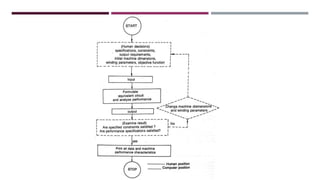
 The design analysis may be defined as the determination of performance of a
system from a knowledge of the relationships among the variables with the
system parameters defined initially remaining unchanged.
 In the case of calculated performance do not agree with the specifications,
the initial parameters are modified and the performance is recalculated.
 The analysis method of design is a very good starting point in the area of
computer aided design.
 It suits well with the beginner as it is fairly simple to make program.
SYNTHESIS METHOD
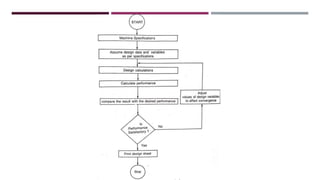
 In the synthesis method, the numerical techniques have to be resorted and
process of iteration may be used to find a solution.
 In this method, the desired performance characteristics are given as input to
the computer.
 The logical decisions required to modify the values of variables.
 Now for set of given performance characteristics several designs are possible
to work out. Therefore, it should be the designer’s aim to make such a
synthesis program to give out an optimum design.
 Once a synthesis program has been developed and fully worked out on a
computer, all incoming designs are nothing but routine computations largely
independent of designer’s interference and time.
Thank You

Computer aided design of electrical machine

  • 1.
  • 2.
    INTRODUCTION  Application ofScience, technology and invention to realization of machine.  Given Specification that a machine has to meet .  There are limitations arising because of inherent material properties.  Optimization is not simple for designing the electrical machines.  Establishment of functional relationship between the various machine constructional variables.  Evolution of a design to meet the given performance specification.
  • 3.
    ADVANTAGES OF COMPUTERAIDED DESIGN  Computer can perform the millions of computations in a few seconds.  CAD helps to study the effects of wide variations in the parameters of a system to obtain its optimum design.  CAD has yielded the solutions to a variety of design and operation problems.  CAD gives advantages of eliminating tedious and time consuming calculations.  Making the data checks at every stage facilitating trial designs preliminary to final design.  CAD permits the much more detailed and precise functional relations.  It gives the possibility of developing new and more comprehensive design procedures.
  • 4.
    METHODS OF APPROACHTO COMPUTER AIDED DESIGN In any practical design, the number of variables and number of constraints involved are very large and for these to be satisfied by the final design and lengthy iterative approach is required. The approaches with computer aided design to electrical machines are commonly presented into two ways as below  Analysis Method  Synthesis Method
  • 5.
    ANALYSIS METHOD  Thedesign analysis may be defined as the determination of performance of a system from a knowledge of the relationships among the variables with the system parameters defined initially remaining unchanged.  In the case of calculated performance do not agree with the specifications, the initial parameters are modified and the performance is recalculated.  The analysis method of design is a very good starting point in the area of computer aided design.  It suits well with the beginner as it is fairly simple to make program.
  • 7.
    SYNTHESIS METHOD  Inthe synthesis method, the numerical techniques have to be resorted and process of iteration may be used to find a solution.  In this method, the desired performance characteristics are given as input to the computer.  The logical decisions required to modify the values of variables.  Now for set of given performance characteristics several designs are possible to work out. Therefore, it should be the designer’s aim to make such a synthesis program to give out an optimum design.  Once a synthesis program has been developed and fully worked out on a computer, all incoming designs are nothing but routine computations largely independent of designer’s interference and time.
  • 9.