As the name suggest two words : Construction Planning & Construction 
Management ,which are co-related with each other. In common it meant that we 
have to execute the plan of construction by means of various management 
techniques. Our presentation is based upon the importance of modern 
technology in Construction Management, Construction Planning, 
Construction Equipment, Construction Contract, Safety Management, 
Earthquake management and also Universal Management with the 
fabricated system of Building Construction in Indian context which can be 
considered as important for the survival in the present scenario of civilization. 
As we know that with the tremendous development taking place in this 
modern period of Science and Technology, Management are of vital importance. 
Without Planning and Management we can’t complete the work of construction 
within our time and cost. So to move rapidly the work of development of World 
or particularly the developing nations like India, we have to participate in the 
modern work of construction with the foot step of planning and management by 
the help of modern technology.
 Completing the work within specified time and 
budget 
 Evolving a reputation for high quality workmanship 
 Providing safe working conditions for staff and 
workers 
 Taking sound decisions at lowest practical 
management level through delegation of authority 
 Motivating people to give their best 
 Creating an organization that works as a team
Deciding in advance what is to be done, how and in what 
order it is to be done. It involves : 
 Crystallizing objectives 
 Collecting and synthesizing information 
 Developing alternatives within specified constraints 
 Comparing alternatives in terms of objective feasibility and 
consequences 
 Selecting optimum course of action 
 Establishing policies, methods, systems, standards and 
budgets for objectives
 Dividing the work into component activities 
 Designing job structures 
 Defining targets and responsibilities 
 Allocating resources 
 Delegating specific tasks to individuals 
 Establishing organizational chart for better 
coordination
 Bringing together and coordinating the work of 
various departments 
 Arranging regular meeting of departments
 Providing right quality resources at right time 
 Preparing resource procurement schedules 
 Developing specifications for required resources 
 Deciding appropriate source of procurement 
 Budgeting resources and arranging approvals and 
purchases 
 Preventing wastage at site
 Providing effective leadership 
 Motivating participants behavior 
 Communicating instructions and orders 
 Providing suitable climate for subordinate’s 
development
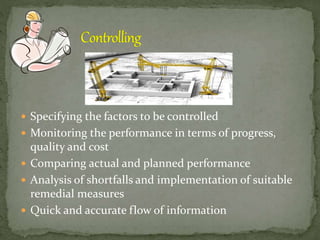
 Specifying the factors to be controlled 
 Monitoring the performance in terms of progress, 
quality and cost 
 Comparing actual and planned performance 
 Analysis of shortfalls and implementation of suitable 
remedial measures 
 Quick and accurate flow of information
Men Material Machinery Money 
Power Water Space 
Communication 
means
 Work force – man power 
 Technical and managerial personnel ( organization)
 Work force is Skilled and unskilled labor. 
 Timely employment of just required numbers of 
workmen of right trade and skill. 
 Over-manning and under-manning both are bad. 
 Sudden fluctuations in labor strength should be 
avoided. 
 Describe work elements.
 Assess no. of workdays to be put every week/month. 
 Draw a chart of manpower needed using CPM 
network. 
 Adjust schedule and requirement avoiding sudden 
fluctuations. 
 Ascertain availability of right trade and skill for 
recruitment. 
 Maintain a reasonable ratio between supervisor and 
workmen.
A social arrangement which pursues collective goals, 
which controls its own performance.
 Give responsibilities to the group of employee. 
 Provides adequate communication. 
 Demarcates authority, responsibilities, and duties of 
each group and employee. 
 Coordinates and controls activities of group and 
individual to achieve common objective.
 Brick, stone, timber, cement, water, aggregate, paint, 
electrical fittings, lime, sand etc. 
 Material schedule showing quantity, quality and time 
of delivery should be prepared with reference to work 
schedule 
 Plan the adequate supply of material.
 Requirements depends on type of project. 
 Batching plant, mixer, trucks, vibrator, tractors, 
excavators and cranes etc. 
 Equipment schedule or calendar should be prepared. 
 Equipments can be transferred from one site to another 
or can be purchased new depending on economic 
analysis. 
 Non-availability of right equipment or tool may lead to 
financial loss or can hold up the work.
 Most important resource 
 All other resources depends on availability of funds. 
 So financial resources should be planned very carefully.
CONSTRUCTIONS 
PARTICIPANTS
There are five main agencies actively associated with 
the execution of major works. These are:- 
Business 
promoter/Client 
Construction 
management 
consultants 
Architect- 
Engineering 
Associates 
Contractors 
Input suppliers
Also called the client, he is the potential owner of the 
construction facility. It is he who sponsors the work, 
finances their construction and utilizes the facility 
constructed. Client may be a govt. body, a public or 
private enterprises. Construction work can be executed 
through clients own organization or through 
contractors
The emerging trend these days is to hire these 
consultants for rendering certain services on contract 
basis. Generally task assigned includes – 
(a) Project feasibility study, including cost estimates. 
(b) Site survey and soil investigation.
(c) Estimating, initial planning and budgeting 
(d) Scrutiny and coordination of design and 
drawing work . 
(e) Processing prequalification of construction 
agencies, tendering and awarding contracts 
to the successful bidder. 
(f)Designing project organization for executing works and 
developing standard operating procedures and systems. 
(g)Developing detailed construction plans, project schedules 
and performance measuring standards. 
(h)Supervising works, including administration of contract 
and controlling of project time, cost and quality objectives.
 An architect is an individual who designs the buildings, 
landscapes and other artistic features. The engineers 
associated with architects develop structural, electrical, 
mechanical and other specialist systems and designs. 
Architect-engineering associates are the firm involving 
both architects as well as engineers to provide complete 
design services under one roof.
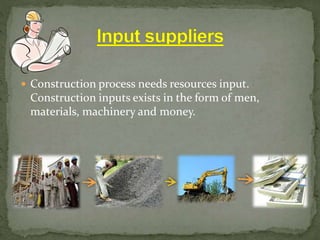
 Construction process needs resources input. 
Construction inputs exists in the form of men, 
materials, machinery and money.
Construction contractors form the backbone of the 
construction business as they execute most of the 
construction work. In the competitive construction 
business, the contractor generally tends to specialize 
in particular area of construction.
 General contractors 
 Building contractors 
 Specialist contractors for various types of heavy 
infrastructure construction work like highways, bridges, 
dams etc. 
 Specialist contractors for various categories of industrial 
works like power plants, process industries, etc. 
 Specialist utility services contractors. These include 
electrical contractors, water supply and sewage disposal 
contractors, HVAC( heating, ventilation and air-conditioning) 
contractors.
Finally after discussing the various aspects of 
“The importance of Construction Planning & 
Management ”, we conclude that these are the 
very essential functions and part of any 
constructional project to get finished within 
time with estimated cost .So we should save 
our input and money with the proper 
planning and smart management skills.
Vishal Kumar 
Manit Agarwal 
Sandeep Kumar 
Brajesh Kumar 
Shashi Shekhar 
Dep Prakash Kumar 
Md. Razwanul Haque 
Wasim Akram 
16301310012 
16301310018 
16301310033 
16301310011 
16301310023 
16301310001 
16301310017 
16301310019 
Name of Participants 
Univ. Roll no.

Construction planning & management

  • 2.
    As the namesuggest two words : Construction Planning & Construction Management ,which are co-related with each other. In common it meant that we have to execute the plan of construction by means of various management techniques. Our presentation is based upon the importance of modern technology in Construction Management, Construction Planning, Construction Equipment, Construction Contract, Safety Management, Earthquake management and also Universal Management with the fabricated system of Building Construction in Indian context which can be considered as important for the survival in the present scenario of civilization. As we know that with the tremendous development taking place in this modern period of Science and Technology, Management are of vital importance. Without Planning and Management we can’t complete the work of construction within our time and cost. So to move rapidly the work of development of World or particularly the developing nations like India, we have to participate in the modern work of construction with the foot step of planning and management by the help of modern technology.
  • 3.
     Completing thework within specified time and budget  Evolving a reputation for high quality workmanship  Providing safe working conditions for staff and workers  Taking sound decisions at lowest practical management level through delegation of authority  Motivating people to give their best  Creating an organization that works as a team
  • 4.
    Deciding in advancewhat is to be done, how and in what order it is to be done. It involves :  Crystallizing objectives  Collecting and synthesizing information  Developing alternatives within specified constraints  Comparing alternatives in terms of objective feasibility and consequences  Selecting optimum course of action  Establishing policies, methods, systems, standards and budgets for objectives
  • 5.
     Dividing thework into component activities  Designing job structures  Defining targets and responsibilities  Allocating resources  Delegating specific tasks to individuals  Establishing organizational chart for better coordination
  • 6.
     Bringing togetherand coordinating the work of various departments  Arranging regular meeting of departments
  • 7.
     Providing rightquality resources at right time  Preparing resource procurement schedules  Developing specifications for required resources  Deciding appropriate source of procurement  Budgeting resources and arranging approvals and purchases  Preventing wastage at site
  • 8.
     Providing effectiveleadership  Motivating participants behavior  Communicating instructions and orders  Providing suitable climate for subordinate’s development
  • 9.
     Specifying thefactors to be controlled  Monitoring the performance in terms of progress, quality and cost  Comparing actual and planned performance  Analysis of shortfalls and implementation of suitable remedial measures  Quick and accurate flow of information
  • 10.
    Men Material MachineryMoney Power Water Space Communication means
  • 11.
     Work force– man power  Technical and managerial personnel ( organization)
  • 12.
     Work forceis Skilled and unskilled labor.  Timely employment of just required numbers of workmen of right trade and skill.  Over-manning and under-manning both are bad.  Sudden fluctuations in labor strength should be avoided.  Describe work elements.
  • 13.
     Assess no.of workdays to be put every week/month.  Draw a chart of manpower needed using CPM network.  Adjust schedule and requirement avoiding sudden fluctuations.  Ascertain availability of right trade and skill for recruitment.  Maintain a reasonable ratio between supervisor and workmen.
  • 14.
    A social arrangementwhich pursues collective goals, which controls its own performance.
  • 15.
     Give responsibilitiesto the group of employee.  Provides adequate communication.  Demarcates authority, responsibilities, and duties of each group and employee.  Coordinates and controls activities of group and individual to achieve common objective.
  • 16.
     Brick, stone,timber, cement, water, aggregate, paint, electrical fittings, lime, sand etc.  Material schedule showing quantity, quality and time of delivery should be prepared with reference to work schedule  Plan the adequate supply of material.
  • 17.
     Requirements dependson type of project.  Batching plant, mixer, trucks, vibrator, tractors, excavators and cranes etc.  Equipment schedule or calendar should be prepared.  Equipments can be transferred from one site to another or can be purchased new depending on economic analysis.  Non-availability of right equipment or tool may lead to financial loss or can hold up the work.
  • 18.
     Most importantresource  All other resources depends on availability of funds.  So financial resources should be planned very carefully.
  • 19.
  • 20.
    There are fivemain agencies actively associated with the execution of major works. These are:- Business promoter/Client Construction management consultants Architect- Engineering Associates Contractors Input suppliers
  • 21.
    Also called theclient, he is the potential owner of the construction facility. It is he who sponsors the work, finances their construction and utilizes the facility constructed. Client may be a govt. body, a public or private enterprises. Construction work can be executed through clients own organization or through contractors
  • 22.
    The emerging trendthese days is to hire these consultants for rendering certain services on contract basis. Generally task assigned includes – (a) Project feasibility study, including cost estimates. (b) Site survey and soil investigation.
  • 23.
    (c) Estimating, initialplanning and budgeting (d) Scrutiny and coordination of design and drawing work . (e) Processing prequalification of construction agencies, tendering and awarding contracts to the successful bidder. (f)Designing project organization for executing works and developing standard operating procedures and systems. (g)Developing detailed construction plans, project schedules and performance measuring standards. (h)Supervising works, including administration of contract and controlling of project time, cost and quality objectives.
  • 24.
     An architectis an individual who designs the buildings, landscapes and other artistic features. The engineers associated with architects develop structural, electrical, mechanical and other specialist systems and designs. Architect-engineering associates are the firm involving both architects as well as engineers to provide complete design services under one roof.
  • 25.
     Construction processneeds resources input. Construction inputs exists in the form of men, materials, machinery and money.
  • 26.
    Construction contractors formthe backbone of the construction business as they execute most of the construction work. In the competitive construction business, the contractor generally tends to specialize in particular area of construction.
  • 27.
     General contractors  Building contractors  Specialist contractors for various types of heavy infrastructure construction work like highways, bridges, dams etc.  Specialist contractors for various categories of industrial works like power plants, process industries, etc.  Specialist utility services contractors. These include electrical contractors, water supply and sewage disposal contractors, HVAC( heating, ventilation and air-conditioning) contractors.
  • 28.
    Finally after discussingthe various aspects of “The importance of Construction Planning & Management ”, we conclude that these are the very essential functions and part of any constructional project to get finished within time with estimated cost .So we should save our input and money with the proper planning and smart management skills.
  • 30.
    Vishal Kumar ManitAgarwal Sandeep Kumar Brajesh Kumar Shashi Shekhar Dep Prakash Kumar Md. Razwanul Haque Wasim Akram 16301310012 16301310018 16301310033 16301310011 16301310023 16301310001 16301310017 16301310019 Name of Participants Univ. Roll no.