Introduction to Wireless
Communications and
Networks
Components of a Communication
System (1)
Components of a Communication
System (2)
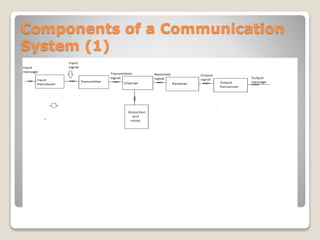
􀂄The source originates a message, which could be a human
voice, a television picture or data. The source is converted by
an input transducer into an electrical waveform referred to
as the baseband signal or message signal.
􀂄The transmitter modifies the baseband signal for efficient
transmission. The transmitter generally consists of one or
more of the following subsystems: a pre-emphasizer, a
sampler, a quantizer, a coder and a modulator.
􀂄The channel is a medium through which the transmitter
output is sent, which could be a wire, a coaxial cable, an
optical fiber, or a radio link, etc.
Based on the channel type, modern communication systems
are divided into two categories:
*1 wire line communication systems.
*2 wireless communication systems.
Components of a Communication
System (3)
􀂄The receiver reprocessed the signal received from the
channel .
The receiver may consist of a demodulator, a decoder, a
filter, and a de-emphasizer.
􀂄The receiver output is fed to the output transducer, which
converts the electrical signal to its original form.
􀂄Transmitters and receivers are carefully designed to overcome the
distortion and noise.
The Goal of Physical layer Communication System is to transmit
information accurately and efficiently.
Examples of Wireless
Communication Systems
􀂄Cellular telephone systems ---provide a wireless connection to the
PSTN for any user location within the radio range.
􀂄Remote controllers for home entertainment equipment
􀂄Hand-held walkie-talkies
􀂄Wireless keyboard and mouse
􀂄Wireless Lan router and adapter
PSTN=Public Switched Telephone Network
Wireless Vs. Wireline
Communications
􀂄Wireless channel
􀂄Have time varying and multipath propagation properties.
􀂄Communicate over a medium significantly less reliable than wire
line communication
MUI is a significant problem in wireless communication
*MUI=Multiuser Interference*
Trends on Wireless
Communications
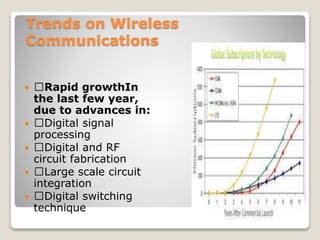
 􀂄Rapid growthIn
the last few year,
due to advances in:
 􀂄Digital signal
processing
 􀂄Digital and RF
circuit fabrication
 􀂄Large scale circuit
integration
 􀂄Digital switching
technique
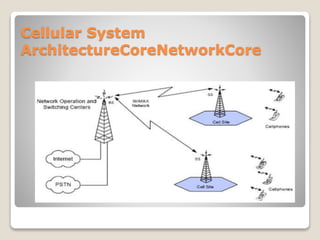
Cellular System
ArchitectureCoreNetworkCore
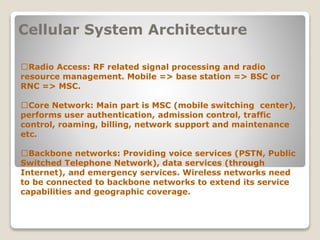
Cellular System Architecture
􀂄Radio Access: RF related signal processing and radio
resource management. Mobile => base station => BSC or
RNC => MSC.
􀂄Core Network: Main part is MSC (mobile switching center),
performs user authentication, admission control, traffic
control, roaming, billing, network support and maintenance
etc.
􀂄Backbone networks: Providing voice services (PSTN, Public
Switched Telephone Network), data services (through
Internet), and emergency services. Wireless networks need
to be connected to backbone networks to extend its service
capabilities and geographic coverage.
How a cellular telephone call is
made?
􀂄Receiving a call
􀂄Turn on a cellular phone.
􀂄The base station informs the MSC of the handshake.
􀂄The MSC instructs the base station to move the call to an
unused voice channel within the cell.
􀂄The base station signals the mobile to change frequencies to
the unused forward and reverse voice channel pair.
􀂄The base station instructs the mobile phone to ring, thereby to
instruct the user to answer the phone.
How a cellular phone call is made
(continued)
􀂄Initiating a call
􀂄The mobile sends a call initiation request through the reverse
control channel, with this the unit transmits its MIN.
􀂄Base station receives the request and sends it to the MSC.
􀂄Roaming
􀂄All cellular systems provide a service called roaming.
􀂄Mobiles report back upon receiving the request.
1G Wireless Systems
􀂄Appeared in late 1970s and deployed in early 1980s.
􀂄All based on analog techniques, all used FDMA and FM
modulation.
􀂄System capacity is low. Data rate: 8~10 kbps
􀂄Representative Standards:
􀂄AMPS: Advanced Mobile Phone System, developed by AT&T
Bell Labs in late 1970s. First deployed in 1983. The first
AMPS system used large cells and omni-directional base
station antennas, therefore, the number of users that can be
supported was quite limited. AMPS is used all over the world
and is esp. popular in US, South America, China and
Australia.
􀂄ETACS: European Total Access Communication Systems.
Almost identical to AMPS except that the channel bandwidth
is scaled to25kHz instead of 30 kHz as in AMPS.
2G Wireless Systems:
􀂄Deployed in mid 1990s, 2G wireless systems all use digital voice
coding and digital modulation.
􀂄Can provide advanced call capabilities and at least a 3-times
increase in overall system capacity.
􀂄Was designed before the widespread of the Internet, mainly
supported voice-centric services and limited date-service, like short
messages, FAX,etc.
􀂄Date rate: on the order of 10 kbps
2G Wireless Systems:
Representative Standards
􀂄GSM (Global Systems for Mobile communications)
􀂄A TDMA system, Support 24.7kbpsdata rate.
􀂄USDC IS-136 (United States Digital Cellular)
􀂄A TDMA system, supports short messages. Support 48.6kbpsdata
rate.
􀂄IS-95 (United States Digital Cellular Standard )
􀂄A CDMA standard ,Support 14.4kbpsdata rate.
3G Wireless Systems: Features
􀂄Features:
􀂄High transmission rate and the support of multimedia
services.
􀂄Date rate: around 2Mbps. Bandwidth: in the order of MHZ
􀂄3GPP and 3GPP2
􀂄3GPP: based on backward compatibility to GSM, IS-136, GPRS,
EDGE etc.
􀂄3GPP2: based on backward compatibility to IS-95, and CDMAone.
Wireless Local Area Networks
(WLANs) and Personal Area
Networks (PANs, Bluetooth)
􀂄WLANs and PANs, provide broadband telecommunications accessin the
local exchange, driven by demand for broadband Internet access from
business and homes due to the rapid growth of the Internet.
􀂄Provide high speed, high performance wireless connections between
computers and the wireless access points, between laptops, between
laptops and printers, scanners, video cameras and other electronics in
local area or at home. => Replace the cumbersome cords that connect
devices to one another.
􀂄Operate at low power and license free spectrum,
􀂄North America: IEEE 802.11x series, example: Wi-Fi.
􀂄Europe: HIPERLAN/2
􀂄Both IEEE 802.11a and HIPERLAN/2 support up to 54Mbps.
􀂄Use spread spectrum and OFDM technologies
􀂄Bluetooth: provides convenient and flexible low power short range
wireless connections in personal area networks. First a manufacture,
then extended to an open standard.
Mobile Ad-Hoc Networks
􀂄Ad-Hoc networks are in frast ructureless and have no fixed
routers. Each node (mobile) in the ad-hoc network can set up
as and play the role of a base station in that it can transmit
to and receive from other nodes in the network.
􀂄A node in an ad-hoc network to other nodes if they are within
line-of-sight.
􀂄Non-line-of-sight-nodes are called hidden nodes. Communication
between a pair of hidden nodes needs to hop over one or more
intermediate nodes, in this sense, it is called multi hop networks.
􀂄A system with a fixed infrastructure is basically a two-hop system.
􀂄Ad-hoc networks are highly dynamic and are generally used for
military services.
Conceptual Layers in a Wireless
Network
􀂄Physical layer---involves the actual signal transmission and
reception over the propagation channel.
􀂄Data link Link layer---deals with signal at the output of the
base station receiver, performs radio resource management,
power control, rate allocation, call admission, error control
etc.
􀂄Networks layer: a protocol stack that includes handoff
management, location management, traffic management and
traffic control.
􀂄Application layer: communicating, distributed processes
running in end systems (hosts), e.g., e-mail, Web, P2P file
sharing, instant messaging
THANK YOU

INTRODUCTION TO WIRELESS COMMUNICATION

  • 1.
  • 2.
    Components of aCommunication System (1)
  • 3.
    Components of aCommunication System (2) 􀂄The source originates a message, which could be a human voice, a television picture or data. The source is converted by an input transducer into an electrical waveform referred to as the baseband signal or message signal. 􀂄The transmitter modifies the baseband signal for efficient transmission. The transmitter generally consists of one or more of the following subsystems: a pre-emphasizer, a sampler, a quantizer, a coder and a modulator. 􀂄The channel is a medium through which the transmitter output is sent, which could be a wire, a coaxial cable, an optical fiber, or a radio link, etc. Based on the channel type, modern communication systems are divided into two categories: *1 wire line communication systems. *2 wireless communication systems.
  • 4.
    Components of aCommunication System (3) 􀂄The receiver reprocessed the signal received from the channel . The receiver may consist of a demodulator, a decoder, a filter, and a de-emphasizer. 􀂄The receiver output is fed to the output transducer, which converts the electrical signal to its original form. 􀂄Transmitters and receivers are carefully designed to overcome the distortion and noise. The Goal of Physical layer Communication System is to transmit information accurately and efficiently.
  • 5.
    Examples of Wireless CommunicationSystems 􀂄Cellular telephone systems ---provide a wireless connection to the PSTN for any user location within the radio range. 􀂄Remote controllers for home entertainment equipment 􀂄Hand-held walkie-talkies 􀂄Wireless keyboard and mouse 􀂄Wireless Lan router and adapter PSTN=Public Switched Telephone Network
  • 6.
    Wireless Vs. Wireline Communications 􀂄Wirelesschannel 􀂄Have time varying and multipath propagation properties. 􀂄Communicate over a medium significantly less reliable than wire line communication MUI is a significant problem in wireless communication *MUI=Multiuser Interference*
  • 7.
    Trends on Wireless Communications 􀂄Rapid growthIn the last few year, due to advances in:  􀂄Digital signal processing  􀂄Digital and RF circuit fabrication  􀂄Large scale circuit integration  􀂄Digital switching technique
  • 8.
  • 9.
    Cellular System Architecture 􀂄RadioAccess: RF related signal processing and radio resource management. Mobile => base station => BSC or RNC => MSC. 􀂄Core Network: Main part is MSC (mobile switching center), performs user authentication, admission control, traffic control, roaming, billing, network support and maintenance etc. 􀂄Backbone networks: Providing voice services (PSTN, Public Switched Telephone Network), data services (through Internet), and emergency services. Wireless networks need to be connected to backbone networks to extend its service capabilities and geographic coverage.
  • 10.
    How a cellulartelephone call is made? 􀂄Receiving a call 􀂄Turn on a cellular phone. 􀂄The base station informs the MSC of the handshake. 􀂄The MSC instructs the base station to move the call to an unused voice channel within the cell. 􀂄The base station signals the mobile to change frequencies to the unused forward and reverse voice channel pair. 􀂄The base station instructs the mobile phone to ring, thereby to instruct the user to answer the phone.
  • 11.
    How a cellularphone call is made (continued) 􀂄Initiating a call 􀂄The mobile sends a call initiation request through the reverse control channel, with this the unit transmits its MIN. 􀂄Base station receives the request and sends it to the MSC. 􀂄Roaming 􀂄All cellular systems provide a service called roaming. 􀂄Mobiles report back upon receiving the request.
  • 12.
    1G Wireless Systems 􀂄Appearedin late 1970s and deployed in early 1980s. 􀂄All based on analog techniques, all used FDMA and FM modulation. 􀂄System capacity is low. Data rate: 8~10 kbps 􀂄Representative Standards: 􀂄AMPS: Advanced Mobile Phone System, developed by AT&T Bell Labs in late 1970s. First deployed in 1983. The first AMPS system used large cells and omni-directional base station antennas, therefore, the number of users that can be supported was quite limited. AMPS is used all over the world and is esp. popular in US, South America, China and Australia. 􀂄ETACS: European Total Access Communication Systems. Almost identical to AMPS except that the channel bandwidth is scaled to25kHz instead of 30 kHz as in AMPS.
  • 13.
    2G Wireless Systems: 􀂄Deployedin mid 1990s, 2G wireless systems all use digital voice coding and digital modulation. 􀂄Can provide advanced call capabilities and at least a 3-times increase in overall system capacity. 􀂄Was designed before the widespread of the Internet, mainly supported voice-centric services and limited date-service, like short messages, FAX,etc. 􀂄Date rate: on the order of 10 kbps
  • 14.
    2G Wireless Systems: RepresentativeStandards 􀂄GSM (Global Systems for Mobile communications) 􀂄A TDMA system, Support 24.7kbpsdata rate. 􀂄USDC IS-136 (United States Digital Cellular) 􀂄A TDMA system, supports short messages. Support 48.6kbpsdata rate. 􀂄IS-95 (United States Digital Cellular Standard ) 􀂄A CDMA standard ,Support 14.4kbpsdata rate.
  • 15.
    3G Wireless Systems:Features 􀂄Features: 􀂄High transmission rate and the support of multimedia services. 􀂄Date rate: around 2Mbps. Bandwidth: in the order of MHZ 􀂄3GPP and 3GPP2 􀂄3GPP: based on backward compatibility to GSM, IS-136, GPRS, EDGE etc. 􀂄3GPP2: based on backward compatibility to IS-95, and CDMAone.
  • 16.
    Wireless Local AreaNetworks (WLANs) and Personal Area Networks (PANs, Bluetooth) 􀂄WLANs and PANs, provide broadband telecommunications accessin the local exchange, driven by demand for broadband Internet access from business and homes due to the rapid growth of the Internet. 􀂄Provide high speed, high performance wireless connections between computers and the wireless access points, between laptops, between laptops and printers, scanners, video cameras and other electronics in local area or at home. => Replace the cumbersome cords that connect devices to one another. 􀂄Operate at low power and license free spectrum, 􀂄North America: IEEE 802.11x series, example: Wi-Fi. 􀂄Europe: HIPERLAN/2 􀂄Both IEEE 802.11a and HIPERLAN/2 support up to 54Mbps. 􀂄Use spread spectrum and OFDM technologies 􀂄Bluetooth: provides convenient and flexible low power short range wireless connections in personal area networks. First a manufacture, then extended to an open standard.
  • 17.
    Mobile Ad-Hoc Networks 􀂄Ad-Hocnetworks are in frast ructureless and have no fixed routers. Each node (mobile) in the ad-hoc network can set up as and play the role of a base station in that it can transmit to and receive from other nodes in the network. 􀂄A node in an ad-hoc network to other nodes if they are within line-of-sight. 􀂄Non-line-of-sight-nodes are called hidden nodes. Communication between a pair of hidden nodes needs to hop over one or more intermediate nodes, in this sense, it is called multi hop networks. 􀂄A system with a fixed infrastructure is basically a two-hop system. 􀂄Ad-hoc networks are highly dynamic and are generally used for military services.
  • 18.
    Conceptual Layers ina Wireless Network 􀂄Physical layer---involves the actual signal transmission and reception over the propagation channel. 􀂄Data link Link layer---deals with signal at the output of the base station receiver, performs radio resource management, power control, rate allocation, call admission, error control etc. 􀂄Networks layer: a protocol stack that includes handoff management, location management, traffic management and traffic control. 􀂄Application layer: communicating, distributed processes running in end systems (hosts), e.g., e-mail, Web, P2P file sharing, instant messaging
  • 19.