
C H A N G E T H E W O R L D
Presented by : Aman Dutt
Mamta
Rahul Yadav
CONTENTW h a t I s B l u e t o o t h ?
H i s t o r y O f B l u e t o o t h ?
N a m e O f B l u e t o o t h ?
H o w W o r l d A c c o r d i n g T o B l u e t o o t h ?
W h i c h P r o d u c t U s e B l u e t o o t h W i r e l e s s T e c h n o l o g y ( B w t ) ?
B l u e t o o t h N e t w o r k A r r a n g e m e n t ?
H o w B l u e t o o t h W i r e l e s s T e c h n o l o g y W o r k s ?
W h i c h M o d e l U s e d B l u e t o o t h W i r e l e s s T e c h n o l o g y ?
B l u e t o o t h S e c u r i t y ?
A d v a n t a g e s O f B l u e t o o t h T e c h n o l o g y ?
D i s a d v a n t a g e s O f B l u e t o o t h T e c h n o l o g y ?
F u t u r e O f B l u e t o o t h T e c h n o l o g y ?
BLUETOOTH
What is Bluetooth?
Bluetooth is a wireless, automatic connection
that is aimed at simplifying and communicating
in the internet and data synchronization
facilitating cable replacement technology.
It works on a universal medium to bridge the
data networks, peripheral interfaces to form a
short range digital unlicensed radio frequency
of 2.4GHz in a wide range of 10mts.
Bluetooth
History
Began as a private development effort at Ericsson in
1994.
The project became successful in spring 1998, the
companies-ERICSSON,TOSHIBA, INTEL, IBM and
NOKIA founded the Bluetooth consortium with the
goal of development of a single-chip, low cost, radio-
based wireless network technology.
First specification released in July 1999.
Bluetooth
 Name comes from the
10th century
 Danish King Herald
Bluetooth (A.D 940–985)
Name
BLUETOOTH 6
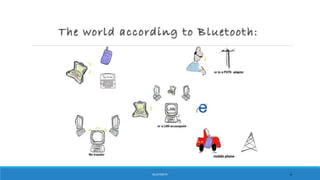
The world according to Bluetooth:
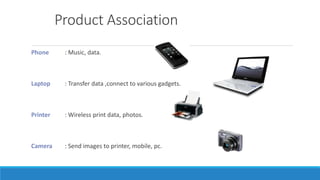
Product Association
Phone : Music, data.
Laptop : Transfer data ,connect to various gadgets.
Printer : Wireless print data, photos.
Camera : Send images to printer, mobile, pc.
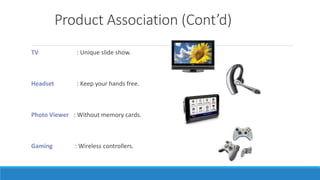
Product Association (Cont’d)
TV : Unique slide show.
Headset : Keep your hands free.
Photo Viewer : Without memory cards.
Gaming : Wireless controllers.
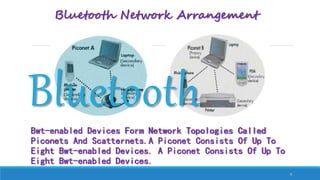
Bluetooth Network Arrangement
9
Bwt-enabled Devices Form Network Topologies Called
Piconets And Scatternets.A Piconet Consists Of Up To
Eight Bwt-enabled Devices. A Piconet Consists Of Up To
Eight Bwt-enabled Devices.
Bluetooth
BWT-enabled devices operate in the unrestricted 2.4-gigahertz (GHz) Industrial,
Science, Medical (ISM) band. The ISM band ranges between 2.400 GHz and 2.483
GHz.
BWT-enabled devices use a technique called frequency hopping to minimize
eavesdropping and interference from other networks that use the ISM band. With
frequency hopping, the data is divided into small pieces called packets. The
transmitter and receiver exchange a data packet at one frequency, and then they
hope to another frequency to exchange another packet. They repeat this process
until all the data is transmitted.
There are three classes of BWT radio devices, each with a different maximum range:
 Class 1 (100 m)
 Class 2 (50 m)
 Class 3 (10 m)
HOW BLUETOOTH WIRELESS TECHNOLOGY WORKS
Bluetooth
Models used in BWT
11
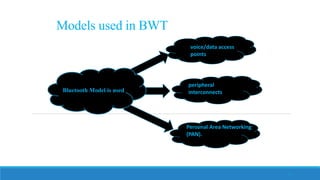
Bluetooth Model is used
voice/data access
points
peripheral
interconnects
Personal Area Networking
(PAN).
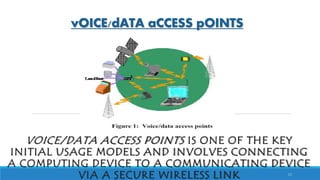
vOICE/dATA aCCESS pOINTS
VOICE/DATA ACCESS POINTS IS ONE OF THE KEY
INITIAL USAGE MODELS AND INVOLVES CONNECTING
A COMPUTING DEVICE TO A COMMUNICATING DEVICE
VIA A SECURE WIRELESS LINK 12
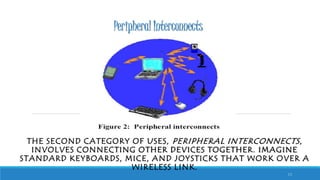
Peripheral Interconnects
THE SECOND CATEGORY OF USES, PERIPHERAL INTERCONNECTS,
INVOLVES CONNECTING OTHER DEVICES TOGETHER. IMAGINE
STANDARD KEYBOARDS, MICE, AND JOYSTICKS THAT WORK OVER A
WIRELESS LINK.
13
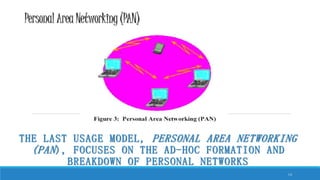
Personal Area Networking (PAN)
THE LAST USAGE MODEL, PERSONAL AREA NETWORKING
(PAN), FOCUSES ON THE AD-HOC FORMATION AND
BREAKDOWN OF PERSONAL NETWORKS
14
8 April, 2011
15
SECURITY
Security Measure
◦ Link Level Encryption & Authentication.
◦ Personal Identification Numbers (PIN) for device
access.
◦ Long encryption keys are used (128 bit keys).
◦ These keys are not transmitted over wireless. Other
parameters are transmitted over wireless which in
combination with certain information known to the
device, can generate the keys.
◦ Further encryption can be done at the application
layer.
Bluetooth: Advantages
1. Bluetooth Devices are Wireless
2. Bluetooth Technology is Inexpensive
3. Multiple Product Association.
4. Low Energy Consumption
5. Bluetooth is Automatic.
Bluetooth: Disadvantages
1. One device at a Time
2. Low Data Transfer Rate
3. Security Threats
◦ Bluejacking
◦ Bluesnarfing
◦ Bluebugging
Bluetooth Is Everywhere
Success of Bluetooth depends on how well it is integrated into
consumer products
Consumers are more interested in applications than the technology
Bluetooth must be successfully integrated into consumer products
Must provide benefits for consumer
Must not destroy current product benefits
Key Success Factors
Interoperability
Mass Production at Low Cost
Ease of Use
End User Experience
Future of Bluetooth
Thankyou

Bluetooth Wireless Technology

  • 1.
    C H AN G E T H E W O R L D Presented by : Aman Dutt Mamta Rahul Yadav
  • 2.
    CONTENTW h at I s B l u e t o o t h ? H i s t o r y O f B l u e t o o t h ? N a m e O f B l u e t o o t h ? H o w W o r l d A c c o r d i n g T o B l u e t o o t h ? W h i c h P r o d u c t U s e B l u e t o o t h W i r e l e s s T e c h n o l o g y ( B w t ) ? B l u e t o o t h N e t w o r k A r r a n g e m e n t ? H o w B l u e t o o t h W i r e l e s s T e c h n o l o g y W o r k s ? W h i c h M o d e l U s e d B l u e t o o t h W i r e l e s s T e c h n o l o g y ? B l u e t o o t h S e c u r i t y ? A d v a n t a g e s O f B l u e t o o t h T e c h n o l o g y ? D i s a d v a n t a g e s O f B l u e t o o t h T e c h n o l o g y ? F u t u r e O f B l u e t o o t h T e c h n o l o g y ?
  • 3.
    BLUETOOTH What is Bluetooth? Bluetoothis a wireless, automatic connection that is aimed at simplifying and communicating in the internet and data synchronization facilitating cable replacement technology. It works on a universal medium to bridge the data networks, peripheral interfaces to form a short range digital unlicensed radio frequency of 2.4GHz in a wide range of 10mts.
  • 4.
    Bluetooth History Began as aprivate development effort at Ericsson in 1994. The project became successful in spring 1998, the companies-ERICSSON,TOSHIBA, INTEL, IBM and NOKIA founded the Bluetooth consortium with the goal of development of a single-chip, low cost, radio- based wireless network technology. First specification released in July 1999.
  • 5.
    Bluetooth  Name comesfrom the 10th century  Danish King Herald Bluetooth (A.D 940–985) Name
  • 6.
    BLUETOOTH 6 The worldaccording to Bluetooth:
  • 7.
    Product Association Phone :Music, data. Laptop : Transfer data ,connect to various gadgets. Printer : Wireless print data, photos. Camera : Send images to printer, mobile, pc.
  • 8.
    Product Association (Cont’d) TV: Unique slide show. Headset : Keep your hands free. Photo Viewer : Without memory cards. Gaming : Wireless controllers.
  • 9.
    Bluetooth Network Arrangement 9 Bwt-enabledDevices Form Network Topologies Called Piconets And Scatternets.A Piconet Consists Of Up To Eight Bwt-enabled Devices. A Piconet Consists Of Up To Eight Bwt-enabled Devices. Bluetooth
  • 10.
    BWT-enabled devices operatein the unrestricted 2.4-gigahertz (GHz) Industrial, Science, Medical (ISM) band. The ISM band ranges between 2.400 GHz and 2.483 GHz. BWT-enabled devices use a technique called frequency hopping to minimize eavesdropping and interference from other networks that use the ISM band. With frequency hopping, the data is divided into small pieces called packets. The transmitter and receiver exchange a data packet at one frequency, and then they hope to another frequency to exchange another packet. They repeat this process until all the data is transmitted. There are three classes of BWT radio devices, each with a different maximum range:  Class 1 (100 m)  Class 2 (50 m)  Class 3 (10 m) HOW BLUETOOTH WIRELESS TECHNOLOGY WORKS Bluetooth
  • 11.
    Models used inBWT 11 Bluetooth Model is used voice/data access points peripheral interconnects Personal Area Networking (PAN).
  • 12.
    vOICE/dATA aCCESS pOINTS VOICE/DATAACCESS POINTS IS ONE OF THE KEY INITIAL USAGE MODELS AND INVOLVES CONNECTING A COMPUTING DEVICE TO A COMMUNICATING DEVICE VIA A SECURE WIRELESS LINK 12
  • 13.
    Peripheral Interconnects THE SECONDCATEGORY OF USES, PERIPHERAL INTERCONNECTS, INVOLVES CONNECTING OTHER DEVICES TOGETHER. IMAGINE STANDARD KEYBOARDS, MICE, AND JOYSTICKS THAT WORK OVER A WIRELESS LINK. 13
  • 14.
    Personal Area Networking(PAN) THE LAST USAGE MODEL, PERSONAL AREA NETWORKING (PAN), FOCUSES ON THE AD-HOC FORMATION AND BREAKDOWN OF PERSONAL NETWORKS 14
  • 15.
    8 April, 2011 15 SECURITY SecurityMeasure ◦ Link Level Encryption & Authentication. ◦ Personal Identification Numbers (PIN) for device access. ◦ Long encryption keys are used (128 bit keys). ◦ These keys are not transmitted over wireless. Other parameters are transmitted over wireless which in combination with certain information known to the device, can generate the keys. ◦ Further encryption can be done at the application layer.
  • 16.
    Bluetooth: Advantages 1. BluetoothDevices are Wireless 2. Bluetooth Technology is Inexpensive 3. Multiple Product Association. 4. Low Energy Consumption 5. Bluetooth is Automatic.
  • 17.
    Bluetooth: Disadvantages 1. Onedevice at a Time 2. Low Data Transfer Rate 3. Security Threats ◦ Bluejacking ◦ Bluesnarfing ◦ Bluebugging
  • 18.
  • 19.
    Success of Bluetoothdepends on how well it is integrated into consumer products Consumers are more interested in applications than the technology Bluetooth must be successfully integrated into consumer products Must provide benefits for consumer Must not destroy current product benefits Key Success Factors Interoperability Mass Production at Low Cost Ease of Use End User Experience Future of Bluetooth
  • 20.