‫االلكتروني‬ ‫المحاضرات‬ ‫نظام‬
Mobile Communications
Prepared for
Dijlah University College
Department of Computer Techniques Engineering
2015 – 2016
Lecture 1 – Introduction to
wireless communications
Dr. Eng. Hussein Jamaluddin Khaleel
Email: hussein.khaleel@duc.edu.iq
http://www.duc.edu.iq/
‫االلكتروني‬ ‫المحاضرات‬ ‫نظام‬
Introduction – Wireless communications
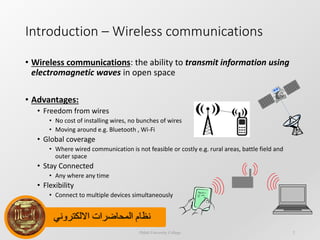
• Wireless communications: the ability to transmit information using
electromagnetic waves in open space
• Advantages:
• Freedom from wires
• No cost of installing wires, no bunches of wires
• Moving around e.g. Bluetooth , Wi-Fi
• Global coverage
• Where wired communication is not feasible or costly e.g. rural areas, battle field and
outer space
• Stay Connected
• Any where any time
• Flexibility
• Connect to multiple devices simultaneously
Dijlah University College 2
‫االلكتروني‬ ‫المحاضرات‬ ‫نظام‬
Introduction – Mobile communications
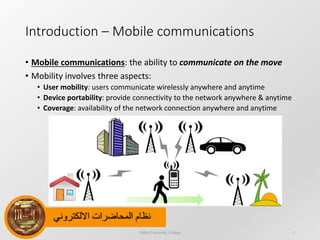
• Mobile communications: the ability to communicate on the move
• Mobility involves three aspects:
• User mobility: users communicate wirelessly anywhere and anytime
• Device portability: provide connectivity to the network anywhere & anytime
• Coverage: availability of the network connection anywhere and anytime
Dijlah University College 3
‫االلكتروني‬ ‫المحاضرات‬ ‫نظام‬
Introduction – Cont.
• Wireless communication methods have been developing for more
than one century
• Growth driven by advancements in:
• Electronic circuits integration and miniaturization
• Signal processing techniques
• Wireless communication technologies
• Materials fabrication
• Resulted in large-scale deployment of portable radio equipment and
communication networks that are:
• Smaller, lighter and cheaper
• More reliable and powerful
• Easy to use
Dijlah University College 4
‫االلكتروني‬ ‫المحاضرات‬ ‫نظام‬
History of wireless communications
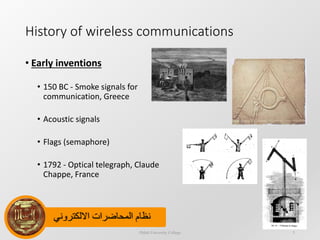
• Early inventions
• 150 BC - Smoke signals for
communication, Greece
• Acoustic signals
• Flags (semaphore)
• 1792 - Optical telegraph, Claude
Chappe, France
Dijlah University College 5
‫االلكتروني‬ ‫المحاضرات‬ ‫نظام‬
History of wireless communications
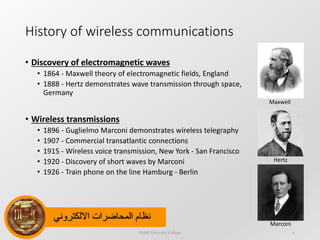
• Discovery of electromagnetic waves
• 1864 - Maxwell theory of electromagnetic fields, England
• 1888 - Hertz demonstrates wave transmission through space,
Germany
• Wireless transmissions
• 1896 - Guglielmo Marconi demonstrates wireless telegraphy
• 1907 - Commercial transatlantic connections
• 1915 - Wireless voice transmission, New York - San Francisco
• 1920 - Discovery of short waves by Marconi
• 1926 - Train phone on the line Hamburg - Berlin
Dijlah University College 6
Maxwell
Hertz
Marconi
‫االلكتروني‬ ‫المحاضرات‬ ‫نظام‬
History of wireless communications – Cont.
• 1934 – Mobile communications for public safety, using AM
• 1935 – Edwin Armstrong demonstrated FM
• WWII – Accelerated the evolution of technology
• Technology used in mobile communications and TV
• Number of mobile users increased significantly
• 1946
Dijlah University College 7
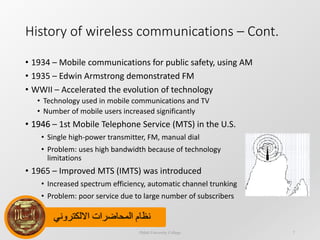
• 1946 – 1st Mobile Telephone Service (MTS) in the U.S.
• Single high-power transmitter, FM, manual dial
• Problem: uses high bandwidth because of technology
limitations
• 1965 – Improved MTS (IMTS) was introduced
• Increased spectrum efficiency, automatic channel trunking
• Problem: poor service due to large number of subscribers
‫االلكتروني‬ ‫المحاضرات‬ ‫نظام‬
History of cellular communications
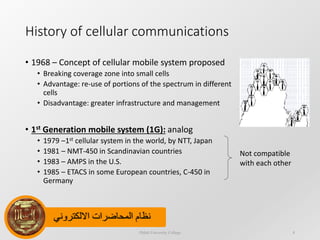
• 1968 – Concept of cellular mobile system proposed
• Breaking coverage zone into small cells
• Advantage: re-use of portions of the spectrum in different
cells
• Disadvantage: greater infrastructure and management
• 1st Generation mobile system (1G): analog
• 1979 –1st cellular system in the world, by NTT, Japan
• 1981 – NMT-450 in Scandinavian countries
• 1983 – AMPS in the U.S.
• 1985 – ETACS in some European countries, C-450 in
Germany
Not compatible
with each other
Dijlah University College 8
‫االلكتروني‬ ‫المحاضرات‬ ‫نظام‬
History of cellular communications – Cont.
• 2nd generation mobile system (2G): digital, SMS
• 1990 – GSM (Global System for Mobile), Europe
• 1991 – D-AMPS (Digital AMPS) or USDC (US Digital Cellular), U.S & Canada
• 1993 – PDC (Pacific Digital Cellular), Japan
• 1995 – CDMAOne, IS-95, IS-136, U.S.
• 2000 – GPRS (General Packet Radio Service), HSCSD (2.5G), MMS, Internet
• 2003 – EDGDE (Enhanced Data rates for GSM Evolution), improved data rate
• 3rd generation mobile system (3G): video calls, high speed Internet
• 2000 – CDMA2000, U.S. and China
• 2000 – UMTS (Universal Mobile Telecommunication System) (W-CDMA),
Europe, worldwide
• 2008 – HSPA (High Speed Packet Access), (HSDPA & HSUPA), higher data rates
• 2010 – HSPA+ (Evolved HSPA), further improved data rates
Dijlah University College 9
‫االلكتروني‬ ‫المحاضرات‬ ‫نظام‬
History of cellular communications – Cont.
• 4th generation mobile system (4G): ultra broadband, high-quality
audio/video streaming
• 2007 – Mobile WiMax, IEEE 802.16, U.S.
• 2009 – LTE (Long Term Evolution), Europe, worldwide
• 2013 – LTE Advanced, improvement on LTE, higher data rates
• 5th generation mobile system (5G): in progress
• Concept in research and development phase
• Expected to achieve even higher data transmission rates
• Aims to achieve more efficient utilization of spectrum
Dijlah University College 10
‫االلكتروني‬ ‫المحاضرات‬ ‫نظام‬
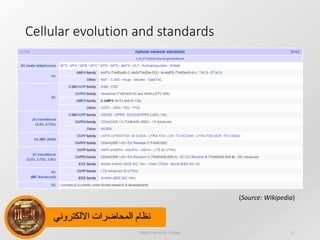
Cellular evolution and standards
(Source: Wikipedia)
Dijlah University College 11
‫االلكتروني‬ ‫المحاضرات‬ ‫نظام‬
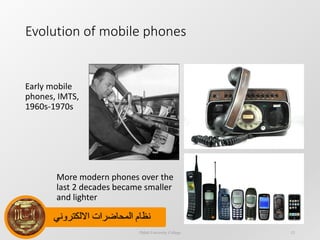
Early mobile
phones, IMTS,
1960s-1970s
Evolution of mobile phones
More modern phones over the
last 2 decades became smaller
and lighter
Dijlah University College 12
‫االلكتروني‬ ‫المحاضرات‬ ‫نظام‬
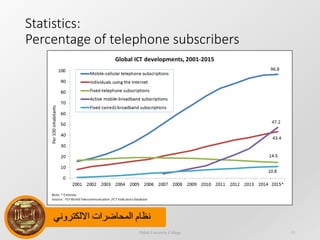
Statistics:
Percentage of telephone subscribers
Dijlah University College 13
‫االلكتروني‬ ‫المحاضرات‬ ‫نظام‬
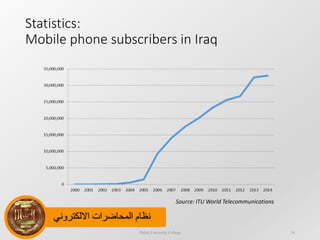
Statistics:
Mobile phone subscribers in Iraq
Dijlah University College 14
Source: ITU World Telecommunications
‫االلكتروني‬ ‫المحاضرات‬ ‫نظام‬
Classification of mobile radio systems
• Historically, “mobile” was used for radio devices that can move
during operation
• Home equipment: garage door opener, remote control
• Walkie-talkie
• Pagers
• Recently, “mobile” is used for a radio terminal that is attached to high
speed mobile platform
• Cellular phone in a fast moving car
• “Portable“ describes a radio terminal that can be hand-held and
moved at walking-speed
• Walkie-talkie and cordless phone
Dijlah University College 15
‫االلكتروني‬ ‫المحاضرات‬ ‫نظام‬
Examples of mobile radio systems
• Paging systems
• Send brief messages (pages) to a subscriber (numeric, alphanumeric or voice)
• Notification, news
• Consist of network of telephone lines, base stations transmitters, radio
towers for broadcasting of messages
• One-way communication (simplex)
• High-power transmitters
• Coverage may vary, within a city or a building
• Standards:
• POCSAG in the 1970s
• ERMES and FLEX in the 1990s
Dijlah University College 16
‫االلكتروني‬ ‫المحاضرات‬ ‫نظام‬
Examples of mobile radio systems – Cont.
• Cordless telephone systems
• Provide wireless extension to the telephone network within a limited area
• Two-way (duplex) communications
• Consists of a portable handset, connected to dedicated base station, which is
connected to the telephone network
• 1st generation: household environment
• 2nd generation: allow mobility in workplace and public use with limited
coverage in urban areas
• DECT (Digital European Cordless Telephone), Europe, 1993
• PACS, U.S., 1994
Dijlah University College 17
‫االلكتروني‬ ‫المحاضرات‬ ‫نظام‬
Examples of mobile radio systems – Cont.
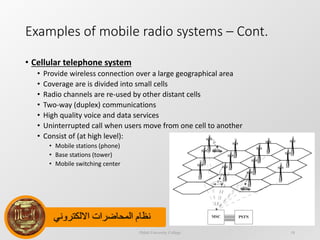
• Cellular telephone system
• Provide wireless connection over a large geographical area
• Coverage are is divided into small cells
• Radio channels are re-used by other distant cells
• Two-way (duplex) communications
• High quality voice and data services
• Uninterrupted call when users move from one cell to another
• Consist of (at high level):
• Mobile stations (phone)
• Base stations (tower)
• Mobile switching center
Dijlah University College 18
‫االلكتروني‬ ‫المحاضرات‬ ‫نظام‬
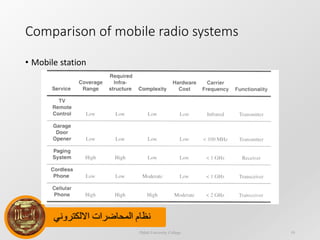
Comparison of mobile radio systems
• Mobile station
Dijlah University College 19
‫االلكتروني‬ ‫المحاضرات‬ ‫نظام‬
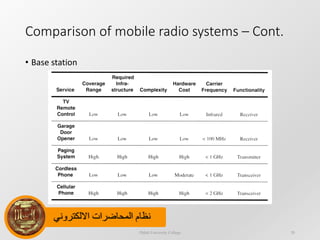
Comparison of mobile radio systems – Cont.
• Base station
Dijlah University College 20
‫االلكتروني‬ ‫المحاضرات‬ ‫نظام‬
Trends in radio communications:
Technologies
(Source: Y. D. Zhang, Villanova University)
Dijlah University College 21
‫االلكتروني‬ ‫المحاضرات‬ ‫نظام‬
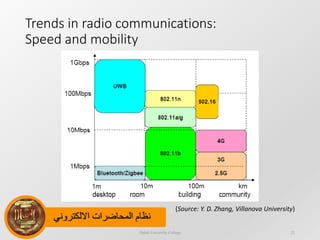
Trends in radio communications:
Speed and mobility
(Source: Y. D. Zhang, Villanova University)
Dijlah University College 22
‫االلكتروني‬ ‫المحاضرات‬ ‫نظام‬
Applications – I
• Mobility
• transmission of news, road condition, weather, music
• personal communication using GSM
• position via GPS
• local ad-hoc network with vehicles close-by to prevent accidents, guidance
system, redundancy
• vehicle data (e.g., from busses, high-speed trains) can be transmitted in
advance for maintenance
• Emergencies
• early transmission of patient data to the hospital, current status, first
diagnosis
• replacement of a fixed infrastructure in case of disasters, e.g. earthquakes,
hurricanes, fire, etc.
• crisis, war, etc.
(Source: Prof. J. Schiller, FU Berlin)
Dijlah University College 23
‫االلكتروني‬ ‫المحاضرات‬ ‫نظام‬
Applications – II
• Travelling salesmen
• direct access to customer files stored in a central location
• consistent databases for all agents
• mobile office
• Replacement of fixed networks
• remote sensors, e.g., weather, earth activities
• flexibility for trade shows
• LANs in historic buildings
• Entertainment & education
• outdoor Internet access
• intelligent travel guide with up-to-date
location dependent information
• ad-hoc networks for
multi user games
(Source: Prof. J. Schiller, FU Berlin)
Dijlah University College 24
‫االلكتروني‬ ‫المحاضرات‬ ‫نظام‬
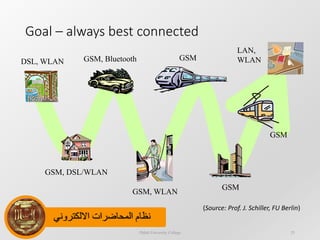
Goal – always best connected
(Source: Prof. J. Schiller, FU Berlin)
GSM
GSM
LAN,
WLANGSM
GSM, WLAN
GSM, Bluetooth
GSM, DSL/WLAN
DSL, WLAN
Dijlah University College 25
‫االلكتروني‬ ‫المحاضرات‬ ‫نظام‬
End of Lecture 1
Any questions?
Dijlah University College 26

01 introduction to wireless communications

  • 1.
    ‫االلكتروني‬ ‫المحاضرات‬ ‫نظام‬ MobileCommunications Prepared for Dijlah University College Department of Computer Techniques Engineering 2015 – 2016 Lecture 1 – Introduction to wireless communications Dr. Eng. Hussein Jamaluddin Khaleel Email: hussein.khaleel@duc.edu.iq http://www.duc.edu.iq/
  • 2.
    ‫االلكتروني‬ ‫المحاضرات‬ ‫نظام‬ Introduction– Wireless communications • Wireless communications: the ability to transmit information using electromagnetic waves in open space • Advantages: • Freedom from wires • No cost of installing wires, no bunches of wires • Moving around e.g. Bluetooth , Wi-Fi • Global coverage • Where wired communication is not feasible or costly e.g. rural areas, battle field and outer space • Stay Connected • Any where any time • Flexibility • Connect to multiple devices simultaneously Dijlah University College 2
  • 3.
    ‫االلكتروني‬ ‫المحاضرات‬ ‫نظام‬ Introduction– Mobile communications • Mobile communications: the ability to communicate on the move • Mobility involves three aspects: • User mobility: users communicate wirelessly anywhere and anytime • Device portability: provide connectivity to the network anywhere & anytime • Coverage: availability of the network connection anywhere and anytime Dijlah University College 3
  • 4.
    ‫االلكتروني‬ ‫المحاضرات‬ ‫نظام‬ Introduction– Cont. • Wireless communication methods have been developing for more than one century • Growth driven by advancements in: • Electronic circuits integration and miniaturization • Signal processing techniques • Wireless communication technologies • Materials fabrication • Resulted in large-scale deployment of portable radio equipment and communication networks that are: • Smaller, lighter and cheaper • More reliable and powerful • Easy to use Dijlah University College 4
  • 5.
    ‫االلكتروني‬ ‫المحاضرات‬ ‫نظام‬ Historyof wireless communications • Early inventions • 150 BC - Smoke signals for communication, Greece • Acoustic signals • Flags (semaphore) • 1792 - Optical telegraph, Claude Chappe, France Dijlah University College 5
  • 6.
    ‫االلكتروني‬ ‫المحاضرات‬ ‫نظام‬ Historyof wireless communications • Discovery of electromagnetic waves • 1864 - Maxwell theory of electromagnetic fields, England • 1888 - Hertz demonstrates wave transmission through space, Germany • Wireless transmissions • 1896 - Guglielmo Marconi demonstrates wireless telegraphy • 1907 - Commercial transatlantic connections • 1915 - Wireless voice transmission, New York - San Francisco • 1920 - Discovery of short waves by Marconi • 1926 - Train phone on the line Hamburg - Berlin Dijlah University College 6 Maxwell Hertz Marconi
  • 7.
    ‫االلكتروني‬ ‫المحاضرات‬ ‫نظام‬ Historyof wireless communications – Cont. • 1934 – Mobile communications for public safety, using AM • 1935 – Edwin Armstrong demonstrated FM • WWII – Accelerated the evolution of technology • Technology used in mobile communications and TV • Number of mobile users increased significantly • 1946 Dijlah University College 7 • 1946 – 1st Mobile Telephone Service (MTS) in the U.S. • Single high-power transmitter, FM, manual dial • Problem: uses high bandwidth because of technology limitations • 1965 – Improved MTS (IMTS) was introduced • Increased spectrum efficiency, automatic channel trunking • Problem: poor service due to large number of subscribers
  • 8.
    ‫االلكتروني‬ ‫المحاضرات‬ ‫نظام‬ Historyof cellular communications • 1968 – Concept of cellular mobile system proposed • Breaking coverage zone into small cells • Advantage: re-use of portions of the spectrum in different cells • Disadvantage: greater infrastructure and management • 1st Generation mobile system (1G): analog • 1979 –1st cellular system in the world, by NTT, Japan • 1981 – NMT-450 in Scandinavian countries • 1983 – AMPS in the U.S. • 1985 – ETACS in some European countries, C-450 in Germany Not compatible with each other Dijlah University College 8
  • 9.
    ‫االلكتروني‬ ‫المحاضرات‬ ‫نظام‬ Historyof cellular communications – Cont. • 2nd generation mobile system (2G): digital, SMS • 1990 – GSM (Global System for Mobile), Europe • 1991 – D-AMPS (Digital AMPS) or USDC (US Digital Cellular), U.S & Canada • 1993 – PDC (Pacific Digital Cellular), Japan • 1995 – CDMAOne, IS-95, IS-136, U.S. • 2000 – GPRS (General Packet Radio Service), HSCSD (2.5G), MMS, Internet • 2003 – EDGDE (Enhanced Data rates for GSM Evolution), improved data rate • 3rd generation mobile system (3G): video calls, high speed Internet • 2000 – CDMA2000, U.S. and China • 2000 – UMTS (Universal Mobile Telecommunication System) (W-CDMA), Europe, worldwide • 2008 – HSPA (High Speed Packet Access), (HSDPA & HSUPA), higher data rates • 2010 – HSPA+ (Evolved HSPA), further improved data rates Dijlah University College 9
  • 10.
    ‫االلكتروني‬ ‫المحاضرات‬ ‫نظام‬ Historyof cellular communications – Cont. • 4th generation mobile system (4G): ultra broadband, high-quality audio/video streaming • 2007 – Mobile WiMax, IEEE 802.16, U.S. • 2009 – LTE (Long Term Evolution), Europe, worldwide • 2013 – LTE Advanced, improvement on LTE, higher data rates • 5th generation mobile system (5G): in progress • Concept in research and development phase • Expected to achieve even higher data transmission rates • Aims to achieve more efficient utilization of spectrum Dijlah University College 10
  • 11.
    ‫االلكتروني‬ ‫المحاضرات‬ ‫نظام‬ Cellularevolution and standards (Source: Wikipedia) Dijlah University College 11
  • 12.
    ‫االلكتروني‬ ‫المحاضرات‬ ‫نظام‬ Earlymobile phones, IMTS, 1960s-1970s Evolution of mobile phones More modern phones over the last 2 decades became smaller and lighter Dijlah University College 12
  • 13.
  • 14.
    ‫االلكتروني‬ ‫المحاضرات‬ ‫نظام‬ Statistics: Mobilephone subscribers in Iraq Dijlah University College 14 Source: ITU World Telecommunications
  • 15.
    ‫االلكتروني‬ ‫المحاضرات‬ ‫نظام‬ Classificationof mobile radio systems • Historically, “mobile” was used for radio devices that can move during operation • Home equipment: garage door opener, remote control • Walkie-talkie • Pagers • Recently, “mobile” is used for a radio terminal that is attached to high speed mobile platform • Cellular phone in a fast moving car • “Portable“ describes a radio terminal that can be hand-held and moved at walking-speed • Walkie-talkie and cordless phone Dijlah University College 15
  • 16.
    ‫االلكتروني‬ ‫المحاضرات‬ ‫نظام‬ Examplesof mobile radio systems • Paging systems • Send brief messages (pages) to a subscriber (numeric, alphanumeric or voice) • Notification, news • Consist of network of telephone lines, base stations transmitters, radio towers for broadcasting of messages • One-way communication (simplex) • High-power transmitters • Coverage may vary, within a city or a building • Standards: • POCSAG in the 1970s • ERMES and FLEX in the 1990s Dijlah University College 16
  • 17.
    ‫االلكتروني‬ ‫المحاضرات‬ ‫نظام‬ Examplesof mobile radio systems – Cont. • Cordless telephone systems • Provide wireless extension to the telephone network within a limited area • Two-way (duplex) communications • Consists of a portable handset, connected to dedicated base station, which is connected to the telephone network • 1st generation: household environment • 2nd generation: allow mobility in workplace and public use with limited coverage in urban areas • DECT (Digital European Cordless Telephone), Europe, 1993 • PACS, U.S., 1994 Dijlah University College 17
  • 18.
    ‫االلكتروني‬ ‫المحاضرات‬ ‫نظام‬ Examplesof mobile radio systems – Cont. • Cellular telephone system • Provide wireless connection over a large geographical area • Coverage are is divided into small cells • Radio channels are re-used by other distant cells • Two-way (duplex) communications • High quality voice and data services • Uninterrupted call when users move from one cell to another • Consist of (at high level): • Mobile stations (phone) • Base stations (tower) • Mobile switching center Dijlah University College 18
  • 19.
    ‫االلكتروني‬ ‫المحاضرات‬ ‫نظام‬ Comparisonof mobile radio systems • Mobile station Dijlah University College 19
  • 20.
    ‫االلكتروني‬ ‫المحاضرات‬ ‫نظام‬ Comparisonof mobile radio systems – Cont. • Base station Dijlah University College 20
  • 21.
    ‫االلكتروني‬ ‫المحاضرات‬ ‫نظام‬ Trendsin radio communications: Technologies (Source: Y. D. Zhang, Villanova University) Dijlah University College 21
  • 22.
    ‫االلكتروني‬ ‫المحاضرات‬ ‫نظام‬ Trendsin radio communications: Speed and mobility (Source: Y. D. Zhang, Villanova University) Dijlah University College 22
  • 23.
    ‫االلكتروني‬ ‫المحاضرات‬ ‫نظام‬ Applications– I • Mobility • transmission of news, road condition, weather, music • personal communication using GSM • position via GPS • local ad-hoc network with vehicles close-by to prevent accidents, guidance system, redundancy • vehicle data (e.g., from busses, high-speed trains) can be transmitted in advance for maintenance • Emergencies • early transmission of patient data to the hospital, current status, first diagnosis • replacement of a fixed infrastructure in case of disasters, e.g. earthquakes, hurricanes, fire, etc. • crisis, war, etc. (Source: Prof. J. Schiller, FU Berlin) Dijlah University College 23
  • 24.
    ‫االلكتروني‬ ‫المحاضرات‬ ‫نظام‬ Applications– II • Travelling salesmen • direct access to customer files stored in a central location • consistent databases for all agents • mobile office • Replacement of fixed networks • remote sensors, e.g., weather, earth activities • flexibility for trade shows • LANs in historic buildings • Entertainment & education • outdoor Internet access • intelligent travel guide with up-to-date location dependent information • ad-hoc networks for multi user games (Source: Prof. J. Schiller, FU Berlin) Dijlah University College 24
  • 25.
    ‫االلكتروني‬ ‫المحاضرات‬ ‫نظام‬ Goal– always best connected (Source: Prof. J. Schiller, FU Berlin) GSM GSM LAN, WLANGSM GSM, WLAN GSM, Bluetooth GSM, DSL/WLAN DSL, WLAN Dijlah University College 25
  • 26.
    ‫االلكتروني‬ ‫المحاضرات‬ ‫نظام‬ Endof Lecture 1 Any questions? Dijlah University College 26