29 Jan 2010 ON Modern  Communication  Network-TETRA M. M A H E S H  C H A N D R A, 0 9 0 1 6 T 6 6 0 4 M.TECH (DIGITAL COMMUNICATION), KAKATIYA INSTITUTE OF TECHNOLOGY , WARANGAL. By
KEYWORDS PMR  –PRIVATE MOBILE RADIO. PAMR - PUBLIC ACCESS MOBILE RADIO. DQPSK -DIFFERENTIAL QUARTERNARY PHASE SHIFT KEYING. DMO -DIRECT MODE OPERATION . TDMA -TIME DIVISION MULTIPLE ACCESS. FDMA -FREQUENCY DIVISION MULTIPLE ACCESS. ETSI  – EUROPEAN TELECOMMUNICATION  STANDADS INSTITUTE .
I N D E X INTRODUCTION TO RADIO TRUNKING.  TETRA –INTRODUCTION. TETRA FRAME STRUCTURE. TETRA CALL TYPES . DIFFERENCE BETWEEN GSM and TETRA SYSTEM . TETRA SUMMARY CONCLUSION.
INTRODUCTION TO RADIO TRUNKING  Digital Radio Trunking Systems – TETRA What is Radio Trunking   ? Trunking stands for “sharing”.  Whenever resources are in short supply, they will have to be shared.  In Radio Communications Trunking System a fixed number radio frequencies  are used and  are shared by large number of remote/ mobile subscribers.  The frequency spectrum is  a Scare resource.  This is commonly known  as Radio Trunking System.
INTRODUCTION TO RADIO TRUNKING  Digital Radio Trunking Systems – TETRA Advantage of Digital Trunking System over Analogue  Trunking  System: More  reliable  . Flexible . Low noise and  Provides internet connectivity . Disadvantages of  Digital Trunking  System over Analogue  Trunking  System: Only  the  low coverage range  as  compared  with Analogue Trunking  System. This can be overcome by  more  repeaters .
TETRA -INTRODUCTION What is TETRA  TETRA stands for “ Terrestrial Trunked Radio ” initially it is    called as “ Trans European  Trunked Radio ”. TETRA –New standard from  ETSI  for digital trunked radio system . TETRA is the  first truly open digital PMR  standard. TETRA standard contains  high functionality for Emergency services. Frequency Range: 380 - 400 MHz for public safety systems, 410 - 430 MHz & 870-876 MHz 915-921MHz for commercial applications
TETRA -INTRODUCTION Provides individual,  group  and  direct mode  communications between radios. Packet data and  fast data transfer  services . Frequency economy. Fast call set-up  time (300 m sec) . Security features &  Encryption  . TETRA provides Voice and Data Services . Video  application in future TETRA-TEDS .
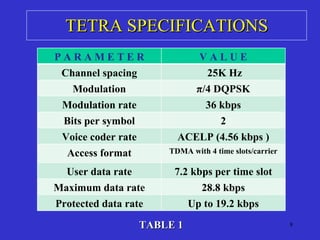
TETRA SPECIFICATIONS TABLE 1 P A R A M E T E R V A L U E Channel spacing 25K Hz Modulation π/4  DQPSK Modulation rate 36 kbps Bits per symbol 2 Voice coder rate ACELP (4.56 kbps ) Access format TDMA with 4 time slots/carrier User data rate 7.2 kbps per time slot Maximum data rate 28.8 kbps Protected data rate Up to 19.2 kbps
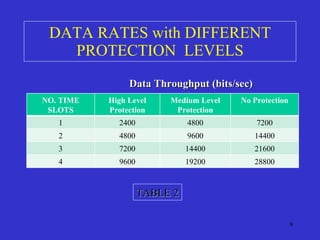
DATA RATES with DIFFERENT PROTECTION  LEVELS Data Throughput (bits/sec) TABLE 2 NO. TIME SLOTS High Level Protection Medium Level Protection No Protection 1 2400 4800 7200 2 4800 9600 14400 3 7200 14400 21600 4 9600 19200 28800
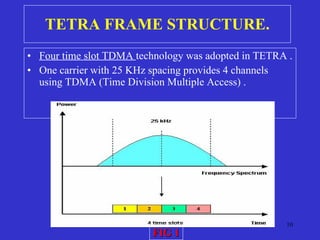
TETRA FRAME STRUCTURE. Four time slot TDMA  technology was adopted in TETRA . One carrier with 25 KHz spacing provides 4 channels using TDMA (Time Division Multiple Access) . FIG 1
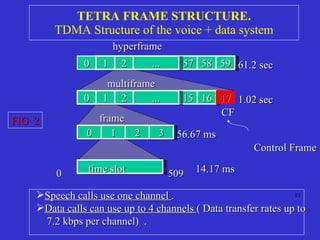
TETRA FRAME STRUCTURE. TDMA Structure of the voice + data system 0 1 2 57 58 59 ... hyperframe 0 1 2 15 16 17 ... multiframe 0 1 2 3 0   time slot  509 frame 14.17 ms 56.67 ms 1.02 sec 61.2 sec CF Control Frame Speech calls use one channel  . Data calls can use up to 4 channels  ( Data transfer rates up to 7.2 kbps per channel)  . FIG  2
TETRA FRAME STRUCTURE. BIT RATE OF TETRA SYSTEM 1 Time Slot =510 modulating bits duration=255 symbols 14.167 msec . Bit duration =14.167 msec/510 Bit rate =1/bit duration Bit rate = 36000 bits/sec Digital modulation,  π/4  - DQPSK  at Modulation rate  36 kbps  .  FIG  3 1  2  3  4  508  509  510
TETRA –SPECTRUM EFFICIENCY COMPARISION WITH OTHER STANDARDS TETRA offers 32 communication  channels and  GSM offers 8  Channels  per 200 K Hz bandwidth . FIG  4
TETRA CALL TYPES TETRA call  types Private call (individual call) . Phone call (PSTN or PABX call). Group call  . Emergency call . Broadcast call . TETRA Traffic case - Trunking options Trunking options only apply to simplex calls . Applies to private simplex calls and group calls . Trunking type is controlled by the Base Station. Message Trunking  . Transmission  Trunking .
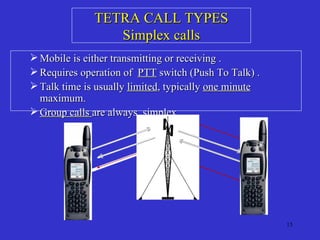
TETRA CALL TYPES Simplex calls Mobile is either transmitting or receiving . Requires operation of  PTT  switch (Push To Talk) . Talk time is usually  limited , typically  one minute  maximum. Group calls  are always  simplex .
TETRA CALL TYPES Duplex calls Mobile is transmitting and receiving (like GSM phone call). Does not require holding PTT to continue transmission . Phone calls are usually but not always duplex .
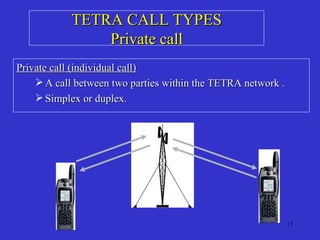
TETRA CALL TYPES Private call Private call (individual call) A call between two parties within the TETRA network . Simplex or duplex.
TETRA CALL TYPES Phone call Phone call (PSTN or PABX call) A call between a TETRA user and a fixed or mobile phone. Call is set up via the TETRA network’s PSTN Gateway. Call is normally duplex, hook signalling.
TETRA CALL TYPES- Group call Group call A call between more than two parties. Call is always simplex, direct set-up. Only possible if one or more groups have been attached.
What about commercial digital networks? GSM /  CDMA 2000 Public mobile networks do  not fulfil all public safety  requirements. Public mobile networks are developed to meet the demands  of consumers, which are very different  from those of public safety organisations. It cannot guarantee  service during emergencies  and disasters. It  cannot provide  FAST call set-up  time(<300 m sec). It cannot provide  special terminal  functionality .
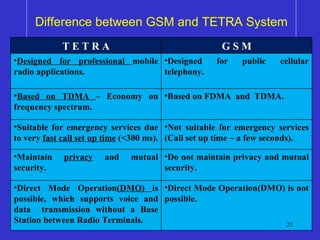
Difference between GSM and TETRA System T E T R A G S M Designed for professional  mobile radio applications.  Designed for public cellular telephony.  Based on TDMA  – Economy on frequency spectrum.  Based on FDMA  and  TDMA. Suitable for emergency services due to very  fast call set up time  (<300 ms). Not suitable for emergency services (Call set up time ~ a few seconds).  Maintain  privacy  and mutual security.  Do not maintain privacy and mutual security.  Direct Mode Operation (DMO)  is possible, which supports voice and data  transmission without a Base Station between Radio Terminals.  Direct Mode Operation(DMO) is not possible.
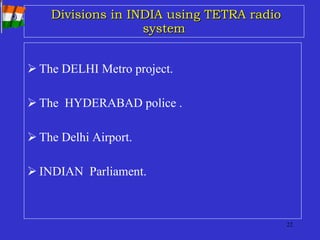
Divisions in INDIA using TETRA radio system The DELHI Metro project. The  HYDERABAD police . The Delhi Airport. INDIAN  Parliament.
Digital Radio Trunking Systems – TETRA  Summary In order to tackle  terrorism , all the user agencies of Govt. and Private Organizations need to upgrade and integrate their communication infrastructure for secure, faster & reliable communications.  This integrated network should be capable of providing unified command and control channels for voice, data and  video applications  in future.
Digital Radio Trunking Systems – TETRA  Summary Disasters  – both natural and man-made .  Major Incidents/  fires  . Incidents . RTA  (Road Traffic  Accidents ) . Routine  policing  .
Digital Radio Trunking Systems – TETRA  Summary Four-channel TDMA gives excellent spectrum economy  - 4 channels in one 25 kHz carrier . Trunking technology supports controlled use of  shared networks  . Three Carriers- 12 Channels FIRE POLICE MEDICAL FIG  5
CONCLUSION TETRA is  emergent digital PMR  technology. Characteristics like  consistent voice quality ,  greater call privacy  ,  fast call set-up  ,high speed data transfer  and  outstanding spectral efficiency  etc .reflects the dominance of TETRA over other PMR and PAMR systems. It is  modern technology for police  ,fire service ,military ,etc. Future success of TETRA depends on network operators to deliver benefits of TETRA services cost effectively to end users.
REFERENCES Mikulic, M.; Modlic, B”  General system architecture of TETRA network for public safety services ”   ELMAR, 2008. 50th International Symposium   Volume 1,  10-12 Sept. 2008 Page(s):207 - 210 . Laakso Nokia,   ”  Overview of TETRA and it’s services facilites    ”   Presentation on www.tetramou.com
THANK YOU
Tetra Ppt 6604   Edited

Tetra Ppt 6604 Edited

  • 1.
    29 Jan 2010ON Modern Communication Network-TETRA M. M A H E S H C H A N D R A, 0 9 0 1 6 T 6 6 0 4 M.TECH (DIGITAL COMMUNICATION), KAKATIYA INSTITUTE OF TECHNOLOGY , WARANGAL. By
  • 2.
    KEYWORDS PMR –PRIVATE MOBILE RADIO. PAMR - PUBLIC ACCESS MOBILE RADIO. DQPSK -DIFFERENTIAL QUARTERNARY PHASE SHIFT KEYING. DMO -DIRECT MODE OPERATION . TDMA -TIME DIVISION MULTIPLE ACCESS. FDMA -FREQUENCY DIVISION MULTIPLE ACCESS. ETSI – EUROPEAN TELECOMMUNICATION STANDADS INSTITUTE .
  • 3.
    I N DE X INTRODUCTION TO RADIO TRUNKING. TETRA –INTRODUCTION. TETRA FRAME STRUCTURE. TETRA CALL TYPES . DIFFERENCE BETWEEN GSM and TETRA SYSTEM . TETRA SUMMARY CONCLUSION.
  • 4.
    INTRODUCTION TO RADIOTRUNKING Digital Radio Trunking Systems – TETRA What is Radio Trunking ? Trunking stands for “sharing”. Whenever resources are in short supply, they will have to be shared. In Radio Communications Trunking System a fixed number radio frequencies are used and are shared by large number of remote/ mobile subscribers. The frequency spectrum is a Scare resource. This is commonly known as Radio Trunking System.
  • 5.
    INTRODUCTION TO RADIOTRUNKING Digital Radio Trunking Systems – TETRA Advantage of Digital Trunking System over Analogue Trunking System: More reliable . Flexible . Low noise and Provides internet connectivity . Disadvantages of Digital Trunking System over Analogue Trunking System: Only the low coverage range as compared with Analogue Trunking System. This can be overcome by more repeaters .
  • 6.
    TETRA -INTRODUCTION Whatis TETRA TETRA stands for “ Terrestrial Trunked Radio ” initially it is called as “ Trans European Trunked Radio ”. TETRA –New standard from ETSI for digital trunked radio system . TETRA is the first truly open digital PMR standard. TETRA standard contains high functionality for Emergency services. Frequency Range: 380 - 400 MHz for public safety systems, 410 - 430 MHz & 870-876 MHz 915-921MHz for commercial applications
  • 7.
    TETRA -INTRODUCTION Providesindividual, group and direct mode communications between radios. Packet data and fast data transfer services . Frequency economy. Fast call set-up time (300 m sec) . Security features & Encryption . TETRA provides Voice and Data Services . Video application in future TETRA-TEDS .
  • 8.
    TETRA SPECIFICATIONS TABLE1 P A R A M E T E R V A L U E Channel spacing 25K Hz Modulation π/4 DQPSK Modulation rate 36 kbps Bits per symbol 2 Voice coder rate ACELP (4.56 kbps ) Access format TDMA with 4 time slots/carrier User data rate 7.2 kbps per time slot Maximum data rate 28.8 kbps Protected data rate Up to 19.2 kbps
  • 9.
    DATA RATES withDIFFERENT PROTECTION LEVELS Data Throughput (bits/sec) TABLE 2 NO. TIME SLOTS High Level Protection Medium Level Protection No Protection 1 2400 4800 7200 2 4800 9600 14400 3 7200 14400 21600 4 9600 19200 28800
  • 10.
    TETRA FRAME STRUCTURE.Four time slot TDMA technology was adopted in TETRA . One carrier with 25 KHz spacing provides 4 channels using TDMA (Time Division Multiple Access) . FIG 1
  • 11.
    TETRA FRAME STRUCTURE.TDMA Structure of the voice + data system 0 1 2 57 58 59 ... hyperframe 0 1 2 15 16 17 ... multiframe 0 1 2 3 0 time slot 509 frame 14.17 ms 56.67 ms 1.02 sec 61.2 sec CF Control Frame Speech calls use one channel . Data calls can use up to 4 channels ( Data transfer rates up to 7.2 kbps per channel) . FIG 2
  • 12.
    TETRA FRAME STRUCTURE.BIT RATE OF TETRA SYSTEM 1 Time Slot =510 modulating bits duration=255 symbols 14.167 msec . Bit duration =14.167 msec/510 Bit rate =1/bit duration Bit rate = 36000 bits/sec Digital modulation, π/4 - DQPSK at Modulation rate 36 kbps . FIG 3 1 2 3 4 508 509 510
  • 13.
    TETRA –SPECTRUM EFFICIENCYCOMPARISION WITH OTHER STANDARDS TETRA offers 32 communication channels and GSM offers 8 Channels per 200 K Hz bandwidth . FIG 4
  • 14.
    TETRA CALL TYPESTETRA call types Private call (individual call) . Phone call (PSTN or PABX call). Group call . Emergency call . Broadcast call . TETRA Traffic case - Trunking options Trunking options only apply to simplex calls . Applies to private simplex calls and group calls . Trunking type is controlled by the Base Station. Message Trunking . Transmission Trunking .
  • 15.
    TETRA CALL TYPESSimplex calls Mobile is either transmitting or receiving . Requires operation of PTT switch (Push To Talk) . Talk time is usually limited , typically one minute maximum. Group calls are always simplex .
  • 16.
    TETRA CALL TYPESDuplex calls Mobile is transmitting and receiving (like GSM phone call). Does not require holding PTT to continue transmission . Phone calls are usually but not always duplex .
  • 17.
    TETRA CALL TYPESPrivate call Private call (individual call) A call between two parties within the TETRA network . Simplex or duplex.
  • 18.
    TETRA CALL TYPESPhone call Phone call (PSTN or PABX call) A call between a TETRA user and a fixed or mobile phone. Call is set up via the TETRA network’s PSTN Gateway. Call is normally duplex, hook signalling.
  • 19.
    TETRA CALL TYPES-Group call Group call A call between more than two parties. Call is always simplex, direct set-up. Only possible if one or more groups have been attached.
  • 20.
    What about commercialdigital networks? GSM / CDMA 2000 Public mobile networks do not fulfil all public safety requirements. Public mobile networks are developed to meet the demands of consumers, which are very different from those of public safety organisations. It cannot guarantee service during emergencies and disasters. It cannot provide FAST call set-up time(<300 m sec). It cannot provide special terminal functionality .
  • 21.
    Difference between GSMand TETRA System T E T R A G S M Designed for professional mobile radio applications. Designed for public cellular telephony. Based on TDMA – Economy on frequency spectrum. Based on FDMA and TDMA. Suitable for emergency services due to very fast call set up time (<300 ms). Not suitable for emergency services (Call set up time ~ a few seconds). Maintain privacy and mutual security. Do not maintain privacy and mutual security. Direct Mode Operation (DMO) is possible, which supports voice and data transmission without a Base Station between Radio Terminals. Direct Mode Operation(DMO) is not possible.
  • 22.
    Divisions in INDIAusing TETRA radio system The DELHI Metro project. The HYDERABAD police . The Delhi Airport. INDIAN Parliament.
  • 23.
    Digital Radio TrunkingSystems – TETRA Summary In order to tackle terrorism , all the user agencies of Govt. and Private Organizations need to upgrade and integrate their communication infrastructure for secure, faster & reliable communications. This integrated network should be capable of providing unified command and control channels for voice, data and video applications in future.
  • 24.
    Digital Radio TrunkingSystems – TETRA Summary Disasters – both natural and man-made . Major Incidents/ fires . Incidents . RTA (Road Traffic Accidents ) . Routine policing .
  • 25.
    Digital Radio TrunkingSystems – TETRA Summary Four-channel TDMA gives excellent spectrum economy - 4 channels in one 25 kHz carrier . Trunking technology supports controlled use of shared networks . Three Carriers- 12 Channels FIRE POLICE MEDICAL FIG 5
  • 26.
    CONCLUSION TETRA is emergent digital PMR technology. Characteristics like consistent voice quality , greater call privacy , fast call set-up ,high speed data transfer and outstanding spectral efficiency etc .reflects the dominance of TETRA over other PMR and PAMR systems. It is modern technology for police ,fire service ,military ,etc. Future success of TETRA depends on network operators to deliver benefits of TETRA services cost effectively to end users.
  • 27.
    REFERENCES Mikulic, M.;Modlic, B” General system architecture of TETRA network for public safety services ” ELMAR, 2008. 50th International Symposium Volume 1,  10-12 Sept. 2008 Page(s):207 - 210 . Laakso Nokia,  ” Overview of TETRA and it’s services facilites   ”  Presentation on www.tetramou.com
  • 28.