

• BASIC RESEARCH CONCEPTS
• HISTORY OF NURSING RESEARCH
• TRENDS IN NURSING RESEARCH
• TYPES OF RESEARCH DESIGNS


                   Dr. Ram Sharan Mehta
                 Medical Surgical Nursing Department
                                College of Nursing

        Dr. R S Mehta, MSND, BPKIHS                1
Basic Research Concepts


     Dr. R S Mehta, MSND, BPKIHS   2
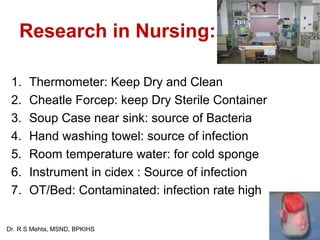
Research in Nursing:

 1.   Thermometer: Keep Dry and Clean
 2.   Cheatle Forcep: keep Dry Sterile Container
 3.   Soup Case near sink: source of Bacteria
 4.   Hand washing towel: source of infection
 5.   Room temperature water: for cold sponge
 6.   Instrument in cidex : Source of infection
 7.   OT/Bed: Contaminated: infection rate high

                                                   3
Dr. R S Mehta, MSND, BPKIHS
What is research?
 A systematic process of inquiry
 Goal directed
 Focused on uncovering new
  knowledge to help understand
  phenomena, answer questions, or
  address problems
Research

• Research means “ to search again or
  carefully examine” (Langford 2001).

• “A systematic study of problems in
  patient care.”
                            - Diers


              Dr. R S Mehta, MSND, BPKIHS   5
Abdellah
• “A systematic detailed attempt
  to discover or confirm facts
  that relate to a specific problem
  to improve the practice and
  profession of nursing.”
Polit and Hungler
• “A systematic search for
  knowledge about issues of
  importance to nursing.”
Henderson
• “A study of the problems in
  practice relating to the effects
  of nursing.”
What makes nursing research?

Nursing research is
 “a scientific process that validates
 and refines existing knowledge and
 generates new knowledge, which
 directly and indirectly influences
 nursing practice”

                 (Burns & Grove, 2005)
Definition of Nursing Research…
  ___________________________

• An organized, systematic, data-based
  critical scientific inquiry or investigation
  into a specific problem, undertaken
  with the objective of finding answers or
  solutions to it.


               Dr. R S Mehta, MSND, BPKIHS   10
GOALS OF NURSING
         RESEARCH
_________________________________
1. Improve nursing care
2. Improve patient care outcomes
3. Improve quality of life
4. Define and expand the scope of nursing
   practice


              Dr. R S Mehta, MSND, BPKIHS   11
Utilization of Nursing Research
             Findings
______________________________
1. To restore health.
2. To prevent illness.
3. To minimize the effects of acute &
   chronic illness & disability.

  Research: Synonyms of problem solving

               Dr. R S Mehta, MSND, BPKIHS   12
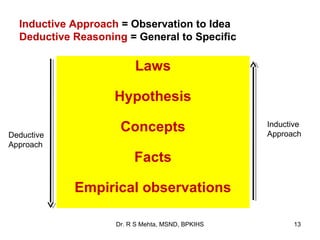
Inductive Approach = Observation to Idea
  Deductive Reasoning = General to Specific

                         Laws

                    Hypothesis

Deductive
                     Concepts                     Inductive
                                                  Approach
Approach
                         Facts

            Empirical observations

                    Dr. R S Mehta, MSND, BPKIHS          13
Tips for research projects:
• Title : must be one breath
• Theoretical base to support empirical data
• Conceptual frame work clear
• Objective maximum three
• Objectives moves round the title
• Title must be like dani ( bamboo stick for
  paddy removal using oxes)
• Methodology to achieve objectives

              Dr. R S Mehta, MSND, BPKIHS   14
Tips for research projects…..
•   Must read books
•   Use multiple sources of data for validity
•   Include advanced development in field
•   Visit library, book shops regularly
•   Find more original articles
•   In literature : Killing many darlings
•   Basis of conceptual frame work: Literature,
    Theories, Experiences & Focus of research.

• Use triangulation method in research:
  qualitative, quantitative and both.
                   Dr. R S Mehta, MSND, BPKIHS    15
History of Nursing Research


         Dr. R S Mehta, MSND, BPKIHS   16
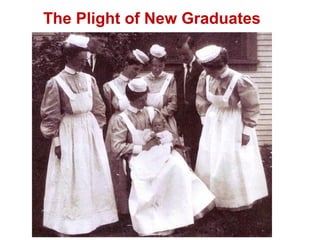
The Plight of New Graduates
Historical Development of nursing Research

Before 1850: No written documents.
After 1850:
• 1852: Nightingale wrote Cassandra.
• 1855 – N. Studied & calculated mortality rates of
  British in Crimean war. (Mortality decrease by 43%)
• 1859 – N. Wrote notes on hospital.
• 1859 – N. Notes on nursing – published.


                   Dr. R S Mehta, MSND, BPKIHS          18
• 1860 – N. Founded: St. Thomas’s Hospital School
  of Nursing in England.

• 1899 – ICN – Organized.

• 1900 – American Journal of Nursing publication
  begins.

• 1912 – American nurses association established.


                 Dr. R S Mehta, MSND, BPKIHS       19
In Nepal:
1991: NHRC established Autonomous body.
     –Conducts Regular training on:
       » Research methodology.
       » Ethical guidelines.
       » Data analysis. (SPSS)
       » Epidemiological research.
       » Others: regularly.
     –Provide research grant
     –Legal authority to control Research
            Dr. R S Mehta, MSND, BPKIHS   20
– 1976 – PB BN. Started. (2033 BS) (IOM)
– 1995 – MN programme started.
– 1996 (2053 BS): -B. Sc. Nursing program
  started at BPKIHS.

Research Compulsory: B.Sc. Nursing, BN,
 M.N./MSN, PhD Nursing


             Dr. R S Mehta, MSND, BPKIHS   21
Trends in nursing research


        Dr. R S Mehta, MSND, BPKIHS   22
Trends in nursing research
• Nepal is virgin area for research.
• The national future trends mainly focus
  in the following areas:
  Nursing leadership and management,
  primary health care, nursing education and
  its utilization, new technology in health,
  nursing curriculum and its implication,
  reproductive health and communicable
  disease
               Dr. R S Mehta, MSND, BPKIHS   23
Prone Areas of Nursing Research:
Nursing Service:
- Cancer
- End life care/Geriatric nursing
- Feeding tubes
- HIV/AIDS
- Diabetes
- CVS disease
- CKD, CLD, HTN,Pain etc
                Dr. R S Mehta, MSND, BPKIHS   24
Nursing Education:
• Assessment Methods: OSCE, OSPE,
  OSLAR, MCQs, MRQs, RA, MEQs, TF,
  MINI CEX (usually we use Essay type)
• Subject Placement
• Attitude of Students
• Problems of students
• Application of Theory in to practice

              Dr. R S Mehta, MSND, BPKIHS   25
Areas of special research
1.   Chronic illness experiences
2.   Cultural and ethnic considerations
3.   End-of-life/palliative care research
4.   Health promotion and disease prevention
5.   Implications of genetic advances
6.   Quality of life and quality of care
7.   Symptom management
8.   Telehealth interventions and monitoring:
     recently in Patan AHS Started.

                  Dr. R S Mehta, MSND, BPKIHS   26
TYPES OF RESEARCH
        &
RESEARCH DESIGNS


     Dr. R S Mehta, MSND, BPKIHS   27
Types of Study Design:
• There is no best type of study design

• The context, assumptions,
  paradigms and perspectives decide
  the type of research methodology


             Dr. R S Mehta, MSND, BPKIHS   28
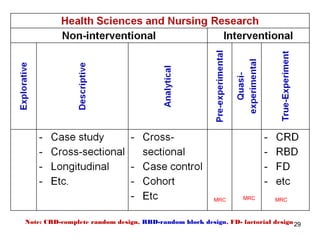
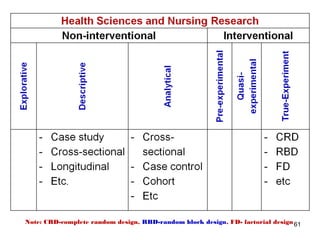
MRC     MRC       MRC


Note: CRD-complete random design, RBD-random block design, FD- factorial design 29
4 Types of Research
•   Basic research
•   Applied research
•   Action research
•   Evaluation research


                Dr. R S Mehta, MSND, BPKIHS   30
Basic Research
• Also known as fundamental research
  (sometimes pure research) is research carried
  out to increase understanding of fundamental
  principles.
• Many times the end results have no direct or
  immediate commercial benefits
• Basic research can be thought of as arising out of
  curiosity.
• However, in the long term it is the basis for many
  commercial products and applied research.
• Basic research is mainly carried out by
  universities    Dr. R S Mehta, MSND, BPKIHS      31
Applied Research
• Concern with addressing problem of the world
  as they are perceived by participants,
  organization or group of people
• Action oriented and aims to assess, describe,
  document or inform people concerned about the
  phenomenon under investigation
• Findings are intended to have immediate and
  practical value
• In the field of education, policy, evaluation and
  contract are all examples of applied research
                 Dr. R S Mehta, MSND, BPKIHS      32
Action Research
Action Research is simply a form of self-reflective
enquiry undertaken by participants in social
situations in order to improve the rationality and
justice of their own practices, their understanding
of these practices, and the situations in which these
practices are carried out.

                  Wilf Carr and Stephen Kemmis (1986)


                  Dr. R S Mehta, MSND, BPKIHS           33
Evaluation research
• Major concern is practical application
• Tends to be viewed as an isolated case study
  though the methodologies may be transferable
• Rooted in values and politics
• Is immediately prescriptive based upon logic and
  experience
• Reports are written for implementers, users and
  other interested people
• The extent of dissemination is controlled by
  sponsor
                 Dr. R S Mehta, MSND, BPKIHS    34
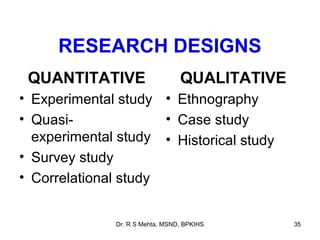
RESEARCH DESIGNS
 QUANTITATIVE                    QUALITATIVE
• Experimental study • Ethnography
• Quasi-              • Case study
  experimental study • Historical study
• Survey study
• Correlational study


              Dr. R S Mehta, MSND, BPKIHS      35
Experimental Design
• Test whether an educational practice or
  idea makes a difference for individuals


              Dr. R S Mehta, MSND, BPKIHS   36
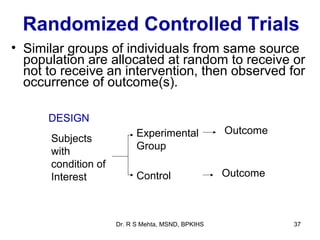
Randomized Controlled Trials
• Similar groups of individuals from same source
  population are allocated at random to receive or
  not to receive an intervention, then observed for
  occurrence of outcome(s).

      DESIGN
                           Experimental            Outcome
      Subjects
                           Group
      with
      condition of
      Interest             Control                 Outcome


                     Dr. R S Mehta, MSND, BPKIHS             37
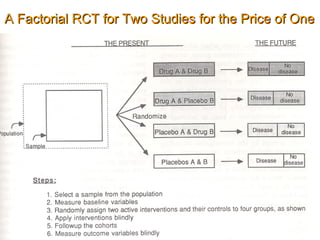
A Factorial RCT for Two Studies for the Price of One


                                                38
CASE-CONTROL STUDIES
SOME KEY POINTS
• Frequently used study design
• Participants selected on the basis of whether or
  not they are DISEASED (remember in a cohort
  study participants are selected based on
  exposure status)
• Those who are diseased are called CASES.
• Those who are not diseased are called
  CONTROLS.
                 Dr. R S Mehta, MSND, BPKIHS    39
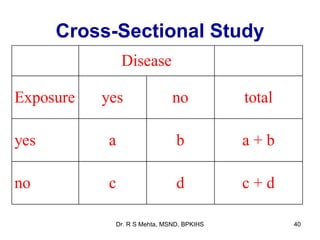
Cross-Sectional Study
                Disease

Exposure   yes                no           total

yes         a                  b           a+b

no          c                  d           c+d

             Dr. R S Mehta, MSND, BPKIHS           40
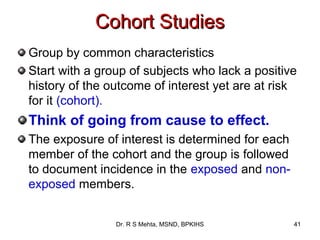
Cohort Studies
Group by common characteristics
Start with a group of subjects who lack a positive
history of the outcome of interest yet are at risk
for it (cohort).
Think of going from cause to effect.
The exposure of interest is determined for each
member of the cohort and the group is followed
to document incidence in the exposed and non-
exposed members.


                Dr. R S Mehta, MSND, BPKIHS       41
When is a cohort study
        warranted?
• When good evidence suggests
  an association of a disease with
  a certain exposure or exposures
 e.g. Smoking & Lung Cancer.


               Dr. R S Mehta, MSND, BPKIHS   42
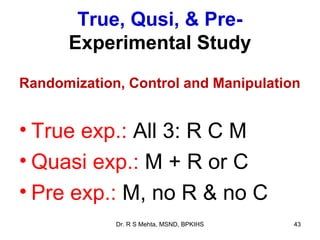
True, Qusi, & Pre-
      Experimental Study
Randomization, Control and Manipulation


• True exp.: All 3: R C M
• Quasi exp.: M + R or C
• Pre exp.: M, no R & no C
             Dr. R S Mehta, MSND, BPKIHS   43
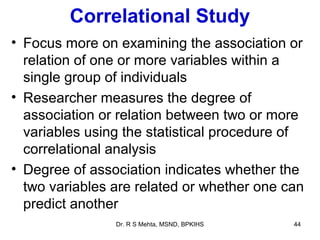
Correlational Study
• Focus more on examining the association or
  relation of one or more variables within a
  single group of individuals
• Researcher measures the degree of
  association or relation between two or more
  variables using the statistical procedure of
  correlational analysis
• Degree of association indicates whether the
  two variables are related or whether one can
  predict another
                Dr. R S Mehta, MSND, BPKIHS   44
Survey Designs
• Describe trends in a large population of
  individuals
• Administer a survey or questionnaire to a
  small group of people (sample) to identify
  trends in attitudes, opinions, behaviors or
  characteristics of a larger group of people
  (population)


               Dr. R S Mehta, MSND, BPKIHS      45
Descriptive Research Design:
  • Describe facts
  • Discover new facts
  • Not invent new theory and methods
  • Largest effort given on data
    collection
  • It answers questions: satisfy
    curiosity
  • Solve problems
Qualitative Research
      Dr. R S Mehta, MSND, BPKIHS   47
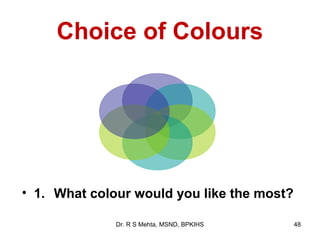
Choice of Colours


• 1. What colour would you like the most?

              Dr. R S Mehta, MSND, BPKIHS   48
2.What do you associate this colour with?
    Good luck
    love
    Confidence
    Truthfulness
    Lively
    Danger
    …


               Dr. R S Mehta, MSND, BPKIHS   49
3. What is the source of this knowledge?
  – Own Idea
  – Own Belief
  – Own observation
  – Own experiences
  – Cultural and Traditional
  – Books & articles
  – etc

              Dr. R S Mehta, MSND, BPKIHS   50
• Not every thing can be quantified.
• Some valuable ideas, opinions,
  perceptions, experiences, behaviours,
  qualities can be described only in
  words
• These subjective things are shared
  between people, but the meanings may
  be distorted in the process of
  communication and recording.


              Dr. R S Mehta, MSND, BPKIHS   51
• Although subjective, these
  aspects often add richness and
  depth
• The art of the doctor and the
  experience of being human are
  aspects that need a qualitative
  approach to
  investigate/research properly.
           Dr. R S Mehta, MSND, BPKIHS   52
Definitions
• Quantitative Research - investigation in which
  the researcher attempts to understand some
  larger reality by isolating and measuring
  components of that reality without regard to their
  contextual setting.

• Qualitative Research - investigation in which the
  researcher attempts to understand some larger
  reality by examining it in a holistic way or by
  examining components of that reality within their
  contextual setting.
                  Dr. R S Mehta, MSND, BPKIHS      53
Qualitative Research
– Human understanding and
   interpretation define reality
– Complex reality can be understood and not
  as simply a sum of its parts
– Goal of research is to examine complex
  phenomena to define the reality within
– To be meaningful, inquiry must be holistic
  and contextual
Characteristics of Qualitative
             Research
•   Purpose is understanding
•   Oriented toward discovery
•   Uses subjective data
•   Extracts meaning from data
•   Interprets results in context
•   Focus is holistic
Disadvantages of Qualitative
            Research
• Subjectivity leads to procedural problems
• Replicability is very difficult
• Researcher bias is built in and unavoidable
• In-depth, comprehensive approach to
  data gathering limits scope
• Labor intensive, expensive
• Not understood well by “classical”
  researchers
Organizational Structures
        (Types)
 Historical Analysis
 Ethnography
 Phenomenology
 Life History,
 Chronology,
 Historiography
 Case Study
            Dr. R S Mehta, MSND, BPKIHS   57
Advantages of Qualitative Research
 In-depth Examination of Phenomena
    (Phenomenological Study/Research)
 Uses subjective information
 Not limited to rigidly definable variables
 Examine complex questions that can be
 impossible with quantitative methods
 Deal with value-laden questions
 Explore new areas of research
 Build new theories           Dr. R S Mehta, MSND, BPKIHS 58
Disadvantages of Qualitative
         Research
Subjectivity leads to procedural problems
Replicability is very difficult
Researcher bias is built in and unavoidable
In-depth, comprehensive approach to
data gathering limits scope
Labor intensive, expensive
Not understood well by
“classical” researchers
              Dr. R S Mehta, MSND, BPKIHS     59
Meta Analysis
• Statistically combines results of existing
  research to estimate overall size of
  relation between variables

• Helps in
  • Developing theory
  • Identifying research needs,
  • Establishing validity

• Can replace large-scale research studies
• Better than literature reviews

                                           60
             Dr. R S Mehta, MSND, BPKIHS
Note: CRD-complete random design, RBD-random block design, FD- factorial design 61
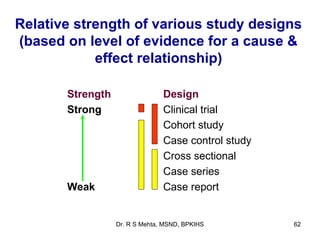
Relative strength of various study designs
(based on level of evidence for a cause &
            effect relationship)

       Strength                 Design
       Strong                   Clinical trial
                                Cohort study
                                Case control study
                                Cross sectional
                                Case series
       Weak                     Case report


                  Dr. R S Mehta, MSND, BPKIHS        62
Websites, Search Engine, and
           address of Journals
•   www.pubmed.com
•   www.google.com
•   www.yahoo.com
•   www.msn.com
•   www.rn.com
•   www.who.int (WHO website)
•   www.randamization.com
•   www.tnaionline.org (TNAI Journal)
•   www.hellis.org (NHRC library site)
•   www.kumj.com.np
•   www.nhrc.org.np
•   www.uicc.org (cancer website)
•   www.unaids.org (HIV/AIDS website)
•   www.ncasc.org.np (HIV/AIDS website)
•   www.healthinternetwork.org (HINARI: needs password)
•   www.blackwell-synergy.com (need passwords)
•   www.doaj.org (free online journal)            Dr. R S Mehta, MSND, BPKIHS   63
Some Popular Resource Sites for Nurses
•   www.delicious.com
•   www.connotea.org                          You can
•   www.scribd.ocm
                                             create your
•   www.authorstream
•   www.zotero.org                          own account
•   www.scratch.mit.edu                      and use it.
•   www.myebook.com
•   www.forvo.com
•   www.biomedcentral.com
•   www.library.nams.org.np (all study conducted in Nepal)
•   www.refworks.com
•   www.sourceforge.net
•   www.citationmachine.net
Web 2.0 includes:
•   Social networking
•   Blogs
•   Wikis
•   Video sharing sites
•   Hosted services
•   Web application
•   Etc.

               Dr. R S Mehta, MSND, BPKIHS   65
“The beautiful thing about
learning is that nobody can
  take it away from you.”

                                       --BB King


      Thank-You                                    66
         Dr. R S Mehta, MSND, BPKIHS

basic research concepts, history, trends & types of study.

  • 1.
    • BASIC RESEARCHCONCEPTS • HISTORY OF NURSING RESEARCH • TRENDS IN NURSING RESEARCH • TYPES OF RESEARCH DESIGNS Dr. Ram Sharan Mehta Medical Surgical Nursing Department College of Nursing Dr. R S Mehta, MSND, BPKIHS 1
  • 2.
    Basic Research Concepts Dr. R S Mehta, MSND, BPKIHS 2
  • 3.
    Research in Nursing: 1. Thermometer: Keep Dry and Clean 2. Cheatle Forcep: keep Dry Sterile Container 3. Soup Case near sink: source of Bacteria 4. Hand washing towel: source of infection 5. Room temperature water: for cold sponge 6. Instrument in cidex : Source of infection 7. OT/Bed: Contaminated: infection rate high 3 Dr. R S Mehta, MSND, BPKIHS
  • 4.
    What is research? A systematic process of inquiry  Goal directed  Focused on uncovering new knowledge to help understand phenomena, answer questions, or address problems
  • 5.
    Research • Research means“ to search again or carefully examine” (Langford 2001). • “A systematic study of problems in patient care.” - Diers Dr. R S Mehta, MSND, BPKIHS 5
  • 6.
    Abdellah • “A systematicdetailed attempt to discover or confirm facts that relate to a specific problem to improve the practice and profession of nursing.”
  • 7.
    Polit and Hungler •“A systematic search for knowledge about issues of importance to nursing.”
  • 8.
    Henderson • “A studyof the problems in practice relating to the effects of nursing.”
  • 9.
    What makes nursingresearch? Nursing research is “a scientific process that validates and refines existing knowledge and generates new knowledge, which directly and indirectly influences nursing practice” (Burns & Grove, 2005)
  • 10.
    Definition of NursingResearch… ___________________________ • An organized, systematic, data-based critical scientific inquiry or investigation into a specific problem, undertaken with the objective of finding answers or solutions to it. Dr. R S Mehta, MSND, BPKIHS 10
  • 11.
    GOALS OF NURSING RESEARCH _________________________________ 1. Improve nursing care 2. Improve patient care outcomes 3. Improve quality of life 4. Define and expand the scope of nursing practice Dr. R S Mehta, MSND, BPKIHS 11
  • 12.
    Utilization of NursingResearch Findings ______________________________ 1. To restore health. 2. To prevent illness. 3. To minimize the effects of acute & chronic illness & disability. Research: Synonyms of problem solving Dr. R S Mehta, MSND, BPKIHS 12
  • 13.
    Inductive Approach =Observation to Idea Deductive Reasoning = General to Specific Laws Hypothesis Deductive Concepts Inductive Approach Approach Facts Empirical observations Dr. R S Mehta, MSND, BPKIHS 13
  • 14.
    Tips for researchprojects: • Title : must be one breath • Theoretical base to support empirical data • Conceptual frame work clear • Objective maximum three • Objectives moves round the title • Title must be like dani ( bamboo stick for paddy removal using oxes) • Methodology to achieve objectives Dr. R S Mehta, MSND, BPKIHS 14
  • 15.
    Tips for researchprojects….. • Must read books • Use multiple sources of data for validity • Include advanced development in field • Visit library, book shops regularly • Find more original articles • In literature : Killing many darlings • Basis of conceptual frame work: Literature, Theories, Experiences & Focus of research. • Use triangulation method in research: qualitative, quantitative and both. Dr. R S Mehta, MSND, BPKIHS 15
  • 16.
    History of NursingResearch Dr. R S Mehta, MSND, BPKIHS 16
  • 17.
    The Plight ofNew Graduates
  • 18.
    Historical Development ofnursing Research Before 1850: No written documents. After 1850: • 1852: Nightingale wrote Cassandra. • 1855 – N. Studied & calculated mortality rates of British in Crimean war. (Mortality decrease by 43%) • 1859 – N. Wrote notes on hospital. • 1859 – N. Notes on nursing – published. Dr. R S Mehta, MSND, BPKIHS 18
  • 19.
    • 1860 –N. Founded: St. Thomas’s Hospital School of Nursing in England. • 1899 – ICN – Organized. • 1900 – American Journal of Nursing publication begins. • 1912 – American nurses association established. Dr. R S Mehta, MSND, BPKIHS 19
  • 20.
    In Nepal: 1991: NHRCestablished Autonomous body. –Conducts Regular training on: » Research methodology. » Ethical guidelines. » Data analysis. (SPSS) » Epidemiological research. » Others: regularly. –Provide research grant –Legal authority to control Research Dr. R S Mehta, MSND, BPKIHS 20
  • 21.
    – 1976 –PB BN. Started. (2033 BS) (IOM) – 1995 – MN programme started. – 1996 (2053 BS): -B. Sc. Nursing program started at BPKIHS. Research Compulsory: B.Sc. Nursing, BN, M.N./MSN, PhD Nursing Dr. R S Mehta, MSND, BPKIHS 21
  • 22.
    Trends in nursingresearch Dr. R S Mehta, MSND, BPKIHS 22
  • 23.
    Trends in nursingresearch • Nepal is virgin area for research. • The national future trends mainly focus in the following areas: Nursing leadership and management, primary health care, nursing education and its utilization, new technology in health, nursing curriculum and its implication, reproductive health and communicable disease Dr. R S Mehta, MSND, BPKIHS 23
  • 24.
    Prone Areas ofNursing Research: Nursing Service: - Cancer - End life care/Geriatric nursing - Feeding tubes - HIV/AIDS - Diabetes - CVS disease - CKD, CLD, HTN,Pain etc Dr. R S Mehta, MSND, BPKIHS 24
  • 25.
    Nursing Education: • AssessmentMethods: OSCE, OSPE, OSLAR, MCQs, MRQs, RA, MEQs, TF, MINI CEX (usually we use Essay type) • Subject Placement • Attitude of Students • Problems of students • Application of Theory in to practice Dr. R S Mehta, MSND, BPKIHS 25
  • 26.
    Areas of specialresearch 1. Chronic illness experiences 2. Cultural and ethnic considerations 3. End-of-life/palliative care research 4. Health promotion and disease prevention 5. Implications of genetic advances 6. Quality of life and quality of care 7. Symptom management 8. Telehealth interventions and monitoring: recently in Patan AHS Started. Dr. R S Mehta, MSND, BPKIHS 26
  • 27.
    TYPES OF RESEARCH & RESEARCH DESIGNS Dr. R S Mehta, MSND, BPKIHS 27
  • 28.
    Types of StudyDesign: • There is no best type of study design • The context, assumptions, paradigms and perspectives decide the type of research methodology Dr. R S Mehta, MSND, BPKIHS 28
  • 29.
    MRC MRC MRC Note: CRD-complete random design, RBD-random block design, FD- factorial design 29
  • 30.
    4 Types ofResearch • Basic research • Applied research • Action research • Evaluation research Dr. R S Mehta, MSND, BPKIHS 30
  • 31.
    Basic Research • Alsoknown as fundamental research (sometimes pure research) is research carried out to increase understanding of fundamental principles. • Many times the end results have no direct or immediate commercial benefits • Basic research can be thought of as arising out of curiosity. • However, in the long term it is the basis for many commercial products and applied research. • Basic research is mainly carried out by universities Dr. R S Mehta, MSND, BPKIHS 31
  • 32.
    Applied Research • Concernwith addressing problem of the world as they are perceived by participants, organization or group of people • Action oriented and aims to assess, describe, document or inform people concerned about the phenomenon under investigation • Findings are intended to have immediate and practical value • In the field of education, policy, evaluation and contract are all examples of applied research Dr. R S Mehta, MSND, BPKIHS 32
  • 33.
    Action Research Action Researchis simply a form of self-reflective enquiry undertaken by participants in social situations in order to improve the rationality and justice of their own practices, their understanding of these practices, and the situations in which these practices are carried out. Wilf Carr and Stephen Kemmis (1986) Dr. R S Mehta, MSND, BPKIHS 33
  • 34.
    Evaluation research • Majorconcern is practical application • Tends to be viewed as an isolated case study though the methodologies may be transferable • Rooted in values and politics • Is immediately prescriptive based upon logic and experience • Reports are written for implementers, users and other interested people • The extent of dissemination is controlled by sponsor Dr. R S Mehta, MSND, BPKIHS 34
  • 35.
    RESEARCH DESIGNS QUANTITATIVE QUALITATIVE • Experimental study • Ethnography • Quasi- • Case study experimental study • Historical study • Survey study • Correlational study Dr. R S Mehta, MSND, BPKIHS 35
  • 36.
    Experimental Design • Testwhether an educational practice or idea makes a difference for individuals Dr. R S Mehta, MSND, BPKIHS 36
  • 37.
    Randomized Controlled Trials •Similar groups of individuals from same source population are allocated at random to receive or not to receive an intervention, then observed for occurrence of outcome(s). DESIGN Experimental Outcome Subjects Group with condition of Interest Control Outcome Dr. R S Mehta, MSND, BPKIHS 37
  • 38.
    A Factorial RCTfor Two Studies for the Price of One 38
  • 39.
    CASE-CONTROL STUDIES SOME KEYPOINTS • Frequently used study design • Participants selected on the basis of whether or not they are DISEASED (remember in a cohort study participants are selected based on exposure status) • Those who are diseased are called CASES. • Those who are not diseased are called CONTROLS. Dr. R S Mehta, MSND, BPKIHS 39
  • 40.
    Cross-Sectional Study Disease Exposure yes no total yes a b a+b no c d c+d Dr. R S Mehta, MSND, BPKIHS 40
  • 41.
    Cohort Studies Group bycommon characteristics Start with a group of subjects who lack a positive history of the outcome of interest yet are at risk for it (cohort). Think of going from cause to effect. The exposure of interest is determined for each member of the cohort and the group is followed to document incidence in the exposed and non- exposed members. Dr. R S Mehta, MSND, BPKIHS 41
  • 42.
    When is acohort study warranted? • When good evidence suggests an association of a disease with a certain exposure or exposures e.g. Smoking & Lung Cancer. Dr. R S Mehta, MSND, BPKIHS 42
  • 43.
    True, Qusi, &Pre- Experimental Study Randomization, Control and Manipulation • True exp.: All 3: R C M • Quasi exp.: M + R or C • Pre exp.: M, no R & no C Dr. R S Mehta, MSND, BPKIHS 43
  • 44.
    Correlational Study • Focusmore on examining the association or relation of one or more variables within a single group of individuals • Researcher measures the degree of association or relation between two or more variables using the statistical procedure of correlational analysis • Degree of association indicates whether the two variables are related or whether one can predict another Dr. R S Mehta, MSND, BPKIHS 44
  • 45.
    Survey Designs • Describetrends in a large population of individuals • Administer a survey or questionnaire to a small group of people (sample) to identify trends in attitudes, opinions, behaviors or characteristics of a larger group of people (population) Dr. R S Mehta, MSND, BPKIHS 45
  • 46.
    Descriptive Research Design: • Describe facts • Discover new facts • Not invent new theory and methods • Largest effort given on data collection • It answers questions: satisfy curiosity • Solve problems
  • 47.
    Qualitative Research Dr. R S Mehta, MSND, BPKIHS 47
  • 48.
    Choice of Colours •1. What colour would you like the most? Dr. R S Mehta, MSND, BPKIHS 48
  • 49.
    2.What do youassociate this colour with? Good luck love Confidence Truthfulness Lively Danger … Dr. R S Mehta, MSND, BPKIHS 49
  • 50.
    3. What isthe source of this knowledge? – Own Idea – Own Belief – Own observation – Own experiences – Cultural and Traditional – Books & articles – etc Dr. R S Mehta, MSND, BPKIHS 50
  • 51.
    • Not everything can be quantified. • Some valuable ideas, opinions, perceptions, experiences, behaviours, qualities can be described only in words • These subjective things are shared between people, but the meanings may be distorted in the process of communication and recording. Dr. R S Mehta, MSND, BPKIHS 51
  • 52.
    • Although subjective,these aspects often add richness and depth • The art of the doctor and the experience of being human are aspects that need a qualitative approach to investigate/research properly. Dr. R S Mehta, MSND, BPKIHS 52
  • 53.
    Definitions • Quantitative Research- investigation in which the researcher attempts to understand some larger reality by isolating and measuring components of that reality without regard to their contextual setting. • Qualitative Research - investigation in which the researcher attempts to understand some larger reality by examining it in a holistic way or by examining components of that reality within their contextual setting. Dr. R S Mehta, MSND, BPKIHS 53
  • 54.
    Qualitative Research – Humanunderstanding and interpretation define reality – Complex reality can be understood and not as simply a sum of its parts – Goal of research is to examine complex phenomena to define the reality within – To be meaningful, inquiry must be holistic and contextual
  • 55.
    Characteristics of Qualitative Research • Purpose is understanding • Oriented toward discovery • Uses subjective data • Extracts meaning from data • Interprets results in context • Focus is holistic
  • 56.
    Disadvantages of Qualitative Research • Subjectivity leads to procedural problems • Replicability is very difficult • Researcher bias is built in and unavoidable • In-depth, comprehensive approach to data gathering limits scope • Labor intensive, expensive • Not understood well by “classical” researchers
  • 57.
    Organizational Structures (Types) Historical Analysis Ethnography Phenomenology Life History, Chronology, Historiography Case Study Dr. R S Mehta, MSND, BPKIHS 57
  • 58.
    Advantages of QualitativeResearch In-depth Examination of Phenomena (Phenomenological Study/Research) Uses subjective information Not limited to rigidly definable variables Examine complex questions that can be impossible with quantitative methods Deal with value-laden questions Explore new areas of research Build new theories Dr. R S Mehta, MSND, BPKIHS 58
  • 59.
    Disadvantages of Qualitative Research Subjectivity leads to procedural problems Replicability is very difficult Researcher bias is built in and unavoidable In-depth, comprehensive approach to data gathering limits scope Labor intensive, expensive Not understood well by “classical” researchers Dr. R S Mehta, MSND, BPKIHS 59
  • 60.
    Meta Analysis • Statisticallycombines results of existing research to estimate overall size of relation between variables • Helps in • Developing theory • Identifying research needs, • Establishing validity • Can replace large-scale research studies • Better than literature reviews 60 Dr. R S Mehta, MSND, BPKIHS
  • 61.
    Note: CRD-complete randomdesign, RBD-random block design, FD- factorial design 61
  • 62.
    Relative strength ofvarious study designs (based on level of evidence for a cause & effect relationship) Strength Design Strong Clinical trial Cohort study Case control study Cross sectional Case series Weak Case report Dr. R S Mehta, MSND, BPKIHS 62
  • 63.
    Websites, Search Engine,and address of Journals • www.pubmed.com • www.google.com • www.yahoo.com • www.msn.com • www.rn.com • www.who.int (WHO website) • www.randamization.com • www.tnaionline.org (TNAI Journal) • www.hellis.org (NHRC library site) • www.kumj.com.np • www.nhrc.org.np • www.uicc.org (cancer website) • www.unaids.org (HIV/AIDS website) • www.ncasc.org.np (HIV/AIDS website) • www.healthinternetwork.org (HINARI: needs password) • www.blackwell-synergy.com (need passwords) • www.doaj.org (free online journal) Dr. R S Mehta, MSND, BPKIHS 63
  • 64.
    Some Popular ResourceSites for Nurses • www.delicious.com • www.connotea.org You can • www.scribd.ocm create your • www.authorstream • www.zotero.org own account • www.scratch.mit.edu and use it. • www.myebook.com • www.forvo.com • www.biomedcentral.com • www.library.nams.org.np (all study conducted in Nepal) • www.refworks.com • www.sourceforge.net • www.citationmachine.net
  • 65.
    Web 2.0 includes: • Social networking • Blogs • Wikis • Video sharing sites • Hosted services • Web application • Etc. Dr. R S Mehta, MSND, BPKIHS 65
  • 66.
    “The beautiful thingabout learning is that nobody can take it away from you.” --BB King Thank-You 66 Dr. R S Mehta, MSND, BPKIHS

Editor's Notes

  • #5 In order to begin to identify research problems is it first necessary to understand what is meant by the term research and to have an understanding of how the research problem fits into the whole research process. A number of different definitions for research exist however common to all of them is an agreement that research is systematic, disciplined and focused on gathering information to understand a phenomena, answer questions or solve research problems. The systematic nature of the research process means that research is undertaken in a methodological fashion using a rigorous approach to collect information (data) about a phenomena or research problem and to analyze and interpret that information in order to begin to answer questions or solve problems. Since research is directed at ultimately helping us to answer a question or address a problem, it is critical that we are as clear as possible about the research problem we are interested in. Thus, developing a problem statement is a critical first step in the research process.
  • #10 Nurses are interested in developing, evaluating and implementing research evidence that is important to us as professionals. This definition by Burns and Grove suggests that nursing research is a systematic inquiry which is directly or indirectly related to nursing practice. This broad view of nursing research suggests that the focus of research in nursing is shaped by phenomena of interest to nurses such as individual and family response to illness as well as nurses roles in impacting care. In addition, nursing research might also address other domains of practice including education, administration and multidisciplinary collaboration. When planning a research project it is important to choose a topic that has relevance to your area of interest and that has the potential to add to our understanding of an important nursing issue. This topic will ultimately be refined into a problem statement that can be used to direct the research process.