INTRODUCTION TO
RESEARCH
By
DR. ERWIN L. PURCIA
SCIENCE
AND
THE
SCIENTIFIC METHOD
DEFINITION OF SCIENCE
- A systematic arrangement of bodies of
knowledge based on facts.
- A systematic pursuit of knowledge involving
recognition and formulation of a problem,
collection of data through observation and
experiment and formulation and testing of
hypotheses.
Definition of Scientific Method
DEFINITION OF RESEARCH
-it is defined as the scientific investigation of
phenomena which includes collection,
presentation, analysis and interpretation of
facts that links an individual’s speculation
with reality. In other words, it is a systematic
study of trend or event which involves
careful collection, presentation, analysis and
interpretation of quantitative data or facts
that relates man’s thinking with reality.
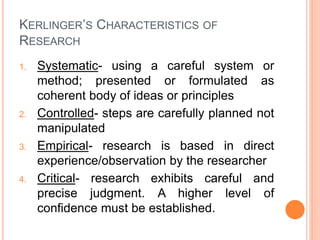
KERLINGER’S CHARACTERISTICS OF
RESEARCH
1. Systematic- using a careful system or
method; presented or formulated as
coherent body of ideas or principles
2. Controlled- steps are carefully planned not
manipulated
3. Empirical- research is based in direct
experience/observation by the researcher
4. Critical- research exhibits careful and
precise judgment. A higher level of
confidence must be established.
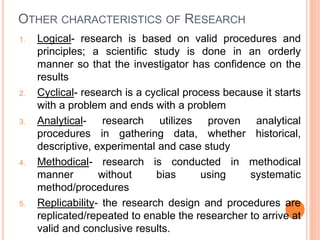
OTHER CHARACTERISTICS OF RESEARCH
1. Logical- research is based on valid procedures and
principles; a scientific study is done in an orderly
manner so that the investigator has confidence on the
results
2. Cyclical- research is a cyclical process because it starts
with a problem and ends with a problem
3. Analytical- research utilizes proven analytical
procedures in gathering data, whether historical,
descriptive, experimental and case study
4. Methodical- research is conducted in methodical
manner without bias using systematic
method/procedures
5. Replicability- the research design and procedures are
replicated/repeated to enable the researcher to arrive at
valid and conclusive results.
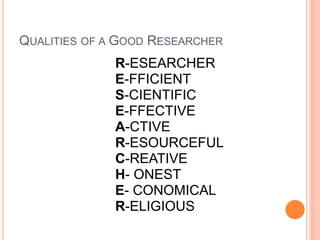
QUALITIES OF A GOOD RESEARCHER
R-ESEARCHER
E-FFICIENT
S-CIENTIFIC
E-FFECTIVE
A-CTIVE
R-ESOURCEFUL
C-REATIVE
H- ONEST
E- CONOMICAL
R-ELIGIOUS
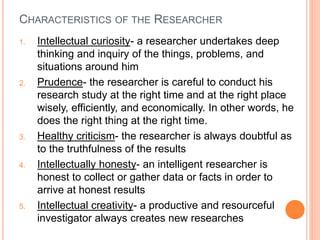
CHARACTERISTICS OF THE RESEARCHER
1. Intellectual curiosity- a researcher undertakes deep
thinking and inquiry of the things, problems, and
situations around him
2. Prudence- the researcher is careful to conduct his
research study at the right time and at the right place
wisely, efficiently, and economically. In other words, he
does the right thing at the right time.
3. Healthy criticism- the researcher is always doubtful as
to the truthfulness of the results
4. Intellectually honesty- an intelligent researcher is
honest to collect or gather data or facts in order to
arrive at honest results
5. Intellectual creativity- a productive and resourceful
investigator always creates new researches
MAN’S MAJOR NEEDS AND PROBLEMS
DEMAND RESEARCH
 Examples of man’s needs and problems where
products of research are born:
- A century ago, rural folks merely used coconut oil
lamp to lighten their house until electricity was
invented
- Before, only typewriters and mimeographing
machines were used as duplicating facilities
- Four decades ago, people found difficulty in hand
washing their clothes, washing machine then was
invented
- Airplanes, ships, buses, jeepneys, automobiles,
vans and many others are products of research for
easy transportation
VALUES OF RESEARCH TO MAN
1. Research improves quality of life – research has led
man to search for ways to improve life.
2. Research improves instruction
3. Research improves students’ achievements
4. Research improves teacher’s competence
5. Research satisfies man’s needs
6. Research reduces the burden of work
7. Research has deep-seated psychological aspects
8. Research improves the exportation of food products
9. Research responds to the economic recovery and
austerity measure of the country
10. Research trains graduates to become responsive to
the economic development of the country globally
TYPES OF RESEARCH
1. Basic Research- It seeks to discover basic truths or principles.
It is intended to add to the body of scientific knowledge by
exploring the unknown to extend the boundaries of
knowledge as well as to discover new facts, and learn more
accurately the characteristics of known without an particular
thought as to immediate practical utility.
2. Applied Research- This type of research seeks new
applications of scientific knowledge to the solution of a
problem, such as the development of a new system or
procedure, new device, or new method in order to solve the
problem.
3. Developmental Research- this is a decision-oriented research
involving the application of the steps of the scientific method
in response to an immediate need to improve existing
practices.
CLASSIFICATION OF RESEARCH
1. Library Research- done in the library where
answers to specific questions or problems of the
study are available.
2. Field Research- research is conducted in a natural
setting. No changes in the environment are made.
3. Laboratory Research- research is conducted in
artificial or controlled conditions by isolating the
study in a thoroughly specified and equipped area.

Introduction to Research

  • 1.
  • 2.
  • 3.
    DEFINITION OF SCIENCE -A systematic arrangement of bodies of knowledge based on facts. - A systematic pursuit of knowledge involving recognition and formulation of a problem, collection of data through observation and experiment and formulation and testing of hypotheses. Definition of Scientific Method
  • 4.
    DEFINITION OF RESEARCH -itis defined as the scientific investigation of phenomena which includes collection, presentation, analysis and interpretation of facts that links an individual’s speculation with reality. In other words, it is a systematic study of trend or event which involves careful collection, presentation, analysis and interpretation of quantitative data or facts that relates man’s thinking with reality.
  • 5.
    KERLINGER’S CHARACTERISTICS OF RESEARCH 1.Systematic- using a careful system or method; presented or formulated as coherent body of ideas or principles 2. Controlled- steps are carefully planned not manipulated 3. Empirical- research is based in direct experience/observation by the researcher 4. Critical- research exhibits careful and precise judgment. A higher level of confidence must be established.
  • 6.
    OTHER CHARACTERISTICS OFRESEARCH 1. Logical- research is based on valid procedures and principles; a scientific study is done in an orderly manner so that the investigator has confidence on the results 2. Cyclical- research is a cyclical process because it starts with a problem and ends with a problem 3. Analytical- research utilizes proven analytical procedures in gathering data, whether historical, descriptive, experimental and case study 4. Methodical- research is conducted in methodical manner without bias using systematic method/procedures 5. Replicability- the research design and procedures are replicated/repeated to enable the researcher to arrive at valid and conclusive results.
  • 7.
    QUALITIES OF AGOOD RESEARCHER R-ESEARCHER E-FFICIENT S-CIENTIFIC E-FFECTIVE A-CTIVE R-ESOURCEFUL C-REATIVE H- ONEST E- CONOMICAL R-ELIGIOUS
  • 8.
    CHARACTERISTICS OF THERESEARCHER 1. Intellectual curiosity- a researcher undertakes deep thinking and inquiry of the things, problems, and situations around him 2. Prudence- the researcher is careful to conduct his research study at the right time and at the right place wisely, efficiently, and economically. In other words, he does the right thing at the right time. 3. Healthy criticism- the researcher is always doubtful as to the truthfulness of the results 4. Intellectually honesty- an intelligent researcher is honest to collect or gather data or facts in order to arrive at honest results 5. Intellectual creativity- a productive and resourceful investigator always creates new researches
  • 9.
    MAN’S MAJOR NEEDSAND PROBLEMS DEMAND RESEARCH  Examples of man’s needs and problems where products of research are born: - A century ago, rural folks merely used coconut oil lamp to lighten their house until electricity was invented - Before, only typewriters and mimeographing machines were used as duplicating facilities - Four decades ago, people found difficulty in hand washing their clothes, washing machine then was invented - Airplanes, ships, buses, jeepneys, automobiles, vans and many others are products of research for easy transportation
  • 10.
    VALUES OF RESEARCHTO MAN 1. Research improves quality of life – research has led man to search for ways to improve life. 2. Research improves instruction 3. Research improves students’ achievements 4. Research improves teacher’s competence 5. Research satisfies man’s needs 6. Research reduces the burden of work 7. Research has deep-seated psychological aspects 8. Research improves the exportation of food products 9. Research responds to the economic recovery and austerity measure of the country 10. Research trains graduates to become responsive to the economic development of the country globally
  • 11.
    TYPES OF RESEARCH 1.Basic Research- It seeks to discover basic truths or principles. It is intended to add to the body of scientific knowledge by exploring the unknown to extend the boundaries of knowledge as well as to discover new facts, and learn more accurately the characteristics of known without an particular thought as to immediate practical utility. 2. Applied Research- This type of research seeks new applications of scientific knowledge to the solution of a problem, such as the development of a new system or procedure, new device, or new method in order to solve the problem. 3. Developmental Research- this is a decision-oriented research involving the application of the steps of the scientific method in response to an immediate need to improve existing practices.
  • 12.
    CLASSIFICATION OF RESEARCH 1.Library Research- done in the library where answers to specific questions or problems of the study are available. 2. Field Research- research is conducted in a natural setting. No changes in the environment are made. 3. Laboratory Research- research is conducted in artificial or controlled conditions by isolating the study in a thoroughly specified and equipped area.