ALL ABOUT RESEARCH – 
INTRODUCTION
Issues... 
 Why are we interested in research? 
 What is research? 
 Why must we understand research? 
 Key concepts and issues
Why are we interested in research? 
 Desire to get a research degree along with its 
consequential benefits; 
 Desire to face the challenge in solving the unsolved 
problems, i.e., concern over practical problems initiates 
research; 
 Desire to get intellectual joy of doing some creative 
work; 
 Desire to be of service to society; 
 Desire to get respectability.
Why are we interested in research? 
 Desire to support and enrich ideas; 
 Desire to increase credibility; 
 Desire to become familiar with gaps in the literature 
(lacking, inconclusive, contradictory and limited 
evidence;) 
And most importantly; 
 Desire to create knowledge.
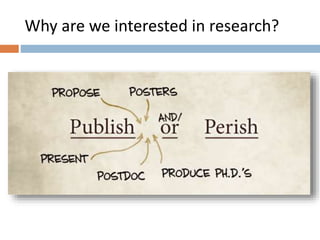
Why are we interested in research?
Why is research a valued source of knowledge? 
 Common ways of knowing… 
 personal experience/intuition 
 experts/traditions/authority 
 scientific method
What is Science, the Scientific Method, and 
Research? 
 Science… 
 a body of established knowledge 
 the observation, identification, investigation, and 
theoretical explanation of natural phenomenon 
usually the ultimate goal is theory 
generation and verification
What is Science, the Scientific Method, and 
Research? 
 Theory… 
 a set of inter-related constructs and propositions that 
specify relations among variables to explain and 
predict phenomena 
 should be simple, consistent with observed 
relationships, tentative and verifiable
What is Science, the Scientific Method, and 
Research? 
 Scientific Method… 
 involves the principles and processes regarded as 
characteristic of or necessary for scientific 
investigation 
 process or approach to generating valid and 
trustworthy knowledge
 What are the fine line difference 
between discovery, invention and 
research?
Research is not 
Accidental discovery : 
1. Accidental discovery may occur in structured 
research process 
2. Usually takes the form of a phenomenon not 
previously noticed 
3. May lead to a structured research process to 
verify or understand the observation 
15
Research is not … cont. 
Data Collection 
• an intermediate step to gain reliable knowledge 
• collecting reliable data is part of the research 
process 
16
Research is not … cont. 
Searching out published research results in libraries 
(or the internet) 
• This is an important early step of research 
• The research process always includes synthesis and 
analysis 
• But, just reviewing of literature is not research 
17
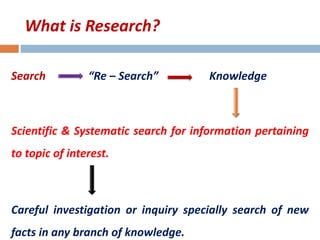
What is Research? 
Search “Re – Search” Knowledge 
Scientific & Systematic search for information pertaining 
to topic of interest. 
Careful investigation or inquiry specially search of new 
facts in any branch of knowledge.
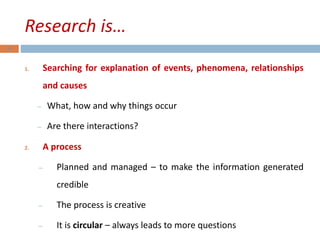
Research is… 
1. Searching for explanation of events, phenomena, relationships 
and causes 
– What, how and why things occur 
– Are there interactions? 
2. A process 
– Planned and managed – to make the information generated 
credible 
– The process is creative 
– It is circular – always leads to more questions 
19
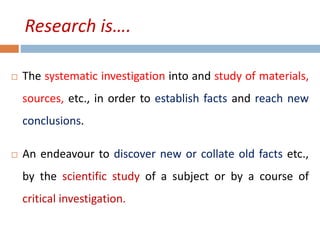
Research is…. 
 The systematic investigation into and study of materials, 
sources, etc., in order to establish facts and reach new 
conclusions. 
 An endeavour to discover new or collate old facts etc., 
by the scientific study of a subject or by a course of 
critical investigation.
Research is…. 
 an activity that contributes to the understanding of a 
phenomenon [Kuhn, 1962; Lakatos, 1978] 
 phenomenon: a set of behaviors of some entity(ies) that is 
found interesting by a research community. 
 understanding: knowledge that allows prediction of the 
behavior of some aspect of the phenomenon. 
 activities considered appropriate to the production of 
understanding (knowledge) are the research methods and 
techniques of a research community.
Research is…. 
“Research is to see what everybody else has seen, and 
to think what nobody has thought.” 
Albert Szent-Gyorgy
Notice that: 
“… truth was not used in the definition of research” 
“This concept of truth is outside of the productive 
realm of thinking by researchers” 
23
Why must we understand research? 
 help make informed decisions 
 need to produce research in career 
 evaluating research 
 assist in classes
Characteristics of Research 
 objective 
 precise 
 verifiable 
 parsimonious 
 empirical 
 logical 
 probabilistic
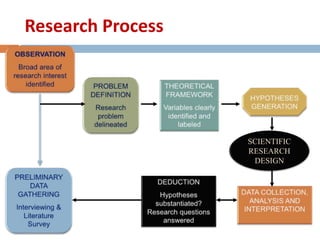
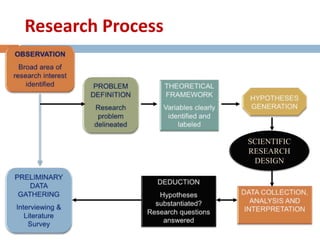
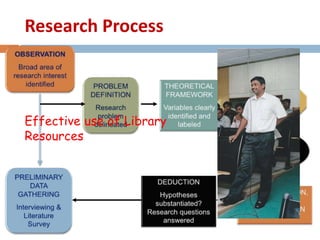
Research Process 
SCIENTIFIC 
RESEARCH 
DESIGN
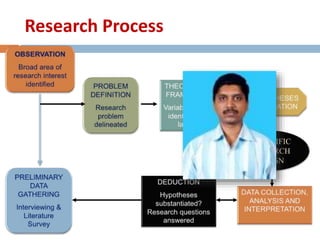
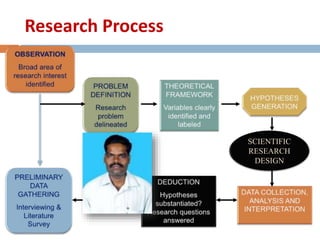
Research Process 
SCIENTIFIC 
RESEARCH 
DESIGN
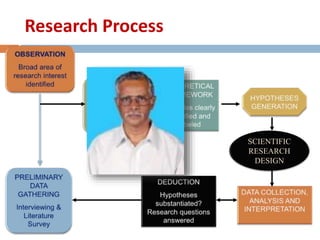
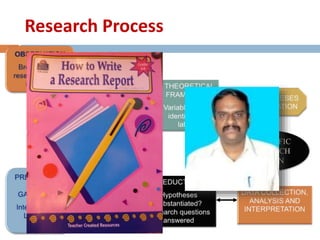
Research Process 
SCIENTIFIC 
RESEARCH 
DESIGN
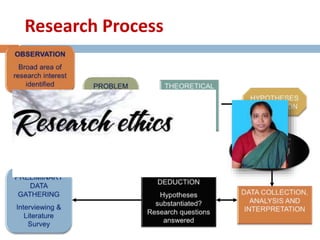
Research Process 
SCIENTIFIC 
RESEARCH 
DESIGN
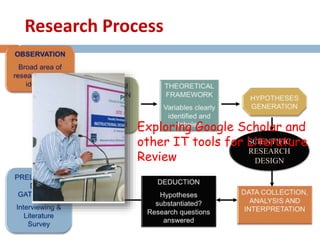
Research Process 
Exploring Google Scholar and 
other IT tools for Literature 
Review 
SCIENTIFIC 
RESEARCH 
DESIGN
Research Process 
SCIENTIFIC 
RESEARCH 
DESIGN 
Effective use of Library 
Resources
Research Process 
SCIENTIFIC 
RESEARCH 
DESIGN
Research Process 
SCIENTIFIC 
RESEARCH 
DESIGN
Research Process 
SCIENTIFIC 
RESEARCH 
DESIGN
We shall take a closer look at these 
steps and the terminology you 
will need to understand before 
we start the training programme.
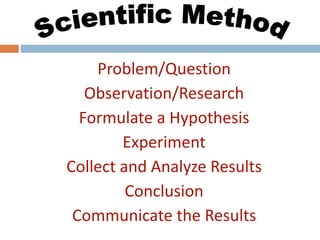
Problem/Question 
Observation/Research 
Formulate a Hypothesis 
Experiment 
Collect and Analyze Results 
Conclusion 
Communicate the Results
Steps of the Scientific Method 
1. Problem/Question: Develop a question or 
problem that can be solved through 
experimentation.
Steps of the Scientific Method 
2.Observation/Research: Make 
observations and research your topic of 
interest.
Do you remember the next step?
Steps of the Scientific Method 
3. Formulate a Hypothesis: Predict a 
possible answer to the problem or 
question. 
Example: If soil temperatures rise, then 
plant growth will increase.
Steps of the Scientific Method 
4. Experiment: Develop and follow a 
procedure. 
Include a detailed materials list. 
The outcome must be measurable 
(quantifiable).
Steps of the Scientific Method 
5. Collect and Analyze Results: Modify the 
procedure if needed. 
Confirm the results by retesting. 
Include tables, graphs, and photographs.
Steps of the Scientific Method 
6. Conclusion: Include a statement that 
accepts or rejects the hypothesis. 
Make recommendations for further study 
and possible improvements to the 
procedure.
Steps of the Scientific Method 
7. Communicate the Results: Be prepared 
to present the project to an audience. 
Expect questions from the audience.
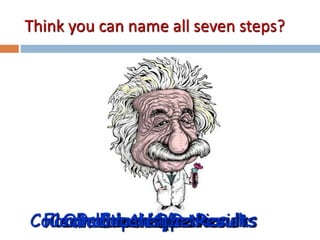
Think you can name all seven steps? 
CoFCloloeOrmcmbPtmus raleouCEanrbntoxdvilencep aA cametaltnir u/oeHiasQmn liyty/oeuphzRnneoeeetst sRtRheieoasnruiucsllhttss
Let’s put our knowledge of the Scientific 
Method to a realistic example that 
includes some of the terms you’ll be 
needing to use and understand.
Problem/Question 
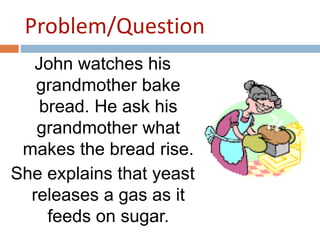
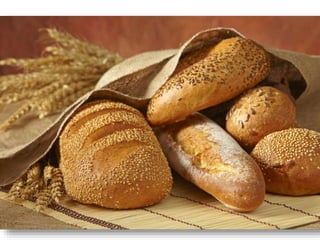
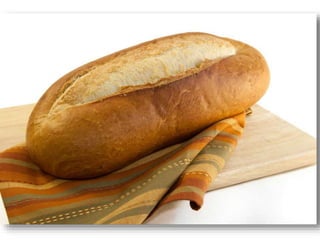
John watches his 
grandmother bake 
bread. He ask his 
grandmother what 
makes the bread rise. 
She explains that yeast 
releases a gas as it 
feeds on sugar.
Problem/Question 
John wonders if the 
amount of sugar used 
in the recipe will affect 
the size of the bread 
loaf?
Caution! 
Be careful how you use effect and 
affect. 
Effect is usually a noun and affect, a 
verb. 
“ The effect of sugar amounts on the 
rising of bread.” 
“How does sugar affect the rising of 
bread?”
Observation/Research 
John researches the 
areas of baking and 
fermentation and tries 
to come up with a way 
to test his question. 
He keeps all of his 
information on this 
topic in a journal.
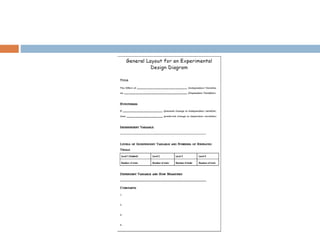
John talks with his teacher and 
she gives him a 
Experimental Design 
Diagram to help him set up 
his investigation.
Formulate a Hypothesis 
After talking with his teacher and 
conducting further research, he 
comes up with a hypothesis. 
“If more sugar is added, then the 
bread will rise higher.”
Hypothesis 
The hypothesis is an educated 
guess about the relationship 
between the independent and 
dependent variables. 
Note: These variables will be 
defined in the next few slides.
Do you know the difference between the 
independent and dependent variables?
Independent Variable 
The independent, or manipulated 
variable, is a factor that’s intentionally 
varied by the experimenter. 
John is going to use 25g., 50g., 100g., 
250g., 500g. of sugar in his experiment.
Dependent Variable 
The dependent, or responding variable, is 
the factor that may change as a result of 
changes made in the independent 
variable. 
In this case, it would be the size of the loaf 
of bread.
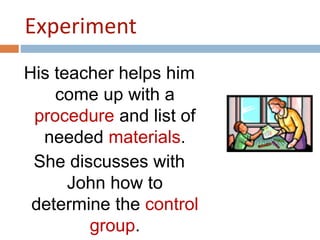
Experiment 
His teacher helps him 
come up with a 
procedure and list of 
needed materials. 
She discusses with 
John how to 
determine the control 
group.
Control Group 
In a scientific experiment, the control is 
the group that serves as the standard of 
comparison. 
The control group may be a “no 
treatment" or an “experimenter 
selected” group.
Control Group 
The control group is exposed to the same 
conditions as the experimental group, 
except for the variable being tested. 
All experiments should have a control 
group.
Control Group 
Because his grandmother always used 
50g. of sugar in her recipe, John is going 
to use that amount in his control group.
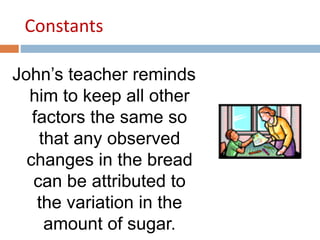
Constants 
John’s teacher reminds 
him to keep all other 
factors the same so 
that any observed 
changes in the bread 
can be attributed to 
the variation in the 
amount of sugar.
Constants 
The constants in an 
experiment are all the 
factors that the 
experimenter attempts 
to keep the same.
Can you think of some constants 
for this experiment?
Constants 
They might include: 
Other ingredients to the bread recipe, oven 
used, rise time, brand of ingredients, 
cooking time, type of pan used, air 
temperature and humidity where the bread 
was rising, oven temperature, age of the 
yeast…
Experiment 
John writes out his procedure for his 
experiment along with a materials 
list in his journal. He has both of 
these checked by his teacher where 
she checks for any safety concerns.
Trials 
Trials refer to replicate groups that 
are exposed to the same 
conditions in an experiment. 
John is going to test each sugar 
variable 3 times.
Collect and Analyze Results 
John comes up with a table he can 
use to record his data. 
John gets all his materials together 
and carries out his experiment.
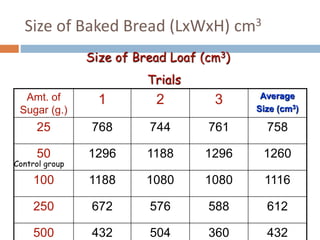
Size of Baked Bread (LxWxH) cm3 
Amt. of 
Sugar (g.) 
Size of Bread Loaf (cm3) 
Trials 
1 2 3 Average 
Size (cm3) 
25 768 744 761 758 
50 1296 1188 1296 1260 
Control group 
100 1188 1080 1080 1116 
250 672 576 588 612 
500 432 504 360 432
Collect and Analyze Results 
John examines his data and notices 
that his control worked the best in 
this experiment, but not significantly 
better than 100g. of sugar.
Conclusion 
John rejects his hypothesis, but 
decides to re-test using sugar 
amounts between 50g. and 
100g.
Experiment 
Once again, John 
gathers his materials 
and carries out his 
experiment. 
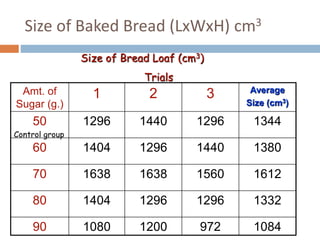
Here are the results.
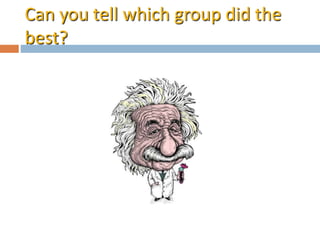
Can you tell which group did the 
best?
Size of Baked Bread (LxWxH) cm3 
Amt. of 
Sugar (g.) 
Size of Bread Loaf (cm3) 
Trials 
1 2 3 Average 
Size (cm3) 
50 1296 1440 1296 1344 
Control group 
60 1404 1296 1440 1380 
70 1638 1638 1560 1612 
80 1404 1296 1296 1332 
90 1080 1200 972 1084
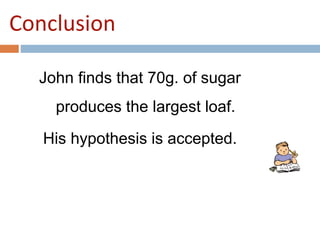
Conclusion 
John finds that 70g. of sugar 
produces the largest loaf. 
His hypothesis is accepted.
Communicate the Results 
John tells his 
grandmother about his 
findings and prepares 
to present his project.
 Every conclusion viewed through a scientific method 
must be verifiable. 
 Scientific laws are universally applicable and tested 
wherever one wants to check their veracity. 
 The scientific conclusions are predictable. 
 Scientific methods are objectivity based 
 Scientific methods employ a systematic approach.
Discuss in view of scientific methods as to how Newton 
ascertained Laws of Gravity by observing apple falling 
from tree
What is the difference between 
 Research Methods 
 Research Methodology 
Please Briefly differentiate!

Introduction to research

  • 1.
    ALL ABOUT RESEARCH– INTRODUCTION
  • 2.
    Issues...  Whyare we interested in research?  What is research?  Why must we understand research?  Key concepts and issues
  • 3.
    Why are weinterested in research?  Desire to get a research degree along with its consequential benefits;  Desire to face the challenge in solving the unsolved problems, i.e., concern over practical problems initiates research;  Desire to get intellectual joy of doing some creative work;  Desire to be of service to society;  Desire to get respectability.
  • 4.
    Why are weinterested in research?  Desire to support and enrich ideas;  Desire to increase credibility;  Desire to become familiar with gaps in the literature (lacking, inconclusive, contradictory and limited evidence;) And most importantly;  Desire to create knowledge.
  • 5.
    Why are weinterested in research?
  • 6.
    Why are weinterested in research?
  • 10.
    Why is researcha valued source of knowledge?  Common ways of knowing…  personal experience/intuition  experts/traditions/authority  scientific method
  • 11.
    What is Science,the Scientific Method, and Research?  Science…  a body of established knowledge  the observation, identification, investigation, and theoretical explanation of natural phenomenon usually the ultimate goal is theory generation and verification
  • 12.
    What is Science,the Scientific Method, and Research?  Theory…  a set of inter-related constructs and propositions that specify relations among variables to explain and predict phenomena  should be simple, consistent with observed relationships, tentative and verifiable
  • 13.
    What is Science,the Scientific Method, and Research?  Scientific Method…  involves the principles and processes regarded as characteristic of or necessary for scientific investigation  process or approach to generating valid and trustworthy knowledge
  • 14.
     What arethe fine line difference between discovery, invention and research?
  • 15.
    Research is not Accidental discovery : 1. Accidental discovery may occur in structured research process 2. Usually takes the form of a phenomenon not previously noticed 3. May lead to a structured research process to verify or understand the observation 15
  • 16.
    Research is not… cont. Data Collection • an intermediate step to gain reliable knowledge • collecting reliable data is part of the research process 16
  • 17.
    Research is not… cont. Searching out published research results in libraries (or the internet) • This is an important early step of research • The research process always includes synthesis and analysis • But, just reviewing of literature is not research 17
  • 18.
    What is Research? Search “Re – Search” Knowledge Scientific & Systematic search for information pertaining to topic of interest. Careful investigation or inquiry specially search of new facts in any branch of knowledge.
  • 19.
    Research is… 1.Searching for explanation of events, phenomena, relationships and causes – What, how and why things occur – Are there interactions? 2. A process – Planned and managed – to make the information generated credible – The process is creative – It is circular – always leads to more questions 19
  • 20.
    Research is…. The systematic investigation into and study of materials, sources, etc., in order to establish facts and reach new conclusions.  An endeavour to discover new or collate old facts etc., by the scientific study of a subject or by a course of critical investigation.
  • 21.
    Research is…. an activity that contributes to the understanding of a phenomenon [Kuhn, 1962; Lakatos, 1978]  phenomenon: a set of behaviors of some entity(ies) that is found interesting by a research community.  understanding: knowledge that allows prediction of the behavior of some aspect of the phenomenon.  activities considered appropriate to the production of understanding (knowledge) are the research methods and techniques of a research community.
  • 22.
    Research is…. “Researchis to see what everybody else has seen, and to think what nobody has thought.” Albert Szent-Gyorgy
  • 23.
    Notice that: “…truth was not used in the definition of research” “This concept of truth is outside of the productive realm of thinking by researchers” 23
  • 24.
    Why must weunderstand research?  help make informed decisions  need to produce research in career  evaluating research  assist in classes
  • 25.
    Characteristics of Research  objective  precise  verifiable  parsimonious  empirical  logical  probabilistic
  • 26.
  • 28.
  • 29.
  • 30.
  • 31.
    Research Process ExploringGoogle Scholar and other IT tools for Literature Review SCIENTIFIC RESEARCH DESIGN
  • 32.
    Research Process SCIENTIFIC RESEARCH DESIGN Effective use of Library Resources
  • 33.
  • 34.
  • 35.
  • 36.
    We shall takea closer look at these steps and the terminology you will need to understand before we start the training programme.
  • 37.
    Problem/Question Observation/Research Formulatea Hypothesis Experiment Collect and Analyze Results Conclusion Communicate the Results
  • 38.
    Steps of theScientific Method 1. Problem/Question: Develop a question or problem that can be solved through experimentation.
  • 39.
    Steps of theScientific Method 2.Observation/Research: Make observations and research your topic of interest.
  • 40.
    Do you rememberthe next step?
  • 41.
    Steps of theScientific Method 3. Formulate a Hypothesis: Predict a possible answer to the problem or question. Example: If soil temperatures rise, then plant growth will increase.
  • 42.
    Steps of theScientific Method 4. Experiment: Develop and follow a procedure. Include a detailed materials list. The outcome must be measurable (quantifiable).
  • 43.
    Steps of theScientific Method 5. Collect and Analyze Results: Modify the procedure if needed. Confirm the results by retesting. Include tables, graphs, and photographs.
  • 44.
    Steps of theScientific Method 6. Conclusion: Include a statement that accepts or rejects the hypothesis. Make recommendations for further study and possible improvements to the procedure.
  • 45.
    Steps of theScientific Method 7. Communicate the Results: Be prepared to present the project to an audience. Expect questions from the audience.
  • 46.
    Think you canname all seven steps? CoFCloloeOrmcmbPtmus raleouCEanrbntoxdvilencep aA cametaltnir u/oeHiasQmn liyty/oeuphzRnneoeeetst sRtRheieoasnruiucsllhttss
  • 47.
    Let’s put ourknowledge of the Scientific Method to a realistic example that includes some of the terms you’ll be needing to use and understand.
  • 48.
    Problem/Question John watcheshis grandmother bake bread. He ask his grandmother what makes the bread rise. She explains that yeast releases a gas as it feeds on sugar.
  • 53.
    Problem/Question John wondersif the amount of sugar used in the recipe will affect the size of the bread loaf?
  • 54.
    Caution! Be carefulhow you use effect and affect. Effect is usually a noun and affect, a verb. “ The effect of sugar amounts on the rising of bread.” “How does sugar affect the rising of bread?”
  • 55.
    Observation/Research John researchesthe areas of baking and fermentation and tries to come up with a way to test his question. He keeps all of his information on this topic in a journal.
  • 56.
    John talks withhis teacher and she gives him a Experimental Design Diagram to help him set up his investigation.
  • 58.
    Formulate a Hypothesis After talking with his teacher and conducting further research, he comes up with a hypothesis. “If more sugar is added, then the bread will rise higher.”
  • 59.
    Hypothesis The hypothesisis an educated guess about the relationship between the independent and dependent variables. Note: These variables will be defined in the next few slides.
  • 60.
    Do you knowthe difference between the independent and dependent variables?
  • 61.
    Independent Variable Theindependent, or manipulated variable, is a factor that’s intentionally varied by the experimenter. John is going to use 25g., 50g., 100g., 250g., 500g. of sugar in his experiment.
  • 62.
    Dependent Variable Thedependent, or responding variable, is the factor that may change as a result of changes made in the independent variable. In this case, it would be the size of the loaf of bread.
  • 63.
    Experiment His teacherhelps him come up with a procedure and list of needed materials. She discusses with John how to determine the control group.
  • 64.
    Control Group Ina scientific experiment, the control is the group that serves as the standard of comparison. The control group may be a “no treatment" or an “experimenter selected” group.
  • 65.
    Control Group Thecontrol group is exposed to the same conditions as the experimental group, except for the variable being tested. All experiments should have a control group.
  • 66.
    Control Group Becausehis grandmother always used 50g. of sugar in her recipe, John is going to use that amount in his control group.
  • 67.
    Constants John’s teacherreminds him to keep all other factors the same so that any observed changes in the bread can be attributed to the variation in the amount of sugar.
  • 68.
    Constants The constantsin an experiment are all the factors that the experimenter attempts to keep the same.
  • 69.
    Can you thinkof some constants for this experiment?
  • 70.
    Constants They mightinclude: Other ingredients to the bread recipe, oven used, rise time, brand of ingredients, cooking time, type of pan used, air temperature and humidity where the bread was rising, oven temperature, age of the yeast…
  • 71.
    Experiment John writesout his procedure for his experiment along with a materials list in his journal. He has both of these checked by his teacher where she checks for any safety concerns.
  • 72.
    Trials Trials referto replicate groups that are exposed to the same conditions in an experiment. John is going to test each sugar variable 3 times.
  • 73.
    Collect and AnalyzeResults John comes up with a table he can use to record his data. John gets all his materials together and carries out his experiment.
  • 74.
    Size of BakedBread (LxWxH) cm3 Amt. of Sugar (g.) Size of Bread Loaf (cm3) Trials 1 2 3 Average Size (cm3) 25 768 744 761 758 50 1296 1188 1296 1260 Control group 100 1188 1080 1080 1116 250 672 576 588 612 500 432 504 360 432
  • 75.
    Collect and AnalyzeResults John examines his data and notices that his control worked the best in this experiment, but not significantly better than 100g. of sugar.
  • 76.
    Conclusion John rejectshis hypothesis, but decides to re-test using sugar amounts between 50g. and 100g.
  • 77.
    Experiment Once again,John gathers his materials and carries out his experiment. Here are the results.
  • 78.
    Can you tellwhich group did the best?
  • 79.
    Size of BakedBread (LxWxH) cm3 Amt. of Sugar (g.) Size of Bread Loaf (cm3) Trials 1 2 3 Average Size (cm3) 50 1296 1440 1296 1344 Control group 60 1404 1296 1440 1380 70 1638 1638 1560 1612 80 1404 1296 1296 1332 90 1080 1200 972 1084
  • 80.
    Conclusion John findsthat 70g. of sugar produces the largest loaf. His hypothesis is accepted.
  • 81.
    Communicate the Results John tells his grandmother about his findings and prepares to present his project.
  • 82.
     Every conclusionviewed through a scientific method must be verifiable.  Scientific laws are universally applicable and tested wherever one wants to check their veracity.  The scientific conclusions are predictable.  Scientific methods are objectivity based  Scientific methods employ a systematic approach.
  • 83.
    Discuss in viewof scientific methods as to how Newton ascertained Laws of Gravity by observing apple falling from tree
  • 84.
    What is thedifference between  Research Methods  Research Methodology Please Briefly differentiate!