
+ 
Introduction 
to Probability, 
Disjoint and non-disjoint outcomes & 
Independence 
Slides edited by Valerio Di Fonzo for www.globalpolis.org 
Based on the work of Mine Çetinkaya-Rundel of OpenIntro 
The slides may be copied, edited, and/or shared via the CC BY-SA license
Random processes 
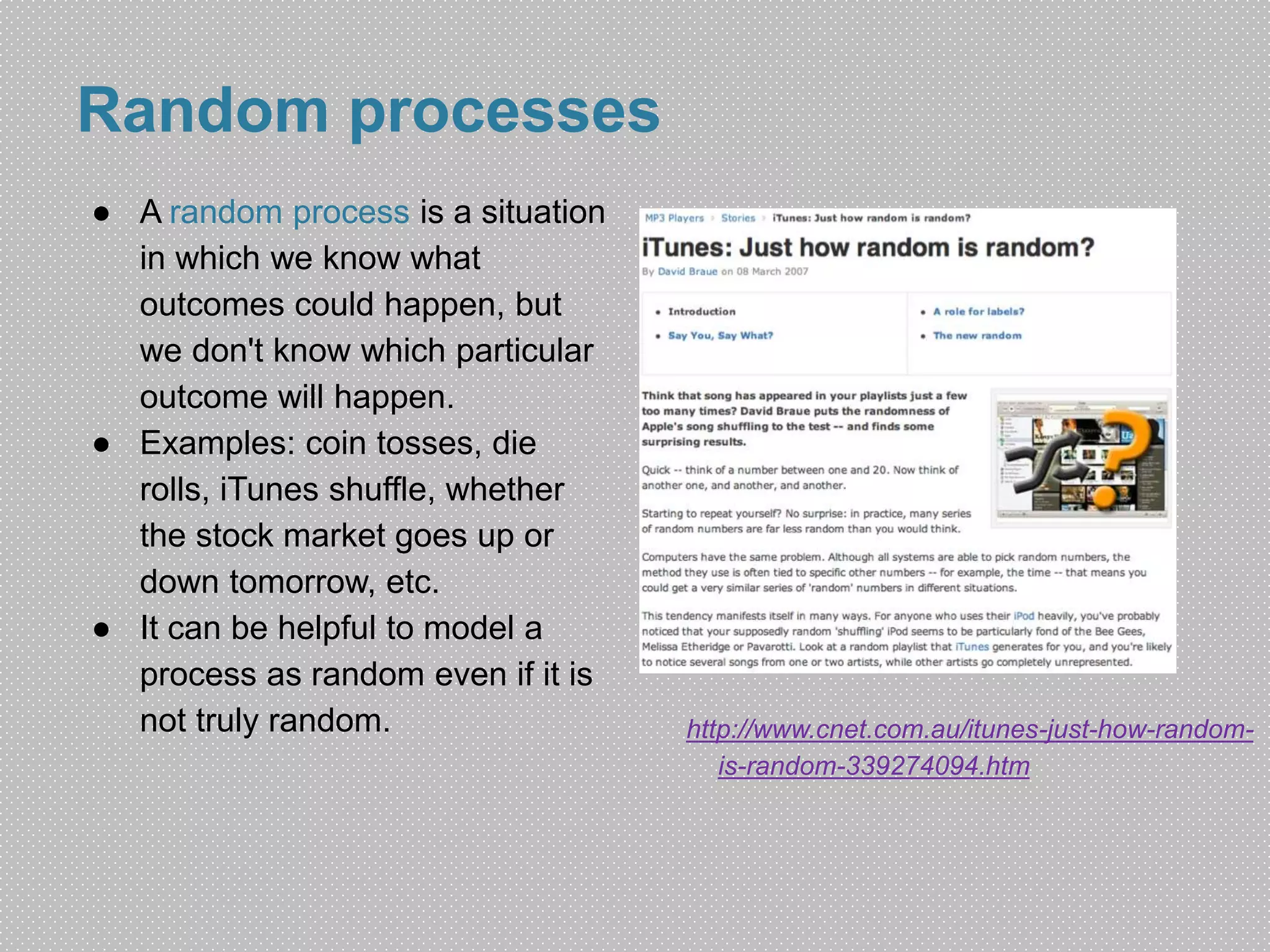
● A random process is a situation 
in which we know what 
outcomes could happen, but 
we don't know which particular 
outcome will happen. 
● Examples: coin tosses, die 
rolls, iTunes shuffle, whether 
the stock market goes up or 
down tomorrow, etc. 
● It can be helpful to model a 
process as random even if it is 
not truly random. http://www.cnet.com.au/itunes-just-how-random-is- 
random-339274094.htm
Probability 
There are several possible interpretations of probability but they (almost) 
completely agree on the mathematical rules probability must follow. 
● P(A) = Probability of event A 
● 0 ≤ P(A) ≤ 1 
Frequentist interpretation: 
● The probability of an outcome is the proportion of times the outcome 
would occur if we observed the random process an infinite number 
of times. 
Bayesian interpretation: 
● A Bayesian interprets probability as a subjective degree of belief: 
For the same event, two separate people could have different 
viewpoints and so assign different probabilities. 
● Largely popularized by revolutionary advance in computational 
technology and methods during the last twenty years.
Law of large numbers 
Law of large numbers states that as more observations are collected, 
the proportion of occurrences with a particular outcome, p^n, 
converges to the probability of that outcome, p.
Disjoint and non-disjoint outcomes 
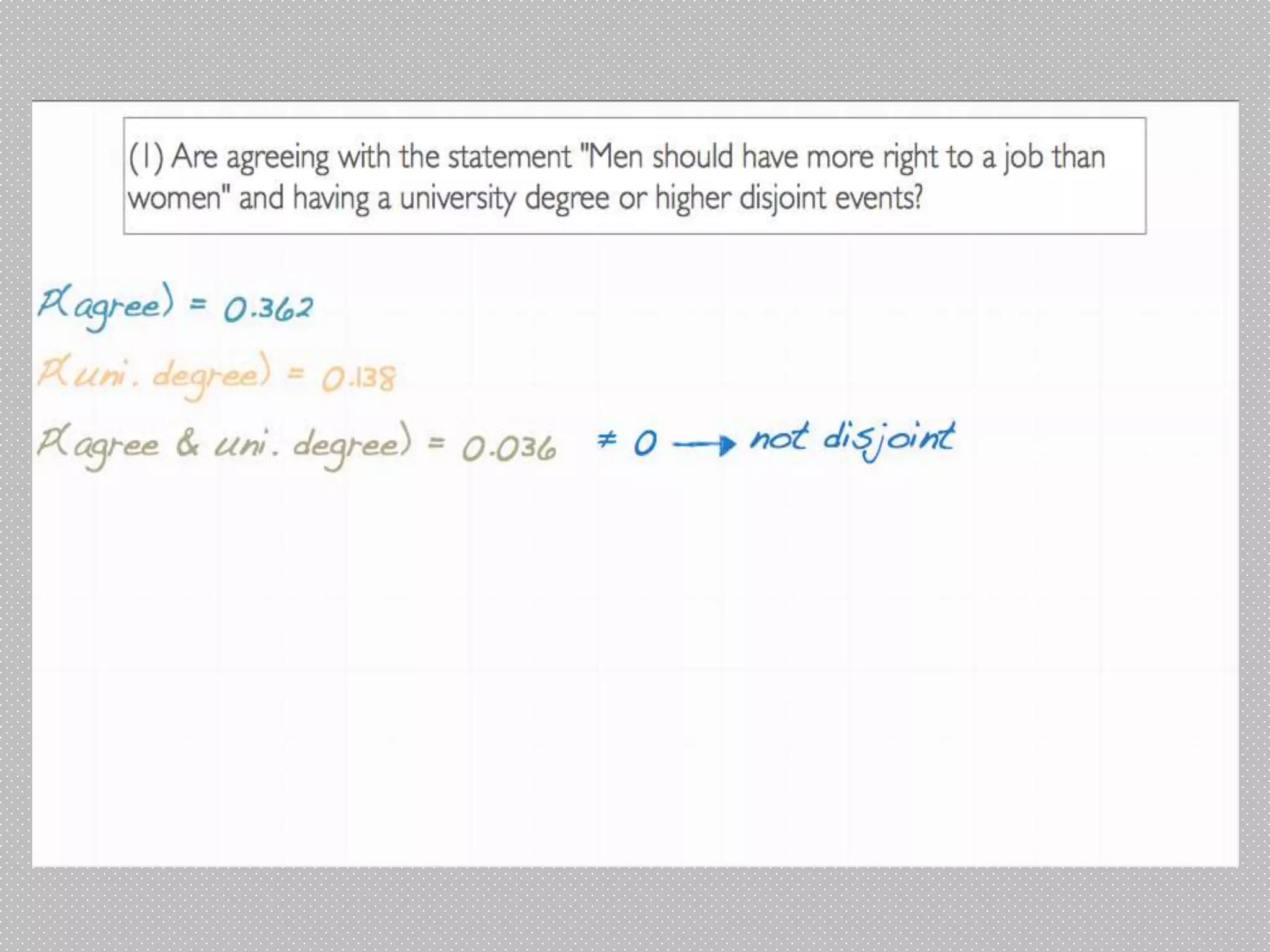
Disjoint (mutually exclusive) outcomes: Cannot happen at the 
same time. 
● The outcome of a single coin toss cannot be a head and 
a tail. 
● A student both cannot fail and pass a class. 
● A single card drawn from a deck cannot be an ace and 
a queen. 
Non-disjoint outcomes: Can happen at the same time. 
● A student can get an A in Stats and A in Econ in the same 
semester.
Union of non-disjoint events 
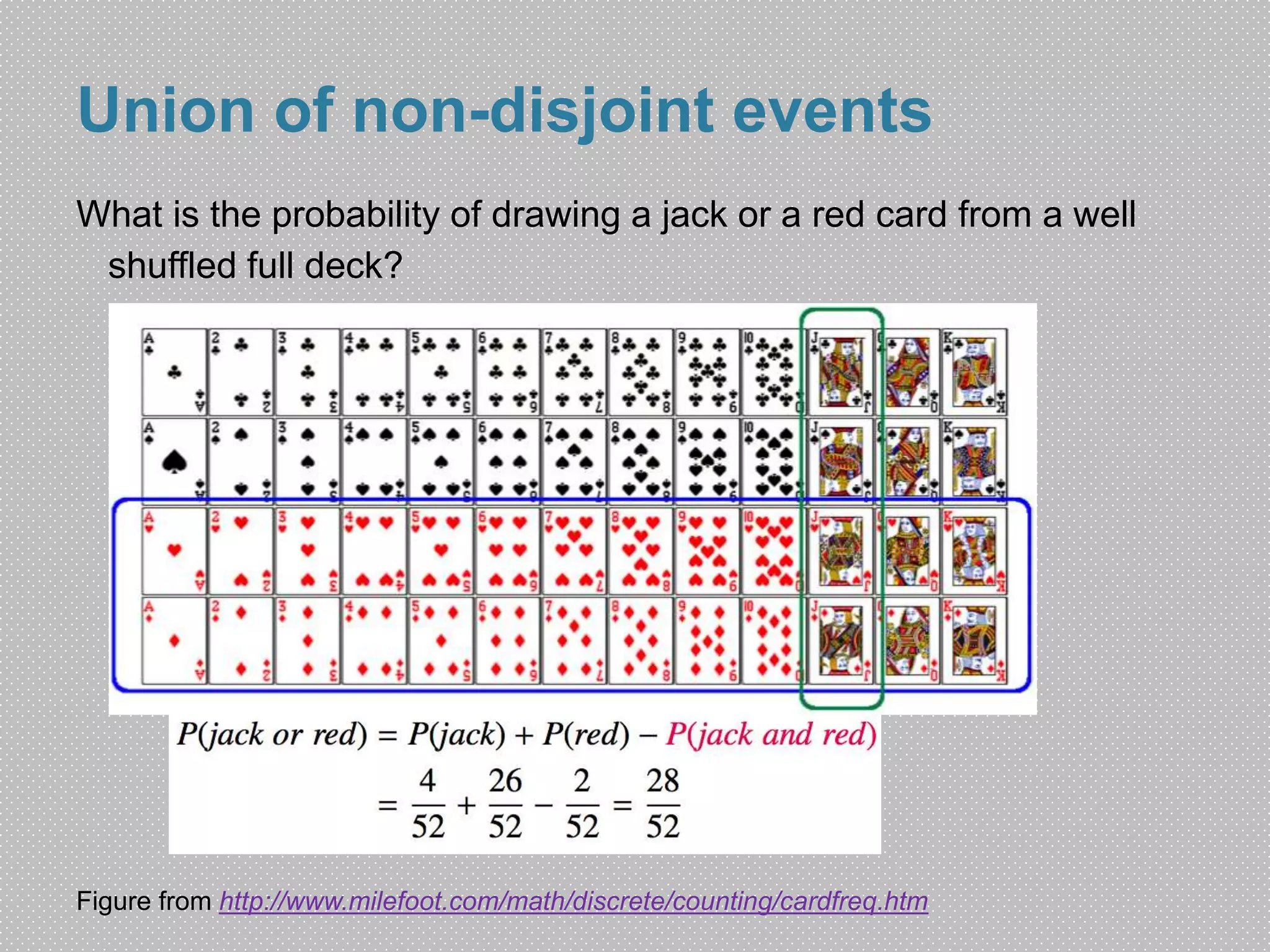
What is the probability of drawing a jack or a red card from a well 
shuffled full deck? 
Figure from http://www.milefoot.com/math/discrete/counting/cardfreq.htm
Practice 
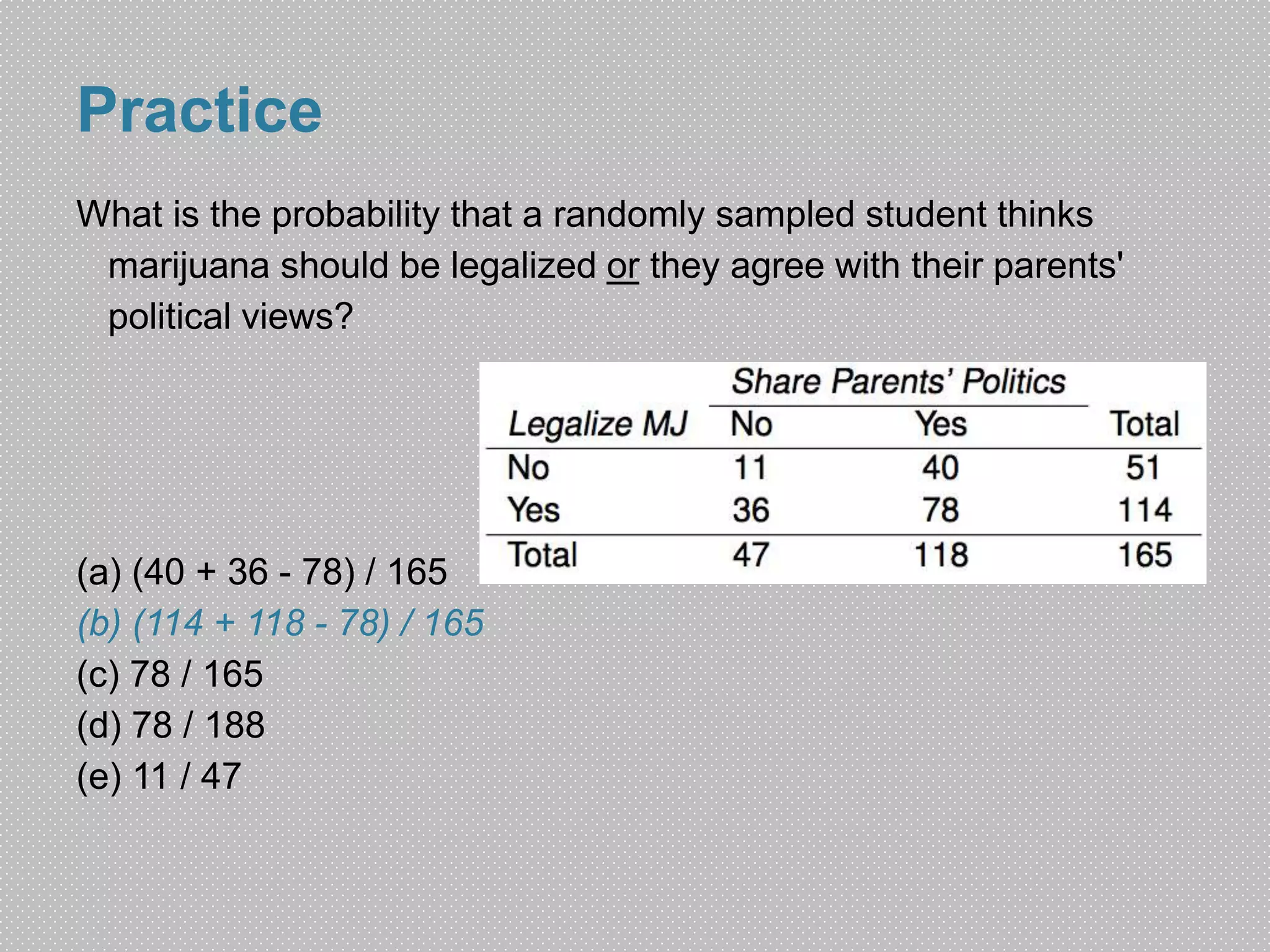
What is the probability that a randomly sampled student thinks 
marijuana should be legalized or they agree with their parents' 
political views? 
(a) (40 + 36 - 78) / 165 
(b) (114 + 118 - 78) / 165 
(c) 78 / 165 
(d) 78 / 188 
(e) 11 / 47
Recap 
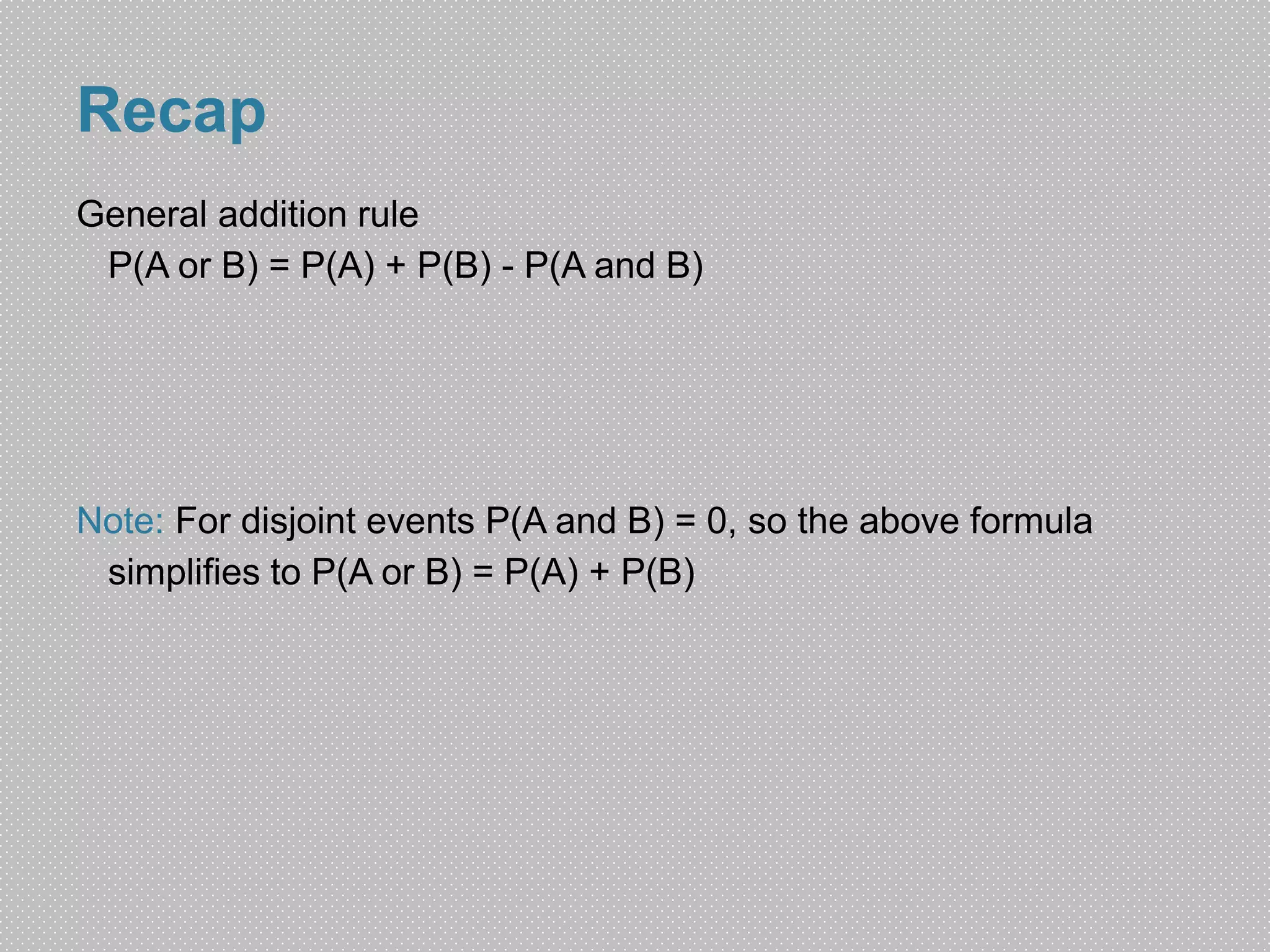
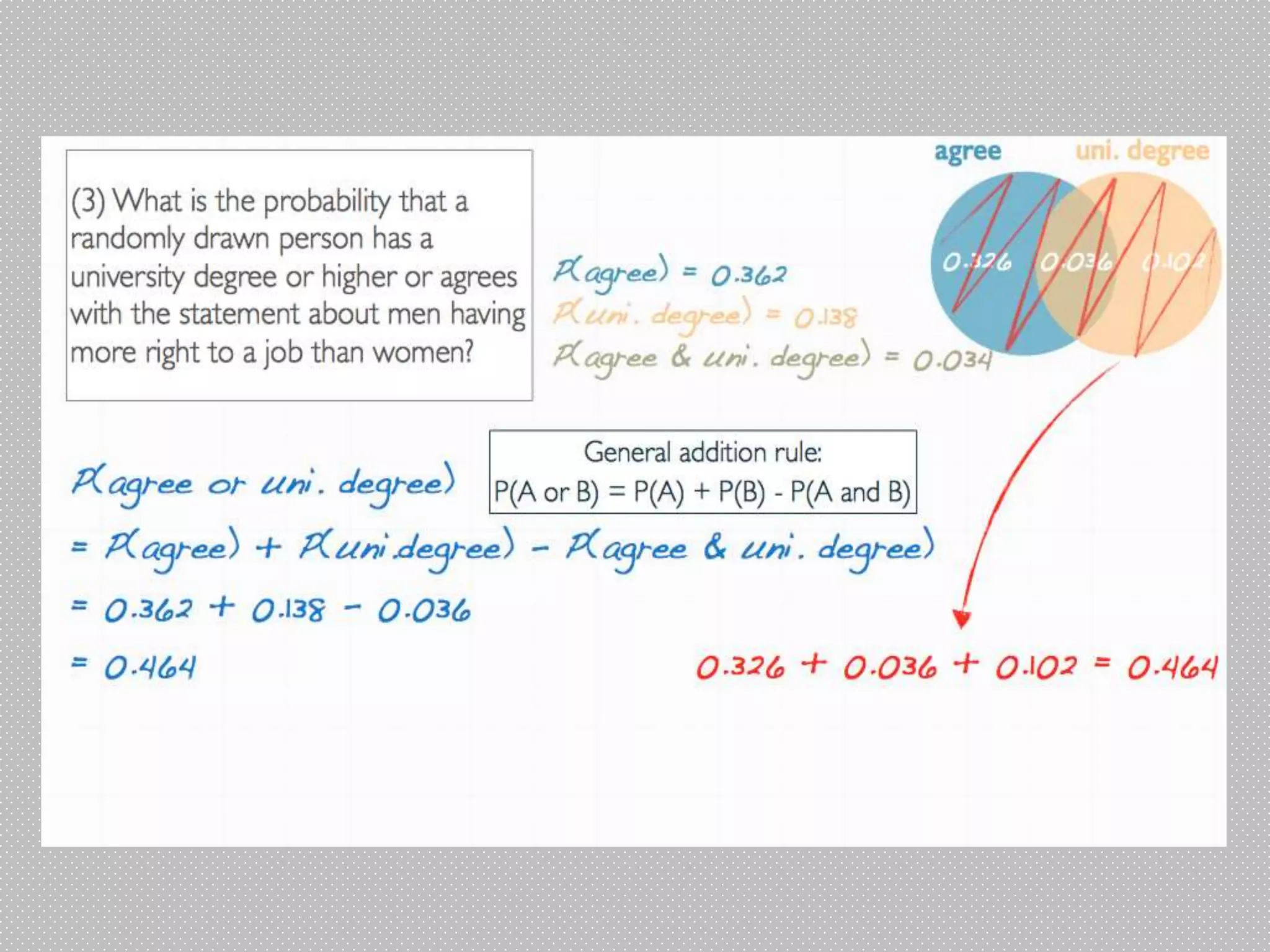
General addition rule 
P(A or B) = P(A) + P(B) - P(A and B) 
Note: For disjoint events P(A and B) = 0, so the above formula 
simplifies to P(A or B) = P(A) + P(B)
Probability distributions 
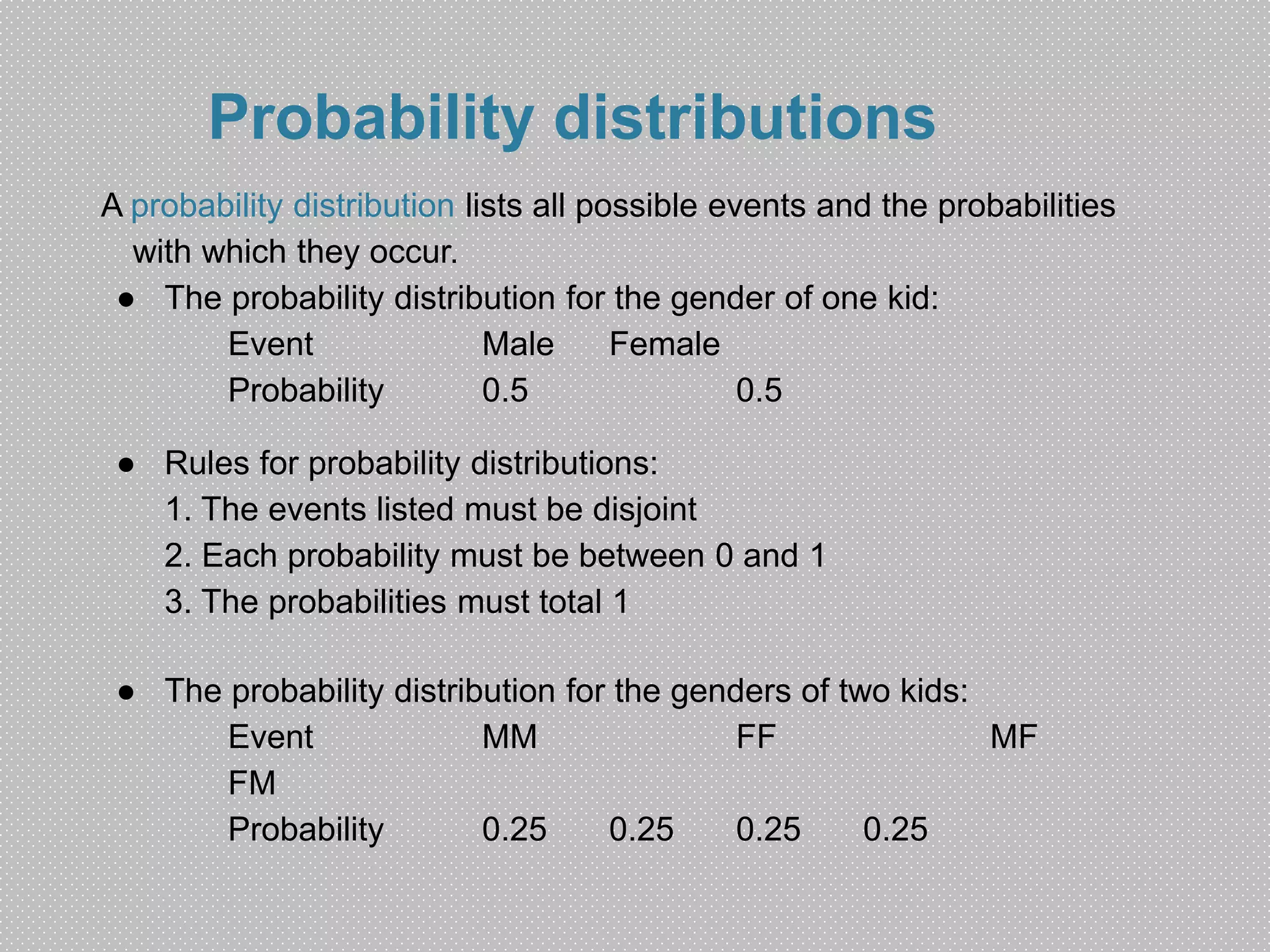
A probability distribution lists all possible events and the probabilities 
with which they occur. 
● The probability distribution for the gender of one kid: 
Event Male Female 
Probability 0.5 0.5 
● Rules for probability distributions: 
1. The events listed must be disjoint 
2. Each probability must be between 0 and 1 
3. The probabilities must total 1 
● The probability distribution for the genders of two kids: 
Event MM FF MF 
FM 
Probability 0.25 0.25 0.25 0.25
Practice 
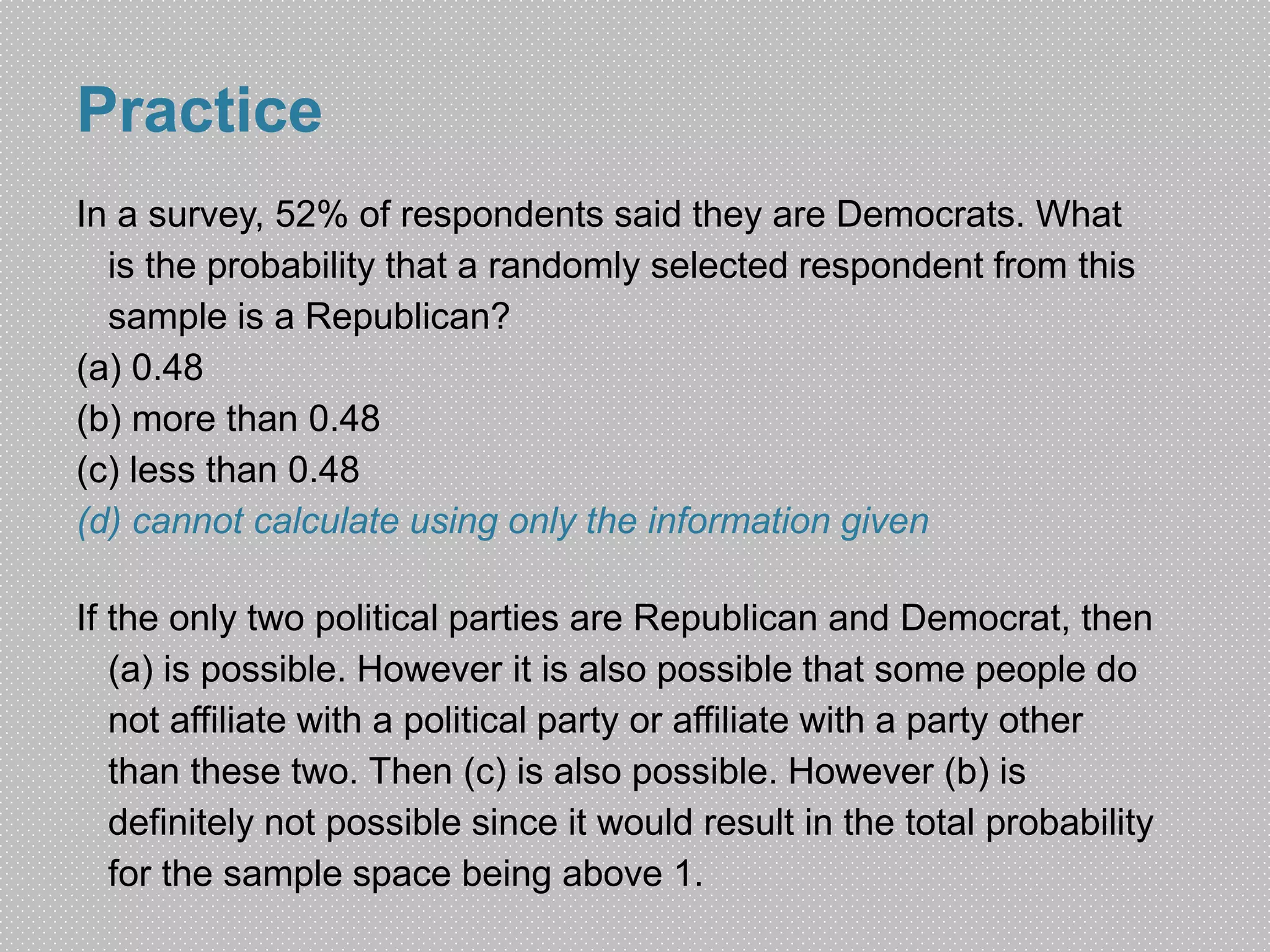
In a survey, 52% of respondents said they are Democrats. What 
is the probability that a randomly selected respondent from this 
sample is a Republican? 
(a) 0.48 
(b) more than 0.48 
(c) less than 0.48 
(d) cannot calculate using only the information given 
If the only two political parties are Republican and Democrat, then 
(a) is possible. However it is also possible that some people do 
not affiliate with a political party or affiliate with a party other 
than these two. Then (c) is also possible. However (b) is 
definitely not possible since it would result in the total probability 
for the sample space being above 1.
Practice 
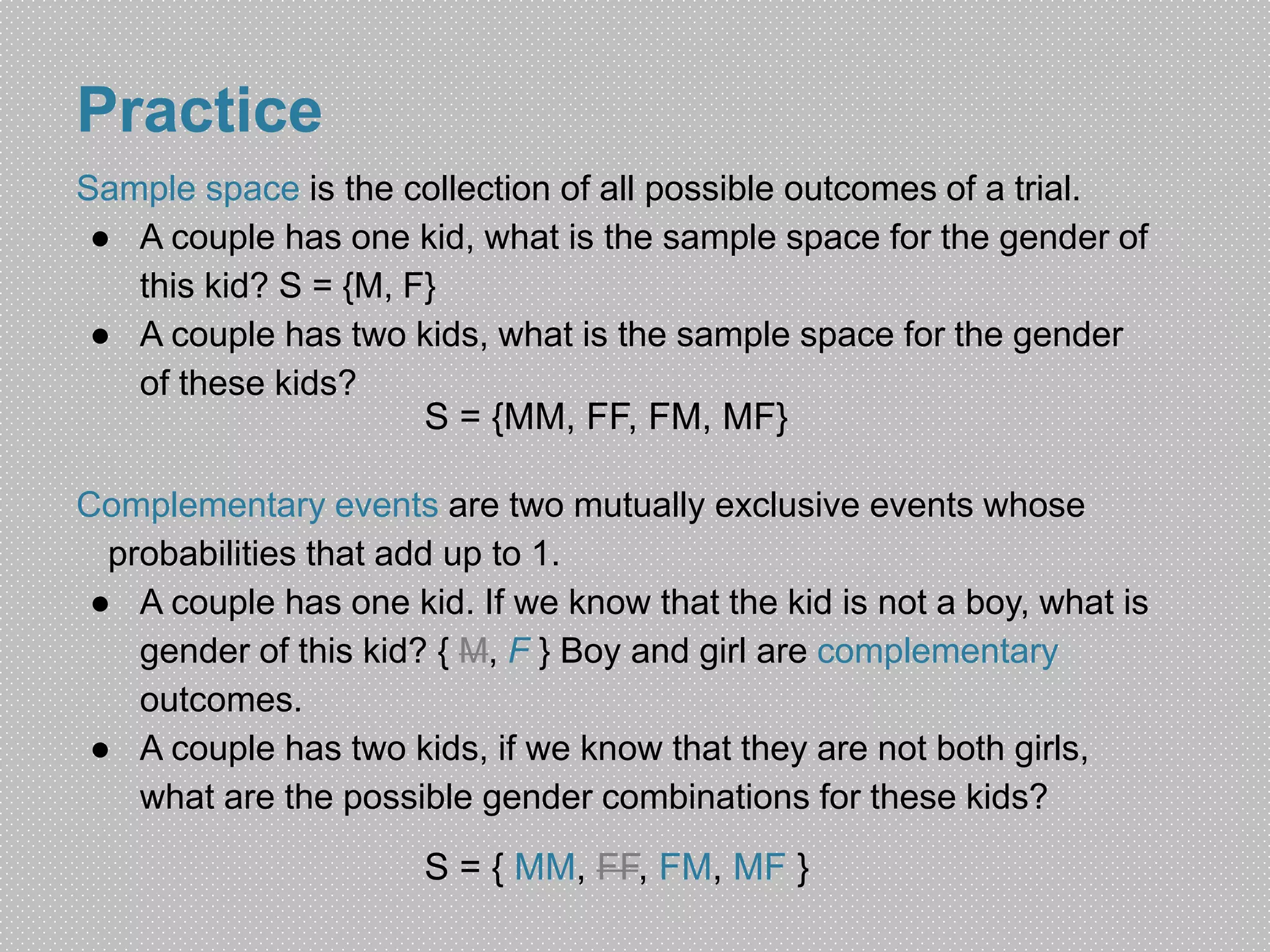
Sample space is the collection of all possible outcomes of a trial. 
● A couple has one kid, what is the sample space for the gender of 
this kid? S = {M, F} 
● A couple has two kids, what is the sample space for the gender 
of these kids? 
S = {MM, FF, FM, MF} 
Complementary events are two mutually exclusive events whose 
probabilities that add up to 1. 
● A couple has one kid. If we know that the kid is not a boy, what is 
gender of this kid? { M, F } Boy and girl are complementary 
outcomes. 
● A couple has two kids, if we know that they are not both girls, 
what are the possible gender combinations for these kids? 
S = { MM, FF, FM, MF }
Independence 
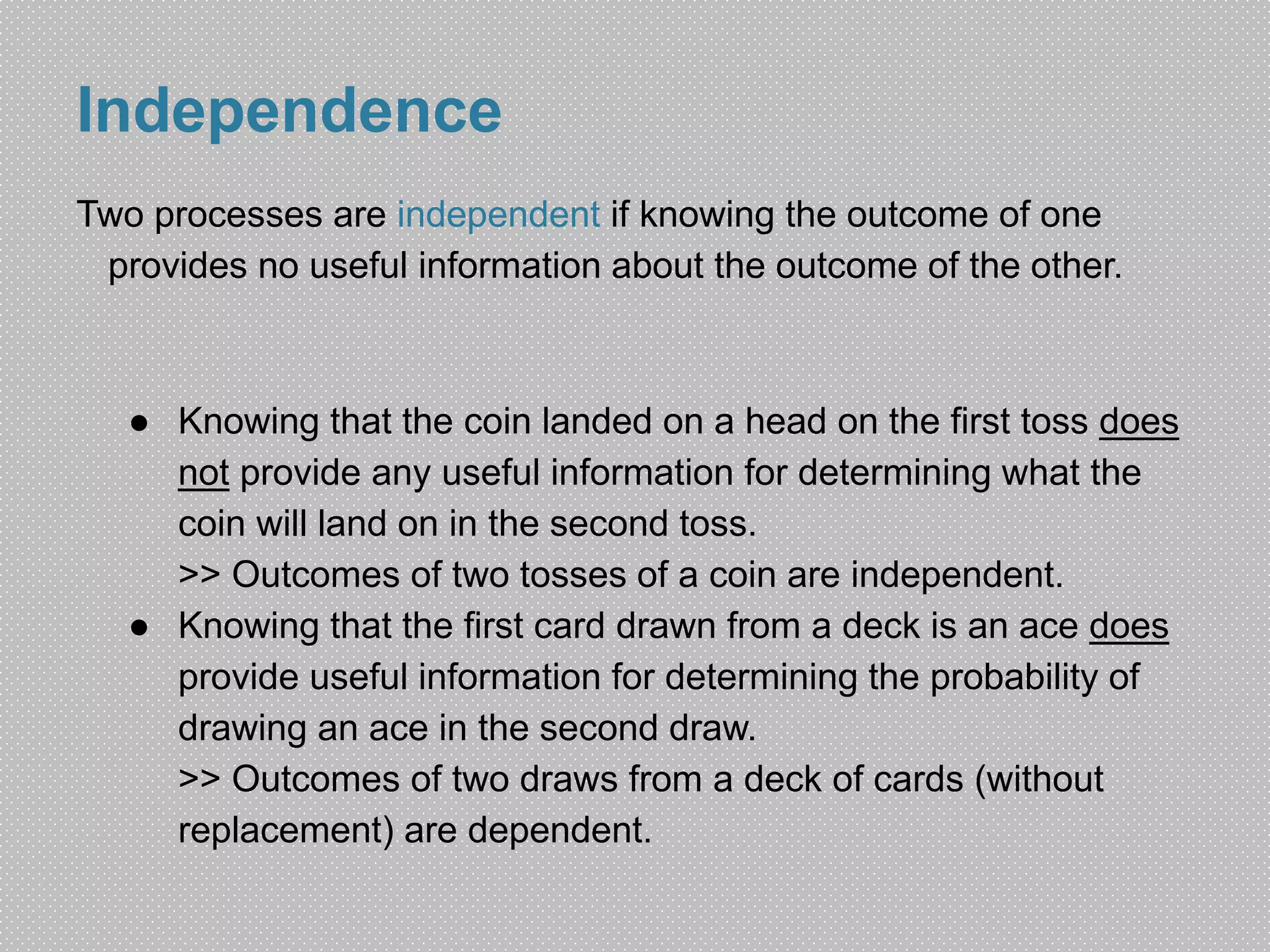
Two processes are independent if knowing the outcome of one 
provides no useful information about the outcome of the other. 
● Knowing that the coin landed on a head on the first toss does 
not provide any useful information for determining what the 
coin will land on in the second toss. 
>> Outcomes of two tosses of a coin are independent. 
● Knowing that the first card drawn from a deck is an ace does 
provide useful information for determining the probability of 
drawing an ace in the second draw. 
>> Outcomes of two draws from a deck of cards (without 
replacement) are dependent.
Practice 
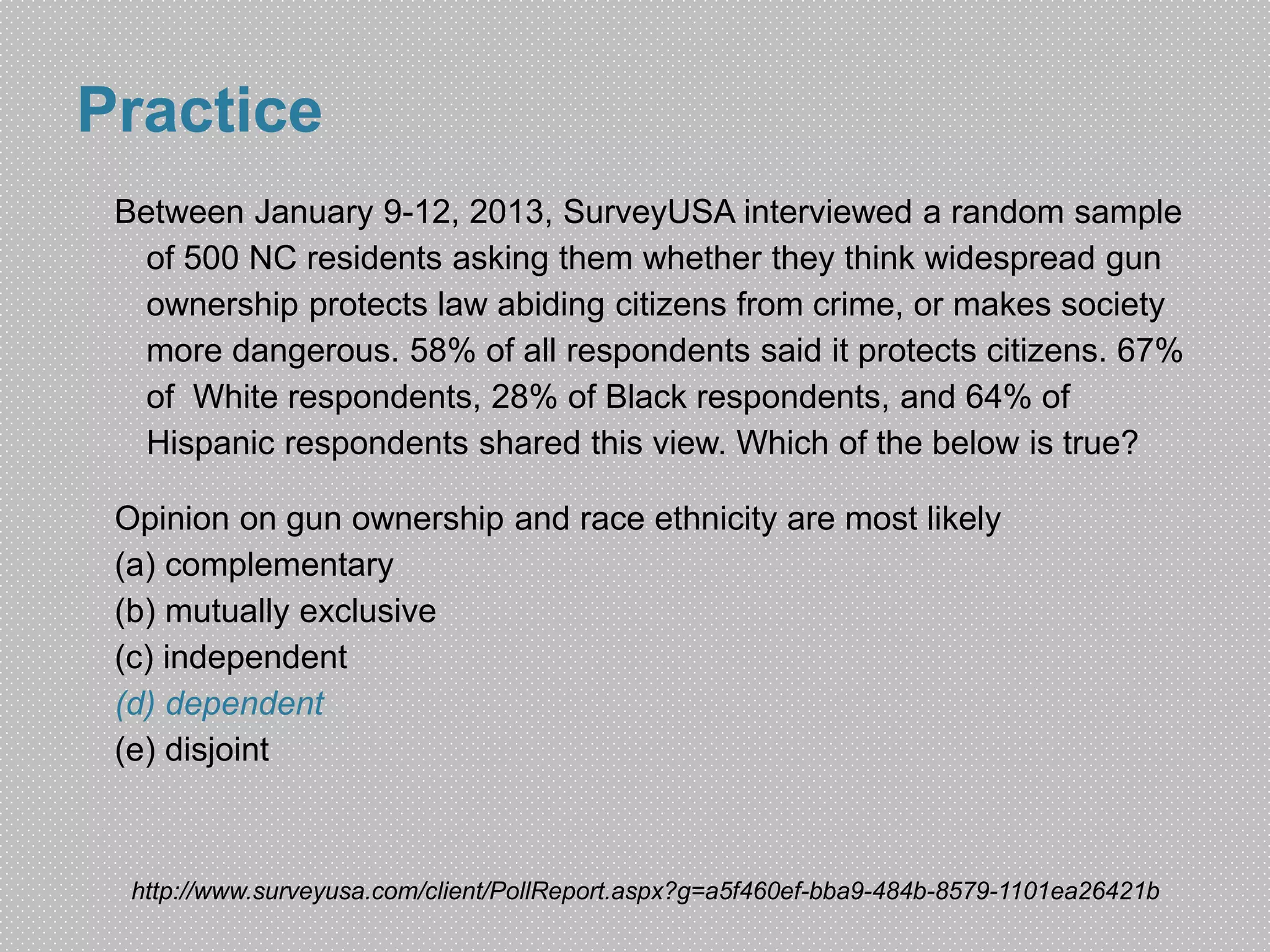
Between January 9-12, 2013, SurveyUSA interviewed a random sample 
of 500 NC residents asking them whether they think widespread gun 
ownership protects law abiding citizens from crime, or makes society 
more dangerous. 58% of all respondents said it protects citizens. 67% 
of White respondents, 28% of Black respondents, and 64% of 
Hispanic respondents shared this view. Which of the below is true? 
Opinion on gun ownership and race ethnicity are most likely 
(a) complementary 
(b) mutually exclusive 
(c) independent 
(d) dependent 
(e) disjoint 
http://www.surveyusa.com/client/PollReport.aspx?g=a5f460ef-bba9-484b-8579-1101ea26421b
Checking for independence 
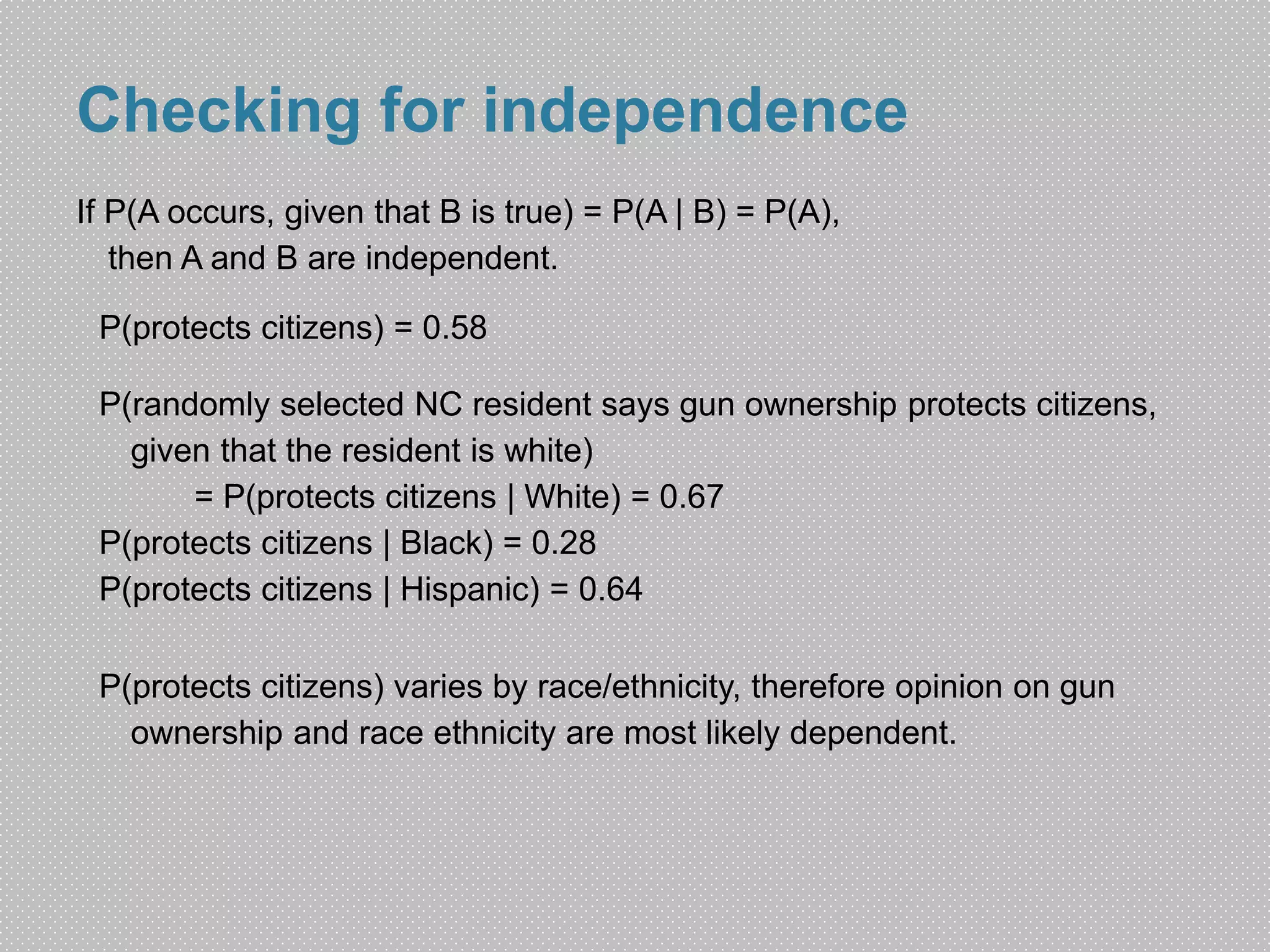
If P(A occurs, given that B is true) = P(A | B) = P(A), 
then A and B are independent. 
P(protects citizens) = 0.58 
P(randomly selected NC resident says gun ownership protects citizens, 
given that the resident is white) 
= P(protects citizens | White) = 0.67 
P(protects citizens | Black) = 0.28 
P(protects citizens | Hispanic) = 0.64 
P(protects citizens) varies by race/ethnicity, therefore opinion on gun 
ownership and race ethnicity are most likely dependent.
Determining dependence 
based on sample data 
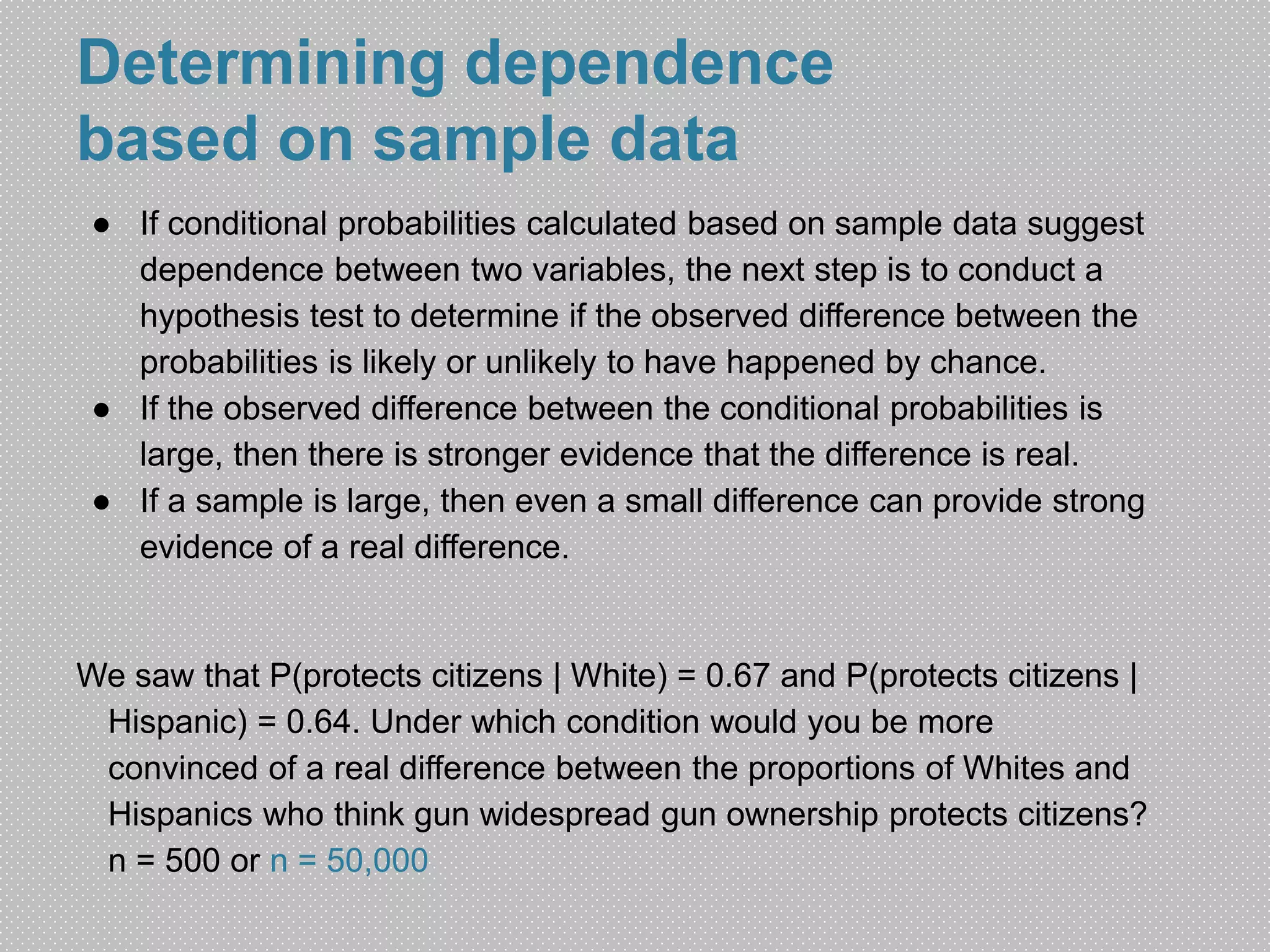
● If conditional probabilities calculated based on sample data suggest 
dependence between two variables, the next step is to conduct a 
hypothesis test to determine if the observed difference between the 
probabilities is likely or unlikely to have happened by chance. 
● If the observed difference between the conditional probabilities is 
large, then there is stronger evidence that the difference is real. 
● If a sample is large, then even a small difference can provide strong 
evidence of a real difference. 
We saw that P(protects citizens | White) = 0.67 and P(protects citizens | 
Hispanic) = 0.64. Under which condition would you be more 
convinced of a real difference between the proportions of Whites and 
Hispanics who think gun widespread gun ownership protects citizens? 
n = 500 or n = 50,000
Product rule for independent events 
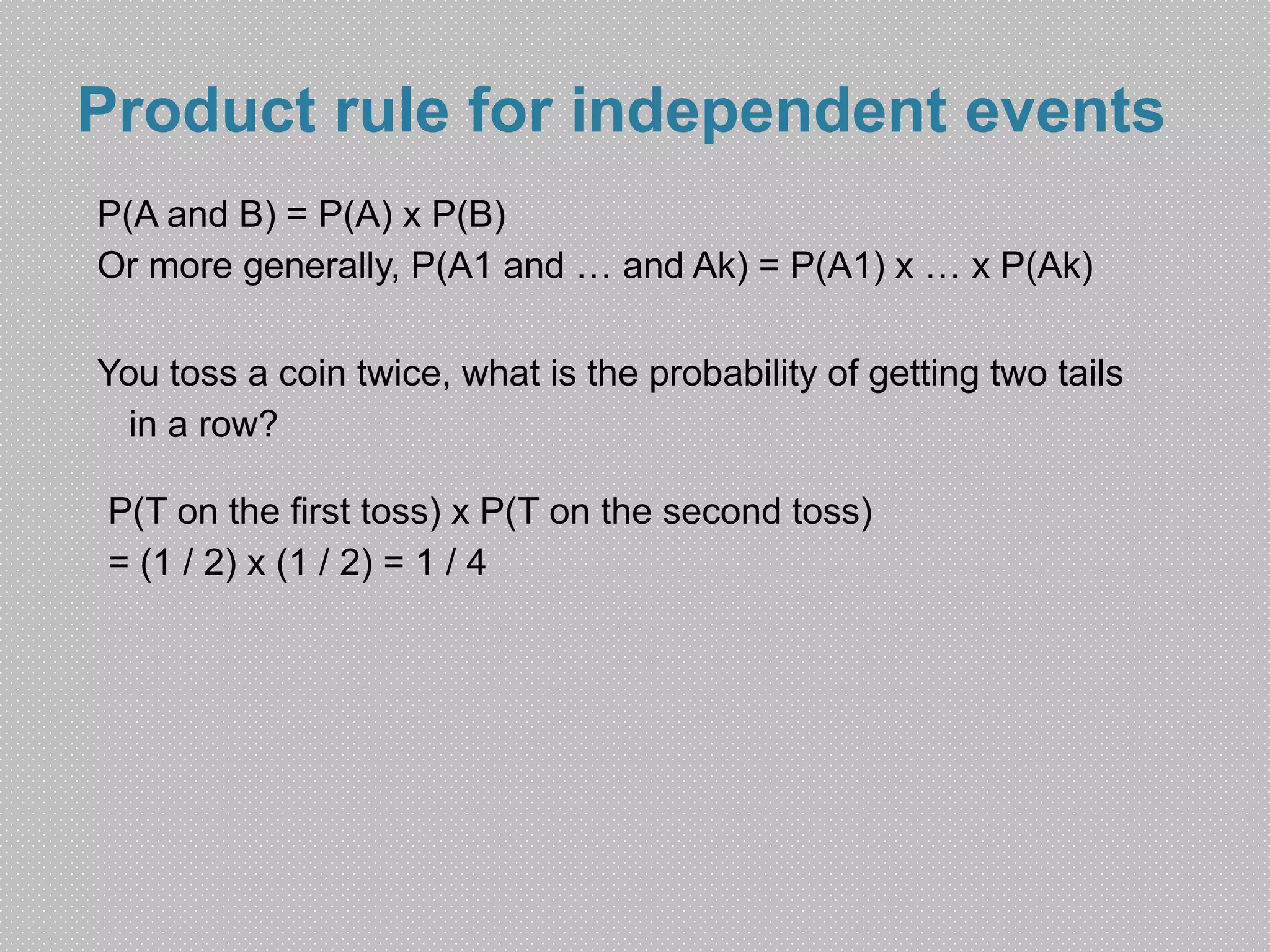
P(A and B) = P(A) x P(B) 
Or more generally, P(A1 and … and Ak) = P(A1) x … x P(Ak) 
You toss a coin twice, what is the probability of getting two tails 
in a row? 
P(T on the first toss) x P(T on the second toss) 
= (1 / 2) x (1 / 2) = 1 / 4
Practice 
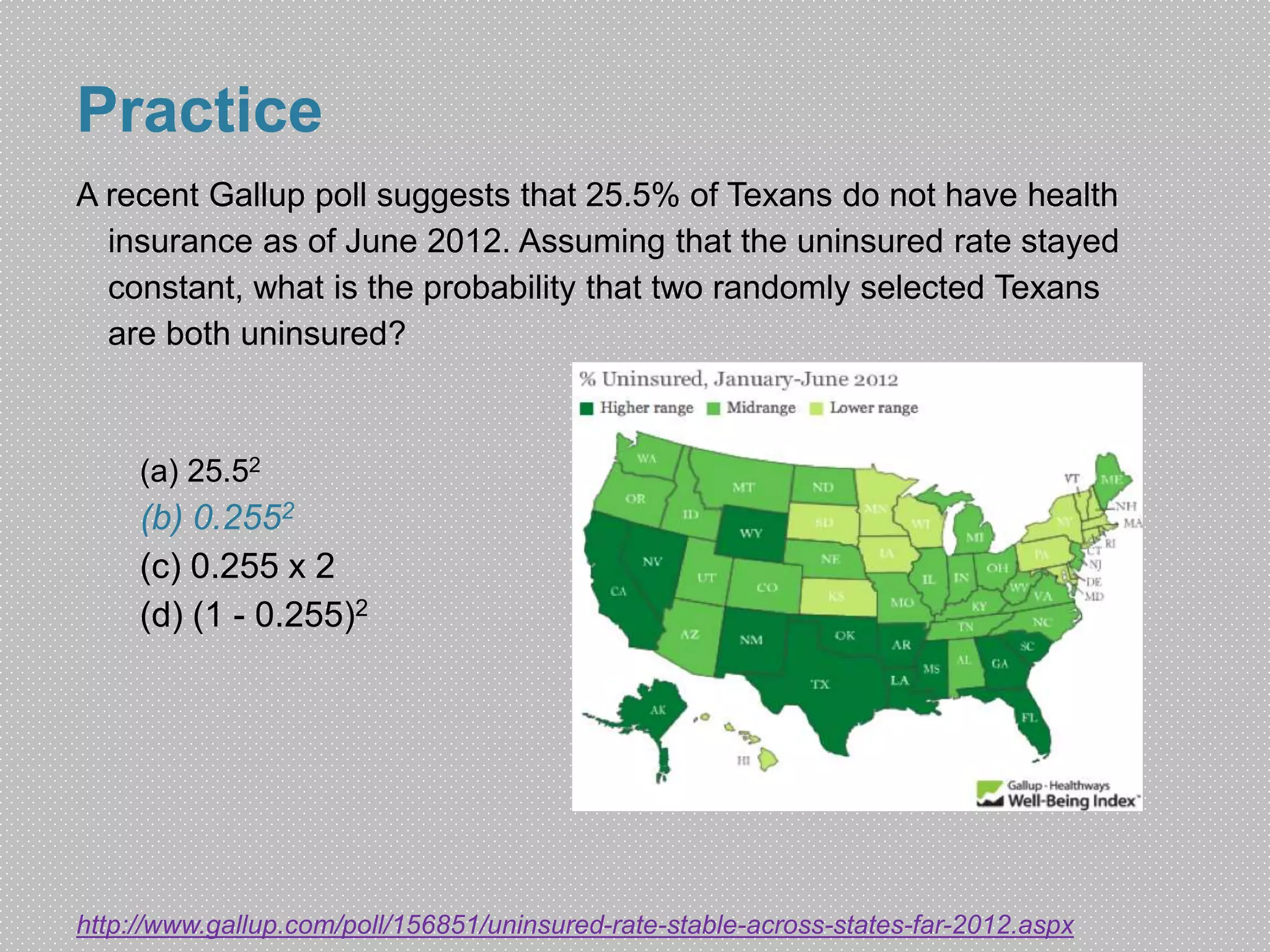
A recent Gallup poll suggests that 25.5% of Texans do not have health 
insurance as of June 2012. Assuming that the uninsured rate stayed 
constant, what is the probability that two randomly selected Texans 
are both uninsured? 
(a) 25.52 
(b) 0.2552 
(c) 0.255 x 2 
(d) (1 - 0.255)2 
http://www.gallup.com/poll/156851/uninsured-rate-stable-across-states-far-2012.aspx
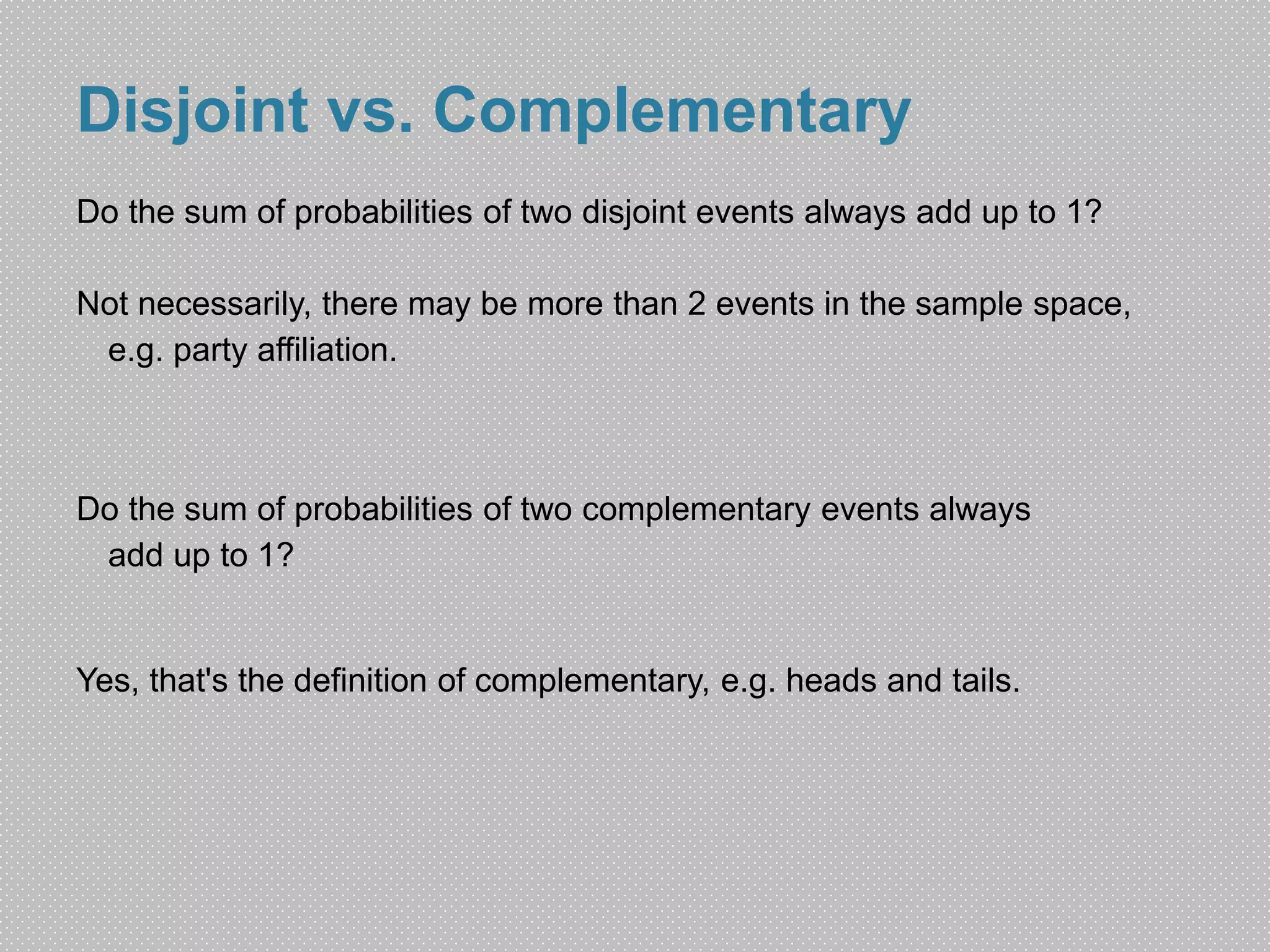
Disjoint vs. Complementary 
Do the sum of probabilities of two disjoint events always add up to 1? 
Not necessarily, there may be more than 2 events in the sample space, 
e.g. party affiliation. 
Do the sum of probabilities of two complementary events always 
add up to 1? 
Yes, that's the definition of complementary, e.g. heads and tails.
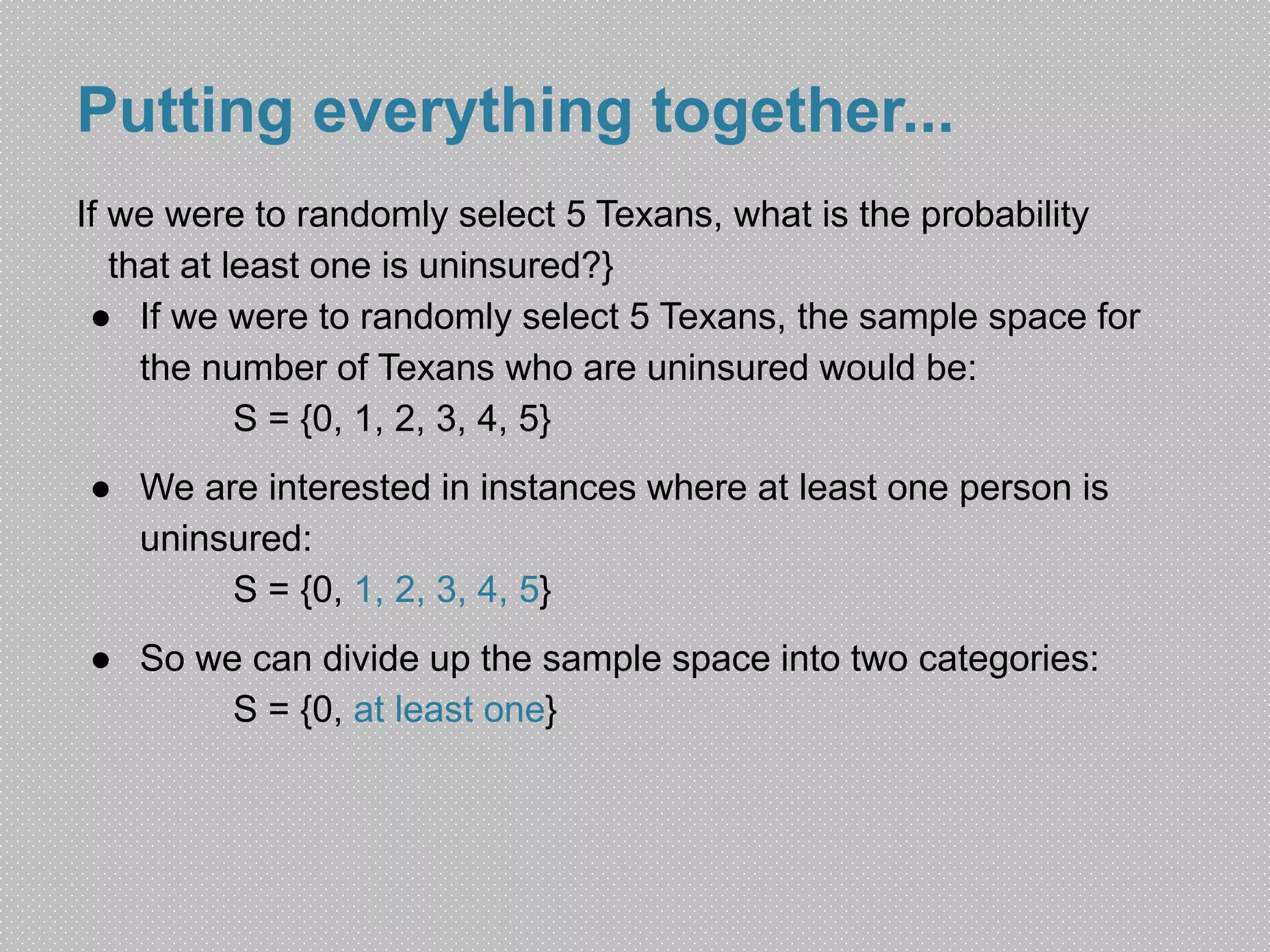
Putting everything together... 
If we were to randomly select 5 Texans, what is the probability 
that at least one is uninsured?} 
● If we were to randomly select 5 Texans, the sample space for 
the number of Texans who are uninsured would be: 
S = {0, 1, 2, 3, 4, 5} 
● We are interested in instances where at least one person is 
uninsured: 
S = {0, 1, 2, 3, 4, 5} 
● So we can divide up the sample space into two categories: 
S = {0, at least one}
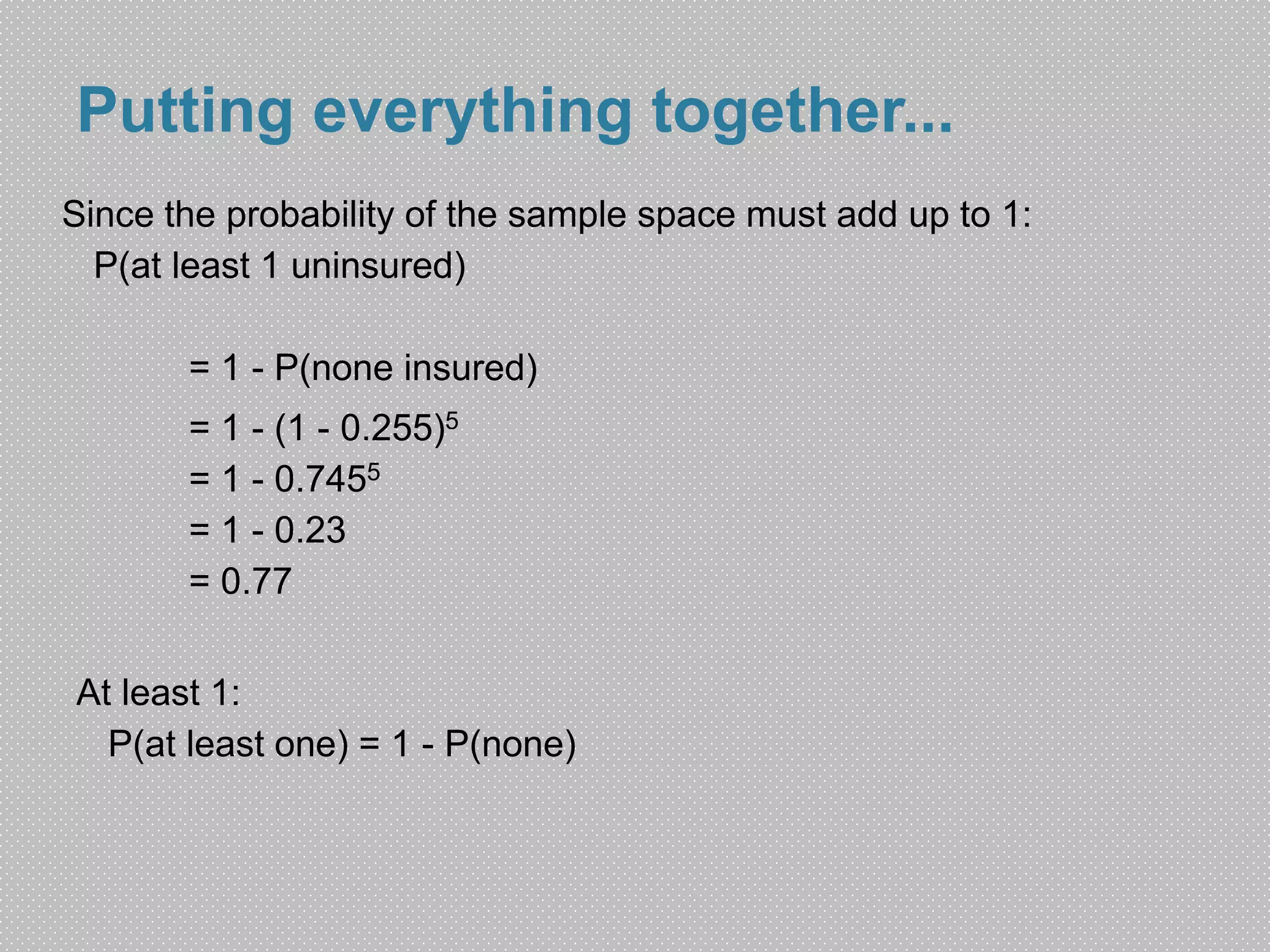
Putting everything together... 
Since the probability of the sample space must add up to 1: 
P(at least 1 uninsured) 
= 1 - P(none insured) 
= 1 - (1 - 0.255)5 
= 1 - 0.7455 
= 1 - 0.23 
= 0.77 
At least 1: 
P(at least one) = 1 - P(none)
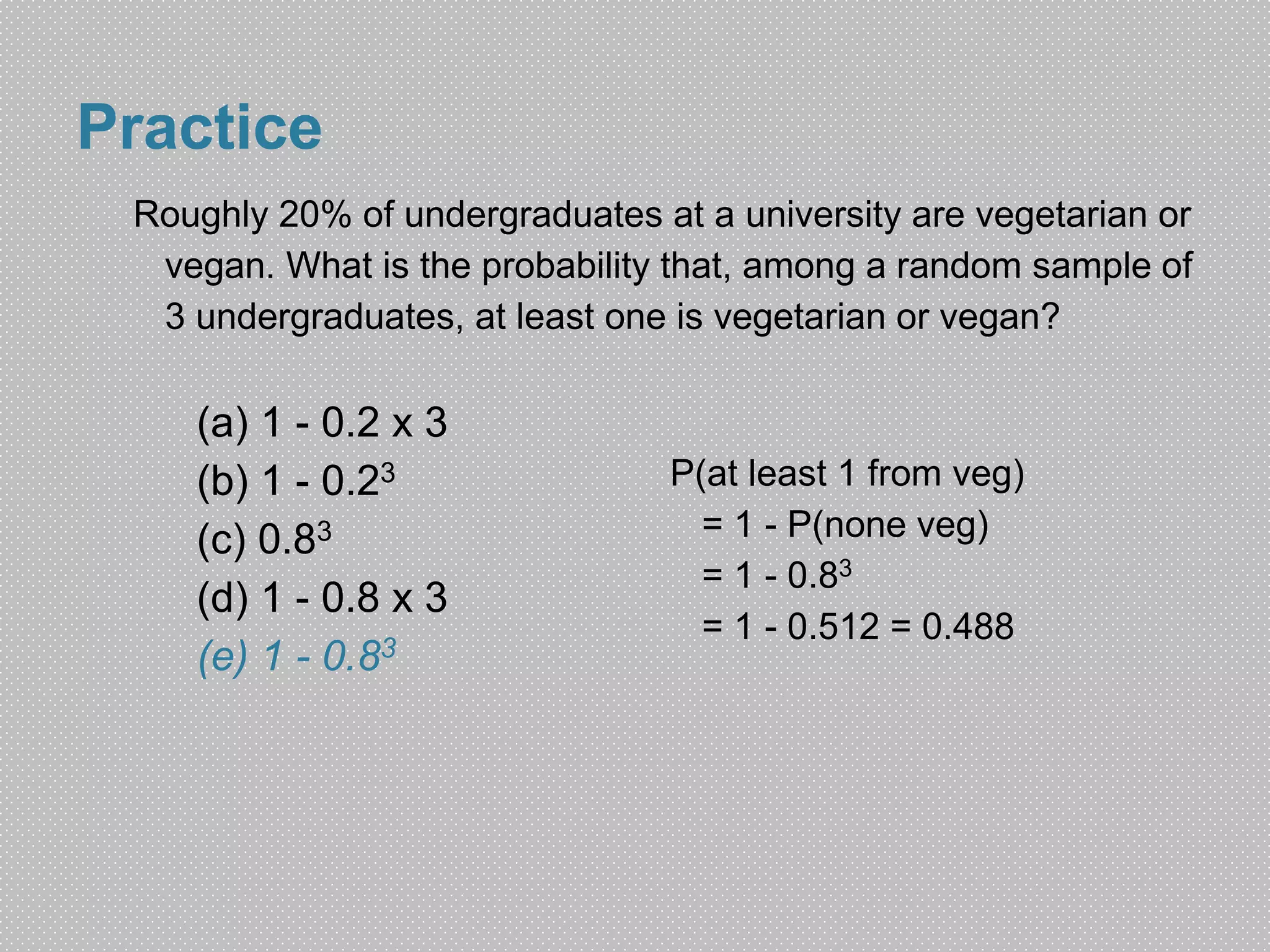
Practice 
Roughly 20% of undergraduates at a university are vegetarian or 
vegan. What is the probability that, among a random sample of 
3 undergraduates, at least one is vegetarian or vegan? 
P(at least 1 from veg) 
= 1 - P(none veg) 
= 1 - 0.83 
= 1 - 0.512 = 0.488 
(a) 1 - 0.2 x 3 
(b) 1 - 0.23 
(c) 0.83 
(d) 1 - 0.8 x 3 
(e) 1 - 0.83
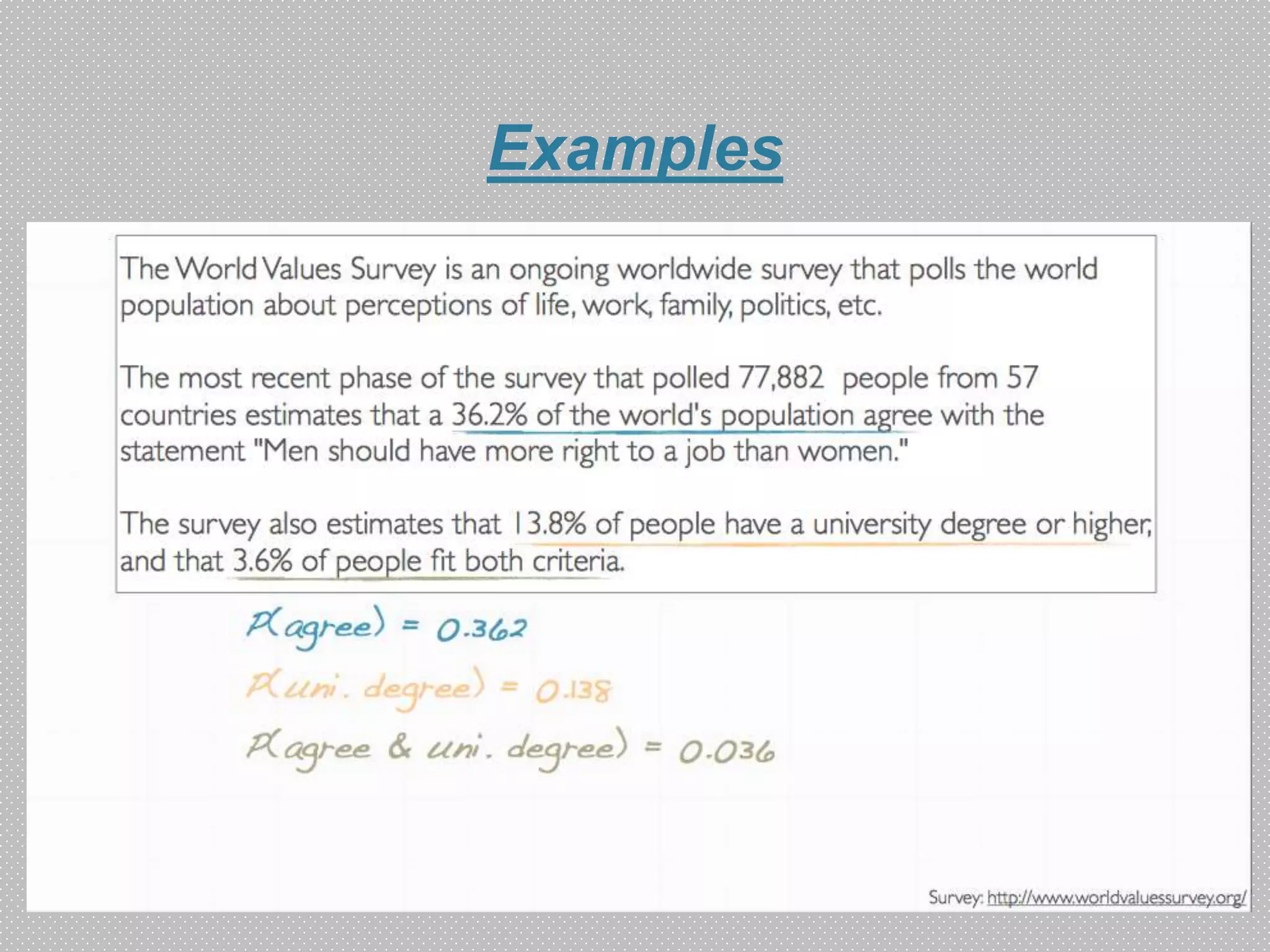
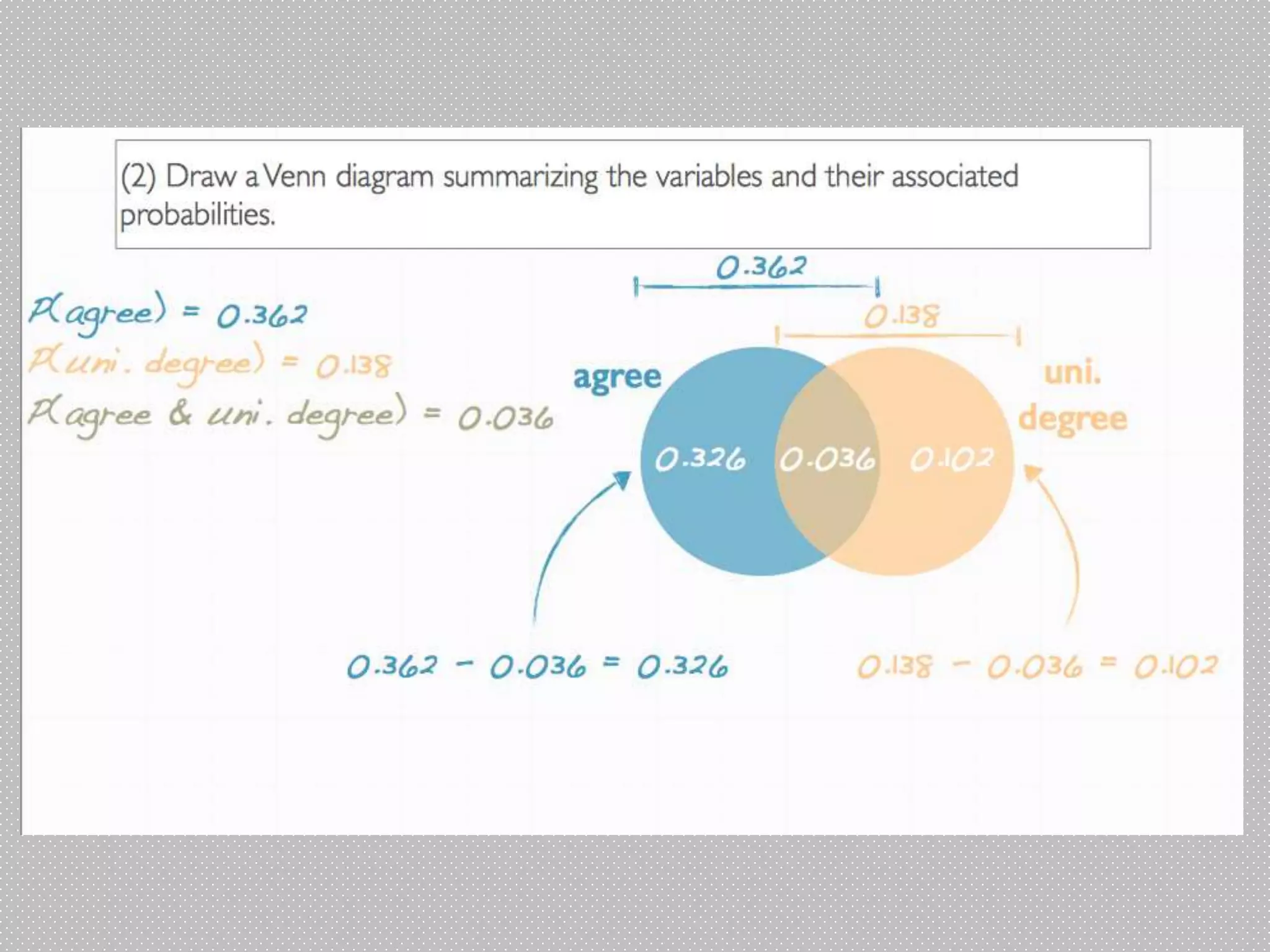
Examples
Introduction to probability

Introduction to probability

  • 1.
    + Introduction toProbability, Disjoint and non-disjoint outcomes & Independence Slides edited by Valerio Di Fonzo for www.globalpolis.org Based on the work of Mine Çetinkaya-Rundel of OpenIntro The slides may be copied, edited, and/or shared via the CC BY-SA license
  • 2.
    Random processes ●A random process is a situation in which we know what outcomes could happen, but we don't know which particular outcome will happen. ● Examples: coin tosses, die rolls, iTunes shuffle, whether the stock market goes up or down tomorrow, etc. ● It can be helpful to model a process as random even if it is not truly random. http://www.cnet.com.au/itunes-just-how-random-is- random-339274094.htm
  • 3.
    Probability There areseveral possible interpretations of probability but they (almost) completely agree on the mathematical rules probability must follow. ● P(A) = Probability of event A ● 0 ≤ P(A) ≤ 1 Frequentist interpretation: ● The probability of an outcome is the proportion of times the outcome would occur if we observed the random process an infinite number of times. Bayesian interpretation: ● A Bayesian interprets probability as a subjective degree of belief: For the same event, two separate people could have different viewpoints and so assign different probabilities. ● Largely popularized by revolutionary advance in computational technology and methods during the last twenty years.
  • 4.
    Law of largenumbers Law of large numbers states that as more observations are collected, the proportion of occurrences with a particular outcome, p^n, converges to the probability of that outcome, p.
  • 5.
    Disjoint and non-disjointoutcomes Disjoint (mutually exclusive) outcomes: Cannot happen at the same time. ● The outcome of a single coin toss cannot be a head and a tail. ● A student both cannot fail and pass a class. ● A single card drawn from a deck cannot be an ace and a queen. Non-disjoint outcomes: Can happen at the same time. ● A student can get an A in Stats and A in Econ in the same semester.
  • 6.
    Union of non-disjointevents What is the probability of drawing a jack or a red card from a well shuffled full deck? Figure from http://www.milefoot.com/math/discrete/counting/cardfreq.htm
  • 7.
    Practice What isthe probability that a randomly sampled student thinks marijuana should be legalized or they agree with their parents' political views? (a) (40 + 36 - 78) / 165 (b) (114 + 118 - 78) / 165 (c) 78 / 165 (d) 78 / 188 (e) 11 / 47
  • 8.
    Recap General additionrule P(A or B) = P(A) + P(B) - P(A and B) Note: For disjoint events P(A and B) = 0, so the above formula simplifies to P(A or B) = P(A) + P(B)
  • 9.
    Probability distributions Aprobability distribution lists all possible events and the probabilities with which they occur. ● The probability distribution for the gender of one kid: Event Male Female Probability 0.5 0.5 ● Rules for probability distributions: 1. The events listed must be disjoint 2. Each probability must be between 0 and 1 3. The probabilities must total 1 ● The probability distribution for the genders of two kids: Event MM FF MF FM Probability 0.25 0.25 0.25 0.25
  • 10.
    Practice In asurvey, 52% of respondents said they are Democrats. What is the probability that a randomly selected respondent from this sample is a Republican? (a) 0.48 (b) more than 0.48 (c) less than 0.48 (d) cannot calculate using only the information given If the only two political parties are Republican and Democrat, then (a) is possible. However it is also possible that some people do not affiliate with a political party or affiliate with a party other than these two. Then (c) is also possible. However (b) is definitely not possible since it would result in the total probability for the sample space being above 1.
  • 11.
    Practice Sample spaceis the collection of all possible outcomes of a trial. ● A couple has one kid, what is the sample space for the gender of this kid? S = {M, F} ● A couple has two kids, what is the sample space for the gender of these kids? S = {MM, FF, FM, MF} Complementary events are two mutually exclusive events whose probabilities that add up to 1. ● A couple has one kid. If we know that the kid is not a boy, what is gender of this kid? { M, F } Boy and girl are complementary outcomes. ● A couple has two kids, if we know that they are not both girls, what are the possible gender combinations for these kids? S = { MM, FF, FM, MF }
  • 12.
    Independence Two processesare independent if knowing the outcome of one provides no useful information about the outcome of the other. ● Knowing that the coin landed on a head on the first toss does not provide any useful information for determining what the coin will land on in the second toss. >> Outcomes of two tosses of a coin are independent. ● Knowing that the first card drawn from a deck is an ace does provide useful information for determining the probability of drawing an ace in the second draw. >> Outcomes of two draws from a deck of cards (without replacement) are dependent.
  • 13.
    Practice Between January9-12, 2013, SurveyUSA interviewed a random sample of 500 NC residents asking them whether they think widespread gun ownership protects law abiding citizens from crime, or makes society more dangerous. 58% of all respondents said it protects citizens. 67% of White respondents, 28% of Black respondents, and 64% of Hispanic respondents shared this view. Which of the below is true? Opinion on gun ownership and race ethnicity are most likely (a) complementary (b) mutually exclusive (c) independent (d) dependent (e) disjoint http://www.surveyusa.com/client/PollReport.aspx?g=a5f460ef-bba9-484b-8579-1101ea26421b
  • 14.
    Checking for independence If P(A occurs, given that B is true) = P(A | B) = P(A), then A and B are independent. P(protects citizens) = 0.58 P(randomly selected NC resident says gun ownership protects citizens, given that the resident is white) = P(protects citizens | White) = 0.67 P(protects citizens | Black) = 0.28 P(protects citizens | Hispanic) = 0.64 P(protects citizens) varies by race/ethnicity, therefore opinion on gun ownership and race ethnicity are most likely dependent.
  • 15.
    Determining dependence basedon sample data ● If conditional probabilities calculated based on sample data suggest dependence between two variables, the next step is to conduct a hypothesis test to determine if the observed difference between the probabilities is likely or unlikely to have happened by chance. ● If the observed difference between the conditional probabilities is large, then there is stronger evidence that the difference is real. ● If a sample is large, then even a small difference can provide strong evidence of a real difference. We saw that P(protects citizens | White) = 0.67 and P(protects citizens | Hispanic) = 0.64. Under which condition would you be more convinced of a real difference between the proportions of Whites and Hispanics who think gun widespread gun ownership protects citizens? n = 500 or n = 50,000
  • 16.
    Product rule forindependent events P(A and B) = P(A) x P(B) Or more generally, P(A1 and … and Ak) = P(A1) x … x P(Ak) You toss a coin twice, what is the probability of getting two tails in a row? P(T on the first toss) x P(T on the second toss) = (1 / 2) x (1 / 2) = 1 / 4
  • 17.
    Practice A recentGallup poll suggests that 25.5% of Texans do not have health insurance as of June 2012. Assuming that the uninsured rate stayed constant, what is the probability that two randomly selected Texans are both uninsured? (a) 25.52 (b) 0.2552 (c) 0.255 x 2 (d) (1 - 0.255)2 http://www.gallup.com/poll/156851/uninsured-rate-stable-across-states-far-2012.aspx
  • 18.
    Disjoint vs. Complementary Do the sum of probabilities of two disjoint events always add up to 1? Not necessarily, there may be more than 2 events in the sample space, e.g. party affiliation. Do the sum of probabilities of two complementary events always add up to 1? Yes, that's the definition of complementary, e.g. heads and tails.
  • 19.
    Putting everything together... If we were to randomly select 5 Texans, what is the probability that at least one is uninsured?} ● If we were to randomly select 5 Texans, the sample space for the number of Texans who are uninsured would be: S = {0, 1, 2, 3, 4, 5} ● We are interested in instances where at least one person is uninsured: S = {0, 1, 2, 3, 4, 5} ● So we can divide up the sample space into two categories: S = {0, at least one}
  • 20.
    Putting everything together... Since the probability of the sample space must add up to 1: P(at least 1 uninsured) = 1 - P(none insured) = 1 - (1 - 0.255)5 = 1 - 0.7455 = 1 - 0.23 = 0.77 At least 1: P(at least one) = 1 - P(none)
  • 21.
    Practice Roughly 20%of undergraduates at a university are vegetarian or vegan. What is the probability that, among a random sample of 3 undergraduates, at least one is vegetarian or vegan? P(at least 1 from veg) = 1 - P(none veg) = 1 - 0.83 = 1 - 0.512 = 0.488 (a) 1 - 0.2 x 3 (b) 1 - 0.23 (c) 0.83 (d) 1 - 0.8 x 3 (e) 1 - 0.83
  • 22.