PROBABILITY
CONCEPT & DISTRIBUTIONS
Group Members
1. ADITI THAPA
2. AGAM PRAKASH
3. ANANYA SINHA
4. ATUL INOCENT KHESS
5. AYUSH KUMAR ( SEC – B)
6. LAKSH RAJ
7. NAIME CHANDRA
8. SHAILEY SUMAN
9. SHREYA SHAH
10. SUMAN BARI
11. YASH KUMAR
02
THEORETICAL
CONCEPT
ADDITION AND
MULTIPLICATION
RULE
01
PROBABILITY
DISTRIBUTION
04
CONDITIONAL &
BAYES THEOREM
03
PROBABILITY
CONCEPT
1.
Probability is a branch of mathematics that deals with calculating the
likelihood of a given event's occurrence
SOME IMPORTANT TERMS
● TRIAL/EXPERIMENT
● EVENT/OUTCOME
● IMPOSSIBLE EVENT
● CERTAIN EVENT
WHAT IS
PROBABILITY
Probability of every event lie between ‘0’ and ‘1’
The concept of probability is of great importance in everyday life. Statistical
analysis is based on this valuable concept.
● BASIS OF STATISTICAL LAWS
● PREDICTION
● BUSINESS DECISIONS
● PERVASIVE
IMPORTANCE OF
PROBABILITY
TYPES OF PROBABILITY
CLASSICAL
We assume that all n
possible outcomes of a
particular experiment are
equally likely. And we
assign a probability of 1/n
to each possible
outcomes.
RELATIVE
P(A) = the limit as n
approaches infinity of m/n,
where n is the number of
times the process (e.g.,
tossing the die) is
performed, and m is the
number of times the
outcome A happens.
SUBJECTIVE
Subjective probability is an
individual person's measure
of belief that an event will
occur.
For eg – the patient has
50% chance of surviving a
certain operation
ADDITION &
MULTIPLICATION
RULE
2.
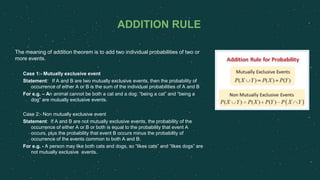
The meaning of addition theorem is to add two individual probabilities of two or
more events.
Case 1:- Mutually exclusive event
Statement: If A and B are two mutually exclusive events, then the probability of
occurrence of either A or B is the sum of the individual probabilities of A and B
For e.g. – An animal cannot be both a cat and a dog: “being a cat” and “being a
dog” are mutually exclusive events.
Case 2:- Non mutually exclusive event
Statement: If A and B are not mutually exclusive events, the probability of the
occurrence of either A or B or both is equal to the probability that event A
occurs, plus the probability that event B occurs minus the probability of
occurrence of the events common to both A and B.
For e.g. - A person may like both cats and dogs, so “likes cats” and “likes dogs” are
not mutually exclusive events.
ADDITION RULE
MULTIPLICATION RULE
The multiplication rule is a way to find the probability of two events happening at
the same time
Case 1 :- Independent event
The probability of occurring of the two events are independent of each other.
For eg - When we roll a die and then flip a coin. The number showing on the die has no
effect on the coin that was tossed.
Case 2 :- Dependent event
An event that is affected by previous events.
For eg – when you draw colored balls from a bag and the first ball is not replaced before you
draw the second ball then the outcome of the second draw will be affected by the
outcome of the first draw.
CONDITIONAL PROBABILITY
&
BAYES THEOREM
3.
Conditional probability is defined as the likelihood of an event or outcome
occurring, based on the occurrence of a previous event or outcome.
If events A and B are not independent, then the probability of the intersection of A and
B (the probability that both events occur) is defined by
P(A and B) = P(A)*P(B|A).
From this definition, the conditional probability P(B|A) is easily obtained by dividing
by P(A):
CONDITIONAL
PROBABILITY
BAYES THEOREM
In Probability theory and statistics BAYES THEOREM named after Thomas Bayes, is a mathematical formula for
determining Conditional Probability. It is also called as Bayes’ rule or Bayes’ law.
P(A|B) = [P(B|A) P(A)]/ P(B), where P(B) ≠ 0
PROBABILITY
DISTRIBUTION
4.
PROBABILITY
DISTRIBUTION
FUNCTION
IN PROBABILITY THEORY AND STATISTICS A PROBABILITY DISTRIBUTION IS THE
MATHEMATICAL FUNCTION THAT GIVES THE PROBABILITES OF
OCCURRENCE OF DIFFERENT POSSIBLE OUTCOMES FOR AN EXPERIMENT
Example of Probability distribution function include the weather condition in a future data,
the height of a person, the fraction of male students in a school etc.
TYPES OF PROBABILITY DISTRIBUTION
1. BINOMIAL DISTRIBUTION
The binomial distribution is a common discrete distribution used in statistics, as opposed to a
continuous distribution, such as the normal distribution.
FOR EXAMPLE - A coin toss has only two possible outcomes HEADS or TAILS and Taking a test can
have only two possible outcomes PASS or FAIL.
2. POISSON DISTRIBUTION
In probability theory and statistics, the Poisson distribution named after French mathematician Siméon
Denis Poisson, is a discrete probability distribution that expresses the probability of a given number of
events occurring in a fixed interval of time or space if these events occur with a known constant mean
rate and independently of the time since the last event.
REAL LIFE EXAMPLE – A textbook store rents an average of 200 books every Saturday night. Using this
data, you can predict the probability that more books will sell (perhaps 300 or 400) . on the following
Saturday night.
TYPES OF PROBABILITY DISTRIBUTION
3. NORMAL DISTRIBUTION
Normal distribution, also known as the Gaussian distribution, is a probability distribution that is symmetric
about the mean, showing that data near the mean are more frequent in occurrence than data far from
the mean. In graph form, normal distribution will appear as a bell curve.
THANKS!

PROBABILITY STATS PPT.pptx

  • 1.
  • 2.
    Group Members 1. ADITITHAPA 2. AGAM PRAKASH 3. ANANYA SINHA 4. ATUL INOCENT KHESS 5. AYUSH KUMAR ( SEC – B) 6. LAKSH RAJ 7. NAIME CHANDRA 8. SHAILEY SUMAN 9. SHREYA SHAH 10. SUMAN BARI 11. YASH KUMAR
  • 3.
  • 4.
  • 5.
    Probability is abranch of mathematics that deals with calculating the likelihood of a given event's occurrence SOME IMPORTANT TERMS ● TRIAL/EXPERIMENT ● EVENT/OUTCOME ● IMPOSSIBLE EVENT ● CERTAIN EVENT WHAT IS PROBABILITY Probability of every event lie between ‘0’ and ‘1’
  • 6.
    The concept ofprobability is of great importance in everyday life. Statistical analysis is based on this valuable concept. ● BASIS OF STATISTICAL LAWS ● PREDICTION ● BUSINESS DECISIONS ● PERVASIVE IMPORTANCE OF PROBABILITY
  • 7.
    TYPES OF PROBABILITY CLASSICAL Weassume that all n possible outcomes of a particular experiment are equally likely. And we assign a probability of 1/n to each possible outcomes. RELATIVE P(A) = the limit as n approaches infinity of m/n, where n is the number of times the process (e.g., tossing the die) is performed, and m is the number of times the outcome A happens. SUBJECTIVE Subjective probability is an individual person's measure of belief that an event will occur. For eg – the patient has 50% chance of surviving a certain operation
  • 8.
  • 9.
    The meaning ofaddition theorem is to add two individual probabilities of two or more events. Case 1:- Mutually exclusive event Statement: If A and B are two mutually exclusive events, then the probability of occurrence of either A or B is the sum of the individual probabilities of A and B For e.g. – An animal cannot be both a cat and a dog: “being a cat” and “being a dog” are mutually exclusive events. Case 2:- Non mutually exclusive event Statement: If A and B are not mutually exclusive events, the probability of the occurrence of either A or B or both is equal to the probability that event A occurs, plus the probability that event B occurs minus the probability of occurrence of the events common to both A and B. For e.g. - A person may like both cats and dogs, so “likes cats” and “likes dogs” are not mutually exclusive events. ADDITION RULE
  • 10.
    MULTIPLICATION RULE The multiplicationrule is a way to find the probability of two events happening at the same time Case 1 :- Independent event The probability of occurring of the two events are independent of each other. For eg - When we roll a die and then flip a coin. The number showing on the die has no effect on the coin that was tossed. Case 2 :- Dependent event An event that is affected by previous events. For eg – when you draw colored balls from a bag and the first ball is not replaced before you draw the second ball then the outcome of the second draw will be affected by the outcome of the first draw.
  • 11.
  • 12.
    Conditional probability isdefined as the likelihood of an event or outcome occurring, based on the occurrence of a previous event or outcome. If events A and B are not independent, then the probability of the intersection of A and B (the probability that both events occur) is defined by P(A and B) = P(A)*P(B|A). From this definition, the conditional probability P(B|A) is easily obtained by dividing by P(A): CONDITIONAL PROBABILITY
  • 13.
    BAYES THEOREM In Probabilitytheory and statistics BAYES THEOREM named after Thomas Bayes, is a mathematical formula for determining Conditional Probability. It is also called as Bayes’ rule or Bayes’ law. P(A|B) = [P(B|A) P(A)]/ P(B), where P(B) ≠ 0
  • 14.
  • 15.
    PROBABILITY DISTRIBUTION FUNCTION IN PROBABILITY THEORYAND STATISTICS A PROBABILITY DISTRIBUTION IS THE MATHEMATICAL FUNCTION THAT GIVES THE PROBABILITES OF OCCURRENCE OF DIFFERENT POSSIBLE OUTCOMES FOR AN EXPERIMENT Example of Probability distribution function include the weather condition in a future data, the height of a person, the fraction of male students in a school etc.
  • 16.
    TYPES OF PROBABILITYDISTRIBUTION 1. BINOMIAL DISTRIBUTION The binomial distribution is a common discrete distribution used in statistics, as opposed to a continuous distribution, such as the normal distribution. FOR EXAMPLE - A coin toss has only two possible outcomes HEADS or TAILS and Taking a test can have only two possible outcomes PASS or FAIL. 2. POISSON DISTRIBUTION In probability theory and statistics, the Poisson distribution named after French mathematician Siméon Denis Poisson, is a discrete probability distribution that expresses the probability of a given number of events occurring in a fixed interval of time or space if these events occur with a known constant mean rate and independently of the time since the last event. REAL LIFE EXAMPLE – A textbook store rents an average of 200 books every Saturday night. Using this data, you can predict the probability that more books will sell (perhaps 300 or 400) . on the following Saturday night.
  • 17.
    TYPES OF PROBABILITYDISTRIBUTION 3. NORMAL DISTRIBUTION Normal distribution, also known as the Gaussian distribution, is a probability distribution that is symmetric about the mean, showing that data near the mean are more frequent in occurrence than data far from the mean. In graph form, normal distribution will appear as a bell curve.
  • 18.