Foundations of
      Mathematics
Week 7: Probability
Subjective, empirical and theoretical
             probability


                                David Radcliffe
                               October 28, 2005


                  1
What is probability?
• Probability is a mathematical tool for making decisions in an uncertain
  world.
• The probability of an event is a number between 0 and 1 that expresses
  how likely it is to occur.
• Probability 0 means that the event is impossible.
• Probability 1 (or 100%) means that the event is certain.
• The greater the probability, the more likely it is to occur.


                                     2
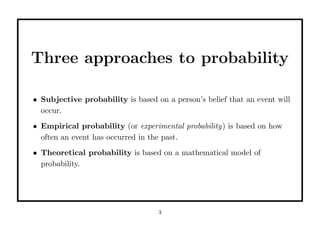
Three approaches to probability

• Subjective probability is based on a person’s belief that an event will
  occur.
• Empirical probability (or experimental probability) is based on how
  often an event has occurred in the past.
• Theoretical probability is based on a mathematical model of
  probability.


                                   3
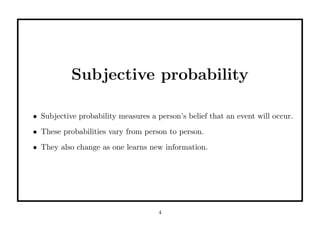
Subjective probability

• Subjective probability measures a person’s belief that an event will occur.
• These probabilities vary from person to person.
• They also change as one learns new information.


                                     4
Example of subjective probability
   Two weeks ago, Sen. Richard Lugar (R., Ind.), chairman of the
   Senate Foreign Relations Committee, released the results of an
   ambitious survey of arms experts. The study was conducted in late
   2004 and early 2005. On average, the 85 respondents predicted a
   29.2% chance of a nuclear attack in the next decade, with 79% saying
   that such an attack was more likely to be carried out by terrorists
   than by a government. Sen. Lugar said in the report that “the
   estimated combined risk of a WMD attack over five years is as high
   as 50%. Over 10 years this risk expands to as much as 70%.”
(Source: WSJ, July 7, 2005)


                                    5
Survey question

Average retail gas prices in the United States rose above $3 per gallon in the
aftermath of Hurricane Katrina. What is your estimate of the probability
that gas prices will again reach $3 per gallon in the next six months?


                                      6
Probability and betting
• Subjective probability reflects how much one would be willing to bet on
  an outcome.
• Example: A person should be willing to pay up to $30 for the chance to
  win $100, if the probability of winning is 30%.
• A project should be accepted if its cost is less than the benefit times the
  probability of success.


                                     7
Exercise

You are the CEO of a corporation. A project has been proposed to develop a
new product. If successful, the project will generate $10 million in revenue.
The cost of the project is $3 million. However, the probability of success is
estimated at only 40%. Should you approve the project?


                                      8
Exercise

You are the CEO of a corporation. A project has been proposed to develop a
new product. If successful, the project will generate $10 million in revenue.
The cost of the project is $3 million. However, the probability of success is
estimated at only 40%. Should you approve the project?


Answer: Yes, because the cost is less than 40% of the anticipated revenue.


                                      9
Empirical probability

Empirical (or experimental ) probability is determined by how often an event
has been observed to occur.

                                           # of successes
                   Empirical probability =
                                            # of trials
Empirical probability only makes sense if the event is repeatable.


                                     10
Exercise

In the 2004-05 season, Kobe Bryant made 573 field goals in 1324 attempts.
What is the empirical probability that Kobe will sink a field goal?


                                    11
Exercise

In the 2004-05 season, Kobe Bryant made 573 field goals in 1324 attempts.
What is the empirical probability that Kobe will sink a field goal?


Answer:

                          573
                              = 0.433, or 43.3%.
                         1324


                                    12
Application: Benford’s Law
Benford’s law states that in lists of numbers from many real-world sources of
data, the leading digit 1 occurs more frequently than the other digits – about
30% of the time.


                                      13
Theoretical probability
• A random experiment is an act whose outcome is uncertain.
• The sample space S is the set of all possible outcomes of the random
  experiment.
• Each outcome is assigned a probability between 0 and 1. The
  probabilities of all the outcomes add up to 1.
• An event is a subset of the sample space (i.e. it is a set of outcomes).
• The probability of an event is the sum of the events of the outcomes that
  comprise the event.
• We write P (E) to denote the probability of the event E.


                                    14
Example
• Consider the random experiment of tossing a fair coin twice.
• The sample space is S = {HH, HT, T H, T T }
                                                                  1
• Since the coin is fair, P (HH) = P (T H) = P (T H) = P (T T ) =
                                                                  4
• The event of getting exactly one head is {HT, T H}.
• The probability of that event is
                                                 1 1  1
              P ({HT, T H}) = P (HT ) + P (T H) = + =
                                                 4 4  2


                                     15
Exercise
An urn contains a large number of ping-pong balls. Half of the balls are
white, 30% of the balls are red, and the rest of the balls are blue. The
following random experiment is conducted: a ball is removed from the urn,
and its color is recorded.
 1. What is the sample space of this experiment?
 2. What is P (white)?
 3. What is P ({red, white})?
 4. What is P (blue)?


                                    16
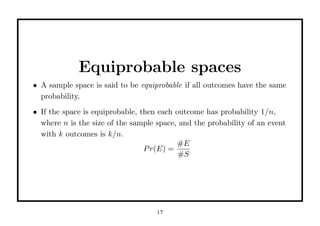
Equiprobable spaces
• A sample space is said to be equiprobable if all outcomes have the same
  probability.
• If the space is equiprobable, then each outcome has probability 1/n,
  where n is the size of the sample space, and the probability of an event
  with k outcomes is k/n.
                                          #E
                                 P r(E) =
                                           #S


                                    17
Exercise

A poker deck has 52 cards, and 4 of these cards are aces. A card is drawn at
random:
 1. What is the probability that the card is an ace?
 2. What is the probability of drawing the ace of spades?


                                     18
Exercise

A poker deck has 52 cards, and 4 of these cards are aces. A card is drawn at
random.
 1. What is the probability that the card is an ace? 4/52
 2. What is the probability of drawing the ace of spades? 1/52


                                     19
Review Questions
1. What is the probability that the sun will rise tomorrow? What is the
   probability that the sun will rise in the West?
2. What is the difference between subjective and empirical probability?
3. Identify each of the following statements as subjective, empirical, or
   theoretical probabilities.
  (a) The probability of being dealt a full house in poker is 1 in 693.
 (b) There is a 40% chance of rain tomorrow.
  (c) Avalanche victims who are found within the first 15 minutes have a
      92 percent chance of survival.


                                     20
Review Questions II
4. A man buys a ticket for a raffle with a $10,000 prize. The probability of
   winning is 0.05%. How much (in theory) should he pay for the ticket?
   Why might he be willing to pay more than this?
5. An oil company plans to invest $5 million to explore a potential oil field.
   If successful, the project will generate $25,000,000 in revenue. What
   probability of success is required to justify this project?


                                     21
Review Questions III
6. A coin is tossed 100 times. It lands heads 61 times, and tails 39 times.
  (a) What is the empirical probability that the next toss will land heads?
 (b) What is the theoretical probability that the next toss will land heads,
     assuming that the coin is fair?
7. What is the probability that Christmas will fall on a weekend?
8. Rolling a fair die is an example of a random experiment. What is the
   sample space of this experiment?


                                     22

Introduction to probability

  • 1.
    Foundations of Mathematics Week 7: Probability Subjective, empirical and theoretical probability David Radcliffe October 28, 2005 1
  • 2.
    What is probability? •Probability is a mathematical tool for making decisions in an uncertain world. • The probability of an event is a number between 0 and 1 that expresses how likely it is to occur. • Probability 0 means that the event is impossible. • Probability 1 (or 100%) means that the event is certain. • The greater the probability, the more likely it is to occur. 2
  • 3.
    Three approaches toprobability • Subjective probability is based on a person’s belief that an event will occur. • Empirical probability (or experimental probability) is based on how often an event has occurred in the past. • Theoretical probability is based on a mathematical model of probability. 3
  • 4.
    Subjective probability • Subjectiveprobability measures a person’s belief that an event will occur. • These probabilities vary from person to person. • They also change as one learns new information. 4
  • 5.
    Example of subjectiveprobability Two weeks ago, Sen. Richard Lugar (R., Ind.), chairman of the Senate Foreign Relations Committee, released the results of an ambitious survey of arms experts. The study was conducted in late 2004 and early 2005. On average, the 85 respondents predicted a 29.2% chance of a nuclear attack in the next decade, with 79% saying that such an attack was more likely to be carried out by terrorists than by a government. Sen. Lugar said in the report that “the estimated combined risk of a WMD attack over five years is as high as 50%. Over 10 years this risk expands to as much as 70%.” (Source: WSJ, July 7, 2005) 5
  • 6.
    Survey question Average retailgas prices in the United States rose above $3 per gallon in the aftermath of Hurricane Katrina. What is your estimate of the probability that gas prices will again reach $3 per gallon in the next six months? 6
  • 7.
    Probability and betting •Subjective probability reflects how much one would be willing to bet on an outcome. • Example: A person should be willing to pay up to $30 for the chance to win $100, if the probability of winning is 30%. • A project should be accepted if its cost is less than the benefit times the probability of success. 7
  • 8.
    Exercise You are theCEO of a corporation. A project has been proposed to develop a new product. If successful, the project will generate $10 million in revenue. The cost of the project is $3 million. However, the probability of success is estimated at only 40%. Should you approve the project? 8
  • 9.
    Exercise You are theCEO of a corporation. A project has been proposed to develop a new product. If successful, the project will generate $10 million in revenue. The cost of the project is $3 million. However, the probability of success is estimated at only 40%. Should you approve the project? Answer: Yes, because the cost is less than 40% of the anticipated revenue. 9
  • 10.
    Empirical probability Empirical (orexperimental ) probability is determined by how often an event has been observed to occur. # of successes Empirical probability = # of trials Empirical probability only makes sense if the event is repeatable. 10
  • 11.
    Exercise In the 2004-05season, Kobe Bryant made 573 field goals in 1324 attempts. What is the empirical probability that Kobe will sink a field goal? 11
  • 12.
    Exercise In the 2004-05season, Kobe Bryant made 573 field goals in 1324 attempts. What is the empirical probability that Kobe will sink a field goal? Answer: 573 = 0.433, or 43.3%. 1324 12
  • 13.
    Application: Benford’s Law Benford’slaw states that in lists of numbers from many real-world sources of data, the leading digit 1 occurs more frequently than the other digits – about 30% of the time. 13
  • 14.
    Theoretical probability • Arandom experiment is an act whose outcome is uncertain. • The sample space S is the set of all possible outcomes of the random experiment. • Each outcome is assigned a probability between 0 and 1. The probabilities of all the outcomes add up to 1. • An event is a subset of the sample space (i.e. it is a set of outcomes). • The probability of an event is the sum of the events of the outcomes that comprise the event. • We write P (E) to denote the probability of the event E. 14
  • 15.
    Example • Consider therandom experiment of tossing a fair coin twice. • The sample space is S = {HH, HT, T H, T T } 1 • Since the coin is fair, P (HH) = P (T H) = P (T H) = P (T T ) = 4 • The event of getting exactly one head is {HT, T H}. • The probability of that event is 1 1 1 P ({HT, T H}) = P (HT ) + P (T H) = + = 4 4 2 15
  • 16.
    Exercise An urn containsa large number of ping-pong balls. Half of the balls are white, 30% of the balls are red, and the rest of the balls are blue. The following random experiment is conducted: a ball is removed from the urn, and its color is recorded. 1. What is the sample space of this experiment? 2. What is P (white)? 3. What is P ({red, white})? 4. What is P (blue)? 16
  • 17.
    Equiprobable spaces • Asample space is said to be equiprobable if all outcomes have the same probability. • If the space is equiprobable, then each outcome has probability 1/n, where n is the size of the sample space, and the probability of an event with k outcomes is k/n. #E P r(E) = #S 17
  • 18.
    Exercise A poker deckhas 52 cards, and 4 of these cards are aces. A card is drawn at random: 1. What is the probability that the card is an ace? 2. What is the probability of drawing the ace of spades? 18
  • 19.
    Exercise A poker deckhas 52 cards, and 4 of these cards are aces. A card is drawn at random. 1. What is the probability that the card is an ace? 4/52 2. What is the probability of drawing the ace of spades? 1/52 19
  • 20.
    Review Questions 1. Whatis the probability that the sun will rise tomorrow? What is the probability that the sun will rise in the West? 2. What is the difference between subjective and empirical probability? 3. Identify each of the following statements as subjective, empirical, or theoretical probabilities. (a) The probability of being dealt a full house in poker is 1 in 693. (b) There is a 40% chance of rain tomorrow. (c) Avalanche victims who are found within the first 15 minutes have a 92 percent chance of survival. 20
  • 21.
    Review Questions II 4.A man buys a ticket for a raffle with a $10,000 prize. The probability of winning is 0.05%. How much (in theory) should he pay for the ticket? Why might he be willing to pay more than this? 5. An oil company plans to invest $5 million to explore a potential oil field. If successful, the project will generate $25,000,000 in revenue. What probability of success is required to justify this project? 21
  • 22.
    Review Questions III 6.A coin is tossed 100 times. It lands heads 61 times, and tails 39 times. (a) What is the empirical probability that the next toss will land heads? (b) What is the theoretical probability that the next toss will land heads, assuming that the coin is fair? 7. What is the probability that Christmas will fall on a weekend? 8. Rolling a fair die is an example of a random experiment. What is the sample space of this experiment? 22