INTRODUCTION TO
ISO 9001:2008
AD SARWAR
What is ISO?
• ISO is the International Organization of Standardization
• ISO is an organization that develops standards for use
worldwide to help companies better manage themselves
• ISO 9001:2008 outlines criteria for a good Quality
Management System (QMS)
• ISO 9001 standards are generic standards that can be applied
to any industry
ISO 9000 Family of Standards
•
•ISO 9000:2000 (Quality Management Systems – Fundamentals and
Vocabulary)
-Defines the fundamental terms & definitions used in ISO 9000
•ISO 9001:2008 (Quality Management Systems – Requirements)
-Defines the requirements for assessing the ability to meet customer and
applicable regulatory requirements and thereby address customer
satisfaction
-Only standard in the ISO 9000 family against which third-party certification
can be carried out
•ISO 9004:2000 (Quality Management Systems – Guidance for Performance
Improvement)
-Provides guidance for continual improvement of the quality management
system to benefit all parties through sustained customer satisfaction
History of ISO 9000
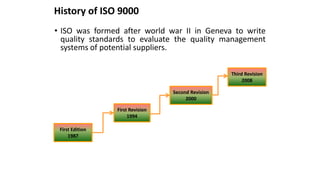
• ISO was formed after world war II in Geneva to write
quality standards to evaluate the quality management
systems of potential suppliers.
First Edition
1987
First Revision
1994
Second Revision
2000
Third Revision
2008
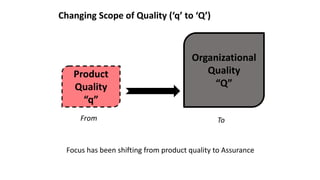
Changing Scope of Quality (‘q’ to ‘Q’)
Product
Quality
“q”
Organizational
Quality
“Q”
Focus has been shifting from product quality to Assurance
From To
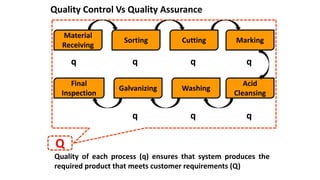
Quality Control Vs Quality Assurance
Material
Receiving
Sorting Cutting Marking
Final
Inspection
Galvanizing Washing
Acid
Cleansing
q q q q
Quality of each process (q) ensures that system produces the
required product that meets customer requirements (Q)
q q q
Q
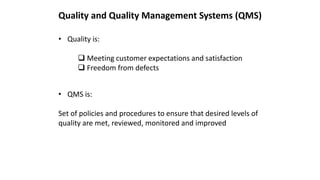
• Quality is:
 Meeting customer expectations and satisfaction
 Freedom from defects
Quality and Quality Management Systems (QMS)
• QMS is:
Set of policies and procedures to ensure that desired levels of
quality are met, reviewed, monitored and improved
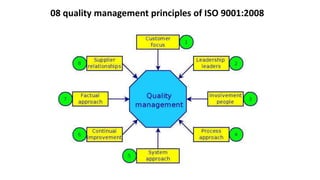
08 quality management principles of ISO 9001:2008
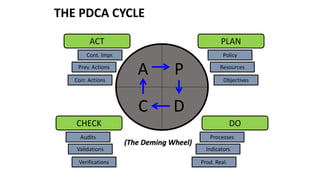
THE PDCA CYCLE
PLAN
Policy
Resources
Objectives
DO
Processes
Indicators
Prod. Real.
ACT
Cont. Impr.
Prev. Actions
Corr. Actions
CHECK
Audits
Validations
Verifications
PA
C D
(The Deming Wheel)
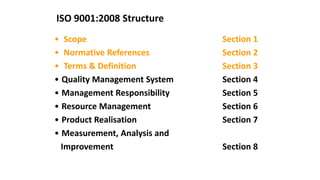
ISO 9001:2008 Structure
• Scope Section 1
• Normative References Section 2
• Terms & Definition Section 3
• Quality Management System Section 4
• Management Responsibility Section 5
• Resource Management Section 6
• Product Realisation Section 7
• Measurement, Analysis and
Improvement Section 8
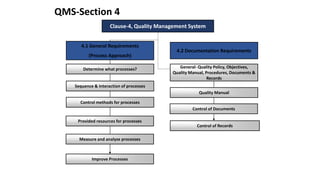
QMS-Section 4
4.1 General Requirements
(Process Approach)
Clause-4, Quality Management System
Determine what processes?
Sequence & Interaction of processes
Control methods for processes
Provided resources for processes
Measure and analyze processes
Improve Processes
4.2 Documentation Requirements
General- Quality Policy, Objectives,
Quality Manual, Procedures, Documents &
Records
Control of Records
Quality Manual
Control of Documents
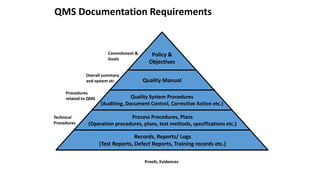
QMS Documentation Requirements
Policy &
Objectives
Quality Manual
Quality System Procedures
(Auditing, Document Control, Corrective Action etc.)
Records, Reports/ Logs
(Test Reports, Defect Reports, Training records etc.)
Process Procedures, Plans
(Operation procedures, plans, test methods, specifications etc.)
Commitment &
Goals
Overall summary
and system str.
Procedures
related to QMS
Technical
Procedures
Proofs, Evidences
Management Responsibility-Section 5
• Management commitment - evidence of commitment to the
development and improvement of QMS
• Customer focus - ensure customer needs and expectations are
understood and satisfied
• Quality policy - appropriate for company, communicated and
reviewed
• Planning - quality objectives and planning
• Administration - responsibility and authority, management
representative and internal communication
• Review - QMS to be reviewed at planned intervals
Resource Management-Section 6
• General – Required and competent resources
• Competence, Training & Awareness
• Infrastructure- Building, workspace, process equipment
& other services
• Facilities - workspace, equipment and supporting
services
• Work environment
Product Realization-Section 7
• Product realisation is the sequence of processes and sub-processes required to
achieve the product - must be planned
• Customer-related processes - identification of requirements, product obligations and
communication
• Design and/or development - planning, inputs and outputs, review, verification and
changes control
• Purchasing - control and purchasing information
• Production and service operations - operations control, traceability, preservation and
verification
• Control of measuring and monitoring devices
Measurement, Analysis & Improvement-Section 8
• Measurement, analysis and improvement (Processes, Customer satisfaction,
Product & Equipment)
- Planning
- Customer satisfaction
- Internal audit
- Control of nonconformity
- Analysis of data
- Improvement (CA & PA)
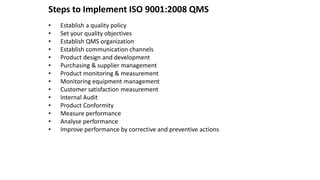
Steps to Implement ISO 9001:2008 QMS
• Establish a quality policy
• Set your quality objectives
• Establish QMS organization
• Establish communication channels
• Product design and development
• Purchasing & supplier management
• Product monitoring & measurement
• Monitoring equipment management
• Customer satisfaction measurement
• Internal Audit
• Product Conformity
• Measure performance
• Analyse performance
• Improve performance by corrective and preventive actions
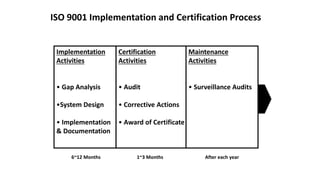
ISO 9001 Implementation and Certification Process
Implementation
Activities
• Gap Analysis
•System Design
• Implementation
& Documentation
Certification
Activities
• Audit
• Corrective Actions
• Award of Certificate
Maintenance
Activities
• Surveillance Audits
6~12 Months 1~3 Months After each year
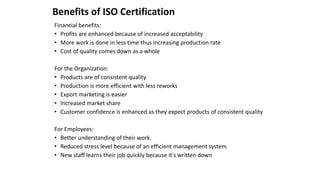
Benefits of ISO Certification
Financial benefits:
• Profits are enhanced because of increased acceptability
• More work is done in less time thus increasing production rate
• Cost of quality comes down as a whole
For the Organization:
• Products are of consistent quality
• Production is more efficient with less reworks
• Export marketing is easier
• Increased market share
• Customer confidence is enhanced as they expect products of consistent quality
For Employees:
• Better understanding of their work.
• Reduced stress level because of an efficient management system
• New staff learns their job quickly because it's written down
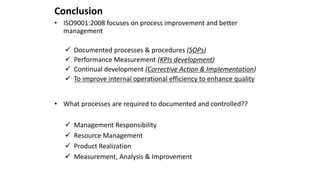
• ISO9001:2008 focuses on process improvement and better
management
 Documented processes & procedures (SOPs)
 Performance Measurement (KPIs development)
 Continual development (Corrective Action & Implementation)
 To improve internal operational efficiency to enhance quality
• What processes are required to documented and controlled??
 Management Responsibility
 Resource Management
 Product Realization
 Measurement, Analysis & Improvement
Conclusion
Quality is the result of a carefully
constructed cultural environment. It has
to be the fabric of the organization, not
part of the fabric
(Philip B. Crosby)
Queries : Questions : Concerns

Introduction to ISO 9001-2008

  • 1.
  • 2.
    What is ISO? •ISO is the International Organization of Standardization • ISO is an organization that develops standards for use worldwide to help companies better manage themselves • ISO 9001:2008 outlines criteria for a good Quality Management System (QMS) • ISO 9001 standards are generic standards that can be applied to any industry
  • 3.
    ISO 9000 Familyof Standards • •ISO 9000:2000 (Quality Management Systems – Fundamentals and Vocabulary) -Defines the fundamental terms & definitions used in ISO 9000 •ISO 9001:2008 (Quality Management Systems – Requirements) -Defines the requirements for assessing the ability to meet customer and applicable regulatory requirements and thereby address customer satisfaction -Only standard in the ISO 9000 family against which third-party certification can be carried out •ISO 9004:2000 (Quality Management Systems – Guidance for Performance Improvement) -Provides guidance for continual improvement of the quality management system to benefit all parties through sustained customer satisfaction
  • 4.
    History of ISO9000 • ISO was formed after world war II in Geneva to write quality standards to evaluate the quality management systems of potential suppliers. First Edition 1987 First Revision 1994 Second Revision 2000 Third Revision 2008
  • 5.
    Changing Scope ofQuality (‘q’ to ‘Q’) Product Quality “q” Organizational Quality “Q” Focus has been shifting from product quality to Assurance From To
  • 6.
    Quality Control VsQuality Assurance Material Receiving Sorting Cutting Marking Final Inspection Galvanizing Washing Acid Cleansing q q q q Quality of each process (q) ensures that system produces the required product that meets customer requirements (Q) q q q Q
  • 7.
    • Quality is: Meeting customer expectations and satisfaction  Freedom from defects Quality and Quality Management Systems (QMS) • QMS is: Set of policies and procedures to ensure that desired levels of quality are met, reviewed, monitored and improved
  • 8.
    08 quality managementprinciples of ISO 9001:2008
  • 9.
    THE PDCA CYCLE PLAN Policy Resources Objectives DO Processes Indicators Prod.Real. ACT Cont. Impr. Prev. Actions Corr. Actions CHECK Audits Validations Verifications PA C D (The Deming Wheel)
  • 10.
    ISO 9001:2008 Structure •Scope Section 1 • Normative References Section 2 • Terms & Definition Section 3 • Quality Management System Section 4 • Management Responsibility Section 5 • Resource Management Section 6 • Product Realisation Section 7 • Measurement, Analysis and Improvement Section 8
  • 11.
    QMS-Section 4 4.1 GeneralRequirements (Process Approach) Clause-4, Quality Management System Determine what processes? Sequence & Interaction of processes Control methods for processes Provided resources for processes Measure and analyze processes Improve Processes 4.2 Documentation Requirements General- Quality Policy, Objectives, Quality Manual, Procedures, Documents & Records Control of Records Quality Manual Control of Documents
  • 12.
    QMS Documentation Requirements Policy& Objectives Quality Manual Quality System Procedures (Auditing, Document Control, Corrective Action etc.) Records, Reports/ Logs (Test Reports, Defect Reports, Training records etc.) Process Procedures, Plans (Operation procedures, plans, test methods, specifications etc.) Commitment & Goals Overall summary and system str. Procedures related to QMS Technical Procedures Proofs, Evidences
  • 13.
    Management Responsibility-Section 5 •Management commitment - evidence of commitment to the development and improvement of QMS • Customer focus - ensure customer needs and expectations are understood and satisfied • Quality policy - appropriate for company, communicated and reviewed • Planning - quality objectives and planning • Administration - responsibility and authority, management representative and internal communication • Review - QMS to be reviewed at planned intervals
  • 14.
    Resource Management-Section 6 •General – Required and competent resources • Competence, Training & Awareness • Infrastructure- Building, workspace, process equipment & other services • Facilities - workspace, equipment and supporting services • Work environment
  • 15.
    Product Realization-Section 7 •Product realisation is the sequence of processes and sub-processes required to achieve the product - must be planned • Customer-related processes - identification of requirements, product obligations and communication • Design and/or development - planning, inputs and outputs, review, verification and changes control • Purchasing - control and purchasing information • Production and service operations - operations control, traceability, preservation and verification • Control of measuring and monitoring devices
  • 16.
    Measurement, Analysis &Improvement-Section 8 • Measurement, analysis and improvement (Processes, Customer satisfaction, Product & Equipment) - Planning - Customer satisfaction - Internal audit - Control of nonconformity - Analysis of data - Improvement (CA & PA)
  • 17.
    Steps to ImplementISO 9001:2008 QMS • Establish a quality policy • Set your quality objectives • Establish QMS organization • Establish communication channels • Product design and development • Purchasing & supplier management • Product monitoring & measurement • Monitoring equipment management • Customer satisfaction measurement • Internal Audit • Product Conformity • Measure performance • Analyse performance • Improve performance by corrective and preventive actions
  • 18.
    ISO 9001 Implementationand Certification Process Implementation Activities • Gap Analysis •System Design • Implementation & Documentation Certification Activities • Audit • Corrective Actions • Award of Certificate Maintenance Activities • Surveillance Audits 6~12 Months 1~3 Months After each year
  • 19.
    Benefits of ISOCertification Financial benefits: • Profits are enhanced because of increased acceptability • More work is done in less time thus increasing production rate • Cost of quality comes down as a whole For the Organization: • Products are of consistent quality • Production is more efficient with less reworks • Export marketing is easier • Increased market share • Customer confidence is enhanced as they expect products of consistent quality For Employees: • Better understanding of their work. • Reduced stress level because of an efficient management system • New staff learns their job quickly because it's written down
  • 20.
    • ISO9001:2008 focuseson process improvement and better management  Documented processes & procedures (SOPs)  Performance Measurement (KPIs development)  Continual development (Corrective Action & Implementation)  To improve internal operational efficiency to enhance quality • What processes are required to documented and controlled??  Management Responsibility  Resource Management  Product Realization  Measurement, Analysis & Improvement Conclusion
  • 21.
    Quality is theresult of a carefully constructed cultural environment. It has to be the fabric of the organization, not part of the fabric (Philip B. Crosby)
  • 22.