Presented by :
M.Suruthi
M.Pharmacy 1st year
Pharmaceutical quality assurance
Annamalai university
Submitted to :
Dr.K.Devi,M.Pharm.,Ph.D
Assistant professor
Department of pharmacy
Annamalai university 1
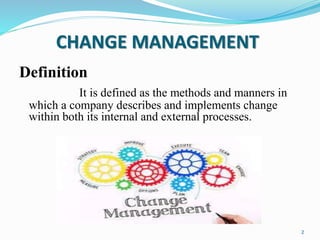
CHANGE MANAGEMENT
Definition
It is defined as the methods and manners in
which a company describes and implements change
within both its internal and external processes.
2
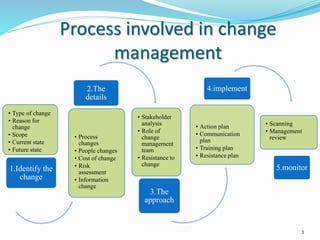
Process involved in change
management
• Type of change
• Reason for
change
• Scope
• Current state
• Future state
1.Identify the
change
• Process
changes
• People changes
• Cost of change
• Risk
assessment
• Information
change
2.The
details
• Stakeholder
analysis
• Role of
change
management
team
• Resistance to
change
3.The
approach
• Action plan
• Communication
plan
• Training plan
• Resistance plan
4.implement
• Scanning
• Management
review
5.monitor
3
BENEFITS
 Improved communication
 Increased productivity
 Reduced stress
 Improved decision making
 It can also help improve employee confidence and create a
more positive environment
4
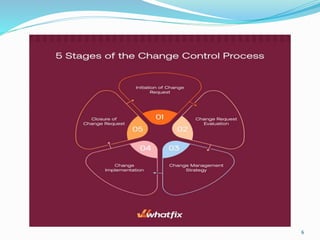
CHANGE CONTROL
Definition :
 It is a set of processes and controls that mitigate risk of
impacts to projects due to variation.
 Change control is a specific element of the overall change
management procedure ; while change management refer
to the complete span of a particular change procedure.
5
6
OUT OF SPECIFICATION (OOS)
Definition :
If the analytical results of a batch or material is / are
failing out side of the established specification ranges, is
called / considered as out of specification.
Or
The term OOS test results includes all suspect results that
fall outside the predetermined specification.
7
There are lot of guidelines are available for
defining to handle the oos
products/materials/batches etc.
MHRA (medicine and health care
products regulatory agency) guideline for
oos
CDER(center for drug evaluation and
research) guideline for oos
8
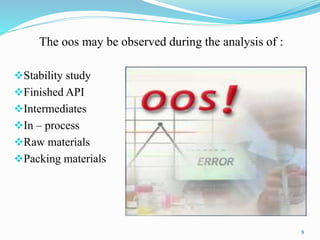
The oos may be observed during the analysis of :
Stability study
Finished API
Intermediates
In – process
Raw materials
Packing materials
9
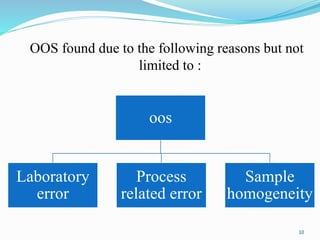
OOS found due to the following reasons but not
limited to :
oos
Laboratory
error
Process
related error
Sample
homogeneity
10
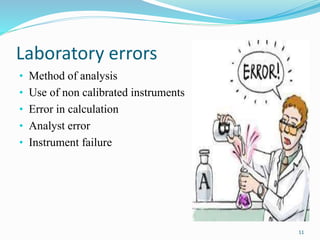
Laboratory errors
• Method of analysis
• Use of non calibrated instruments
• Error in calculation
• Analyst error
• Instrument failure
11
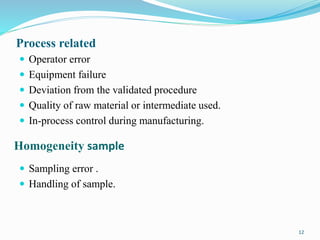
Process related
 Operator error
 Equipment failure
 Deviation from the validated procedure
 Quality of raw material or intermediate used.
 In-process control during manufacturing.
Homogeneity sample
 Sampling error .
 Handling of sample.
12
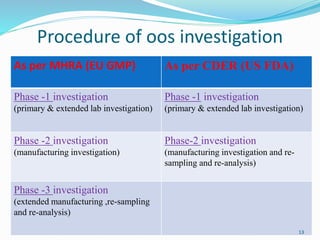
Procedure of oos investigation
As per MHRA (EU GMP) As per CDER (US FDA)
Phase -1 investigation
(primary & extended lab investigation)
Phase -1 investigation
(primary & extended lab investigation)
Phase -2 investigation
(manufacturing investigation)
Phase-2 investigation
(manufacturing investigation and re-
sampling and re-analysis)
Phase -3 investigation
(extended manufacturing ,re-sampling
and re-analysis)
13
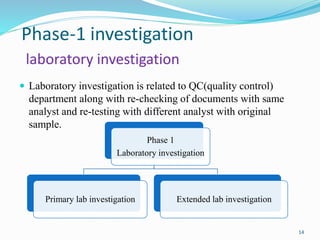
Phase-1 investigation
laboratory investigation
 Laboratory investigation is related to QC(quality control)
department along with re-checking of documents with same
analyst and re-testing with different analyst with original
sample.
Phase 1
Laboratory investigation
Primary lab investigation Extended lab investigation
14
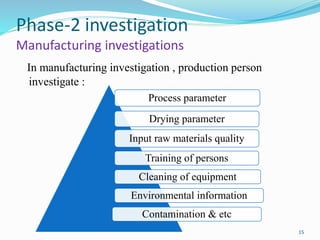
Phase-2 investigation
Manufacturing investigations
In manufacturing investigation , production person
investigate :
Process parameter
Drying parameter
Input raw materials quality
Training of persons
Cleaning of equipment
Environmental information
Contamination & etc
15
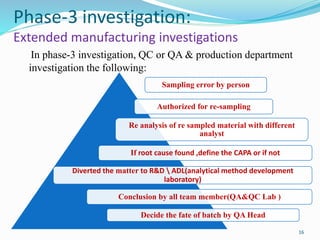
Phase-3 investigation:
Extended manufacturing investigations
In phase-3 investigation, QC or QA & production department
investigation the following:
Sampling error by person
Authorized for re-sampling
Re analysis of re sampled material with different
analyst
If root cause found ,define the CAPA or if not
Diverted the matter to R&D  ADL(analytical method development
laboratory)
Conclusion by all team member(QA&QC Lab )
Decide the fate of batch by QA Head
16
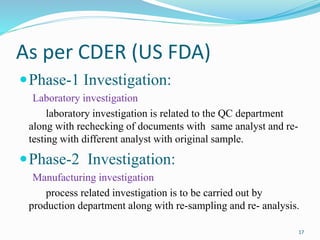
As per CDER (US FDA)
Phase-1 Investigation:
Laboratory investigation
laboratory investigation is related to the QC department
along with rechecking of documents with same analyst and re-
testing with different analyst with original sample.
Phase-2 Investigation:
Manufacturing investigation
process related investigation is to be carried out by
production department along with re-sampling and re- analysis.
17
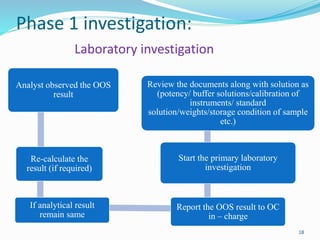
Phase 1 investigation:
Laboratory investigation
Analyst observed the OOS
result
Re-calculate the
result (if required)
If analytical result
remain same
Report the OOS result to OC
in – charge
Start the primary laboratory
investigation
Review the documents along with solution as
(potency/ buffer solutions/calibration of
instruments/ standard
solution/weights/storage condition of sample
etc.)
18
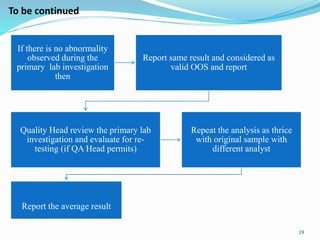
If there is no abnormality
observed during the
primary lab investigation
then
Report same result and considered as
valid OOS and report
Quality Head review the primary lab
investigation and evaluate for re-
testing (if QA Head permits)
Repeat the analysis as thrice
with original sample with
different analyst
Report the average result
19
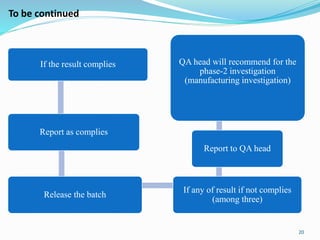
To be continued
If the result complies
Report as complies
Release the batch
If any of result if not complies
(among three)
Report to QA head
QA head will recommend for the
phase-2 investigation
(manufacturing investigation)
20
To be continued
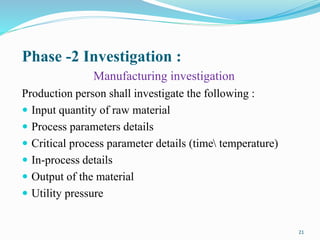
Phase -2 Investigation :
Manufacturing investigation
Production person shall investigate the following :
 Input quantity of raw material
 Process parameters details
 Critical process parameter details (time temperature)
 In-process details
 Output of the material
 Utility pressure
21
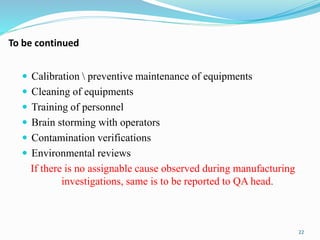
 Calibration  preventive maintenance of equipments
 Cleaning of equipments
 Training of personnel
 Brain storming with operators
 Contamination verifications
 Environmental reviews
If there is no assignable cause observed during manufacturing
investigations, same is to be reported to QA head.
22
To be continued
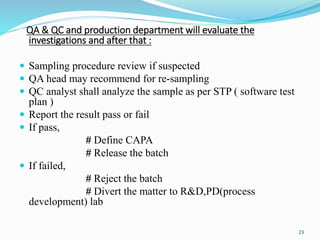
QA & QC and production department will evaluate the
investigations and after that :
 Sampling procedure review if suspected
 QA head may recommend for re-sampling
 QC analyst shall analyze the sample as per STP ( software test
plan )
 Report the result pass or fail
 If pass,
# Define CAPA
# Release the batch
 If failed,
# Reject the batch
# Divert the matter to R&D,PD(process
development) lab
23
R&DProcess Development lab shall :
 Take the user trail with the material
 Investigate the failure based on experimentsexperience.
 To find out the root cause
 To identify ,is this material can be reprocessed  reworked
 Make a summary report
 Defined the corrective actions
24
QA & QC  Production department shall
 QA head shall define the fate of batch for reprocess  rework 
destruction
 Accept the CAPA
 Training to all concerned for root cause  CAPA
 Monitor the activity and Evaluate the results of corrective actions
 Implement and Verify the implementation of preventive actions
 After satisfactory implementation close the OOS & CAPA
All these activity for investigation prevention actions should be
recorded , reviewed and archived.
25
If OOS batch is to be responded / reworked
Follow the written approval BMR(batch manufacturing
record) for reprocess/rework
Sample as per SOP for sampling of material
Analyze the material according to the specification and
STP(standard testing procedure)
Evaluate the quality of the batch
Keep this batch for stability
Evaluate the stability results of the batch
Communicate the OOS to the customers
26
Impact of OOS on regulatory
 OOS should be reported to RA ( regulatory affairs)
 OOS batch should not be sold to regulatory market
 OOA batch can not be blend with fresh approved batch
 OOS batch can not be directly sell to the market
27
Out of trend(OOT)
Definition:
Out of trend is defined as a result of a sequence of the
analytical results which conform to the specifications but
not in the expected trend with respect to the initial or
expected result.
 The main purpose of OOT is to lay down a procedure for
managing out-of-trend results in active raw material, finished
product , stability study, environmental monitoring & water
trend in pharmaceutical industries.
28
 During investigation if the cause of the OOT results is
indentified as a laboratory error the executive QC should carry
out the repeat analysis with a fresh sample and fresh standard
preparation if required.
 And if the purpose of the OOT result isn’t the diagnosed as a
laboratory error then the head of the QC will suggest re-analysis
to conform OOT outcomes.
 The analyst must hold the record of the re-evaluation effect in
the work sheet.
 If the cause of the re-analysis the initial evaluation need to be
suggested.
Out of Trend procedures
29
•In the case of raw material , the head quality control ought to
overview the OOT outcomes and forward them to QA and prevent
the re-occurance of such incidence.
•In the case of finished products, the head QC should review the
OOT results and forward them to QA and the production team for
investigation to take a final decision.
•Based on the investigation report, the head QC takes the final
decision.
30
To be continued
Complaints – evaluation & handling
Complaints – definition:
“Complaints is defined as statement that is
something wrong or not good enough, which shows
customer dissatisfaction about the company and the
product ”.
Example- complaint about the packaging materials .
Advantages :
 Sustained improvement of quality of product and process.
 Maintaining good relation with customers.
31
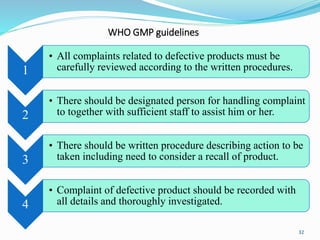
WHO GMP guidelines
1
• All complaints related to defective products must be
carefully reviewed according to the written procedures.
2
• There should be designated person for handling complaint
to together with sufficient staff to assist him or her.
3
• There should be written procedure describing action to be
taken including need to consider a recall of product.
4
• Complaint of defective product should be recorded with
all details and thoroughly investigated.
32
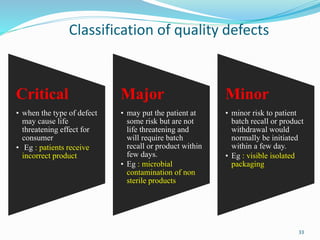
Classification of quality defects
Critical
• when the type of defect
may cause life
threatening effect for
consumer
• Eg : patients receive
incorrect product
Major
• may put the patient at
some risk but are not
life threatening and
will require batch
recall or product within
few days.
• Eg : microbial
contamination of non
sterile products
Minor
• minor risk to patient
batch recall or product
withdrawal would
normally be initiated
within a few day.
• Eg : visible isolated
packaging
33
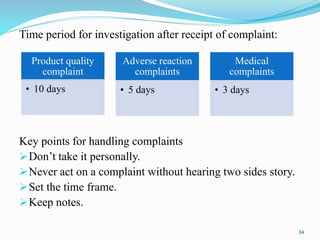
Time period for investigation after receipt of complaint:
Key points for handling complaints
Don’t take it personally.
Never act on a complaint without hearing two sides story.
Set the time frame.
Keep notes.
Product quality
complaint
• 10 days
Adverse reaction
complaints
• 5 days
Medical
complaints
• 3 days
34
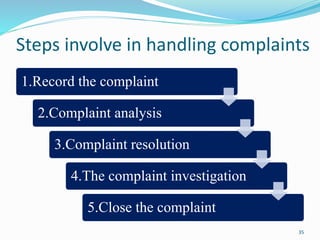
Steps involve in handling complaints
1.Record the complaint
2.Complaint analysis
3.Complaint resolution
4.The complaint investigation
5.Close the complaint
35
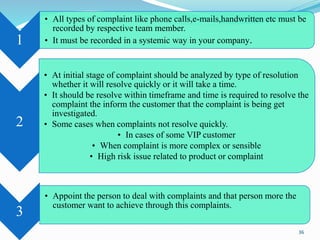
1
• All types of complaint like phone calls,e-mails,handwritten etc must be
recorded by respective team member.
• It must be recorded in a systemic way in your company.
2
• At initial stage of complaint should be analyzed by type of resolution
whether it will resolve quickly or it will take a time.
• It should be resolve within timeframe and time is required to resolve the
complaint the inform the customer that the complaint is being get
investigated.
• Some cases when complaints not resolve quickly.
• In cases of some VIP customer
• When complaint is more complex or sensible
• High risk issue related to product or complaint
3
• Appoint the person to deal with complaints and that person more the
customer want to achieve through this complaints.
36
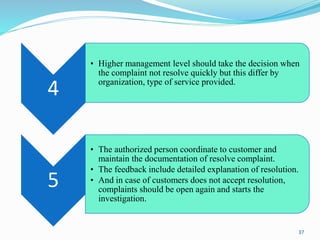
4
• Higher management level should take the decision when
the complaint not resolve quickly but this differ by
organization, type of service provided.
5
• The authorized person coordinate to customer and
maintain the documentation of resolve complaint.
• The feedback include detailed explanation of resolution.
• And in case of customers does not accept resolution,
complaints should be open again and starts the
investigation.
37
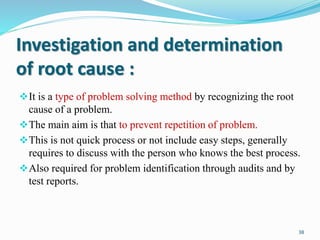
Investigation and determination
of root cause :
It is a type of problem solving method by recognizing the root
cause of a problem.
The main aim is that to prevent repetition of problem.
This is not quick process or not include easy steps, generally
requires to discuss with the person who knows the best process.
Also required for problem identification through audits and by
test reports.
38
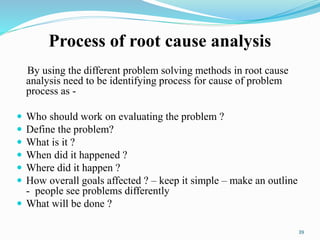
Process of root cause analysis
By using the different problem solving methods in root cause
analysis need to be identifying process for cause of problem
process as -
 Who should work on evaluating the problem ?
 Define the problem?
 What is it ?
 When did it happened ?
 Where did it happen ?
 How overall goals affected ? – keep it simple – make an outline
- people see problems differently
 What will be done ?
39
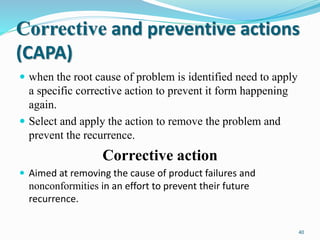
Corrective and preventive actions
(CAPA)
 when the root cause of problem is identified need to apply
a specific corrective action to prevent it form happening
again.
 Select and apply the action to remove the problem and
prevent the recurrence.
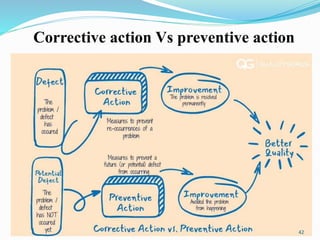
Corrective action
 Aimed at removing the cause of product failures and
nonconformities in an effort to prevent their future
recurrence.
40
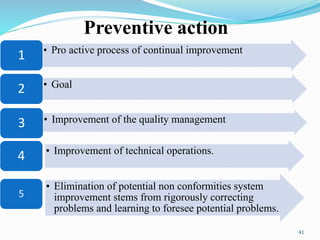
Preventive action
• Pro active process of continual improvement
1
• Goal
2
• Improvement of the quality management.
3
• Improvement of technical operations.
4
• Elimination of potential non conformities system
improvement stems from rigorously correcting
problems and learning to foresee potential problems.
5
41
Corrective action Vs preventive action
42
Return and recall
• Recall is the steps to put something back to its original place
• Demand to return, exchange ,or replace the product when the
manufacturer or customer found defects in product or product related
issues, harm to customer is known as recall.
43
 To aware safety of the customer, most of industries focus
on taking preventive measures, established one internal
product recall team and applying QC steps to reduced
the risk or to prevent product recall cost.
 Product recall will be done by various sources including
manufacturers,
 wholesalers,
 retailers and customer.
44
Approach of product recall team
 If a product recall is there or recall is on progress the prepare
a product recall action plan which followed to recalled
procedure.
Recall team consisting some of following job roles:
• Management representative
• Product manager
• Chief engineer
• Quality control manager
• Public relations expert
45
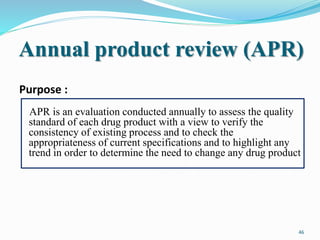
Annual product review (APR)
Purpose :
APR is an evaluation conducted annually to assess the quality
standard of each drug product with a view to verify the
consistency of existing process and to check the
appropriateness of current specifications and to highlight any
trend in order to determine the need to change any drug product
46
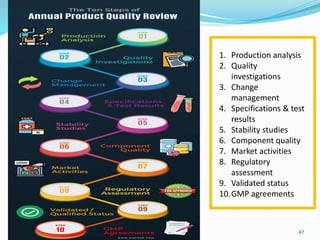
1. Production analysis
2. Quality
investigations
3. Change
management
4. Specifications & test
results
5. Stability studies
6. Component quality
7. Market activities
8. Regulatory
assessment
9. Validated status
10.GMP agreements
47
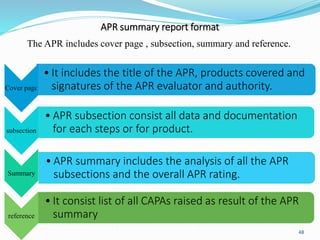
APR summary report format
The APR includes cover page , subsection, summary and reference.
Cover page
• It includes the title of the APR, products covered and
signatures of the APR evaluator and authority.
subsection
• APR subsection consist all data and documentation
for each steps or for product.
Summary
• APR summary includes the analysis of all the APR
subsections and the overall APR rating.
reference
• It consist list of all CAPAs raised as result of the APR
summary
48
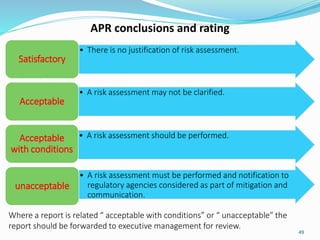
APR conclusions and rating
• There is no justification of risk assessment.
Satisfactory
• A risk assessment may not be clarified.
Acceptable
• A risk assessment should be performed.
Acceptable
with conditions
• A risk assessment must be performed and notification to
regulatory agencies considered as part of mitigation and
communication.
unacceptable
Where a report is related “ acceptable with conditions” or “ unacceptable” the
report should be forwarded to executive management for review.
49
APR report approval
Each APR report having signed off with –
 The QA manager
 The regulatory affairs manager
 Production  operations manager
 Other groups who may be affected by any change
50
Batch review and batch release
Purpose :
 For approval and release of the finished product batch
establish the process.
 The Batch Record Review is an essential tool for assuring the
quality of a pharmaceutical process.
51
Responsibility :
 Executive ,QA or the production department is responsible
for receiving the batch record for its completeness and
accuracy.
 Head production is responsible for completion and review
of batch release product.
 Head, QC responsible for completion and review of
analytical  microbiology records.
 QA is responsible for the review of analytical 
microbiology data in either hard or soft copy.
52
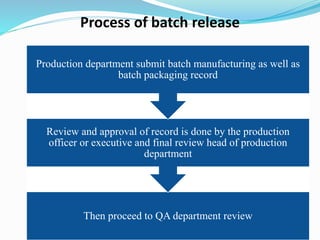
Process of batch release
Then proceed to QA department review
Review and approval of record is done by the production
officer or executive and final review head of production
department
Production department submit batch manufacturing as well as
batch packaging record
53
Review of batch records
 Officer or executive of QA review the documents of both batch
manufacturing and batch packaging record for any deficiency
which affect on quality of the product or customer safety 
marketing.
Condition for batch release :
 For batch manufactured and sold by the company for the India
region only shall permitted by conditional transfer.
 There is no permission given to another party to sell the product
 After approval of the contract then there will be planned for
conditional transfer.
 Product from export market then conditional transfer not allowed.
54
Concept of IPQC (IN-PROCESS QUALITY
CONTROL)
Objectives of IPQC
 To develop the technical procedure used in manufacturing
process.
 Control and enhance efficacy of finished products.
 Investigation of raw material, instrument, environmental,
process , evaluation and packaging etc.
55
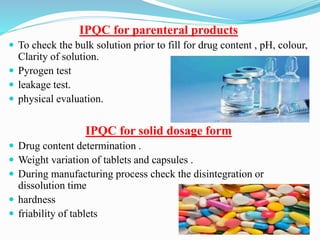
IPQC for parenteral products
 To check the bulk solution prior to fill for drug content , pH, colour,
Clarity of solution.
 Pyrogen test
 leakage test.
 physical evaluation.
IPQC for solid dosage form
 Drug content determination .
 Weight variation of tablets and capsules .
 During manufacturing process check the disintegration or
dissolution time
 hardness
 friability of tablets
56
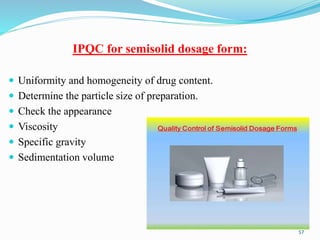
IPQC for semisolid dosage form:
 Uniformity and homogeneity of drug content.
 Determine the particle size of preparation.
 Check the appearance
 Viscosity
 Specific gravity
 Sedimentation volume
57
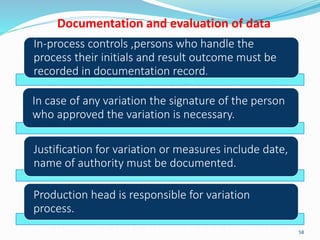
Documentation and evaluation of data
In-process controls ,persons who handle the
process their initials and result outcome must be
recorded in documentation record.
In case of any variation the signature of the person
who approved the variation is necessary.
Justification for variation or measures include date,
name of authority must be documented.
Production head is responsible for variation
process.
58
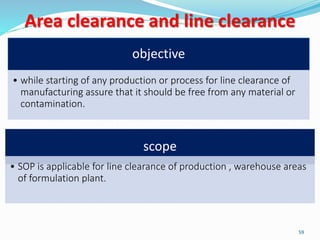
Area clearance and line clearance
objective
• while starting of any production or process for line clearance of
manufacturing assure that it should be free from any material or
contamination.
scope
• SOP is applicable for line clearance of production , warehouse areas
of formulation plant.
59
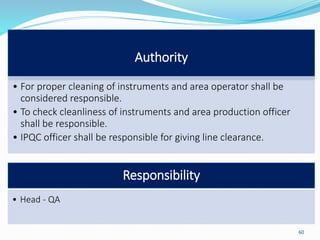
Authority
• For proper cleaning of instruments and area operator shall be
considered responsible.
• To check cleanliness of instruments and area production officer
shall be responsible.
• IPQC officer shall be responsible for giving line clearance.
Responsibility
• Head - QA
60
REFERENCE:
1. https://www.slideshare.net/shravandubey2/out-of-
specification-shravan
2. https://www.slideshare.net/FarukHossen12/out-of-
specifications
3. https://www.slideshare.net/MayuriMore15/complaints-in-
quality-management-system
4. https://www.slideshare.net/pranav10/root-cause-analysis-
12547191
5. https://www.slideshare.net/POURNIMABHALEKAR/ipqc-
71238255
6. The Theory and Practice of Industrial Pharmacy by Leon Lachman
7. A text book of quality management system by
Dr. Md. Rageeb Md usman , snehal s.abhang 61
62

QUALITY SYSTEMS

  • 1.
    Presented by : M.Suruthi M.Pharmacy1st year Pharmaceutical quality assurance Annamalai university Submitted to : Dr.K.Devi,M.Pharm.,Ph.D Assistant professor Department of pharmacy Annamalai university 1
  • 2.
    CHANGE MANAGEMENT Definition It isdefined as the methods and manners in which a company describes and implements change within both its internal and external processes. 2
  • 3.
    Process involved inchange management • Type of change • Reason for change • Scope • Current state • Future state 1.Identify the change • Process changes • People changes • Cost of change • Risk assessment • Information change 2.The details • Stakeholder analysis • Role of change management team • Resistance to change 3.The approach • Action plan • Communication plan • Training plan • Resistance plan 4.implement • Scanning • Management review 5.monitor 3
  • 4.
    BENEFITS  Improved communication Increased productivity  Reduced stress  Improved decision making  It can also help improve employee confidence and create a more positive environment 4
  • 5.
    CHANGE CONTROL Definition : It is a set of processes and controls that mitigate risk of impacts to projects due to variation.  Change control is a specific element of the overall change management procedure ; while change management refer to the complete span of a particular change procedure. 5
  • 6.
  • 7.
    OUT OF SPECIFICATION(OOS) Definition : If the analytical results of a batch or material is / are failing out side of the established specification ranges, is called / considered as out of specification. Or The term OOS test results includes all suspect results that fall outside the predetermined specification. 7
  • 8.
    There are lotof guidelines are available for defining to handle the oos products/materials/batches etc. MHRA (medicine and health care products regulatory agency) guideline for oos CDER(center for drug evaluation and research) guideline for oos 8
  • 9.
    The oos maybe observed during the analysis of : Stability study Finished API Intermediates In – process Raw materials Packing materials 9
  • 10.
    OOS found dueto the following reasons but not limited to : oos Laboratory error Process related error Sample homogeneity 10
  • 11.
    Laboratory errors • Methodof analysis • Use of non calibrated instruments • Error in calculation • Analyst error • Instrument failure 11
  • 12.
    Process related  Operatorerror  Equipment failure  Deviation from the validated procedure  Quality of raw material or intermediate used.  In-process control during manufacturing. Homogeneity sample  Sampling error .  Handling of sample. 12
  • 13.
    Procedure of oosinvestigation As per MHRA (EU GMP) As per CDER (US FDA) Phase -1 investigation (primary & extended lab investigation) Phase -1 investigation (primary & extended lab investigation) Phase -2 investigation (manufacturing investigation) Phase-2 investigation (manufacturing investigation and re- sampling and re-analysis) Phase -3 investigation (extended manufacturing ,re-sampling and re-analysis) 13
  • 14.
    Phase-1 investigation laboratory investigation Laboratory investigation is related to QC(quality control) department along with re-checking of documents with same analyst and re-testing with different analyst with original sample. Phase 1 Laboratory investigation Primary lab investigation Extended lab investigation 14
  • 15.
    Phase-2 investigation Manufacturing investigations Inmanufacturing investigation , production person investigate : Process parameter Drying parameter Input raw materials quality Training of persons Cleaning of equipment Environmental information Contamination & etc 15
  • 16.
    Phase-3 investigation: Extended manufacturinginvestigations In phase-3 investigation, QC or QA & production department investigation the following: Sampling error by person Authorized for re-sampling Re analysis of re sampled material with different analyst If root cause found ,define the CAPA or if not Diverted the matter to R&D ADL(analytical method development laboratory) Conclusion by all team member(QA&QC Lab ) Decide the fate of batch by QA Head 16
  • 17.
    As per CDER(US FDA) Phase-1 Investigation: Laboratory investigation laboratory investigation is related to the QC department along with rechecking of documents with same analyst and re- testing with different analyst with original sample. Phase-2 Investigation: Manufacturing investigation process related investigation is to be carried out by production department along with re-sampling and re- analysis. 17
  • 18.
    Phase 1 investigation: Laboratoryinvestigation Analyst observed the OOS result Re-calculate the result (if required) If analytical result remain same Report the OOS result to OC in – charge Start the primary laboratory investigation Review the documents along with solution as (potency/ buffer solutions/calibration of instruments/ standard solution/weights/storage condition of sample etc.) 18
  • 19.
    If there isno abnormality observed during the primary lab investigation then Report same result and considered as valid OOS and report Quality Head review the primary lab investigation and evaluate for re- testing (if QA Head permits) Repeat the analysis as thrice with original sample with different analyst Report the average result 19 To be continued
  • 20.
    If the resultcomplies Report as complies Release the batch If any of result if not complies (among three) Report to QA head QA head will recommend for the phase-2 investigation (manufacturing investigation) 20 To be continued
  • 21.
    Phase -2 Investigation: Manufacturing investigation Production person shall investigate the following :  Input quantity of raw material  Process parameters details  Critical process parameter details (time temperature)  In-process details  Output of the material  Utility pressure 21
  • 22.
     Calibration preventive maintenance of equipments  Cleaning of equipments  Training of personnel  Brain storming with operators  Contamination verifications  Environmental reviews If there is no assignable cause observed during manufacturing investigations, same is to be reported to QA head. 22 To be continued
  • 23.
    QA & QCand production department will evaluate the investigations and after that :  Sampling procedure review if suspected  QA head may recommend for re-sampling  QC analyst shall analyze the sample as per STP ( software test plan )  Report the result pass or fail  If pass, # Define CAPA # Release the batch  If failed, # Reject the batch # Divert the matter to R&D,PD(process development) lab 23
  • 24.
    R&DProcess Development labshall :  Take the user trail with the material  Investigate the failure based on experimentsexperience.  To find out the root cause  To identify ,is this material can be reprocessed reworked  Make a summary report  Defined the corrective actions 24
  • 25.
    QA & QC Production department shall  QA head shall define the fate of batch for reprocess rework destruction  Accept the CAPA  Training to all concerned for root cause CAPA  Monitor the activity and Evaluate the results of corrective actions  Implement and Verify the implementation of preventive actions  After satisfactory implementation close the OOS & CAPA All these activity for investigation prevention actions should be recorded , reviewed and archived. 25
  • 26.
    If OOS batchis to be responded / reworked Follow the written approval BMR(batch manufacturing record) for reprocess/rework Sample as per SOP for sampling of material Analyze the material according to the specification and STP(standard testing procedure) Evaluate the quality of the batch Keep this batch for stability Evaluate the stability results of the batch Communicate the OOS to the customers 26
  • 27.
    Impact of OOSon regulatory  OOS should be reported to RA ( regulatory affairs)  OOS batch should not be sold to regulatory market  OOA batch can not be blend with fresh approved batch  OOS batch can not be directly sell to the market 27
  • 28.
    Out of trend(OOT) Definition: Outof trend is defined as a result of a sequence of the analytical results which conform to the specifications but not in the expected trend with respect to the initial or expected result.  The main purpose of OOT is to lay down a procedure for managing out-of-trend results in active raw material, finished product , stability study, environmental monitoring & water trend in pharmaceutical industries. 28
  • 29.
     During investigationif the cause of the OOT results is indentified as a laboratory error the executive QC should carry out the repeat analysis with a fresh sample and fresh standard preparation if required.  And if the purpose of the OOT result isn’t the diagnosed as a laboratory error then the head of the QC will suggest re-analysis to conform OOT outcomes.  The analyst must hold the record of the re-evaluation effect in the work sheet.  If the cause of the re-analysis the initial evaluation need to be suggested. Out of Trend procedures 29
  • 30.
    •In the caseof raw material , the head quality control ought to overview the OOT outcomes and forward them to QA and prevent the re-occurance of such incidence. •In the case of finished products, the head QC should review the OOT results and forward them to QA and the production team for investigation to take a final decision. •Based on the investigation report, the head QC takes the final decision. 30 To be continued
  • 31.
    Complaints – evaluation& handling Complaints – definition: “Complaints is defined as statement that is something wrong or not good enough, which shows customer dissatisfaction about the company and the product ”. Example- complaint about the packaging materials . Advantages :  Sustained improvement of quality of product and process.  Maintaining good relation with customers. 31
  • 32.
    WHO GMP guidelines 1 •All complaints related to defective products must be carefully reviewed according to the written procedures. 2 • There should be designated person for handling complaint to together with sufficient staff to assist him or her. 3 • There should be written procedure describing action to be taken including need to consider a recall of product. 4 • Complaint of defective product should be recorded with all details and thoroughly investigated. 32
  • 33.
    Classification of qualitydefects Critical • when the type of defect may cause life threatening effect for consumer • Eg : patients receive incorrect product Major • may put the patient at some risk but are not life threatening and will require batch recall or product within few days. • Eg : microbial contamination of non sterile products Minor • minor risk to patient batch recall or product withdrawal would normally be initiated within a few day. • Eg : visible isolated packaging 33
  • 34.
    Time period forinvestigation after receipt of complaint: Key points for handling complaints Don’t take it personally. Never act on a complaint without hearing two sides story. Set the time frame. Keep notes. Product quality complaint • 10 days Adverse reaction complaints • 5 days Medical complaints • 3 days 34
  • 35.
    Steps involve inhandling complaints 1.Record the complaint 2.Complaint analysis 3.Complaint resolution 4.The complaint investigation 5.Close the complaint 35
  • 36.
    1 • All typesof complaint like phone calls,e-mails,handwritten etc must be recorded by respective team member. • It must be recorded in a systemic way in your company. 2 • At initial stage of complaint should be analyzed by type of resolution whether it will resolve quickly or it will take a time. • It should be resolve within timeframe and time is required to resolve the complaint the inform the customer that the complaint is being get investigated. • Some cases when complaints not resolve quickly. • In cases of some VIP customer • When complaint is more complex or sensible • High risk issue related to product or complaint 3 • Appoint the person to deal with complaints and that person more the customer want to achieve through this complaints. 36
  • 37.
    4 • Higher managementlevel should take the decision when the complaint not resolve quickly but this differ by organization, type of service provided. 5 • The authorized person coordinate to customer and maintain the documentation of resolve complaint. • The feedback include detailed explanation of resolution. • And in case of customers does not accept resolution, complaints should be open again and starts the investigation. 37
  • 38.
    Investigation and determination ofroot cause : It is a type of problem solving method by recognizing the root cause of a problem. The main aim is that to prevent repetition of problem. This is not quick process or not include easy steps, generally requires to discuss with the person who knows the best process. Also required for problem identification through audits and by test reports. 38
  • 39.
    Process of rootcause analysis By using the different problem solving methods in root cause analysis need to be identifying process for cause of problem process as -  Who should work on evaluating the problem ?  Define the problem?  What is it ?  When did it happened ?  Where did it happen ?  How overall goals affected ? – keep it simple – make an outline - people see problems differently  What will be done ? 39
  • 40.
    Corrective and preventiveactions (CAPA)  when the root cause of problem is identified need to apply a specific corrective action to prevent it form happening again.  Select and apply the action to remove the problem and prevent the recurrence. Corrective action  Aimed at removing the cause of product failures and nonconformities in an effort to prevent their future recurrence. 40
  • 41.
    Preventive action • Proactive process of continual improvement 1 • Goal 2 • Improvement of the quality management. 3 • Improvement of technical operations. 4 • Elimination of potential non conformities system improvement stems from rigorously correcting problems and learning to foresee potential problems. 5 41
  • 42.
    Corrective action Vspreventive action 42
  • 43.
    Return and recall •Recall is the steps to put something back to its original place • Demand to return, exchange ,or replace the product when the manufacturer or customer found defects in product or product related issues, harm to customer is known as recall. 43
  • 44.
     To awaresafety of the customer, most of industries focus on taking preventive measures, established one internal product recall team and applying QC steps to reduced the risk or to prevent product recall cost.  Product recall will be done by various sources including manufacturers,  wholesalers,  retailers and customer. 44
  • 45.
    Approach of productrecall team  If a product recall is there or recall is on progress the prepare a product recall action plan which followed to recalled procedure. Recall team consisting some of following job roles: • Management representative • Product manager • Chief engineer • Quality control manager • Public relations expert 45
  • 46.
    Annual product review(APR) Purpose : APR is an evaluation conducted annually to assess the quality standard of each drug product with a view to verify the consistency of existing process and to check the appropriateness of current specifications and to highlight any trend in order to determine the need to change any drug product 46
  • 47.
    1. Production analysis 2.Quality investigations 3. Change management 4. Specifications & test results 5. Stability studies 6. Component quality 7. Market activities 8. Regulatory assessment 9. Validated status 10.GMP agreements 47
  • 48.
    APR summary reportformat The APR includes cover page , subsection, summary and reference. Cover page • It includes the title of the APR, products covered and signatures of the APR evaluator and authority. subsection • APR subsection consist all data and documentation for each steps or for product. Summary • APR summary includes the analysis of all the APR subsections and the overall APR rating. reference • It consist list of all CAPAs raised as result of the APR summary 48
  • 49.
    APR conclusions andrating • There is no justification of risk assessment. Satisfactory • A risk assessment may not be clarified. Acceptable • A risk assessment should be performed. Acceptable with conditions • A risk assessment must be performed and notification to regulatory agencies considered as part of mitigation and communication. unacceptable Where a report is related “ acceptable with conditions” or “ unacceptable” the report should be forwarded to executive management for review. 49
  • 50.
    APR report approval EachAPR report having signed off with –  The QA manager  The regulatory affairs manager  Production operations manager  Other groups who may be affected by any change 50
  • 51.
    Batch review andbatch release Purpose :  For approval and release of the finished product batch establish the process.  The Batch Record Review is an essential tool for assuring the quality of a pharmaceutical process. 51
  • 52.
    Responsibility :  Executive,QA or the production department is responsible for receiving the batch record for its completeness and accuracy.  Head production is responsible for completion and review of batch release product.  Head, QC responsible for completion and review of analytical microbiology records.  QA is responsible for the review of analytical microbiology data in either hard or soft copy. 52
  • 53.
    Process of batchrelease Then proceed to QA department review Review and approval of record is done by the production officer or executive and final review head of production department Production department submit batch manufacturing as well as batch packaging record 53
  • 54.
    Review of batchrecords  Officer or executive of QA review the documents of both batch manufacturing and batch packaging record for any deficiency which affect on quality of the product or customer safety marketing. Condition for batch release :  For batch manufactured and sold by the company for the India region only shall permitted by conditional transfer.  There is no permission given to another party to sell the product  After approval of the contract then there will be planned for conditional transfer.  Product from export market then conditional transfer not allowed. 54
  • 55.
    Concept of IPQC(IN-PROCESS QUALITY CONTROL) Objectives of IPQC  To develop the technical procedure used in manufacturing process.  Control and enhance efficacy of finished products.  Investigation of raw material, instrument, environmental, process , evaluation and packaging etc. 55
  • 56.
    IPQC for parenteralproducts  To check the bulk solution prior to fill for drug content , pH, colour, Clarity of solution.  Pyrogen test  leakage test.  physical evaluation. IPQC for solid dosage form  Drug content determination .  Weight variation of tablets and capsules .  During manufacturing process check the disintegration or dissolution time  hardness  friability of tablets 56
  • 57.
    IPQC for semisoliddosage form:  Uniformity and homogeneity of drug content.  Determine the particle size of preparation.  Check the appearance  Viscosity  Specific gravity  Sedimentation volume 57
  • 58.
    Documentation and evaluationof data In-process controls ,persons who handle the process their initials and result outcome must be recorded in documentation record. In case of any variation the signature of the person who approved the variation is necessary. Justification for variation or measures include date, name of authority must be documented. Production head is responsible for variation process. 58
  • 59.
    Area clearance andline clearance objective • while starting of any production or process for line clearance of manufacturing assure that it should be free from any material or contamination. scope • SOP is applicable for line clearance of production , warehouse areas of formulation plant. 59
  • 60.
    Authority • For propercleaning of instruments and area operator shall be considered responsible. • To check cleanliness of instruments and area production officer shall be responsible. • IPQC officer shall be responsible for giving line clearance. Responsibility • Head - QA 60
  • 61.
    REFERENCE: 1. https://www.slideshare.net/shravandubey2/out-of- specification-shravan 2. https://www.slideshare.net/FarukHossen12/out-of- specifications 3.https://www.slideshare.net/MayuriMore15/complaints-in- quality-management-system 4. https://www.slideshare.net/pranav10/root-cause-analysis- 12547191 5. https://www.slideshare.net/POURNIMABHALEKAR/ipqc- 71238255 6. The Theory and Practice of Industrial Pharmacy by Leon Lachman 7. A text book of quality management system by Dr. Md. Rageeb Md usman , snehal s.abhang 61
  • 62.